Sensor-based formation control
using a generalised rigidity
framework and passivity
techniques
Geoff Stacey
A thesis submitted for the degree of
Doctor of Philosophy
The Australian National University
c
Except where otherwise indicated, this thesis is my own original work.
Acknowledgments
There are, of course, many great people who have supported me during my PhD studies, and my heartfelt thanks go to every one of them. Without them, I would not be where I am today.
I wish to start by thanking my supervisor, Prof. Robert Mahony, for his continu-ous support and guidance. He is an excellent mentor and role model who has not only been interested in the development of my research, but also in the develop-ment of my professional skills that I am sure to use in the future. I also wish to acknowledge his assistance with financing my research.
Next, I wish to thank the rest of my advisory panel, which consists of Dr. Jochen Trumpf, Prof. Peter Corke, and Assoc. Prof. Brad Yu. In particular, this panel pro-vided guidance during the early days of my PhD and ensured I made a good start. I also wish to give special thanks to Jochen for the numerous times he has assisted me with mathematical insight, as well as advice while Rob was unavailable.
Over the years, many wonderful people have been a part of our research group at the ANU. I am grateful to all of these people for contributing to such an excel-lent working environment, and I wish to give particular mention to Alex Martin, Dr. Mohammad (Behzad) Zamani, Evan Slatyer, Dr. Xiaolei (Eric) Hou, Dr. Alireza Khosravian, Moses Bangura, Juan Adarve, Dr. Viorela Ila, Dr. Chuong Nguyen, Sean O’Brien, Jean-Luc Stevens and Mina Henein who have been part of our group for a significant period of my PhD. Outside of my immediate research group, I wish to give particular acknowledgement to Dist. Prof. Brian Anderson and Zhiyong Sun for our interesting discussions concerning rigidity theory, as well as Prof. Richard Hartley for his recent tutorial sessions on Lie groups. I have also made many good friendships with members of the broader ANU community (beyond the Research School of Engineering); there are surely too many to name but I wish to express what a delight they have made the past few years.
Amongst the international research community, I wish to thank Prof. Stefano Stramigioli of the University of Twente for my visit in 2013, and Prof. Jacquelien Scherpen, Prof. Arjan van der Schaft, and Dr. Ewoud Vos of the University of Gronin-gen for my visit in 2014. These visits were truly highlights of my PhD candidature. I greatly valued the opportunity to spend time amongst other research groups and it was a pleasure to share ideas with you. Thanks also to Prof. Tarek Hamel from the University of Nice-Sophia-Antipolis and Dr. Christian Lageman from the University of Würzburg for our interesting discussions during your visits to the ANU.
Last but not least, I owe thanks to my family and other friends in Canberra, for their continuous support throughout this journey. They have been invaluable in maintaining a healthy work-life balance that has ensured steady progress towards the
Abstract
The research in this thesis addresses the subject of sensor-based formation control for a network of autonomous agents. The task of formation control involves the stabili-sation of the agents to a desired set of relative states, with the possible additional objective of manoeuvring the agents while maintaining this formation. Although the formation control challenge has been widely studied in the literature, many existing control strategies are based on full state information, and give little consideration to the sensor modalities available for the task. The focus of this thesis lies in the use of a generic arrangement of partial state measurements as can commonly be acquired by onboard sensors; for example, time-of-flight sensors can be used to measure the distances between vehicles, and onboard cameras can provide the bearing from one vehicle to each of the others. Particular aspects of the problem that are addressed in this thesis include (i) ways of modelling the formation control task, (ii) methods of analysing the system’s behaviour, and (iii) the design of a formation control scheme based on generic arrangements of sensors that provide only partial position informa-tion.
A key contribution in this thesis is a generalisation of the classical notion of rigid-ity, which considers the use of distance constraints between agents in R2 or R3 to
specify a rigid body (or formation). This enables the concept of rigidity to be applied to agent networks involving a variety of (possibly non-Euclidean) state-spaces, with a generic set of state constraints that may, for example, include bearings between agents as well as distances. I demonstrate that this framework is very well-suited for modelling a wide variety of formation control problems (addressing goal (i) above), and I extend several fundamental results from classical rigidity theory in order to provide significant insight for system analysis (addressing goal (ii) above). To design a formation control scheme that uses generic partial position measurements (address-ing goal (iii) above), I employ a modular passivity-based approach that is developed using the bondgraph modelling formalism. I illustrate how adaptive compensation can be incorporated into this design approach in order to account for the unknown position information that is not available from the onboard sensors. Although forma-tion control is the subject of this thesis, it should be noted that the rigidity-based and passivity-based frameworks developed here are quite general and may be applied to a wide range of other problems.
Contents
Acknowledgments vii
Abstract ix
1 Introduction 1
1.1 Introduction . . . 1
1.2 Contributions . . . 7
1.3 Publications . . . 9
1.4 Thesis Outline . . . 10
1.5 Notation . . . 10
2 Literature Review 15 2.1 System Architectures for Formation Control . . . 15
2.1.1 Leader-Follower Control . . . 16
2.1.2 Virtual Structure Control . . . 17
2.1.3 Behavioural Control . . . 18
2.1.4 Consensus . . . 19
2.2 The Role of Rigidity Theory . . . 20
2.2.1 Applications of Rigidity Theory . . . 20
2.2.2 Graph-Based Analysis . . . 21
2.2.3 Rigidity-Based Formation Control . . . 22
2.3 The Role of Passivity Theory . . . 25
2.3.1 State Estimation and Task-Based Control . . . 25
2.3.2 Passivity-Based Formation Control . . . 27
2.4 Conclusions from the Literature . . . 29
3 Generalised Rigidity Theory 31 3.1 Introduction . . . 31
3.2 System Model and Symmetries . . . 33
3.2.1 Agent Networks and Formations . . . 33
3.2.2 Equivariance and Congruence . . . 41
3.3 Generalised Rigidity . . . 45
3.3.1 Defining Rigidity . . . 45
3.3.2 Rigidity Analysis . . . 50
3.4 Path-Rigidity . . . 53
3.4.1 Defining Path-Rigidity . . . 53
3.4.2 Group Theoretic Analysis . . . 54
xii Contents
3.4.3 Analysis of Path-Rigidity . . . 57
3.5 Conclusions and Future Work . . . 58
4 Generalised Infinitesimal Rigidity 61 4.1 Introduction . . . 61
4.2 Infinitesimal Rigidity . . . 63
4.2.1 Defining Infinitesimal Rigidity . . . 63
4.2.2 Analysis of Infinitesimal Rigidity . . . 65
4.2.3 Discussion and Examples . . . 68
4.3 Robust Rigidity . . . 71
4.3.1 Defining Robust Rigidity . . . 72
4.3.2 Analysis of Robust Rigidity . . . 72
4.3.3 Discussion and Examples . . . 75
4.4 Applications . . . 76
4.4.1 Application I: Network Localisation . . . 76
4.4.2 Application II: Formation Control . . . 80
4.5 Conclusions and Future Work . . . 83
5 Passivity-Based Formation Control 85 5.1 Introduction . . . 85
5.2 Vehicle and Sensor Models . . . 87
5.2.1 Vehicle Model . . . 87
5.2.2 Sensor Model . . . 90
5.2.3 Specification of the Formation Control Task . . . 91
5.3 Control using Virtual Mechanical Couplings . . . 93
5.3.1 Controller Model . . . 93
5.3.2 Stability Analysis . . . 95
5.3.3 Discussion and Simulations . . . 97
5.4 Adaptive Compensation for Direction and Distance Measurements . . . 102
5.4.1 Control using Direction Measurements . . . 102
5.4.2 Control using Distance Measurements . . . 104
5.4.3 Stability Analysis . . . 107
5.4.4 Discussion and Simulations . . . 112
5.5 Conclusions and Future Work . . . 116
6 Conclusion 119 6.1 Summary . . . 119
6.2 Future Work . . . 120
A Summary of Group Theory 123 A.1 The (Special) Orthogonal group . . . 125
A.2 The (Special) Euclidean group . . . 125
A.3 The (Special) Similarity group . . . 126
A.4 The (Scaled) Translations group . . . 126
Contents xiii
B Classical Rigidity Theory 129
C Port-Hamiltonian Theory 131
D Bondgraph Diagrams 133
List of Figures
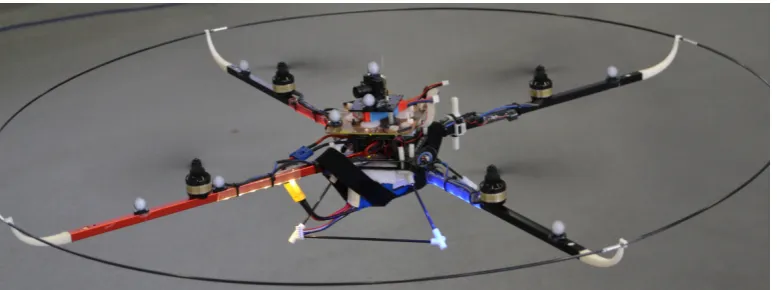
2.1 A quadrotor vehicle from the ANU Computer Vision and Robotics Lab. 30
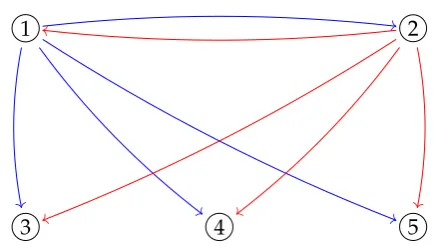
3.1 Network configuration for Example 3.2.24. Distances in blue are mea-sured by y1, and those in red are measured byy2. . . 40
3.2 Diagrams illustrating the analysis in Example 3.3.4. The dots represent agent positions, withξ5labelled and thexandyaxes of the orientation
R5denoted byRx5andR
y
5, respectively. Solid red lines indicate distance
constraints, while blue arrows indicate bearing constraints. . . 48 3.3 Diagram of a rectangular formation (in R2) satisfying the constraints
specified in Example 3.3.5. Distance constraints (a,b, andc) associated withh1are shown in red, while the constraints on the maximum angles
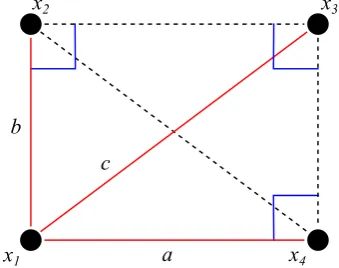
observed by agents 2, 3, and 4 are shown in blue (all right-angles). Dotted lines are only for reference. . . 49 3.4 Mappings between spaces for a globally rigid formation F(y˚). Here,
π is the canonical projection, and the diagram commutes. . . 51 4.1 The agent network for Example 4.2.11. The dots represent agent
po-sitions inR3, the red lines indicate distance constraints between pairs of agents, and the blue arrows indicate direction constraints between pairs of agents. . . 70
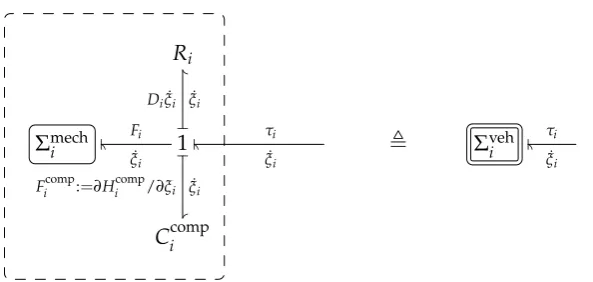
5.1 Bondgraph notation for the mechanical subsystem of vehicle i. The power port is associated with the implemented control forceFi and the resulting velocity ˙ξi. . . 88 5.2 Bondgraph model of a single vehicle in the formation control problem.
The rightmost bond is the power port through which the formation control inputτi is applied. The vehicle’s system in the dashed box will later be denoted as shown on the right. . . 89 5.3 Bondgraph model showing the construction ofτi given by (5.12). . . 92 5.4 Bondgraph model of a control link between two vehicles, given a
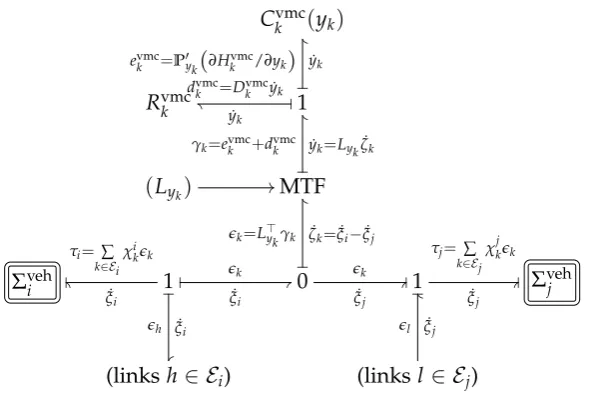
par-tial relative position measurement yk. Note the difference in the rela-tive orientation of the energy bonds going to each vehicle’s subsystem. The relative orientations of the linkshandlmay vary. . . 95 5.5 Network topology for the simulation. Blue arrows indicate direction
measurements obtained by vehicle 1, while red arrows indicate dis-tance measurements obtained by vehicle 2. . . 98
xvi LIST OF FIGURES
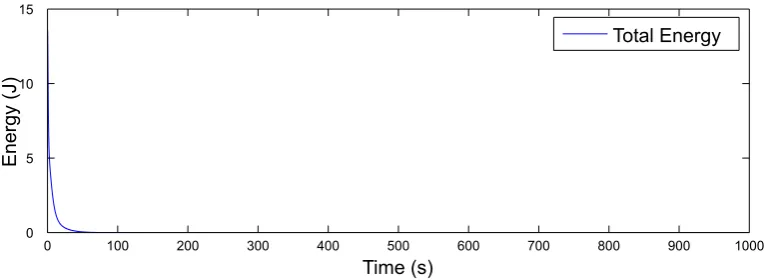
5.6 Simulation results for the proposed passivity-based formation control scheme, with full knowledge of the measurement Jacobians. The goal formation is achieved by regulating directions from vehicle 1 and dis-tances from vehicle 2. . . 99 5.7 Simulation results for the proposed passivity-based formation control
scheme, with full knowledge of the measurement Jacobians. The goal formation is achieved by regulating directions from vehicle 1 and dis-tances from vehicle 2. Here, the goal measurement ˚yis writteny0. . . . 100
5.8 Bondgraph model of a control link k between two vehicles, given a direction measurementsk and using adaptive compensation to handle the unknown distancerk. . . 104 5.9 Bondgraph model of a control link k between two vehicles, using a
distance measurementrk and an adaptive variable ˆζk ∈ R3. . . 107 5.10 Simulation results for the proposed passivity-based formation control
scheme, using adaptive compensation to account for the unknown information in the measurement Jacobians. The goal formation is achieved by regulating directions from vehicle 1 and distances from vehicle 2. . . 113 5.11 Simulation results for the proposed passivity-based formation control
scheme, using adaptive compensation to account for the unknown information in the measurement Jacobians. The goal formation is achieved by regulating directions from vehicle 1 and distances from vehicle 2. Here, the goal measurement ˚yis writteny0. . . 114 5.12 Simulation results for the proposed passivity-based formation control
scheme, using adaptive compensation to account for the unknown in-formation in the measurement Jacobians. In this case the initial state lies outside the region of attraction and the vehicles converge to an undesired equilibrium. . . 115
A.1 Relation between various groups discussed in this thesis, with arrows pointing from subgroups to overgroups. Some invariant sensor modal-ities of interest are written underneath each group. The relevant state-space for these measurements is written in parentheses. The acronym BFFstands forbody-fixed-frame. . . 127
Chapter1
Introduction
In this chapter, I introduce the motivation behind my research on formation control, and outline the remainder of the thesis. I begin by providing an introduction to the field in Section 1.1, which motivates the contributions of my research as summarised in Section 1.2. In Section 1.3 I list the publications in which my work has been pre-sented. An outline of the remaining chapters is given in Section 1.4, with a summary of common notation used throughout the thesis being provided in Section 1.5.
1
.
1
Introduction
The topic of autonomous formation control has acquired considerable interest due to the developments of unmanned vehicles in recent years. In this scenario, the challenge is to design a control scheme that enables multiple agents (i.e. vehicles) to achieve and maintain a desired position with respect to each other (see e.g. the review papers by Chen and Wang [2005]; Anderson et al. [2008]; Oh et al. [2015]). Often, additional objectives, such as manoeuvring the formation along a desired tra-jectory, are also considered. There are a variety of interesting applications motivating the study of formation control. For example, Beard et al. [2001] have discussed the task of spacecraft interferometry, which requires precise regulation of agent posi-tions to image distant stars. Ögren et al. [2004] presented a control algorithm for locating the maximum of an environmental field, such as temperature. The use of aerial vehicles to transport objects too large for a single vehicle to carry has received considerable attention by e.g. Michael et al. [2011]; Fink et al. [2011]. Recently, Vos et al. [2014] have addressed the even distribution of satellites in an orbit. The advan-tages of having multiple vehicles collaboratively working together in a formation are numerous, and include improved precision from measurements of the environment, redundancy in the presence of single-vehicle failures, and faster coverage of an area in exploration tasks. However, there are also many challenges that must be over-come for the successful coordination of multiple vehicles, and these have beover-come the subject of extensive and ongoing research in the literature.
One clear consideration for formation control applications is the vehicle model. Kinematic agent models have commonly been used to simplify the problem (as seen in e.g. Das et al. [2002]; Antonelli and Chiaverini [2006]; Krick et al. [2009]), but
2 Introduction
their validity requires the vehicles to possess a sufficiently high power-to-mass ratio. Hence, it is often more appropriate to model the full dynamics as in e.g. Olfati-Saber [2006]; Franchi et al. [2012b]. Although formation control schemes commonly con-sider agent states in Euclidean space, for many vehicles the linear position dynamics are coupled with the vehicle’s attitude (e.g. the underactuated quadrotor). Thus, such control schemes require the use of local controllers to implement the dynamics modelled for the formation controller, and rely on a separation principle for stability. A more comprehensive solution is to include attitude in the vehicle models for the formation controller, leading to states in the Special Euclidean group as addressed by e.g. Sarlette et al. [2010]; Hatanaka et al. [2012]. This approach is further motivated by the use of directional onboard sensors such as cameras, which require field-of-view limitations to be taken into account. In addition, nonholonomic constraints of the vehicles can significantly complicate the formation control algorithm. Most notably, such constraints apply to classical wheeled robots, which have seen extensive study in the formation control literature by e.g. Das et al. [2002]; Consolini et al. [2008]; Vos et al. [2016].
§1.1 Introduction 3
Although position regulation using only partial relative state variables is quite a challenging task, it has begun to receive some attention in recent years. Cao et al. [2011] propose astop-and-gostrategy for kinematic agents inR2with only range mea-surements between them. The idea is to have the agents take turns in stopping, with each moving agent making multiple range measurements of the stationary one and using triangulation to estimate its relative state in a local frame. For bearing mea-surements, Franchi et al. [2012a] employ two arbitrarily chosen beacon agents to act as reference vehicles (i.e. with special control inputs), enabling formation control of dynamic agents in R3. Both of these approaches exploit the particular geometrical structure of the measurement considered, and consequently, they are not easily gen-eralisable to other sensor modalities. More recently, Zelazo et al. [2015] proposed a control scheme that uses distance measurements and two bearing measurements (available to a special agent) to estimate relative states across the network. Zhao and Zelazo [2016] have addressed formation control of kinematic agents using bearing-only measurements, without knowledge of a global reference frame. Beyond these papers, there is remarkably little literature that explicitly considers the regulation of a formation in the presence of limited relative state information. Clearly, extensions to more general sensor modalities and configurations would be of high interest for further development in the field of formation control.
4 Introduction
effect of delays in the network communications, as has been explicitly considered by Secchi et al. [2012].
With the aforementioned challenges in mind, a variety of formation control ar-chitectures have been proposed in the literature, each offering certain advantages to particular scenarios. For example, in the leader-follower approach as employed by Das et al. [2002], each vehicle regulates a direct relative state measurement to a phys-ical leader vehicle that is guiding the formation along a trajectory. Consequently, this control scheme is a simple and natural choice when the practical constraints of physical onboard sensor measurements are of concern. However, centralising the architecture around a physical leader in this way can inhibit scalability of the forma-tion (e.g. due to error propagaforma-tion through a chain of leaders as studied in Tanner et al. [2004]) and create a point of vulnerability in the control scheme (i.e. should the leader suffer a critical failure such as a collision). An alternative is the virtual structure approach proposed by Lewis and Tan [1997], where reference trajectories for each agent are generated by considering the desired motion of a virtual structure formed by the agents (see Ren and Beard [2004a] for a decentralised approach us-ing this framework). However, this approach typically requires the positions of the vehicles to be known in the inertial frame, since tracking a virtual reference means no physical measurement of the errors can be directly obtained. A third popular formation control strategy is the concept of behavioural control introduced by Balch and Arkin [1998]. In this approach, the overall control law is composed of multiple functions that are each designed to achieve a particular sub-task, such as formation regulation or collision avoidance. While this control scheme offers great flexibility for addressing a variety of goals, it often leads to complex stability analysis and the resulting behaviour of the system can be difficult to determine. Another perspec-tive is to formulate formation control as a consensus problem; this approach has been reviewed by Olfati-Saber et al. [2007]; Ren et al. [2007]. For example, position regulation may be regarded as the task of achieving agreement between the vehicle positions, with each vehicle physically implementing the update law of a consensus protocol. As discussed in the review papers, the consensus framework has proven to be particularly well-suited for addressing time-varying communication topologies, and communication delays. A limitation of this approach is that it is not well-suited to other aspects of the formation control problem, such as collision avoidance.
§1.1 Introduction 5
An introduction to this approach has been presented by Anderson et al. [2008], with the concepts ofpersistence(Hendrickx et al. [2007]) andstructural persistence(Yu et al. [2007]) enabling extensions to directed network topologies (i.e. where only one agent is trying to enforce each distance constraint). The key advantages of applying rigidity theory to formation control are that it naturally incorporates the network structure into the framework, and it explicitly specifies the distance variables to be controlled, which can assist in determining an appropriate sensor configuration. It should be noted that most techniques for regulating the specified distances still require knowl-edge of the full relative states.
Of particular interest to the formation control task is the notion of infinitesimal rigidity, which describes whether any infinitesimal deviation from a rigid formation must result in an instantaneous change in at least one of the regulated distances. This has important implications in the stability analysis of a control scheme based on enforcing those constraints, and is exploited by e.g. Oh and Ahn [2011]. Dörfler and Francis [2009] have assumed infinitesimal rigidity along with minimal rigidity (i.e. that the distance constraints do not overconstrain the agents), and used this to show exponential stability for a gradient-descent algorithm. Further investigation by Sun et al. [2016] has recently revealed that the requirement of minimal rigidity is not necessary to prove exponential stability of the gradient-descent approach. Another useful result is that the set of points satisfying a given infinitesimally rigid formation is a regular submanifold of the state-space. This property has enabled Krick et al. [2009] to perform stability analysis using centre manifold theory, and is also of sig-nificance for the geometrical approach used by Dörfler and Francis [2010] to study the stability or instability of equilibria in the control dynamics. Recent work by Ze-lazo et al. [2015] has focused on the limitation of using distance-only measurements (with two bearing measurements available to a single special agent), and proposes a formation control scheme based on preserving infinitesimal rigidity of the formation through regulation of the rigidity eigenvalue of the symmetric rigidity matrix. Mean-while, Sun and Anderson [2015] have studied formation control for dynamic agents by extending rigidity-based analysis from the kinematic case.
6 Introduction
making the orientation of each vehicle an important state variable. Furthermore, it is not necessarily the case that all vehicles lie in the same state-space; a simple motivation for the exceptional scenario is the control of a formation involving both ground and aerial vehicles. For more advanced formation control scenarios, one may even consider constraints on the relative velocities between agents via a generalised rigidity framework. It is worth noting that a generalised concept of rigidity will not only assist with the control design of a system, but it will also provide insight into the symmetry of the system and can thus resolve the aforementioned question of observability for the available sensor measurements. The success of geometrical approaches in the formation control literature makes the generalisation of rigidity theory a highly appealing avenue for further research.
The second popular approach to formation control is to use an energy-based design that is oriented around ensuring passivity of the system, with the desired state corresponding to a global minima of the total energy function. The appeal of this technique lies in its ability to greatly simplify the stability analysis in the pres-ence of multiple control laws corresponding to a variety of separate objectives. As a consequence, this strategy has proven particularly valuable for behavioural control schemes. Many energy-based approaches lead to modular control architectures that can be readily extended to additional considerations, such as a haptic control input from a human pilot as in Franchi et al. [2012b]. Energy-based control architectures also offer considerable flexibility via shaping of the energy functions from which the control terms are derived. They have proven particularly useful for double-integrator agent models, as seen in e.g. Leonard and Fiorelli [2001]; Franchi et al. [2012b]; Vos et al. [2016]. Formation regulation is commonly achieved by applying virtual me-chanical couplings to the relative states of the agents. These couplings consist of a spring-like force based on the error in the distance between agents, and a damping term based on the relative velocity. It should be noted that although the magnitude of the force is usually derived from the distance error, the implementation of the resulting control term relies on full relative position information.
§1.2 Contributions 7
to my knowledge, been considered.
In summary, formation control is a complex problem that involves the coordina-tion of multiple agents, and in particular, the regulacoordina-tion of their relative states. Many aspects of this scenario have been studied extensively in the literature, for a wide va-riety of tasks. Common considerations include nonholonomic and dynamic vehicle models, trajectory tracking, collision avoidance, and the structure of the communica-tion topology. However, the restriccommunica-tion of usingpartial relative state measurements, as are often available from onboard sensors in practice, appears to have received re-markably limited attention. Furthermore, the existing strategies for addressing this particular issue have not been sufficiently generalised to allow an arbitrary mix of ap-propriate sensor modalities, or vehicle state-spaces. In the existing literature, frame-works based on rigidity theory and the property of passivity have proven highly successful for distance regulation in formation control problems. The generalisation of these two approaches is therefore a highly promising avenue of research for more widely applicable solutions to the challenge of sensor-based formation control.
1
.
2
Contributions
The primary objective of the research in this thesis is to investigate approaches for the task of sensor-based formation control. In particular, my focus is on the di-rect regulation of generic partial relative state measurements, as are typically pro-vided by onboard sensors such as cameras or time-of-flight sensors. My approaches to this problem are inspired by two major avenues of research from the literature. The first approach is to extend the classical notion of rigidity theory to include far more generic agent states and state measurements, thereby enabling geometrical ar-guments and techniques based on a generalised rigidity matrix to be employed for the stability analysis of formation control schemes. The second strategy is to ap-ply virtual mechanical couplings to generic sensor modalities in order to obtain a highly modular passivity-based control architecture that can be easily extended to address additional considerations, such as adaptive compensation for the unknown state variables required for implementation of the control law.
8 Introduction
symmetry up to which the agent states can be determined from the available sensor measurements. In the absence of a differentiable structure on the output maps, I introduce the notion ofpath-rigidityas the case where one can continuously transition between any two configurations of a globally rigid formation without breaching any state constraints. Useful characterisations of generalised rigidity and path-rigidity are provided via group-theoretic analysis.
If the symmetry is described by the action of a Lie group, and the sensor modal-ities possess a continuously differentiable structure, then the notion of infinitesimal rigidity can be naturally defined for the generalised framework. In this setting, I have proven that the generalised form of infinitesimal rigidity implies local rigidity, extending the important result by Asimow and Roth [1979] for the classical case. Furthermore, I show that an infinitesimally rigid formation consists of a collection of disjoint closed regular submanifolds of the state-space (these could theoretically be of different dimensions). This provides important structure for the analysis of many formation control schemes (see e.g. the methods employed by Krick et al. [2009]; Dörfler and Francis [2010]). I have also shown that any infinitesimally rigid forma-tion has an open neighbourhood on which all configuraforma-tions are infinitesimally rigid, which enables the structure associated with infinitesimal rigidity to be exploited in a local neighbourhood for the purposes of stability analysis. Furthermore, I have in-troduced a stronger notion ofrobust rigidity, which describes the case where the non-zero singular values of the output maps are bounded on an open neighbourhood of the formation. This provides important structure for stability analysis concern-ing non-compact formations, and enables techniques such as those employed by Sun et al. [2016] to be applied in the generalised setting. In the classical literature (e.g. Krick et al. [2009]), non-compact formations are often handled by relying on com-pactness of the set ofrelativestates satisfying the formation; however, this approach depends on the geometry associated with the classical setting and cannot be easily extended to the generalised scenario. Robust rigidity allows exponential stability to be guaranteed, which implies boundedness of the trajectories.
§1.3 Publications 9
As an alternative to the rigidity framework, I develop a passivity-based approach to the formation control of dynamic agents in R3, with the aid of bondgraph dia-grams. Relative to the rigidity framework, this approach aligns more closely with the highly flexible behavioural control strategy. The bondgraph modelling formal-ism enables an elegant representation of the energy flow between components of a port-Hamiltonian system, and ensures that the resulting design is strictly energy-consistent. This makes it an excellent tool for both the design and the analysis of the system. Formation control is achieved by applying virtual mechanical couplings directly to the available sensor measurements, using the concept of a measurement Jacobian to transform the control effort in the sensor space to a control input for the vehicles. Local asymptotic stability to a desired formation is ensured by a passivity-based argument, and the behaviour of the system can be adjusted by appropriate shaping of the virtual energy functions. In particular, this method can be used to avoid collisions between agents.
A shortcoming of the basic design, shared with classical passivity-based forma-tion control algorithms (e.g. Franchi et al. [2012b]), is that implementaforma-tion of the control input requires full relative position information. Such information is not typically available from the onboard sensor output and implementing the control re-quires a full state observer to run on each vehicle. In particular, this problem arises for the important sensor modalities of directions and distances. To resolve this chal-lenging issue, I exploit the high modularity of the energy-based approach to incor-porate adaptive compensation for the unknown state information. Adaptive control schemes for direction and distance modalities are developed separately, due to dif-ferences in the geometrical structure of the measurements. For the modified control architecture, I prove local asymptotic stability under an assumption on the structure of the sensor network, and present simulation results. It is worth emphasising that the resulting decentralised control framework allows for more general sensor con-figurations than those addressed by many existing approaches in the literature (e.g. Franchi et al. [2012a]; Zelazo et al. [2015]); in particular, it does not rely on the use of special agents that employ fundamentally different control schemes to the others in the network.
1
.
3
Publications
The research in this thesis has been presented in the following publications:
• Stacey, G.; Mahony, R.; and Corke, P., 2013. A bondgraph approach to forma-tion control using relative state measurements. InProc. European Control Conf. (Zürich, Switzerland, July 2013).
10 Introduction
• Stacey, G. and Mahony, R., 2016. A passivity-based approach to formation con-trol using partial measurements of relative position. IEEE Trans. on Automatic Control, 61, 2 (February 2016), 538-543.
• Stacey, G.; Mahony, R.; and Trumpf, J., 2016. Generalised rigidity and path-rigidity for agent formations. InProc. Int. Symposium on Mathematical Theory of Networks and Systems(Minneapolis, Minnesota, USA, July 2016).
Some material in this thesis is also contained in the following manuscript, sub-mitted for review:
• Stacey, G. and Mahony, R., 2016. The role of symmetry in rigidity analysis: A tool for network localisation and formation control. Submitted toIEEE Trans. on Automatic Control.
1
.
4
Thesis Outline
The thesis is structured as follows. In Chapter 2, I review the formation control lit-erature with a particular focus on the rigidity- and passivity-based approaches. In Chapter 3 I develop the generalised rigidity framework, and provide analysis of the associated topological structure as well as introducing the concept of path-rigidity. The properties of infinitesimal rigidity and robust rigidity are studied in Chapter 4, where I prove some key results for control problems concerning agent networks. This chapter is concluded by demonstrating the application of the theory to the tasks of network localisation and formation control. The passivity-based approach to forma-tion control using virtual mechanical couplings is presented in Chapter 5. This de-sign is primarily focused on the use of distance and inertial direction measurements, with adaptive compensation techniques being employed to account for the unknown state information. Note that the material in Chapter 5 was developed prior to that of Chapters 3 and 4 and is formulated directly with an explicit state representation rather than the more abstract rigidity-based theory. A brief conclusion is provided in Chapter 6, which includes a discussion of future work that involves the integration of theory from Chapters 3 and 4 with that of Chapter 5. Background group theory is summarised in Appendix A, and the classical notion of rigidity is reviewed in Appendix B. Port-Hamiltonian theory and the bondgraph modelling technique are described in Appendices C and D, respectively. Code used for the simulations is given in Appendix E.
1
.
5
Notation
To briefly clarify some standard notation; I use R, R≥0, and R>0 to denote the set
§1.5 Notation 11
I do not consider the field of complex numbers in this thesis. All angles are given in radians.
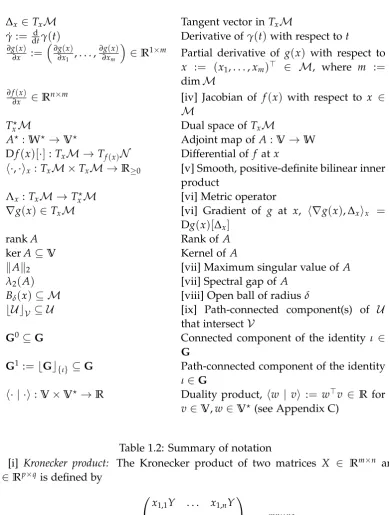
Further notation used throughout this thesis is outlined in Table 1.2. For the purpose of the following definitions, m,n,p,q ≥ 1 are integers, v ∈ Rn is a vector, X ∈ Rm×n and Y ∈ Rp×q are matrices, M and N are arbitrary smooth manifolds of finite dimension, f : M → N, g : M → R andγ : R → M are smooth maps, x ∈ M is a point, V ⊆ U ⊆ M are sets, A : V → W is a linear operator between Euclidean spaces (assumed to be expressed as a matrix using given bases),δ >0 is a scalar constant, and Gis a topological group. Note that this notation does not hold throughout the remainder of the thesis. Additional notes [·] are provided below the table.
Sn Unitn-sphere, embedded inRn+1
T0 Kolmogorov topology
T1 Fréchet topology
T2 Hausdorff topology
In ∈Rn×n Then×nidentity matrix
0n∈ Rn Then-vector of zeroes
0m×n∈Rm×n Them×nmatrix of zeroes
kvk Euclidean norm of a vectorv∈Rn
kXkF Frobenius norm of a matrixX∈Rm×n
X>∈Rn×m Transpose of a matrixX∈Rm×n ¯
v Homogeneous coordinates, (v>, 1)>, for v∈Rn
X⊗Y∈Rmp×nq [i] Kronecker product of matricesXandY
O(n) Orthogonal group (Section A.1)
SO(n) Special Orthogonal group (Section A.1)
E(n) Euclidean group (Section A.2)
SE(n) Special Euclidean group (Section A.2)
S(n) Similarity group (Section A.3)
SS(n) Special Similarity group (Section A.3)
ST(n) Scaled-Translations group (Section A.4)
G Group (Appendix A)
Pn Permutation group for a set ofnelements
g Lie algebra of a Lie groupG
Φ:G× M → M (Lie) group action of a (Lie) groupG
ι∈ G Group identity ofG
stabΦx⊆ G [ii] Stabiliser ofΦatx
Mτ [iii] SetMequipped with a generic
topol-ogyτ(M)
M℘:=∏n
i=1Mτi [iii] Product space
dimM Dimension ofM
f(U)⊆ N Image ofU through f
12 Introduction
∆x∈ TxM Tangent vector inTxM
˙
γ:= ddtγ(t) Derivative ofγ(t)with respect tot
∂g(x) ∂x :=
∂g(x) ∂x1 , . . . ,
∂g(x) ∂xm
∈R1×m Partial derivative of g(x) with respect to x := (x1, . . . ,xm)> ∈ M, where m := dimM
∂f(x)
∂x ∈R
n×m [iv] Jacobian of f(x) with respect to x ∈
M
T?
xM Dual space ofTxM
A? :W? →V? Adjoint map of A:V→W
Df(x)[·]:TxM →Tf(x)N Differential of f atx
h·,·ix :TxM ×TxM → R≥0 [v] Smooth, positive-definite bilinear inner product
Λx :TxM →Tx?M [vi] Metric operator
∇g(x)∈ TxM [vi] Gradient of g at x, h∇g(x),∆xix = Dg(x)[∆x]
rankA Rank ofA
kerA⊆V Kernel ofA
kAk2 [vii] Maximum singular value ofA
λ2(A) [vii] Spectral gap ofA
Bδ(x)⊆ M [viii] Open ball of radiusδ
bU cV ⊆ U [ix] Path-connected component(s) of U
that intersectV
G0⊆ G Connected component of the identity ι ∈
G
G1:=bGc{ι} ⊆G Path-connected component of the identity ι∈G
h· | ·i:V×V? →R Duality product, hw | vi := w>v ∈ R for
[image:28.595.81.471.99.615.2]v∈V,w∈V? (see Appendix C)
Table 1.2: Summary of notation
[i] Kronecker product: The Kronecker product of two matrices X ∈ Rm×n and Y∈Rp×q is defined by
X⊗Y:=
x1,1Y . . . x1,nY ..
. . .. ... xm,1Y . . . xm,nY
∈R
mp×nq,
wherexi,j denotes the element of Xin rowiand column j.
[ii]Stabiliser of a group action:The stabiliser is defined as the set of group elements that leave x unchanged by the group actionΦ, i.e. stabΦx := {S ∈ G| Φx(S) =x} (where Φx(S) := Φ(S,x)). The stabiliser is a subgroup of G, and continuity ofΦx implies stabΦx is closed sinceMis Hausdorff.
§1.5 Notation 13
be smooth (C∞) manifolds, and the topology superscript is omitted.
[iv]Jacobian: Given a map f :M → N, the Jacobian of f(x) = (f1(x), . . . ,fn(x))> with respect to x∈ Mis given by
∂f(x) ∂x :=
∂f1(x) ∂x
.. .
∂fn(x)
∂x
∈Rn×m,
wherem:=dimMandn:=dimN.
[v] Riemannian metric: The family of inner products h·,·ix define a Riemannian metric structure onM.
[vi] Metric operator: Given a metric h·,·ix, fix ∆x ∈ TxM and define Λx(∆x) : TxM → R, Λx(∆x)[∆0x] 7→ h∆x,∆0xix. The metric operator is the mapping Λx : TxM → Tx?M from tangent vectors ∆x ∈ TxM to dual elements Λx(∆x) ∈ Tx?M. The inverseΛ−1x :Tx?M → TxMis well defined and positive definite sinceΛx is pos-itive definite. The implicit relationship h∇g(x),∆xix = Dg(x)[∆x]can be written ex-plicitly using the operator notation∇g(x) =Λ−1x (Dg(x)). The inverse operator also defines a positive-definite inner product on the dual spaceh·,·i?
x: Tx?M ×Tx?M → R,
hDg1(x), Dg2(x)i?x 7→Dg2(x)[Λ−1x (Dg1(x))]forg1,g2:M → R.
[vii] Singular values: The left singular vectors of A are the critical points of
hAv,Avi subject tohv,vi=1, whereh·,·iandh·,·i are inner products onVandW
respectively. One hasΛ(Avi)◦A−σi2Λ(vi) =0 forvi singular vectors andσi singu-lar values, whereΛandΛ are the metric operators associated with inner products
h·,·iandh·,·i. With n:= min{dimV, dimW}, one haskAk
2 :=maxs=1,...,n{σs(A)} andλ2(A) := mins=1,...,n{σs(A) |σs(A) 6= 0}, whereσs(A)denotes the s’th singular value ofA. The spectral gapλ2 is undefined for the zero matrix.
[viii] Open balls: The open ballBδ(x)⊆ Mis defined with respect to the distance
measure d : M × M → R≥0 associated with the Riemannian distance on M, with Bδ(x):={x0 ∈ M | d(x,x0)< δ}.
Chapter2
Literature Review
This chapter reviews the existing literature associated with the problem of formation control. In the process, it highlights key shortcomings of the existing techniques, and thus provides a strong motivation for the research presented in this thesis. The literature review begins in Section 2.1 with a brief summary of some popular system architectures that have been developed for formation control. In Section 2.2, I review graph-based frameworks for the formation control problem with a particular focus on the important concept of rigidity and its role in stability analysis. Energy-based approaches to formation control, which are particularly appealing for the considera-tion of dynamic agent models, are reviewed in Secconsidera-tion 2.3.
2
.
1
System Architectures for Formation Control
In this section I review the classical formation control architectures that have been developed over the past couple of decades. The focus here is on the general de-sign approaches, rather than the analysis techniques discussed in Sections 2.2 and 2.3. Specifically, I will discuss the popular architectures of leader-follower control (Subsection 2.1.1),virtual structures(Subsection 2.1.2), andbehavioural control (Subsec-tion 2.1.3), as well as theconsensus-based formulationof the problem (Subsection 2.1.4). Typically, this literature assumes full state measurements of pose and velocity, al-though I will note some exceptions where the control approach is motivated by the particular sensors available.
Before proceeding, it is worthwhile to establish some terminology for the subse-quent discussion. By formation control, I refer to the problem of driving the relative positions of the agents or vehicles to a desired configuration, with the possible ad-ditional task of having the formation as a whole track a desired trajectory. The term consensusrefers to the task of having agents reach agreement about particular vari-ables, which may be associated with the current state of the system or desirable goals. The network topology of a group of agents refers to the topology of the information flow between them, and is usually represented as a network graph (with nodes corre-sponding to agents and edges correcorre-sponding to relative state measurements or com-munication links between them). Finally, the concept offlockingis defined according to Reynolds [1987], which states that flocking is achieved when three behaviours are
16 Literature Review
obeyed by each agent: collision avoidance between nearby flockmates, velocity con-sensus between nearby flockmates, and local attraction to a neighbourhood of nearby flockmates.
2.1.1 Leader-Follower Control
In a basic leader-follower design approach, one or more of the vehicles are desig-nated as leaders and the remaining vehicles are termed followers. The task of the leaders is to follow the specified trajectory, whilst the followers attempt to preserve a desired position with respect to the leaders, thus keeping the vehicles moving in an intended formation. The simplicity of this approach, and the fact that each vehicle is typically only concerned with one or two other vehicles, generally results in more straightforward control design and stability analysis than for some other architec-tures. A drawback of this approach is the lack of a distributed network topology, i.e. the leaders are central to guiding the formation along the desired trajectory. A consequence of this is that the control schemes tend not to scale well with the num-ber of vehicles (see Tanner et al. [2004] for some interesting analysis concerning error propagation). Furthermore, if a leader fails in some way (e.g. from a collision), then all of the vehicles following it may be unable to proceed. Another weakness in many leader-follower designs is that the leader generally does not receive feedback from the followers, meaning that scenarios could arise in which the followers are unable to track or keep up with the leader.
The leader-follower control approach has natural appeal when the vehicles are equipped with onboard cameras, since each follower simply needs to follow a leader observed in the image (at some prescribed relative state). This application has been studied for nonholonomic wheeled robots by Das et al. [2002] and Vidal et al. [2003], as well as for planes by Johnson et al. [2004]. The well-known work of Das et al. [2002] considers arrangements where each follower is guided by one or two other vehicles, which may in turn be followers guided by other leaders. It contemplates error propagation through a chain of leader-follower links, collision avoidance with obstacles in the environment, switching between different control modes or desired formations (e.g. to handle cases where a vehicle loses sight of its leader), and the communication requirements for state observation. By contrast, the work of Vidal et al. [2003] focuses primarily on the sensor model and the implementation of an image-based visual servo control scheme. Johnson et al. [2004] study two methods of using camera images to estimate the range and velocity of a leading aircraft, thus avoiding the need for communication between vehicles. The first approach involves an Extended Kalman Filter (EKF) augmented by a Neural Network (NN), while the second relies on the physical size of an observed aircraft in the image.
§2.1 System Architectures for Formation Control 17
by Consolini et al. [2008]. The work by Hong et al. [2008] considers dynamic agents with a single leader, and develops a distributed observer for the leader’s velocity us-ing locally available relative position measurements. Liu et al. [2008] study the con-trollability of a leader-follower arrangement with a time-varying network topology. In addition to the aforementioned vehicles, underactuated autonomous underwater vehicles (AUVs) subject to environmental disturbances have also received attention, see e.g. Cui et al. [2010].
2.1.2 Virtual Structure Control
A virtual structure control approach specifies a desired formation (the virtual struc-ture) that transitions along a desired trajectory. As it does so, each agent tracks its corresponding point in the virtual structure. A significant shortcoming of this ap-proach in practice is that it requires a measurement of the tracking error for each agent. Typically this involves measuring the agent positions in the inertial frame, since the virtual reference cannot be physically measured by the vehicle (as can be done with physical leaders). As a consequence, this approach is better suited for more structured or controlled environments where such measurements are available. A variant of the virtual structure approach uses the concept of a virtual leader that computes and tracks a desired reference trajectory; this can provide improved robust-ness relative to the case of a physical leader since it will not be subject to mechanical failures.
18 Literature Review
2.1.3 Behavioural Control
The behaviour-based approach to formation control involves defining a set of control laws (i.e. behaviours) that are each designed to accomplish a particular aspect of the overall task. For example, some common goals include maintaining desired relative positions, tracking a trajectory with the formation, and obstacle avoidance. The fi-nal control for each vehicle is typically derived as a weighted sum of the various behavioural components. It is important to note that behavioural control strategies generally do not involve designing for a specific intended solution; rather, the be-haviour of the system (e.g. the solution trajectory) is said toemerge from the collec-tion of control factors. The combinacollec-tion of multiple control components often makes analysis of the system difficult; consequently, energy-based analysis techniques are a natural tool of choice, since the individual energy functions corresponding to each objective can be combined to obtain a total energy function that describes the overall behaviour of the system.
An early implementation of the behavioural control strategy is studied by Balch and Arkin [1998], where the behavioural components are move-to-goal, avoid-static-obstacle, avoid-robot, andnoise, the latter of which introduces a random factor to the control that helps overcome undesired local behaviour that might arise in particular cases. The experiments detail the performance of various formations that employ different references for each vehicle’s desired position (e.g. with respect to a leader, or with respect to the centre of the formation). Lawton et al. [2003] approach the control problem by separating the task of regulating the relative positions from that of tracking a specified trajectory for the formation. They address control input satu-ration and include more detailed mathematical analysis than the earlier work. A very general behavioural control strategy has been presented by Antonelli and Chiaverini [2006], who consider arbitrarytask functionsthat describe objectives as a function of the system state. Examples of task functions are provided for collision avoidance, the preservation of a rigid formation, keeping vehicles close together, and escorting a target. To implement these tasks, the pseudo-inverse of the Jacobian of the task function is used to determine a desired velocity for the agents to track. Particular consideration is given to the combination of multiple (possibly conflicting) tasks, which is handled by projecting the velocity reference from low-priority tasks onto the space of velocities permitted by more important objectives.
flexi-§2.1 System Architectures for Formation Control 19
ble and indeed can often be combined with aspects of the other formation control frameworks.
2.1.4 Consensus
Many researchers have posed aspects of formation control as a consensus problem. In this scenario, the goal is to synchronise a particular property of each agent in a network, such as its velocity, in a decentralised manner. For formation control, the consensus problem typically involves synchronising the variable of interest (e.g. po-sition or velocity) with a particular reference value. In achieving consensus on the vehicle positions, it is also commonly necessary to incorporate position offsets for each vehicle depending on where it should lie with respect to the rest of the forma-tion. By integrating the consensus algorithm into the control input for the vehicles, they can be physically driven towards the common desired state. While consensus algorithms apply quite naturally to particular aspects of the formation control prob-lem, such as arranging the agents in a desired shape, it should be noted that they often need to be combined with other strategies in order to achieve additional tasks such as collision avoidance.
20 Literature Review
While many consensus approaches have found success through graph theory, other results have relied on energy-based approaches that might be more easily com-bined with additional strategies for tasks such as collision avoidance. An example is the study of flocking by Olfati-Saber [2006], which uses a consensus algorithm to synchronise the velocities of the agents. This work has been extended by Su et al. [2009] to allow a time-varying reference velocity, and to study the case where not all agents have knowledge of this reference.
2
.
2
The Role of Rigidity Theory
The classical concept of rigidity (Appendix B) is concerned with the case where a set of distance constraints between nodes positioned in R2 or R3 is sufficient to
enforce a rigid formation; i.e. to constrain the nodes up to global translations and rotations. The subject of rigidity theory has found application in many areas of science and engineering, some of which are briefly discussed in Subsection 2.2.1. In the field of formation control, the interest in rigidity theory builds upon the model of an agent network as a graph, where the vehicles correspond to nodes and the communication topology is represented by the edges. I briefly mention some of the graph-based studies of formation control in Subsection 2.2.2, before providing a more detailed review of the application of rigidity theory in Subsection 2.2.3. In addition to the classical case of distance constraints between agents in Euclidean space, various extensions to rigidity theory are also discussed, including rigidity for bearing-based formations and consideration ofdirected constraints where only one agent regulates its distance from the other.
2.2.1 Applications of Rigidity Theory
The study of classical rigidity theory has a long history that includes a wide range of applications, such as the analysis of tensegrity frameworks (Juan and Tur [2008]) and of chemical molecules (see e.g. the collection of papers in Thorpe and Duxbury [1999]). Although this project is primarily concerned with the generalisation of rigid-ity theory for the purposes of formation control, it is worth briefly reviewing research for other applications where similar generalisations have proven useful.
§2.2 The Role of Rigidity Theory 21
each case. Recently, Gortler et al. [2013] have studied a general notion ofaffine rigidity with the perspective of groups and monoids acting onRd.
A related problem to formation control is that ofnetwork localisation, where a set of stationary agents attempt to determine their relative positions using limited sensor measurements. The literature on network localisation has been reviewed by Patwari et al. [2005]; Mao et al. [2007], and gives attention to the modelling of various sensor modalities and noise. Aspnes et al. [2006] have demonstrated the significance of rigidity theory to this field, noting that in the case of distance measurements, global rigidity is precisely the condition required for the network localisation problem to be solvable up to the symmetry of Euclidean transforms. Typically, the network localisation problem assumes the presence of a few anchor nodes that know their own positions in the inertial frame, thus providing a reference for the rest of the network that enables the ambiguity from this symmetry to be removed. Eren [2011] has considered an extension of the rigidity-based approach to enable the inclusion of bearing (angle-of-arrival) measurements in the localisation task. Another rigidity formulation for agents in SE(2)has been employed by Zelazo et al. [2014] to achieve unscaled relative position estimation from bearing-only measurements.
2.2.2 Graph-Based Analysis
One of the fundamental tools for the analysis of formation control schemes, includ-ing some energy-based approaches as discussed in the Section 2.3, is graph theory (Godsil and Royle [2001]). The idea is to encode the network structure as a graph representing the interactions of the agents. A key aspect of classical graph theory is that the inter-agent structure can be mapped to a matrix structure, and questions on the graph structure can be addressed by classical matrix analysis techniques. This ap-proach is particularly common for consensus problems, as illustrated by Olfati-Saber et al. [2007]; Ren et al. [2007] and references therein. An appealing aspect of the ap-proach is that it leads to a distributed control architecture that naturally incorporates the available relative state information between agents.
22 Literature Review
overrelaxation iterationto drive the vehicles to a solution.
2.2.3 Rigidity-Based Formation Control
In formation control problems it is common for the desired formation to be rigid; i.e. one often considers a desired virtual structure specified by distance constraints between agents in R2 or R3, such that only global rotations or translations of the structure are permitted. Rigidity analysis, which builds upon techniques provided by graph theory, has become an increasingly popular tool that addresses such sce-narios. In particular, it provides insight into whether achieving a given set of dis-tance constraints will be sufficient (possibly in only a local region) to enforce the whole rigid structure. The graph structure underlying the rigidity framework leads to some similarities with many consensus-based approaches to formation control, and rigidity theory can also play a critical role in leader-follower control schemes since it determines how agents may respond to motions of their leaders.
A review of rigidity-based formation control approaches is provided by Anderson et al. [2008]. An important result for formations in R2 is Laman’s theorem (Laman [1970]), which provides a combinatorial characterisation of rigid planar graphs; how-ever, a generalisation of Laman’s theorem to higher dimensions is yet to be found. Some detailed discussion of the structure associated with rigid formations, including methods of constructing them, has been presented by Eren et al. [2002]. Addition-ally, Olfati-Saber and Murray [2002c] have studied how rigid planar formations can be split into multiple rigid formations and rejoined into a single rigid formation, as may be necessary to negotiate obstacles. Olfati-Saber and Murray [2002b] build upon this insight to develop a decentralised controller for a directed network, based on a separation principle of coordinated rotations, coordinated translations, and shape preservation.
§2.2 The Role of Rigidity Theory 23
argument constructed by Dörfler and Francis [2010] also exploits the submanifold structure of a set of equilibria to determine stability or instability. Their approach is illustrated by the example of a triangular formation enforced via a gradient con-trol law, for which they demonstrate that the set of undesired equilibria is unstable. This enables them to conclude almost global asymptotic stability of the formation. For the practical application of rigidity theory to formation control, an important consideration is the preservation of a rigid structure under a switching graph topol-ogy, as might result from sensor limitations such as range constraints and obstacle occlusions. This issue has been addressed by Zelazo et al. [2012] using the construc-tion of asymmetric rigidity matrix. The goal is achieved by ensuring that the switching graph topology induced by the agent motions does not cause therigidity eigenvalueof the symmetric rigidity matrix to approach zero. Recently, Sun and Anderson [2015] have studied the relationship between the equilibria of rigid formations with single-integrator agent models and those of double-single-integrator agent models. The analysis models the double-integrator case as a parametrised Hamiltonian system, and leads to a result for local exponential stability. The theory is also extended to address the flocking scenario.
A particularly appealing aspect of rigidity-based formation control is that it pro-vides a natural framework into which one can directly incorporate consideration of the available distance measurements. However, the majority of control algorithms, such as those mentioned above, cannot be implemented without full relative position measurements betweenneighbouringagents (i.e. the pairs of agents for which the rel-ative state is directly controlled). This is quite a challenging issue to overcome and has become the focus of increasing attention in recent years. Cao et al. [2011] con-sider the case whereonlythe distance between agents can be measured, and present a "stop-and-go" control algorithm for kinematic agents inR2. The idea here is to have agents take turns in stopping so that the moving agents can evaluate their relative positions by obtaining multiple distance measurements for triangulation. Recently, the task of rigidity maintenance without full relative state measurements has been considered by Zelazo et al. [2015] (extending the previously mentioned work by Ze-lazo et al. [2012]). In this work, only distance measurements between agents, and two additional bearing measurements available to a single agent, are required for imple-mentation of the proposed control scheme. The bearing measurements, along with infinitesimal rigidity of the formation, enable a consensus protocol to be employed that estimates the relative positions of all agents in the network. Global estimates of the rigidity eigenvalue and the corresponding eigenvector can then be computed in a fully distributed manner. The result is a formation control scheme that permits a switching network topology as necessitated by obstacles, sensor occlusions, or range limitations.
ear-24 Literature Review
lier work by Desai [2002] to address shapemaintenance (i.e. formation control up to scaling, rotations and translations) for kinematic nonholonomic agents in the plane. In this approach, each agent may follow either one or two leaders, which need not be common between all agents. If it follows a single leader, it regulates a desired distance l and bearing ψ; this arrangement is termed an l−ψ control. Otherwise, the agent must preserve either the desired distances to each leader (l−l control) or the desired bearings (ψ−ψcontrol). Graph theory is employed to study the various network arrangements, and to accommodate changes to the network topology. The ψ−ψ control arrangement is the primary focus of Eren [2012], and is built upon rigidity analysis for bearing-based formations. However, it should be noted that full relative position information for each link is required by the control implementation. This information is not required for the control algorithm proposed by Franchi et al. [2012a], who consider bearing-only formation control inR3 for a collection of agents equipped with onboard cameras. They designate two arbitrary agents asbeacon agents that act as a reference for the other vehicles (i.e. with special control inputs), while the formation as a whole is guided via a haptic interface by a human pilot. The system is implemented using quadrotors and includes consideration of field-of-view constraints. The challenge of bearing-based formation control has also been studied recently by Zhao and Zelazo [2016], after establishing numerous properties of bear-ing rigidity. The resultbear-ing formation control scheme for kinematic agents is almost globally asymptotically stable for infinitesimally bearing-rigid formations, under a reasonable assumption on the initial agent orientations. It is worth noting that this control scheme does not require the agents to have common knowledge of a global reference frame.
§2.3 The Role of Passivity Theory 25
a formation with two such leaders will not be persistent). The study of persistent formations is particularly relevant to the popular leader-follower control approach, since the directed maintenance of constraints is a natural component of this control architecture. For minimally persistent agent networks in R2, Yu et al. [2009];
Sum-mers et al. [2011] have used linearisation techniques to present case-by-case control algorithms for particular leadership arrangements (i.e. particular allocations of re-sponsibility for guiding the formation along its various degrees of freedom). The work by Eren [2012] on bearing formations also employs persistence analysis to mo-tivate the study of a two-leader control architecture with an acyclic graph topology. More recently, Bayezit and Fidan [2013] have used persistence theory to generate reference trajectories that can be tracked by quadrotors and fixed-wing UAVs.
2
.
3
The Role of Passivity Theory
The idea inpassivity-based controlis to model the total energy present in the system, which may include virtual energy associated with the control law. Then, stability of the system can be achieved by designing the control law such that the total energy is strictly decreasing, with the desired system state being one of minimal energy. The following discussion of passivity-based control is motivated by two key considera-tions. The first is the task ofsensor-basedformation control, where the full state of the agents is not necessarily known. Passivity theory has proven to be a highly valuable tool for the sensor-based control of a single autonomous vehicle, and my research in this thesis draws inspiration from the literature reviewed in Subsection 2.3.1 concern-ing this subject. Secondly, for many of the formation control schemes derived from the geometrical structure provided by rigidity theory, only kinematic agent models are assumed. For many autonomous vehicles, and for more aggressive manoeuvres, a full dynamic agent model is more appropriate. Energy-based approaches are a very popular and natural way to incorporate dynamic agents into the control design and analysis, as reviewed in Subsection 2.3.2. Of particular note is the port-Hamiltonian frameworkbriefly described in Appendix C.
2.3.1 State Estimation and Task-Based Control
A fundamental requirement for the control of an autonomous vehicle is knowledge of the vehicle’s state. In the formation control literature, full state information is often assumed to be available (with some exceptions as noted in the preceding sections). However, in practice the state information available for each vehicle must typically be acquired by onboard sensors, which may not only suffer from noise and bias, but may also only provide partial state measurements (e.g. the bearing to a recognised landmark, but not the distance to it). To ensure that the control scheme can be implemented, it is clearly important to consider how the necessary information might be reliably obtained from available sensors.
26 Literature Review
and angular velocity are available via an onboard inertial measurement unit (IMU), which consists of accelerometers, gyrometers and magnetometers. The estimation of vehicle attitude from such measurements has been well-studied, see e.g. the filters on the Special Orthogonal group SO(3)presented in Crassidis et al. [2007]; Mahony et al. [2008] and references therein.
Reliable position estimates in an inertial frame are more difficult to acquire, and usually depend on external motion capture systems or global positioning systems (GPS); thus, they require a relatively controlled environment with external infras-tructure. Consequently, inertial position measurements are often unavailable under-water, in areas without a clear view to the sky (such as canyons or cities with many high-rise buildings), or in hostile environments where communication signals may be interrupted. A more practical method of deriving position estimates is to consider relative measurements to known features or landmarks. This solution has been ex-plored by Vasconcelos et al. [2010], where state estimation on SE(3)is achieved using position measurements to known landmarks as well as (possibly biased) measure-ments of linear and angular velocity.
Unfortunately, even the relative position measurements used in the approach of Vasconcelos et al. [2010] can be difficult to obtain from common onboard sensors such as cameras, which typically offer reasonable bearing information but poor distance estimates. The use of onboard cameras has found considerable popularity since they are cheap, lightweight, and offer an extraordinary amount of additional informa-tion about the environment, relative to other sensors. This has motivated extensive research concerned with the use of cameras for state estimation and autonomous control, which is generally known as the field of visual servo control. Two main vi-sual servo control approaches are present in the literature, known as position-based visual servo (PBVS) control and image-based visual servo (IBVS) control, as outlined in the tutorials by Hutchinson et al. [1996]; Chaumette and Hutchinson [2006, 2007]. Position-based visual servo (PBVS) control involves estimating the full system state from visual data, for use by the control scheme. This motivates the use of bearings and inertial measurements for pose estimation on SE(3), as considered by Baldwin et al. [2009]. Recently, Bras et al. [2015] have addressed position estimation in Euclidean space using a singlebearing measurement and knowledge of linear ve-locity, assuming a persistence of excitation condition. Of course, attitude estimation on SO(3) could be performed separately to obtain a full estimate of the vehicle’s pose. Velocity estimates from visual and inertial information can also be obtained, as described by Cheviron et al. [2007].