Abstract— Clustering is heart of WSN. It plays very important role to enhance network life. This paper will firstly discuss concept of our previously proposed two new clustering protocols MEDC (Mutual Exclusive Distributed Clustering) and MEHEED (Mutual Exclusive Hybrid Energy-Efficient Distributed clustering). After that paper will present Comparative analysis of our MEDC, MEHEED with most famous existing protocol HEED (Hybrid Energy-Efficient Distributed clustering). The first proposed MEDC clustering protocol had worked on mutual exclusion selection of cluster head over range of communication. MEHEED clustering protocol is combination of two clustering protocols MEDC and HEED. MEHHED had taken mutual exclusion parameter from MEDC and residual energy parameter from HEED together. This paper will show conceptual and also experimental comparative results of these three protocols.
Index Terms— Clustering Protocol, MEDC, MEHEED..
I. INTRODUCTION
ENSORS are manually deployed over engineered planed area for sensing certain phenomena. Sensors are assigned with three major targets. One of them is sensing; Sensing can be on regular basis or event based. Regular sensing drains more energy of sensors in contrast of event based detection. Second target for sensors is, representing this sensed information and followed by third which is transmission. Transmission is the third and most energy consuming target. The fact regarding transmission energy is that, according to communication theory, energy consumption in radio communication is proportional to the data size and square or the fourth power of the distance [13]. The fact that cannot be ignored is, In Current scenario saving energy is challenge for Sensors as they are having limited battery life. So WSN (Wireless Sensor networks) required to keep sensors alive for maximum time as much as possible. According to communication theory, energy consumption in radio communication is proportional to the data size and square or the fourth power of the distance [13].
Wireless Sensor Networks are categorized as flat U. C. is scholar in Jay Pee University of Information Technology. She is working with department of Computer Science, FET, Manav Rachna International University, Faridabad-121002, Haryana, India. (phone 91-95-407-20801; email: [email protected])
Y. S. is working with Department of computer science, Jay Pee University of Information Technology, Waknaghat, Solan-173 234, Himachal Pradesh, India. (e-mail: [email protected]).
M. V. Ramana Murthy is working with Department of Computer Science and Mathematics Osmania University Hydrabad, India (e-mail: [email protected]).
networks and hierarchical networks. In flat networks, each sensor is expected to transmit the gathered information to the base station, which results in high energy consumption. In hierarchical networks each sensor will not transmit the sensed information to the base station; instead groups of sensors will transmit their information to their first representative. Clustering is more or less implementation of hierarchical network. To save communication usage in WSN concept of clustering is introduced in [12, 13]. Objective of clustering is to reduce the power requirement for communication. Clustering is a technique to group the sensors in which there will be a single cluster head and other sensors will be cluster members [1, 3]. In clusters, only cluster head will transmit aggregated information to base station instead of each sensor. Cluster members will communicate to near located cluster head only, not to the far located base station. In clustering, cluster member sensors will send their sensed information to the next level i.e. cluster head and after that, the cluster head will aggregate it and forward this information to the next level which may be the base station or head of cluster heads. The benefits of clustering are increased scalability and lifetime of the network.
In homogeneous networks for clustering cluster head rotation in is done via clustering protocols. In this paper, section II presents some related work for existing clustering protocols and their comparison followed by section III which will discuss three protocols HEED, MEDC, and MEHEED. MEDC is our proposed protocol and MEHEED is merged protocol of MEDC with existing HEED protocol. Section IV presents comparative experimental results of these three protocols, followed by the conclusion in section V.
II. RELATED WORK
Clustering can be parameterized or compared on various factors. These factors are like; centralized clustering protocols, distributive clustering protocols; power base, location aware, multilevel and multi-hop inter-cluster communication. Centralized clustering protocols are those in which Cluster heads are chosen by base station. Base station will allocate which sensor will be the cluster head for cluster. The advantage of centralized is that there is no message passing head acknowledgement over the network. Only broadcasted message from base station will be sufficient for informing cluster head example of such algorithm is LEACH-C, SHORT etc. Distributed clustering protocols decide their cluster head via message passing in between sensors. They decide in between of them which sensor will be the cluster head and also keep Rotating their Urvashi Chugh, Yashwant Singh, and M.V. Ramana Murthy
Comparative Analysis of HEED, MEDC,
MEHEED
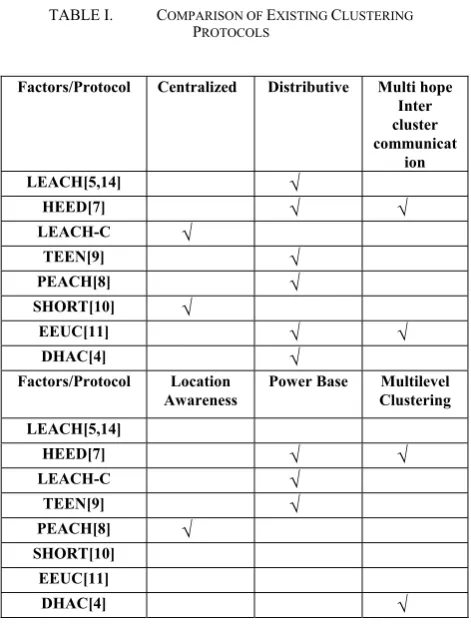
Role of being cluster head, example of such algorithm is well known traditional LEACH, ERA, RRCH, and DHAC etc. Some clustering algorithm worked on the basis of network structure they use the parameter of residual energy for deciding next cluster head example of such algorithm is HEED. Some clustering protocols are differentiated on the basis of nature of sensors homogeneous or heterogeneous [2]. Above shown Table I will present comparison of different clustering protocols on different factors.
III. CLUSTERING PROTOCOLS
This section will present firstly concept of three protocols; followed by comparisons. Three considered protocols are HEED (Hybrid Energy-Efficient Distributed clustering) MEDC (Mutual Exclusive Distributed Clustering) and MEHEED. Conceptual comparison has been given by Table II. Table II will discuss working parameters of these protocols in tabular manner.
A. HEED
In paper [7], HEED (Hybrid Energy-Efficient Distributed clustering) was proposed. HEED is Distributive protocol, which selects the cluster heads among sensors on behalf of hybrid of the, node residual energy and intra-cluster communication cost [7]. HEED follow single hop communication, which means sensors will directly communicate with their respective cluster heads. The HEED algorithm is divided into three phases. First phase is Initialization phase, second is repletion phase followed by third phase that is finalizing phase [7]. The Initialization
phase is for calculation of communication cost on behalf of node degree and Chprob. In the Second phase each sensor is get allocated status either of tentative cluster head of final cluster head. Tentative cluster head status will be given to sensors that are having minimum cost i.e. Snbr. The sensor
will be selected as final cluster head if it’s CHprob = 1. Third phase is Finalization phase in which some sensors will be declared as cluster heads and other as cluster members. Further research work has been carried out from there iHEED [15] has been proposed. This work is implementation of HEED with data aggregation. One more protocol MCCP (minimum-cost clustering protocol) [16] also work on residual energy factor as like HEED. This protocol is for underwater sensors. ECPF (Energy-aware distributed dynamic clustering protocol) [17] also takes primary factor of residual energy. This protocol had also used fuzzy logic for cluster head selection. HEED protocol is improvised in paper PADCP (Power-Aware Dynamic Clustering Protocol for Wireless Sensor Network) [18]. HEED is limited with factor of Uniform distribution, PADCP worked with unequal distribution and shown improvement in performance.
B. MEDC (Mutual Exclusive Distributed Clustering)
[19]
MEDC is our proposed work in [19]. MEDC protocol works on principal of mutual exclusive selection of Cluster Heads. Cluster heads will be chosen in mutual exclusive way over range of communication. Under a range of communication sensor that’s having maximum of residue energy only and only that will be cluster head. The protocol will run in iterations, each iteration follow three steps. The new cluster heads will be again chosen in succeeding iteration. When iteration starts, step 1 Sensors will advertise their remaining battery power to the sensors under range of Rf. All sensors will send and receive advertisement.
A queue for incoming advertisements will be maintained at sensors. Step 2 will work, as now sensors will check all incoming advertisements, after that all Sensors send OK message to only those sensors that are having residue energy more than its own. This step gives clarity that if any sensor is sending OK message to the any of other sensor, which means presently there is no chance for itself becoming cluster head. If a sensor got advertisement of other sensors those are having power less than or equal to its own power then it will wait up to some period of time. This Step 2 will take TDMA slot. In step 3 each sensor will look up its own status. If sensor had not sent OK message to any other sensor that means presently itself is having higher residue battery power. So it will send a declaration message of becoming cluster head to every sensor under range Rf.
There will be only one cluster head that’s having highest residue energy no other sensor is allowed to be cluster head [19].
Algorithm
There are n sensors. Each sensor is given with ID. Definitions
[image:2.595.54.290.81.394.2]IDi: ID of node i. TABLE I. COMPARISON OF EXISTING CLUSTERING
PROTOCOLS
Factors/Protocol Centralized Distributive Multi hope Inter cluster communicat
ion
LEACH[5,14] √
HEED[7] √ √
LEACH-C √
TEEN[9] √
PEACH[8] √
SHORT[10] √
EEUC[11] √ √
DHAC[4] √
Factors/Protocol Location Awareness
Power Base Multilevel Clustering
LEACH[5,14]
HEED[7] √ √
LEACH-C √
TEEN[9] √
PEACH[8] √
SHORT[10] EEUC[11]
Rf: Radius of frequency. Qi: Queue of sensor i.
Eresidual_i: Residual energy of node i. For each Next iteration
Procedure Cluster_formation (n) For each IDi
Counter =0
For each IDj within Rf of IDi Advertise Eresidual_i For each IDi
Put all incoming advertisements from sensors j Into Qi
For each IDi
While Qi is not empty If (Eresidual_i <= Eresidual_j) Send ok message to IDj Counter = 1
Else
Delete this advertisement from queue For each IDi
If (counter =0)
Send cluster_head_declaration message to IDj Within Rf
C. MEHEED[20]
MEHHED is extension Work of the MEDC. The MEDC was working on the parameters of residue energy Eresidual
and Range of communication. Well known HEED protocol considers three factors one of them is Chprob second is Snbr
and last is Range of communication.
TABLE I. CONCEPTUAL COMPARISION -WORKING FACTOR OF
CLUSTERING
The proposed MEHEED will take first parameter same i.e. Chprob and second parameter will be Eresidual instead of
Snbr; the third factor is same for all three protocols here i.e.
Range of communication. The idea to change second parameter is, instead of considering previous calculated Snbr,
which was dependent on remaining energy of starting level, why not to consider Eresidual that have been recalculated after
each iteration.
Benefit of this idea will be that recent updated value i.e.
Eresidual will also reflect energy detrainment of previous
cluster heads. So decisions will be more accurate. The results have been shown that this idea has given more affective results to save network life. MEHEED clustering protocol will works in two phases. First phase will be of initialization and calculations phase is same like HEED. Second phase will decide the cluster head and the members under clusters. In the starting of first phase first of all sensors under the range are queued. On basis of this queue, Communication cost and Eresidual will be calculated. After
that in First phase, Chprob will be calculated, with the help of
Cprob. Cprob had been be initialized with a predefined
probability value [7] like of HEED. Second phase will decide which sensor will be cluster head. This decision firstly depends on Chprob after that this decision will depend
on the Eresidual unlike HEED, in which second factor was Snbr.
Algorithm Phase I
1. For each sensor i
2. Qi ˂-- v: v under of Rf of sensor i.
3. Compute the communication cost of i after investing on Qi also compute Eresidual. 4. Chprob i = max (Cprob × Eresidual /Emax, pmin) Phase II
1. For each sensor i 2. If (Chprob i == 1)
cluster_head_declaration message 3. else For each sensor i
4. Advertise Eresidual_i each j within Qi
5. Queue all incoming advertisements from sensors j into adv_Qi
6. While Qi is not empty
7. If (Eresidual_i <= Eresidual_i) 8. Send ok message to sensor j 9. do Counter = 1
10. Else Working Factors for Clustering
HEED MEDC MEHEED
Chprob Snbr (cost) Range of Communication
Eresidual Range of Communication
11. Delete this advertisement from queue 12. For each sensor i
13. If (counter ==0)
14. Send cluster_head_declaration message to IDj within Rf
15. Else if
16. Find j in adv_Qi having Epresent_j >= Epresent_i 17. Compare this Epresent_j with other
sensors in adv_Qi and find the highest energy sensor let its r
18. do Chprob r = 1
19. Do Chprob i = max (1, Chprob i *2)
IV. EXPERIMENTAL RESULTS
The above discussed three clustering protocol HEED, MEDC and MEHEED had been implemented for experimental evaluation and comparison. Simulation has been carried out on MATLAB with parameters as energy of sensor is eo=0.05, xm=100, ym=100, eo=0.05, n=100,transmission energy is ETX= 50*1.E-12, receiving energy is ERX=50*1.E-12, free space energy is Efs=10*1.E-12, data aggregation energy is EDA=5*1.E-12, advertizing energy is Eadv =50*1.E-12, range of communication is RC=15, packet size is PS=32, and size of advertizing packet is adv =10. S(i).chprob will be
S(i).chprob=max(((S(i).cprob*S(i).eres)/eo),S(i).pmin).
S(i).cprob will be initialized and S(i).eres is residual energy
will be calculated after each iteration. Transmission Energy (Etx) Dissipation will be calculated via equation 1.
Etx (k) =k× Eelec. + Etx_amp (k, d). (1)
Etx_amp (k, d) depend on path whether its free space or multipath
Etx_amp (k, d)= k× d2× Ɛmp (2)
Etx_amp (k, d)= k× d4× Ɛfs (3)
Where amplification energy for free space is represented as Ɛfs and amplification energy for multipath is Ɛmp. Receiving Energy (Erx) Dissipation will be calculated via equation 4. Receiving energy for k bits is Erx (k)
Erx (k) = k× Eelec. (4)
According to these parameters three protocols have been simulated and, network lifetime is checked. Network lifetime is experimentally checked in terms of Number of Alive nodes v/s Number of Rounds. Experimental results are shown in Fig 1 where vertical axis represents Number of Alive nodes and horizontal axis represents Number of Rounds. Results had shown that MEHHED is giving better results means number of alive nodes up to last iterations.
Fig 1. Comparative graph of HEED, MEDC, MEHEED
V. CONCLUSION
Clustering protocols play important role for life enhancement in WSNs. This work is study of different clustering protocols and aimed at compare our new proposed protocols with HEED. This comparison is carried out in order to represent that our proposed protocols works MEHEED work even better that our previous proposed MEDC and existing HEED. Experimental results are shown to support conclusion. This work concludes that working parameter Chprob and Eresidual works best together as selection
criteria of cluster heads in clustering protocols. REFERENCES
[1] Ossama Younis, Marwan Krunz, and Srinivasan Ramasubramanian, “Node Clustering in Wireless Sensor Networks: Recent Developments and Deployment Challenges”, In IEEE international journal of Network Volume20, Issue 3 on 2006, pages 20-25.
[2] Vivek Mhatre and Catherine Rosenberg,”Homogeneous v/s Heterogeneous Clustered Sensor Networks: A Comparative Study”, In IEEE International Conference on Communications, Volume: 6 on 2004 pages 3646-3651.
[3] Vivek Mhatre and Catherine Rosenberg, “Design guidelines for wireless sensor networks communication, clustering and aggregation”, In Elsevier Ad Hoc Networks Volume 2, Issue 1, 2004, Pages 45–63.
[4] Chung-Horng Lung and Chenjuan Zhou, “Using hierarchical agglomerative clustering in wireless sensor networks: An energy-efficient and flexible approach”, In Elsevier international Journal of Adhoc Networks, volume:8, issue:3 ,2010,pages 328-344.
[5] Wendi B. Heinzelman and Anantha P. Chandrakasan and Hari Balakrishnan, “An Application-Specific Protocol Architecture for Wireless Microsensor Networks”, In IEEE transactions on Wireless Communications ,voilume: 1, issue: 4, October 2002,pages 660-670. [6] Gaurav Gupta and Mohamed Younis, “Performance evaluation of
load-balanced clustering of wireless sensor networks”, In 10th International Conference on Telecommunications, ICT 10th international conference on telecommunications,2003,pages 1577-1583
[7] Ossama Younis and Sonia Fahmy, “HEED: A Hybrid, Energy-Efficient, Distributed Clustering Approach for Ad-hoc Sensor Networks”, In IEEE transaction on Mobile Computing Volume 3, Issue 4, 2004.pages 366-379.
[8] Sangho Yi , Junyoung Heo , Yookun Cho and Jiman Hong, “PEACH: Power efficient and adaptive clustering hierarchy protocol for wireless sensor networks”, In Elsevier International Journal of Computer Communication Network Coverage and Routing Schemes for Wireless Sensor Networks. On Volume 30, Issues 14–15, October 2007, Pages 2842–2852.
0 10 20 30 40 50 60 70 80 90 100
0 100 200 300 400 500 600 700 800 900 1000
HEED
MEDC
[9] Arati Manjeshwar and Dharma P. Agrawal, “TEEN: A Routing Protocol for Enhanced Efficiency in Wireless Sensor Networks”, In IEEE 15th international conference on parallel, 2001.
[10] Y.Yang , H.H. Wu and H.H. Chen, “Short: Shortest hop routing tree for wireless sensor networks”, International Journals of sensor networks,volume:2, 2007,pages 368-374
[11] C. Li, M. Ye, G. Chen and J. Wu, “An energy-efficient unequal clustering mechanism for wireless sensor networks”, in Proceedings of the 2nd IEEE International conference on performance,computing,and communicationIPCCC , 2005, pages 535-540.
[12] Ameer Ahmed Abbasi and Mohamed Younis, “A survey on clustering algorithms for wireless sensor networks”, Elsevier , International journal computer communication Volume 30, Issues 14–15, October 2007. pages 2826-2841
[13] Noritaka Shigei, Hiromi Miyajima,Hiroki Morishita, Michiharu Maeda, “Centralized and Distributed clustering methods for energy efficient wireless sensor Networks”, In Proceedings of the International Multi Conference of Engineers and Computer Scientists IMECS, volume 1,March 2009.
[14] V. Loscrì, G. Morabito and S. Marano, “A Two-Levels Hierarchy for Low-Energy Adaptive Clustering Hierarchy (TL-LEACH)”, In IEEE international conference on Vehicular Technology , 2005, pages 1809-1813.
[15] Ossama Younis and Sonia Fahmy, “An Experimental Study of Routing and Data Aggregation in Sensor Networks”, In IEEE International Conference on Mobile Adhoc and Sensor Systems Conference, 2005,pages 8-57
[16] Pu Wang, Cheng Li, Jun Zheng, “ Distributed Minimum-Cost Clustering Protocol for UnderWater Sensor Networks (UWSNs) “ in IEEE International Conference on Communications, 2007 pages 3510 - 3515
[17] Hoda Taheri, Peyman Neamatollahi, Ossama Mohamed Younis, ” An energy-aware distributed clustering protocol in wireless sensor networks using fuzzy logic” in Elseveir journal of Ad hoc Networks Volume 10, Issue 7, September 2012, Pages 1469–1481
[18] Jyun-Yuan Cheng, Shanq-Jang Ruan, Ray-Guang Cheng, Teng-Tai Hsu,” PADCP: Power-Aware Dynamic Clustering Protocol for Wireless Sensor Network “ IEEE IFIP International Conference on Wireless and Optical Communications Networks, 2006 pages 6-12 [19] Yashwant Singh, Urvashi Chugh, ”Mutual Exclusive Distributive
Clustering (MEDC) Protocol for Wireless Sensors Networks” “International Journal of Sensors, Wireless Communications and Control”, Bentham Science Press, Vol. 3 No. 2, 2013(reprint pending) [20] Yashwant Singh, and Urvashi Chugh, “MEHEED: Mutual Exclusive Hybrid Energy Efficient Distributed Clustering in Wireless Sensor Networks”, In Proceeding of ELSEVIER ERCICA, Aug 1-2, 2014, Bangalore, India. (2014)