ARTICLE
OPEN
Accessible quanti
fi
cation of multiparticle entanglement
Marco Cianciaruso1,2, Thomas R Bromley1,2and Gerardo Adesso1
Entanglement is a key ingredient for quantum technologies and a fundamental signature of quantumness in a broad range of phenomena encompassing many-body physics, thermodynamics, cosmology and life sciences. For arbitrary multiparticle systems, entanglement quantification typically involves nontrivial optimisation problems, and it may require demanding tomographical techniques. Here, we develop an experimentally feasible approach to the evaluation of geometric measures of multiparticle entanglement. Our framework provides analytical results for particular classes of mixed states ofNqubits, and computable lower bounds to global, partial, or genuine multiparticle entanglement of any general state. For global and partial entanglement, useful bounds are obtained with minimum effort, requiring local measurements in just three settings for anyN. For genuine
entanglement, a number of measurements scaling linearly withNare required. We demonstrate the power of our approach to estimate and quantify different types of multiparticle entanglement in a variety ofN-qubit states useful for quantum information processing and recently engineered in laboratories with quantum optics and trapped ion setups.
npj Quantum Information(2016)2,16030; doi:10.1038/npjqi.2016.30; published online 18 October 2016
INTRODUCTION
The fascination with quantum entanglement has evolved over the last eight decades, from the realm of philosophical debate1to a very concrete recognition of its resource role in a range of applied sciences.2,3Although considerable progress has been achieved in the detection of entanglement,4–12 its experimentally accessible quantification remains an open problem for any real implementa-tion of an entangled system.13–23Quantifying entanglement is yet necessary to gauge precisely the quantum enhancement in information processing and computation,2,3,24 and to pin down
exactly how much a physical or biological system under observation departs from an essentially classical behaviour.25This
is especially relevant in the case of complex, multiparticle systems, for which only quite recently have notable advances been reported on the control of entanglement.26–29
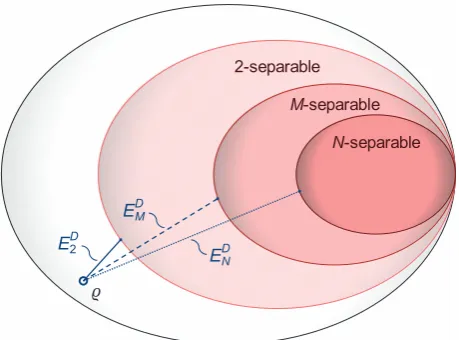
An intuitive framework for quantifying the degree of multi-particle entanglement relies on a geometric perspective.30–32 Within this approach, one first identifies a hierarchy of non-entangled multiparticle states, also referred to as M-separable states for 2⩽M⩽N, whereNis the number of particles composing the quantum system of interest; see Figure 1. Introducing then a distance functional D with respect to the natural properties of contractivity under quantum operations and joint convexity (see Materials and Methods),33the quantityEDMdefined as
EDMð Þ ¼ρ inf
ςM separable Dðρ;ςÞ; ð1Þ
is a valid geometric measure of (M-inseparable) multiparticle entanglement in the stateρ.
Some special cases are prominent in this hierarchy. ForM=N, the distance from N-separable (also known as fully separable) states defines the global multiparticle entanglement ED
N,
which accounts for any form of entanglement distributed among
two or more of the N particles. Geometric measures of global entanglement have been successfully employed to characterise quantum phase transitions in many-body systems34 and directly assess the usefulness of initial states for Grover’s search algorithms.35 On the other extreme of the hierarchy, for M= 2, the distance from two-separable (also known as biseparable) states defines instead the genuine multiparticle entanglementED2, which quantifies the entanglement shared by all theNparticles, that is the highest degree of inseparability. Genuine multiparticle entanglement is an essential ingredient for quantum technologies including multiuser quantum cryptography,36quantum metrology37 and measurement-based quantum computation.38Finally, for any intermediate M, we can refer to EDM as partial multiparticle entanglement. The presence of partial entanglement is relevant in quantum informational tasks such as quantum secret sharing10 and may have a relevant role in biological phenomena.25,39 Probing and quantifying different types of entanglement can shed light on which nonclassical features of a mixed multiparticle state are necessary for quantum-enhanced performance in specific tasks7 and can guide the understanding of the emergence of classicality in multiparticle quantum systems of increasing complexity.40
The quantitative amount of multiparticle entanglement, be it global or genuine (or any intermediate type), has an intuitive operational meaning when adopting the geometric approach. Namely,EDMmeasures how distinguishable a given stateρis from the closestM-separable state. Given some widely adopted metrics, such a distinguishability is directly connected to the usefulness of ρ for quantum information protocols relying on multiparticle entanglement. For instance, the trace distance of entanglement is operationally related to the minimum probability of error in the discrimination betweenρand anyM-separable state with a single measurement.33 Furthermore, the geometric entanglement with
respect to relative entropy or Bures distance sets quantitative
1
Centre for the Mathematics and Theoretical Physics of Quantum Non-equilibrium Systems, School of Mathematical Sciences, The University of Nottingham, University Park, Nottingham NG7 2RD, UK.
Correspondence: M Cianciaruso ([email protected]) TR Bromley ([email protected]) or G Adesso ([email protected]) 2
These authors contributed equally to this work.
bounds on the number of orthogonal states that can be discriminated by local operations and classical communication (LOCC).41 The geometric entanglement based on infidelity31
(monotonically related to Bures distance) has also a dual interpretation based on the convex roof construction;42that is, it
quantifies the minimum price (in units of pure-state entangle-ment) that has to be spent on average to create a given density matrixρas a statistical mixture of pure states.
It is therefore clear that finding the minimum in Equation (1), and hence evaluating geometric measures of multiparticle entanglement defined by meaningful distances, is a central challenge to benchmark quantum technologies. However, obtain-ing such a solution for general multiparticle states is in principle a formidable problem. Even if possible, there would remain major challenges for experimental evaluation, which would in general require a complete reconstruction of the state through full tomography. For multiparticle states of any reasonable number of qubits, full state tomography places significant demands on experimental resources, and it is thus highly desirable to provide quantitative guarantees on the geometric multiparticle entangle-ment present in a state, via nontrivial lower bounds, in an experimentally accessible way.13–23
Here we provide substantial advances towards addressing this problem in a general fashion. We identify a general framework for the provision of experimentally friendly quantitative guarantees on the geometric multiparticle entanglement present in a state. This approach consists of:
(1) Choosing a set of reference states:find a restricted family of
N-qubit states with the property that any state may be mapped into this family through afixed procedure of single-qubit LOCC. This reference family should be simple to
characterise, and can be chosen from experimental or theoretical considerations.
(2) Identifying M-separable reference states: Apply thefixed LOCC procedure to the general set of M-separable states, hence identifying the subset of M-separable states within the reference family.
(3) CalculatingED
Mfor the reference states: solve the optimisation
problem for the geometric entanglement of reference states. This is markedly simplified by using the properties of contractivity and joint convexity, that hold for any distance functional D defining a valid entanglement measure, and imply in particular that one of the closestM-separable states to any reference state is to be found itself within the reference family.
(4) Deriving optimised lower bounds for any state: exploit the freedom to apply single-qubit unitaries to any N-qubit state ρin order tofind the corresponding reference state with the highest geometric entanglement, providing an optimised lower bound toEDMð Þρ.
This process presents a versatile and comprehensive approach to obtain lower bounds on geometric multiparticle entanglement measures according to any valid distance. While building on some previously utilised methods for steps (1)13–16 and (4)13,15,16 it
introduces novel techniques in steps (2) and most importantly (3), which are crucial for completing the framework and making it effective in practice (see e.g., Appendix C, D, E and F of the Supplementary Material).
To illustrate the power of our approach, we focus initially on a reference family of mixed statesϖofNqubits, that we labelM3 N
states, which form a subset of the class of states having all maximally mixed marginals. This family includes maximally entangled Bell states of two qubits and their mixtures, as well as multiparticle bound entangled states.43–46For anyN, these states are completely specified by three easily measurable quantities, given by the correlation functions cj¼〈σNj 〉, where {σj}j= 1,2,3
are the Pauli matrices. In the following we show how every entanglement monotone EDM can be evaluated exactly for any evenNon these states, by revealing an intuitive geometric picture common to all valid distances D. For odd N, the results are distance-dependent; we show nonetheless that ED
M can still be
evaluated exactly ifDdenotes the trace distance. The results are nontrivial for allM4dN=2ein the hierarchy of Figure 1. A central observation, in line with the general framework, is that an arbitrary state ofNqubits can be transformed into anM3
Nstate by an LOCC
procedure, which cannot increase entanglement by definition. This implies that our exact formulae readily provide practical lower bounds to the degree of global and partial multiparticle entanglement in completely general states. Importantly, the bounds are obtained by measuring only the three correlation functions {cj} for any number of qubits, and can be further
improved by adjusting the local measurement basis (see Figure 2 for an illustration).
Furthermore, we discuss how our results can be extended to allow for the quantitative estimation of genuine multiparticle
entanglement as well, at the cost of performing extra
measurements. As M3
N states are always biseparable, we must
consider a different reference family. We focus on the class of
N-qubit states obtained as mixtures of Greenberger–Horne– Zeilinger (GHZ) states,5,47 the latter being central resources for quantum communication and estimation; this class of states depends on 2N−1 real parameters. We calculate exactly distance-based measures of genuine multiparticle entanglement ED
2 for
these states, for every validD. Once more, these analytical results provide lower bounds to geometric measures of genuine entanglement for any general state of N qubits, obtainable
E2D
EMD
END
2-separable
M-separable
[image:2.595.55.285.58.228.2]N-separable
Figure 1. Geometric picture of multiparticle entanglement in a quantum system ofNparticles. Each red-shaded convex set contains M-separable states (for 2⩽M⩽N), which can be defined as follows. The set of pureM-separable states is given by the union of the sets of tensor products jΨMi ¼ Mk¼1ψ
k
ð Þ of pure states ψð Þk , with
respect to any partition of theNparticles intoMsubsystemsk=1,…, M; the set of general (mixed)M-separable states is then formed by all convex mixtures of pureM-separable states, where each term in the mixture may be factorised with respect to a different multipartition. This provides a partition-independent classification of separability (see also the Supplementary Material). For anyM, the multiparticle entanglement measureED
Mof a stateρis defined as the minimum
experimentally in this case by performing at least N+1 local measurements.48
We demonstrate that our results provide overall accessible quantitative assessments of global, partial and genuine multi-particle entanglement in a variety of noisy states produced in recent experiments,40,44,49–52 going beyond mere detection,4–12
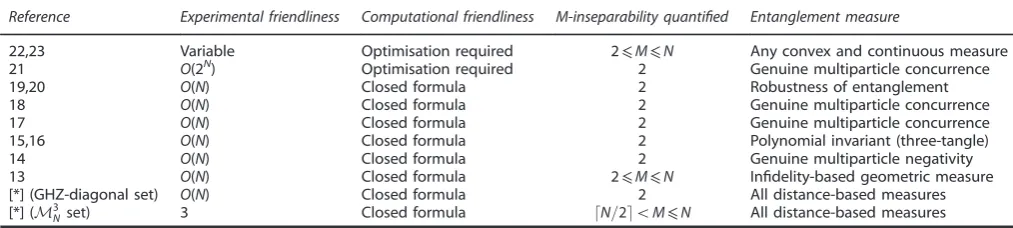
yet with a significantly reduced experimental overhead. Compared with some recent complementary approaches to the quantifi ca-tion of multiparticle entanglement,13–23wefind that our results,
obtained via the general quantitative framework discussed above, fare surprisingly well in their efficiency and versatility despite the
minimal experimental requirements (see Table 1 for an in-depth comparison).
RESULTS
Global and partial multiparticle entanglement
We begin by choosing as our reference family the set ofN-qubit M3
Nstates. AnM3Nstate is defined asϖ¼21N INþ
P3
j¼1cjσNj
,
[image:3.595.54.532.57.396.2]where I is the 2 × 2 identity matrix. These states are invariant under permutations of any pair of qubits and enjoy a nice
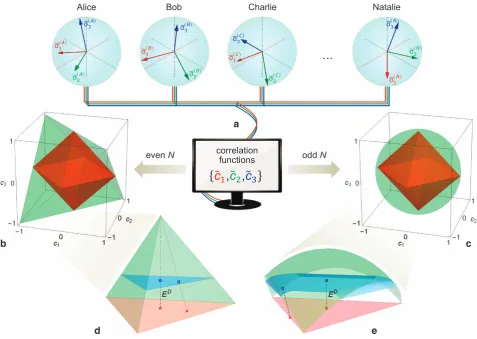
Figure 2. Experimentally friendly protocol to quantify global and partialN-particle entanglement.Top row:(a) A stateρofNqubits is shared by Nparties, named Alice, Bob, Charlie, ..., Natalie. Each party, labelled byα=A,…,N, locally measures her or his qubit in three orthogonal directionsfσ~ð Þα
j g, with j=1, 2, 3, indicated by the solid arrows. If the shared stateρis completely unknown, a standard choice can be to
measure the three canonical Pauli operators for all the qubits (corresponding to the directions of the dashed axes); if instead some partial information onρis available, the measurement directions can be optimiseda priori. Once all the data are collected, theNparties communicate classically to construct the three correlation functions ~cj , with~cj¼〈ασ~ð Þjα〉. Middle row: for anyN, one can define a reference subset of
N-qubit states with all maximally mixed marginals (M3
Nstates), which are completely specified by a triple of orthogonal correlation functions
{cj}. These states enjoy a convenient representation in the space of {c1,c2,c3}. (b) For evenN,M3Nstatesfill the tetrahedron with vertices
{1, (−1)N/2, 1}, {−1,−(−1)N/2, 1}, {1, −(−1)N/2,−1} and {−1, (−1)N/2,−1}. (c) For oddN, they are instead contained in the unit Bloch ball. For any M4dN=2e,M-separableM3Nstates are confined to the octahedron with vertices {±1, 0, 0}, {0,±1, 0} and {0, 0,±1}, illustrated in red in both
panels; conversely, forM≤dN=2e, allM3
Nstates areM-separable. Bottom row: geometric analysis of multiparticle entanglement. The bottom
panels depict zooms of (d) a corner of the tetrahedron for evenNand (e) a sector of the unit sphere for odd N, opposing a face of the octahedron ofM-separableM3
Nstates (forM4dN=2e). Instances of inseparableM
3
N states are indicated by blue circles, and their closest
M-separable states by red crosses. The cyan surfaces in each of the two bottom panels contain states with equal global and partial multiparticle entanglementED
M, which we compute exactly. The results are valid for any contractive and jointly convex distanceDin the evenN
case, and for the trace distance in the oddNcase. The entanglement of anM3
Nstate with correlation functions f~c1;~c2;~c3gprovides an analytical lower bound for the entanglement of anyN-qubit state with the same correlation functions, such as the stateρinitially shared by theNparties ina. The bound is effective for the most relevant families ofN-qubit states in theoretical and experimental investigations of quantum information processing, as we show in this article.
geometrical representation in the space of the three correlation functionscj, corresponding to a tetrahedron for evenNand to the
unit ball for odd N, as depicted in Figure 2. We can then characterise the subset ofM-separableM3
N states for anyN. We find that, if M4dN=2e, then the M-separable M3N states fill a subset corresponding to an octahedron in the space of the correlation functions (Figure 2). WhenM⩽dN=2e, all M3
N states
are instead M-separable. The proofs are deferred to the Supplementary Material.
We can now tackle the quantification of global and partial multiparticle entanglement in these states; for the latter, we will always focus on the nontrivial case M4dN=2e throughout this section. First, we observe that the closestM-separable stateςϖto anM3
Nstateϖ, which solves the optimisation in Equation (1), can
always be found within the subset of M-separable M3 N states,
yielding a considerable simplification of the general problem. To
find the exact form of ςϖ, and consequently of EDMð Þϖ , we approach the cases of even and oddNseparately.
For evenN, we prove that there exists a unique solution to the minimisation in Equation (1), independent of the specific choice of contractive and jointly convex distance D. Namely, the closest
M-separable stateςϖis on the face of the octahedron bounding the corner of the tetrahedron in which ϖ is located, and is identified by the intersection of such octahedron face with the line connectingϖto the vertex of the tetrahedron corner, as depicted in Figure 2d. It follows that, for any nontrivialM, validDand even
N, the multiparticle entanglementED
MðϖfcjgÞof anM 3 Nstateϖ
cj f g with correlation functions {cj} is only a monotonically increasing
function of the Euclidean distance between the point of coordinates {cj} and the closest octahedron face, which is in turn
proportional tohϖ ¼1 2
P3
j¼1 cj -1
(notice thathϖequals the
bipartite measure known as concurrence for N= 2 (refs 24,53)). We have then a closed formula for any valid geometric measure of
global and partial multiparticle entanglement on an arbitraryM3 N
stateϖf gcj with evenN, given by
EDM ϖf gcj
¼ 0; hϖ0 orð MN=2Þ; fDðhϖÞ; otherwise;
ð2Þ
where fD denotes a monotonically increasing function whose
explicit form is specific to each distanceD. In Table 2, we present the expression offDfor relevant distances in quantum information
theory.
For oddN, the closestM-separable stateςϖto anyM3 Nstateϖ
is still independent of (any nontrivial) M. However, different choices ofDin Equation (1) are minimised by different statesςϖ. We focus on the important but notoriously hard-to-evaluate case of the trace distanceDTr(ϖ,ς) (Table 2). In the representation of
Figure 2c, the trace distance amounts to half the Euclidean distance on the unit ball. It follows that the closestM-separable state ςϖ to ϖ is the Euclidean orthogonal projection onto the boundary of the octahedron, see Figure 2e. We can then get a closed formula for the trace distance measure of global and partial multiparticle entanglement EDTr
M ðϖfcjgÞ of an arbitrary M3N state ϖfcjgwith oddNas well, given by
EDTr
M ϖf gcj
¼
0; hϖ0 orð MdN=2eÞ;
hϖffiffi 3
p; 0< hϖ3cj=28j;
min
j 1 2
ffiffiffiffiffiffiffiffiffiffiffiffiffiffiffiffiffiffiffiffiffiffiffiffiffiffiffiffiffiffiffiffiffiffiffiffiffiffiffiffiffi
cj 2
þ1
2 2hϖ- cj
2
q
; otherwise: 8
> > < > > :
ð3Þ
The usefulness of the just-derived analytical results for multi-particle entanglement is not limited to the M3
N states. In
accordance with our general framework, a crucial observation is that theM3
Nstates are extremal among all quantum states with
given correlation functions {cj}. Specifically, any general stateρof
Nqubits can be transformed into anM3
[image:4.595.48.555.87.201.2]Nstate with the same {cj}
Table 1. A comparison of relevant literature on experimentally friendly quantification of multiparticle entanglement (based on accessible lower bounds)
Reference Experimental friendliness Computational friendliness M-inseparability quantified Entanglement measure
22,23 Variable Optimisation required 2⩽M⩽N Any convex and continuous measure
21 O(2N) Optimisation required 2 Genuine multiparticle concurrence
19,20 O(N) Closed formula 2 Robustness of entanglement
18 O(N) Closed formula 2 Genuine multiparticle concurrence
17 O(N) Closed formula 2 Genuine multiparticle concurrence
15,16 O(N) Closed formula 2 Polynomial invariant (three-tangle)
14 O(N) Closed formula 2 Genuine multiparticle negativity
13 O(N) Closed formula 2⩽M⩽N Infidelity-based geometric measure
[*] (GHZ-diagonal set) O(N) Closed formula 2 All distance-based measures
[*] (M3
Nset) 3 Closed formula dN=2eoM⩽N All distance-based measures
[image:4.595.48.563.285.374.2]For each reference, we give the experimental friendliness, in terms of the number of local measurement settings required, and also the computational friendliness. The levels ofM-inseparability quantified are given, along with the entanglement measures to which each work applies; [*] refers to this paper.
Table 2. Analytical expression of global and partial multiparticle entanglementED
MforM
3
Nstates of an even numberNof qubits as defined by
Equation (2), for representative choices of the distanceD
DistanceD D(ρ,ς) fD(hϖ)
Relative entropyDRE Tr½ρðlog2ρ-log2ςÞ 21½ð1-hϖÞlog2ð1-hϖÞ þð1þhϖÞlog2ð1þhϖÞ
TraceDTr 12Trjρ-ςj 12hϖ
InfidelityDF 1- Tr
ffiffiffiffiffiffiffiffiffiffiffiffiffiffiffiffiffiffiς
p
ρpffiffiffiς
p
2 1
2 1
-ffiffiffiffiffiffiffiffiffiffiffiffiffi
1-h2 ϖ
q
Squared BuresDB 2 1-Tr
ffiffiffiffiffiffiffiffiffiffiffiffiffiffiffiffiffiffiς
p
ρpffiffiffiς
p
2-pffiffiffiffiffiffiffiffiffiffiffiffiffi1-hϖ-pffiffiffiffiffiffiffiffiffiffiffiffiffiffi1þhϖ Squared HellingerDH 2 1-Tr ffiffiffiρ
p ffiffiffi
ς
p
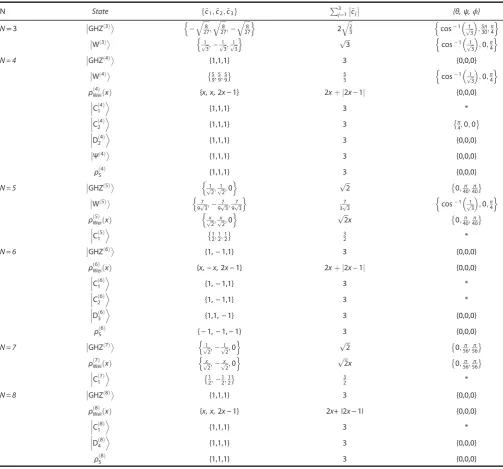
Table 3. Applications of our framework to construct accessible lower bounds on global and partial (M-inseparable) multiparticle entanglement (which are nonzero for anyM4dN=2ewhenPj~cj >1), for the families ofN-qubit states listed as follows
N State f~c1;~c2;~c3g
P3
j¼1 ~cj {θ,ψ,ϕ}
N=3 GHZð Þ3 - ffiffiffiffi8
27
q
; ffiffiffiffi8 27
q
;- ffiffiffiffi8 27
q
n o
2 ffiffi2 3
q
cos-1 1ffiffi 3
p ;5π
30;π4
n o
Wð Þ3 1ffiffi
3
p;- 1ffiffi
3
p; 1ffiffi
3
p
n o ffiffiffi
3 p
cos-1 1ffiffi 3
p ;0;π4
n o
N = 4 GHZð Þ4 {1,1,1} 3 {0,0,0}
Wð Þ4 5
9;59;59
5
3 cos-1 p1ffiffi3 ;0; π 4
n o
ρð Þ4
Weið Þx {x,x, 2x−1} 2xþj2x-1j {0,0,0}
Cð Þ14
E {1,1,1} 3 *
Cð Þ24
E {1,1,1} 3 π4;0;0
Dð Þ24
E {1,1,1} 3 {0,0,0}
Ψð Þ4 {1,1,1} 3 {0,0,0}
ρð Þ4
S {1,1,1} 3 {0,0,0}
N = 5 GHZð Þ5 1ffiffi
2
p; 1ffiffi
2
p;0
n o ffiffiffi
2 p
0;40π;40π
Wð Þ5 7
9pffiffi3; -7 9pffiffi3;
7 9pffiffi3
n o
7
3pffiffi3 cos
-1 1ffiffi 3
p ;0;π4
n o
ρð Þ5
Weið Þx pxffiffi2;
xffiffi
2
p;0
n o ffiffiffi
2 p
x 0;40π;40π
Cð Þ15
E 1 2; 1 2; 1 2 3 2 *
N = 6 GHZð Þ6 {1,−1,1} 3 {0,0,0}
ρð6Þ
Weið Þx {x,−x, 2x−1} 2xþj2x-1j {0,0,0}
Cð Þ16
E {1,−1,1} 3 *
Cð Þ26
E {1,−1,1} 3 *
Dð Þ36
E {1,1,−1} 3 {0,0,0}
ρð Þ6
S {−1,−1,−1} 3 {0,0,0}
N = 7 GHZð Þ7 1ffiffi
2
p;- 1ffiffi 2
p;0
n o ffiffiffi
2 p
0;56π;56π
ρð7Þ
Weið Þx pxffiffi2;
-xffiffi
2
p;0
n o ffiffiffi
2 p
x 0;56π;56π
Cð Þ17
E 1
2; -1 2; 1 2 3 2 *
N = 8 GHZð Þ8 {1,1,1} 3 {0,0,0}
ρð Þ8
Weið Þx {x,x, 2x−1} 2x+|2x−1| {0,0,0}
Cð Þ18
E {1,1,1} 3 *
Dð Þ48
E {1,1,1} 3 {0,0,0}
ρð Þ8
S {1,1,1} 3 {0,0,0}
(i)N-qubitGHZstates47GHZð ÞN¼ 1ffiffi 2
pðj00 00i þj11 11iÞwithN⩾3. (ii)N-qubit W states54Wð ÞN¼ 1ffiffiffi N
p ðj00 01i þj00 10i þ þj10 00iÞ, with
N⩾3. (iii)N-qubit Wei states55,56ρð ÞWeiNð Þ ¼x xGHZ N
ð Þ
GHZð ÞN
þð1-xÞ
2N
PN k¼1 PkþPk
;whereN⩾4,x∈[0, 1] andPkis the projector onto the binaryN-qubit representation of 2k−1, whereasPi¼σN
1 Piσ1N. (iv)N-qubit linear cluster states9C N
ð Þ
1 icorresponding to theN-vertex linear graph . 14,38
(v)N-qubit
rectangular cluster states 9Cð Þ2Ni corresponding to the N-vertex ladder-type graph 38,57 (vi) N-qubit (symmetric) Dicke states
9Dð ÞkNi ¼ 1ffiffi Z
pPiΠi j i0N-kj i1k
, which are superpositions of all states withkqubits in the excited state |1〉andN−kqubits in the ground state |0〉, with the
symbolfΠið ÞgU Zi¼1denoting all theZ N
k distinct permutations of 0’s and 1’s; we focus on half-excited Dicke states, given byk=N/2 for any evenN. 51,52,58,66
(vii) 4-qubit singlet state62 Ψð4Þ ¼ 1ffiffi 3
p½j0011i þj1100i-ðj0101i þj0110i þj1001i þj1010iÞ=2. (viii)N-qubit generalised Smolin states43,46,68ρð ÞN
S for evenN⩾4, which
are instances ofM3
Nstates with correlation triple {(−1) N/2
, (−1)N/2, (−1)N/2}, hence their entanglement quantification is exact. The asterisk indicates non-permutationally invariant states for which the optimisation of the bounds requires different angles for each qubit (not reported here). Notice that in the table we listed mostly pure states. In general, if the triple ~cj is optimal for a pureN-qubit state |Φ(N)〉, then for the mixed stateρð ÞNð Þ ¼q q9Φð ÞN〉〈Φð ÞN9þ1-q
2NI
N, obtained by mixing |Φ(N)〉with white
noise, one still gets nonzero lower bounds to global and partial entanglement for allq>1=P3j¼1 ~cj, as shown in Figure 3 for some representative examples.
by means of a procedure that we nameM3N-fication, involving only LOCC (see Materials and Methods). This immediately implies that, for any M4dN=2e, the multiparticle entanglement ED
M of
ρ can have a nontrivial exact lower bound given by the corresponding multiparticle entanglement of the M3N state ϖ with the same {cj},
EDM ϖf gcj
EDMð Þρ; 8ρ:Tr ρσNj
¼cjðj¼1;2;3Þ: ð4Þ
From a practical point of view, one needs only to measure the three correlation functions {cj}, as routinely done in optical, atomic,
and spin systems,4,44,49,50to obtain an estimate of the global and
partial multiparticle entanglement content of an unknown stateρ, with no need for a full state reconstruction.
Furthermore, the lower bound can be improved if a partial knowledge of the state ρis assumed, as is usually the case for experiments aiming to produce specific families of states for applications in quantum information processing.44,45,49 In those realisations, one typically aims to detect entanglement by constructing optimised entanglement witnesses tailored on the target states.4 By exploiting similar ideas, we can optimise the quantitative lower bound in Equation (4) over all possible single-qubit local unitaries applied to the stateρbefore theM3
N-fication,
sup
U ED
M ϖf g~cj
ED M UρUy
¼ED
Mð Þρ; ð5Þ
where TrðUρUyσNj Þ ¼c~j and U¼ Nα¼1Uð Þα denote a
single-qubit local unitary operation. Experimentally, the optimised bound can then be still accessed by measuring a triple of correlation functions ~cj given by the expectation values of correspondingly
rotated Pauli operators on each qubit, ~cj¼〈UyσNj U〉, as
illustrated in Figure 2a. Optimality in Equation (5) can be achieved by the choice ofU⊗such thath~ϖ¼1
2
P3
j¼1 ~cj -1
is maximum.
The optimisation procedure can be significantly simplified when considering a stateρ, which is invariant under permutations of any pair of qubits. In such a case, one may need to optimise only over
three angles {θ,ψ,ϕ} parameterising a generic unitary applied to each single qubit; the optimisation can be equivalently performed over an orthogonal matrix acting on the Bloch vector of each qubit (see Materials and Methods).
We can now investigate how useful our results are on concrete examples. Table 3 presents a compendium of optimised analytical lower bounds on the global and partial multiparticle entangle-ment of several relevant families ofN-qubit states,46,47,51,52,54–61up to N= 8. All the bounds are experimentally accessible by measuring the three correlation functions ~cj , corresponding
to optimally rotated Pauli operators (Figure 2).
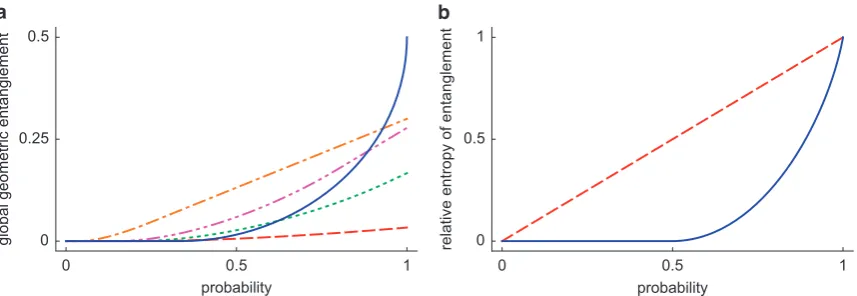
Let us comment on some cases where our analysis is particularly effective. For GHZ states, cluster states, and half-excited Dicke states, which constitute primary resources for quantum computation and metrology,37,38we get the maximum hϖ= 1 for any evenN. This means that our bounds remain robust to estimate global and partial entanglement in noisy versions of these states (i.e., when one considers mixtures of any of these states with probability q and the maximally mixed state with probability 1−q) for allq41/3. Notably, for values ofqsufficiently close to 1, our bounds to global entanglement can be tighter than the (more experimentally demanding) ones derived very recently in ref. 13, as shown in Figure 3a. Focusing on noisy GHZ states, we observe, however, that our scale-invariant threshold q41/3, obtained by measuring the three canonical Pauli operators for each qubit, is weaker than the well-established inseparability thresholdq41/(1+2N−1).9Nevertheless, we note that our simple quantitative bound given by Equation (4) becomes tight in the paradigmatic limit of pure GHZ states (q= 1) of any even number
N of qubits, thus returning the exact value of their global multiparticle entanglement via Equation (2), despite the fact that such states are not (and are very different from) M3
N states.
Equation (4) also provides a useful nonvanishing lower bound to the global (and partial)N-particle entanglement of Wei states in the intervalx∈(1
2, 1], for any evenN. A comparison between such a
bound (withDdenoting the relative entropy), which requires only three local measurements, and the true value of the relative
0 0.5 1
0 0.25 0.5
probability
0 0.5 1
0 0.5 1
[image:6.595.90.519.57.205.2]probability global geometric entanglement relative entropy of entanglement
Figure 3. (a) Lower bounds to the global geometric entanglementEDF
N based on infidelity for noisy versions of someN-qubit states (defined in
the caption of Table 3), as functions of the probabilityqof obtaining the corresponding pure states. The non-solid lines refer to bounds obtained by the method of ref. 13 for: 4-qubit linear cluster state (green dotted), 6-qubit rectangular cluster state (red dashed), 6-qubit half-excited Dicke state (orange dot-dashed), 4-qubit singlet state (magenta dot-dot-dashed). The solid blue line corresponds to our bound based on M3
N-fication for all the considered states, which is accessible by measuring only the three correlation functions~cj¼〈ασ~ð Þjα〉.
(b) Relative entropy of multiparticle entanglement ofN-qubit Wei statesρð ÞWeiN defined in Table 3, as a function of the probabilityxof obtaining a GHZ state. The dashed red lineEDRE
N ρ
ðNÞ
Wei
¼xdenotes the exact value of the global relative entropy of entanglement as computed in ref. 56. The solid blue line denotes our accessible lower bound, obtained by combining Equations (2) and (5) with the expressions in Tables 2 and 3, and given explicitly byEDRE
N;low ρ
N
ð Þ
Wei
¼log2ð2-2xÞ þxðlog2ð Þx -log2ð1-xÞÞfor12ox⩽1, while it vanishes for 0⩽x⩽ 1
2. The bound becomes tight forx=1, thus quantifying exactly the global multiparticle entanglement of pure GHZ states. We further show that our lower bound to global entanglement coincides with the exact genuine multiparticle entanglement of Wei states,EDRE
N;low ρ
N
ð Þ
Wei
¼EDRE 2 ρ
N
ð Þ
Wei
, that is computed in the next section of this paper. The results are scale-invariant and hold for any evenN.
entropy of global N-particle entanglement for these states,56
whose experimental evaluation would conventionally require a complete state tomography, is presented in Figure 3b.
Genuine multiparticle entanglement
We now show how general analytical results for geometric measures of genuine multiparticle entanglement can be obtained as well within our approach. The results from the previous section, while quite versatile, cannot provide useful bounds for the complete hierarchy of multiparticle entanglement, because M3 N
states are M-separable for all M⩽dN=2e, and thus in particular biseparable for any numberNof qubits. Therefore, to investigate genuine entanglement we consider a different reference set of states, specifically formed by mixtures of GHZ states, hence incarnating archetypical representatives of full inseparability.5,47 Any such state ξ, which will be referred to as a GHZ-diagonal (in short, GN) state, can be written as ξ¼
P
i;7pi7 βi7 βi7
in terms of its eigenvalues pi7, with the eigenvectors β7
i ¼p1ffiffi2 I
N7σN 1
i
j i forming a basis of N-qubit GHZ states
(where f gj ii 2i¼0N-1 denotes the binary ordered N-qubit computa-tional basis). TheGN states have been studied in recent years as
testbeds for multiparticle entanglement detection,5,48and specific algebraic measures of genuine multiparticle entanglement such as the N-particle concurrence18,21 and negativity14 have been computed for these states. Here, we calculate exactly the whole class of geometric measures of genuine multiparticle entangle-mentED2 defined by Equation (1), with respect to any contractive and jointly convex distanceD, forGNstates of an arbitrary number Nof qubits.
By applying our general framework, we can prove that, for every validD, the closest biseparable state to anyGNstate can be found
within the subset of biseparable GN states (see Supplementary
Material for detailed derivations). The latter subset is well characterised,5and is formed by all, and only, theGNstates with
eigenvalues such thatpmaxmaxi;7pi71=2. We can then show
that the closest biseparableGNstate to an arbitraryGN state has
maximum eigenvalue equal to 1/2, which allows us to solve the optimisation in the definition ofED
2, with respect to every validD.
We have then a closed formula for the geometric multiparticle entanglement of anyGN stateξwith maximum eigenvaluepmax,
given by
ED2 ξfpi7g
¼ 0; pmax1=2; gDðpmaxÞ; otherwise;
ð6Þ
where gD denotes a monotonically increasing function whose
explicit form is specific to each distanceD, as reported in Table 4 for typical instances.
Let us comment on some particular results. The genuine multiparticle trace distance of entanglement EDTr
2 is found
to coincide with the genuine multiparticle negativity14 and with half the genuine multiparticle concurrence18for allGNstates,
thus providing the latter entanglement measures with an insightful geometrical interpretation on this important set of states. Examples of GN states include several resources for
quantum information processing, such as the noisy GHZ states and Wei states introduced in the previous section. In particular, for noisy GHZ states (described by a pure-state probability q as detailed in Table 3), we recover that every geometric measure of genuine multiparticle entanglement is nonzero if and only if
q>ð1þ ð1-2NÞ-1Þ=
2
N44!11=2 (ref. 5) and monotonically increasing with q, as expected; for q= 1 (pure GHZ states), genuine and global entanglement coincide, i.e., the hierarchy of Figure 1 collapses, meaning that all the entanglement ofN-qubit GHZ states is genuinely shared among all theNparticles.32On the other hand, the relative entropy of genuine multiparticle entanglement of Wei states55,56 can be calculated exactly via Equation (6); interestingly, for evenNit is found to coincide with the lower bound to their global entanglement that we had obtained byM3
N-fication, plotted as a solid line in Figure 3b. This
means that for these states also the genuine multiparticle entanglement can be quantified entirely by measuring the three canonical correlation functions {cj}, for anyN. More generally, for
arbitraryGNstates, all the genuine entanglement measures given
by equation (6) can be obtained by measuring the maximum GHZ overlap pmax, which requires N+1 local measurement settings given explicitly in ref. 48. This is remarkable, as with the same experimental effort needed to detect full inseparability5we have now a complete quantitative picture of genuine entanglement in these states based on any geometric measure, agreeing with and extending thefindings of refs 14,18. Furthermore, as evident from Equation (6), all the geometric measures are monotonic functions of each other: our analysis thus reveals that there is a unique ordering of genuinely entangled GN states within the
distance-based approach of Figure 1.
In the same spirit as the previous section, and in compliance with our general framework, we note that the exact results obtained for the particular reference family ofGN states provide
quantitative lower bounds to the genuine entanglement of general N-qubit states. This follows from the observation that any N-qubit state ρ can be transformed into a GN state with
eigenvalues pi7 ¼ βi7
ρ βi7 by an LOCC procedure that
we may call GHZ-diagonalisation.14Therefore, given a completely general state ρ, one only needs to measure its overlap with a suitable reference GHZ state; if this overlap is found larger than 1/2, then by using Equation (6) withpmaxequal to the measured
overlap one obtains analytical lower bounds to the genuine multiparticle entanglementED2 of ρ with respect to any desired distanceD. As before, the bounds can be optimised in situations of partial prior knowledge—e.g., by applying local unitaries on each qubit before the GHZ-diagonalisation, which has the effect of maximising the overlap with a chosen particular GHZ vector in the basisβi7 . The bounds then remain accessible for any stateρ byN+1 local measurements,48with exactly the same demand as
for just witnessing entanglement.5
For instance, for the singlet state |Ψ(4)〉,62 which is a relevant resource in a number of quantum protocols including multiuser secret sharing,63–65 one has pmax¼ βþ3 Ψð Þ4 Ψð Þ4 βþ
3 ¼2=3>1=2
, obtainable by measuring the overlap with the GHZ basis state
βþ
3 ¼ðj0011i þj1100iÞ=
ffiffiffi 2 p
. Optimised bounds to the genuine
multiparticle entanglement of half-excited Dicke states D ð ÞNN=2 E
(for evenN⩾4), defined in Table 3,58,66can be found as well based on
GHZ-diagonalisation, and are expressed bypð ÞmaxN ¼ N N=2
21-N,
[image:7.595.39.287.105.188.2]meaning that they become looser with increasing N and stay nonzero only up toN= 8. In this respect, we note that alternative methods to detect full inseparability of Dicke states for anyNare
Table 4. Analytical expression of genuine multiparticle entanglement ED
2 for GHZ-diagonal states of any numberNof qubits as defined by Equation (6), for representative choices of the distance functionD (introduced in Table 2)
Distance D gD(pmax)
Relative entropyDRE 1+pmaxlog2pmax+(1−pmax) log2(1−pmax)
TraceDTr pmax-12
InfidelityDF 12
-ffiffiffiffiffiffiffiffiffiffiffiffiffiffiffiffiffiffiffiffiffiffiffiffiffiffiffiffiffi
pmaxð1-pmaxÞ p
Squared BuresDB 2
-ffiffiffi
2
p ffiffiffiffiffiffiffiffiffiffiffiffiffiffiffiffi 1-pmax
p
þ ffiffiffiffiffiffiffiffiffipmax
p
Squared HellingerDH 2
-ffiffiffi
2
p ffiffiffiffiffiffiffiffiffiffiffiffiffiffiffiffi 1-pmax
p
þ ffiffiffiffiffiffiffiffiffipmax
p
available,4,51,52 but quantitative results are lacking in general. Nevertheless, applying our general approach to an alternative reference family more tailored to the Dicke states could yield tighter lower bounds that do not vanish beyondN= 8.
Finally, notice that a lower bound to a distance-based measure of genuine multiparticle entanglement, as derived in this section, is automatically also a lower bound to corresponding measures of global and any form of partial entanglement, as evident by looking at the geometric picture in Figure 1. However, for states that are entangled yet not genuinely entangled, the simple bound from the previous section remains instrumental to assess their inseparability with minimum effort. M3
N states are themselves
instances of such states (in fact, for evenN,M3
Nstates are alsoGN
states, but withpmax⩽1/2 forN42).
Applications to experimental states
In this section, we benchmark the applicability of our results to real data from recent experiments.44,49–52,67
In, refs 44,45 the authors used quantum optical setups to prepare an instance of a bound entangled four-qubit state, known as Smolin state.68 Such a state cannot be written as a convex mixture of product states of the four qubits, yet no entanglement can be distilled out of it, thus incarnating the irreversibility in entanglement manipulation, while still representing a useful resource for information locking and quantum secret sharing.3,46 It turns out that noisy Smolin states are particular types ofM3 N
states (for any evenN),43,46that in the representation of Figure 2b
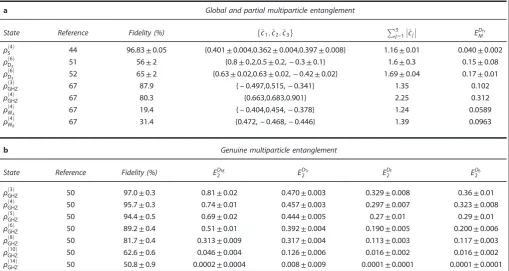
are located along the segment connecting the tetrahedron vertex {(−1)N/2, (−1)N/2, (−1)N/2} with the origin. Therefore, this work provides exact analytical formulae for all the nontrivial hierarchy of their global and partial entanglement, as mentioned in Table 3. In the specific experimental implementation of ref. 44 forN= 4, the global entanglement was detected (but not quantified) via a witness constructed by measuring precisely the three correlation functions {cj}. On the basis of the existing data alone (and without
assuming that the produced state is within theM3N family), we can then provide a quantitative estimate to the multiparticle entanglement of this experimental bound entangled state in terms of any geometric measureEDM, by using Table 2. The results are reported in Table 5a for the illustrative case of the trace distance.
Remaining within the domain of quantum optics, recently two laboratories reported the creation of six-photon Dicke states
9Dð Þ36i.51,52 Dicke states58 are valuable resources for quantum
metrology, computation and networked communication and emerge naturally in many-body systems as ground states of the isotropic Lipkin–Meshkov–Glick model.66 On the basis of the values of the three correlation functions {cj}, which were measured
in refs 51,52 to construct some entanglement witnesses, we can provide quantitative bounds to their global and partial geometric entanglementED
M(for 4⩽M⩽6) from Equation (4); see Table 5a.
[image:8.595.49.559.75.346.2]A series of experiments at Innsbruck40,49,50,67 resulted in the generation of a variety of relevant multi-qubit states with trapped ion setups, for explorations of fundamental science and for the
Table 5. Accessible lower bounds to global, partial and genuine multiparticle entanglement for a variety of experimental quantum states
a Global and partial multiparticle entanglement
State Reference Fidelity (%) f~c1;~c2;c~3g P3j¼1 ~cj EDMTr
ρð Þ4
S 44 96.83±0.05 {0.401±0.004,0.362±0.004,0.397±0.008} 1.16±0.01 0.040±0.002
ρð Þ6
D3 51 56±2 {0.8±0.2,0.5±0.2,−0.3±0.1} 1.6±0.3 0.15±0.08
ρð Þ6
D3 52 65±2 {0.63±0.02,0.63±0.02,−0.42±0.02} 1.69±0.04 0.17±0.01
ρð Þ3
GHZ 67 87.9 {−0.497,0.515,−0.341} 1.35 0.102
ρð Þ4
GHZ 67 80.3 {0.663,0.683,0.901} 2.25 0.312
ρð Þ4
WA 67 19.4 {−0.404,0.454,−0.378} 1.24 0.0589
ρð Þ4
WB 67 31.4 {0.472,−0.468,−0.446} 1.39 0.0963
b Genuine multiparticle entanglement
State Reference Fidelity (%) EDRE
2 ED2Tr ED2F ED2B
ρð Þ3
GHZ 50 97.0±0.3 0.81±0.02 0.470±0.003 0.329±0.008 0.36±0.01
ρð Þ4
GHZ 50 95.7±0.3 0.74±0.01 0.457±0.003 0.297±0.007 0.323±0.008
ρð Þ5
GHZ 50 94.4±0.5 0.69±0.02 0.444±0.005 0.27±0.01 0.29±0.01
ρð Þ6
GHZ 50 89.2±0.4 0.51±0.01 0.392±0.004 0.190±0.005 0.200±0.006
ρð Þ8
GHZ 50 81.7±0.4 0.313±0.009 0.317±0.004 0.113±0.003 0.117±0.003
ρð10Þ
GHZ 50 62.6±0.6 0.046±0.004 0.126±0.006 0.016±0.002 0.016±0.002
ρð14Þ
GHZ 50 50.8±0.9 0.0002±0.0004 0.008±0.009 0.0001±0.0001 0.0001±0.0001
(a) Accessible lower bounds to global and partial multiparticle entanglement of some experimentally prepared states, given by Equation (5) and evaluated in particular for the trace distance of entanglementEDTrby using Equation (2) for evenNand Equation (3) for oddN. Following the theoretical analysis of Table 3,
data obtained by direct measurements of the canonical correlation functions were used to construct bounds for a noisy Smolin state of 4 photons,44noisy Dicke
states of 6 photons51,52and noisy GHZ states of four ions.67For noisy GHZ states of three ions and noisy W states of four ions (two implementations labelled asA andB),67full data sets were used to extract the optimised correlation functions ~cj required for the bounds. For all the presented experimental states (whose
fidelities with the ideal target states are reported for reference), we are able to provide a reliable estimate of the multiparticle entanglementED
Mfor anyM4dN=2e. (b) Lower bounds to genuine multiparticle entanglement of experimental noisy GHZ states of up to 14 ions,50as quantified in terms of all the distance-based
entanglement measuresED
2reported in Table 4, obtained by Equation (6) withpmaxgiven in each case by the measuredfidelity with the pure reference GHZ state.
All the reported entanglement estimates are obtained from the same data needed to witness full inseparability, which for generalN-qubit states can be accessed byN+1 local measurements without the need for a full tomography.
implementation of quantum protocols. In those realisations, data acquisition and processing for the purpose of entanglement verification was often a more demanding task than running the experiment itself.49Focusingfirst on global and partial entangle-ment, we obtained full datasets for experimental density matrices corresponding to particularly noisy GHZ and W states of up to four qubits, produced during laboratory test runs.67 Despite the relatively lowfidelity with their ideal target states, we still obtain meaningful quantitative bounds from Equation (5). The results are compactly presented in Table 5a.
Regarding now genuine multiparticle entanglement, the authors of ref. 50 reported the creation of (noisy) GHZ states of up toN= 14 trapped ions. In each of these states, full inseparability was witnessed by measuring precisely the maximum overlappmax
with a reference pure GHZ state, without the need for complete state tomography. Thanks to Equation (6), we can now use the same data to obtain a full quantification of the genuineN-particle entanglement of these realistic states, according to any measure
ED
2, at no extra cost in terms of experimental or computational
resources. The results are in Table 5b, for all the representative choices of distances enumerated in Table 4. Notice that we do not need to assume that the experimentally produced states are in the GNset: the obtained results can be still safely regarded as lower
bounds.
DISCUSSION
We have introduced a general framework for estimating and quantifying geometric entanglement monotones. This enabled us to achieve a compendium of exact results on the quantification of general distance-based measures of (global, partial and genuine) multiparticle entanglement in some pivotal reference families of
N-qubit mixed states. In turn, these results allowed us to establish faithful lower bounds to various forms of multiparticle entangle-ment for arbitrary states, accessible by few local measureentangle-ments and effective on prominent resource states for quantum informa-tion processing.
Our results can be regarded as realising simple yet particularly convenient instances of quantitative entanglement witnesses,22,23 with the crucial advance that our lower bounds are analytical (in contrast to conventional numerical approaches requiring semidefinite programming) and hold for all valid geometric measures of entanglement, which are endowed with meaningful operational interpretations yet have been traditionally hard to evaluate.13,69
A key aspect of our analysis lies in fact in the generality of the adopted techniques, which rely on natural information-theoretic requirements of contractivity and joint convexity of any valid distance D entering Equation (1). We can expect our general framework to be applicable to other reference families of states (for example, states diagonal in a basis of cluster states,14,69or more general states with X-shaped density matrices18), thereby
leading to alternative entanglement bounds for arbitrary states, which might be more tailored to different classes, or to specific measurement settings in laboratory.
Furthermore, our framework lends itself to numerous other applications. These include the obtention of accessible analytical results for the geometric quantification of other useful forms of multiparticle quantum correlations, such as Einstein–Podolsky– Rosen steering,70,71and Bell nonlocality in many-body systems.66 This can eventually lead to a unifying characterisation, resting on the structure of information geometry, of the whole spectrum
of genuine signatures of quantumness in cooperative
phenomena. We plan to extend our approach in this sense in subsequent works.
Another key feature of our results is the experimental accessibility. Having tested our entanglement bounds on a selection of very different families of theoretical and
experimentally produced states with high levels of noise, we can certify their usefulness in realistic scenarios. We recall that, for instance, three canonical local measurements suffice to quantify exactly the global entanglement of GHZ states of any even numberN of qubits, whereas N+1 local measurements provide their exact genuine entanglement, according to every geometric measure for anyN, when such states are realistically mixed with white noise. Compared with other complementary studies of accessible quantification of multiparticle entanglement,13–23 our study retains not only a comparably low resource demand but also crucial aspects such as efficiency and versatility, as shown in Table 1. This can lead to a considerable simplification of quantitative resource assessment in future experiments based on large-scale entangled registers, involving e.g., two quantum bytes (16 qubits) and beyond.50,67
MATERIALS AND METHODS
Distance-based measures of multiparticle entanglement
A general distance-based measure of multiparticle entanglementED M is
defined in Equation (1). In this work, the distanceDis required to satisfy the following two physical constraints:
(D.i) Contractivity under quantum channels, i.e., DðΩð Þρ;Ωð Þρ0Þ
Dðρ;ρ0Þ, for any states ρ, ρ′, and any completely positive trace
preserving mapΩ;
(D.ii) Joint convexity, i.e., D qðρþð1-qÞρ0;qχþð1-qÞχ0ÞqDðρ;χÞ
þð1-qÞDðρ0;χ0Þ, for any statesρ,ρ0,χ, andχ′, and anyq∈[0, 1]. Constraint (D.i) implies thatED
M is invariant under local unitaries and
monotonically nonincreasing under LOCC (i.e., it is an entanglement monotone24). Constraint (D.ii) implies thatED
Mis also convex. A selection of
distance functionals with respect to these properties is given in Table 2.
M3
N-fication Theorem. Any N-qubit stateρ can be transformed into a
correspondingM3
Nstateϖthrough afixed transformation,Θ, consisting of
single-qubit LOCC, such that Θð Þ ¼ρ ϖ¼ 1 2NðI
NþP3
i¼1ciσiNÞ; where
ci¼TrρσiN
.
Proof. Here we sketch the form of the M3
N-fication channel Θ. We
begin by setting 2(N−1) single-qubit local unitaries Uj
2ðN-1Þ
j¼1 ¼
σ1σ1IN-2
, Iσ1σ1IN-3
,…, IN-3σ1σ1I
, IN-2σ
1σ1
, σ2σ2IN-2
, Iσ2σ2IN-3
,…, IN-3σ
2σ2I
, IN-2σ2σ2
g. Then, we fix a sequence of states {ρ0,ρ1,…ρ2ðN-1Þ} defined byρj¼12 ρj-1þUjρj-1U
y
j
;forj∈{1, 2,
…2(N−1)}. By settingρ0¼ρandρ2ðN-1Þ¼Θð Þρ, we define the required
channel:Θð Þ ¼ρ 1 22ðN-1Þ
P22ðN-1Þ i¼1 U′iρU′
y
i, where: U′i
22ðN-1Þ
i¼1 ¼ I
N; U i1
f g2i1¼ðN1-1Þ;
n
Ui2Ui1
f g2i2ð>Ni-1¼1Þ1,…, Ui2ðN-1Þ¼Ui2Ui1
n o2ðN-1Þ
i2ðN-1Þ>¼>i2>i1¼1
g. Notice that U′i 2 2ðN-1Þ i¼1 is still a sequence of single-qubit local unitaries. Since Θ is a convex mixture of such local unitaries, it belongs to the class of single-qubit LOCC, mapping anyM-separable set into itself. In the Supplementary Material, we show thatΘð Þ ¼ρ ϖ, concluding the proof.
Lower-bound optimisation
For any valid distance-based measure of global and partial multiparticle entanglement EDM, the maximisation in Equation (5) is equivalent (for
evenN) to maximisingj j þ~c1 j j þ~c2 j j~c3, where~cj¼Tr UρUyσjN
h i
, over local single-qubit unitaries U⊗=⊗α U(α) (α= 1,…, N). By using the well-known correspondence between the special unitary group SU(2) and special orthogonal group SO(3), we have that to any one-qubit unitary U(α) corresponds the orthogonal 3 × 3 matrix O(α) such that Uð Þα!nU!σUð Þyα ¼Oð Þα!nU!σ, where ! ¼n n
1;n3;n3
f gAℝ3 and
σ
! ¼fσ1;σ2;σ3g is the vector of Pauli matrices. We have then that supfUð Þαgðj j þ~c1 j j þ~c2 j j~c3Þ¼supfOð Þαg T~111þT~222þT~333
, where
~ Ti1i2iN¼
P
j1j2jNTj1j2jNO 1
ð Þ
i1j1O
2
ð Þ
i2j2 O
N
ð Þ
iNjN, and Ti1i2iN¼Tr½ρ σð i1σi2
σiNÞ. In the case of permutationally invariant states ρ, the 3 × 3 ×⋯× 3 tensorTi1i2iN is fully symmetric, i.e.,Ti1i2iN¼Tϑði1i2iNÞ for any permutationϑof the indices, so that the optimisation can be achieved
whenO(1)=O(2)=
⋯=O(N)(ref. 72). As indicated in the main text, we then
need to perform the maximisation over just the three angles {θ,ψ,ϕ}, which determine the orthogonal matrixO(α)corresponding to an arbitrary single-qubit unitary
Uð Þα ¼ cosy2e-i
ψþϕ
2 -isiny
2e-i ϕ-ψ
2
-isiny2eiϕ-2ψ cosy
2e
iψþ2ϕ
!
:
As a special case, for a two-qubit state (N= 2) the optimal local operation is the one which diagonalises the correlation matrixðTi1i2Þ.
ACKNOWLEDGEMENTS
We warmly thank Thomas Monz, Mauro Paternostro, Christian Schwemmer and Witlef Wieczorek for providing experimental data, and we acknowledge fruitful discussions with (in alphabetical order) I Almeida Silva, M Blasone, D Cavalcanti, E Carnio, T Chanda, M Christandl, P Comon, M Cramer, M Gessner, T Ginestra, D Gross,
O Gühne, M Gută, M Huber, F Illuminati, I Kogias, T Kypraios,
P Liuzzo-Scorpo, C Macchiavello, A Milne, T Monz, P Ott, AK Pal, M Piani, M Prater, S Rat, A Sanpera, P Skrzypczyk, A Streltsov, G Tóth and A. Winter. This work was supported by the European Research Council (ERC) Starting Grant GQCOP, Grant Agreement No. 637352.
CONTRIBUTIONS
All the authors conceived the idea, derived the technical results, discussed all stages of the project, and prepared the manuscript andfigures.
COMPETING INTERESTS The authors declare no conflict of interest.
REFERENCES
1. Einstein, A., Podolsky, B. & Rosen, N. Can quantum-mechanical description of physical reality be considered complete?Phys. Rev.47, 777–780 (1935). 2. Vedral, V. Quantum entanglement.Nat. Phys.10, 256–258 (2014).
3. Horodecki, R., Horodecki, P., Horodecki, M. & Horodecki, K. Quantum entanglement.Rev. Mod. Phys.81, 865–942 (2009).
4. Gühne, O. & Tóth, G. Entanglement detection.Phys. Rep.474, 1–75 (2009). 5. Gühne, O. & Seevinck, M. Separability criteria for genuine multiparticle
entanglement.New J. Phys.12, 053002 (2010).
6. Gao, T., Yan, F. & van Enk, S. J. Permutationally invariant part of a density matrix and nonseparability ofn-qubit states.Phys. Rev. Lett.112, 180501 (2014). 7. Levi, F. & Mintert, F. Hierarchies of multipartite entanglement.Phys. Rev. Lett.110,
150402 (2013).
8. Huber, M., Mintert, F., Gabriel, A. & Hiesmayr, B. C. Detection of high-dimensional
genuine multipartite entanglement of mixed states. Phys. Rev. Lett. 104,
210501 (2010).
9. Dür, W. & Cirac, J. I. Classification of multiqubit mixed states: Separability and distillability properties.Phys. Rev. A61, 042314 (2000).
10. Gabriel, A., Hiesmayr, B. C. & Huber, M. Criterion for k-separability in mixed multipartite systems.Quant. Inform. Comput.10, 829–836 (2010).
11. Klöckl, C. & Huber, M. Characterizing multipartite entanglement without shared reference frames.Phys. Rev. A91, 042339 (2015).
12. Badzia-g, P., Brukner,Č, Laskowski, W., Paterek, T. &Żukowski, M. Experimentally friendly geometrical criteria for entanglement.Phys. Rev. Lett.100, 140403 (2008). 13. Buchholz, L. E., Moroder, T. & Ghne, O. Evaluating the geometric measure of
multiparticle entanglement.Ann. Phys. (Berlin)528, 278–287 (2016).
14. Hofmann, M., Moroder, T. & Gühne, O. Analytical characterization of the genuine multiparticle negativity.J. Phys. A: Math. Theor.47, 155301 (2014).
15. Siewert, J. & Eltschka, C. Quantifying tripartite entanglement of three-qubit generalized werner states.Phys. Rev. Lett.108, 230502 (2012).
16. Eltschka, C. & Siewert, J. A quantitative witness for greenberger-horne-zeilinger entanglement.Sci. Rep.2(2012).
17. Wu, J.-Y., Kampermann, H., Bruß, D., Klöckl, C. & Huber, M. Determining lower bounds on a measure of multipartite entanglement from few local observables. Phys. Rev. A86, 022319 (2012).
18. Hashemi Rafsanjani, S. M., Huber, M., Broadbent, C. J. & Eberly, J. H. Genuinely multipartite concurrence ofn-qubitxmatrices.Phys. Rev. A86, 062303 (2012).
19. Audenaert, K. & Plenio, M. When are correlations quantum?-verification and
quantification of entanglement by simple measurements. New J. Phys. 8,
266 (2006).
20. Wunderlich, H. & Plenio, M. B. Quantitative verification of entanglement and fidelities from incomplete measurement data.J. Mod. Optics56, 2100–2105 (2009). 21. Ma, Z.-H.et al.Measure of genuine multipartite entanglement with computable
lower bounds.Phys. Rev. A83, 062325 (2011).
22. Gühne, O., Reimpell, M. & Werner, R. F. Estimating entanglement measures in experiments.Phys. Rev. Lett.98, 110502 (2007).
23. Eisert, J., Brandão, F. G. & Audenaert, K. M. Quantitative entanglement witnesses. New J. Phys.9, 46 (2007).
24. Plenio, M. B. & Virmani, S. An introduction to entanglement measures.Quant. Inf. Comput.7, 1 (2007).
25. Sarovar, M., Ishizaki, A., Fleming, G. R. & Whaley, K. B. Quantum entanglement in photosynthetic light-harvesting complexes.Nat. Phys.6, 462–467 (2010). 26. Cramer, M., Plenio, M. B. & Wunderlich, H. Measuring entanglement in condensed
matter systems.Phys. Rev. Lett.106, 020401 (2011).
27. Cramer, M.et al.Spatial entanglement of bosons in optical lattices.Nat. Commun. 4, 2161 (2013).
28. Marty, O.et al.Quantifying entanglement with scattering experiments.Phys. Rev. B89, 125117 (2014).
29. Marty, O., Cramer, M. & Plenio, M. B. Practical entanglement estimation for spin-system quantum simulators.Phys. Rev. Lett.116, 105301 (2016).
30. Vedral, V., Plenio, M. B., Rippin, M. A. & Knight, P. L. Quantifying entanglement. Phys. Rev. Lett.78, 2275–2279 (1997).
31. Wei, T.-C. & Goldbart, P. M. Geometric measure of entanglement and applications to bipartite and multipartite quantum states. Phys. Rev. A68, 042307 (2003).
32. Blasone, M., Dell’Anno, F., De Siena, S. & Illuminati, F. Hierarchies of geometric entanglement.Phys. Rev. A77, 062304 (2008).
33. Bengtsson, I. & Zyczkowski, K.Geometry of Quantum States: An Introduction to Quantum Entanglement(Cambridge Univ. Press, 2006).
34. Wei, T.-C., Das, D., Mukhopadyay, S., Vishveshwara, S. & Goldbart, P. M. Global
entanglement and quantum criticality in spin chains. Phys. Rev. A 71,
060305 (2005).
35. Biham, O., Nielsen, M. A. & Osborne, T. J. Entanglement monotone derived from grover’s algorithm.Phys. Rev. A65, 062312 (2002).
36. Bell, B. A.et al. Experimental demonstration of graph-state quantum secret sharing.Nat. Commun.5, 5480 (2014).
37. Giovannetti, V., Lloyd, S. & Maccone, L. Advances in quantum metrology. Nat. Photon.5, 222 (2011).
38. Briegel, H. J., Browne, D. E., Dür, W., Raussendorf, R. & den Nest, M. V.Nat. Phys.5, 19–26 (2009).
39. Tiersch, M., Popescu, S. & Briegel, H. J. A critical view on transport and
entanglement in models of photosynthesis. Phil. Trans. Roy. Soc. A 370,
3771–3786 (2012).
40. Barreiro, J. T.et al.Experimental multiparticle entanglement dynamics induced by decoherence.Nat. Phys.6, 943 (2010).
41. Hayashi, M., Markham, D., Murao, M., Owari, M. & Virmani, S. Bounds on multi-partite entangled orthogonal state discrimination using local operations and classical communication.Phys. Rev. Lett.96, 040501 (2006).
42. Streltsov, A., Kampermann, H. & Bruß, D. Linking a distance measure of entanglement to its convex roof.New J. Phys.12, 123004 (2010).
43. Hiesmayr, B. C., Hipp, F., Huber, M., Krammer, P. & Spengler, C. Simplex of bound entangled multipartite qubit states.Phys. Rev. A78, 042327 (2008).
44. Lavoie, J., Kaltenbaek, R., Piani, M. & Resch, K. J. Experimental bound entanglement in a four-photon state.Phys. Rev. Lett.105, 130501 (2010). 45. Amselem, E. & Bourennane, M. Experimental four-qubit bound entanglement.
Nat. Phys.5, 748 (2009).
46. Augusiak, R. & Horodecki, P. Generalized smolin states and their properties. Physical Review A73, 012318 (2006).
47. Greenberger, D. M., Horne, M. & Zeilinger, A. inBell’s Theorem, Quantum Theory, and Conceptions of the Universe(ed. Kafatos, M.) 69–72 (Kluwer, 1989). 48. Gühne, O., Lu, C.-Y., Gao, W.-B. & Pan, J.-W. Toolbox for entanglement detection
andfidelity estimation.Phys. Rev. A76, 030305 (2007).
49. Häffner, H.et al.Scalable multiparticle entanglement of trapped ions.Nature438, 643–646 (2005).
50. Monz, T.et al.14-qubit entanglement: creation and coherence.Phys. Rev. Lett. 106, 130506 (2011).
51. Prevedel, R.et al.Experimental realization of dicke states of up to six qubits for multiparty quantum networking.Phys. Rev. Lett.103, 020503 (2009).
52. Wieczorek, W. et al.Experimental entanglement of a six-photon symmetric
dicke state.Phys. Rev. Lett.103, 020504 (2009).
54. Dür, W., Vidal, G. & Cirac, J. I. Three qubits can be entangled in two inequivalent ways.Phys. Rev. A62, 062314 (2000).
55. Wei, T. C., Altepeter, J. B., Goldbart, P. M. & Munro, W. J. Measures of
entanglement in multipartite bound entangled states. Phys. Rev. A 70,
022322 (2004).
56. Wei, T.-C. Relative entropy of entanglement for multipartite mixed states: Permutation-invariant states and dür states.Phys. Rev. A78, 012327 (2008). 57. Raussendorf, R. & Briegel, H. J. A one-way quantum computer.Phys. Rev. Lett.86,
5188–5191 (2001).
58. Dicke, R. H. Coherence in spontaneous radiation processes. Phys. Rev. 93, 99–110 (1954).
59. Cabello, A. Solving the liar detection problem using the four-qubit singlet state. Phys. Rev. A68, 012304 (2003).
60. Kiesel, N.et al.Experimental analysis of a four-qubit photon cluster state.Phys. Rev. Lett.95, 210502 (2005).
61. Kiesel, N., Schmid, C., Tóth, G., Solano, E. & Weinfurter, H. Experimental obser-vation of four-photon entangled dicke state with highfidelity.Phys. Rev. Lett.98, 063604 (2007).
62. Weinfurter, H. &Żukowski, M. Four-photon entanglement from down-conversion. Phys. Rev. A64, 010102 (2001).
63. Bourennane, M.et al.Decoherence-free quantum information processing with four-photon entangled states.Phys. Rev. Lett.92, 107901 (2004).
64. Murao, M., Jonathan, D., Plenio, M. & Vedral, V. Quantum telecloning and multiparticle entanglement.Phys. Rev. A59, 156 (1999).
65. Gaertner, S., Kurtsiefer, C., Bourennane, M. & Weinfurter, H. Experimental
demonstration of four-party quantum secret sharing. Phys. Rev. Lett. 98,
020503 (2007).
66. Tura, J.et al.Detecting nonlocality in many-body quantum states.Science344, 1256–1258 (2014).
67. Monz, T.Quantum information processing beyond ten ion-qubits, Ph.D. thesis Institute for Experimental Physics, University of Innsbruck, (2011).
68. Smolin, J. A. Four-party unlockable bound entangled state. Phys. Rev. A63, 032306 (2001).
69. Chen, X.-Y., Yu, P., Jiang, L.-Z. & Tian, M. Genuine entanglement of four-qubit cluster diagonal states.Phys. Rev. A87, 012322 (2013).
70. Wiseman, H. M., Jones, S. J. & Doherty, A. C. Steering, entanglement, nonlocality, and the einstein-podolsky-rosen paradox.Phys. Rev. Lett.98, 140402 (2007). 71. Armstrong, S.et al.Multipartite einstein-podolsky-rosen steering and genuine
tripartite entanglement with optical networks.Nat. Phys.11, 167 (2015). 72. Comon, P. & Sorensen, M. Tensor diagonalization by orthogonal transforms.
Report ISRN I3S-RR-2007-06-FR (2007). Available online (http://www.i3s.unice.fr/ ~mh/RR/2007/RR-07.06-P.COMON.pdf).
This work is licensed under a Creative Commons Attribution 4.0 International License. The images or other third party material in this article are included in the article’s Creative Commons license, unless indicated otherwise in the credit line; if the material is not included under the Creative Commons license, users will need to obtain permission from the license holder to reproduce the material. To view a copy of this license, visit http://creativecommons.org/licenses/ by/4.0/
© The Author(s) 2016
Supplementary Information accompanies the paper on thenpj Quantum Informationwebsite (http://www.nature.com/npjqi)