Characterization of rubberized cement bound aggregate mixtures using
indirect tensile testing and fractal analysis
Ahmed Hilal Farhan*, Andrew Robert Dawson, Nicholas Howard Thom
Accepted manuscript
http://dx.doi.org/10.1016/j.conbuildmat.2015.12.018
Characterization of rubberized cement bound aggregate mixtures using
1indirect tensile testing and fractal analysis
23
Ahmed Hilal Farhan*, Andrew Robert Dawson, Nicholas Howard Thom
4
School of Civil Engineering, Faculty of Engineering, University of Nottingham, University Park,
5
Nottingham NG7 2RD, UK, Tel: +44 (0) 7448461314, E-mail: [email protected]
6
*corresponding author
7
8
9
Abstract
10
The main focus of this paper is to investigate the tensile properties of virgin and rubberized 11
cement bound granular mixtures. This was conducted using indirect tensile testing with lateral 12
displacement measurements, nondestructive resonant frequency testing, X-ray CT and 13
quantitative assessment for cracking pattern using fractal analysis. The investigated properties 14
were density, compacity, indirect tensile strength (ITS), indirect tensile static modulus, 15
toughness, dynamic modulus of elasticity, dynamic modulus of rigidity, dynamic poison’s 16
ratio, fractal dimension and fracture energy. To keep the same aggregate packing, the natural 17
aggregate was replaced by waste tyres’ crumb rubber of similar gradation. Four volumetric 18
replacement percentages (0%, 15%, 30% and 45%) of the 6 mm fraction size were utilized. 19
This adjustment was observed to affect the material density not only due to the lower specific 20
gravity, but because it also affects the compactibility of the mixture negatively due to the 21
damping action of the rubber particles. In addition, strength was also affected detrimentally. 22
However, material toughness was improved and stiffness was mitigated. The latter findings 23
were supported by quantitative assessment of the cracking pattern which revealed more 24
tortuosity and a higher fractal dimension as a result of rubber content increasing. A failure 25
mechanism for this type of mixture was suggested and support by examining the internal 26
aggregate base with a small percentage of added crumb rubber may ensure a more sustainable 28
and environmental-friendly pavement material and, at the same time, improve the properties 29
of stabilized layers. However, behaviour of these mixtures under cyclic loading and 30
evaluation of their durability should be assessed to fully validate their use. 31
32
Keywords: cement-stabilized aggregate; waste tyres; rubberized cement bound mixture; 33
indirect tensile; sustainable pavement; fractal analysis. 34
35
1. Introduction
36
Stockpiling waste materials and depletion of natural resources represent two accompanying 37
problems in the modern world. One of the most common and continuously increasing waste 38
materials is derived from the vehicle tires consumed every year. Over the years, many authors 39
have attempted to make use of these waste materials to ensure proper disposal of these 40
materials and to save natural resources. Authors (Khatib and Bayomy 1999; Güneyisi et al. 41
2004; Papakonstantinou and Tobolski 2006; Balaha et al. 2007; Gesoğlu and Güneyisi 2007;
42
Zheng et al. 2007; Khaloo et al. 2008; Taha et al. 2008; Zheng et al. 2008; Güneyisi 2010; 43
Pelisser et al. 2011; Najim and Hall 2012; Güneyisi et al. 2014) have investigated the 44
feasibility of using waste tire materials in different types of concrete mixtures as a 45
replacement of either fine or coarse aggregate or both. Others (Pincus et al. 1994; Cecich et al. 46
1996; Foose et al. 1996; Masad et al. 1996; Liu et al. 2000; Youwai and Bergado 2003; Kim 47
et al. 2005; Humphrey 2007) studied the possible use of these materials in geotechnical 48
applications as fill materials for embankments and behind retaining walls. 49
50
No doubt, highway construction consumes large quantities of natural materials as compared 51
with other civil engineering projects (Cao 2007; Barišić et al. 2014). Therefore, studies have
52
been conducted to investigate the possibility of using these waste materials within the 53
either through the wet or dry process (Chiu and Lu 2007; Fontes et al. 2010); (Cao 2007; Xiao 55
et al. 2007; Chiu 2008). A very few studies were conducted to investigate the possibility of 56
using crumb rubber within cement-stabilized aggregate mixtures typically used as a base 57
and/or subbase courses in flexible composite pavement structure. The usage in this case might 58
be more feasible than in asphaltic mixtures used as a base or surface course since the latter 59
two layers usually have a limited thickness due to their high cost as compared with cement-60
stabilized layers. Cement-stabilized mixtures as defined by (Lim and Zollinger 2003) are a 61
mixture of aggregate, Portland cement and a small quantity of water to facilitate compaction 62
and to hydrate the cement. Cement-stabilized aggregate can be classified as a cementitious 63
material. The Portland Concrete Association (PCA 2005) has classified these materials into 64
four types depending on the amount of water and cement being used. Materials with high 65
cement contents are roller-compacted concrete and normal concrete. However, the first one is 66
constructed by rolling due to the low level of water as compared with the latter. On the other 67
hand, flowable fill and cement-stabilized materials are the other types which contain low 68
cement levels with first one being constructed by rolling due to its low water content. 69
70 71
2. Rationale and aims
72
The motivation of this research is to make use of the above waste materials which in turn 73
should help to save natural resources as well as to reduce the environmentally detrimental 74
effect of these materials. Another motivation comes from the fact that the use of Portland 75
cement to stabilize granular materials usually produces stiff mixtures which are sensitive to 76
cracking, overloading and fatigue failure (Wu et al. 2015). Furthermore, the reflection cracks 77
mostly accompanying the cement-stabilization, especially at high cement contents. 78
Consequently, an attempt was made in this paper to mitigate the above disadvantages by 79
using the crumb rubber to modify some cement-stabilized mixtures. The purpose of this paper 80
is to study the effect of crumb rubber particles on the properties of cement-stabilized mixtures, 81
fact that, in pavement structural design, tensile properties are the most influential factors since 83
all bound layers (including cement bound granular mixture (CBGM) are designed based on 84
the tensile stress / strain at the bottom of these layers. A review of literature indicated that 85
there is no published study about the quantitative evaluation of cracking pattern of rubberized, 86
nor even of conventional cement-stabilized materials. Therefore, another complementary 87
objective of this paper is to use the fractal analysis concept to quantitatively study the 88
cracking pattern of cement-stabilized aggregate containing different rubber contents and to 89
investigate any possible correlation with macro-scale properties. This will help to better 90
understand the failure mechanism of this type of modified mixture. 91
92
3. Experimental program and methodology
93
3.1 Materials and their properties
94
A crushed limestone aggregate of 20 mm maximum size is used across this study. To ensure 95
the manufacture of comparable mixtures containing the same gradation and densities and 96
hence investigating the effect of rubber alone, two steps were conducted. The first one was to 97
use and combine different fractional sizes (20 mm, 14 mm, 10 mm, 6 mm and dust (less than 98
6mm)) in different proportions to constitute the required gradation and the second was to 99
batch, mix and compact each sample individually. This was so as to ensure comparable 100
strength since there is a high dependency of the strength on mixture density (Williams 1986). 101
Different fractions of limestone aggregate were collected from Dene Quarry in 102
Nottinghamshire in the UK. The gradations were assessed in accordance with BS EN 933-103
1:2012. The crumb rubber particles were sourced from J Allcock and Sons Ltd. in 104
Manchester, UK. Its gradation is presented in Figure 1. Initial examination showed a 105
similarity between the 6 mm aggregate fraction size and that of crumb rubber as shown in this 106
figure. Consequently, it was decided to replace the former by the latter in order to ensure the 107
The specific gravity of the rubber was adopted as 1.12 as measured by (Najim and Hall 2012). 109
CEM I 52.5 R Portland cement conforming to BS EN 197-1: 2000 was used for aggregate 110
mixtures stabilization. Potable tape water was utilized to moisturize the cement- aggregate 111
mixture. 112
113
3.2 Mixture design and samples production
114
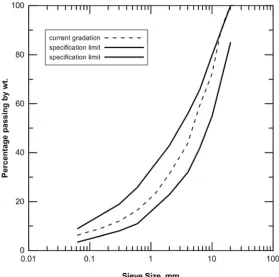
The final gradation, after blending, of the CBGM was to specification BS EN 142271:2013 -115
[CBGM2-0/20]. It is illustrated in Figure 2. 5% cement, by dry weight of aggregate, was used. 116
Optimum water content for aggregate-cement mixture was estimated as 4.6% (by the total dry 117
weight of aggregate and cement) in accordance with BS EN 13286-4:2003. Regarding the 118
degree of replacement by rubber, three volumetric replacement percentages was investigated 119
and the resulting materials compared with mixtures contain no rubber. These are 15%, 30% 120
and 45% of the 6 mm aggregate fraction volume. These are equivalent to 2.1%, 4.2% and 121
6.2% of the total volume of the aggregate, respectively. Because of the considerable 122
differences between the specific gravities of natural aggregate and crumb rubber, 123
proportioning on the weight basis is a misleading approach. This is because the cement is 124
normally added by the dry weight of aggregate which will reduce after replacing with crumb 125
rubber due to the low specific gravity of the latter. This in turn would cause a change in the 126
cement content and accordingly water content for different replacement levels. Accordingly, 127
volumetric proportioning was taken into consideration. All volumetric proportion was kept 128
constant as used in the virgin mixture and the only variable was the rubber volume. This was 129
simply done by keeping the weight of cement and water as that used in the virgin mix. For the 130
purpose of designation, C5R0 was used to indicates the mixture containing 5% cement 131
content and 0% rubber replacement i.e., virgin mix. On the other hand, C5R15, C5R30 and 132
C5R45 were used to describe the mixtures containing 5% cement and 15, 30 and 45% 133
replacement levels, respectively. 134
Regarding mixing sequence, cement and dust were mixed firstly until uniform colour was 136
achieved. The cement- dust mixtures was added to the rest of aggregate sizes and mixed for a 137
minute. After adding the appropriate water quantity, all materials were mixed thoroughly for 138
another two minutes. All mixing was conducted manually. On completion of mixing, each 139
mixture was compacted in three layers inside a lubricated spilt mould with diameter of 101.6 140
mm using a Kango 638 vibrating hammer. The compaction time was 60 sec. per layer as 141
recommended by BS EN 13286-51:2004. Past experience with testing cement-stabilized 142
samples predicted that a very low strain would develop during testing and that there would be 143
a high sensitivity to the small unevenness in the surface which the loading platens touch, 144
necessitating accurate instrumentation (Scullion et al. 2008). From initial investigations made 145
during this study, the impossibility of achieving a smooth and level surface, which will make 146
it is difficult to fix the instrumentations, had been observed. To overcome this problem, it was 147
decided to manufacture the sample to achieve a height of about 115 mm and then trim it down 148
to 100 mm. In addition, another set of samples was manufactured for resonant frequency 149
testing using standard split moulds of 150 mm diameter and 300 mm height. Again, a 150
removable mould extension was fabricated and used to ensure a specimen more than 300 mm 151
tall which was then sawn down to 300 mm using a diamond saw. Three samples were 152
manufactured for each mix. Once the compaction was finished, specimens were left inside 153
their moulds and covered with wet paper and polythene sheets overnight to prevent moisture 154
loss. On the next day, these were demoulded and wrapped with nylon film and placed in wet 155
polythene bags and closed tightly and left in a humid room for 28 days. 156
157
3.3 Testing procedures and analysis performed
158
3.3.1 Compacity and density
159
It was observed that the performance of cement-stabilized aggregate mixture is greatly 160
causes 40-50 % reduction in the mixture strength. Thus, effective compaction can be expected 162
to be critical for adequate performance. Accordingly, the British specification (BS EN 14227-163
1:2013) has introduced the compacity factor as a measure of the efficiency of compaction. It 164
has been reported by the above specification that the compacity for cement-bound mixtures 165
should be not less than 0.82. Critical analysis of this criterion shows that this is a movement 166
towards the concept applied in asphaltic mixture to calculate the percent of air-voids. 167
Compacity can be calculated as [100 - % air-voids]. In the current paper, due to the damping 168
tendency of the rubber particles, these may affect the effectiveness of compaction negatively. 169
Therefore, an investigation was carried out to evaluate if the rubber particle have a 170
detrimental effect on the compactibility of the mixtures. Compacity in accordance with the 171
above specification can be calculated using the following equation 172
173
=ቀቁࢽ × (ࢽࢇ +ࢽ࢈ +ࢽࢉ … )
where: C is the compacity factor, γm is the maximum dry density of the mixture and γA, γB,
174
γC, are particle densities of material A, B and C, respectively. a, b, c represent the percentages
175
of material A, B, C in the total mixture. Dry density of the specimens was measured after 176
curing by drying them in an oven at 105±5°C until constant weight, then using the water 177
displacement method to measure the density. 178
179
3.3.2 Indirect tensile strength and static modulus of elasticity
180
This test was performed at 28 days in accordance with BS EN 13286-42:2003. A 200 KN 181
capacity Instron universal testing machine was used. The indirect tensile strength (ITS), in 182
MPa, was estimated using the following equation: ITS=2P/πhD where P is the ultimate load
183
(N), h is the sample thickness (mm) and D is the diameter of the sample (mm). In order to 184
estimate the static modulus of elasticity, deformation was measured utilizing two linear 185
variable differential transducers (LVDTs) mounted using LVDTs’ blocks. These were glued 186
ensure accurate instrumentation, the gluing jig was manufactured and used as reported by 188
(Wen et al. 2014) to ensure precise alignment of the LVDTs blocks on both faces of the 189
sample. The average displacement value from these two LVDTs was used at each load 190
application. Finally, the static elastic modulus was estimated for a load being 30% of the 191
maximum load, and the corresponding lateral displacement according to EN 13286-43:2003. 192
However, instead of using the equation provided in the latter specification, which assumes 193
specific arrangement for the LVDTs, the following formula was used (Solanki and Zaman 194
2013): 195
196
ܧ=ߨ.ܦ.ݐ. ∆ܪ2்(ܲܦଶ+ܦ
ଶ)൜(3 +߭)ܦ ଶ.ܦ
+ (1 −߭)ܦଷ− 2ܦ൫ܦଶ+ܦଶ൯ݐܽ݊ିଵ൬ܦܦ ൰൨ൠ
197
Where: P= load; D=diameter of sample; t= sample thickness; ∆ܪ்=lateral deformation; 198
Dg=LVDTs gauge distance and߭= Poisson’s ratio. 199
200
3.3.3 Mesostructural investigation
201
To better understand the failure mechanism and to observe how the cracks propagated, failed 202
specimens were scanned using an X- ray CT machine. This includes two systems located in 203
the same cabinet. The first one is the mini focus system of a 300 kV X-ray source and a linear 204
detector. The second system is a micro focus having a 225 kV with an area detector. To 205
ensure sufficient power of X-ray for penetration through stabilized mixtures, the first system 206
was used in this investigation. Two scans were done for each sample at the top and bottom of 207
the middle third of sample. The resolution of the reported scan is 0.065 mm/pixel. 208
209
3.3.4 Toughness through indirect tensile test
210
To obtain the post-peak load-deflection behaviour and hence quantify toughness of the 211
deflection was measured as mentioned earlier. To evaluate the post-peak loading bearing 213
capacity enhancement, the area under the load-deformation curve can be used to compute the 214
toughness or energy absorption capacity of the material. The estimation of toughness in this 215
manner may include the improvement in strength and ductility due to rubber incorporation as 216
stated by (Sobhan and Mashnad 2000). However, due to the reduction in the strength of the 217
mixture as a result of rubber inclusion, it is necessary to normalize the load to its ultimate 218
value to evaluate the enhancement in terms of ductility only. This is also logical since in the 219
mechanistic pavement design the stress is usually normalized with respect to the strength and 220
the stress ratio is normally used. 221
222
3.3.5 Dynamic properties through resonant frequency
223
Dynamic modulus of elasticity represents an important input for pavement analysis and 224
design. (Nunn 2004) in TRL615 report and (Lav et al. 2006) adopted dynamic modulus as 225
determined from resonant frequency for pavement design. In the present paper, dynamic 226
properties were measured nondestructively using a resonant frequency tester (ERUDITE) in 227
accordance with (ASTM C215-02). In this test, dynamic properties were evaluated in terms of 228
dynamic modulus of elasticity (Ed), dynamic modulus of rigidity (Gd) and dynamic Poisson’s 229
ratio (υd). During the test, the sample was supported at its centre on the equipment bench and 230
clamped in place. The driver and pick up parts were placed at different locations depending 231
on whether dynamic modulus of elasticity or dynamic modulus of rigidity is to be measured. 232
For each dynamic modulus type, there is a different recommended frequency range as shown 233
in the equipment manual. Using the recommended frequency range and starting from a low 234
frequency, the frequency was increased gradually until the output meter showed the maximum 235
value which indicates the fundamental resonant frequency of the mixture. The latter was used 236
to calculate the dynamic modulus of elasticity (Ed) and dynamic shear modulus (Gd) as 237
explained in the above specification. From these two moduli, dynamic Poisson’s ratio was 238
3.3.6 Damage quantification using fractal analysis and image processing
240
To provide better a understanding of the mechanism of failure of this type of mixture, the 241
failure cracking pattern was characterized quantitatively using fractal analysis. This technique 242
has been extensively used in normal concrete to quantify cracking patterns (Erdem et al. 2012; 243
Farhidzadeh et al. 2014) and fractured surfaces (Issa and Hammad 1994; Carpinteri et al. 244
1999; Guo et al. 2007). However, no published study was found in literature regarding the 245
quantification of surface cracks of cement-stabilized mixtures using fractal analysis. In this 246
study, the fractal analysis was performed in terms of the fractal dimension. The latter was 247
estimated using the box-counting method (Mihashi et al. 2006; Erdem and Blankson 2013). 248
An initial investigation performed to extract topological information concerning the cracked 249
area using image processing software, ImageJ, had difficulty in differentiating between the 250
cracks and the rubber particles utilizing a grey thresholding process. For this reason it was 251
decided to digitize the crack network using the following procedure: images of failed samples 252
were firstly captured using a high resolution camera. These images were inserted into 253
AutoCAD software and scaled up to reflect the actual dimensions. The cracks were digitized 254
after that using the software tools. Then these were covered by imaginary meshes with 255
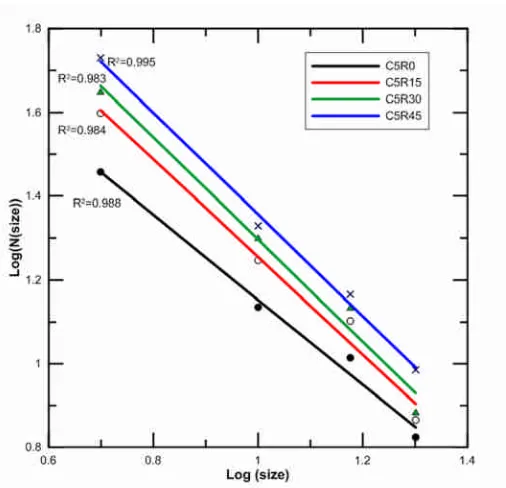
rectangular grid sizes decreasing linearly (Figure 4). Then the number of grid squares required 256
to cover the cracks was counted. Finally the fractal dimension was computed from the slope 257
of the line joining the logarithm of number of grid squares encountered by the crack and the 258
logarithm of the grid square dimension. From surface macro-crack fractal dimension, the 259
fracture energy was roughly estimated based on the formula suggested by (Guo et al. 2007) 260
which is Ws/Gf=a*(δ/a)1-D1-dwhere Wsis the energy dissipated at the surface of the crack, Gf 261
is the fracture energy at the observation scale, a is the Euclidean length (equal to the diameter 262
of the sample) and D1-dis the fractal dimension computed previously. 263
4. Results and discussion
270
4.1 Density and compacity
271
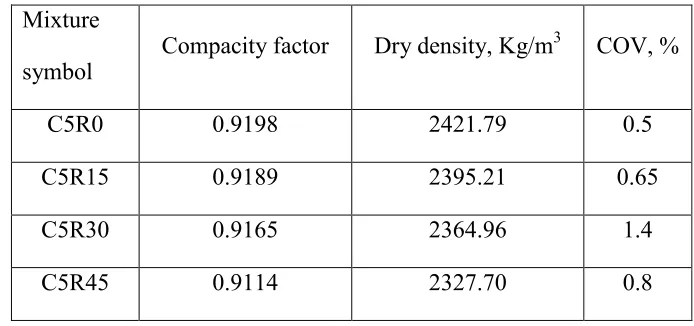
Table 1 shows a reduction in the material density after rubber incorporation. This is logical 272
since the specific gravity of natural aggregate is much higher than that of crumb rubber. 273
However, unlike natural aggregate, rubber particles of high elasticity may absorb the energy, 274
due to their damping characteristics, from a vibrating hammer. This could causes a reduction 275
in the compaction efficiency and, hence in mixture density. As can be seen from Table 1, the 276
maximum difference was at a rubber replacement of 45% where there is a 0.92% reduction in 277
the compacity of the mixture (i.e, a decline in density). This can lead to the conclusion that it 278
is not only the low specific gravity of rubber that is responsible for density reduction, but it is 279
also the reduction in compaction efficiency, due to the damping action of the rubber particles, 280
that affects the density of the mixture detrimentally. The practical consequence of the latter 281
finding is to avoid high levels rubber replacement in compacted mixtures. 282
283 284
4.2 Indirect tensile strength
285
It is generally accepted that all cementitious materials (including concretes) are weak in 286
tension and have low strain capacity. It was found that replacement of natural aggregate by 287
crumb rubber has a negative effect on the indirect tensile strength (ITS) as shown in Figure 5. 288
ITS decreased by 3% for each 1% of rubber replacement. This can be attributed, in addition to 289
the lower modulus of elasticity, to the decrease in the number of contacts points between 290
natural aggregate particles as a result of compacity drop and hence a reduction in the 291
efficiency of aggregate interlock. This may affect the frictional resistance and accelerated 292
mixture deterioration since frictional resistance is one of the main mechanisms for sustaining 293
loads. The same decrease in ITS was observed at both 7 and 28 days for all mixes except 294
C5R45 where there was no further reduction in this parameter, perhaps because of a specific 295
rubber distribution. 296
4.3 load-deformation relationship, static modulus of elasticity and toughness
298
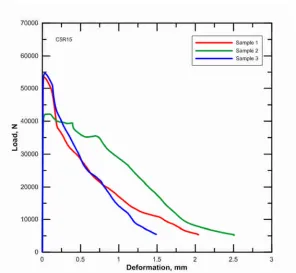
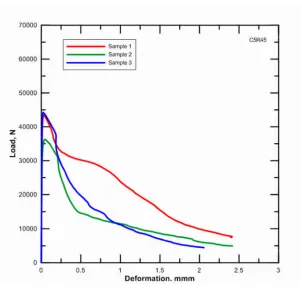
The load-deformation relationships for different mixtures are illustrated in Figure 6. From 299
these curves, toughness index was calculated as shown in Figure 7. It is clearly seen, at all 300
replacement levels, that there was an improvement in the energy absorption capacity of the 301
mixtures. This improvement was around about 27%. Although many researcher reported 302
similar behaviour when they investigated the effect of rubber on toughness of normal concrete, 303
no clear reasons was reported to explain this behaviour. However, (Chiaia et al. 1998) 304
claimed that the ductility improvement when using weak aggregates is due to a change in the 305
mechanism of microcracking. The reasons behind ductility improvement due to rubber 306
addition in cement-stabilized materials might be a) partly because the crumb rubber particles 307
helped to delay crack propagation by relieving some induced local stresses b) and partly due 308
to embedding of weak particles inside stiff media lengthening the crack path since the crack 309
path tends to propagate through these weak points. In addition, since the cracks tend to be 310
propagating as a main crack and branches rather than one main crack, especially for rich 311
rubber mixtures, this would cause more energy dissipation as described by Shah et al. (1995) 312
and (Erdem 2012). To clarify the mechanism of failure and to elucidate the above hypotheses, 313
X-ray CT was utilized to investigate the internal structure of failed samples at mesoscale level. 314
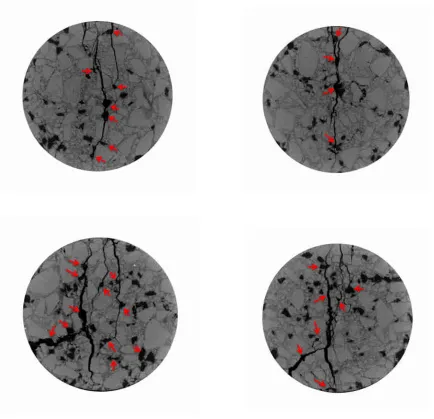
Part (b) of the suggested mechanism is evidenced in Figure 8 which shows how the cracks 315
propagated for different mixtures containing different rubber contents. Examining these scans 316
clearly supports the suggested failure mechanism as the cracks can be seen to connect rubber 317
particles as indicated by the red arrows in the same figure and tend to avoid areas without 318
rubber (as predicted by reason (b) above). Furthermore, the load-deflection responses and 319
estimated improved energy absorption capacity clearly support the explanation (a) of the 320
mechanism suggested as presented in Figure 7. This was also supported by the tortuous and 321
complex crack pattern as highlighted in fractal analysis. No doubt the applicability of this 322
more uniform the rubber distribution, the more uniform the stress/strain distribution can be 324
anticipated inside the mixture. 325
326
As the stiffness of the mixture depends, to a large extent, on the stiffnesses of its constituents, 327
replacement of stiffer natural aggregate by softer crumb rubber particles reduces the stiffness 328
of the mixture as shown in Figure 9. The increase in the stiffness of C5R45 relative to C5R30 329
might be because of the less uniform distribution of rubber particles in the mixture. Perhaps 330
an accumulation of rubber particles caused a stress concentration and resulted in premature 331
failure of the sample without large deformation. 332
333 334
4.4 Dynamic properties
335
Similar to the static modulus of elasticity results, there was a decrease in both dynamic 336
modulus of elasticity and that of rigidity due to rubber replacement, as shown in Figure 10. 337
This is because these two moduli depend on mixture density and type of aggregate. However, 338
these parameters decreased linearly at all replacement levels. This, in fact, supports the above 339
hypothesis regarding the possible rubber accumulation. As it known, during nondestructive 340
testing, there was zero applied stress which eliminates the formation of micro-cracks and 341
possible creep (Najim and Hall 2012). In other words, it depends on the mixture constituents 342
and mixture fabrication alone. For this reason, it can be concluded that nondestructive testing 343
does not depend, to a large extent, on rubber distribution as compared with sensitivity of 344
destructive ones. With regard to dynamic Poisson’s ratio, Figure 11 shows a decline in the 345
value of this parameter as rubber content increase in the mixture. This is consistent with 346
Goulias and Ali (1997) as cited by (Nehdi and Khan 2001) 347
348 349
4.5 Damage quantification
350
Figure 12 demonstrates the fractal dimensions and fracture energies for different rubber 351
replacement levels. Generally, higher fractal dimensionality and fracture energy are observed 352
energy will dissipate to fracture the sample as suggested by (Guo et al. 2007) and (Erdem 354
2012). The possible explanation for this phenomenon is that when the cracks developed they 355
propagated through the weak points (i.e., rubber particles), as noted previously. Before their 356
propagation, the rubber particles tend to absorb energy developed at the crack tip when the tip 357
reaches them, especially at the microcracking level. In addition, more energy will disperse 358
since the cracks more easily propagate as branches rather than as one main crack, which 359
agrees with (Yan et al. 2003) who attributed this to the disordered crack growth characteristics 360
found in a mixture’s internal structure during load application. This means that more energy 361
was absorbed by the mixture before failure. Energy dissipation capacity improvement is one 362
of the findings reported by (Atahan and Yücel 2012) when they investigated the effect of 363
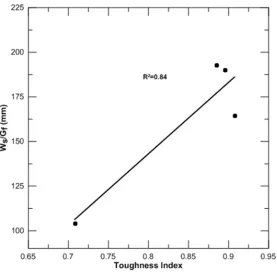
rubber on fracture energy of normal concrete during impact tests. The dissipated energy at the 364
surface macro-crack based on fractal analysis correlated well (Figure 13) with the toughness 365
of mixture calculated from the load-deformation responses. This supports the above 366
explanation and confirms that a strong relationship exists between the cracking pattern, 367
represented by the fractal dimension, and the toughness, a finding which is consistent with 368
(Yan et al. 2002; Tang and Wang 2012). 369
370
5. Conclusions
371
The effect of replacement of natural aggregate by crumb rubber on the tensile properties and 372
mechanism of their failure was investigated in this paper. This was done utilizing indirect 373
tensile tests and fractal analysis. The following conclusions can be drawn: 374
375
1. Even though the reduction in density after replacement with crumb rubber is a logical 376
finding due to the low specific gravity of rubber particles as compared with natural 377
aggregate, this is not the only reason for density reduction. Evaluation of the 378
compaction as the rubber inclusion rate increased. This can be attributed to the 380
damping effect that the rubber particles of high elasticity possess which may absorb 381
some of the compaction energy during vibratory compaction. 382
383
2. Indirect tensile strength reduced due to the inclusion of rubber particles in cement-384
stabilized aggregates mixtures due to the weakness of these introduced particles. 385
However, an increase was observed in the post-peak behaviour which caused an 386
improvement in the toughness of the modified mixtures. In addition, the high stiffness 387
of the original mixtures was mitigated after partial replacement with rubber particles. 388
389
3. By observing stress-strain responses and the failure pattern and examining the internal 390
structure of the failed specimens, the failure mechanism for a rubberized compacted 391
system has been proposed in this paper. It assumes that the crack propagates through 392
rubber particles which are thought to be absorbing energy on the crack tip. In addition, 393
due to the distribution of these weak particles, this may also lengthen the path of the 394
crack. Both of these would improve the energy absorption capacity of the modified 395
mixtures. 396
397
4. The Fractal analysis concept is found to permit quantitative distinguishing between 398
different failure patterns of CBGMs. Findings indicate that there is an increasing 399
fractal dimension due to rubber replacement. This also provides a support for the 400
suggested failure mechanism. 401
402
5. Non-destructive investigation confirmed that added rubber produced less stiff 403
materials. It is also proved the ability of this test method to distinguish between 404
mixtures with low rubber contents and its suitability to assess the performance of these 405
modified mixtures. 406
407
6. It is not recommended to use high content of rubber particles contents due to their 408
modified mixture. Evaluation of the durability of these mixtures and assessment of 410
their performance under cyclic load is important to validate their use. 411
412
413
414
415
Acknowledgements
416
The support from the Higher Committee of Education Development in Iraq (HCED) by 417
providing a scholarship for this research is gratefully acknowledged. Thanks are also due to 418
Dr. Luis Neves for his valuable discussion. Acknowledgement is also extended to Mr. Chris 419
Fox for helping to perform the x-ray CT scans. 420
421
422
423
424
425
426
427
428
429
430
Figure Captions
432
Fig.1. Grain size distribution rubber and 6 mm natural aggregate. 433
Fig.2. Grain size distribution for investigated material (specification limit as defined by BS 434
EN 14227-1:2013). 435
Fig.3. Indirect tensile testing configuration. 436
Fig.4.Methodology of fractal dimension calculation. 437
Fig.5. Indirect tensile strength for examined mixtures. 438
Fig.6. Load-diametrical deformation curves for different replacement levels: a. C5R0; 439
b.C5R15; c. C5R30; and d. C5R45. 440
Fig.7. Effect of replacement on toughness indices. 441
Fig.8. Sample scans of the failed specimens showing crack propagation through rubber 442
particles: A and B represents the mixtures with 30% and 45% rubber replacement, 443
respectively. 444
Fig.9. Effect of rubber content on static modulus of elasticity. 445
Fig.10. Effect of rubber replacement on dynamic elasticity and shear moduli. 446
Fig.11. Effect of rubber replacement on dynamic Poisson’s ratio. 447
Fig.12. Fractal dimensions for virgin and modified mixtures with different replacement level. 448
Table 1: Investigated mixtures, compacity and dry density 450
451
452
453
454
455
456
457
458
459
460
461
462
463
464
465
466
467
468
469
470
471
472
473
474
475
476
477
478
479
Mixture
symbol Compacity factor Dry density, Kg/m
3 COV, %
C5R0 0.9198 2421.79 0.5
C5R15 0.9189 2395.21 0.65
C5R30 0.9165 2364.96 1.4
480
481
482
483
484
485
486
487
488
489
490
491
492
493
494
495
496
497
498
499
500
501
502
503
504
505
506
507
508
509
Mix ID Fractal dimension Ws/Gf
C5R0 1.013 103.99
C5R15 1.166 164.40
C5R30 1.219 192.70
C5R45 1.214 189.67
References
510
ASTM (C215-02). Standard Test Method for Fundamental Transverse, Longitudinal, and 511
Torsional Frequencies of Concrete Specimens, ASTM International, West 512
Conshohocken, PA, 2002,www.astm.org. 513
Atahan, A. O. and A. Ö. Yücel (2012). "Crumb rubber in concrete: Static and dynamic 514
evaluation." Construction and Building Materials36: 617-622. 515
Balaha, M. M., A. A. M. Badawy and M. Hashish (2007). "effect of using ground waste tire 516
rubber on the behavior of concrete mixes." Indian journal of Engineering and 517
Materials Science14: 427-435. 518
Barišić, I., S. Dimter and T. Rukavina (2014). "Strength properties of steel slag stabilized 519
mixes." Composites Part B: Engineering58: 386-391. 520
Cao, W. (2007). "Study on properties of recycled tire rubber modified asphalt mixtures 521
using dry process." Construction and Building Materials21(5): 1011-1015. 522
Carpinteri, A., B. Chiaia and S. Invernizzi (1999). "Three-dimensional fractal analysis of 523
concrete fracture at the meso-level." Theoretical and Applied Fracture Mechanics 524
31(3): 163-172. 525
Cecich, V., L. Gonzales, A. Hoisaeter, J. Williams and K. Reddy (1996). "Use of shredded 526
tires as lightweight backfill material for retaining structures." Waste Management 527
& Research14(5): 433-451. 528
Chiaia, B., J. Van Mier and A. Vervuurt (1998). "Crack growth mechanisms in four 529
different concretes: microscopic observations and fractal analysis." Cement and 530
Concrete Research28(1): 103-114. 531
Chiu, C.-T. (2008). "Use of ground tire rubber in asphalt pavements: Field trial and 532
evaluation in Taiwan." Resources, conservation and recycling52(3): 522-532. 533
Chiu, C.-T. and L.-C. Lu (2007). "A laboratory study on stone matrix asphalt using 534
ground tire rubber." Construction and Building Materials21(5): 1027-1033. 535
Erdem, S. (2012). Impact load-induced microstructural damage of concrete made with 536
unconventional aggregates. PhD thesis, University of Nottingham. 537
Erdem, S. and M. A. Blankson (2013). "Fractal–fracture analysis and characterization of 538
impact-fractured surfaces in different types of concrete using digital image 539
analysis and 3D nanomap laser profilometery." Construction and Building 540
Materials40: 70-76. 541
Erdem, S., A. R. Dawson and N. H. Thom (2012). "Impact load-induced micro-structural 542
damage and micro-structure associated mechanical response of concrete made 543
with different surface roughness and porosity aggregates." Cement and Concrete 544
Research42(2): 291-305. 545
Farhidzadeh, A., E. Dehghan-Niri and S. Salamone (2014). "Crack pattern quantification 546
of concrete structures based on fractal analysis." Safety, Reliability, Risk and Life-547
Cycle Performance of Structures and Infrastructures: 361. 548
Fontes, L. P., G. Trichês, J. C. Pais and P. A. Pereira (2010). "Evaluating permanent 549
deformation in asphalt rubber mixtures." Construction and Building Materials 550
24(7): 1193-1200. 551
Foose, G. J., C. H. Benson and P. J. Bosscher (1996). "Sand reinforced with shredded 552
waste tires." Journal of Geotechnical Engineering122(9): 760-767. 553
Gesoğlu, M. and E. Güneyisi (2007). "Strength development and chloride penetration in 554
rubberized concretes with and without silica fume." Materials and Structures 555
40(9): 953-964. 556
Güneyisi, E. (2010). "Fresh properties of self-compacting rubberized concrete 557
incorporated with fly ash." Materials and Structures43(8): 1037-1048. 558
Güneyisi, E., M. Gesoğlu, K. Mermerdaş and S. İpek (2014). "Experimental investigation 559
on durability performance of rubberized concrete." 560
Güneyisi, E., M. Gesoğlu and T. Özturan (2004). "Properties of rubberized concretes 561
containing silica fume." Cement and Concrete Research34(12): 2309-2317. 562
Guo, L.-P., W. Sun, K.-R. Zheng, H.-J. Chen and B. Liu (2007). "Study on the flexural 563
fatigue performance and fractal mechanism of concrete with high proportions of 564
ground granulated blast-furnace slag." Cement and Concrete Research 37(2): 565
Humphrey, D. (2007). Tire derived aggregate as lightweight fill for embankments and 567
retaining walls. Proceedings International Workshop on Scrap Tire Derived 568
Geomaterials, Yokosuka, Japan. 569
Issa, M. and A. Hammad (1994). "Assessment and evaluation of fractal dimension of 570
concrete fracture surface digitized images." Cement and Concrete Research24(2): 571
325-334. 572
Khaloo, A. R., M. Dehestani and P. Rahmatabadi (2008). "Mechanical properties of 573
concrete containing a high volume of tire-rubber particles." Waste Management 574
28(12): 2472-2482. 575
Khatib, Z. K. and F. M. Bayomy (1999). "Rubberized Portland cement concrete." Journals 576
of Materials in Civil Engineering, ASCE11: 206-213. 577
Kim, B., M. Prezzi and R. Salgado (2005). "Geotechnical properties of fly and bottom ash 578
mixtures for use in highway embankments." Journal of geotechnical and 579
geoenvironmental engineering131(7): 914-924. 580
Lav, A. H., M. A. Lav and A. B. Goktepe (2006). "Analysis and design of a stabilized fly 581
ash as pavement base material." Fuel85(16): 2359-2370. 582
Lim, S. and D. G. Zollinger (2003). "Estimation of the compressive strength and modulus 583
of elasticity of cement-treated aggregate base materials." Transportation 584
Research Record: Journal of the Transportation Research Board1837(1): 30-38. 585
Liu, H., J. Mead and R. Stacer (2000). "Environmental effects of recycled rubber in light-586
fill applications." Rubber chemistry and technology73(3): 551-564. 587
Masad, E., R. Taha, C. Ho and T. Papagiannakis (1996). "Engineering properties of 588
tire/soil mixtures as a lightweight fill material." Geotechnical Testing Journal(19). 589
Mihashi, H., S. Ahmed, T. Mizukami and T. Nishiwaki (2006). "Quantification of crack 590
formation using image analysis and its relationship with permeability." 591
Najim, K. B. and M. R. Hall (2012). "Mechanical and dynamic properties of self-592
compacting crumb rubber modified concrete." Construction and Building Materials 593
27(1): 521-530. 594
Nehdi, M. and A. Khan (2001). "Cementitious composites containing recycled tire rubber: 595
an overview of engineering properties and potential applications." Cement 596
Concrete and Aggregates23(1): 3-10. 597
Nunn, M. (2004). Development of a more versatile approach to flexible and flexible 598
composite pavement design : prepared for highways agency, TRL report. 599
Papakonstantinou, C. G. and M. J. Tobolski (2006). "Use of waste tire steel beads in 600
Portland cement concrete." Cement and Concrete Research36(9): 1686-1691. 601
PCA (2005). "soil cement technology for pavement different products for different 602
applications." Portland Concrete Association(illinois). 603
Pelisser, F., N. Zavarise, T. A. Longo and A. M. Bernardin (2011). "Concrete made with 604
recycled tire rubber: Effect of alkaline activation and silica fume addition." Journal 605
of Cleaner Production19(6-7): 757-763. 606
Pincus, H., T. Edil and P. Bosscher (1994). "Engineering properties of tire chips and soil 607
mixtures." 608
Scullion, T., J. Uzan, S. Hilbrich and P. Chen (2008). "Thickness Design Systems for 609
Pavements Containing Soil-Cement Bases." PCA R&D Serial(2863). 610
Sobhan, K. and M. Mashnad (2000). "Fatigue durability of stabilized recycled aggregate 611
base course containing fly ash and waste-plastic strip reinforcement." Final Rep. 612
Submitted to the Recycled Materials Resource Centre, Univ. of New Hampshire. 613
Solanki, P. and M. Zaman (2013). "Behavior of Stabilized Subgrade Soils under Indirect 614
Tension and Flexure." Journal of Materials in Civil Engineering26(5): 833-844. 615
Taha, M. M. R., A. S. El-Dieb, M. A. Abd El-Wahab and M. E. Abdel-Hameed (2008). 616
"Mechanical, Fracture, and Microstructural Investigations of Rubber Concrete." 617
Jounal of Materials in Civil Engineering, ASCE20: 640-649. 618
Tang, W. and Y. Wang (2012). "Fractal characterization of impact fracture surface of 619
steel." Applied Surface Science258(10): 4777-4781. 620
Wen, H., B. Muhunthan, J. Wang, X. Li, T. Edil and J. M. Tinjum (2014). Characterization 621
of Cementitiously Stabilized Layers for Use in Pavement Design and Analysis. 622
Williams, R. I. T. (1986). "Cement-treated pavements : materials, design and 623
Wu, P., L. Houben, A. Scarpas, C. Egyed and R. de La Roij (2015). "Stiffness modulus 625
and fatigue peoperties of cement-stabil;ized sand with use of a synthetic 626
modified-zeolite additive." 2015 Annual meeting of transportation research board. 627
Xiao, F., S. Amirkhanian and C. H. Juang (2007). "Rutting resistance of rubberized 628
asphalt concrete pavements containing reclaimed asphalt pavement mixtures." 629
Journal of Materials in Civil Engineering19(6): 475-483. 630
Yan, A., K.-R. Wu, D. Zhang and W. Yao (2003). "Influence of concrete composition on 631
the characterization of fracture surface." Cement and Concrete Composites 25(1): 632
153-157. 633
Yan, A., K. Wu and X. Zhang (2002). "A quantitative study on the surface crack pattern 634
of concrete with high content of steel fiber." Cement and Concrete Research32(9): 635
1371-1375. 636
Youwai, S. and D. T. Bergado (2003). "Strength and deformation characteristics of 637
shredded rubber tire sand mixtures." Canadian Geotechnical Journal 40(2): 254-638
264. 639
Zheng, L., X. Sharon Huo and Y. Yuan (2007). "Experimental investigation on dynamic 640
properties of rubberized concrete." Construction and Building Materials 22(5): 641
939-947. 642
Zheng, L., X. Sharon Huo and Y. Yuan (2008). "Strength, Modulus of Elasticity, and 643
Brittleness Index of Rubberized Concrete." Journal of Civil Engineering , ASCE. 644
645
Figure 1: Grain size distribution rubber and 6 mm natural aggregate
[image:24.595.151.430.421.698.2]Figure 3: Indirect tensile testing configuration
[image:25.595.86.501.536.650.2]Figure 5: Indirect tensile strength for examined mixtures
Figure 6: for different replacement levels: a. C5R0; b.C5R15; c. C5R30; and d.
[image:26.595.160.442.394.658.2]0 10 20 30 40 50
Rubber replacement, %
0.22 0.24 0.26 0.28 0.3
D
yn
am
ic
P
o
is
si
o
n
's
ra
ti
o
[image:31.595.148.409.80.337.2]R2=0.511
Figure 11: Effect of rubber replacement on dynamic Poisson’s ratio
[image:31.595.168.421.447.691.2]