A COMPARATIVE ANALYSIS OF INSTITUTIONALISED AND NON
ORPHANED CHILDREN WITH REFERENCE TO THEIR WELLBEING
1,*
Ephias Gudyanga,
1
Department of Educational Foundations,
Studies
2Department of Educational Foundation
ARTICLE INFO ABSTRACT
The study was premised on orphaned children with reference to
where most of the institutionalised orphans learn and another purposively selected 5 primary school teachers where most of the non
comprised 10 orphans, 5 from the local orphanage centre and another 5 from non
20 participants were individually interviewed and audiotape. Data was transcribed and thematically anaysed. It was found out that non
and were often burdened by problems and chores at home and their keenness to learn was hindered by absenteeism and sometimes coming to school on empty stomachs thereby losing concentration. They lacked resourc
school attendance and educational achievement was negatively impacted upon. Orphans from both institutions reported being abused emotionally, physically, and sexually by th
teachers and the guardians (relatives). Poor health and malnutrition negatively affected orphaned children. Other children looked down upon orphans and in the process disassociating themselves from them (orphaned children) and this neg
groups when they are marginalized, sidelined especially when sharing materials. This negatively affected their self
children were marred with more challenges than the institutionalised orphaned children. It was recommended (among others) stiff penalties to be applied by Government on child abuse perpetrators.
Copyright © 2015 Ephias Gudyanga et al. This is an open access ar
use, distribution, and reproduction in any medium, provided the original work is properly cited.
INTRODUCTION
This study, based on a comparative analysis of institutionalised and non-institutionalised orphaned children with reference to their wellbeing, was carried out in Mtoko district of Zimbabwe. Children, grieved by the death of a parent, are often stigmatized by society through association with HIV and AIDS. Such children are labeled with a new alien title called an orphan and they automatically begin to live a different life style as a result of their orphan hood. Some orphans are adopted by relatives, others are adopted into institutions like orphanages / homes by unknowns to the orphan, and others remain in their former parents’ homes as children headed families.
*Corresponding author:Ephias Gudyanga,
Department of Educational Foundations, Midlands State University, Management and Curriculum Studies Bag 9055, Gweru, Zimbabwe
ISSN: 0975-833X
Article History:
Received 06th March, 2015
Received in revised form 12th April, 2015
Accepted 09th May, 2015
Published online 30th June,2015
Key words:
Caregiver, Institutionalization, Non-Institutionalisation, Orphan, Orphanage, School.
Citation: Ephias Gudyanga, Sarah Moyo, Anna Gudyanga, Richard
institutionalised orphaned children with reference to their wellbeing
RESEARCH ARTICLE
A COMPARATIVE ANALYSIS OF INSTITUTIONALISED AND NON-INSTITUTIONALISED
ORPHANED CHILDREN WITH REFERENCE TO THEIR WELLBEING
Ephias Gudyanga,
2Sarah Moyo,
1Anna Gudyanga, and
2Richard Susa
Department of Educational Foundations, Midlands State University, Management and Curriculum
Studies Bag 9055, Gweru, Zimbabwe
Department of Educational Foundations, Great Zimbabwe University, BOX 1235, Masvingo, Zimbabwe
ABSTRACT
The study was premised on a comparative analysis of institutionalised and non
orphaned children with reference to their wellbeing .A sample of 5 rural primary school teachers, where most of the institutionalised orphans learn and another purposively selected 5 primary school teachers where most of the non-institutionalised orphans learn, was made. Another part of samp comprised 10 orphans, 5 from the local orphanage centre and another 5 from non
20 participants were individually interviewed and audiotape. Data was transcribed and thematically anaysed. It was found out that non-institutionalised orphaned children had worse academic challenges and were often burdened by problems and chores at home and their keenness to learn was hindered by absenteeism and sometimes coming to school on empty stomachs thereby losing concentration. They lacked resources to meet the basic needs, education and health care all of which resulted in poor school attendance and educational achievement was negatively impacted upon. Orphans from both institutions reported being abused emotionally, physically, and sexually by th
teachers and the guardians (relatives). Poor health and malnutrition negatively affected orphaned children. Other children looked down upon orphans and in the process disassociating themselves from them (orphaned children) and this negatively affected their intention to be in the same academic groups when they are marginalized, sidelined especially when sharing materials. This negatively affected their self-perception and image. It was concluded that non
ren were marred with more challenges than the institutionalised orphaned children. It was recommended (among others) stiff penalties to be applied by Government on child abuse perpetrators.
is an open access article distributed under the Creative Commons Attribution License, which use, distribution, and reproduction in any medium, provided the original work is properly cited.
This study, based on a comparative analysis of institutionalised institutionalised orphaned children with reference to their wellbeing, was carried out in Mtoko district of Zimbabwe. Children, grieved by the death of a parent, are en stigmatized by society through association with HIV and AIDS. Such children are labeled with a new alien title called an orphan and they automatically begin to live a different life Some orphans are atives, others are adopted into institutions like orphanages / homes by unknowns to the orphan, and others remain in their former parents’ homes as children headed
Midlands State University, Management and Curriculum Studies Bag 9055, Gweru, Zimbabwe.
The wellbeing of orphans in institutions and those from non institutions are different (Evans, 2006) and this study focused on that scenario. The wellbeing of the
likes of their academic, social, emotional, physical, intellectual including health developmental perspectives
Context
Institutionalisation of children in Africa
Bukenya (1999) assert that when the AIDS pandemic generated an orphan crisis in East and Central Africa in the 1980’s well-meaning groups and individuals in the West responded by building orphanages to have these children. Thus, this trend alarmed internat
the same vein, the unfolding tragedy of Africa’s orphan crisis received wide publicity in the West and created a groundswell
International Journal of Current Research
Vol. 7, Issue, 06, pp. 17546-17554, June 2015
INTERNATIONAL
Ephias Gudyanga, Sarah Moyo, Anna Gudyanga, Richard Susa, 2015. “A comparative analysis of institutionalised and non institutionalised orphaned children with reference to their wellbeing”, International Journal of Current Research
INSTITUTIONALISED
ORPHANED CHILDREN WITH REFERENCE TO THEIR WELLBEING
Richard Susa
Management and Curriculum
BOX 1235, Masvingo, Zimbabwe
a comparative analysis of institutionalised and non-institutionalised A sample of 5 rural primary school teachers, where most of the institutionalised orphans learn and another purposively selected 5 primary school institutionalised orphans learn, was made. Another part of sample comprised 10 orphans, 5 from the local orphanage centre and another 5 from non-institution. All the 20 participants were individually interviewed and audiotape. Data was transcribed and thematically rphaned children had worse academic challenges and were often burdened by problems and chores at home and their keenness to learn was hindered by absenteeism and sometimes coming to school on empty stomachs thereby losing concentration. es to meet the basic needs, education and health care all of which resulted in poor school attendance and educational achievement was negatively impacted upon. Orphans from both institutions reported being abused emotionally, physically, and sexually by the caregivers, school teachers and the guardians (relatives). Poor health and malnutrition negatively affected orphaned children. Other children looked down upon orphans and in the process disassociating themselves atively affected their intention to be in the same academic groups when they are marginalized, sidelined especially when sharing materials. This negatively perception and image. It was concluded that non-institutionalised orphaned ren were marred with more challenges than the institutionalised orphaned children. It was recommended (among others) stiff penalties to be applied by Government on child abuse
ribution License, which permits unrestricted
The wellbeing of orphans in institutions and those from non-institutions are different (Evans, 2006) and this study focused on that scenario. The wellbeing of the orphans spans from the likes of their academic, social, emotional, physical, intellectual including health developmental perspectives
Institutionalisation of children in Africa
Bukenya (1999) assert that when the AIDS pandemic generated an orphan crisis in East and Central Africa in the meaning groups and individuals in the West responded by building orphanages to have these children. Thus, this trend alarmed international welfare organisations. In the same vein, the unfolding tragedy of Africa’s orphan crisis received wide publicity in the West and created a groundswell
INTERNATIONAL JOURNAL OF CURRENT RESEARCH
of individual and organisations wishing to provide assistance, (UNICEF, 2014). Governments of countries like Uganda, Zimbabwe, and South Africa including most other countries in the sub-Saharan Africa have been critically affected by the HIV and AIDS pandemic. Pharaoh (2004) purports that international donor agencies, faith-based organisations and individual philanthropists made significant contributions. It is acknowledged that, the endeavours were spontaneous and was viewed as emergency in Africa and in trying to keep with the traditional care; they focused on the construction of orphanages (institutions). Bukenya (1999) added that Uganda in the first years of the epidemic over fifty new orphanages came into operation.
The World Vision (2005) purports that the most publicized region with the highest number of orphans continues to be the sub- Saharan where an estimated seventy-five million are orphans orphaned by HIV and AIDS and poverty. In Ghana, researches have again suggested that they are more orphaned children relying solely on traditional elder care. In Tanzania, all the children that are in orphanages have been severely neglected or abused, servants and hence have been absorbed into institutionalization, (UNICEF, 2004). Orphanages in other African countries were brought with the European Missionaries who took up the activity of caring for orphaned children who were for certain reasons, seen as undesirable to be absorbed into families. Evans (2006) asserts that the need for orphanages in Africa grew with the increase of rural to urban migration and overall modernization.
The new developments resulted in a heterogeneous mix of tribes and cultures, with a restructuring of traditional community practices within urban environments, (Forster, 2000). Hence, this gave rise to a number of orphaned and vulnerable children. The resulting force of the socio-economic factors and civil unrest reduced the capacity of the extended family to absorb and fully support the growing numbers of orphaned and vulnerable children; therefore institutionalization in the form of children’s homes and orphanages was the only solution in Africa. Levine (2001) added that due to the rise in orphans and vulnerable children, Africa has seen an increase in children’s institutions, homes and orphanages established and run by individuals, private institutions and non-governmental organisations as one of the responses to the problem. There is a continuous dependency on external donors in form of aid and funding. Thus, researches according to Garcia, Pence and Evans (2008) continually shows that institutionalization in Africa is not the most cost effective way of caring for the orphaned and vulnerable children, hence institutionalization has harmful effects on children and should be used as a last resort.
Institutionalisation of children in Zimbabwe
Powell et al (2002) acknowledge that Zimbabwe has highly developed social welfare system backed by an effective legislation directed at the centre of caring and protection of children at the onset of the orphan crisis. Thus, the Department of Social Services working in cahoots with the Ministry of Public Service, Labour and Social Welfare serves as the key legislation in protecting the children.
Hence, they have been starved of resources; loss of staff, the economic crisis has failed to honour its obligations effectively. This has an adverse effect on children in care and other children in difficult circumstances. Again in Zimbabwe the African culture has preserved its own ethos of using the extended family for caring orphans. Thus, finding refugee within their relatives. UNICEF (2008) has it that the rapid increasing poverty and rising numbers of deaths of adults from AIDS has placed the extended family under pressure. With this at hand, the increasing numbers of orphans and vulnerable children are now failing through the weaknesses of the system and governments and non-governmental organisations are faced with the challenge of providing assistance in terms of an alternative form of care. Safety nets as given by Chirwa (2002) has a strong backing of cultural influence to the concept of adoption in Zimbabwe and insignificant numbers of children have been placed with adoptive parents since the onset of the orphan crisis. Thus, in Zimbabwe orphaned children have been institutionalised, foster cared informally or formally as alternatives forms of care. Hence, the introduction of Basic Education Assistance Module (BEAM) by the government has managed to work as a head start for the orphaned and vulnerable children to go to school or to access education.
Further context
Proper family environment plays an important role in the life of children. No one can deny the important role of parents in developing balanced and harmonious development of the “whole” child, emotionally, socially, cognitively, and physically. It is clear that non-institutionalised and institutionalised orphaned children continue to face many challenges on a micro and macro scale thereby negatively or positively affecting their wellbeing. Carl Rogers, Urine Bronfenbrenner, John Bowlby, Abraham Maslow, Maria Montessori, Albert Bandura only to mention a few, have immensely shared on child development, which also can be put into cognissance when articulating the conceptual framework of institutionalised and non-institutionalised orphaned children. Hence, we used the eclectic approach, which entails the integration of different theories in one situation.
Hence assigning a label on these institutionalised and non-institutionalised orphaned children in a classroom set up, the teacher emits expectations that the children behave in accordance with the label attached to him or her for example scolding the orphaned children for non- performing in classroom activities. Haralambos and Holborn (2001) posit that students labeled as trouble makers tend to seek out others’ company and within their group awarded high status to those who broke the rules, thus, disrupting lessons, being cheek to teachers, failing to hand in homework, cheating and playing truant, all bring about prestige. This is most commonly associated with non-institutionalised orphaned children who lack parental guidance and advocacy at home. Thus serving as a self-fulfilling prophecy that these non-institutionalised kids are arrogant, rude, quarrelsome, unfriendly and thoughtless. Evans (2006) proposes that, ‘deviance like beauty is in the eyes of the beholder.” Hence, these orphaned behave obnoxiously because of the tags attached to them. At the end, their academic performance dwindles because of these tags. Both non-institutionalised and institutionalised orphaned children are bedeviled by abuse and showed psychological effects of abuse. Thus, mistreatment of these orphaned children that results in harm, potential harm or a threat of harm is severely witnessed in the academic circles. When the physical needs of children such as food, clothing, general care, security, supervision or shelter are not met, these orphaned children are psychologically affected. Maslow (1987 as cited in Mangal, 2002) holds that physiological needs are the basic needs which have to be satisfied first before high level needs can be attended to and these include food, air, shelter only to mention a few. Again, Maslow (1987 as quoted in Snowman and Biehler, 2000) argues that if the physiological and psychological needs are not satisfied the child is socially, cognitively and emotionally affected.
Non-institutionalised orphaned children become quite insecure, inferior and withdrawn, thus, they lack to pay attention to the teacher as he or she presents concepts to the class, the neglected orphaned child would be busy digesting on what to do as to get the basic needs. In the same vein, non-institutionalised orphaned children fail to concentrate on the issues at hand and they lack participation in class and group activities, hence their performance in daily written work is negatively affected. They even fail to do assigned homework thereby impinging their academic performance. Gonzalez-Dehass and Willems (2013) confirmed that these orphaned children ended up cheating, lying, and stealing (pilfering) for example, food from the peers, money so as to buy food and steal articles of clothing so as to meet the basic needs. Since this behaviour is regarded by society as unacceptable hence they end up being abused and isolated by peers and they develop poor low self-esteem. Coopersmith (cited in Newcombe, 1996) studied levels of self-esteem and found out that these levels affect learning negatively.
The findings of Owen (2004) were that academic deficits were noted among institutionalised maltreated orphaned children and they performed poorly in language, reading and mathematics. This reflected that these children ended up dropping out of school due to poor academic performance and social adjustment.
On the same note, non-institutionalised orphaned children who are deprived of adequate health care experienced ill-health and this affected their academic performance since they tend to concentrate more on their suffering than their school work.
Additionally, non-institutionalised orphaned children
experienced physical abuse in the form of beating, being spanked, and coming to school with abrasions, swellings and bruises of different colours. Smart (2003) posits that, beating and child labour are forms of child abuse that affect the learner’s performance and health. These non-institutionalised orphaned learners concentrated on the pain experienced and they also flashed back on the beating scene hence losing the concepts being presented by the teacher. The leaner’s attention is withdrawn from the teacher and from the class discussions and this leads to loss of meaningful learning.
The thorniest issue is that learners tend to develop fear of the abusers and adults. This manifests when they protect their heads with hands or other forms of self-defense when approached unexpectedly by adults. The orphaned children end up having psychological disorders and severe emotional problems. In support of the above, Dembo (1994) asserts that if caregivers are harsh and punitive, children may express their hostility towards them by challenging the teachers’ authority or by becoming fearful and withdrawn. Due to physical abuse, non-institutionalised orphaned children have emotional distress and aggressive behaviours. According to Parke (1977 cited in Combe, 1996), a child who is regularly slapped, spanked, shaken or shouted, may learn to use these forms of aggression in interactions with peers for they take their caregivers and teachers as models. Thus, these orphaned children who are corporally punished are more aggressive and sadistic, that is they derive pleasure from inflicting pain on others taking after their abusive carers, adopted parents and teachers as their role models as asserted by Bandura.
By so doing, due to harsh and inconsistent discipline on either institutionalised or non-institutionalised orphaned children, this lead them to be antisocial and their peers reject them and fail in their school work. This is so because they cannot participate in co-operative learning such as group work due to their behaviour disorders. In some instances, these children experience learning disorders since they have low self-esteem and negative self-concepts as they experience punitive consequences. Ferkany (2008 in Tuckman & Monetti, 2011) suggested that self-esteem is crucially linked to the confidence and motivation needed by children to participate in and achieve educational pursuits.
Furthermore, non-institutionalised and institutionalised
Bandura regards one’s personal feeling of self-efficacy to be a powerful influence of one’s thoughts, patterns, behaviour and motivation. Institutionalised orphaned children hold a self-belief in their capabilities to cope or excel in different in different situations as compared to the non-institutionalised orphaned children who find their self-efficacy judgments undermined, leading to a continuing downward spiral of performance. Maria Montessori believed that, children were able to act on their surroundings. Thus, the environment in which the non-institutionalised and institutionalised orphaned children live, which must enable freedom of experience, sensory and observation, independence and self-education and lastly discipline. Crain (2005) holds that Montessori acknowledges the environment as fundamental in facilitating the process of child development by a reduction of obstacles to a minimum and allowing free scope for a child’s energies by offering the necessary means for the activities to which they give rise.
Bronfenbrenner’s theory again serves as the very systems theory that allows tackling numerous environmental factors and numerous persons, that is, the institutionalised and non-institutionalised orphaned children in different relationships, roles, actions and processes. Thus, the dependency of these orphaned children with the environment. Berk (2000) asserts that development and socialization are influenced by the environment with which a person is in active interaction. This include some major assumptions that, the person is an active player exerting influence on his or her environment, secondly, the environment is compelling the person to adapt to its conditions and restrictions and lastly environment is understood to consist of different size entities that are placed one inside another of their reciprocal relationships and of micro system, meso system, exo system, macro system and the chromo system, (Bronfenbrenner 1979 in Berk 2000).
It is in the micro system where the orphaned children keep their closest environment and includes the structures with which they maintain direct contact. Minnet (2005) argues that the caregivers or foster parents have an influence on beliefs and behaviours of orphaned children but the children as well can influence caregiver’s beliefs and behaviour. That is bi-directional influence is at its strongest since the micro system is made up of the developing person’s closest surroundings like home, day care group, the kids in the courtyard, classmates at school, close relatives or hobby club members. Hence, for the institutionalised and non-institutionalised orphaned children to perform better or bad at school, it is how these individuals interact with the child that has profound effect on how the child grows. The more encouraging and nurturing these interactions are the better the orphaned institutionalised or non-institutionalised child will be able to perform academically. Montessori (in Morrison, 2012) has it that, the caregiver himself or herself is part of the child’s environment; the adult must adjust himself or herself to the child’s environment if he or she is not to stand as a hindrance. Bowlby (1951 in Crain 2011) was struck by the inability of many institutionally reared children to form deep attachments in life. According to Bowlby, conditions in many institutions do seem unfavorable for the formation of intimate humanities.
Ainsworth (1963 in Crain 2011) asserts that such individuals use other people solely for their own ends and seem incapable of forming loving, lasting ties to others. Thus, institutionalised orphaned children, receive physical needs and no-one is around to heed the orphaned children’s cries to return to their smiles, talk to them, pick them up when they desire. Parental care is important in the academic circles of an individual. The interaction between the child’s biology or his/her immediate environment fuels development academically, mentally, socially, emotionally, physically and intellectually within a child. Changes or conflict in that set up will lead to separation anxiety. This according to Santrock (2009), stress and anxiety are the physiological and psychological reactions people exhibit as a result or in response to environmental events called stressors. Institutionalised and non-institutionalised orphaned children go through a period of despair. They become quieter and less active and appear to be in deep mourning thereby affecting their overall wellbeing negatively.
Institutionalised and non-institutionalised orphaned children, although the same in their physiological make up, human dignity, they are unique individuals who differ from one person to another in a variety of ways. Pupils differ in intelligence, learning styles, interests, experiences, socio economic backgrounds, personality, the way they retrieve or access information is different. According to Slavin (2008), such differences are likely to have an impact on the teaching and learning. Educators should put an extra effort to familiarize themselves with individual differences so that they can take them into consideration in the preparation of course instruction. Mangal (2002) defines individual differences as the various ways in which individuals differ from one another in a distinct and permanent manner.
They are further elaborated by Chauhan (2008), who postulates that individual differences are variations or deviations among individuals in regard to a single characteristic or a number of characteristics. Thus, individuals in institutionalised and non-institutionalised orphaned children can be seen as the differences amongst themselves that separate them from one another and making every orphaned child a unique person. These differences include physical differences, mental differences, differences in motor ability, differences in achievement, emotional differences, differences in interests and aptitudes only to mention a few. Hence, teachers, caregivers, foster parents must consider orphaned children’s needs and interests.
MATERIALS AND METHODS
Design and methods
A qualitative approach was employed in order to understand the social phenomenon under study within its context (Creswell, 2008, 2014). Schratz and Walker (1995) also posit that if we are involved in qualitative research that helps us to become reflexive in our workplaces and practices, gain some insight into our perceptions, and awareness that others around us may perceive things differently, we will gain a deeper understanding of our situations and this can result in change. These authors see research as social action resulting from the processes of individual and social reflexivity and reciprocity. They consider that individuals gain understanding of themselves and others through social interaction. Their suggestion for methods or tools for doing research as social change includes the use of interviews which has been used in this study in order to understand the lived experiences of teachers as they interact with orphans and vice versa.
A sample of 5 rural primary school teachers was made from a school where most of the institutionalised orphans learn in Mtoko district of Zimbabwe. Another purposive 5 primary school teachers was made from yet another rural school which had orphans attending there but coming from the surrounding homes / villages (non-institutionalised orphans). The teachers were purposively selected on the basis of their knowledge of the orphans in their schools. Some of the teachers were in charge of orphans and vulnerable children (o.v.c.) as prescribed by their School Development Associations (S.D.A.s) in the area. The community had many orphans, hence S.D.A., created a register of o.v.c. from grade zero to grade seven in both schools. Both schools had institutionalised and non institutionalised orphans. We also interviewed 10 orphans, 5 from the local orphanage centre and another 5 from non-institution. All the 20 participants were individually interviewed, audiotaped in order to prevent data loss.
Ethical considerations
Permission was sought and granted by our institutions for a study of this nature to be carried out. We also got permission from the Ministry of Education which allowed us to enter into their schools for data collection. Since the 10 orphans were minors, their guardians, some in writing, and others used their thumb print for signature (because they could not write), consented to us interviewing their children. The head of the orphanage centre consented in writing on behalf of the 5 institutionalised orphans. Confidentiality and anonymity were granted to all participants. Reasons of the study were well explained to participants and understood The participants were informed of the freedom to withdraw from the study at any point if they so wished of which one teacher did so on personal reasons because every person has the right to privacy and dignity of treatment (Creswell, 2008). In both schools, narrative interviews were carried out in unoccupied classrooms on different days, with different interviewees, in order to make the study findings credible. The narrative interviews were transcribed and coded according to emerging themes in an attempt to make meaning of the data.
RESULTS
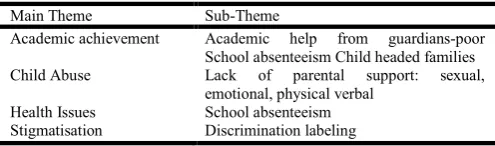
[image:5.595.309.557.134.207.2]Analysis of transcribed data resulted in five themes emerging, each one with some sub-theme(s) as shown in Table 1.
Table 1. Emerging themes
Main Theme Sub-Theme
Academic achievement Academic help from guardians-poor School absenteeism Child headed families Child Abuse Lack of parental support: sexual,
emotional, physical verbal Health Issues School absenteeism Stigmatisation Discrimination labeling
Academic Achievement
One direct question asked during interview which we wanted to find out responses from was: which of these two institutions negatively impacted on academic achievement of orphans? Three teachers felt that institutionalised orphaned children are having worse academic challenges than their counterparts. One
of the respondents said institutionalised orphaned children are
affected because of the way they are raised, that is, caregivers in institutions are mere workers who may just do things to get
paid,. The other respondent teacher echoed that the institution
may fail to provide all the basics for the success of the orphaned children due to economic hardships hence their academic performance is poor.
However, the other seven respondents felt that non-institutionalised orphaned children had worse academic challenges. In support of their assertions, they shared that non-institutionalised orphaned children were often burdened by problems and chores at home and their keenness to learn was hindered by absenteeism and sometimes coming to school on empty stomachs thereby losing concentration. One of the respondents suggested that non-institutionalised orphaned children stayed with guardians who were not capable of providing the basic requirements wanted by the school. Other respondents shared that, non-institutionalised orphaned children lacked resources to meet the basic needs of food, education and health care all of which resulted in poor school attendance and educational achievement was negatively affected. To add to that on the plight of non-institutionalised orphaned children, one respondent shared that these orphans were the heads of households looking after other children as the custodians. Hence, this brings out the issue of child-headed families whilst the child also expected support himself or herself.
Child Abuse
One of the respondent teacher said, some orphans had a quiet behaviour as a result of abuse and did not feel comfortable to
participate with other children. It was noted that one orphan
reported an alleged sexual abuse to the step mother, who in
turn shouted at her and called her a hure meaning a prostitute.
Other respondents shared that, they lived under stressful conditions at home and in institutions which affected their performance and if teachers failed to understand the social background of these children, they again looked at the school as a bad place for them.
Institutionalised orphaned children bemoaned the issue of irrelevant modes of punishment in institutions. Some of them during the interview stressed that they even preferred to stay at school than going back for lunch or break at the institution and even raised the issue of taking his or her own life because of the stressful events he/she was exposed to by caregivers. Thus, caregivers underestimated the capabilities of these orphaned children in every respect. Likewise, they reiterated that teachers, peers and caregivers had a negative perception of these non-institutionalised and institutionalised orphans. They aligned them to individuals who were naughty, directionless, incapable, deviant, bullies and aggressive. Hence, most teachers confirmed the above as a true reflection of orphans from both sets of institutions. Furthermore, one of the teacher
respondents added that non-institutionalised orphans are
sometimes subject to all forms of abuse. I know of a case where the orphaned girl child, in grade 7 was abused by her uncle, I shall not mention names.
Health Issues
The issue of congregate living conditions was mentioned as one of the causes of diseases especially on institutionalised orphaned children. In the interviews with teachers, they hinted that poor health and malnutrition, affected negatively the self-concept of orphaned children since they were affected mentally, physically, psychologically, emotionally and socially leading to poor social adjustment, absenteeism from school and restricted social interaction.
Stigmatisation
Some non-institutionalised orphaned children highlighted that they did not want to be stigmatized because of other pupils who laugh at them saying that they are living with non parents hence they wanted to keep in touch with their lineages. They castigated institutionalization as a way of eroding the cultural society since they will be alienated from their forefathers’ graves and that alone will bring about bad omen in their wellbeing. Apart from this, some institutionalised orphans suggested that, they seemed more stigmatized because of their
living conditions. The orphaned children asserted that some
children at school often despised them when interacting. Other institutionalised and non-institutionalised orphaned children held that other children looked down upon them and in the process disassociating themselves from them (orphaned children) and this negatively affected their intention to be in the same academic groups when they are marginalized, sidelined especially when sharing materials. This negatively affected their self-perception and image.
Some orphaned children complained that vamwe vanotidaidza
vachiti veBEAM vari kudiwa kana kuti vanodzidza mahara
(some students and teachers usually refer them as BEAM students who get education for free). This is so because of the Basic Education Assistance Module fund honoured by the Government to assist all these orphans to attain better education.
DISCUSSION
Four themes which emerged out of the data analysis are discussed below.
Academic achievement
Educationally, it was noted that, non-institutionalised orphaned children were negatively impacted on worse than their counterparts. Lots of household chores after school time were one contributing factor, unlike their peers. Some guardians/ foster parents were illiterate or showed no interest in helping with homework. One can conclude that, institutionalization if properly handled can however be a safe model for orphaned children. Non-institutionalised orphaned children were weaved with a myriad of problems as compared to the institutionalised orphaned children. Pharaoh (2004) shared that after a parent dies, most children continued to live and slided more deeply into poverty. School fees, notebooks and pencils became unaffordable as children began to struggle to provide care to other siblings. Such orphans play the role of the lost parent(s). Huber and Gould (2003) added that the effects weakened knowledge acquisition and children do not academically perform well.
The poor performance by such children led to low productivity of adults in future. Thus, institutionalised orphaned children had an added advantage on their academic performance since institutions provided them with a participatory engagement that is, steering activities which provide direction and guidance to the orphans. However both non-institutionalised and institutionalised orphans confirmed that the caregivers did not have the time to supervise their children’s homework hence their academic performance is low. They lacked attachment and close relationship with the caregivers, although others try to help with home works. Naturally, it is possible that non-biological children may not develop a close and strong bond with non-biological mothers. However, caregivers and all foster parents are encouraged to deliberately make an effort to have such a strong bond. It is critical because it is the basis of future total developmental wellbeing.
Institutionalised orphans performed better than
Although they complained that the caregivers usually took those handouts for personal use and let down their mandate or mission statement. But generally, they were satisfied with the fruitful efforts which ensured that their needs were catered for academically.
Child Abuse
It was established that institutionalised orphaned children were exposed to physical abuse, emotional abuse, sexual abuse and neglect by caregivers. It also emerged during interview with non-institutionalised orphans that their households were composed of children without parental guidance or at times they were left under the supervision of older children or under the care of extended family members whose supervisory role was limited. Some of these extended family members were named as perpetrators of abuse.
Teachers confirmed the above assertion as a true verdict, sharing that the girl child from the non-institutionalised orphaned camp were becoming victims of sexual abuse by their guardians and close relatives and subsequently some fall pregnant. One orphan respondent shared that there were high cases of abuse (sexual) on non-institutionalised orphans which went unreported. Boler and Carrol (2003) purport that
adolescent sexual abuse was higher among
non-institutionalised and non-institutionalised orphaned children especially the girl child. Bennell, Hyde and Swainson (2002), added that, an increased likelihood of smoking, prostitution, teenage pregnancies and illegal drug use were associated with either institutionalised or non-institutionalised orphaned children. Both institutionalised and non-institutionalised orphaned children expressed grief of abuse, although the United Nations (1989, cited in UNICEF, 2011) state that, it was expected from the States to protect children from physical or mental harm and neglect, including sexual abuse or exploitation.
.Sexually abused children were unable to concentrate in their school work as a result of the guilt feeling and some ended up being drop outs and or commit suicide. Pharaoh (2004) shared that, non-institutionalised and institutionalised orphaned children when abused, tend to be absent minded and instead of being involved and concentrating on learning, their thoughts flashed back to the abuse scene, hence, lost the learning task(s) at hand. In support of the above, Ainsworth and Filmer (2002), asserted that sexually abused learners developed a low self-esteem, feelings of powerlessness, lack of confidence, feeling isolated or lonely and ended up engaging in destructive behaviours. Teachers alluded that abused institutionalised and non-institutionalised orphans dropped in school grades, lacked interest in school work and this negatively affected their academic performance.
It was noted that one non-institutionalised orphan reported the case of abuse to the step mother who turned against her, calling her a prostitute. Such behavior on the part of the parent exacerbates abuse. Normally out of fear, children will not open up and hence will continue to suffer emotionally. We encourage parents and or any adults to listen to children when they speak to them about such issues.
Reading in between lines and filling in of missing gaps must be indicators of possible abuse which must all be reported to the police. In some communities, sexual abuse perpetrators, especially young men, offer to customarily marry the abused girl, as a cover up to avoid prosecution. We argue here that such barbaric acts should not be culturally tolerated, since it violates the dignity, untuism, and the rights of the girl child because the probability of divorce, a few months down the marriage period is high. Perpetrators of abuse must always be reported to the police and must face the wrath of the law. We
call for heavy penalties which should act as deterrents. For the teachers, who take advantage of their professional
authority, as loco-parentis, and go ahead to abuse pupils, (Gudyanga, 2014), argues for immediate arrest, if suspected and if found guilty, should be imprisoned and expelled from the teaching profession.
Health Issues
The non-institutionalised orphaned children accepted that the living conditions at home were not good for their health, however for the institutionalised children they confirmed to have fairly satisfactory accommodation and good food although a few claimed that the living conditions were bad. On the other hand, Keenan (2002) indicated that institutionalised and non-institutionalised orphaned children were at health risk and safety risk associated to poor conditions of living. Building on this argument, Robertson and Simons (2000) illuminated that health and safety risks caused physical, cognitive, neurological or sensory problems in the brains that are likely to cause disabilities and learning difficulties. Thus, children’s level of attention and their ability to perform complex intellectual work requires the sense organs to function well.
Caregivers and foster parents are encouraged to make sure that the orphaned children, just like their biological children, must be kept warm and free from any form of diseases. They must be tidy and well dressed up. From the faith based standpoint, we must always treat orphans with respect and dignity, by doing so the creator pours down blessings into one’s life. Whether one believes in the faith based perspectives or not, from the humanistic viewpoint, everybody must be loved, treated with care and dignity. And so likewise the orphans whose environment must always be clean at all times.
Stigmatisation
Snowman and Biehler (2000) posit that the Rogerian principle of positive self-regard or loving warmth is an essential human need. Thus, an individual’s self-efficacy, self-actualising tendency can be put into shambles when positive regard is withdrawn. Slavin (2008) views positive regard as love, attention and respect that comes from significant persons and those in authority According to Chauhan (2008) every individual has a natural value of positive regard. Hence, positive regard entails esteem and a positive self-image, that empowers and show value which the individual attaches to himself or herself, BEAM labeling must be done
away with. Schools must find a better way to approach this. With regards to this study, the Rogerian theory on
unconditional positive regard implies that the teachers should accept their learners as they are, whether institutionalised orphaned children or non-institutionalised orphans and irrespective of their socio-economic backgrounds, (Santrock, 2009).
These orphaned children need to be listened to genuinely when they bring their concerns to the attention of the significant persons. Empathy, also helps the teacher to put himself or herself in the shoes of the orphaned children either institutionalised or non-institutionalised and understand where these children need help to develop resilience and develop into fully-functioning individuals. Non-institutionalised orphaned children claimed that, teachers tend to favour children from affluent families or backgrounds because they looked presentable, healthy, supportive and bring learning resources to school. They further contend that they also experience inferiority complex, being rejected by peers especially from
those who come from high socio-economic background. Teachers are implicated as instrumental in shaping and
chaining negative self-concepts of the learners. Berk (2000) cited Rogers that they need to be genuine, warm and loving and empathise with their learners to help them self-actualise. The self-esteem suffers mostly when there is a big difference between one’s ideal self and the self-image. Consequently, teachers and peers must desist from calling names such as, “vaya vanodzidza mahara” (those who learn for free) and appreciate their individual differences. Every learner requires to be regarded with high self esteem by peers. Such high self esteem leads to high self confidence which will in turn lead to high achievement in several aspects of the being including academically.
Conclusion
The study focused on the comparative analysis of institutionalised orphaned children and non institutionalised orphaned children with reference to their wellbeing. We concluded that non-institutionalised orphan children were marred with more challenges than the institutionalised orphaned children. The institutionalised orphaned child performs better academically and had better resources. However, both the institutionalised and non-institutionalised orphaned children were abused by significant others, at homes, in the orphanage centre, and at school. The caregivers, teachers
and guardians, who should act as loco-parentis, are noted to be
the main perpetrators. If such people are the supposedly guardians of the orphans, then who shall “guard the guardian?” this seems to be a big question with no answer.
However, we recommend stiff penalties to be imposed by Government on child abuse perpetrators. Inasmuch both sets of children suffer from health challenges, the non institutionalised appear to be in a worse situation. The Ministry of Health is requested to increase intense supervision on the Health issues in institutions. It was noted that Government intervention with implementable policies as well as paying fees for the disadvantaged children (BEAM) is welcome. Furthermore, school heads were tasked to guard against stigmatization and labeling of pupils by other pupils in order to make school environments a safe learning place for all learners. It was recommended that teachers must employ different teaching and learning techniques so as to cater for individual differences in the classroom situation, avoiding labeling. Caregivers and teachers should source for assistance from both the government and non-governmental organisations for the provision of resources to fund institutionalised and non-institutionalised orphaned children. Policies, laws and community-based monitoring systems should be put in place to eliminate child labour and sexual abuse. Schools should form social clubs that can help in paying fees for the disadvantaged learners, that is, institutionalised and non-institutionalised orphaned children.
REFERENCES
Aggrawal, J.C. 2004. Teacher and Education in a Developing
Society. 4th Edition. New Delhi; Vikas Publishers.
Andres, L. 2012. Designing and Doing Research. London:
Sage.
Barnett, S. 2008. Pre-school Education and its Lasting Effects:
Research and Policy Implication. New Dehli; Boulder and
Tempe Publishers.
Bellany, J.F. 2001. Community Based Support for Households
affected by HIV/AIDS. Arlington; USAIDS publications.
Bennell, P., Hyde, P. and Swainson, N. 2002. The impact of
the HIV/AIDS epidemic on Education sector in
Sub-Saharan Africa. Brighton; Centre for International
Education; University of Sussex.
Biehler, R and Snowman, J. 2000. Psychology applied to teaching. Boston; Houghton Mifflin.
Boler, T. and Carroll, K. 2003. HIV/AIDS and Education.
Addressing the Educational needs of Orphans and
vulnerable children. London; Longman.
Borg, W. R. and Gall, M.A. 2004. Educational Research: An
Introduction. 6th Edition. New York; Macmillan Publishers.
Bruce, T. and Meggitt, C. 2002. Childcare and Education 3rd
Edition. London; Hodder Education Publishers.
Buckner, J.C. 2004. Impact of Homelessness on Children. In
Levinson. (ed). Thousand Oaks; CA. Sage.
Chirwa, W. 2002. Social Exclusion and Inclusion challenges to
orphan care in Malawi. Nordic Journal of African studies.
Retrieved 14 April 2014.
Cresswell, J.W. 2008. Research Design. Qualitative,
Quantitative and Mixed Method Approaches. Los Angels;
C.A. Sage publications.
Creswell, J. W. 2014. Educational Research: Planning,
Conducting and Evaluating Quantitative and Qualitative
Research (4th ed.). Essex. England: Pearson Education
D’Allessandro, B. 2006. Missing Mothers. Meeting the needs
of children affected by AIDS. Geneva; Save the children
(UNICEF).
David, G.T. and Weinstein, S.C. 1997. Spaces for Children.
New York; Plenum Press.
De’Paul, V. 2010. Poverty in the world. Phillipines; Charity
Mission.
Evans, G. W. 200). Child Development and the Physical
Environment. Boston; Houghton Mifflin.
Freidman, D.H. 2000. Parenting in public; Family, Shelter and
Public Assistance. New York; C.A Sage Publishers.
Green, S. 2007. Child Care, Learning and Development.
Chettenham; Nelson Thornes.
Gudyanga, E. 2014. Emerging issues on child abuse: Voices of
student Teachers. Education Journal. 3(3): 146-152.
Published online April 30, 2014
(http://www.sciencepublishinggroup.com/j/edu) doi: 10. 11648/j. edu.20140303.15.
Gulliford, R. 1997. Special Education Needs. London;
Routledge and Keegan Paul.
Haralambos, M and Holborn, M. 2001. Sociology; Themes and
Perspectives. London: Collin Harper Educational.
Keenan, E. 2002. Times like these; An Endless Journey.
Hartland; Amazon Publishers.
Lindgren, C.H. 2001. An introduction to Social Psychology.
New York; John Wiley and Sons.
McMillan, L. H. and Schumacher, S. 1993. Research in
Education: A Conceptual Introduction. New York;
Harcourt Brace Publishers.
Minnet, P. 2005. Child Care and Development. London;
Anorld Publishers.
North, D.C. 1990. Institutions, Institutional Change and
Economic Performance. Cambridge; University Press.
Ochim, W. M. K. 2006. Educational Designs. Boston; Alyn
and Bacon.
Ormrod, J.E. 2000. Educational Psychology. Ohio.
Prentice-hall.
Polit, L.D.F. and Beck, C. T. 2004. Nursing Research
Principles and Methods. New York; Lippoinott Williams.
Robertson, R. and Simons, L.P. 2000. Children and Poverty In
South Africa. The Right to Social Security. Educational
Research and Review. Johannesburg; Institutional Press.
Santrock, J.W. 2004. Educational Psychology. (2nd Ed). New
York; McGraw Hill.
Scanlon, T.J. 1998. Street Children In Latin America. B.M.J.;
Williams publishers.
Schratz, M. & Walker, R. (Eds.). 1995. Research as social
change: New opportunities for qualitative research. New
York: Routledge.
Slavin, R.E. 2008. Educational Psychology: theory and
Practice (10th Ed). Boston; McGraw Hill.
Smart, R. 2003. Policies for Orphans and Vulnerable
Children. A frame work for moving ahead. Washington
D.C.; Futures Group.
UNESCO. 2009.Education for all. Global Monitoring Report.
Paris; UNESCO.
UNICEF. 2004. Children on the Brink. A joint report on
orphan estimates and a framework for Action. Retrieved
from www.unicef.org/publications.index22212.html.
UNICEF. 2014. The state of the world’s children. Geneva;
Switzerland. Retrieved from www.unicef.org/sowco4/14. html.
WORLD BANK. 2011. World Development Report
2010/2011. Attacking Poverty. New York; Oxford
University Press.