Hydra: A Software System for Wordnet
Borislav Rizov
Department of Computational Linguistics Institute for Bulgarian
Bulgarian Academy of Sciencies Sofia, Bulgaria
Abstract
This paper presents an overview of the software for wordnet processing Hydra. The system has fully-fledged GUI and API, both working with powerful modal query language. Hydra has been used for the development of the Bulgarian Word-Net for the last 7 years and recently was improved, became open source and is dis-tributed as part of the Meta-Share plat-form.
1 Introduction
During the development of Bulgarian WordNet (BulNet (Koeva et al., 2004)) at IBL1 the need for a convenient and powerful tool for creating and processing wordnet arose. Multiple appli-cations of wordnet in various computational lin-guistics tasks suggested definition and implemen-tation of API (Application Programing Interface) to work with Wordnet as well. The presented sys-tem, Hydra, solved these problems, and provided additional benefits such as abstract mathematical query language, concurrent user access, undo / redo of user operations, synchronization between languages. As part of the project CESAR2 Hydra was improved, the range of the supported linguis-tic databases that it can work with was increased, configurability and use by end users was greatly facilitated. Hydra’s code was opened and is cur-rently used by several teams working with word-nets for various languages like Croatian and Ro-manian.
2 Overview
Hydra is a system for dealing with lexical-semantic networks such as wordnet. It is open
1
http://dcl.bas.bg/
2http://cesar.nytud.hu/
source under the GPL v3 license and it is avail-able at: http://dcl.bas.bg/en/hydra. html. The program has a convenient and rich user interface. Hydra provides an API for access to the semantic networks of this type, which pro-vides an abstract and easy access to such linguistic databases. It was used in the last several years for the development of BulNet. The relational model that Hydra uses is generic enough and allowed the archive of the Department of Bulgarian Dialectol-ogy and Linguistic Geography at IBL3 to be im-ported and the user interface and API of Hydra used for its processing.
Hydra supports all the operations necessary for the creation of electronic linguistic databases sim-ilar to wordnet (definable in terms of a relational structure). The main features include editing of existing synsets and relations adding, editing and deleting a synonym set, reverting a single action (undo) or group of actions (cancel), returning a canceled operation (redo). The second type of features includes two operations (i) creation of synsets and relations which do not have analog in another Wordnet (e.g. language-specific con-cepts), and (ii) cloning synsets, an operation where synset is copied from one language wordnet to an-other.
Hydra is implemented in Python4, using the platform independent GUI library Tkinter. The data is managed by a MySQL server, which re-mains hidden from the end users after the initial in-stallation. The system has been successfully used on Windows and Linux.
Hydra has the following important features:
• The program allows users to edit or query any number of wordnets simultaneously. Individ-ual wordnets can be synchronized, allowing
3
http://ibl.bas.bg/en/departments_en4. htm
simultaneous visualization of the equivalent synsets in different languages.
• Allows concurrent access by multiple users.
• The changes in the database are available to all users right after they are made.
• Powerful modal language for searching in linguistic data (Rizov, 2008), as well as an user interface with variety of predefined query utilities:
– simple queries on words and combina-tions of words
– search with regular expressions using MySQL syntax
– search formulas - complex searches based on the Modal Language for Word-Net.
• Enables checks for completeness and consis-tency, some of which are built into the pro-gram.
3 Wordnet as a Relational Structure
This paper does not aim to describe the properties and applications of wordnet. Let us just recall the main features to focus on the proposed solution. Words of the language are divided into synonym sets (synsets) and their relationships expressed in relations such as hyperonymy, antonymy, etc (se-mantic, morpho-semantic and other). (Vossen, 2004) The modal approach to logical represen-tation of this formalism in Hydra suggests that wordnet is encoded as a relational structure: a set of objects and a set of binary relations between them. Consider the data in Wordnet. We have synsets provided with:
1. Identifier that is common to the equivalent meanings (synsets) in different languages (ili)
2. part-of-speech (pos)
3. encyclopedic definition (definition)
These data will be designated as single type be-cause they have just one instance in one synset. We also have those of multiple type such as us-age examples, the synsets notes (snotes) and oth-ers. Synsets comprise several words. They have, in the Bulgarian WordNet, the form of
the word/compound word (word), basic form (lemma), and a unique number to identify the word sense (sense). These are the data of single type. The members of a synset often are provided with notes that are of multiple type – we may have any number of them. The following convention is adopted for encoding the data as a relational struc-ture. Objects contain all single type data. Any object of multiple type is a separate object and its belonging to the original object is expressed by a relation. Thus the following 3 types of objects are defined ( we call them linguistic units). Synset contains the data: pos, ili, definition and other sin-gle type data.Literalrepresents a word in a synset and contains the data: word, form, sense. Mem-bership of a literal to synset is expressed by the relationliteral, so every literal in a synset is asso-ciated with a single synset with this relation. The third type of object is formally called Note and presents text information such as examples and notes. Several provisional relations such asliteral
are responsible to assign objects to their ’owners’. For example, usage examples are associated with synsets with the relationusage. An important as-sumption is that each object is associated to ex-actly one synset. Each synset is associated to it-self, each literal to the synset it belongs to and each note is ’part of’ exactly one synset or literal and thus inherits its synset association. This associa-tion is not explicit but it is important and is true in the other wordnet representations. It allows to syn-chronize linguistic units from different languages. This is achieved by synchronizing their synsets. Here it is appropriate to mention that synsets in different languages, which have the same mean-ing, are connected by the relationili.
4 Modal Language for Wordnet
(single type) in the already defined types.
Modal language in Hydra is based on that given in (Koeva et al., 2004).
4.1 Syntax and Semantics
Detailed syntax and semantics of The Modal Lan-guage for Wordnet is given in (Rizov, 2008). We will present how the syntax looks in Hydra and also its informal interpretation. Note that for a given formula the system returns all objects that are a model for it (the formula is true in them). Also, we will use the term query, together with a formula which is natural in the context of the sys-tem Hydra.
Atomic Queries:
• Each object in the database has a primary key and it is a nominal (constant) in our lan-guage. They are natural numbers divided into 3 disjoint sets, and thus their type is identi-fiable. Examples: 1 – Literal, 12111003 – Note, 1231100311 – The synset nominals are encoded to be portable and depend only on ili, pos and the language of the synsets they denote.
• constants $s – all synsets, $l – all literals, and $n – all text objects (of type Note) at the lin-guistic database.
• constants for fields of objects,type(0value0), such as word(’person’). Returns items that have a field type with value value. To use a regular expression, add # before the first quote – word(#’c[au]t’).
Queries:
• Atomic queries are queries.
Let q and r be queries (formulae), then the following queries are true in the objects where:
• !q – q is not true;
• q & r – q and r are true;
• q|r – q is true or r is true;
• q =>r – q is not true or r is true;
• q<=>r – q and r have the same thruth value.
Let also R be a relation:
• In x the query <R> q is true if there is an object y, xRy and q is true in y. In other words, find those objects, for whose neighbours by the relation R the query q is true. For example, to find hypernyms of synset with number 10140069453, we need the query<∼hypernym>10140069453 (∼ R is the reversed relation of R) or <hyponym>10140069453.
• <R,n> q is true in the object x iff |{y |xRy∧yϕ}| > n. So to find the synsets with more than one hypernym we can use the query<hypernym, 1>$s
• In x is true <R,n:m> q iff |{y |xRy∧yϕ}|m > n|{y |xRy}|
4.2 Example Queries
Here are some example queries and how they are expressed in the defined language:
• Find all literals that have word with value
game: word(’game’), then all of its mean-ings (synsets): <literal>word(’game’) and their meanings in bulgarian (bg): <ili><literal>word(’game’)&lang(’bg’)
• ili(’eng-30-01815628-v’)- returns the synset with the ILI eng-30-01815628-v in every wordnet in the wordnet database in which it is found
• <snote>$n - retrieves all the synsets that have at least one Snote
• <literal><lnote>note(’pl. t.’) – synsets that contain literals having an lnote pl. t. D. Searching in synset-to-synset relations
• <hypernym>ili(’eng-30-02396716-v’) – matches all the synsets that share a hypernym
5 Graphical User Interface
to the file in the search box prefixed with ’file:’, e.g. ’file:/home/boby/biology.txt’. This function-ality provides an easy way for using results from external scripts (for example, those who use API of Hydra). It is very important for some data ex-tractions that cannot be expressed with the modal language, such as some transitive closures of rela-tions. For example, we can find all the hyponyms of a given synset (not only immediate one) with this simple script:
from wordnet import wn
def hyponyms(synset):
for h in wn.relations[’hyponym’].neighbours(synset): print h.ID()
hyponyms(h)
hyponyms(wn.ling(1231100311))
Then we can start it, store the output in file hy-ponyms.txt and open it in the searcher.
[image:4.595.124.238.327.454.2]$ python hyponyms.py > hyponyms.txt
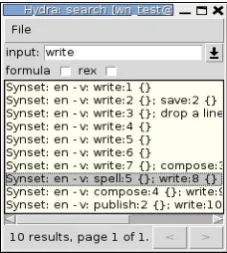
Figure 1: Search Window
Each dictionary in the second window contains multiple views for visualization of a synset. The dictionary is tied to a single language and displays the clone (see API) of the current object in this lan-guage. Dictionaries can be synchronized accord-ing to the users will.
Figure 2: The Dictionaries Window
Editing and adding new linguistic units is done directly in the main view of the dictionary. Data consistency during concurrent access is provided by locking of the edited units and their neighbours. User actions in navigation and editing can be can-celed one by one (undo), in groups (cancel) and redone (redo).
A detailed overview of the user interface and other features of the Hydra system is available in the user guide:
http://dcl.bas.bg/Tools/Hydra/ Hydra-UserManual.pdf
6 Data Representation
When developing a solution how to store and man-age the data, the choice fell to relational DBMS and specifically to MySQL. Hydra instances work directly with the MySQL server and take care for consistency of the data during the concurrent ac-cess. Modal formulas of the Language for Word-net are translated directly to SQL queries, each returning those object where the formula is true. The main data types are stored in the tables corre-sponding to their names: Synset, Literal and Note. The relation pair are in table Rel. Also the table Relation keeps the definitions of the relations in Wordnet. Hydra is designed to work in a very general case(Gamma et al., 1995). The data in an object type is not strictly fixed. Its structure is configured in module descriptor.py. Consider the structure of Synset.
class SynsetId(Table): table = ’Synset’
fields = (’id’, ’ili’, ’pos’, ’definition’, ’stamp’, ’bcs’, ’lang’,
’frequency’,’domain’)
foreign = {’pos’: POSId,
’lang’: LangId, ’domain’: DomainId}
In any such definition there are two mandatory fields: table – specifies the name of the database tables and fields – list of fields in that table. As is shown in the example, there is a third field, which is optional, foreign. It specifies the foreign key fields. Values in the dictionary are the descrip-tors of the tables whose keys are stored in the re-spective fields. Here, such field is pos, the part of speech of the synset. The ’Synset’ table stores only keys from the table ’POS’. Its descriptor is:
class POSId(Table): table = "POS"
fields = (’id’, ’name’)
easily accessible and its values can be easily mod-ified without affecting other tables in the database. For example, we can change the name of a part of speech, and that will not change any record in the table Synset. However, users will see the new name in the synsets. Another place where the changes need to be specified in the structure of the data is dbfeeder.py, which is responsible for database creation and feed with data.
7 API
The entry point of the Hydra API is the objectwn
in thewordnetmodule. Search by a formula is car-ried out with itsgetmethod. The method receives one argument, formula of the modal language, and returns a list of all the objects in which the formula is true. Objects in the result are in three types of objects, which build wordnet – Synset, Literal and Note. They are defined in thelinguistic units mod-ule.
To get all the synsets from language ’bg’:
>>> from wordnet import wn
>>> synsets = wordnet.get("lang(’bg’)")
wn.lingconstructs an object by its nominal (its ID in the database).
wn.relations is dictionary of the type ’relation name’: object of type Relation (defined in module relations.py)
7.1 Objects
The main wordnet object types inherit the class Ling. Here are its main methods.
1. to string(field=None) – return the string rep-resentation of the object. Can be called with an optional field name argument, in which case it returns its string value.
>>> literals = wn.get("word(’name’)") >>> print literals[0].to_string() name:1 {}
>>> print literals[0].to_string(’word’) name
More convenient way to access the field is:
>>> print literals[0][’word’] name
2. edit() – turns the object in edit mode
3. from string(value, field) – when in edit mode, the field receives the value
4. save() – save the changes and turns the object in non-edit mode.
>>> print literal[’word’] name
>>> literal.edit()
>>> literal.from_string(’NAME’, ’word’) >>> literal.save()
>>> print literal[’word’] NAME
5. check() – Used for data consistency checks of the object and its relations. The inherited ob-ject provides implementations to maintain the invariants in the Wordnet structure. It is used by the user interface. For example, when sav-ing a Synset it is mandatory to have at least one Literal. Literals are checked to have non-empty field word.
6. clonning(lang) – returns the corresponding object in the language lang. If lang is equal to the object language, the object itself is re-turned, otherwise the synset with the same ili as the synset associated with our object, but in language lang is returned.
Synset
literals() – returns the list of the literals in the synonym set.
7.2 Relations
Another type is that of the relations – Relation. It provides methods to add and remove elements of relation, use the reverse relation etc. Access to ob-jects for each of the relations in the database is provided by the wn.relations dictionary, the values being of type Relation or its inheritants, such as ReverseRelation.
>>> relation = wn.relations[’hypernym’] >>> relation[’name’]
u’hypernym’
>>> relation[’rname’] u’hyponym’
>>> synset = wn.get("<literal>word(’game’)")[0] >>> print relation.neighbours(synset)[0].to_string() en - n: activity:2 {}
The example demonstrated the method neighbours, which returns the immediate neighbours of the given linguistic object.
7.3 Applications
The API is used in many products of DCL like the DCL Search Engine5, Bulgarian WordNet– web access6(RESTful webservice) etc. The GUI classes were used for the open source corpora an-notation tool Chooser7but their use is beyond the scope of this paper.
Acknowledgments
This paper was prepared within the project In-tegrating New Practices and Knowledge in
Un-5
http://search.dcl.bas.bg
6http://metashare.ibl.bas.bg/
7http://dcl.bas.bg/en/Chooser.html. Also
dergraduate and Graduate Courses in Compu-tational Linguistics (BG051PO001-3.3.06-0022) implemented with the financial support of the Hu-man Resources Development OP 2007-2013 co-financed by the European Social Fund of the EU. The author takes full responsibility for the con-tent and under no conditions can the conclusions be considered a position of the European Union or the Ministry of Education, Youth and Science of the Republic of Bulgaria.
References
Erich Gamma, R. Helm, R. Johnson and J. Vlissides.
1995. Design Patterns: Elements of Reusable
Object-Oriented Software. Addison-Wesley.
Svetla Koeva, S. Mihov and T. Tinchev. 2004.
Bul-garian Wordnet - Structure and Validation volume 7, No. 1-2: 61–78. Journal: Romanian Journal of Information Science and Technology.
Svetla Koeva 2010. Bulgarian Wordnet - current state,
applications and prospects. Bulgarian-American Dialogues, Prof. M. Drinov Academic Publishing House. Sofia. 120–132
Borislav Rizov. 2008. Processing Wordnet with Modal
Logic: 93–100. Proceedings of the 6th International Conference on Formal Approaches to South Slavic and Balkan Languages.
Piek Vossen. 2004. EuroWordNet: A Multilingual