Modelling Human Clarification Strategies
Svetlana Stoyanchev, Alex Liu, Julia Hirschberg
Columbia University, New York NY 10027
sstoyanchev, al3037, julia @cs.columbia.edu
Abstract
We model human responses to speech recog-nition errors from a corpus of human clarifi-cation strategies. We employ learning tech-niques to study 1) the decision to either stop and ask a clarification question or to continue the dialogue without clarification, and 2) the decision to ask a targeted clarification question or a more generic question. Targeted clarifi-cation questions focus specifically on the part of an utterance that is misrecognized, in con-trast with generic requests to ‘please repeat’ or ‘please rephrase’. Our goal is to generate targeted clarification strategies for handling er-rors in spoken dialogue systems, when appro-priate. Our experiments show that linguis-tic features, in parlinguis-ticular the inferred part-of-speech of a misrecognized word are predictive of human clarification decisions. A combina-tion of linguistic features predicts a user’s de-cision to continue or stop a dialogue with ac-curacy of 72.8% over a majority baseline accu-racy of 59.1%. The same set of features predict the decision to ask a targeted question with ac-curacy of 74.6% compared with the majority baseline of 71.8%.1
1 Introduction
Clarification questions are common in human-human dialogue. They help dialogue participants main-tain dialogue flow and resolve misunderstandings. Purver (2004) finds that in human-human dialogue speakers most frequently userepriseclarification ques-tions to resolve recognition errors. Reprise clarification questions use portions of the misunderstood utterance which are thought to be correctly recognized totarget the part of an utterance that was misheard or misunder-stood. In the following example from (Purver, 2004), Speaker B has failed to hear the wordtoastand so con-structs a clarification question using a portion of the correctly understood utterance — the wordsome— to query the portion of the utterance B has failed to under-stand:
1This work was partially funded by DARPA HR0011-12-C-0016 as a Columbia University subcontract to SRI Interna-tional.
A: Can I havesometoastplease? B: Some?
A: Toast.
Unlike human conversational partners, most di-alogue systems today employ generic ‘please re-peat/rephrase’ questions asking a speaker to repeat or rephrase an entire utterance. Our goal is to introduce reprise, or targeted, clarifications into an automatic spoken system. Targeted clarifications can be espe-cially useful for systems accepting unrestricted speech, such as tutoring systems, intelligent agents, and speech translation systems. Using a reprise question, a user can correct an error by repeating only a portion of an utterance. Targeted questions also provide natural grounding and implicit confirmation by signalling to the conversation partner which parts of an utterance have been recognized.
In order to handle a misrecognition, the system must first identify misrecognized words (Stoyanchev et al., 2012), determine the type of question to ask, and con-struct the question. In this work, we address two points necessary for determining the type of question to ask:
• Is it appropriate for a system to ask a clarification
question when a misrecognized word is detected?
• Is it possible to ask a targeted clarification ques-tion for a given sentence and an error segment? To answer these questions, we analyze a corpus of hu-man responses to transcribed utterances with missing information which we collected using Amazon Me-chanical Turk (2012). Although the data collection was text-based, we asked annotators to respond as they would in a dialogue. In Section 2, we describe related work on error recovery strategies in dialogue systems. In Section 3, we describe the corpus used in this exper-iment. In Section 4, we describe our experiments on human clarification strategy modelling. We conclude in Section 5 with our plan for applying our models in spoken systems.
2 Related work
To handle errors in speech recognition, slot-filling di-alogue systems typically use simple rejection (“I’m sorry. I didn’t understand you.”) when they have low confidence in a recognition hypothesis and ex-plicit or imex-plicit confirmation when confidence scores
are higher. Machine learning approaches have been successfully employed to determine dialogue strate-gies (Bohus and Rudnicky, 2005; Bohus et al., 2006; Rieser and Lemon, 2006), such as when to provide help, repeat a previous prompt, or move on to the next prompt. Reiser and Lemon (2006) use machine learn-ing to determine an optimal clarification strategy in multimodal dialogue. Komatani et al. (2006) propose a method to generate a help message based on perceived user expertise. Corpus studies on human clarifications in dialogue indicate that users ask task-related ques-tions and provide feedback confirming their hypothesis instead of giving direct indication of their misunder-standing (Skantze, 2005; Williams and Young, 2004; Koulouri and Lauria, 2009). In our work, we model human strategies with the goal of building a dialogue system which can generate targeted clarification ques-tions for recognition errors that require additional user input but which can also recover from other errors au-tomatically, as humans do.
3 Data
In our experiments, we use a dataset of human re-sponses to missing information, which we collected with Amazon Mechanical Turk (AMT). Each AMT an-notator was given a set of Automatic Speech Recog-nition (ASR) transcriptions of an English utterance with a single misrecognized segment. 925 such utter-ances were taken from acted dialogues between En-glish and Arabic speakers conversing through SRI’s IraqCommspeech-to-speech translation system (Akba-cak et al., 2009). Misrecognized segments were re-placed by“XXX”to indicate the missing information, simulating a dialogue system’s automatic detection of misrecognized words (Stoyanchev et al., 2012). For each sentence, AMT workers were asked to 1) indi-cate whether other information in the sentence made its meaning clear despite the error, 2) guess the miss-ing word if possible, 3) guess the missmiss-ing word’s part-of-speech (POS) if possible, and 4) create a targeted clarification question if possible. Three annotators an-notated each sentence. Table 1 summarizes the results. In 668 (72%) of the sentences an error segment corre-sponds to a single word while in 276 (28%) of them, an error segment corresponds to multiple words. For mul-tiple word error segments, subjects had the option of guessing multiple words and POS tags. We scored their guess correct if any of their guesses matched the syn-tactic head word of an error segment determined from an automatically assigned dependency parse structure.
We manually corrected annotators’ POS tags if the hypothesized word was itself correct. After this post-processing, we see that AMT workers hypothesized POS correctly in 57.7% of single-word and 60.2% of multi-word error cases. They guessed words correctly in 34.9% and 19.3% of single- and multi-word error cases. They choose to ask a clarification question in 38.3% /47.9% of cases and 76.1%/62.3% of these ques-tions were targeted clarification quesques-tions. These
re-Single-word Agree Multi-word
error error
Total sent 668 (72%) - 276 (28%)
Correct POS 57.7% 62% 60.2%
Correct word 34.9% 25% 19.3%
Ask a question 38.3% 39% 47.9%
[image:2.595.308.536.64.150.2]Targeted question 76.1% 25% 62.3%
Table 1: Annotation summary for single-word and multi-word error cases. Absolute annotator agreement is shown for single-word error cases.
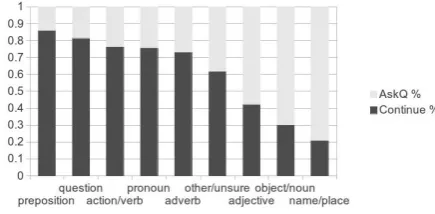
sults indicate that people are often able to guess a POS tag and sometimes an actual word. We observe that 1) in a single-word error segment, subjects are better at guessing an actual word than they are in a multi-word error segment; and 2) in a multi-word error segment, subjects are more likely to ask a clarification question and less likely to ask a targeted question. All three an-notators agree on POS tags in 62% of cases and on hy-pothesized words in 25%. Annotators’ agreement on response type is low — not surprising since there is more than one appropriate and natural way to respond in dialogue. In 39% of cases, all three annotators agree on the decision to stop/continue and in only 25% of cases all three annotators agree on asking a targeted clarification question. Figure 1 shows the annotator
Figure 1:Distribution of decisions to ask a question or continue dialogue without a question.
distribution for asking a clarification question vs. con-tinuing the dialogue based on hypothesized POS tag. It indicates that annotators are more likely to ask a ques-tion than continue without a quesques-tion when they hy-pothesize a missing word to be a content word (noun or adjective) or when they are unsure of the POS of the missing word. They are more likely to continue when they believe a missing word is a function word. How-ever, when they believe a missing word is a verb, they are more likely to continue, and they are also likely to identify the missing verb correctly.
[image:2.595.310.528.382.489.2]Figure 2:Distribution of decisions for targeted, confir-mation, and generic question types.
4 Experiment
We use our AMT annotations to build classifiers for 1) choice of action: stop and engage in clarification vs. continue dialogue; and 2) type of clarification ques-tion (targeted vs. non-targeted) to ask. For the con-tinue/stopexperiment, we aim to determine whether a system should stop and ask a clarification question. For thetargeted vs. non-targetedexperiment, we aim to de-termine whether it is possible to ask a targeted clarifi-cation question.2
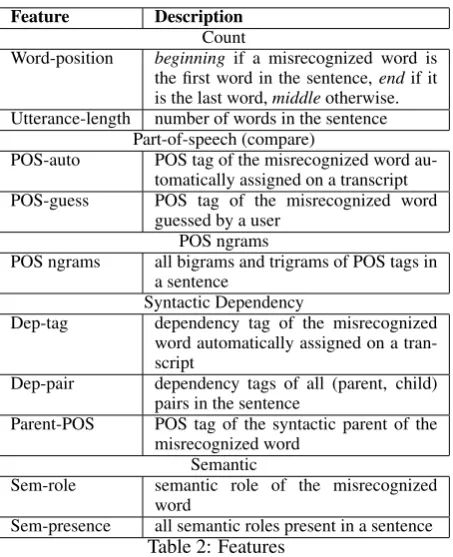
Using the Weka (Witten and Eibe, 2005) machine learning framework, we build classifiers to predict AMT decisions. We automatically assign POS tags to transcripts using the Stanford tagger (Toutanova and others, 2003). We compare models built with an au-tomatically tagged POS for an error word (POS-auto) with one built with POS guessed by a user (POS-guess). Although a dialogue manager may not have access to a correct POS, it may simulate this by pre-dicting POS of the error. We assign dependency tags using the AMU dependency parser (Nasr et al., 2011) which has been optimized on the Transtac dataset.
We hypothesize that a user’s dialogue move depends on the syntactic structure of a sentence as well as on syntactic and semantic information about the er-ror word and its syntactic parent. To capture sentence structure, we use features associated with the whole sentence: POS ngram, all pairs of parent-child depen-dency tags in a sentence (Dep-pair), and all semantic roles (Sem-presence) in a sentence. To capture the syn-tactic and semantic role of a misrecognized word, we use features associated with this word: POS tag, depen-dency tag (Dep-tag), POS of the parent word (Parent-POS), and semantic role of an error word (Sem-role).
We first model individual annotators’ decisions for each of the three annotation instances. We measure the value that each feature adds to a model, using an-notators’ POS guess (POS-guess). Next, we model a joint annotators’ decision using the automatically as-signedPOS-autofeature. This model simulates a sys-tem behaviour in a dialogue with a user where a syssys-tem chooses a single dialogue move for each situation. We run 10-fold cross validation using the Weka J48
Deci-2If any annotators asked a targeted question, we assign a positive label to this instance, and negative otherwise.
sion Tree algorithm.
Feature Description
Count
Word-position beginning if a misrecognized word is the first word in the sentence,endif it is the last word,middleotherwise. Utterance-length number of words in the sentence
Part-of-speech (compare)
POS-auto POS tag of the misrecognized word au-tomatically assigned on a transcript POS-guess POS tag of the misrecognized word
guessed by a user POS ngrams
POS ngrams all bigrams and trigrams of POS tags in a sentence
Syntactic Dependency
Dep-tag dependency tag of the misrecognized word automatically assigned on a tran-script
Dep-pair dependency tags of all (parent, child) pairs in the sentence
Parent-POS POS tag of the syntactic parent of the misrecognized word
Semantic
Sem-role semantic role of the misrecognized word
Sem-presence all semantic roles present in a sentence
Table 2: Features 4.1 Stop/Continue Experiment
In this experiment, we classify each instance in the dataset into a binarycontinueor stopdecision. Since each instance is annotated by three annotators, we first predict individual annotators’ decisions. The absolute agreement on continue/stop is 39% which means that 61% of sentences are classified into both classes. We explore the role of each feature in predicting these de-cisions. All features used in this experiment, except for thePOS-guessfeature, are extracted from the sentences automatically. Variation in thePOS-guessfeature may explain some of the difference between annotator deci-sions.
Features Acc F-measure %Diff
Majority baseline 59.1%
All features 72.8%† 0.726 0.0%
less utt length 72.9%† 0.727 +0.1% less POS ngrams 72.8%† 0.727 +0.1% less Semantic 72.6%† 0.724 -0.3% less Syn. Depend. 71.5%† 0.712 -1.9% less Position 71.2%† 0.711 -2.0%
less POS 67.9%† 0.677 -6.7%
[image:3.595.308.535.83.362.2]POS only 70.1%† 0.690 -5.0%
Table 3: Stop/Continue experiment predicting individ-ual annotator’s decision withPOS-guess. Accuracy, F-measure and Difference of f-F-measure fromAll feature.
†indicates statistically significant difference from the majority baseline (p<.01)
[image:3.595.309.526.534.693.2]Next, we evaluate the utility of each feature by re-moving it from the feature set and comparing the model built without it with a model built on all features. POS is the most useful feature, as we expected: when it is removed from the feature set, the f-measure decreases by 6.7%. A model trained on the POS-guessfeature alone outperforms a model trained on all other features. Wordpositionin the sentence is the next most salient feature, contributing 2% to the f-measure. The syntac-tic dependency featuresSyn-Dep, Dep-pair,andParent POStogether contribute 1.9%.3
Next, we predict a majority decision for each sen-tence. Table 4 shows the accuracy of this prediction. A majority baseline has an accuracy of 59.9%. When we use a model trained on thePOS-autofeature alone, accuracy rises to 66.1%, while a combination of all fea-tures further increases it to 69.2%.
Features Acc F-measure
Majority baseline 59.9%
POS 66.1%† 0.655
[image:4.595.310.526.62.193.2]All features 69.2%† 0.687
Table 4: Stop/Continue experiment predicting majority decision, usingPOS-auto. †indicates statistically sig-nificant difference from the majority baseline (p<.01).
4.2 Targeted Clarification Experiment
In this experiment, we classify each instance into tar-getedornot targetedcategories. Thetargetedcategory comprises the cases in which an annotator chooses to stop and ask a targeted question. We are interested in identifying these cases in order to determine whether a system should try to ask a targeted clarification ques-tion. Table 5 shows the results of this experiment. The majority baseline predictsnot targetedand has a 71.8% accuracy because in most cases, no question is asked. A model trained on all features increases accuracy to 74.6%. POS is the most salient feature, contributing 3.8% to the f-measure. All models that use POS fea-ture are significantly different from the baseline. The next most salient features are POS ngram and a com-bination of syntactic dependency features contributing 1% and .5% to the f-measure respectively.
Table 6 shows system performance in predicting a joint annotators’ decision of whether a targeted ques-tion can be asked. A joint decision in this experiment is considerednot targetedwhen none of the annotators chooses to ask a targeted question. We aim at identi-fying the cases where position of an error word makes it difficult to ask a clarification question, such as for a sentenceXXX somebody steal these supplies.Using the automatically assigned POS (POS-auto) feature alone achieves an accuracy of 62.2%, which is almost 10% above the baseline. A combination of all features, sur-prisingly, lowers the accuracy to 59.4%. Interestingly, a combination of all featuresless POSincreases accuracy
3All trained models are significantly different from the baseline. None of the trained models are significantly dif-ferent from each other.
Features Acc F-measure %Diff
Majority baseline 71.8%
All features 74.6%† 0.734 0.0%
All feature (POS guess)
less Utt length 74.8%† 0.736 +0.3% less Position 74.9%† 0.731 -0.4% less Semantic 74.8%† 0.737 +0.4% less Syn. Depend. 74.2%† 0.730 -0.5% less POS ngram 74.2%† 0.727 -1.0%
less POS 74.0% 0.706 -3.8%
[image:4.595.323.511.271.326.2]POS 74.1%† 0.731 -0.4%
Table 5: Targeted/not experiment predicting individ-ual annotator’s decision withPOS-guess. Accuracy, F-measure and Difference of f-F-measure fromAll feature.
†indicates statistically significant difference from the majority baseline (p<.05)
above the baseline by 7.6% points to 60.1% accuracy.
Features Acc F-measure
Majority baseline 52.5%
POS only 62.2%† 0.622
All features 59.4%† 0.594 All featuresless POS 60.1%† 0.600
Table 6: Targeted/not experiment predicting majority decision, using POS tag featurePOS-auto. †indicates statistically significant difference from the majority baseline.
5 Conclusions and Future Work
In this paper we have described experiments modelling human strategies in response to ASR errors. We have used machine learning techniques on a corpus anno-tated by AMT workers asked to respond to missing in-formation in an utterance. Although annotation agree-ment in this task is low, we aim to learn natural strate-gies for a dialogue system by combining the judge-ments of several annotators. In a dialogue, as in other natural language tasks, there is more than one appro-priate response in each situation. A user does not judge the system (or another speaker) by a single response. Over a dialogue session, appropriateness, or lack of it in system actions, becomes evident. We have shown that by using linguistic features we can predict the de-cision to either ask a clarification question or continue dialogue with an accuracy of 72.8% in comparison with the 59.1% baseline. The same linguistic features pre-dict a targeted clarification question with an accuracy of 74.6% compared to the baseline of 71.8%.
[image:4.595.97.268.274.320.2]References
M. Akbacak, Franco, H., M. Frandsen, S. Hasan, H. Jameel, A. Kathol, S. Khadivi, X. Lei, A. Man-dal, S. Mansour, K. Precoda, C. Richey, D. Vergyri, W. Wang, M. Yang, and J. Zheng. 2009. Recent ad-vances in SRI’s IraqCommtm Iraqi Arabic-English speech-to-speech translation system. In ICASSP, pages 4809–4812.
Amazon Mechanical Turk. 2012. http://aws.amazon.com/mturk/, accessed on 28 may, 2012.
D. Bohus and A. I. Rudnicky. 2005. A principled ap-proach for rejection threshold optimization in spoken dialog systems. In INTERSPEECH, pages 2781– 2784.
D. Bohus, B. Langner, A. Raux, A. Black, M. Eske-nazi, and A. Rudnicky. 2006. Online supervised learning of non-understanding recovery policies. In Proceedings of SLT.
Y. Fukubayashi, K. Komatani, T. Ogata, and H. Okuno. 2006. Dynamic help generation by estimating user’s mental model in spoken dialogue systems. In Pro-ceedings of the International Conference on Spoken Language Processing (ICSLP).
T. Koulouri and S. Lauria. 2009. Exploring miscom-munication and collaborative behaviour in human-robot interaction. In SIGDIAL Conference, pages 111–119.
A. Nasr, F. B´echet, J.F. Rey, B. Favre, and J. Le Roux. 2011. Macaon: an nlp tool suite for processing word lattices. In Proceedings of the 49th Annual Meeting of the Association for Computational Lin-guistics: Human Language Technologies: Systems Demonstrations, pages 86–91. Association for Com-putational Linguistics.
M. Purver. 2004. The Theory and Use of Clarification Requests in Dialogue. Ph.D. thesis, King’s College, University of London.
V. Rieser and O. Lemon. 2006. Using machine learn-ing to explore human multimodal clarification strate-gies. InACL.
G. Skantze. 2005. Exploring human error recov-ery strategies: Implications for spoken dialogue sys-tems.Speech Communication, 45(2-3):325–341.
Svetlana Stoyanchev, Philipp Salletmayr, Jingbo Yang, and Julia Hirschberg. 2012. Localized detection of speech recognition errors. InSLT, pages 25–30. IEEE.
K. Toutanova et al. 2003. Feature-rich part-of-speech tagging with a cyclic dependency network. In Pro-ceedings of the 2003 Conference of the North Amer-ican Chapter of the Association for Computational Linguistics on Human Language Technology - Vol-ume 1. Association for Computational Linguistics.
J. D. Williams and S. Young. 2004. Characterizing task-oriented dialog using a simulated ASR channel. InProceedings of the ICSLP, Jeju, South Korea. I. Witten and F. Eibe. 2005. Data Mining: