A Semantic Feature for Statistical Machine Translation
Rafael E. Banchs
Marta R. Costa-jussà
Institute for Infocomm Research
Barcelona Media Innovation Centre
1 Fusionopolis Way, 21-01, Singapore 138632
Av. Diagonal 177, planta 9, 08018 Barcelona
[email protected]
[email protected]Abstract
A semantic feature for statistical machine trans-lation, based on Latent Semantic Indexing, is proposed and evaluated. The objective of the proposed feature is to account for the degree of similarity between a given input sentence and each individual sentence in the training dataset. This similarity is computed in a reduced vector-space constructed by means of the Latent Se-mantic Indexing decomposition. The computed similarity values are used as an additional fea-ture in the log-linear model combination ap-proach to statistical machine translation. In our implementation, the proposed feature is dy-namically adjusted for each translation unit in the translation table according to the current in-put sentence to be translated. This model aims at favoring those translation units that were ex-tracted from training sentences that are seman-tically related to the current input sentence being translated. Experimental results on a Spanish-to-English translation task on the Bible corpus demonstrate a significant improvement on translation quality with respect to a baseline system.
1
Introduction
In recent years, the statistical approach to machine translation has gained a lot of attention from both the scientific and the commercial perspective. This has basically been a consequence of the increasing availability of bilingual training material as well as the increasing storage and processing capabilities of current computational systems, which have al-lowed for the construction of machine translation systems with general-public acceptance quality.
For several reasons, the most prominent statisti-cal machine translation paradigm currently used is the phrase-based approach (Koehn et al., 2003), which has been derived from the IBM’s word-based approach originally proposed in the early 90’s (Brown et al., 1993). This original approach was heavily rooted on the noisy-channel model framework, which, in our view, continues to play an important role in the fundamental conception of current statistical machine translation.
While one of the major assumptions of the noisy-channel model approach is the independence between decoding and source language probabili-ties, there exists strong evidence on the important role played by source language structure and con-text within the task of human translation (Padilla & Bajo, 1998). In this sense, the inability of main-stream statistical machine translation to tackle with source-context information in a reliable way has been already recognized as a major drawback of the statistical approach, whereas the use of source-context information has been proven to be effec-tive in the case of example-based machine transla-tion (Carl & Way, 2003). In this regard, attempts for incorporating source-context information into the phrase-based machine translation framework have been already reported (Carpuat & Wu, 2007; Carpuat & Wu, 2008; Haque et al., 2009; España-Bonet et al., 2009; Haque et al., 2010; Costa-jussà & Banchs, 2010). However, as far as we know, no transcendental improvements in performance have been achieved or, at least, reported yet.
In this work, we elaborate deeper on the ideas we have recently presented and discussed in Costa-jussà & Banchs (2010), where we used a similarity metric between the source sentence to be translated and all the sentences in the training set as an
tional feature in the log-linear combination (Och & Ney, 2002) of models of a phrase-based translation system. Such a feature, which is dynamic in the sense that depends on the input sentence to be translated, is intended to favor those translation units which were extracted from training sentences that are similar to the current input sentence over those translation units which were extracted from different or unrelated sentences. Different from our original methodology, where sentence similarities were assessed over a term-document matrix repre-sentation for words and statistical classes of words, here we compute sentence similarities in a low-dimensional vector space constructed by means of Latent Semantic Indexing (Landauer et al., 1998).
The rest of the paper is organized as follows. Section 2 presents an overview of some recent ap-proaches attempting to introduce source-context information into the statistical machine translation framework. Then, section 3 introduces the meth-odology that is proposed and evaluated in this work, and section 4 focuses on some implementa-tion issues. Secimplementa-tion 5 describes the experimental settings and results. Section 6 presents a manual evaluation of a selected sample of system transla-tions and discusses the most relevant findings and observations. Finally, section 7 presents the most relevant conclusions of this work and provides guidelines for further research in this area.
2
Related Work
Several attempts for incorporating source-context information into the statistical machine translation framework have been reported in the literature dur-ing the last few years. Without attemptdur-ing to be comprehensive, we provide a brief overlook of some of the most sounded recent works within this area which are relevant to the phrase-based statisti-cal machine translation approach. For a more com-prehensive review of the state-of-the-art, the reader can refer to Haque et al. (2010).
On the one hand, there are some semantic ap-proaches. In Carpuat & Wu (2007), for instance, word sense disambiguation techniques are intro-duced into statistical machine translation; and in Carpuat & Wu (2008), dynamically-built context-dependant phrasal translation lexicons are shown to be more useful for phrase-based machine trans-lation than conventional static phrasal transtrans-lation lexicons, which ignore all contextual information.
On the other hand, there are approaches which use machine learning techniques. In Haque et al. (2009), different syntactic and lexical features are proposed for incorporating information about the neighbouring words; and in España-Bonet et al. (2009), local classifiers are trained, using linguistic and context information, to translate a phrase.
Finally, our recent approach, which is inspired on information retrieval techniques for measuring the source-context similarity between the input sentence to be translated and the original training material, was presented in Costa-jussà & Banchs (2010). As our present methodology is closely re-lated to this approach, more details are provided in the following section.
3
Proposed Methodology
As already mentioned, the methodology proposed and evaluated in this work is based on the source-context similarity approach we presented in Costa-jussà & Banchs (2010). Different from that work, here we introduce the use Latent Semantic Index-ing (Landauer et al., 1998) to construct a vector-space model representation of the data collection in a reduced-dimensionality space before computing source sentence similarities. First, in subsection 3.1, we review the source-context similarity ap-proach. Then, in subsection 3.2 we present the ba-sics of Latent Semantic Indexing.
3.1
The Source-Context Similarity ApproachThe method we proposed in Costa-jussà & Banchs (2010) introduces and extended concept of transla-tion unit or phrase by defining a tuple of three ele-ments: phrase-source-side, phrase-target-side, and source-context:
TU = {PSS ||| PTS ||| SC} . (1)
ojos están brillantes por el vino y sus dientes blan-cos por la leche}. Notice that, from this definition, identical source-target phrase pairs that have been extracted from different training sentences are re-garded as different translation units!
According to this definition, the relatedness of contexts between any translation unit and an input sentence to be translated can be computed by means of some distance or similarity metric over a semantic space representation for sentences. This idea is implemented in practice by means of the following dynamic feature function:
F(TU,IN) = SIM(TU,IN) = SIM(SC,IN) , (2)
where TU refers to a given translation unit, IN re-fers to the input sentence to be translated, SC rere-fers to the source-context component of translation unit TU (which in our implementation is the source training sentence which the translation unit was extracted from), and SIM is a similarity metric over a given model space.
As implied in (2), the source-context feature to be implemented consists of a similarity measure-ment between the input sentence to be translated IN and the source-context component SC of the available translation units.
In Costa-jussà & Banchs (2010), we used the cosine of the angle between vectors in a term-sentence matrix representation (Salton et al., 1975) for computing the source-context similarity feature described in (2). In this work, we use Latent Se-mantic Indexing (Landauer et al., 1998) for pro-jecting the term-sentence matrix representation into a low-dimensional space and use the cosine of the angle between vectors in the resulting reduced space for computing the source-context similarity feature. With this, we expect to reduce the noise resulting from data sparseness problems in the original full-dimensional representation.
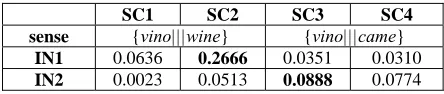
To better illustrate the concepts discussed here, let us consider the Spanish word vino and the cor-responding English translations for its two senses: wine and came. Both translations can be automati-cally inferred from training data; and Table 1 illus-trates the resulting probability values derived for both senses of the Spanish word vino from the ac-tual training dataset used in this work (a detailed description of the dataset is given in section 5).
Notice from the table, how in general the most probable sense of vino in our considered dataset is
wine. This actually happens because the English word wine is always related to the Spanish word vino, whereas the English word came can refer to many different inflections of the same Spanish word: vine, viniste, vino, vinimos, vinieron, etc.
phrase φ(f|e) lex(f|e) φ(e|f) lex(e|f)
{vino|||wine} 0.665198 0.721612 0.273551 0.329431 {vino|||came} 0.253568 0.131398 0.418478 0.446488
Table 1: Actual probability values for the two pos-sible translations of the Spanish word vino.
The idea of the proposed source-context feature is to use the contextual similarity between the input sentence to be translated and the sentences in the training dataset as an additional source of informa-tion that should be helpful during decoding.
Consider for instance the following two sen-tences corresponding to the wine sense of vino:
SC1: No habéis comido pan ni tomado vino ni licor , para que se-páis que yo soy Jehovah vuestro Dios . (Ye have not eaten bread , neither have ye drunk wine or strong drink : that ye might know that I am the Lord your God .)
SC2: Cuando fue divulgada esta orden , los hijos de Israel dieron muchas primicias de grano , vino nuevo , aceite , miel y de todos los frutos de la tierra . (And as soon as the commandment came abroad , the children of Israel brought in abundance the firstfruits of corn , wine , and oil , and honey , and of all the increase of the field .)
and the following two sentences corresponding to the came sense of vino:
SC3: Al tercer día vino Jeroboam con todo el pueblo a Roboam , como el rey había hablado diciendo : Volved a mí al tercer día . (So Jeroboam and all the people came to Rehoboam the third day , as the king had appointed , saying , Come to me again the third day .)
SC4: Ella vino y ha estado desde la mañana hasta ahora . No ha vuelto a casa ni por un momento . (She came , and hath continued even from the morning until now , that she tarried a little in the house .)
As the context for a given word is generally de-termined by its surrounding words, we should be able to infer the correct sense for the word vino in a new Spanish sentence by considering its similar-ity to sentences SC1, SC2, SC3 and SC4. Now,
sup-pose we want to translate the following two input sentences into English:
IN2: Cuando amanecía , la mujer vino y cayó delante de la puerta de la casa de aquel hombre donde estaba su señor , hasta que fue de día . (Then came the woman in the dawning of the day , and fell down at the door of the man 's house where her lord was , till it was light .)
We can select the appropriate sense for vino in each case by considering the sentence similarity between each of these two sentences and “training” sentences SC1, SC2, SC3 and SC4. The actual
similar-ity values are presented in Table 2.
SC1 SC2 SC3 SC4 sense {vino|||wine} {vino|||came}
IN1 0.0636 0.2666 0.0351 0.0310
[image:4.612.74.296.188.235.2]IN2 0.0023 0.0513 0.0888 0.0774
Table 2: Actual similarity values between input and training sentences containing the word vino.
As seen from the table, the source-context simi-larity feature is actually giving preference to the phrase pair {vino|||wine} in the case of input sen-tence IN1 and to {vino|||came} in the case of IN2.
Notice that more than one similarity value is gen-erally available for each phrase pair. In our pro-posed implementation, the largest similarity value is the one that is retained. More details on how we compute these sentence similarities are given in the following subsection.
3.2
Latent Semantic IndexingLatent Semantic Indexing (Landauer et al., 1998) can be regarded as the text mining equivalent of Principal Component Analysis (Pearson, 1901). Both methods are based on the singular value de-composition (SVD) of a matrix (Golub & Kahan, 1965), according to which a rectangular matrix X of dimensions MxN can be factorized as follows:
X = UΣVT , (3)
where U and V are unitary matrices of dimensions MxM and NxN, respectively, and Σ is a diagonal matrix containing the singular values associated to the decomposition.
According to Landauer et al. (1998), a low-dimensional representation of a given document vector x can be obtained by means of the SVD de-composition depicted in (3) as follows:
yT = xT UMxL , (4)
where y is the L-dimensional document vector
cor-responding to the projection of an M-dimensional document vector x, and UMxL is a matrix
contain-ing the L first column vectors of the unitary matrix U obtained from (3).
Finally, the feature F(TU,IN) described in (2) is implemented as the internal product between nor-malized versions of the vector projections obtained in (4). In our case, a vector-space model represen-tation is constructed for sentences, instead of documents, and the source-context similarity val-ues between translation units and input sentences are computed accordingly:
F (TU, IN) = (5)
<scT UMxL / |scTUMxL| , inT UMxL / |inTUMxL|>
While the value of M is given by the vocabulary size in the data collection under consideration, se-veral implementation questions arise regarding the most appropriate values for N (amount of sen-tences to be used for estimating the projection op-erator U) and L (the dimensionality of the reduced space). These and other implementation issues are discussed in detail in the following section.
4
Implementation Issues
This section discusses some important implemen-tation issues that have to be dealt with in order to implement and evaluate the proposed approach. First, in subsection 4.1, the problem of implement-ing a dynamic feature in a standard phrase-based machine translation framework is discussed. Then, in subsections 4.2 and 4.3, the problems of deter-mining the amount of data required for estimating the Latent Semantic Indexing projection operator and the most appropriate dimensionality size for the reduced space representation are discussed.
4.1
Implementing a Dynamic FeatureAs defined in (2), the value of the proposed source-context similarity feature depends on each individ-ual input sentence to be translated by the system. This definition implies a major difference between this feature and other conventional phrase-based translation features: it is a dynamic feature in the sense that it cannot be computed in advance before the input sentences to be translated are known.
makes it not possible to directly implement the proposed methodology within a standard phrase-based machine translation framework such as MOSES (Koehn et al., 2007). As it is not our in-tention to develop a customized decoding tool for implementing and testing our proposed feature, we followed or previous implementation of an off-line version of the proposed methodology (Costa-jussà & Banchs, 2010), which, although very inefficient in the practice, allows us to evaluate the impact of the source-context feature on a state-of-the-art phrase-based translation system.
According to this, our practical implementation is a follows:
• Two sentence similarity matrices are com-puted: one between sentences in the devel-opment and training sets, and the other between sentences in the test and training datasets.
• Each matrix entry mij should contain the
similarity score between the ith sentence in
the training set and the jth sentence in the
development (or test) set.
• For each sentence s in the test and develop-ment sets, a phrase list LS of all potential
phrases that can be used during decoding is extracted from the aligned training set.
• The corresponding source-context similarity values are assigned to each phrase in lists LS
according to values in the corresponding similarity matrices.
• Each phrase list LS is collapsed into a phrase
table TS by removing repetitions (when
re-moving repeated entries in the list, the larg-est value of the source-context similarity feature is retained).
• Each phrase table is completed by adding standard feature values (which are computed in the standard manner).
• MOSES is used on a sentence-per-sentence basis, using a different translation table for each development (or test) sentence.
4.2
Dataset for Latent Semantic IndexingAnother important implementation issue that re-quires attention is the computation of the Singular Value Decomposition described in (3). Ideally, the term-sentence matrix X to be decomposed should include all available data, i.e. training, develop-ment and test sentences; however, in the practice,
this is not possible because of two reasons. First, the sizes of typical datasets and vocabularies used in statistical machine translation systems are large enough to make Singular Value Decomposition unfeasible from a computational point of view1. Second, in a practical application system, the “test set” is actually unknown during the system con-struction and training phases. In this way, a realis-tic implementation should be able to work with previously unseen data.
In order to overcome the problem of applying the Singular Value Decomposition described in (3) to the full term-sentence matrix of all available data, we implemented an approximated procedure. In our approximation, we compute the similarity matrix between two set of sentences as the average of several similarity matrices that are computed over reduced space projections estimated with dif-ferent random samples of the training data sen-tences. In this way, our source-context similarity feature, previously defined in (5), becomes:
F (TU, IN) ≈ (6)
1/K Σk <scTUkMxL/|scTUkMxL| , inTUkMxL/|inTUkMxL|>
where UkMxL refers to a projection operator that has
been computed by means of the Singular Valued Decomposition of a term-sentence matrix Xk con-structed with a random sample of N sentences. Note that a total of K different similarity scores are averaged in (6).
In order to evaluate the variability of the similar-ity values estimated by this approximation, several experiments were conducted for different values of N and L, where the variance of the estimates over K=10 different realizations were computed. Figure 1 shows the resulting standard deviations for simi-larity values estimated for different values of L when varying N (upper panel), and for different values of N when varying L (lower panel).
As seen from the figure, the range 500<N<1000 seems to constitute a good compromise between the size of selected random sentence sets and the observed variability for similarity value estimates, as it provides a significant reduction in the com-puted standard deviations with respect to N=100, and not important improvement is observed when
1 Even in the case of a small dataset such as the one
N>1000. According to this, we selected N=1000 for our proposed approximation described in (6).
Figure 1: Standard deviations (STD) for similarity values between development and test datasets (de-scribed in section 5) estimated for different values of L when varying N (upper panel), and for differ-ent values of N when varying L (lower panel). In all cases K=10.
4.3
Reduced Space DimensionalityThe third and final implementation issue to be dis-cussed is the selection of the reduced space dimen-sionality. It have been reported in the literature that dimensionality reduction, by means of Latent Se-mantic Indexing, into the range between 100 and 1000 provides good space representations for word and sentence association applications (Landauer et al., 1998). Although it is reasonable to assume this condition to be valid also for the application under consideration, we conducted a more detailed ex-ploratory analysis for selecting the dimensionality L to be used in our experiments.
First, we studied the distributions of context-similarity values computed according to (6) over the available data. Figure 2 shows the average dis-tributions of similarities between sentences in the development and training datasets (see data de-scription in section 5) at different dimensionality values. As can be seen from the figure, a dimen-sionality value of L=100 exhibits a very nice dis-tribution of similarity values; however, according to the results depicted in Figure 1 (lower panel), the variability of estimates for such a low dimen-sionality is relatively high. On the other hand, no-tice again from Figure 2, how a much larger
dimensionality value such as L=5000 already starts to exhibit a distribution of similarities that is heav-ily biased towards the low similarity region. Ac-cording to this result, and taking also into account the results in Figure 1, we finally decided setting the dimensionality of the reduced space to L=500.
Figure 2: Average distributions of similarity values between development and training sentences com-puted at different dimensionality values. For all cases presented here N=500 and K=10.
5
Experimental Work
This section describes the experimental work con-ducted to evaluate the incidence of the proposed source-context similarity feature on translation quality for a state-of-the-art phrase-based statistical machine translation. First, subsection 5.1 describes the dataset and experimental setting. Then, subsec-tion 5.2 presents and discusses the results.
5.1
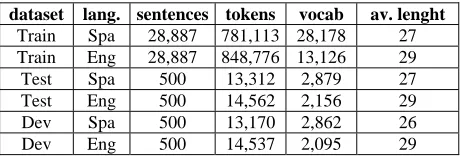
Experimental SettingThe proposed methodology is evaluated on the Bi-ble dataset (Chew et al., 2006) Spanish-to-English translation task, using the MOSES framework as baseline phrase-based statistical machine transla-tion system (Koehn et al., 2007). Table 3 presents the main statistics of the bilingual corpus used.
dataset lang. sentences tokens vocab av. lenght
[image:6.612.316.537.146.227.2]Train Spa 28,887 781,113 28,178 27 Train Eng 28,887 848,776 13,126 29 Test Spa 500 13,312 2,879 27 Test Eng 500 14,562 2,156 29 Dev Spa 500 13,170 2,862 26 Dev Eng 500 14,537 2,095 29
Table 3: Main statistics of the bilingual corpus un-der consiun-deration (number of sentences, tokens, vocabulary, and average sentence length)
[image:6.612.312.542.528.606.2]grow-final-diagonal alignment symmetrisation, the lexicalized reordering, a 5-gram language model using Kneser-Ney smoothing, and phrases up to length 10, among others. The optimization was done using the standard MERT procedure (Och & Ney, 2002).
[image:7.612.313.542.241.655.2]5.2
Experimental ResultsTable 4 presents the translation BLEU, measured over the development and test sets, for three differ-ent system implemdiffer-entations: the baseline system, a second system implementing the source-context similarity feature over the full-dimensional vector space (FVS), just as we implemented it in Costa-jussà & Banchs (2010), and a third system imple-menting the source-context similarity feature based on Latent Semantic Indexing (LSI).
Development Test
Baseline 39.92 38.92
Source-context (FVS) 40.61 39.43
Source-context (LSI) 40.80 39.86
Table 4: BLEU scores over development and test datasets corresponding to three system implemen-tations: baseline, and source-context similarity fea-ture at full-dimensional vector space (FVS) and by means of Latent Semantic Indexing (LSI).
As seen from the table, the system implementing the Latent Semantic Indexing based source-context similarity feature outperforms the baseline system by almost one absolute BLEU point, and the full-dimensional vector space system by some less than a half absolute BLEU point. An analysis of signifi-cance (Koehn, 2004) showed that the differences among the systems are statistically significant.
A more comprehensive manual analysis of both the baseline and source-context LSI system outputs was required to better asses the incidence of the implemented source-context similarity feature on the generated translations. The result of this analy-sis is presented in the following section.
6
Manual Evaluation
This section presents and discusses the results of a manual evaluation that was conducted over a sam-ple set of translations. Previous to the manual evaluation, we performed a sentence-based auto-matic evaluation using BLEU for the 500 sen-tences in the test dataset. We obtained that our
proposed approach is better than the baseline sys-tem in 208 sentences, while the baseline is better than our system in 173 sentences and the remain-ing 119 had the same BLEU scores.
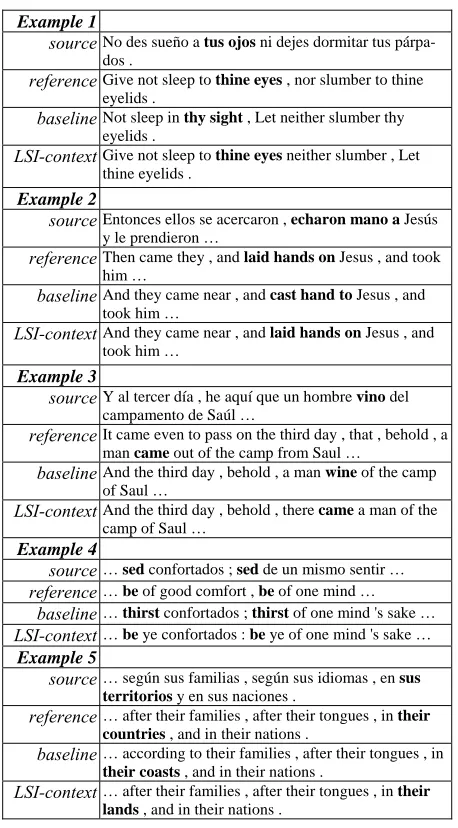
Some output sentences were randomly selected, regardless of which system performed better, for conducting a manual inspection. From these sen-tences, we have extracted some segments that illus-trate specific cases in which our proposed source-context feature is actually helping to select a better translation unit according to the context of the in-put sentence being translated. Five of these seg-ments are presented in Table 5, where the relevant fragments within the segments are shown in bold.
Example 1
sourceNo des sueño a tus ojos ni dejes dormitar tus párpa-dos .
referenceGive not sleep to thine eyes , nor slumber to thine eyelids .
baselineNot sleep in thy sight , Let neither slumber thy eyelids .
LSI-contextGive not sleep to thine eyes neither slumber , Let thine eyelids .
Example 2
sourceEntonces ellos se acercaron , echaron mano a Jesús y le prendieron …
referenceThen came they , and laid hands on Jesus , and took him …
baselineAnd they came near , and cast hand to Jesus , and took him …
LSI-contextAnd they came near , and laid hands on Jesus , and took him …
Example 3
sourceY al tercer día , he aquí que un hombre vino del campamento de Saúl …
referenceIt came even to pass on the third day , that , behold , a man came out of the camp from Saul …
baselineAnd the third day , behold , a man wine of the camp of Saul …
LSI-contextAnd the third day , behold , there came a man of the camp of Saul …
Example 4
source… sed confortados ; sed de un mismo sentir …
reference… be of good comfort , be of one mind …
baseline… thirst confortados ; thirst of one mind 's sake …
LSI-context… be ye confortados : be ye of one mind 's sake … Example 5
source… según sus familias , según sus idiomas , en sus territorios y en sus naciones .
reference… after their families , after their tongues , in their countries , and in their nations .
baseline… according to their families , after their tongues , in
their coasts , and in their nations .
[image:7.612.79.289.284.330.2]LSI-context… after their families , after their tongues , in their lands , and in their nations .
As seen from the table, the LSI-based source-context system is clearly accomplishing more ap-propriate unit selections. However, in most of the cases this does not imply either a better overall translation or a closer match to the available refer-ence translation. This can explain the relative low BLEU gain achieved by the method.
Similarly, we also extracted some segments that illustrate specific cases in which our proposed source-context feature fails in helping to select a better translation unit. Table 6 presents four of these cases.
Example 1
source … yo he sido enviado con malas noticias para ti .
reference … for I am sent to thee with heavy tidings .
baseline … for I have sent with evil tidings unto thee .
LSI-context … I am sent with evil tidings unto thee . Example 2
source … heredad de Jehovah son los hijos ; recompensa es el fruto del vientre .
reference … children are an heritage of the Lord : and the fruit of the womb is his reward .
baseline … the inheritance of the Lord , are the children ; reward is the fruit of the belly .
LSI-context … the inheritance of the Lord are the children , and reward is the fruit of the belly .
Example 3
source … y que había enaltecido su reino por amor a su pueblo Israel .
reference … and that he had exalted his kingdom for his people Israel 's sake .
baseline … and for his kingdom was lifted up his people Israel .
LSI-context … and for his kingdom was lifted up unto his people Israel .
Example 4
source Y sucederá que a causa de la abundancia de leche , comerá leche cuajada …
reference And it shall come to pass , for the abundance of milk that he shall eat butter …
baseline And it shall come to pass , that by reason of the
multitude of milk , shall eat with milk cuajada …
[image:8.612.73.301.218.537.2]LSI-context And it shall come to pass by reason of the multitude of milk , and shall eat with milk cuajada …
Table 6: Sample segments where the LSI-based source-context feature has failed to accomplish better translation unit selections.
In the latter examples in Table 6, the proposed source-context feature is clearly failing to provide better lexical selections. In some cases, this seems to be due to the lack of enough source-context in-formation in the input sentence to be translated. However, in other cases, it is because the source-context feature alone is not able to compensate the system’s bias towards more frequent translations.
7
Conclusions and Future Work
A new semantically-motivated feature for statisti-cal machine translation based on Latent Semantic Indexing has been proposed and evaluated. The objective of the proposed feature is to account for the degree of similarity between a given input sen-tence and each individual sensen-tence in the training dataset. This similarity is computed in a reduced vector-space constructed by means of the Latent Semantic Indexing decomposition.
The computed similarity values are used as an additional feature in the log-linear model combina-tion approach to statistical machine translacombina-tion. In our implementation, the proposed feature is dy-namically adjusted for each translation unit in the translation table according to the current input sen-tence to be translated.
Experimental results on a Spanish-to-English translation task on the Bible corpus showed sig-nificant improvements of almost 1 and 0.5 absolute BLEU points with respect to a baseline system and a similar system evaluating sentence similarity at the full-dimensional vector space, respectively. A manual evaluation revealed that the proposed fea-ture is actually helping the translation system to perform a better selection of translation units on a semantic basis.
As future work, we intend to evaluate different association and distance metrics, as well as to ex-tend the current notion of source-context from the input sentence to be translated to any other kind of available information beyond the input sentence limits. Similarly, different paradigms of semantic space representations, including those statistically motivated, will be studied and evaluated.
Implementation issues are also to be revisited for better evaluating the impact of both the amount of training data and the dimensionality of the re-duced space on the method’s performance. Finally, an on-line version of the method must be imple-mented in order to be able to evaluate the proposed methodology over larger data collections.
Acknowledgments
References
Brown, P., Della-Pietra, S., Della-Pietra, V., Mercer, R. (1993) The Mathematics of Statistical Machine Translation: Computational Linguistics 19(2), 263--311
Carl, M., Way, A. (2003) Recent Advances in Example-Based Machine Translation. Kluwer Academic
Carpuat, M., Wu, D. (2007) How Phrase Sense Disam-biguation Outperforms Word Sense DisamDisam-biguation for Statistical Machine Translation. In: 11th Interna-tional Conference on Theoretical and Methodological Issues in Machine Translation. Skovde
Carpuat, M., Wu, D. (2008) Evaluation of Context-Dependent Phrasal Translation Lexicons for Statisti-cal Machine Translation. In: 6th International Con-ference on Language Resources and Evaluation (LREC). Marrakech
Chew, P. A., Verzi, S. J., Bauer, T. L., McClain, J. T. (2006) Evaluation of the Bible as a Resource for Cross-Language Information Retrieval. In: Workshop on Multilingual Language Resources and Interopera-bility, pp. 68--74, Sydney
Costa-jussà, M. R., Banchs, R.E. (2010) A Vector-Space Dynamic Feature for Phrase-Based Statistical Machine Translation. Journal of Intelligent Informa-tion Systems
España-Bonet, C., Gimenez, J., Marquez, L. (2009) Discriminative Phrase-Based Models for Arabic Ma-chine Translation. ACM Transactions on Asian Lan-guage Information Processing Journal (Special Issue on Arabic Natural Language Processing)
Golub, G. H., Kahan, W. (1965) Calculating the Singu-lar Values and Pseudo-Inverse of a Matrix. Journal of the Society for Industrial and Applied Mathematics: Numerical Analysis 2(2), 205--224
Haque, R., Naskar, S. K., Ma, Y., Way, A. (2009) Using Supertags as Source Language Context in SMT. In: 13th Annual Conference of the European Association for Machine Translation, pp. 234--241. Barcelona
Haque, R., Naskar, S. K., van den Bosh, A., Way, A. (2010) Supertags as Source Language Context in Hi-erarchical Phrase-Based SMT. In: 9th Conference of the Association for Machine Translation in the Americas (AMTA)
Koehn, P., Och, F. J., Marcu, D. (2003) Statistical Phrase-Based Translation. In: Human Language Technology Conference and Conference on Empiri-cal Methods in Natural Language Processing (HLT-EMNLP), pp. 48--54. Edmonton
Koehn, P. (2004) Statistical Significance Test for Ma-chine Translation Evaluation. In: Conference on Em-pirical Methods in Natural Language Processing (EMNLP)
Koehn, P., Hoang, H., Birch, A., Callison-Burch, C., Federico, M., Bertoldi, N., Cowan, B., Shen, W., Moran, C., Zens, R., Dyer, C., Bojar, O., Constantin, A., Herbst, E. (2007) Moses: Open Source Toolkit for Statistical Machine Translation. In: 45th Annual Metting of the Association for Computational Lin-guistics, pp. 177--180. Prague
Landauer, T. K., Laham, D., Foltz, P. (1998) Learning Human-Like Knowledge by Singular Value Decom-position: A Progress Report. In: Conference on Ad-vances in Neural Information Processing Systems, pp. 45--51. Denver
Landauer, T. K., Foltz, P.W., Laham, D. (1998) Intro-duction to Latent Semantic Analysis. Discourse Processes 25, 259--284
Och, F. J., Ney, H. (2002) Discriminative Training and Maximum Entropy Models for Statistical Machine Translation. In: 40th Annual Meeting of the Associa-tion for ComputaAssocia-tional Linguistics, pp. 295--302
Padilla, P., Bajo, T. (1998) Hacia un Modelo de Memo-ria y Atención en la Interpretación Simultánea. Quad-erns: Revista de Traducció 2, 107--117
Pearson, K. (1901) On Lines and Planes of Closest Fit to Systems of Points in Space. Philosophical Maga-zine 2(6), 559--572