DATR
T h e o r i e s and
DATR
M o d e l s
Bill Keller
School of Cognitive and Computing Sciences
The University of Sussex
Brighton, UK
email: [email protected]
A b s t r a c t
Evans and Gazdar (Evans and Gazdar, 1989a; Evans and Gazdar, 1989b) intro- duced DATR as a simple, non-monotonic language for representing natural language lexicons. Although a number of implemen- tations of DATR exist, the full language has until now lacked an explicit, declarative se- mantics. This paper rectifies the situation by providing a mathematical semantics for DATR. We present a view of DATR as a lan- guage for defining certain kinds of partial functions by cases. The formal model pro- vides a transparent treatment of DATR's notion of global context. It is shown that DA-I'R's default mechanism can be accoun- ted for by interpreting value descriptors as families of values indexed by paths.
1 I n t r o d u c t i o n
DATR was introduced by Evans and Gazdar (1989a; 1989b) as a simple, declarative language for repre- senting lexical knowledge in terms of path/value equations. The language lacks many of the con- structs found in general purpose, knowledge repre- sentation formalisms, yet it has sufficient expressive power to capture concisely the structure of lexical information at a variety of levels of linguistic des- cription. At the present time, DATR is probably the most widely-used formalism for representing natu- ral language lexicons in the natural language pro- cessing (NLP) community. There are around a do- zen different implementations of the language and large DATR lexicons have been constructed for use in a variety of applications (Cahill and Evans, 1990; Andry et al., 1992; Cahill, 1994). DATR has been applied to problems in inflectional and derivational morphology (Gazdar, 1992; Kilbury, 1992; Corbett and Fraser, 1993), lexical semantics (Kilgariff, 1993), morphonology (Cahill, 1993), prosody (Gibbon and Bleiching, 1991) and speech (Andry et al., 1992). In more recent work, the language has been used to
provide a concise encoding of Lexicalised Tree
Ad-
joining
Grammar (Evans etal., 1994;
Evans etal.,
1995).
A primary objective in the development of DATR has been the provision of an explicit, mathematically rigorous semantics. This goal was addressed in one of the first publications on the language (Evans and Gazdar, 1989b). The definitions given there deal with a subset of DATR that includes core features of the language such as the notions of local and global inheritance and DATR's default mechanism. Howe- ver, they exclude some important and widely-used constructs, most notably string (or 'list') values and evaluable paths. Moreover, it is by no means clear that the approach can be generalized appropriately to cover these features. In particular, the formal ap- paratus introduced by Evans and Gazdar in (1989b) provides no explicit model of DATR's notion of glo- bal contexL Rather, local and global inheritance are represented by distinct semantic functions £: and G. This approach is possible only on the (overly restric- tive) assumption that DArR statements involve eit- her local or global inheritance relations, but never both.
informal introduction to the DATR language is pro- vided, by example, in section 3. T h e semantics of DATR is then covered in two stages. Section 4.1 introduces DATR interepretations and describes the semantics of a restricted version of the language wit- hout defaults. T h e t r e a t m e n t of implicit information is covered in section 4.2, which provides a definition of a default model for a DATR theory.
2
DATR
T h e o r i e sLet NODE and ATOM be disjoint sets of symbols (the
nodes
andatoms
respectively). Nodes are denotedby N and atoms by a. T h e set DESC of DATR
value
descriptors
(or simplydescriptors)
is built up from the atoms and nodes as shown below. Descriptors are denoted by d.• a E DESC for any a E ATOM
• For any N E NODE and
d l . . . d n E
DESC:N : ( d l ' " d n ) E DESC " N : (dl - - . d n ) "
E
DESC "(dl " - ' d n ) " • DESC " N " • DESCValue descriptors are either a t o m s or
inheritance
descriptors,
where an inheritance descriptor is fur- ther distinguished as eitherlocal
(unquoted) orglo-
bal
(quoted). T h e r e is just one kind of local descrip- tor ( n o d e / p a t h ) , but three kinds of global descriptor ( n o d e / p a t h , path and node) 1A path (al...an)
is a (possibly e m p t y ) sequence of atoms enclosed in angle brackets. Paths are deno- ted by P . For N a node, P a p a t h and a • ATOM* a (possibly e m p t y ) sequence of atoms, an equation of the form N : P = a is called anextensional sentence.
Intuitively, an extensional sentence N : P = a states that the value associated with the path P at node N is a. For ¢ a (possibly e m p t y ) sequence of value descriptors, an equation of the form N : P = = ¢ is called a
definitional sentence.
A definitional sent- ence N : P - - - ¢ specifies a property of the node N, namely t h a t the path P is associated with the value defined by the sequence of value descriptors ¢.A collection of equations can be used to specify the properties of different nodes in terms of one another, and a finite set of DATR sentences 7- is called a DATR
theory.
In principle, a DATR theory 7" m a y consist of any combination of DATR sentences, either defini- tional or extensional, but in practice, DATR theories are more restricted t h a n this. T h e theory 7- is said to bedefinitional
if it consists solely of definitional sentences and it is said to befunctional
if it meets the following condition:1The syntax presented in (Evans and Gazdar, 1989a; Evans and Gazdar, 1989b) permits nodes and paths to stand as local descriptors. However, these additional forms can be viewed as conventional abbreviations, in the appropriate syntactic context, for node/path pairs
N : P = = ~b and N : P = = ¢ E 7" implies ~b = ¢
T h e r e is a pragmatic distinction between defini- tional and extensional sentences akin to t h a t drawn between the language used to define a database and t h a t used to query it. DATR interpreters conventio- nally treat all extensional sentences as 'goal' state- ments, and evaluate them as soon as they are en- countered. Thus, it is not possible, in practice, to combine definitional and extensional sentences wi- thin a theory 2. Functionality for DATR theories, as defined above, is really a syntactic notion. Howe- ver, it approximates a deeper, semantic requirement t h a t the nodes should correspond to (partial) func- tions from p a t h s to values.
In the remainder of this paper we will use the t e r m (DATR)
theory
always in the sensefunctional, defi-
nitional
(DATR)theory.
For a given DATR theory7" and node N of 7", we write
7"/N
to denote that subset of the sentences in 7" t h a t relate to the node N . T h a t is:T / N
= {s e 7-Is = N : P = = ~b}T h e set
T I N
is referred to as thedefinition
of N(in 7-).
3 A n O v e r v i e w o f
DATR
An
example
of (a fragment of) aDATR
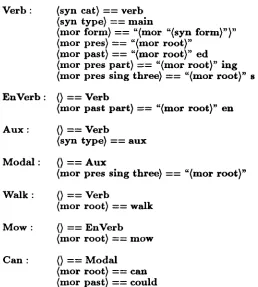
theory is shown in figure 1. T h e theory makes use of some standard abbreviatory devices t h a t enable nodes a n d / o r paths to be o m i t t e d in certain cases. For example, sets of sentences relating to the same node are written with the node n a m e implicit in all but the first-given sentence in the set. Also, we write S e e : 0==
V e r b to abbreviate the definitional sentence S e e : 0 = = V e r b : 0 , and similarly else- where.T h e theory defines the properties of seven nodes: an abstract V e r b node, nodes E n V e r b , A u x and M o d a l , and three abstract lexemes W a l k , M o w and C a n . Each node is associated with a collec- tion of definitional sentences t h a t specify values as- sociated with different paths. This specification is achieved either
explicitly,
orimplicitly.
Values given explicitly are specified eitherdirectly,
by exhibiting a particular value, orindirectly,
in terms of local a n d / o r global inheritance. Implicit specification is achieved via D A T R ' s default mechanism.For example, the definition of the V e r b node gives the values of the paths ( s y n c a t ) and ( s y n t y p e ) directly, as v e r b and m a i n , respectively. Similarly, the definition of W a l k gives the value of ( m o r r o o t / directly as w a l k . On the other hand, the value of
V e r b :
E n V e r b :
A u x :
M o d a l :
W a l k :
M o w :
C a n :
(syn cat) = = verb (syn t y p e ) = = m a i n
( m o r f o r m ) = = " ( m o r "(syn f o r m ) " ) " ( m o r pres) = = "(mor r o o t ) "
( m o r past) = = "(mor r o o t ) " e d ( m o r p r e s p a r t ) --= " ( m o r r o o t ) " i n g (mor pres sing three) = = "(mor root)"
0 = = V e r b
( m o r p a s t p a r t ) = = "(mor r o o t ) " e n
0 = = V e r b
(syn t y p e ) = = a u x
0 = = A u x
( m o r pres sing three) = = "(mor root)"
0 = = V e r b
( m o r root) = = walk
0 = = E n V e r b ( m o r r o o t ) --= m o w
0 = = M o d a l ( m o r r o o t ) = = can
( m o r past) = = c o u l d
Figure 1: A DATR Theory
the empty path at W a l k is given indirectly, by local inheritance, as the value of the empty path at Verb. Note that in itself, this might not appear to be par- ticularly useful, since the theory does not provide an explicit value for the empty path in the definition of Verb. However, DATR's default mechanism permits any definitional sentence to be applicable not only to the path specified in its left-hand-side, but also for any rightward extension of that path for which no more specific definitional sentences exist. This means that the statement W a l k : 0 = = V e r b : 0 actually corresponds to a class of i m p l i c i t definitio- nal sentences, each obtained by extending paths on the left- and the right-hand-sides of the equation in the same manner. Examples include the following:
W a l k : (mor) = = V e r b : (mor)
W a l k : ( m o r form) = - V e r b : (mor form) W a l k : (syn cat) = = V e r b : (syn cat)
Thus, the value associated with (syn cat) at W a l k is given (implicitly) as the value of (syn cat) at Verb, which is given (explicitly) as v e r b . Also, the values of (mor) and ( m o r form), amongst many others, are inherited from Verb. In the same way, the value of (syn cat) at M o w is inherited lo- cally from E n V e r b (which in turn inherits locally from V e r b ) and the value of (syn cat) at C a n is inherited locally from M o d a l (which ultimately gets
its value from V e r b via Aux). Note however, that
the following sentences do n o t follow by default from the specifications given at the relevant nodes:
W a l k : ( m o r r o o t ) = = V e r b : ( m o r r o o t ) C a n : ( m o r past) = = M o d a l : ( m o r past)
A u x : (syn t y p e ) = = V e r b : (syn t y p e )
In each of the above cases, the theory provides an explicit statement about the value associated with the indicated path at the given node. As a result the default mechanism is effectively over-ridden.
In order to understand the use of global (i.e. quo- ted) inheritance descriptors it is necessary to intro- duce DATR's notion of a g l o b a l c o n t e x t . Suppose then that we wish to determine the value associated with the path ( m o r pres) at the node Walk. In this case, the global context will initially consist of the node/path pair W a l k / / m o r pres). Now, by de- fault the value associated with ( m o r pres) at W a l k is inherited locally from ( m o r pres) at Verb. This, in turn, inherits g l o b a l l y from the path ( m o r root). That is:
V e r b : ( m o r pres) = = " ( m o r root)"
[image:3.612.175.433.65.352.2]Verb I
nV°*Ul
I
I
L
TM
Mow I
Modal[
I Can I
Figure 2: A Lexical Inheritance Hierarchy
associated with ( m o r past) at W a l k is obtained as w a l k e d (i.e. the string of atoms formed by evalua- ting the specification " ( m o r r o o t ) " e d in the global context W a l k / ( m o r past)).
More generally, the global context is used to fill in the missing node (path) when a global path (node) is encountered. In addition however, the evalua- tion of a global descriptor results in the global con- text being set to the new node/path pair. Thus in the preceding example, after the quoted descriptor " ( m o r r o o t ) " is encountered, the global context ef- fectively becomes W a l k / ( m o r root) (i.e. the path component of the global context is altered). Note that there is a real distinction between a local inhe- ritance descriptor of the form N : P and it's global counterpart "N : P ' . The former has no effect on the global context, while the latter effectively over- writes it.
Finally, the definition of V e r b in the theory of figure 1 illustrates a use of the 'evaluable path' con- struct:
V e r b : ( m o r f o r m ) = = "(mor "(syn f o r m ) " ) "
This states that the value of ( m o t form) at Verb is inherited globally from the path ( m o r . . . ) , where the dots represent the result of evaluating the global path "(syn f o r m ) " (i.e. the value associated with (syn form) in the prevailing global context). Eva- luable paths provide a powerful means of capturing generalizations about the structure of lexical infor- mation.
4
DATR
M o d e l sTo a first level of approximation, the DATR theory of figure 1 can be understood as a representation of an inheritance hierarchy (a 'semantic network') as shown in figure 2. In the diagram, nodes are written as labelled boxes, and arcs correspond to (local) in- heritance, or isa links. Thus, the node C a n inherits from M o d a l which inherits from A u x which in turn is a Verb. The hierarchy provides a useful means of visualising the overall structure of the lexical know- ledge encoded by the DATR theory. However, the
semantic network metaphor is of far less value as a way of thinking about the DATR language itself. Note that there is nothing inherent in DATR to en- sure that theories correspond to simple isa hierar- chies of the kind shown in the figure. What is more, the DATR language includes constructs that cannot be visualized in terms of simple networks of nodes connected by (local) inheritance links. Global inhe- ritance, for example, has a dynamic aspect which is difficult to represent in terms of static links. Simi- lar problems are presented by both string values and evaluable paths. Our conclusion is that the network metaphor is of primary value to the DATR user. In order to provide a satisfactory, formal model of how the language 'works' it is necessary to adopt a diffe- rent perspective.
[image:4.612.179.431.64.312.2]tions to node symbols t h a t is consistent with the definitions of those nodes within the theory. This picture of DATR as a formalism for defining partial functions is complicated by two features of the lan- guage however. First, the meaning of a given node depends, in general, on the global context of inter- pretation, so t h a t nodes do not correspond directly to mappings from paths to values, but rather to func- tions from contexts to such mappings. Second, it is necessary to provide an account of DATR's default mechanism. It will be convenient to present our ac- count of the semantics of DATR in two stages.
4.1 DATR I n t e r p r e t a t i o n s
This section considers a restricted version of DATR without the default mechanism. Section 4.2 then shows how implicit information can be modelled by treating value descriptors as families of values in- dexed by paths.
D e f i n i t i o n 4.1 A DATR interpretation is a triple I = (U, I¢, F), where
1. U is a set;
2. ~ is a function assigning to each element of the set (U x V*) a partial funclion from (U x U*)
to U*.
3. F is a valuation function assigning to each node N and atom a an element of U, such that di- stinct atoms are assigned distinct elements.
Elements of the set U are denoted by u and ele- ments of U* are denoted by v. Intuitively, U* is the domain of (semantic) values/paths. Elements of the set C = (U x U*) are called contexts and denoted by c. T h e function t¢ can be thought of as mapping global contexts onto (partial) functions from local contexts to values. T h e function F is extended to paths, so t h a t for P = (ax.-.a,~) (n > 0) we write
F ( P ) to denote Ul . . . u n E U*, where ui = F ( a i ) for each i (1 < i < n).
Intuitively, value descriptors denote elements of U* (as we shall see, this will need to be revised later in order to account for DATR's default mechanism). We associate with the interpretation I = (U, t:, F ) a partial denotation function D : DESC -'-+ ( C -+ U*)
and write [d], to denote the meaning (value) of de- scriptor d in the global context c. T h e denotation function is defined as shown in figure 3. Note that an a t o m always denotes the same element of U, re- gardless of the context. By contrast, the denotation of an inheritance descriptor is, in general, sensitive to the global context c in which it appears. Note also that in the case of a global inheritance descrip- tor, the global context is effectively altered to reflect the new local context c'. T h e denotation function is extended to sequences of value descriptors in the ob- vious way. Thus, for ¢ = d l .. "dn (n >_ 0), we write [ ¢ ] , t o d e n o t e v l . - . v n E U* ifvi = [di]c (1 < i < n) is defined (and [ ¢ ] , is undefined otherwise).
Now, let I = (U, s, F ) be an interpretation and 7" a theory. We will write [ T / N ] c to denote that partial function from U* to U* given by
[ T / N ] , = U { ( F ( P ) , [¢],)}
N:P==~bE~T
It is easy to verify t h a t [ T / N ] , does indeed denote a partial function (it follows from the functionality of the theory 7-). Let us also write [ N ] , to denote t h a t partial function from U* to U* given by
[N],(v)
=~ ( c ) ( F ( N ) , v ) , for all v e U*. Then, I models 7-
just in case the following containment holds for each node N and context c:
[ N ] , _.D [ T / N ] ,
T h a t is, an interpretation is a model of a DATR theory just in case (for each global context) the func- tion it associates with each node respects the defini- tion of that node within the theory.
4.2 I m p l i c i t I n f o r m a t i o n a n d D e f a u l t M o d e l s
T h e notion of a model presented in the preceding section is too liberal in t h a t it takes no account of information implicit in a theory. For example, con- sider again the definition of the node W a l k from the theory of figure 1, and repeated below.
W a l k : 0 = = V e r b
( m o r r o o t ) = = w a l k
According to the definition of a model given previ- ously, any model of the theory of figure 1 will as- sociate with the node W a l k a function from paths to values which respects the above definition. This means that for every global context c, the following containment must hold3:
[Walk], ~ {(0, [Verb: 0]*), ((mor root), walk)}
O n the other hand, there is no guarantee that a given model will also respect the following contain- ment:
[ W a l k ] e _D { ( ( m o r ) , [ V e r b : ( m o r ) ] , ) , ( ( m o r r o o t r o o t ) , w a l k ) }
In fact, this containment (amongst other things)
should hold. It follows 'by default' from the state- ments made a b o u t W a l k t h a t the path ( m o r ) inhe- rits locally from V e r b and t h a t the value associated with any extension of ( m o r r o o t ) is w a l k .
[a]c
~'N: ( d l - - . d . ) l o
[ " N : (dl """ d,)"]~
[ " ( d x ' . . d . ) ' l .
["N"]¢
= F ( a )
if vi = ~di]c is defined for each i (1 < i < n), then = t ~ ( c ) ( F ( N ) , v l . . "vn)
undefined otherwise
if vi = [di]e is defined for each i (1 < i < n), then i¢(c')(d) where d = ( F ( N ) , vl . . . vn)
undefined otherwise
if vi = [di]e is defined for each i (1 < i < n), then = ~¢(d)(d) where c = (u, v) and d = (u, V l . . - v , )
undefined otherwise
= i¢(d)(e) where c = (u, v) and d = ( F ( N ) , v)
Figure 3: Denotation function for DATR Descriptors
There have been a number of formal treatments of defaults in the setting of attribute-value formalisms (Carpenter, 1993; Bouma, 1992; Russell et al., 1992; Young and Rounds, 1993). Each of these approa- ches formalizes a notion of default inheritance by defining appropriate operations (e.g. default unifi- cation) for combining strict and default information. Strict information is allowed to over-ride default in- formation where the combination would otherwise lead to inconsistency (i.e. unification failure). In the case of DATR however, the formalism does not draw an explicit distinction between strict and de- fault values for paths. In fact, all of the information given explicitly in a DATR theory is strict. The non- monotonic nature of DATR theories arises from a general, default mechanism which 'fills in the gaps' by supplying values for paths not explicitly speci- fied in a theory. More specifically, DATR's default mechanism ensures t h a t any path t h a t is not expli- citly specified for a given node will take its definition from the longest prefix of that path t h a t is specified. Thus, the default mechanism defines a class of im- plicit, definitional sentences with paths on the left t h a t extend paths found on the left of explicit sent- ences. Furthermore, this extension of paths is also carried over to paths occurring on the right. In ef- fect, each (explicit) path is associated not just with a single value specification, but with a whole family of specifications indexed by extensions of those paths.
This suggests the following approach to the se- mantics of defaults in DATR. Rather than interpre- ting node definitions (in a given global context) as partial functions from paths to values (i.e. of type U* --+ U*) we choose instead to interpret them as partial functions from (explicit) paths, to functions from extensions of those paths to values (i.e. of type U* -+ (U* --+ U*)). Now suppose t h a t f : U* --~ (U* --~ U*) is the function associated with the node definition T / N in a given DATR interpretation. We can define a partial function A ( f ) : U* --~ U* (the default interpretation of T / N ) as follows. For each v E U* set
A ( f ) ( v ) = f(vl)(V2)
where v = vlv2 and vx is the longest prefix of v such t h a t f ( v l ) is defined. In effect, the function A ( f ) makes explicit t h a t information about paths and values t h a t is only implicit in f , but just in so far as it does not conflict with explicit information provided by f .
In order to re-interpret node definitions in the manner suggested above, it is necessary to modify the interpretation of value descriptors. In a given global context c, a value descriptor d now corre- sponds to a total function [d]~ : U* --+ U* (intui- tively, a function from path extensions to values). For example, atoms now denote constant functions:
[a]c(v) = F(a) for all v G U"
More generally, value descriptors will denote dif- ferent values for different paths. Figure 4 shows the revised clause for global n o d e / p a t h pairs, the other definitions being very similar. Note the way in which the ' p a t h ' argument v is used to extend Vl . . . v n in order to define the new local (and in this case also, global) context c ~. On the other hand, the meaning of each of the di is obtained with respect to the 'em- pty path' e (i.e. path extension does not apply to subterms of inheritance descriptors).
As before, the interpretation function is extended to sequences of path descriptors, so t h a t for ¢ = d l . . . d , (n >_ o) we have [¢]~(v) = V l . . . v , G V*, if vi = Idil(v) is defined, for each i (1 < i < n) (and
[¢],(v) is undefined otherwise). The definition of
the interpretation of node definitions can be taken over unchanged from the previous section. However, for a theory T and node N, the function [ T / N ] e is now of type U* --+ (U* ~ U*). An interpretation I = (U, x, F ) is a default model for theory T just in case for every context c and node N we have:IN], _~ A(IT"/NI,)
[image:6.612.125.491.67.196.2][ " N : (dl'-"dn)"]c(v)
={
if v, = [dil¢(e) is defined for each i(1 < i < n), then
~(d)(d)
where c ' =( f ( g ) , v l . . . v n v )
undefined otherwise
Figure 4: Revised denotation for global node/path pairs
definition, any default model of the theory of figure 1 must respect the following containment:
[W kL
( ( m o r r o o t ) , Av.walk)}
/,From the definition of A, it follows that for any path v, if v extends ( m o r r o o t ) , then it is mapped onto the value walk, and otherwise it is mapped to the value given by [ V e r b : 0It(v). We have the following picture:
[Walklc _D {(0, [Verb: Oft(O)),
((mor),
[ V e r b :Olc((mor))),
((mor root), walk),
((mor root root), walk),
• . . }
The default models of a theory 7" constitute a pro- per subset of the models o f T : just those that respect the default interpretations of each of the nodes defi- ned within the theory.
5 C o n c l u s i o n s
The work described in this paper fulfils one of the objectives of the DATR programme: to provide the language with an explicit, declarative semantics. We have presented a formal model of DATR as a lan- guage for defining partial functions and this model has been contrasted with an informal view of DATR as a language for representing inheritance hierar- chies. The approach provides a transparent treat- ment of DATR's notion of (local and global) context and accounts for DATR's default mechanism by re- garding value descriptors (semantically) as families of values indexed by paths.
The provision of a formal semantics for DATR is important for several reasons. First, it provi- des the DATR user with a concise, implementation- independent account of the meaning of DATR theo- ries. Second, it serves as a standard against which other, operational definitions of the formalism can be judged. Indeed, in the absence of such a stan- dard, it is impossible to demonstrate formally the correctness of novel implementation strategies (for an example of such a strategy, see (Langer, 1994)). Third, the process of formalisation itself aids our understanding of the language and its relationship
to other non-monotonic, attribute-value formalisms. Finally, the semantics presented in this paper provi- des a sound basis for subsequent investigations into the mathematical and computational properties of
DATR.
6 A c k n o w l e d g e m e n t s
The author would like to thank Roger Evans, Gerald Gazdar, Bill Rounds and David Weir for helpful dis- cussions on the work described in this paper.
R e f e r e n c e s
Francois Andry, Norman Fraser, Scott McGlashan, Simon Thornton, and Nick Youd. 1992. Ma- king DATR work for speech: lexicon compila- tion in SUNDIAL•
Computational Linguistics,
18(3):245-267.Gosse Bouma. 1992. Feature structures and nonmo- notonicity.
Computational Linguistics,
18(2):183- 203.Lynne Cahill and Roger Evans. 1990. An applica- tion of DATR: the TIC lexicon. In
Proceedings of
the 9th European Conference on Artificial Intelli-
gence,
pages 120-125.Lynne Cahill. 1993. Morphonology in the lexicon. In
Proceedings of the 6th Conference of the Euro-
pean Chapter of the Association for
Computatio-
nal
Linguistics,
pages 87-96.Lynne Cahill. 1994. An inheritance-based lexicon for message understanding systems. In
Procee-
dings of the ~th ACL Conference on Applied Na-
tural Language Processing,
pages 211-212.Bob Carpenter. 1993. Skeptical and credulous de- fault unification with applications to templates and inheritance. In Ted Briscoe, Valeria de Paiva, and Ann Copestake, editors,
Inheritance, Defaults
and the Lexicon,
pages 13-37. Cambridge Univer-sity Press, Cambridge.
Greville Corbett and Norman Fraser. 1993. Net- work morphology: a DATR account of Russian nominal inflection.
Journal of Linguistics,
29:113- 142.Roger Evans and Gerald Gazdar. 1989b. The se- mantics of DATR. In
Proceedings of AISB-89,
pages 79-87.Roger Evans, Gerald Gazdar, and David Weir. 1994. Using default inheritance to describe LTAG. In
3e Colloque International sur les Grammaires
d'Arbres Adjoints (TAG-l-3),
pages 79-87. Roger Evans, Gerald Gazdar, and David Weir.1995. Encoding lexicalized tree adjoining gram- mars with a nonmonotonic inheritance hierarchy.
In
Proceedings of the 33rd Annual Meeting of the
Association for Computational Linguistics.
Gerald Gazdar. 1992. Paradigm function morpho-logy in DATR. In Lynne Cahill and Richard Coa- tes, editors,
Sussez Papers in General and Compu-
tational Linguistics,
number CSRP 239 in Cogni- tive Science Research Papers, pages 45-53. Uni- versity of Sussex, Brighton.Dafydd Gibbon and Doris Bleiching. 1991. An ILEX model for German compound stress in DATR. In
Proceedings of the FORWISS-ASL
Workshop on Prosody in Man-Machine Commu-
nication.
James Kilbury. 1992. Pardigm-based derivational morphology. In Guenther Goerz, editor,
Procee-
dings of KONVENS 92,
pages 159-168. Springer,Berlin.
Adam Kilgariff. 1993. Inheriting verb alternations. In
Proceedings of the 6th Conference of the Euro-
pean Chapter of the Association for Computatio-
nal Linguistics,
pages 213-221.Hagen Langer. 1994. Reverse queries in DATR. In
Proceedings of the 15th International Conference
on Computational Linguistics,
volume II, pages1089-1095, Kyoto.
Graham Russell, Afzal Ballim, John Carroll, and Susan Warwick-Armstrong. 1992. A practi- cal approach to multiple default inheritance for unification-based lexicons.
Computational Lingui-
stics,
18(2):311-337.Mark Young and Bill Rounds. 1993. A logical se- mantics for nonmonotonic sorts. In
Proceedings
of the 31st Annual Meeting of the Association for