Munich Personal RePEc Archive
Gender-based Segregation before and
after the Great Recession
Humpert, Stephan
Leuphana University
2015
Online at
https://mpra.ub.uni-muenchen.de/63555/
Gender-based Segregation before and after the Great Recession
Stephan Humpert
BAMF, Frankensstr. 210, 90461 Nuremberg / Germany
dr.stephan.humpert(at)bamf.bund.de
&
Leuphana University Lueneburg, Scharnhorststr.1, 21335 Lueneburg / Germany
humpert(at)leuphana.de
ABSTRACT
Pooled international survey data is used to analyze occupational
segregation in times of the great recession. Observing over 30 European
economies and the United States over a time span of 10 years, I present
evidence of a somehow surprising crisis effect on gender-based
segregation. While all economies differ in their general magnitudes, the
economic downturn affects a temporary reduction of segregation in
terms of two dissimilarity measures.
Keywords: Gender Segregation, Duncan Index, Karmel-MacLachlan Index, European
Social Survey (ESS), General Social Survey (GSS)
1. Introduction:
The economic crisis of 2007/2008 hit economies world-wide and especially there labor
markets. In this paper I analyze the topic from a view of gender equality. Therefore, I
use pooled European Social Survey data (ESS) and, U.S. General Social Survey (GSS)
with the time span 2002 to 2012, to calculate two measures of gender-specific
segregation (Duncan and Karmel-MacLachlan). The effect of the economic crisis is
visible in most observed economies. Here, between 2008 and 2010, those economies
have a temporary reduction of their segregation magnitudes. This somehow surprising
result is driven by a redistribution of the male-female employment ratio. While males
work more often in cyclic or export-orientated occupations and industries, they suffer
more from job-losses than females. Sierminska and Takhtamanova (2011) call the
phenomenon of higher job separation and lower job finding rates of male workers
‘mancession’. Figure 1 shows that males have in general higher employment rates in the
decade of observation (EU and U.S), but perceive a higher reduction in times of the
crisis, as well.
This descriptive paper is structured as following. In section two we give a brief review
of the literature. In the section three I describe both data sets and the methodology. The
results are reported and discussed in section four, while I give a brief conclusion in the
Figure 1 – Gender-specific employment-rates (EU without Croatia and U.S.)
Source: Labour Force Survey, Eurostat (2014)
2. Literature review:
Following the definition of Alonso-Villar and del Rio (2014) I understand segregation
as a non-similar distribution of a specific sub-population over organizational units. Here
females can be over or under-represented over a set of given occupations relative to
males. It is well known that men and women differ in their occupations. This
phenomenon is known as horizontal segregation, while vertical segregation denotes the
over or under-represented of a group at the top of a given occupation (e.g. Estévez-Abe
2006).
A series of papers verify the incident of gender-based segregation over time and space.
E.g. Blau and Hendricks (1979), Charles (1992), Hakim (1992), Anker (1997), Baunach
(2002), Estévez-Abe (2006), Jarman et al. (2012), Schäfer et. al (2012), Lippa et al.
(2014), and Humpert (2014a) show world-wide cross-country evidence for occupational
2002 2003 2004 2005 2006 2007 2008 2009 2010 2011 2012 50
55 60 65 70 75 80
segregation. One finding is that segregation decline over time. However, Blau et al.
(2013), and Humpert (2014b) show that different coding of job classifications have an
impact on the calculation of segregation measures.
3. Data and Methodology:
For the analysis two social surveys, the European Social Survey (ESS) data with pooled
information for 32 economies for six waves of observations each (2002 to 2012). In this
data, 24 countries are members of the EU, while the others are not. The U.S. General
Social Survey (GSS) include a much longer time span from 1972 to 2012. But for the
case of the analysis it is shortened to the same waves. Both are weighted with obligatory
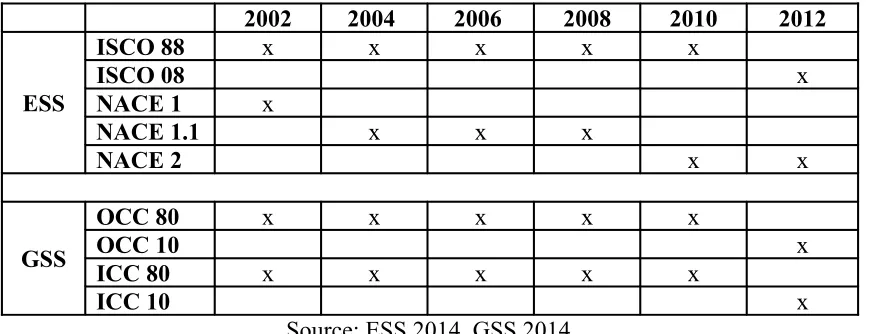
sample weights taken from by the data provider. Table 1 provides a matrix of given
years, and characteristics. For the descriptive analysis I analyze occupation-specific
segregation for man and women. This is made by two different segregation measures,
[image:5.595.82.518.510.677.2]which are discussed below.
Table 1 - Time and classifications
2002 2004 2006 2008 2010 2012
ESS
ISCO 88 x x x x x
ISCO 08 x
NACE 1 x
NACE 1.1 x x x
NACE 2 x x
GSS
OCC 80 x x x x x
OCC 10 x
ICC 80 x x x x x
ICC 10 x
Here, occupations in the ESS data are measured by ISCO classifications (International
Standard Classification of Occupations) 1988 and 2008, while they are measured by
ICC (U.S. Census Occupational Coding) 1980 and 2010.
Unfortunately, not every classification is available for every economy and every year.
So structural breaks between two classifications, and cyclical differences in segregation
over time, may harm the power of the analysis. E.g. Humpert (2014b) for a discussion
of ISCO classifications and segregation over time. Here, the choice of a given ISCO
classifications has an effect on the intensity of segregation in a given year. The always
most actual classification available turns segregation into a relative stability (Humpert
2014a). For robustness reasons the same approach is conducted for industries, classified
by NACE groups (Nomenclature Générale des Activités Economique dans l'Union
Européenne) and CIC (U.S. Census Industry Coding).
For the analysis itself I calculate two general measures of segregation: the Duncan
index, and the Karmel-MacLachlan index. The Stata routine and the algebraic
description is given by Gradín (2014). I begin with a given population of N workers
distributed across T>1 organizational units with N=Σj=1 T
nj>0
;nj 0being the total
number of individuals in the jth occupation j=
1,...T
. Then I consider an exhaustivepartition of the population into two groups, males and females. Each group has size,
where i 0 j
n is the number of members of the ith group
i=1,2
in jth occupation, with2 1 N + N =
N . In the first step, I use the Duncan index composed by Duncan and
Duncan (1955) to compute overall segregation. See equation (1) for the formula of the
D index.
1, 2
2 2 1 1
/ /
1 2Σ /
1 = n N n N
= n n
In the second step the same approach is calculated with the Karmel-MacLachlan, or KM
index composed by Karmel and MacLachlan (1988). See equation (2) for the formula.
1, 2
1 2
1, 2
/ /
2 N N N N D n n
= n n
KM (2)
4. Results:
In this section I present computed results of the two indexes, and how segregation has
developed over time, especially in times of the crisis. For the purpose of simplicity I
present two figures, with pooled information for EU and non-EU economies taken from
the ESS and for the U.S. taken from the GSS. They represent occupation-specific
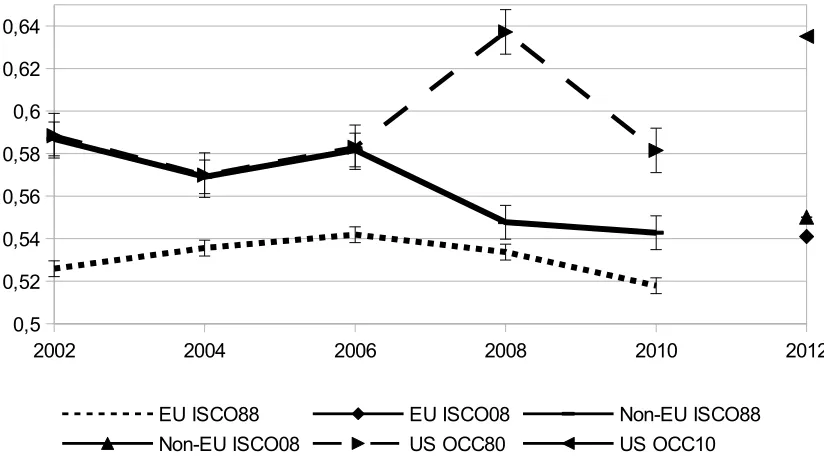
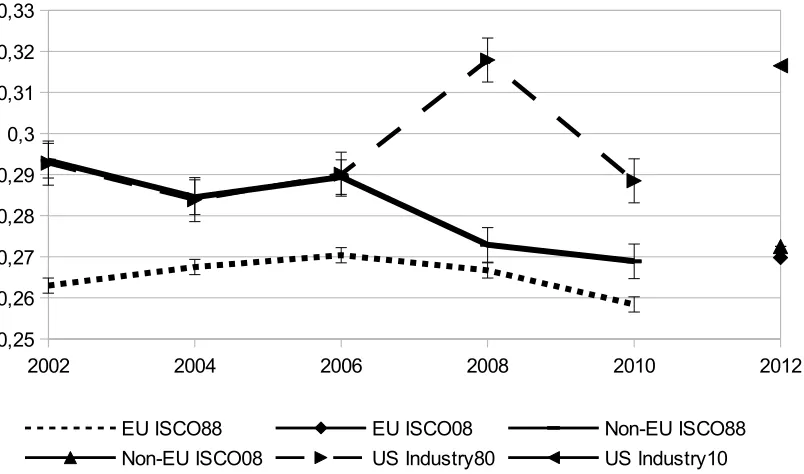
segregation. While figure 2 shows the computed results for the Duncan indices, figure 3
shows the values for the Karmel-McLachlin indices.
At first, economies with EU-member status are less segregated, than non-EU
economies. The lowest levels are in 2008 each. Here segregation declines from the
highest value in 2006 (EU: 0.5419, non-EU: 0.5817) to 2008 (EU: 0.5179, non-EU:
0.5428). In general, EU-members differ around 0.02 segregation points over time, while
the others differ around 0.04 segregation points. While both values for 2012 re-increase,
the EU-specific one raises more intensive. However, the 2012 value is calculated for
ISCO 2008 and not for ISCO 1988. Therefore, it is difficult to disentangle the increase
Figure 2 - Duncan Index (with standard errors)
Source: ESS 2014 and GSS 2014, own calculation with design weight.
Second, in U.S segregation is the highest, at all. Here, the values are even higher than
for the non-EU economies. In general, segregation in U.S. differs around 0.06
segregation points over time. The highest levels are in 2008 (0.6372), while the lowest
is in 2010 (0.5815). There is the interesting finding that non-EU and the U.S. are rather
identical between 2002 and 2006, while the scissor opens and the U.S. increases till
2008.
This pattern remains in terms of the Karmel-MacLachlan index, as well (figure 3). As
reported earlier, economies with EU-member status are lower segregated. The highest
levels are in 2006, and the lowest in 2010. This is the main differences between both
measures, that the lowest levels are calculated for 2008, or 2010. Here, segregation
declines from the highest value in 2006 (EU: 0.2704, non-EU: 0.2584) to 2010 (EU:
2002 2004 2006 2008 2010 2012
0,5 0,52 0,54 0,56 0,58 0,6 0,62 0,64
0.2894, non-EU: 0.2689). In general, EU-members differ around 0.01 segregation
points over time, while the others differ around 0.02 segregation points.
Again, U.S segregation remains the highest in this figure. In general, segregation in U.S.
differs around 0.03 segregation points over time. The highest levels are in 2008
(0.6372), while the lowest levels are in 2004 (0.2839) and 2010 (0.5815). As reported
above, the non-EU and the U.S. are rather identical between 2002 and 2006, while the
[image:9.595.105.507.347.584.2]scissor opens and the U.S. increases till 2008.
Figure 3 - Karmel-MacLachlan Index (with standard errors)
Source: ESS 2014 and GSS 2014, own calculation with design weight.
The computed results for each of the economies are reported in tables 2 (ESS) and 3
(GSS) in the appendix-section. Generally spoken, each example of segregation shows a
generally declining trend. However, around the point of the Great Recession (2008 to
2010) the magnitudes decline very intensive, and turn back in 2012.
2002 2004 2006 2008 2010 2012
0,25 0,26 0,27 0,28 0,29 0,3 0,31 0,32 0,33
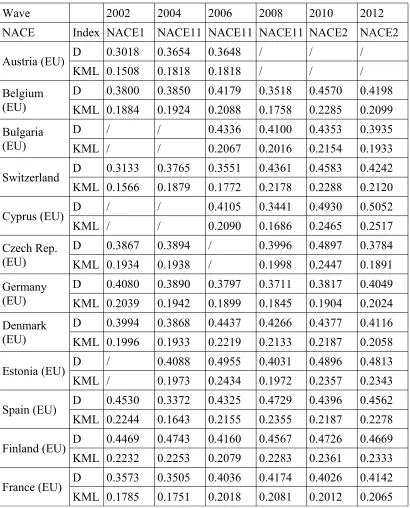
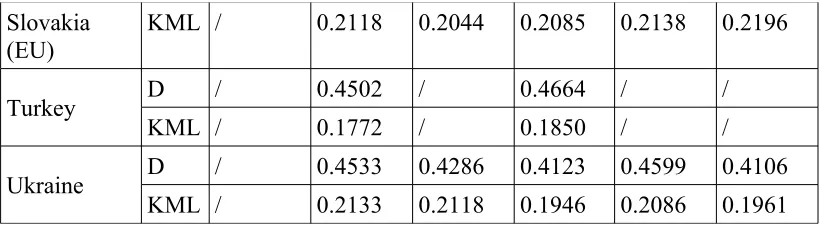
For robustness reasons the same approach is repeated for industry-specific segregation.
Here, NACE and ICC groups are used as substitutes of occupations. The crisis-specific
pattern remains with the described u-shape around the years 2008 to 2010. However,
three NACE and two ICC classifications do not fit in the timing of the ISCO or OCC
points of time. Therefore, the lowering of segregation is less easy to explain by the
effect of the economic downturn, or by changes in the industry-specific categories. See
tables 4 and 5 in the appendix-section for the country-specific results.
5. Conclusions:
To sum up, I use pooled European Social Survey data (ESS) for 32 European economies
and the U.S. General Social Survey (GSS) to analyze how gender-specific segregation
develop in times of the crisis. While I calculate the Duncan index, and the
Karmel-MacLachlan index for gender-specific differences in employment patterns, I present two
key results. First, EU member states in general are less segregated than the non-EU
ones. It is obvious that these economies are much more heterogeneous in their economic
power, and their national labor laws. However, it is clear that the U.S. is higher
segregated than the EU economy as a whole.
Second, there is a temporary effect of the economic crisis in most economies. Here,
between 2008 and 2010 economies realize a temporary reduction of segregation
magnitudes. The effect of lower segregation is based especially on male job-losses.
Males work more often in cyclical-sensitive occupations and industries, such as
construction. This follows the analysis of Maier (2011), who concludes that
employment is hit harder in every recession since the 1960s. However,
male-employment re-increases faster and higher in economic booms. On the other hand,
shrinks while males remain employed. However, the economic crisis itself hit all
workers notwithstanding being male or female. See for instance Gregory et al. (2013)
for a discussion of working time and work life balance in times of the recession.
Acknowledgment:
The findings, views, and conclusions expressed are entirely those of the author and
References:
Alonso-Villar, O., del Rio, C. (2014): Occupational Sex Segregation, In: Michalos, A.C.
(Ed.), Encyclopedia of Quality of Life and Well-Being Research, Berlin: Springer, pp.
4453-4456.
Anker, R. (1997): Theories of Occupational Segregation by Sex: An Overview,
International Labor Review, Vol. 136(3), pp. 315-339.
Baunach, D.M. (2002): Trends in Occupational Sex Segregation and Inequality, 1950 to
1990, Social Science Research, Vol. 31(1), pp. 77-98.
Blau, F.D., Hendricks, W.E. (1979): Occupational Segregation by Sex: Trends and
Prospects, Journal of Human Resources, Vol. 14(2), pp. 197-210.
Blau, F.D., Brummund, P., Liu, A.Y.-H. (2013): Trends in Occupational Segregation by
Gender 1970-2009: Adjusting for the Impact of Changes in the Occupational Coding
System, Demography, Vol. 50(2), pp. 471-492.
Charles, M. (1992): Cross-National Variation in Occupational Sex Segregation,
American Sociological Review, Vol. 57(4), pp. 483-502.
Duncan, O., Duncan, B. (1955): A Methodological Analysis of Segregation Indexes,
American Sociological Review, Vol. (20)2, pp. 210-217.
Estévez-Abe, M. (2006): Gendering the Varieties of Capitalism: A Study of
Occupational Segregation by Sex in Advanced Industrial Societies, World Politics, Vol.
59(1), pp. 142-175.
European Social Survey (ESS) (2014): ESS1- 6 cumulative data file, release date
Eurostat (2014): Labour Force Survey (annual average), release date October 22, 2014.
Gradín, C. (2014): Measuring Segregation using Stata: The two Group Case,
unpublished manuscript.
Gregory, A., Milner, S., Windebank, J. (2013): Work-life Balance in Times of
Economic Crisis and Austerity, International Journal of Sociology and Social Policy,
Vol. 33(9/10), pp. 528-541.
General Social Survey (GSS) (2014): GSS 1972-2012 Cross-Sectional Cumulative Data
release date June 19, 2014.
Hakim, C. (1992): Explaining Trends in Occupational Segregation: The Measurement,
Causes, and Consequences of the Sexual Division of Labour, European Sociological
Review, Vol. 8 (2), pp. 127-152.
Humpert, S. (2014a): Occupational Sex Segregation and Working Time: Regional
Evidence from Germany, Panoeconomicus, Vol. 61 (3), pp. 317-329.
Humpert, S. (2014b): Trends in occupational segregation: What happened with women
and foreigners in Germany?, European Economics Letters, Vol. 3(2), pp. 36-39.
Jarman, J., Blackburn R.M., Racko, G. (2012): The Dimensions of Occupational Gender
Segregation in Industrial Countries, Sociology, Vol. 46(6), pp. 1003-1019.
Karmel, T., MacLachlan, M. (1988): Occupational Sex Segregation - Increasing or
Decreasing, Economic Record, Vol. 64(3), pp. 147-179.
Lippa R.A., Preston K., Penner J. (2014): Women's Representation in 60 Occupations
from 1972 to 2010: More Women in High-Status Jobs, Few Women in Things-Oriented
Maier, F. (2011): Will the Crisis Change Gender Relations in Labour Markets and
Society?, Journal of Contemporary European Studies, Vol. 19(1), pp. 83-95.
Milkman, R. (1976): Women's Work and Economic Crisis: Some Lessons of the Great
Depression, Review of Radical Political Economics, Vol. 8(1), pp. 71-97.
Schäfer, A., Tucci, I., Gottschall, K. (2012): Top Down or Bottom Up? A
Cross-National Study of Vertical Occupational Sex Segregation in Twelve European
Countries, Comparative Social Research, Vol. 29, pp. 3-43.
Sierminska E., Takhtamanova Y. (2011): Job Flows, Demographics, and the Great
Recession, Research in Labor Economics, Vol. 32, pp. 115-154.
Watts, M. (1998): Occupational Gender Segregation: Index Measurement and
Appendix
Table 2 – Occupation-specific segregation (European Social Survey - ESS)
Wave 2002 2004 2006 2008 2010 2012
ISCO Class. Index ISCO 88 ISCO 88 ISCO 88 ISCO 88 ISCO 88 ISCO 08
Austria (EU) D 0.5254 0.5536 0.5520 / / / KML 0.2625 0.2754 0.2744 / / /
Belgium (EU)
D 0.5623 0.5941 0.6054 0.6317 0.6227 0.6162
KML 0.2784 0.2969 0.3024 0.3157 0.3113 0.3081
Bulgaria (EU)
D / / 0.6872 0.6595 0.6337 0.6371
KML / / 0.3298 0.3242 0.3135 0.3296
Switzerland D 0.5918 0.6065 0.6289 0.6677 0.6143 0.6223 KML 0.2959 0.3023 0.3135 0.3331 0.3068 0.3110
Cyprus (EU) D / / 0.6136 0.6164 0.6595 0.6321 KML / / 0.3065 0.3019 0.3298 0.3150
Czech Rep. (EU)
D 0.6117 0.6097 / 0.6222 0.6608 0.6068
KML 0.3058 0.3030 / 0.3111 0.3300 0.3032
Germany (EU)
D 0.6338 0.6224 0.6356 0.6096 0.6111 0.6257
KML 0.3167 0.3108 0.3178 0.3035 0.3049 0.3127
Denmark (EU)
D 0.6839 0.6348 0.6619 0.6478 0.6427 0.5824
KML 0.3417 0.3173 0.3309 0.3239 0.3210 0.2912
Estonia (EU) D / 0.6171 0.6826 0.6391 0.6594 0.7162 KML / 0.2979 0.3355 0.3119 0.3171 0.3489
Spain (EU) D 0.695 0.5815 0.6512 0.6299 0.5769 0.6192 KML 0.3270 0.2863 0.3246 0.3137 0.2869 0.3092
Finland (EU) D 0.6320 0.6658 0.6494 0.6336 0.6466 0.6598 KML 0.3158 0.3320 0.3246 0.3168 0.3229 0.3296
France (EU) D 0.6130 0.6099 0.6395 0.6145 0.5959 0.6037 KML 0.3062 0.3047 0.3197 0.3062 0.2976 0.3003
U.K. (EU) D 0.5847 0.6095 0.5878 0.5738 0.5683 0.6498 KML 0.2923 0.3047 0.2932 0.2864 0.2821 0.3187
Greece (EU) D 0.5385 0.5148 / 0.5296 0.5291 / KML 0.2683 0.2573 / 0.2645 0.2643 /
Croatia* D / / / 0.6276 0.5990 /
Hungary (EU)
D 0.6178 0.7069 0.6399 0.6895 0.5375 0.5948
KML 0.3088 0.3436 0.3131 0.3435 0.2923 0.2945
Ireland (EU) D 0.6480 0.6707 0.6567 0.6544 0.5806 0.6808 KML 0.3233 0.3317 0.3283 0.3268 0.2900 0.3402
Israel D 0.6271 / / 0.5852 0.6158 0.6002 KML 0.3128 / / 0.2910 0.3066 0.2982
Iceland D / 0.6138 / / / 0.6424
KML / 0.3063 / / / 0.3212
Italy (EU) D 0.6446 0.5978 / / / 0.6097 KML 0.3217 0.2892 / / / 0.3033
Lithuania (EU)
D / / / / 0.6909 0.7621
KML / / / / 0.3044 0.3745
Luxembourg (EU)
D 0.6780 0.6739 / / / /
KML 0.3390 0.3305 / / / /
Netherlands (EU)
D 0.6075 0.6220 0.6192 0.6150 0.5737 0.6156
KML 0.3023 0.3072 0.3094 0.3094 0.2864 0.3073
Norway D 0.6438 0.6130 0.6258 0.6182 0.5597 0.6309 KML 0.3215 0.3062 0.3127 0.3085 0.2799 0.3146
Poland (EU) D 0.6396 0.6445 0.6430 0.5918 0.5939 0.6514 KML 0.3198 0.3222 0.3211 0.2956 0.2969 0.3255
Portugal (EU)
D 0.6545 0.6170 0.6368 0.6104 0.6059 0.6791
KML 0.3267 0.3066 0.3131 0.3010 0.2970 0.3302
Russia D / / 0.6660 0.6781 0.6636 0.6976 KML / / 0.3250 0.3326 0.3260 0.3351
Sweden (EU) D 0.6449 0.6542 0.6199 0.6293 0.6332 0.6255 KML 0.3224 0.3270 0.3099 0.3146 0.3164 0.3124
Slovenia (EU)
D 0.6080 0.6510 0.6446 0.5446 0.6481 0.6480
KML 0.3040 0.3254 0.3224 0.2719 0.3236 0.3231
Slovakia (EU)
D / 0.6681 0.6655 0.6834 0.6363 0.6387
KML / 0.3339 0.3325 0.3303 0.3101 0.3136
Turkey D / 0.6478 / 0.5956 / /
KML / 0.2555 / 0.2310 / /
Table 3 – Occupation-specific segregation (General Social Survey - GSS)
Wave 2002 2004 2006 2008 2010 2012
US Census Index OCC80 OCC80 OCC80 OCC80 OCC80 OCC10
United States
D 0.5884 0.5699 0.5830 0.6372 0.5815 0.6351
KML 0.2928 0.2839 0.2901 0.3179 0.2885 0.3165
Source: GSS 2014, own calculation with design weight.
Table 4 – Industry-specific segregation (European Social Survey - ESS)
Wave 2002 2004 2006 2008 2010 2012
NACE Index NACE1 NACE11 NACE11 NACE11 NACE2 NACE2
Austria (EU) D 0.3018 0.3654 0.3648 / / / KML 0.1508 0.1818 0.1818 / / /
Belgium (EU)
D 0.3800 0.3850 0.4179 0.3518 0.4570 0.4198
KML 0.1884 0.1924 0.2088 0.1758 0.2285 0.2099
Bulgaria (EU)
D / / 0.4336 0.4100 0.4353 0.3935
KML / / 0.2067 0.2016 0.2154 0.1933
Switzerland D 0.3133 0.3765 0.3551 0.4361 0.4583 0.4242 KML 0.1566 0.1879 0.1772 0.2178 0.2288 0.2120
Cyprus (EU) D / / 0.4105 0.3441 0.4930 0.5052 KML / / 0.2090 0.1686 0.2465 0.2517
Czech Rep. (EU)
D 0.3867 0.3894 / 0.3996 0.4897 0.3784
KML 0.1934 0.1938 / 0.1998 0.2447 0.1891
Germany (EU)
D 0.4080 0.3890 0.3797 0.3711 0.3817 0.4049
KML 0.2039 0.1942 0.1899 0.1845 0.1904 0.2024
Denmark (EU)
D 0.3994 0.3868 0.4437 0.4266 0.4377 0.4116
KML 0.1996 0.1933 0.2219 0.2133 0.2187 0.2058
Estonia (EU) D / 0.4088 0.4955 0.4031 0.4896 0.4813 KML / 0.1973 0.2434 0.1972 0.2357 0.2343
Spain (EU) D 0.4530 0.3372 0.4325 0.4729 0.4396 0.4562 KML 0.2244 0.1643 0.2155 0.2355 0.2187 0.2278
Finland (EU) D 0.4469 0.4743 0.4160 0.4567 0.4726 0.4669 KML 0.2232 0.2253 0.2079 0.2283 0.2361 0.2333
[image:17.595.95.505.259.767.2]U.K. (EU) D 0.3866 0.3907 0.4320 0.4062 0.4256 0.4191 KML 0.1932 0.1953 0.2155 0.2027 0.2113 0.2064
Greece (EU) D 0.3590 0.3390 / 0.3864 0.3860 / KML 0.1789 0.1695 / 0.1930 0.1928 /
Croatia* D / / / 0.4292 0.4987 /
KML / / / 0.2143 0.2493 /
Hungary (EU)
D / / 0.6399 0.4437 0.3926 0.4154
KML / / 0.3131 0.2209 0.1953 0.2060
Ireland (EU) D 0.4393 0.4577 0.4255 0.4926 0.4713 0.4862 KML 0.2192 0.2260 0.2127 0.2462 0.2355 0.2430
Israel D / / / 0.3218 0.4578 0.2977 KML / / / 0.1601 0.2278 0.1480
Iceland D / 0.4298 / / / 0.4677
KML / 0.2146 / / / 0.2338
Italy (EU) D 0.4025 0.3987 / / / 0.3788 KML 0.2009 0.1916 / / / 0.1882
Lithuania (EU)
D / / / / 0.3827 0.5400
KML / / / / 0.1667 0.2658
Luxembourg (EU)
D 0.4223 0.4677 / / / /
KML 0.2112 0.2290 / / / /
Netherlands (EU)
D 0.4027 0.4153 0.4064 0.3961 0.4012 0.4566
KML 0.2006 0.2050 0.2029 0.1980 0.2003 0.2279
Norway D 0.4701 0.4728 0.4678 0.4413 0.4250 0.4889 KML 0.2347 0.2361 0.2338 0.2202 0.2125 0.2443
Poland (EU) D 0.4179 0.4243 0.4331 0.3854 0.3956 0.4226 KML 0.2089 0.2121 0.2162 0.1926 0.1977 0.2111
Portugal (EU)
D 0.4709 0.4482 0.4963 0.4314 0.4872 0.5299
KML 0.2352 0.2229 0.2441 0.2126 0.2388 0.2579
Russia D / / 0.3861 0.4161 0.4846 0.4449 KML / / 0.1885 0.2041 0.2379 0.2127
Sweden (EU)
D 0.4973 0.4176 0.4392 0.4687 0.4725 0.4246
KML 0.2486 0.2087 0.2196 0.2343 0.2360 0.2120
Slovenia (EU)
D 0.3747 0.1658 0.4086 0.3297 0.4137 0.3988
KML 0.1873 0.0819 0.2038 0.1646 0.2066 0.1987
Slovakia (EU)
KML / 0.2118 0.2044 0.2085 0.2138 0.2196
Turkey D / 0.4502 / 0.4664 / /
KML / 0.1772 / 0.1850 / /
[image:19.595.94.505.84.197.2]Ukraine D / 0.4533 0.4286 0.4123 0.4599 0.4106 KML / 0.2133 0.2118 0.1946 0.2086 0.1961 *Croatia joined the EU in 2014. Source: ESS 2014, own calculation with design weight.
Table 5 – Industry-specific segregation (General Social Survey - GSS)
Wave 2002 2004 2006 2008 2010 2012
US Census Index ICC80 ICC80 ICC80 ICC80 ICC80 ICC10
United States
D 0.4581 0.4844 0.4596 0.5402 0.5027 0.5060
KML 0.2279 0.2415 0.2286 0.2696 0.2491 0.2520