Enhanced word decomposition by calibrating the decision threshold of
probabilistic models and using a model ensemble
Sebastian Spiegler Intelligent Systems Laboratory,
University of Bristol, U.K. [email protected]
Peter A. Flach
Intelligent Systems Laboratory, University of Bristol, U.K. [email protected]
Abstract
This paper demonstrates that the use of ensemble methods and carefully calibrat-ing the decision threshold can signifi-cantly improve the performance of ma-chine learning methods for morphologi-cal word decomposition. We employ two algorithms which come from a family of generative probabilistic models. The mod-els consider segment boundaries as hidden variables and include probabilities for let-ter transitions within segments. The ad-vantage of this model family is that it can learn from small datasets and easily gen-eralises to larger datasets. The first
algo-rithm PROMODES, which participated in
the Morpho Challenge 2009 (an interna-tional competition for unsupervised mphological analysis) employs a lower or-der model whereas the second algorithm PROMODES-H is a novel development of the first using a higher order model. We present the mathematical description for both algorithms, conduct experiments on the morphologically rich language Zulu and compare characteristics of both algo-rithms based on the experimental results.
1 Introduction
Words are often considered as the smallest unit of a language when examining the grammatical structure or the meaning of sentences, referred to as syntax and semantics, however, words them-selves possess an internal structure denominated
by the term word morphology. It is worthwhile
studying this internal structure since a language description using its morphological formation is more compact and complete than listing all
pos-sible words. This study is called
morpholog-ical analysis. According to Goldsmith (2009)
four tasks are assigned to morphological analy-sis: word decomposition into morphemes, build-ing morpheme dictionaries, defining morphosyn-tactical rules which state how morphemes can
be combined to valid words and defining
mor-phophonological rules that specify phonological changes morphemes undergo when they are com-bined to words. Results of morphological analy-sis are applied in speech syntheanaly-sis (Sproat, 1996) and recognition (Hirsimaki et al., 2006), machine translation (Amtrup, 2003) and information re-trieval (Kettunen, 2009).
1.1 Background
In the past years, there has been a lot of inter-est and activity in the development of algorithms for morphological analysis. All these approaches
have in common that they build a
morphologi-cal modelwhich is then applied to analyse words.
Models are constructed using rule-based
meth-ods (Mooney and Califf, 1996; Muggleton and
Bain, 1999), connectionist methods (Rumelhart
and McClelland, 1986; Gasser, 1994) or
statisti-calorprobabilisticmethods (Harris, 1955; Hafer and Weiss, 1974). Another way of classifying
ap-proaches is based on the learning aspect during
the construction of the morphological model. If the data for training the model has the same struc-ture as the desired output of the morphological analysis, in other words, if a morphological model is learnt from labelled data, the algorithm is
clas-sified undersupervised learning. An example for
a supervised algorithm is given by Oflazer et al. (2001). If the input data has no information to-wards the desired output of the analysis, the
algo-rithm uses unsupervised learning. Unsupervised
algorithms for morphological analysis are Lin-guistica (Goldsmith, 2001), Morfessor (Creutz,
2006) and Paramor (Monson, 2008).Minimally or
semi-supervised algorithmsare provided with par-tial information during the learning process. This
has been done, for instance, by Shalonova et al. (2009) who provided stems in addition to a word list in order to find multiple pre- and suffixes. A comparison of different levels of supervision for morphology learning on Zulu has been carried out by Spiegler et al. (2008).
Our two algorithms, PROMODES and
PROMODES-H, perform word
decomposi-tion and are based on probabilistic methods
by incorporating a probabilistic generative
model.1 Their parameters can be estimated
from either labelled data, using maximum like-lihood estimates, or from unlabelled data by
expectation maximization2 which makes them
eithersupervisedorunsupervisedalgorithms.
The purpose of this paper is an analysis of the underlying probabilistic models and the types of errors committed by each one. Furthermore, it is investigated how the decision threshold can be cal-ibrated and a model ensemble is tested.
The remainder is structured as follows. In Sec-tion 2 we introduce the probabilistic generative process and show in Sections 2.1 and 2.2 how
we incorporate this process in PROMODES and
PROMODES-H. We start our experiments with ex-amining the learning behaviour of the algorithms in 3.1. Subsequently, we perform a position-wise comparison of predictions in 3.2, show how we find a better decision threshold for placing mor-pheme boundaries in 3.3 and combine both algo-rithms using a model ensemble to leverage indi-vidual strengths in 3.4. In 3.5 we examine how the single algorithms contribute to the result of the ensemble. In Section 4 we will compare our ap-proaches to related work and in Section 5 we will draw our conclusions.
2 Probabilistic generative model
Intuitively, we could say that our models describe the process of word generation from the left to the right by alternately using two dice, the first for de-ciding whether to place a morpheme boundary in the current word position and the second to get a corresponding letter transition. We are trying to reverse this process in order to find the underlying sequence of tosses which determine the morpheme
boundaries. We are applying the notion of a
prob-1P
ROMODESstands for PRObabilistic MOdel for different
DEgrees ofSupervision. The H of PROMODES-H refers to
Higher order.
2In (Spiegler et al., 2009; Spiegler et al., 2010a) we have
presented an unsupervised version of PROMODES.
abilistic generative processconsisting of words as
observed variablesX and their hidden
segmenta-tion as latent variablesY. If a generative model is
fully parameterised it can be reversed to find the underlying word decomposition by forming the conditional probability distributionPr(Y|X).
Let us first define the model-independent
com-ponents. A givenword wj∈W with 1≤j≤ |W|
consists of n letters and has m=n−1 positions
for inserting boundaries. A word’s segmentation is depicted as aboundary vector bj= (bj1, . . . ,bjm)
consisting of boundary values bji∈ {0,1} with
1≤i≤mwhich disclose whether or not a
bound-ary is placed in positioni. Aletter lj,i-1precedes
the positioniinwjand a letterljifollows it. Both
letters lj,i-1 andlji are part of an alphabet.
Fur-thermore, we introduce aletter transition tjiwhich
goes fromlj,i-1tolji.
2.1 PROMODES
PROMODES is based on a zero-order model for
boundariesbjiand on a first-order model for letter
transitionstji. It describes a word’s segmentation
by its morpheme boundaries and resulting letter transitions within morphemes. A boundary vector
bjis found by evaluating each positioniwith
arg max
bji
Pr(bji|tji) = (1)
arg max
bji
Pr(bji)Pr(tji|bji) .
The first component of the equation above is theprobability distribution over non-/boundaries
Pr(bji). We assume that a boundary in i is
in-serted independently from other boundaries (zero-order) and the graphemic representation of the word, however, is conditioned on the length of
the word mj which means that the probability
distribution is in fact Pr(bji|mj). We guarantee
∑1r=0Pr(bji=r|mj) =1. To simplify the notation
in later explanations, we will refer to Pr(bji|mj)
asPr(bji).
The second component is the letter transition
probability distribution Pr(tji|bji). We suppose a
first-order Markov chain consisting of transitions
tjifrom letter lj,i-1∈AB to letter lji∈AwhereA
is a regular letter alphabet andAB=A∪ {B}
in-cludes B as an abstract morpheme start symbol
which can occur in lj,i-1. For instance, the
suf-fix ‘s’ of the verb formgets, marking 3rd person
singular, would be modelled asB→swhereas a
guarantee∑lji∈APr(tji|bji)=1 withtjibeing a
tran-sition from a certain lj,i−1∈AB to lji. The
ad-vantage of the model is that instead of evaluating an exponential number of possible segmentations (2m), the best segmentation b∗j=(b∗j1, . . . ,b∗jm) is
found with 2mposition-wise evaluations using
b∗ji=arg max
bji
Pr(bji|tji) (2)
=
1, ifPr(bji=1)Pr(tji|bji=1) >Pr(bji=0)Pr(tji|bji=0)
0, otherwise .
The simplifying assumptions made, however, reduce the expressive power of the model by not allowing any dependencies on preceding bound-aries or letters. This can lead to over-segmentation
and therefore influences the performance of PRO
-MODES. For this reason, we have extended the
model which led to PROMODES-H, a higher-order
probabilistic model.
2.2 PROMODES-H
In contrast to the original PROMODES model, we
also consider the boundary value bj,i-1 and
mod-ify our transition assumptions for PROMODES
-H in such a way that the new algorithm applies a first-order boundary model and a second-order
transition model. A transition tji is now defined
as a transition from an abstract symbol inlj,i-1∈
{N ,B}to a letter inlji∈A. The abstract
sym-bol isN orBdepending on whetherbjiis 0 or 1.
This holds equivalently for letter transitionstj,i-1.
The suffix of our previous examplegetswould be
modelledN →t→B→s.
Our boundary vectorbjis then constructed from
arg max
bji
Pr(bji|tji,tj,i-1,bj,i-1) = (3)
arg max
bji
Pr(bji|bj,i-1)Pr(tji|bji,tj,i-1,bj,i-1) .
The first component, the probability distribution
over non-/boundaries Pr(bji|bj,i-1), satisfies
∑1r=0Pr(bji=r|bj,i-1)=1 with bj,i-1,bji ∈ {0,1}.
As for PROMODES, Pr(bji|bj,i-1) is
short-hand for Pr(bji|bj,i-1,mj). The second
component, the letter transition
proba-bility distribution Pr(tji|bji,bj,i-1), fulfils
∑lji∈APr(tji|bji,tj,i-1,bj,i-1)=1 with tji being
a transition from a certainlj,i−1∈AB tolji. Once
again, we find the word’s best segmentationb∗j in
2mevaluations with
b∗ji=arg max
bji
Pr(bji|tji,tj,i-1,bj,i-1) = (4)
1, ifPr(bji=1|bj,i-1)Pr(tji|bji=1,tj,i-1,bj,i-1)
>Pr(bji=0|bj,i-1)Pr(tji|bji=0,tj,i-1,bj,i-1)
0, otherwise .
We will show in the experimental results that in-creasing the memory of the algorithm by looking atbj,i−1leads to a better performance.
3 Experiments and Results
In the Morpho Challenge 2009, PROMODES
achieved competitive results on Finnish, Turkish, English and German – and scored highest on non-vowelized and non-vowelized Arabic compared to 9 other algorithms (Kurimo et al., 2009). For the experiments described below, we chose the South
African language Zulu since our research work
mainly aims at creating morphological resources for under-resourced indigenous languages. Zulu
is anagglutinative languagewith a complex
mor-phology where multiple prefixes and suffixes
con-tribute to a word’s meaning. Nevertheless, it
seems that segment boundaries are more likely in
certain word positions. The PROMODES family
harnesses this characteristic in combination with describing morphemes by letter transitions. From theUkwabelana corpus(Spiegler et al., 2010b) we sampled 2500 Zulu words with a single segmenta-tion each.
3.1 Learning with increasing experience
In our first experiment we applied 10-fold cross-validation on datasets ranging from 500 to 2500 words with the goal of measuring how the learning improves with increasing experience in terms of training set size. We want to remind the reader that our two algorithms are aimed at small datasets.
We randomly split each dataset into 10 subsets where each subset was a test set and the corre-sponding 9 remaining sets were merged to a
train-ing set. We kept the labels of the training set
false negative (FN) morpheme boundary
predic-tions. Counts were summarised using precision3,
recall4and f-measure5, as shown in Table 1.
Data Precision Recall F-measure 500 0.7127±0.0418 0.3500±0.0272 0.4687±0.0284 1000 0.7435±0.0556 0.3350±0.0197 0.4614±0.0250 1500 0.7460±0.0529 0.3160±0.0150 0.4435±0.0206 2000 0.7504±0.0235 0.3068±0.0141 0.4354±0.0168 2500 0.7557±0.0356 0.3045±0.0138 0.4337±0.0163
(a) PROMODES
Data Precision Recall F-measure 500 0.6983±0.0511 0.4938±0.0404 0.5776±0.0395 1000 0.6865±0.0298 0.5177±0.0177 0.5901±0.0205 1500 0.6952±0.0308 0.5376±0.0197 0.6058±0.0173 2000 0.7008±0.0140 0.5316±0.0146 0.6044±0.0110 2500 0.6941±0.0184 0.5396±0.0218 0.6068±0.0151
[image:4.595.312.542.66.216.2](b) PROMODES-H
Table 1: 10-fold cross-validation on Zulu.
For PROMODES we can see in Table 1a that
the precision increases slightly from 0.7127 to
0.7557 whereas the recall decreases from 0.3500
to 0.3045 going from dataset size 500 to 2500.
This suggests that to some extent fewer morpheme boundaries are discovered but the ones which are found are more likely to be correct. We believe that this effect is caused by the limited memory of the model which uses order zero for the occur-rence of a boundary and order one for letter tran-sitions. It seems that the model gets quickly sat-urated in terms of incorporating new information and therefore precision and recall do not drasti-cally change for increasing dataset sizes. In
Ta-ble 1b we show results for PROMODES-H. Across
the datasets precision stays comparatively
con-stant around a mean of 0.6949 whereas the recall
increases from 0.4938 to 0.5396. Compared to
PROMODES we observe an increase in recall
be-tween 0.1438 and 0.2351 at a cost of a decrease in
precision between 0.0144 and 0.0616.
Since both algorithms show different behaviour
with increasing experience and PROMODES-H
yields a higher f-measure across all datasets, we will investigate in the next experiments how these differences manifest themselves at the boundary level.
3precision= T P
T P+FP.
4recall= T P
T P+FN.
5f-measure=2·precision·recall
precision+recall.
TNPH = 0.8726
TNP = 0.9472
TPPH= 0.5394
TPP = 0.3045
FPPH= 0.1274
FPP = 0.0528
FNPH = 0.4606
FNP = 0.6955
0.3109 0.7889
0.2111 0.6891
+ 0.0819 (net) + 0.0486
(net)
0.5698 0.8828
0.4302 0.1172
Figure 1: Contingency table for PROMODES[grey
with subscriptP] and PROMODES-H [black with
subscript PH] results including gross and net
changes of PROMODES-H.
3.2 Position-wise comparison of algorithmic predictions
In the second experiment, we investigated which
aspects of PROMODES-H in comparison to PRO
-MODES led to the above described differences in
performance. For this reason we broke down
the summary measures of precision and recall into their original components: true/false positive (TP/FP) and negative (TN/FN) counts presented in
the 2×2 contingency table of Figure 1. For
gen-eral evidence, we averaged across all experiments using relative frequencies. Note that the relative frequencies of positives (TP + FN) and negatives (TN + FP) each sum to one.
The goal was to find out how predictions in each word position changed when applying PROMODES-H instead of PROMODES. This
would show where the algorithms agree and
where they disagree. PROMODES classifies
non-boundaries in 0.9472 of the times correctly as TN
and in 0.0528 of the times falsely as boundaries
(FP). The algorithm correctly labels 0.3045 of the
positions as boundaries (TP) and 0.6955 falsely as
non-boundaries (FN). We can see that PROMODES
follows a rather conservative approach.
When applying PROMODES-H, the majority of
the FP’s are turned into non-boundaries, how-ever, a slightly higher number of previously cor-rectly labelled non-boundaries are turned into
false boundaries. The net change is a 0.0486
[image:4.595.74.293.121.286.2]non-boundaries (FN) are turned into non-boundaries than in the opposite direction with a net increase of
0.0819 of correct boundaries which led to the
in-creased recall. Since the deduction of precision is less than the increase of recall, a better over-all
performance of PROMODES-H is achieved.
In summary, PROMODES predicts more
accu-rately non-boundaries whereas PROMODES-H is
better at finding morpheme boundaries. So far we have based our decision for placing a boundary in a certain word position on Equation 2 and 4 as-suming thatP(bji=1|. . .)>P(bji=0|. . .)6gives the
best result. However, if the underlying distribu-tion for boundaries given the evidence is skewed, it might be possible to improve results by introduc-ing a certain decision threshold for insertintroduc-ing mor-pheme boundaries. We will put this idea to the test in the following section.
3.3 Calibration of the decision threshold
For the third experiment we slightly changed our experimental setup. Instead of dividing datasets during 10-fold cross-validation into training and test subsets with the ratio of 9:1 we randomly split the data into training, validation and test sets with the ratio of 8:1:1. We then run our experiments and measured contingency table counts.
Rather than placing a boundary if
P(bji=1|. . .) > P(bji=0|. . .) which corresponds
to P(bji=1|. . .)>0.50 we introduced a decision
threshold P(bji=1|. . .)>h with 0≤h≤1. This
is based on the assumption that the underlying
distribution P(bji|. . .) might be skewed and an
optimal decision can be achieved at a different threshold. The optimal threshold was sought on the validation set and evaluated on the test set. An overview over the validation and test results is given in Table 2. We want to point out that the threshold which yields the best f-measure result on the validation set returns almost the same result on the separate test set for both algorithms which suggests the existence of a general optimal threshold.
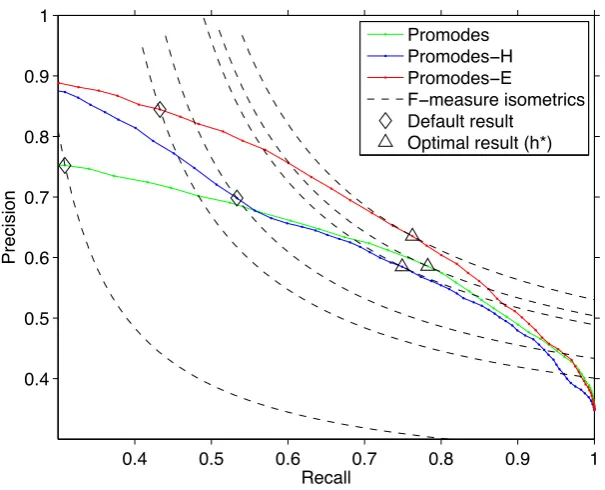
Since this experiment provided us with a set of data points where the recall varied monotonically with the threshold and the precision changed
ac-cordingly, we reverted to precision-recall curves
(PR curves) from machine learning. Following Davis and Goadrich (2006) the algorithmic
perfor-6Based on Equation 2 and 4 we use the notationP(b
ji|. . .)
if we do not want to specify the algorithm.
mance can be analysed more informatively using these kinds of curves. The PR curve is plotted with
recall on thex-axis and precision on they-axis for
increasing thresholdsh. The PR curves for PRO
-MODES and PROMODES-H are shown in Figure 2 on the validation set from which we learnt our
optimal thresholdsh∗. Points were connected for
readability only – points on the PR curve cannot be interpolated linearly.
In addition to the PR curves, we plotted isomet-rics for corresponding f-measure values which are defined as precision=2recallf-measure−f-·measurerecall and are hy-perboles. For increasing f-measure values the iso-metrics are moving further to the top-right corner
of the plot. For a threshold ofh=0.50 (marked
by ‘3’) PROMODES-H has a better performance
than PROMODES. Nevertheless, across the entire
PR curve none of the algorithms dominates. One
curve would dominate another if all data points
of the dominated curve were beneath or equal
to the dominating one. PROMODES has its
opti-mal threshold ath∗=0.36 and PROMODES-H at
h∗=0.37 where PROMODEShas a slightly higher
f-measure than PROMODES-H. The points of
op-timal f-measure performance are marked with ‘4’
on the PR curve.
Prec. Recall F-meas.
PROMODESvalidation (h=0.50) 0.7522 0.3087 0.4378 PROMODEStest (h=0.50) 0.7540 0.3084 0.4378 PROMODESvalidation (h∗=0.36) 0.5857 0.7824 0.6699 PROMODEStest (h∗=0.36) 0.5869 0.7803 0.6699 PROMODES-H validation (h=0.50) 0.6983 0.5333 0.6047 PROMODES-H test (h=0.50) 0.6960 0.5319 0.6030 PROMODES-H validation (h∗=0.37) 0.5848 0.7491 0.6568 PROMODES-H test (h∗=0.37) 0.5857 0.7491 0.6574
Table 2: PROMODES and PROMODES-H on
vali-dation and test set.
Summarizing, we have shown that both algo-rithms commit different errors at the word
posi-tion level whereas PROMODES is better in
pre-dicting non-boundaries and PROMODES-H gives
better results for morpheme boundaries at the
de-fault threshold of h=0.50. In this section, we
demonstrated that across different decision thresh-olds h for P(bji=1|. . .)>h none of algorithms
dominates the other one, and at the optimal
thresh-old PROMODESachieves a slightly higher
perfor-mance than PROMODES-H. The question which
arises is whether we can combine PROMODESand
0.4 0.5 0.6 0.7 0.8 0.9 1 0.4
0.5 0.6 0.7 0.8 0.9 1
Recall
Precision
Promodes
Promodes−H
Promodes−E
F−measure isometrics Default result
[image:6.595.148.451.59.304.2]Optimal result (h*)
Figure 2: Precision-recall curves for algorithms on validation set.
3.4 A model ensemble to leverage individual strengths
Amodel ensembleis a set of individually trained classifiers whose predictions are combined when classifying new instances (Opitz and Maclin,
1999). The idea is that by combining PROMODES
and PROMODES-H, we would be able to avoid
cer-tain errors each model commits by consulting the
other model as well. We introduce PROMODES-E
as theensembleof PROMODES and PROMODES
-H. PROMODES-E accesses the individual proba-bilitiesPr(bji=1|. . .)and simply averages them:
Pr(bji=1|tji) +Pr(bji=1|tji,bj,i-1,tj,i-1)
2 >h .
As before, we used the default threshold
h=0.50 and found the calibrated threshold
h∗=0.38, marked with ‘3’ and ‘4’ in Figure 2
and shown in Table 3. The calibrated threshold
improves the f-measure over both PROMODESand
PROMODES-H.
Prec. Recall F-meas. PROMODES-E validation (h=0.50) 0.8445 0.4328 0.5723 PROMODES-E test (h=0.50) 0.8438 0.4352 0.5742 PROMODES-E validation (h∗=0.38) 0.6354 0.7625 0.6931
PROMODES-E test (h∗=0.38) 0.6350 0.7620 0.6927
Table 3: PROMODES-E on validation and test set.
The optimal solution applying h∗ = 0.38 is
more balanced between precision and recall and
boosted the original result by 0.1185 on the test
set. Compared to its components PROMODESand
PROMODES-H the f-measure increased by 0.0228
and 0.0353 on the test set.
In short, we have shown that by combining PROMODES and PROMODES-H and finding the
optimal threshold, the ensemble PROMODES-E
gives better results than the individual models themselves and therefore manages to leverage the individual strengths of both to a certain extend. However, can we pinpoint the exact contribution of each individual algorithm to the improved re-sult? We try to find an answer to this question in the analysis of the subsequent section.
3.5 Analysis of calibrated algorithms and their model ensemble
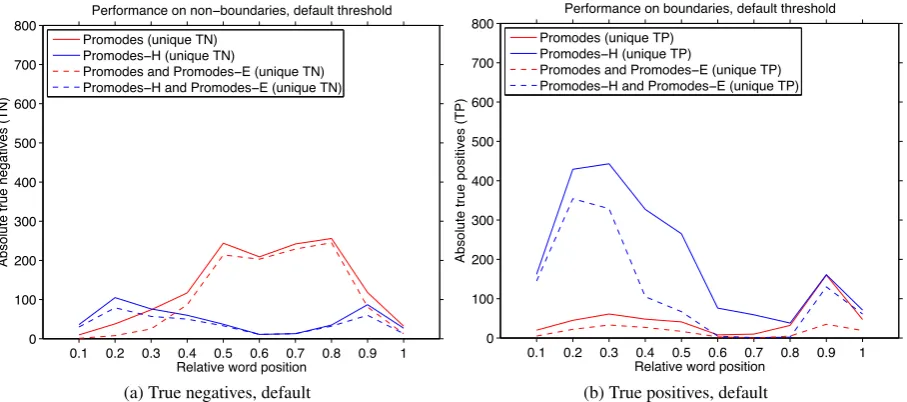
For the entire dataset of 2500 words, we have examined boundary predictions dependent on the relative word position. In Figure 3 and 4 we have plotted the absolute counts of correct boundaries
(TP) and non-boundaries (TN) which PROMODES
predicted but not PROMODES-H, and vice versa,
as continuous lines. We furthermore provided the number of individual predictions which were
ulti-mately adopted by PROMODES-E in the ensemble
as dashed lines.
In Figure 3a we can see for the default
thresh-old that PROMODESperforms better in predicting
non-boundaries in the middleand the end of the
shows the statistics for correctly predicted
bound-aries. Here, PROMODES-H outperforms PRO
-MODESin predicting correct boundaries across the
entireword length. After the calibration, shown
in Figure 4a, PROMODES-H improves the correct
prediction of non-boundaries at the beginning of
the word whereas PROMODES performs better at
theend. For the boundary prediction in Figure 4b
the signal disappears after calibration.
Concluding, it appears that our test language Zulu has certain features which are modelled best with either a lower or higher-order model. There-fore, the ensemble leveraged strengths of both al-gorithms which led to a better overall performance with a calibrated threshold.
4 Related work
We have presented two probabilistic
genera-tive models for word decomposition, PROMODES
and PROMODES-H. Another generative model
for morphological analysis has been described by Snover and Brent (2001) and Snover et al. (2002), however, they were interested in finding
paradigmsas sets of mutual exclusive operations on a word form whereas we are describing a gener-ative process using morpheme boundaries and re-sulting letter transitions.
Moreover, our probabilistic models seem to
re-sembleHidden Markov Models (HMMs) by
hav-ing certain states and transitions. The main differ-ence is that we have dependencies between states as well as between emissions whereas in HMMs emissions only depend on the underlying state.
Combining different morphological analysers has been performed, for example, by Atwell and Roberts (2006) and Spiegler et al. (2009). Their
approaches, though, used majority voteto decide
whether a morpheme boundary is inserted in a cer-tain word position or not. The algorithms
them-selves were treated asblack-boxes.
Monson et al. (2009) described an indirect approach to probabilistically combine ParaMor (Monson, 2008) and Morfessor (Creutz, 2006). They used a natural language tagger which was trained on the output of ParaMor and Morfes-sor. The goal was to mimic each algorithm since ParaMor is rule-based and there is no access to Morfessor’s internally used probabilities. The tag-ger would then return a probability for starting a new morpheme in a certain position based on the original algorithm. These probabilities in
com-bination with a threshold, learnt on a different dataset, were used to merge word analyses. In
contrast, our ensemble algorithm PROMODES-E
directly accesses the probabilistic framework of each algorithm and combines them based on an optimal threshold learnt on a validation set.
5 Conclusions
We have presented a method to learn a
cali-brated decision thresholdfrom a validation set and
demonstrated that ensemble methods in
connec-tion with calibrated decision thresholds can give better results than the individual models them-selves. We introduced two algorithms for word de-composition which are based on generative prob-abilistic models. The models consider segment boundaries as hidden variables and include prob-abilities for letter transitions within segments. PROMODEScontains a lower order model whereas
PROMODES-H is a novel development of PRO
-MODES with a higher order model. For both algorithms, we defined the mathematical model and performed experiments on language data of
the morphologically complex languageZulu. We
compared the performance on increasing train-ing set sizes and analysed for each word position whether their boundary prediction agreed or
dis-agreed. We found out that PROMODES was
bet-ter in predicting non-boundaries and PROMODES
-H gave better results for morpheme boundaries at a default decision threshold. At an optimal de-cision threshold, however, both yielded a simi-lar f-measure result. We then performed a fur-ther analysis based on relative word positions and
found out that the calibrated PROMODES-H
pre-dicted non-boundaries better for initial word
posi-tions whereas the calibrated PROMODES for
mid-and final word positions. For boundaries, the cali-brated algorithms had a similar behaviour.
Subse-quently, we showed that amodel ensembleof both
algorithms in conjunction with finding an optimal threshold exceeded the performance of the single algorithms at their individually optimal threshold.
Acknowledgements
We would like to thank Narayanan Edakunni and Bruno Gol´enia for discussions concerning this pa-per as well as the anonymous reviewers for their comments. The research described was sponsored
by EPSRC grant EP/E010857/1Learning the
0.1 0.2 0.3 0.4 0.5 0.6 0.7 0.8 0.9 1 0
100 200 300 400 500 600 700 800
Relative word position
Absolute true negatives (TN)
Performance on non−boundaries, default threshold
Promodes (unique TN) Promodes−H (unique TN)
Promodes and Promodes−E (unique TN) Promodes−H and Promodes−E (unique TN)
(a) True negatives, default
0.1 0.2 0.3 0.4 0.5 0.6 0.7 0.8 0.9 1 0
100 200 300 400 500 600 700 800
Relative word position
Absolute true positives (TP)
Performance on boundaries, default threshold
Promodes (unique TP) Promodes−H (unique TP)
Promodes and Promodes−E (unique TP) Promodes−H and Promodes−E (unique TP)
[image:8.595.78.532.187.388.2](b) True positives, default
Figure 3: Analysis of results using default threshold.
0.1 0.2 0.3 0.4 0.5 0.6 0.7 0.8 0.9 1
0 100 200 300 400 500 600 700 800
Relative word position
Absolute true negatives (TN)
Performance on non−boundaries, calibrated threshold
Promodes (unique TN)
Promodes−H (unique TN)
Promodes and Promodes−E (unique TN)
Promodes−H and Promodes−E (unique TN)
(a) True negatives, calibrated
0.1 0.2 0.3 0.4 0.5 0.6 0.7 0.8 0.9 1
0 100 200 300 400 500 600 700 800
Relative word position
Absolute true positives (TP)
Performance on boundaries, calibrated threshold
Promodes (unique TP)
Promodes−H (unique TP)
Promodes and Promodes−E (unique TP)
Promodes−H and Promodes−E (unique TP)
(b) True positives, calibrated
[image:8.595.76.531.421.617.2]References
J. W. Amtrup. 2003. Morphology in machine trans-lation systems: Efficient integration of finite state transducers and feature structure descriptions. Ma-chine Translation, 18(3):217–238.
E. Atwell and A. Roberts. 2006. Combinatory hy-brid elementary analysis of text (CHEAT). Proceed-ings of the PASCAL Challenges Workshop on Un-supervised Segmentation of Words into Morphemes, Venice, Italy.
M. Creutz. 2006.Induction of the Morphology of Nat-ural Language: Unsupervised Morpheme Segmen-tation with Application to Automatic Speech Recog-nition. Ph.D. thesis, Helsinki University of Technol-ogy, Espoo, Finland.
J. Davis and M. Goadrich. 2006. The relationship between precision-recall and ROC curves. Interna-tional Conference on Machine Learning, Pittsburgh, PA, 233–240.
M. Gasser. 1994. Modularity in a connectionist model of morphology acquisition. Proceedings of the 15th conference on Computational linguistics, 1:214–220.
J. Goldsmith. 2001. Unsupervised learning of the mor-phology of a natural language. Computational Lin-guistics, 27:153–198.
J. Goldsmith. 2009. The Handbook of Computational Linguistics, chapter Segmentation and morphology. Blackwell.
M. A. Hafer and S. F. Weiss. 1974. Word segmenta-tion by letter successor varieties. Information Stor-age and Retrieval, 10:371–385.
Z. S. Harris. 1955. From phoneme to morpheme. Lan-guage, 31(2):190–222.
T. Hirsimaki, M. Creutz, V. Siivola, M. Kurimo, S. Vir-pioja, and J. Pylkkonen. 2006. Unlimited vocabu-lary speech recognition with morph language mod-els applied to Finnish. Computer Speech And Lan-guage, 20(4):515–541.
K. Kettunen. 2009. Reductive and generative ap-proaches to management of morphological variation of keywords in monolingual information retrieval: An overview. Journal of Documentation, 65:267 – 290.
M. Kurimo, S. Virpioja, and V. T. Turunen. 2009. Overview and results of Morpho Challenge 2009. Working notes for the CLEF 2009 Workshop, Corfu, Greece.
C. Monson, K. Hollingshead, and B. Roark. 2009. Probabilistic ParaMor. Working notes for the CLEF 2009 Workshop, Corfu, Greece.
C. Monson. 2008. ParaMor: From Paradigm Structure To Natural Language Morphology Induc-tion. Ph.D. thesis, Language Technologies Institute, School of Computer Science, Carnegie Mellon Uni-versity, Pittsburgh, PA, USA.
R. J. Mooney and M. E. Califf. 1996. Learning the past tense of English verbs using inductive logic pro-gramming. Symbolic, Connectionist, and Statistical Approaches to Learning for Natural Language Pro-cessing, 370–384.
S. Muggleton and M. Bain. 1999. Analogical predic-tion. Inductive Logic Programming: 9th Interna-tional Workshop, ILP-99, Bled, Slovenia, 234.
K. Oflazer, S. Nirenburg, and M. McShane. 2001. Bootstrapping morphological analyzers by combin-ing human elicitation and machine learncombin-ing. Com-putational. Linguistics, 27(1):59–85.
D. Opitz and R. Maclin. 1999. Popular ensemble methods: An empirical study. Journal of Artificial Intelligence Research, 11:169–198.
D. E. Rumelhart and J. L. McClelland. 1986. On learning the past tenses of English verbs. MIT Press, Cambridge, MA, USA.
K. Shalonova, B. Gol´enia, and P. A. Flach. 2009. To-wards learning morphology for under-resourced fu-sional and agglutinating languages. IEEE Transac-tions on Audio, Speech, and Language Processing, 17(5):956965.
M. G. Snover and M. R. Brent. 2001. A Bayesian model for morpheme and paradigm identification. Proceedings of the 39th Annual Meeting on Asso-ciation for Computational Linguistics, 490 – 498.
M. G. Snover, G. E. Jarosz, and M. R. Brent. 2002. Unsupervised learning of morphology using a novel directed search algorithm: Taking the first step. Pro-ceedings of the ACL-02 workshop on Morphological and phonological learning, 6:11–20.
S. Spiegler, B. Gol´enia, K. Shalonova, P. A. Flach, and R. Tucker. 2008. Learning the morphology of Zulu with different degrees of supervision. IEEE Work-shop on Spoken Language Technology.
S. Spiegler, B. Gol´enia, and P. A. Flach. 2009. Pro-modes: A probabilistic generative model for word decomposition. Working Notes for the CLEF 2009 Workshop, Corfu, Greece.
S. Spiegler, B. Gol´enia, and P. A. Flach. 2010a. Un-supervised word decomposition with the Promodes algorithm. In Multilingual Information Access Eval-uation Vol. I, CLEF 2009, Corfu, Greece, Lecture Notes in Computer Science, Springer.
S. Spiegler, A. v. d. Spuy, and P. A. Flach. 2010b. Uk-wabelana - An open-source morphological Zulu cor-pus. in review.
![Figure 1: Contingency table for PROMODES [greywith subscript P] and PROMODES-H [black withsubscript PH] results including gross and netchanges of PROMODES-H.](https://thumb-us.123doks.com/thumbv2/123dok_us/228211.522216/4.595.312.542.66.216/contingency-promodes-subscript-promodes-withsubscript-including-netchanges-promodes.webp)