adfa, p. 1, 2011.
© Springer-Verlag Berlin Heidelberg 2011
A Comparison of Evolutionary Algorithms and Ant
Colony Optimization for Interactive Software Design
Christopher Simons and James Smith
Department of Computer Science and Creative Technologies University of the West of England, Bristol BS16 1QY, United Kingdom
{chris.simons, jim.smith}@uwe.ac.uk
Abstract. Evolutionary algorithms have a well-documented history of success in Search-Based Software Engineering, but arguably the preponderance of evo-lutionary algorithms stems from history rather than as a conscious design choice of meta-heuristic based on the characteristics of the problem at hand. This paper sets out to examine the basis for that assumption, taking as a case study the do-main of object-oriented software design. We consider a range of factors that should affect the design choice including representation, scalability, and of course, performance, i.e. that ability to generate good solutions within the lim-ited number of evaluations. We then evaluate Evolutionary Algorithms and Ant Colony Optimization with a variety of representations for candidate solutions. Results show that after suitable parameter tuning, Ant Colony Optimization is highly effective and out-performs Evolutionary Algorithms with respect to in-creasing numbers of attributes and methods in the software design problem. However, when larger numbers of classes are present in the software design, an evolutionary algorithm using an integer-based representation appears more scalable.
Keywords: Ant Colony Optimization, Evolutionary Algorithms, Software De-sign
1
Introduction
space to discover useful and relevant software designs, and so provide insight into the design task at hand. Here the precise balance of factors affecting the subjective judg-ments of the human software designer is less well understood – hence the oft-heard references to the “art” of software design. Indeed, this is precisely the sort of scenario in which Interactive Evolutionary Algorithms (IEAs) have been shown to perform well (see e.g. the survey of Takagi [4]). Our earlier work demonstrates that we can indeed successfully use meta-heuristics to provide computational support for an inter-active software design process, evolving object-oriented class models that meet de-signers’ criteria –both subjective [5] and aesthetic [6].
As with most papers in the field, such interactive design search uses an Evolution-ary Algorithm (EA) [7] because of their long history of successful applications. How-ever, as the name of the field of Search-Based Software Engineering suggests, poten-tially any search algorithm could be used, although in practice research effort has also tended to concentrate on meta-heuristics, in particular Evolutionary Algorithms. It is appropriate that we challenge adoption of a technology based on history, and examine whether other search methods might be better suited to some, if not all, interactive design search tasks. Indeed the same argument has been made for SBSE in general: “We must be wary of the unquestioning adoption of evolutionary algorithms merely because they are popular and widely applicable or because, historically, other re-searchers have adopted them for SBSE problems; none of these are scientific motiva-tions for adoption.” [8].
The contribution of this paper is to compare evolutionary algorithms with ant colo-ny optimization in order to make a more informed choice for an underlying search engine for interactive search of the object-oriented software design search space. Sec-tion 2 outlines object-oriented software design, while secSec-tion 3 describes the search algorithms investigated. The experimental methodology is described in section 4 and the results of investigations are revealed in section 5. Finally in section 6, we con-clude by contrasting the performance characteristics of evolutionary algorithms and ant colony optimization in object-oriented software design.
2
Object-Oriented Software Design
3
Search Algorithms
Two candidate representations have been chosen to investigate search of the software design search space. In the first representation, which we shall call “naïve grouping” (NG), the genotype is a sequence of d integers from the set {1,…,c}, (where c is the maximum number of classes allowed), with an allele value of grouping gi = j being interpreted as putting element i into class j. The search space is of size cd, but there is considerable redundancy in the genotype-phenotype mapping since as far as the class model is concerned; the label applied to a class is irrelevant. The second representa-tion is that of a graph inspired by the Travelling Salesman Problem (TSP) and Vehicle Routing Problem (VRP) [10] which we shall call Extended Permutation (XP). In this graph, candidate solutions are represented as permutations of a set of (e+c) elements, where e are the attribute and method elements and the extra c elements are interpreted as “end of class” markers akin to a “return to depot” in a VRP instance.
It is generally understood in software engineering that designers strive for high co-hesion in classes (to reflect a clear purpose) and low coupling between objects (to ensure the design is robust yet flexible to change). Therefore, the measure of the structural integrity chosen is inspired by the “Coupling Between Objects” (CBO) measure [11. Regardless of the representation chosen, each candidate solution is de-coded into a set of classes, and the CBO is calculated as the proportion of all uses of attributes by methods that occur across class boundaries. This is expressed as a max-imization function fCBO = (1.0 -CBO) x 100, so that fCBO = 100.0 for a completely coupled design (all uses occur inside classes) and 0.0 for a completely coupled de-sign.
The evolutionary algorithm chosen for comparison uses deterministic binary tour-naments for parent selection and a generational replacement model ensuring the search is comparable to ACO. To the NG representation is applied random uniform mutation with either One-Point or Uniform crossover. For the XP representation, we used Order-based crossover [12] and “Edge Recombination” [13]. The former pre-serves the relative order of elements (as per scheduling type problems) and the latter preserves adjacency information (as per TSP or VRP). Following the scheme in [14] a single extra gene is used to encode for one of a set of possible mutation rates. During mutation, first the encoded value is randomly reset with probability 0.1, and then a mutation event occurs in each locus with the encoded probability.
4
Methodology
Unfortunately, benchmark software design problems do not appear readily in either the research literature or industrial repositories. Therefore, three real-life software design problems have been selected for use. While it is not possible to precisely as-sess how representative these might be of the software design field as a whole, both the second and third problems have been drawn from fully enterprise scale industrial software developments, and are decidedly non-trivial in size and complexity. The first test design problem relates to a cinema booking system (CBS), and comprises 16 attributes and 15 methods. The second test design problem relates to the Graduate Development Program (GDP) recording system deployed at the University of the West of England, UK, and comprises 43 attributes and 12 methods. Lastly, the third design problem relates to a nautical holiday booking system, Select Cruises (SC), which comprises 52 attributes and 30 methods. Specifications of the three test design problems can be found at [16]. Manual, hand-crafted designs are available for the three test design problems [17], and fCBO values are 84.6%, 70.3% and 54.8% for CBS, GDP and SC respectively.
Parameter values are drawn from the literature (e.g. [7], [15]). All search runs use a fixed number of classes – the same as in the manual design solution to provide com-parability. Manual designs comprise 5, 5 and 16 classes for CBS, GDP and SC re-spectively. To ensure repeatability of results, we made 50 runs for each test, i.e., each combination of algorithm, problem, encoding, and parameter values. Each run is al-lowed to continue until either one million solutions were evaluated, or a software design with fitness 100.0 was discovered. For each run we recorded fitness (the values of fCBOfor best solution found) and speed (the number of solutions evaluated before this best solution is first discovered).
5
Results
5.1 Evolutionary Algorithms
Results showed that for every problem-representation pairing, the use of self-adapting mutation leads to the discovery of solutions with significantly higher fitness than any of the fixed mutation rates, without any significant penalty in terms of the number of evaluations taken. Furthermore, when using self-adaptive mutation neither the choice of tournament size nor of crossover probability (within the range 0.2-0.8) made any significant difference to the fCBO values.
5.2 Ant Colony Optimization
Results of parameter tuning are as follows:
α: performance increases as α increases from 0 to 1.0 – 1.5 but tails off thereafter; µ: performance increases as µ increases from zero to 3.0;
ρ: little effect for CBS and GDP, but for SC performance increases as ρ increases from 0 to 1.0.
In terms of the time taken to reach the best design solution, analysis shows that some degree of pheromone decay (i.e. ρ > 0) is necessary to achieve fast performance (at higher values of α and µ). This suggests that a degree of pheromone decay is crucial in exploiting the search space by making the algorithm able to ‘forget’ design solu-tions of poor fitness.
5.3 Comparative Analysis
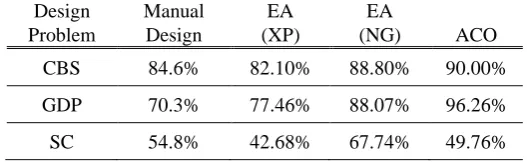
After parameters have been tuned, Table 1 shows a comparison of the fCBO fitness of the three search algorithms while table 2 shows the number of generations / iterations required to achieve the fCBO values stated in table 1. Both tables relate to a population / colony size of 100. In most cases the meta-heuristics create solutions with lower coupling than manual designs. Interestingly, the NG landscape appears to be more amenable to EA search than XP, yet ACO produces better fitness values for CBS and GDP but not SC. This suggests that the EA with the NG landscape is more robust to increased scale in terms of the number of classes in the design.
Table 1. Comparison of Mean Best Coupling ( fCBO).
Design Problem
Manual Design
EA (XP)
EA
(NG) ACO
CBS 84.6% 82.10% 88.80% 90.00%
GDP 70.3% 77.46% 88.07% 96.26%
[image:5.595.165.429.475.556.2]SC 54.8% 42.68% 67.74% 49.76%
Table 2. Comparison of the Number of Generations / Iterations required.
Design Problem
EA (XP)
EA
(NG) ACO
CBS 400 350 27
GDP 350 200 34
6
Conclusions
Comparison of evolutionary algorithms and ant colony optimization reveals that with respect to solution fitness, both approaches produce software design solutions of fit-ness values superior to those of the hand-crafted design solutions, except ACO for the SC problem. The EA with the integer NG representation emerges as the clear favorite in terms of performance for high numbers of classes, and with self-adaptive mutation, is far more robust to parameter settings. However, if a wholly interactive search is required for designs with smaller numbers of classes but higher numbers of attributes and methods and a limited computational budget, then a very different picture emerg-es. In this case, ACO discovers higher quality solutions, and in less time than the EAs.
References
1. Zhang, Y.: Repository of Publications on Search-Based Software Engineering, http://crestweb.cs.ucl.ac.uk/resources/sbse_repository/
2. Raiha, O.: A Survey of Search-Based Software Design. Computer Science Review, 4, 203-249 (2010)
3. Bowman, M., Briand, L.C., Labiche, Y.: Solving the Class Responsibility Assignment Problem in Object-Oriented Analysis with Multi-Objective Genetic Algorithms. IEEE Trans. Softw. Eng. 36, 817-837 (2010).
4. Tagaki, H.: Interactive Evolutionary Computation: A Fusion of the Capabilities of EC Op-timization and Human Evaluation. Proc. IEEE, 89, 1275-1298 (2001)
5. Simons, C.L., Parmee, I.C., Gwynllyw, R.: Interactive, Evolutionary Search ion Upstream Object-Oriented Class Design. IEEE Trans. Softw. Eng. 36, 798-816 (2012)
6. Simons, C.L., Parmee, I.C.: Elegant Object-Oriented Software Design via Interactive Evo-lutionary Computation, Technical Report UWE-AIG 2012-13, submitted to IEEE Trans. Sys., Man and Cybernetics, Part C.
7. Eiben, A.E., Smith, J.E.: Introduction to Evolutionary Computing, Springer Verlag (2003) 8. Harman, M.; Software Engineering meets Evolutionary Computation. Computer, 44, 31-39
(2011)
9. Object Management Group: Unified Modeling Language Resource Page. http://www.uml.org/
10. Toth, P., Vigo, D.: The Vehicle Routing Problem. Philadelphia (2001)
11. Harrison, R., Councell, S., Nithi, R.: An Investigation into the Applicability and Validity of Object-Oriented Design Metrics. Emp. Softw. Eng, 3, 255-273 (1998)
12. Davis, L. Ed.: Handbook of Genetic Algorithms, Van Nostrand Reinhold, 1991
13. Mathias, N., Whitley, D.: Genetic Operators, the Fitness Landscape and the Travelling Salesman Problem. In: Proceedings of Parallel Problem Solving from Nature (PPSB ’92), pp. 219-228 (1992)
14. Serpell, M., Smith, J.E.: Self-Adaptation of Mutation Operator and Probability for Permu-tation RepresenPermu-tations in Genetic Algorithms. Evol. Comput. 18, 1-24 (2010)
15. Dorigo, M., Stutzle, T.: Ant Colony Optimization. MIT Press (2004)
16. Simons, C.L.: Case Study Design Problems, http://www.cems.uwe.ac.uk/~clsimons/CaseStudies/casestudies.htm