Discriminative Training of 150 Million Translation Parameters
and Its Application to Pruning
Hendra Setiawan and Bowen Zhou IBM T.J. Watson Research Center Yorktown Heights, NY 10598, USA
{hendras, zhou}@us.ibm.com
Abstract
Until recently, the application of discrimina-tive training to log linear-based statistical ma-chine translation has been limited to tuning the weights of a limited number of features or training features with a limited number of pa-rameters. In this paper, we propose to scale up discriminative training of (He and Deng, 2012) to train features with 150 million pa-rameters, which is one order of magnitude higher than previously published effort, and to apply discriminative training to redistribute probability mass that is lost due to model pruning. The experimental results confirm the effectiveness of our proposals on NIST MT06 set over a strong baseline.
1 Introduction
State-of-the-art statistical machine translation sys-tems based on a log-linear framework are parame-terized by {λ,Φ}, where the feature weightsλare discriminatively trained (Och and Ney, 2002; Chi-ang et al., 2008b; Simianer et al., 2012) by directly optimizing them against a translation-oriented met-ric such as BLEU. The feature parameters Φ can be roughly divided into two categories: dense fea-ture that measures the plausibility of each translation rule from a particular aspect, e.g., the rule transla-tion probabilitiesp(f|e)andp(e|f); and sparse fea-ture that fires when certain phenomena is observed, e.g., when a frequent word pair co-occured in a rule. In contrast toλ, feature parameters inΦare usually modeled by generative models for dense features, or by indicator functions for sparse ones. It is therefore desirable to train the dense features for each rule in a discriminative fashion to maximize some translation criterion. The maximum expected BLEU training of (He and Deng, 2012) is a recent effort towards this
direction, and in this paper, we extend their work to a scaled-up task of discriminative training of the features of a strong hierarchical phrase-based model and confirm its effectiveness empirically.
In this work, we further consider the application of discriminative training to pruned model. Various pruning techniques (Johnson et al., 2007; Zens et al., 2012; Eck et al., 2007; Lee et al., 2012; Tomeh et al., 2011) have been proposed recently to filter transla-tion rules. One common consequence of pruning is that the probability distribution of many surviving rules become deficient, i.e.P
fp(f|e)<1. In
prac-tice, others have chosen either to leave the pruned rules as it-is, or simply to re-normalize the proba-bility mass by distributing the pruned mass to sur-viving rules proportionally. We argue that both ap-proaches are suboptimal, and propose a more prin-cipled method to re-distribute the probability mass, i.e. using discriminative training with some trans-lation criterion. Our experimental results demon-strate that at various pruning levels, our approach improves performance consistently. Particularly at the level of 50% of rules being pruned, the discrimi-natively trained models performs better than the un-pruned baseline grammar. This shows that discrim-inative training makes it possible to achieve smaller models that perform comparably or even better than the baseline model.
Our contributions in this paper are two-folded: First of all, we scale up the maximum expected BLEU training proposed in (He and Deng, 2012) in a number of ways including using 1) a hierarchical phrase-based model, 2) a richer feature set, and 3) a larger training set with a much larger parameter set, resulting in more than 150 million parameters in the model being updated, which is one order magnitude higher than the phrase-based model reported in (He and Deng, 2012). We are able to show a reasonable
improvement over this strong baseline. Secondly, we combine discriminative training with pruning techniques to reestimate parameters of pruned gram-mar. Our approach is shown to alleviate the loss due to pruning, and sometimes can even outperform the baseline unpruned grammar.
2 Discriminative Training ofΦ
Given the entire training data{Fn, En}Nn=1, and
cur-rent parameterization{λ,Φ}, we decode the source side of training data Fn to produce hypothesis
{Eˆn}Nn=1. Our goal is to updateΦtowardsΦ0 that
maximizes the expected BLEU scores of the entire training data given the currentλ:
U(Φ) =X
∀Eˆ1...EˆN
˜
PΦ( ˆE1..EˆN|F1..FN)B( ˆE1..EˆN) (1)
where B( ˆE1...EˆN) is the BLEU score of the
con-catenated hypothesis of the entire training data, fol-lowing (He and Deng, 2012).
Eq. 1 summarizes over all possible combina-tions of Eˆ1...EˆN, which is intractable. Hence we
make two simplifying approximations as follows. First, let the k-best hypotheses of the n-th sen-tence, Eˆn =
n
ˆ
En1, ...,EˆnK o
, approximate all its possible translation. In other words, we assume that PK
k=1P˜( ˆEnk|Fn) = 1, ∀n. Second, let the
sum of sentence-level BLEU approximate the cor-pus BLEU. We note that corcor-pus BLEU is not strictly decomposable (Chiang et al., 2008a), however, as the training data’s sizeNgets big as in our case, we expect them to become more positively correlated.
Under these assumptions and the fact that each sentence is decoded independently, Eq. 1 can be al-gebraically simplified into:
U(Φ) =
N
X
n=1
K
X
k=1
PΦ( ˆEnk|Fn)B( ˆEnk) (2)
where PΦ( ˆEnk|Fn)=P˜Φ( ˆEnk|Fn)/P∀kP˜Φ( ˆEnk|Fn).
We detail the process in the Appendix.
To further simplify the problem and relate it with model pruning, we consider to update a subset of
θ ⊂ Φ while keeping other parameterization ofΦ unchanged, whereθ={θij =p(ej|fi)}denotes our
parameter set that satisfiesP
jθij = 1andθij ≥0.
In experiments, we also consider{θji=p(fi|ej)}.
To alleviate overfitting, we introduce KL-distance based reguralization as in (He and Deng, 2012). We thus arrive at the following objective function:
O(θ) = log(U(θ))−τ ·KL(θ||θ0)/N (3)
whereτ controls the regularization term’s contribu-tion, and θ0 represents a prior parameter set, e.g., from the conventional maximum likelihood training. The optimization algorithm is based on the Ex-tended Baum Welch (EBW) (Gopalakrishnan et al., 1991) as derived by (He and Deng, 2012). The final update rule is as follow:
θij0 =
P
n
P
kγ(n, k, i, j) +U(θ)τ θ0ij/λ+Diθij
P
n
P
k
P
jγ(n, k, i, j) +U(θ)τ /λ+Di
(4)
whereθij0 is the updated parameter, γ(n, k, i, j) =
Pθ( ˆEnk|Fn){B( ˆEnk) − Un(θ)}Pl1(fn,k,l =
fi, en,k,l =ej);Un(θ) =PKk=1Pθ( ˆEnk|Fn)B( ˆEnk);
Di = Pn,k,jmax(0,−γ(n, k, i, j)) and λ is the
current feature’s weight.
3 DT is Beneficial for Pruning
Pruning is often a key part in deploying large-scale SMT systems for many reasons, such as for reduc-ing runtime memory footprint and for efficiency. Many pruning techniques have been proposed to as-sess translation rules and filter rules out if they are less plausible than others. While different pruning techniques may use different criterion, they all as-sume that pruning does not affect the feature func-tion values of the surviving rules. This assumpfunc-tion may be suboptimal for some feature functions that have probabilistic sense since pruning will remove a portion of the probability mass that is previously assigned to the pruned rules. To be concrete, for the rule translation probabilitiesθijunder consideration,
the constraintP
jθij = 1will not hold for all source
rulesiafter pruning. Previous works typically left the probability mass as it-is, or simply renormalize the pruned mass, i.e.θ¯ij =θij/Pjθij.
the significance test based pruning (Johnson et al., 2007), though our general idea can be appllied to any pruning techniques. For our experiments, we use the significance pruning tool that is available as part of Moses decoder package (Koehn et al., 2007).
4 Experiments
Our experiments are designed to serve two goals: 1) to show the performance of discriminative train-ing of feature parameters θ in a large-scale task; and 2) to show the effectiveness of DT when ap-plied to pruned grammar. Our baseline system is a state-of-the-art hierarchical phrase-based system as described in (Zhou et al., 2008), trained on six mil-lion parallel sentences corpora that are available to the DARPA BOLT Chinese-English task. The train-ing corpora includes a mixed genre of news wire, broadcast news, web-blog and comes from various sources such as LDC, HK Hansard and UN data.
In total, there are 50 dense features in our trans-lation system. In addition to the standard features which include the rule translation probabilities, we incorporate features that are found useful for devel-oping a state-of-the-art baseline, e.g. provenance-based lexical features (Chiang et al., 2011). We use a large 6-gram language model, which we train on a 10 billion words monolingual corpus, including the English side of our parallel corpora plus other cor-pora such as Gigaword (LDC2011T07) and Google News. To prevent possible over-fitting, we only kept the rules that have at most three terminal words (plus up to two nonterminals) on the source side, resulting in a grammar with 167 million rules.
Our discriminative training procedure includes updating bothλandθ, and we follow (He and Deng, 2012) to optimize them in an alternate manner. That is, when we optimize θvia EBW, we keep λfixed and when we optimizeλ, we keepλfixed. We use PRO (Hopkins and May, 2011) to tuneλ.
For discriminative training ofθ, we use a subset of 550 thousands of parallel sentences selected from the entire training data, mainly to allow for faster ex-perimental cycle; they mainly come from news and web-blog domains. For each sentence of this subset, we generate500-best of unique hypotheses using the baseline model. The 1-best and the oracle BLEU scores for this subset are 40.19 and 47.06
respec-tively. Following (He and Deng, 2012), we focus on discriminative training ofp(f|e) andp(e|f), which in practice affects around 150 million of parameters; hence the title.
For the tuning and development sets, we set aside 1275 and 1239 sentences respectively from LDC2010E30 corpus. The tune set is used by PRO for tuningλwhile the dev set is used to decide the best DT model. As for the blind test set, we re-port the performance on the NIST MT06 evaluation set, which consists of 1644 sentences from news and web-blog domains. Our baseline system’s perfor-mance on MT06 is 39.91 which is among the best number ever published so far in the community.
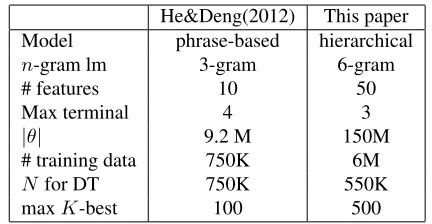
Table 1 compares the key components of our baseline system with that of (He and Deng, 2012). As shown, we are working with a stronger system than (He and Deng, 2012), especially in terms of the number of parameters under consideration|θ|.
He&Deng(2012) This paper
Model phrase-based hierarchical
n-gram lm 3-gram 6-gram
# features 10 50
Max terminal 4 3
|θ| 9.2 M 150M
# training data 750K 6M
Nfor DT 750K 550K
[image:3.612.318.534.324.436.2]maxK-best 100 500
Table 1: Our system compares to He&Deng’s (2012).
4.1 DT of 150 Million Parameters
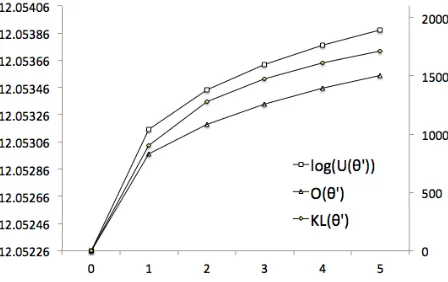
To ensure the correctness of our implementation, we show in Fig 2, the first five EBW updates with
τ = 0.10. As shown, the utility functionlog(U(θ)) increases monotonically but is countered by the KL term, resulting in a smaller but consistent increase of the objective functionO(θ). This monotonically-increasing trend of the objective function confirms the correctness of our implementation since EBW algorithm is a bound-based technique that ensures growth transformations between updates.
andp(e|f)according to Eq. 4, followed by one up-date ofλvia PRO (as in (He and Deng, 2012)). In total, we run 10 such iterations for eachτ.
tau=0.01N tau=0.05N tau=0.10N tau=0.25N tau=0.50N tau=0.75N tau=0.10
0 32.22 32.22 32.22 32.22 32.22 32.22 0 32.22
1 32.33 32.24 32.39 32.42 32.5 32.34 1 32.39
2 32.39 32.34 32.63 32.45 32.41 32.33 2 32.63
3 32.37 32.29 32.54 32.32 32.24 32.45 3 32.54
4 32.35 32.18 32.41 32.45 32.41 32.38 4 32.41
5 32.38 32.21 32.45 32.62 32.31 32.08 5 32.45
6 32.26 32.27 32.68 32.45 32.26 32.28 6 32.68
7 32.17 32.15 32.45 32.54 32.37 32.15 7 32.45
8 31.93 32.26 32.29 32.56 32.25 32.31 8 32.29
9 32.1 32.36 32.25 32.33 32.23 32.54 9 32.25
10 32.1 32.29 32.2 32.42 32.29 32.31 10 32.2
32.39 32.36 32.68 32.62 32.5 32.54
33.09
0.01 0.05 0.1 0.25 0.5 0.75
0.01 (2) 0.05 (9) 0.10 (6) 0.25 (5) 0.50 (1) 0.75 (9)
32.39 32.36 32.68 32.62 32.5 32.54
32.22 32.22 32.22 32.22 32.22 32.22
32.2$ 32.3$ 32.4$ 32.5$ 32.6$ 32.7$ 32.8$
0$ 1$ 2$ 3$ 4$ 5$ 6$ 7$ tau=0.10$
32.39$ 32.36$
32.68$
32.62$
32.5$ 32.54$
32.22$
32.2$ 32.25$ 32.3$ 32.35$ 32.4$ 32.45$ 32.5$ 32.55$ 32.6$ 32.65$ 32.7$
0.01$(2)$ 0.05$(9)$ 0.10$(6)$ 0.25$(5)$ 0.50$(1)$ 0.75$(9)$
[image:4.612.315.539.63.204.2]DT$ baseline$ τ=0.01N
Figure 1: The dev set’s BLEU score (y-axis) on different
setting ofτ(x-axis). The grey line indicates the baseline
performance on dev set. The number in bracket on the x-axis indicates the iteration at which the score is obtained.
Across different τ, we find that the first iteration provides most of the gain while the subsequent iter-ations provide additional, smaller gain with occas-sional performance degradation; thus the translation performance is not always monotonically increasing over iteration. We report the best score of eachτ in Fig. 1 and at which iteration that score is produced. As shown in Fig. 1, all settings ofτ improve over the baseline andτ = 0.10gives the highest gain of 0.45 BLEU score. This improvement is in the same ball-park as in (He and Deng, 2012) though on a scaled-up task. We next decode the MT06 using the best model (i.e. τ = 0.10at 6-th iteration) observed on the dev set, and obtained 40.33 BLEU with an im-provement of around 0.4 BLEU point. We see this result as confirming the effectiveness of discrimi-native training but on a larger-scale task, adding to what was reported by (He and Deng, 2012).
4.2 DT for Significance Pruning
Next, we show the contribution of discriminative training for model pruning. To do so, we prune the translation grammar so that its size becomes 50%, 25%, 10% of the original grammar. Respectively, we delete rules whose significance value below 15, 50 and 500. Table 2 compares the statistics of the pruned grammars and the unpruned one. In particu-lar, columns 4 and 5 show the total averaged prob-ability mass of the remaining rules. This statistics provides some indication of how deficient the
fea-Figure 2: Objective function (O(θ0)), the regularization
term (KL(θ0)) and the unregularized objective function
(log(U(θ0))) for five EBW updates of updatingp(ej|fi)
tures are after pruning. As shown, the total averaged probability mass after pruning is below 100% and even lower for the more aggressive pruning.
To show that the deficiency is suboptimal, we con-siders two baseline systems: models with/without mass renormalization. We tune a new λ for each model and use the newλto decode the dev and test sets. The results are shown in columns 6 and 9 of Table 2 where we show the results for the unnor-malized model in the brackets following the results for the re-normalized model. The results show that pruning degrades the performances and that naively re-normalizing the model provides no significant changes in performance. Subsequently, we will fo-cus on the normalized models as the baseline as they represents the starting points of our EBW iteration.
Next, we run discriminative training that would reassign the probability mass to the surviving rules. First, we normalizep(f|e) andp(e|f), so that they satisfy the sum to one constraint required by the al-gorithm. Then, we run discriminative training on these pruned grammars using τ = 0.10 (i.e. the setting that gives the best performance for the un-pruned grammar as discussed in Section 4.1). We report the results in columns 7 and 9 for the dev and test sets respectively, as well as the gain over the baseline system in columns 8 and 10.
[image:4.612.73.295.109.235.2]size |f| |e| p(∗|e) p(∗|f) dev-set test-set (MT06)
(%) (M) (M) baseline (un) DT (iter) gain baseline (un) DT gain
100 59 50 1.00 1.00 32.22(32.08) 32.68(6) +0.44 39.91(39.71) 40.33 +0.42
50 38 35 0.92 0.94 31.84 (32.02) 32.31(6) +0.57 39.61(39.72) 40.08 +0.47
25 14 14 0.87 0.91 31.39 (31.43) 31.68 (2) +0.29 39.23 (39.17) 39.43 +0.20
[image:5.612.71.542.57.141.2]10 4 3 0.77 0.84 27.27 (27.10) 27.82 (2) +0.55 36.01 (36.04) 36.43 +0.42
Table 2: The statistics of grammars pruned at various level (column 1), including the number of unique source and
target phrases (columns 2 & 3), total probability mass of the remaining rules forp(f|e)andp(e|f)(columns 4 & 5),
the performance of the pruned model before and after discriminative training as well as the gain on the dev and the test sets (columns 6 to 11). The iteration at which DT gives the best dev set is indicated by the number enclosed by
bracket in column 7. The baseline performance is initalics, followed by a number in the bracket which refers to the
performance of using unnormalized model. The above-the-baseline performances are inbold.
BLEU point after pruning. With the DT on pruned model, all pruning losses are reclaimed and the new pruned model is even better than the unpruned orig-inal model. This empirical result shows that leaving probability mass unassigned after pruning is sub-optimal and that discriminative training provides a principled way to redistribute the mass.
5 Conclusion
In this paper, we first extend the maximum expected BLEU training of (He and Deng, 2012) to train two features of a state-of-the-art hierarchical phrase-based system, namely: p(f|e) and p(e|f). Com-pared to (He and Deng, 2012), we apply the algo-rithm to a strong baseline that is trained on a big-ger parallel corpora and comes with a richer feature set. The number of parameters under consideration amounts to 150 million. Our experiments show that discriminative training these two features (out of 50) gives around 0.40 BLEU point improvement, which is consistent with the conclusion of (He and Deng, 2012) but in a much larger-scale system.
Furthermore, we apply the algorithm to redis-tribute the probability mass ofp(f|e)andp(e|f)that is commonly lost due to conventional model prun-ing. Previous techniques either leave the probability mass as it is or distribute it proportionally among the surviving rules. We show that our proposal of us-ing discriminative trainus-ing to redistribute the mass empirically performs better, demonstrating the ef-fectiveness of our proposal.
Appendix
We describe the process to simplify Eq. 1 to Eq. 2, which is omitted in (He and Deng, 2012). For con-ciseness, we drop the conditions and writeP( ˆEi|Fi)
asP( ˆEi). We write Eq. 1 again below as Eq. 5 .
X
∀Eˆ1...EˆN
N
Y
i=1
P( ˆEi|Fi)· N
X
i=1
B( ˆEi) (5)
We first focus on the first sentenceE1/F1and ex-pand the related terms from the equation as follow:
X
∀Eˆ1 X
∀Eˆ2...EˆN P( ˆE1)
N
Y
i=2
P( ˆEi).
"
B( ˆE1)+
N
X
i=2
B( ˆEi)
#
Expanding the inner summation, we arrive at:
X
∀Eˆ1
P( ˆE1)B( ˆE1) X
∀Eˆ2...EˆN
N
Y
i=2
P( ˆEi) +
X
∀Eˆ1
P( ˆE1) X
∀Eˆ2...EˆN
N
Y
i=2
P( ˆEi) N
X
i=2
B( ˆEi)
Due to the that PK
k=1P˜( ˆEnK|Fn) = 1, we can
equateP
∀Eˆ2...EˆNQNi=2P( ˆEi)andP∀Eˆ1P( ˆE1)to
1. Thus, we arrive at:
X
∀Eˆ1
P( ˆE1)B( ˆE1) +X
∀Eˆ2...EˆN
N
Y
i=2
P( ˆEi) N
X
i=2
B( ˆEi)
Acknowledgments
We thank Xiadong He for helpful discussions. We would like to acknowledge the support of DARPA under Grant HR0011-12-C-0015 for funding part of this work. The views, opinions, and/or findings con-tained in this article/presentation are those of the au-thor/presenter and should not be interpreted as rep-resenting the official views or policies, either ex-pressed or implied, of the DARPA.
References
David Chiang, Steve DeNeefe, Yee Seng Chan, and Hwee Tou Ng. 2008a. Decomposability of transla-tion metrics for improved evaluatransla-tion and efficient
al-gorithms. InProceedings of the 2008 Conference on
Empirical Methods in Natural Language Processing, pages 610–619, Honolulu, Hawaii, October. Associa-tion for ComputaAssocia-tional Linguistics.
David Chiang, Yuval Marton, and Philip Resnik. 2008b. Online large-margin training of syntactic and
struc-tural translation features. InProceedings of the 2008
Conference on Empirical Methods in Natural Lan-guage Processing, pages 224–233, Honolulu, Hawaii, October. Association for Computational Linguistics. David Chiang, Steve DeNeefe, and Michael Pust. 2011.
Two easy improvements to lexical weighting. In
Pro-ceedings of the 49th Annual Meeting of the Associa-tion for ComputaAssocia-tional Linguistics: Human Language Technologies, pages 455–460, Portland, Oregon, USA, June. Association for Computational Linguistics. Matthias Eck, Stephan Vogel, and Alex Waibel. 2007.
Translation model pruning via usage statistics for
sta-tistical machine translation. In Human Language
Technologies 2007: The Conference of the North American Chapter of the Association for Computa-tional Linguistics; Companion Volume, Short Papers, pages 21–24, Rochester, New York, April. Association for Computational Linguistics.
P. S. Gopalakrishnan, Dimitri Kanevsky, Arthur N´adas, and David Nahamoo. 1991. An inequality for ratio-nal functions with applications to some statistical
esti-mation problems. IEEE Transactions on Information
Theory, 37(1):107–113.
Xiaodong He and Li Deng. 2012. Maximum expected bleu training of phrase and lexicon translation
mod-els. InProceedings of the 50th Annual Meeting of the
Association for Computational Linguistics (Volume 1: Long Papers), pages 292–301, Jeju Island, Korea, July. Association for Computational Linguistics.
Mark Hopkins and Jonathan May. 2011. Tuning as
rank-ing. InProceedings of the 2011 Conference on
Empir-ical Methods in Natural Language Processing, pages 1352–1362, Edinburgh, Scotland, UK., July. Associa-tion for ComputaAssocia-tional Linguistics.
Howard Johnson, Joel Martin, George Foster, and Roland Kuhn. 2007. Improving translation quality by
dis-carding most of the phrasetable. InProceedings of the
2007 Joint Conference on Empirical Methods in Nat-ural Language Processing and Computational Natu-ral Language Learning (EMNLP-CoNLL), pages 967– 975, Prague, Czech Republic, June. Association for Computational Linguistics.
Philipp Koehn, Hieu Hoang, Alexandra Birch, Chris Callison-Burch, Marcello Federico, Nicola Bertoldi, Brooke Cowan, Wade Shen, Christine Moran, Richard Zens, Chris Dyer, Ondrej Bojar, Alexandra Con-stantin, and Evan Herbst. 2007. Moses: Open source
toolkit for statistical machine translation. In
Proceed-ings of the 45th Annual Meeting of the Association for Computational Linguistics Companion Volume Pro-ceedings of the Demo and Poster Sessions, pages 177– 180, Prague, Czech Republic, June. Association for Computational Linguistics.
Seung-Wook Lee, Dongdong Zhang, Mu Li, Ming Zhou, and Hae-Chang Rim. 2012. Translation model size reduction for hierarchical phrase-based statistical
ma-chine translation. InProceedings of the 50th Annual
Meeting of the Association for Computational Linguis-tics (Volume 2: Short Papers), pages 291–295, Jeju Is-land, Korea, July. Association for Computational Lin-guistics.
Franz Josef Och and Hermann Ney. 2002. Discrimi-native training and maximum entropy models for
sta-tistical machine translation. In Proceedings of 40th
Annual Meeting of the Association for Computational Linguistics, pages 295–302, Philadelphia, Pennsylva-nia, USA, July. Association for Computational Lin-guistics.
Patrick Simianer, Stefan Riezler, and Chris Dyer. 2012. Joint feature selection in distributed stochastic learn-ing for large-scale discriminative trainlearn-ing in smt. In
Proceedings of the 50th Annual Meeting of the Associ-ation for ComputAssoci-ational Linguistics (Volume 1: Long Papers), pages 11–21, Jeju Island, Korea, July. Asso-ciation for Computational Linguistics.
N. Tomeh, M. Turchi, G. Wisniewski, A. Allauzen, and F. Yvon. 2011. How good are your phrases? assess-ing phrase quality with sassess-ingle class classification. In
Proceedings of the International Workshop on Spoken Language Translation, pages 261–268.
Richard Zens, Daisy Stanton, and Peng Xu. 2012. A systematic comparison of phrase table pruning
tech-niques. InProceedings of the 2012 Joint Conference
pages 972–983, Jeju Island, Korea, July. Association for Computational Linguistics.
Bowen Zhou, Bing Xiang, Xiaodan Zhu, and Yuqing
Gao. 2008. Prior derivation models for formally
syntax-based translation using linguistically syntactic
parsing and tree kernels. InProceedings of the