Proceedings of the SIGDial 2019 Conference, pages 215–225 215
Learning Question-Guided Video Representation for
Multi-Turn Video Question Answering
Guan-Lin Chao
Carnegie Mellon University
Abhinav Rastogi
Google AI
Semih Yavuz
University of California, Santa Barbara
Dilek Hakkani-T ¨ur
Amazon Alexa AI
Jindong Chen
Google AI
Ian Lane
Carnegie Mellon University
Abstract
Understanding and conversing about dynamic scenes is one of the key capabilities of AI agents that navigate the environment and con-vey useful information to humans. Video question answering is a specific scenario of such AI-human interaction where an agent generates a natural language response to a question regarding the video of a dynamic scene. Incorporating features from multiple modalities, which often provide supplemen-tary information, is one of the challenging aspects of video question answering. Fur-thermore, a question often concerns only a small segment of the video, hence encoding the entire video sequence using a recurrent neural network is not computationally effi-cient. Our proposed question-guided video representation module efficiently generates the token-level video summary guided by each word in the question. The learned represen-tations are then fused with the question to gen-erate the answer. Through empirical evalu-ation on the Audio Visual Scene-aware Di-alog (AVSD) dataset (Alamri et al., 2019a), our proposed models in single-turn and multi-turn question answering achieve state-of-the-art performance on several automatic natural language generation evaluation metrics.
1 Introduction
Nowadays dialogue systems are becoming more and more ubiquitous in our lives. It is essential for such systems to perceive the environment, gather data and convey useful information to humans in an accessible fashion. Video question answering (VideoQA) systems provide a convenient way for humans to acquire visual information about the en-vironment. If a user wants to obtain information about a dynamic scene, one can simply ask the VideoQA system a question in natural language, and the system generates a natural-language an-swer. The task of a VideoQA dialogue system in
User System
Video
Can you tell me what is happening in the video?
A person is packing a bag and then looking into the mirror.
Is the person a woman?
No, the person is a youngman.
What room is this person in ?
It looks like a bedroom or a dorm room.
What color are the walls?
[image:1.595.307.526.218.449.2]The walls look like light purple.
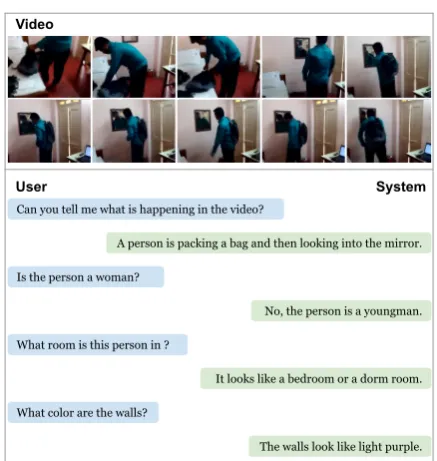
Figure 1: An example from the AVSD dataset. Each example contains a video and its associated question answering dialogue regarding the video scene.
this paper is described as follows. Given a video as grounding evidence, in each dialogue turn, the system is presented a question and is required to
generate an answer in natural language. Figure1
shows an example of multi-turn VideoQA. It is composed of a video clip and a dialogue, where the dialogue contains open-ended question answer pairs regarding the scene in the video. In order to answer the questions correctly, the system needs to be effective at understanding the question, the video and the dialogue context altogether.
Recent work on VideoQA has shown promising performance using multi-modal attention fusion for combination of features from different
modali-ties (Xu et al.,2017;Zeng et al.,2017;Zhao et al.,
a small segment in the video. Therefore, it may be time inefficient to encode the entire video se-quence using a recurrent neural network.
In this work, we present the question-guided video representation module which learns 1) to summarize the video frame features efficiently us-ing an attention mechanism and 2) to perform fea-ture selection through a gating mechanism. The learned question-guided video representation is a compact video summary for each token in the question. The video summary and question in-formation are then fused to create multi-modal representations. The multi-modal representations and the dialogue context are then passed as in-put to a sequence-to-sequence model with
atten-tion to generate the answer (Secatten-tion 3). We
em-pirically demonstrate the effectiveness of the
pro-posed methods using the AVSD dataset (Alamri
et al., 2019a) for evaluation (Section 4). The experiments show that our model for single-turn VideoQA achieves state-of-the-art performance, and our multi-turn VideoQA model shows com-petitive performance, in comparison with existing
approaches (Section5).
2 Related Work
In the recent years, research on visual ques-tion answering has accelerated following the release of multiple publicly available datasets.
These datasets include COCO-QA (Ren et al.,
2015a), VQA (Agrawal et al., 2017), and
Vi-sual Madlibs (Yu et al.,2015) for image question
answering and MovieQA (Tapaswi et al., 2016),
TGIF-QA (Jang et al., 2017), and TVQA (Lei
et al.,2018) for video question answering.
2.1 Image Question Answering
The goal of image question answering is to infer the correct answer, given a natural language ques-tion related to the visual content of an image. It as-sesses the system’s capability of multi-modal un-derstanding and reasoning regarding multiple as-pects of humans and objects, such as their
appear-ance, counting, relationships and interactions (Lei
et al., 2018). State-of-the-art image question an-swering models make use of spatial attention to obtain a fixed length question-dependent embed-ded representation of the image, which is then combined with the question feature to predict the
answer (Yang et al.,2016;Xu and Saenko,2016;
Kazemi and Elqursh,2017;Anderson et al.,2018).
Dynamic memory (Kumar et al., 2016; Xiong
et al.,2016) and co-attention mechanism (Lu et al.,
2016;Ma et al.,2018) are also adopted to model sophisticated cross-modality interactions.
2.2 Video Question Answering
VideoQA is a more complex task. As a video is a sequence of images, it contains not only ap-pearance information but also motion and transi-tions. Therefore, VideoQA requires spatial and temporal aggregation of image features to encode the video into a question-relevant representation. Hence, temporal frame-level attention is utilized to model the temporal dynamics, where frame-level attribute detection and unified video
repre-sentation are learned jointly (Ye et al.,2017;Xu
et al., 2017; Mun et al., 2017). Similarly, Lei et al.(2018) use Faster R-CNN (Ren et al.,2015b)
trained with the Visual Genome (Krishna et al.,
2017) dataset to detect object and attribute
re-gions in each frame, which are used as input fea-tures to the question answering model. Previous works also adopt various forms of external
mem-ory (Sukhbaatar et al.,2015;Kumar et al.,2016;
Graves et al., 2016) to store question informa-tion, which allows multiple iterations of
question-conditioned inference on the video features (Na
et al., 2017;Kim et al.,2017;Zeng et al., 2017;
Gao et al.,2018;Chenyou Fan,2019).
2.3 Video Question Answering Dialogue
Recently in DSTC7, Alamri et al. (2019a)
introduce the Audio-Visual Scene-aware Dialog (AVSD) dataset for multi-turn VideoQA. In ad-dition to the challenge of integrating the ques-tions and the dynamic scene information, the di-alogue system also needs to effectively incorpo-rate the dialogue context for coreference resolu-tion to fully understand the user’s quesresolu-tions across
turns. To this end,Alamri et al.(2019b) use
two-stream inflated 3D ConvNet (I3D) model (
Car-reira and Zisserman, 2017) to extract spatiotem-poral visual frame features (I3D-RGB features for RGB input and I3D-flow features for optical flow input), and propose the Na¨ıve Fusion method to combine multi-modal inputs based on the
hierar-chical recurrent encoder (HRE) architecture (Das
et al.,2017). Hori et al.(2018) extend the Na¨ıve Fusion approach and propose the Attentional Fu-sion method which learns multi-modal attention weights to fuse features from different modalities.
Fu-r2 r3
r1 rL
I3D-RGB Feature Extraction
Question
“What is he doing ?”
BiLSTM Encoder x2
x1 xK
xtok 2
xtok
1 x
tok K
xsen
Feedforward Layers
gate
v2
v1 vK
vg 2
vg
1 v
g K
○ ○ ○
+
• • •
• • •
• • •
• • •
• • •
+ +
Question-Guided Visual Feature Summarization
Question-Guided Visual Feature
Gating Embedding
Lookup
x2
x1 • • • xK
BiLSTM Encoder
LSTM Decoder
Attention
Answer
"Looks like he's cooking something to eat"
y2
y1 y3 • • • yN Video
Frames
d2 d3
d1 • • • dM Dialogue Context
“What is happening there ? <SEP> Someone is cooking food it appears <SEP> What gender ?
<SEP> Appears to be a male”
Embedding Lookup
BiLSTM
[image:3.595.79.525.64.265.2]Encoder Attention
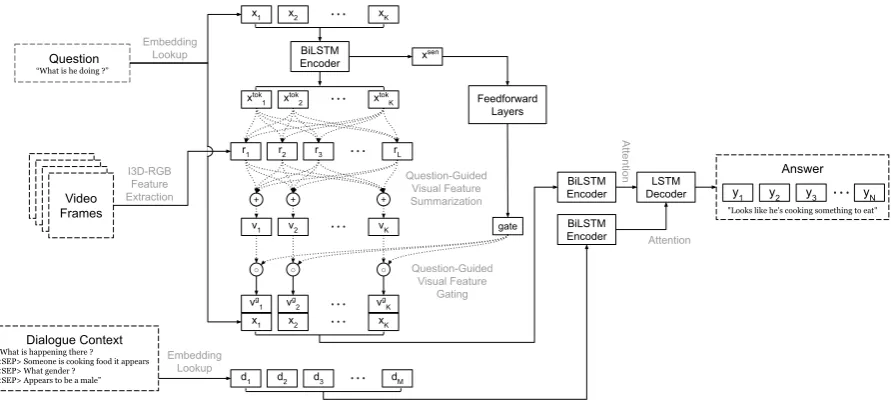
Figure 2: Overview of the proposed approach. First the I3D-RGB frame features are extracted. The question-guided video representation module takes as input the question sentence and the I3D-RGB features, generates a video representation for each token and applies gating using question as guidance. Then the question tokens are augmented by the per-token video representations and encoded by a bidirectional LSTM encoder. Similarly, the dialogue context is encoded by a bidirectional LSTM encoder. Finally, the LSTM answer decoder predicts the answer sequence.
sion method and propose to use Maximum Mutual
Information (MMI) (Bahl et al.,1986) as the
train-ing objective. Besides the HRE architecture, the multi-source sequence-to-sequence (Multi-Source
Seq2Seq) architecture with attention (Zoph and
Knight,2016;Firat et al.,2016) is also commonly
applied (Pasunuru and Bansal,2019;Kumar et al.,
2019;Yeh et al.,2019). Previous works (Sanabria et al.,2019;Le et al.,2019;Pasunuru and Bansal,
2019) also explore various attention mechanisms
to incorporate the different modal inputs, such as
hierarchical attention (Libovick`y and Helcl,2017)
and cross attention (Seo et al., 2017). For
mod-eling visual features, Lin et al. (2019) propose
to use Dynamic memory networks (Kumar et al.,
2016) and Nguyen et al. (2019) propose to use
feature-wise linear modulation layers (Perez et al.,
2018).
3 Approach
We formulate the multi-turn VideoQA task as
fol-lows. Given a sequence of raw video framesf, the
embedded question sentence x = {x1, . . . , xK}
and the single concatenated embedded sentence of
the dialogue context d = {d1, . . . , dM}, the
out-put is an answer sentencey={y1, . . . , yN}.
The architecture of our proposed approach is
illustrated in Figure 2. First the Video Frame
Feature Extraction Module extracts the
I3D-RGB frame features from the video frames
(Sec-tion3.1). The Question-Guided Video
Represen-tation Module takes as input the embedded ques-tion sentence and the I3D-RGB features, and gen-erates a compact video representation for each
to-ken in the question sentence (Section3.2). In the
Video-Augmented Question Encoder, the question tokens are first augmented by their corresponding per-token video representations and then encoded
by a bidirectional LSTM (Section 3.3).
Simi-larly, in the Dialogue Context Encoder, the dia-logue context is encoded by a bidirectional LSTM
(Section3.4). Finally, in the Answer Decoder, the
outputs from the Video-Augmented Question En-coder and the Dialogue Context EnEn-coder are used as attention memory for the LSTM decoder to
pre-dict the answer sentence (Section 3.5). Our
en-coders and decoder work in the same way as the multi-source sequence-to-sequence models with
attention (Zoph and Knight, 2016; Firat et al.,
2016).
3.1 Video Frame Feature Extraction Module
In this work, we make use of the I3D-RGB frame features as the visual modality input, which are pre-extracted and provided in the AVSD
dataset (Alamri et al., 2019a). Here we briefly
describe the I3D-RGB feature extraction process,
Zisser-man, 2017) for more details of the I3D model. Two-stream Inflated 3D ConvNet (I3D) is a state-of-the-art action recognition model which operates on video inputs. The I3D model takes as input two streams of video frames: RGB frames and optical flow frames. The two streams are sepa-rately passed to a respective 3D ConvNet, which is inflated from 2D ConvNets to incorporate the temporal dimension. Two sequences of spatiotem-poral features are produced by the respective 3D ConvNet, which are jointly used to predict the action class. The I3D-RGB features provided in the AVSD dataset are intermediate spatiotemporal representations from the ”Mixed 5c” layer of the RGB stream’s 3D ConvNet. The AVSD dataset uses the I3D model parameters pre-trained on the
Kinetics dataset (Kay et al.,2017). To reduce the
number of parameters in our model, we use a train-able linear projection layer to reduce the dimen-sionality of I3D-RGB features from 2048 to 256.
Extracted from the video frames f and projected
to a lower dimension, the sequence of dimension-reduced I3D-RGB frame features are denoted by r={r1, . . . , rL}, whereri ∈R256,∀i.
3.2 Question-Guided Video Representation Module
We use a bidirectional LSTM network to en-code the sequence of question token embedding x = {x1, . . . , xK}. The token-level
inter-mediate representations are denoted by xtok =
{xtok1 , . . . , xtokK}, and the embedded representation
of the entire question is denoted by xsen. These
outputs will be used to guide the video representa-tion.
~h0 = K~h +1 =0 (1)
~hk=LSTMforwguide(xk, ~hk−1) (2) ~h
k=LSTMbackguide(xk, k~h+1) (3)
xtokk =~hk⊕ k~h (4)
∀k∈ {1, . . . , K}
xsen =~hK⊕ 1~h (5)
where ⊕ denotes vector concatenation; ~h and h~
represent the local forward and backward LSTM hidden states.
3.2.1 Per-Token Visual Feature Summarization
Generally the sequence length of the video frame
features is quite large, as shown in Table1.
There-fore it is not computationally efficient to encode the video features using a recurrent neural net-work. We propose to use the attention mechanism to generate a context vector to efficiently summa-rize the I3D-RGB features. We use the trilinear
function (Seo et al.,2017) as a similarity measure
to identify the frames most similar to the question
tokens. For each question tokenxk, we compute
the similarity scores of its encoded representation
xtok
k with each of the I3D-RGB features r. The
similarity scores sk are converted to an attention
distributionwattk over the I3D-RGB features by the
softmax function. And the video summaryvk
cor-responding to the question tokenxkis defined as
the attention weighted linear combination of the I3D-RGB features. We also explored using dot product for computing similarity and empirically found out it yields suboptimal results.
sk,l=trilinear(xtokk , rl) (6)
=Wsim[xtokk ⊕rl⊕(xtokk rl)] (7)
∀l∈ {1, . . . , L}
wattk =softmax(sk) (8)
vk= L X
l=1
wattk,lrl (9)
∀k∈ {1, . . . , K}
wheredenotes element-wise multiplication, and
Wsimis a trainable variable.
3.2.2 Visual Feature Gating
Not all details in the video are important for an-swering a question. Attention helps in discarding the unimportant frames in the time dimension. We propose a gating mechanism which enables us to perform feature selection within each frame. We project the sentence-level question representation
xsen through fully-connected layers with ReLU
nonlinearity to generate a gate vectorg. For each
question token xk, its corresponding video
sum-maryvkis then multiplied element-wise with the
gate vectorgto generate a gated visual summary
vgk. We also experimented applying gating on the
dimension-reduced I3D-RGB features r, prior to
the per-token visual feature summarization step, but it resulted in an inferior performance.
g=sigmoid(Wg, 1(ReLU(Wg, 2xsen+bg, 2)
+bg, 1) (10)
vgk=vkg (11)
where Wg, 1, bg, 1, Wg, 2, bg, 2 are trainable
vari-ables.
3.3 Video-Augmented Question Encoder
Given the sequence of per-token gated visual
summary vg = {vg1, . . . , vKg }, we augment the
question features by concatenating the
embed-ded question tokens x = {x1, . . . , xK} with
their associated per-token video summary. The augmented question features are then encoded using a bidirectional LSTM. The token-level video-augmented question features are denoted by qtok ={q1tok, . . . , qtokK}, and the sentence-level
fea-ture is denoted byqsen.
~h0 = K~h +1=0 (12)
~hk=LSTMforwques(xk⊕vkg, ~hk−1) (13) ~h
k=LSTMbackques(xk⊕vkg, k~h+1) (14)
qktok=~hk⊕ k~h (15)
∀k∈ {1, . . . , K}
qsen =~hK⊕ 1~h (16)
where ~h and h~ represent the local forward and
backward LSTM hidden states.
3.4 Dialogue Context Encoder
Similar to the video-augmented question encoder, we encode the embedded dialogue context tokens d = {d1, . . . , dM} using a bidirectional LSTM.
The embedded token-level representations are
de-noted bydtok ={dtok
1 , . . . , dtokM}.
~h0 = M~h +1 =0 (17)
~hm=LSTMforwdial(dm, ~hm−1) (18) ~h
m=LSTMbackdial(dm, m~h +1) (19)
dtokm =~hm⊕ m~h (20)
∀m∈ {1, . . . , M}
where ~h and h~ represent the local forward and
backward LSTM hidden states.
3.5 Answer Decoder
The final states of the forward and backward LSTM units of the question encoder are used to
initialize the state of answer decoder. Letynbe the
output of the decoder at stepn, where1≤n≤N,
y0 be the special start of sentence token andynemb
be the embedded representation of yn. At a
de-coder step n, the previous decoder hidden state
hn−1 is used to attend over qtok and dtok to get
the attention vectorshatt, qn andhatt, dn respectively.
These two vectors retrieve the relevant features from the intermediate representations of the video-augmented question encoder and the dialogue con-text encoder, both of which are useful for generat-ing the next token of the answer. At each decoder
step, the decoder hidden statehnis used to
gener-ate a distribution over the vocabulary. The decoder
outputy∗nis defined to be argmaxyn p(yn|y≤n−1).
h0 =qsen (21)
sqn,k=vans, q> tanh(Wans, q[hn−1⊕qtokk ]) (22)
∀k∈ {1, . . . , K}
wqn=softmax(sqn) (23)
hatt, qn = K X
k=1
wn,kq qtokk (24)
sdn,m=v>ans, dtanh(Wans, d[hn−1⊕dtokm]) (25)
∀m∈ {1, . . . , M}
wdn=softmax(sdn) (26)
hatt, dn = M X
m=1
wn,md dtokm (27)
hn=LSTMans(yembn−1,[hatt, qn ⊕hatt, dn ⊕hn−1])
(28)
p(yn|y≤n−1) =softmax(Wanshn+bans) (29)
∀n∈ {1, . . . , N}
wherehrepresents the local LSTM hidden states,
andWans, q, Wans, d, Wans, bans are trainable
vari-ables.
4 Experiments
4.1 Dataset
We consider the Audio-Visual Scene-aware
Di-alog (AVSD) dataset (Alamri et al., 2019a) for
evaluating our proposed model in single-turn and multi-turn VideoQA. We use the official release of
train set for training, and the public (i.e.,
proto-type) validation and test sets for inference. The AVSD dataset is a collection of text-based human-human question answering dialogues based on the
video clips from the CHARADES dataset (
Training Validation Test
# of dialogues 7659 732 733
# of turns 153,180 14,680 14,660
# of words 1,450,754 138,314 138,790
Avg. length of
8.5 8.4 8.5
question (K) Avg. length of
179.2 173.0 171.3
[image:6.595.71.291.65.177.2]I3D-RGB (L)
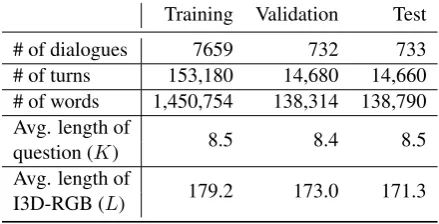
Table 1: Data statistics of the AVSD dataset. We use the official training set, and the public (i.e.,prototype) validation and test sets. We also present the average length of the question token sequences and the I3D-RGB frame feature sequences to highlight the impor-tance of time efficient video encoding without using a recurrent neural network. The sequence lengths of the questions and I3D-RGB frame features are denoted by K and Lrespectively in the model description (Sec-tion3).
the video clips and associated question answer-ing dialogues, the AVSD dataset also provides the pre-extracted I3D-RGB visual frame features us-ing a pre-trained two-stream inflated 3D ConvNet
(I3D) model (Carreira and Zisserman,2017). The
pre-trained I3D model was trained on the Kinetics
dataset (Kay et al.,2017) for human action
recog-nition.
In Table1, we present the statistics of the AVSD
dataset. Given the fact that the lengths of the I3D-RGB frame feature sequences are more than 20 times longer than the questions, using a recurrent neural network to encode the visual feature se-quences will be very time consuming, as the vi-sual frames are processed sequentially. Our pro-posed question-guided video representation module summarizes the video sequence efficiently -aggregating the visual features by question-guided attention and weighted summation and performing gating with a question-guided gate vector, both of which can be done in parallel across all frames.
4.2 Experimental Setup
We implement our models using the
Ten-sor2Tensor framework (Vaswani et al.,2018). The
question and dialogue context tokens are both em-bedded with the same randomly-initialized word embedding matrix, which is also shared with the answer decoder’s output embedding. The dimen-sion of the word embedding is 256, the same di-mension to which the I3D-RGB features are trans-formed. All of our LSTM encoders and decoder
have 1 hidden layer. Bahdanau attention
mecha-nism (Bahdanau et al., 2015) is used in the
an-swer decoder. During training, we apply dropout
rate0.2in the encoder and decoder cells. We use
the ADAM optimizer (Kingma and Ba,2015) with
α = 2 × 10⁻⁴, β1 = 0.85, β2 = 0.997, =
10−6, and clip the gradient with L2 norm
thresh-old 2.0 (Pascanu et al., 2013). The models are trained up to 100K steps with early stopping on the validation BLEU-4 score using batch size 1024 on a single GPU. During inference, we use beam search decoding with beam width 3. We
exper-imented with word embedding dimension {256,
512}, dropout rate{0, 0.2}, Luong and Bahdanau
attention mechanisms, {1, 2}hidden layer(s) for
both encoders and the decoder. We found the
aforementioned setting worked best for most mod-els.
5 Results
5.1 Comparison with Existing Methods
We evaluate our proposed approach using the same natural language generation evaluation
toolkit NLGEval (Sharma et al.,2017) as the
pre-vious approaches. The corpus-wide scores of the following unsupervised automated metrics are
re-ported, including BLEU-1 through BLEU-4 (
Pa-pineni et al., 2002), METEOR (Banerjee and Lavie,2005), ROUGE-L (Lin and Och,2004) and
CIDEr (Vedantam et al., 2015). The results of
our models in comparison with the previous
ap-proaches are shown in Table 2. We report the
mean and standard deviation scores of 5 runs us-ing random initialization and early stoppus-ing on the public (prototype) validation set. We apply our model in two scenarios: single-turn and multi-turn VideoQA. The only difference is that in single-turn VideoQA, the dialogue context encoder is ex-cluded from the model.
Single-Turn VideoQA Models BLEU-1 BLEU-2 BLEU-3 BLEU-4 METEOR ROUGE-L CIDEr
Na¨ıve Fusion 27.7 17.5 11.8 8.3 11.7 28.8 74.0
Multi-source Seq2Seq - - - 8.83 12.43 34.23 95.54
Ours 29.56±0.75 18.60±0.49 13.16±0.33 9.77±0.21 13.19±0.20 34.29±0.19 101.75±1.03
Multi-Turn VideoQA Models BLEU-1 BLEU-2 BLEU-3 BLEU-4 METEOR ROUGE-L CIDEr
Na¨ıve Fusion 27.7 17.6 12.0 8.5 11.8 29.0 76.5
Attentional Fusion 27.6 17.7 12.2 8.7 11.7 29.3 78.7
Modified Attn. Fusion 27.7 17.6 12.0 8.5 11.8 29.0 76.5
+MMI objective 28.3 18.1 12.4 8.9 12.1 29.6 80.5
Hierarchical Attention 29.1 18.6 12.6 9.0 12.7 30.1 82.4
+pre-trained embedding 30.7 20.4 14.4 10.6 13.6 32.0 99.5
Multi-Source Seq2Seq - - - 10.58 14.13 36.54 105.39
[image:7.595.73.526.63.215.2]Ours 30.52±0.34 20.00±0.20 14.46±0.14 10.93±0.11 13.87±0.10 36.62±0.23 113.28±1.37
Table 2: Comparison with existing approaches: Na¨ıve Fusion (Alamri et al.,2019b;Zhuang et al.,2019), Atten-tional Fusion (Hori et al.,2018;Zhuang et al.,2019), Multi-Source Sequence-to-Sequence model (Pasunuru and
Bansal,2019), Modified Attentional Fusion with Maximum Mutual Information objective (Zhuang et al.,2019)
and Hierarchical Attention with pre-trained embedding (Le et al.,2019), on the AVSD public test set. For each approach, we report its corpus-wide scores on BLEU-1 through BLEU-4, METEOR, ROUGE-L and CIDEr. We report the mean and standard deviation scores of 5 runs using random initialization and early stopping on the public (prototype) validation set.
Model BLEU-4 METEOR ROUGE-L CIDEr
Ours 10.94 13.73 36.30 111.12
-TokSumm 10.46 13.49 35.81 110.08
-Gating 10.59 13.64 36.11 108.51
-TokSumm-Gating 10.06 13.20 35.35 104.01
Table 3: Ablation study on the AVSD validation set. We observe that the performance degrades when either of both of the question-guided per-token visual feature summarization (TokSumm) and feature gating (Gating) techniques are removed.
with previous multi-turn VideoQA models, our approach that uses the dialogue context (ques-tions and answers in previous turns) yields state-of-the-art performance on the BLEU-3, BLEU-4, ROUGE-L and CIDEr metrics and competitive re-sults on BLEU-1, BLEU-2 and METEOR. It is worth mentioning that our model does not use pre-trained word embedding or audio features as in the
previous hierarchical attention approach (Le et al.,
2019).
5.2 Ablation Study and Weights Visualization
We perform ablation experiments on the valida-tion set in the multi-turn VideoQA scenario to an-alyze the effectiveness of the two techniques in the question-guided video representation module. The
results are shown in Table3.
5.2.1 Question-Guided Per-Token Visual Feature Summarization (TokSumm)
Instead of using token-level question
representa-tionsxtok ={xtok1 , . . . , xtokK}to generate per-token
video summaryv={v1, . . . , vK}, we experiment
with using the sentence-level representation of the
questionxsenas the query vector to attend over the
I3D-RGB visual features to create a visual
sum-maryv, and usevto augment each of the question
tokens in the video-augmented question encoder.
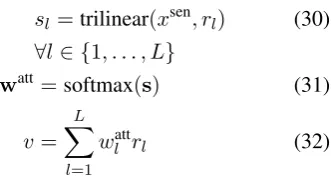
sl=trilinear(xsen, rl) (30)
∀l∈ {1, . . . , L}
watt=softmax(s) (31)
v= L X
l=1
wattl rl (32)
We observe the performance degrades when the sentence-level video summary is used instead of the token-level video summary.
Figure 3 shows an example of the attention
weights in the question-guided per-token visual feature summarization. We can see that for dif-ferent question tokens, the attention weights are shifted to focus on the different segment in the se-quence of the video frame features.
5.2.2 Question-Guided Visual Feature Gating (Gating)
We also experiment with using the non-gated
[image:7.595.360.526.478.568.2]Figure 3: Question-guided per-token visual feature summary weights on a question. Each row represents the attention weightswatt
k of the corresponding encoded question tokenx tok
[image:8.595.87.524.295.399.2]k over the I3D-RGB visual features. We can observe that the attention weights are shifted to focus on the relevant segment of the visual frame features for the question tokens “after the younger man leaves<eos>?”
Figure 4: Question-guided gate weightsgfor some example questions. Across the questions about similar subjects, we observe a similar trend of weight distribution over visual feature dimensions. Conversely, questions about different topics show different gate weights patterns.
augment the question information in the
video-augmented question encoder. We observe the
model’s performance declines when the question-guided gating is not applied on the video summary feature. Removing both the per-token visual fea-ture summarization and the gating mechanism re-sults in further degradation in the model perfor-mance.
Figure 4 illustrates the question-guided gate
weights g of several example questions. We
observe that the gate vectors corresponding to the questions regarding similar subjects assign weights on similar dimensions of the visual fea-ture. Although many of the visual feature dimen-sions have low weights across different questions, the feature dimensions of higher gate weights still exhibit certain topic-specific patterns.
6 Conclusion and Future Work
In this paper, we present an end-to-end trainable model for single-turn and multi-turn VideoQA.
to extend the models to incorporate audio features and experiment with more advanced techniques to incorporate the dialogue context with the question and video information, such as hierarchical atten-tion and co-attenatten-tion mechanisms. We also plan to employ our model on TVQA, a larger scale VideoQA dataset.
References
Aishwarya Agrawal, Jiasen Lu, Stanislaw Antol, Mar-garet Mitchell, C Lawrence Zitnick, Devi Parikh, and Dhruv Batra. 2017. VQA: Visual question an-swering. International Journal of Computer Vision (IJCV).
Huda Alamri, Vincent Cartillier, Abhishek Das, Jue Wang, Stefan Lee, Peter Anderson, Irfan Essa, Devi Parikh, Dhruv Batra, Anoop Cherian, Tim K. Marks, and Chiori Hori. 2019a. Audio visual scene-aware dialog. InComputer Vision and Pattern Recognition
(CVPR).
Huda Alamri, Chiori Hori, Tim K. Marks, Dhruv Batra, and Devi Parikh. 2019b. Audio visual scene-aware dialog (avsd) track for natural language generation in dstc7. InDSTC7 at AAAI 2019 Workshop.
Peter Anderson, Xiaodong He, Chris Buehler, Damien Teney, Mark Johnson, Stephen Gould, and Lei Zhang. 2018. Bottom-up and top-down attention for image captioning and visual question answering. In
Computer Vision and Pattern Recognition (CVPR).
Dzmitry Bahdanau, Kyunghyun Cho, and Yoshua Ben-gio. 2015. Neural machine translation by jointly learning to align and translate. InInternational Con-ference on Learning Representations (ICLR).
Lalit R Bahl, Peter F Brown, Peter V De Souza, and Robert L Mercer. 1986. Maximum mutual infor-mation estiinfor-mation of hidden markov model param-eters for speech recognition. InInternational Con-ference on Acoustics, Speech and Signal Processing (ICASSP).
Satanjeev Banerjee and Alon Lavie. 2005. Meteor: An automatic metric for mt evaluation with improved correlation with human judgments. In ACL work-shop on intrinsic and extrinsic evaluation measures for machine translation and/or summarization.
Joao Carreira and Andrew Zisserman. 2017. Quo vadis, action recognition? a new model and the Kinetics dataset. In Computer Vision and Pattern
Recognition (CVPR).
Shu Zhang Wensheng Wang Chi Zhang Heng Huang Chenyou Fan, Xiaofan Zhang. 2019. Heterogeneous memory enhanced multimodal attention model for video question answering. InComputer Vision and Pattern Recognition (CVPR).
Abhishek Das, Satwik Kottur, Khushi Gupta, Avi Singh, Deshraj Yadav, Jos´e MF Moura, Devi Parikh, and Dhruv Batra. 2017. Visual dialog. InComputer Vision and Pattern Recognition (CVPR).
Orhan Firat, Kyunghyun Cho, and Yoshua Bengio. 2016. Multi-way, multilingual neural machine translation with a shared attention mechanism. In
Annual Conference of the North American Chap-ter of the Association for Computational Linguistics
(NAACL).
Jiyang Gao, Runzhou Ge, Kan Chen, and Ram Nevatia. 2018. Motion-appearance co-memory networks for video question answering. InComputer Vision and Pattern Recognition (CVPR).
Alex Graves, Greg Wayne, Malcolm Reynolds, Tim Harley, Ivo Danihelka, Agnieszka Grabska-Barwi´nska, Sergio G´omez Colmenarejo, Edward Grefenstette, Tiago Ramalho, John Agapiou, et al. 2016. Hybrid computing using a neural network with dynamic external memory.Nature.
Chiori Hori, Huda Alamri, Jue Wang, Gordon Winch-ern, Takaaki Hori, Anoop Cherian, Tim K Marks, Vincent Cartillier, Raphael Gontijo Lopes, Ab-hishek Das, et al. 2018. End-to-end audio vi-sual scene-aware dialog using multimodal
attention-based video features. Computing Research
Reposi-tory, arXiv:1806.08409.
Yunseok Jang, Yale Song, Youngjae Yu, Youngjin Kim, and Gunhee Kim. 2017. TGIF-QA: Toward spatio-temporal reasoning in visual question answering. In
Computer Vision and Pattern Recognition (CVPR).
Will Kay, Joao Carreira, Karen Simonyan, Brian Zhang, Chloe Hillier, Sudheendra Vijaya-narasimhan, Fabio Viola, Tim Green, Trevor Back, Paul Natsev, et al. 2017. The kinetics
human action video dataset. Computing Research
Repository, arXiv:1705.06950.
Vahid Kazemi and Ali Elqursh. 2017. Show, ask, at-tend, and answer: A strong baseline for visual
ques-tion answering. Computing Research Repository,
arXiv:1704.03162.
Kyung-Min Kim, Min-Oh Heo, Seong-Ho Choi, and Byoung-Tak Zhang. 2017. DeepStory: video story QA by deep embedded memory networks. In Inter-national Joint Conferences on Artificial Intelligence (IJCAI).
D Kingma and Jimmy Ba. 2015. A method for stochas-tic optimization. In International Conference on
Learning Representations (ICLR).
Ranjay Krishna, Yuke Zhu, Oliver Groth, Justin John-son, Kenji Hata, Joshua Kravitz, Stephanie Chen, Yannis Kalantidis, Li-Jia Li, David A Shamma, et al. 2017. Visual Genome: Connecting language and vi-sion using crowdsourced dense image annotations.
Ankit Kumar, Ozan Irsoy, Peter Ondruska, Mohit Iyyer, James Bradbury, Ishaan Gulrajani, Victor Zhong, Romain Paulus, and Richard Socher. 2016. Ask me anything: Dynamic memory networks for natural language processing. InInternational
Con-ference on Machine Learning (ICML).
Shachi H Kumar, Eda Okur, Saurav Sahay, Juan Jose Alvarado Leanos, Jonathan Huang, and Lama Nachman. 2019. Context, attention and audio fea-ture explorations for audio visual scene-aware dia-log. InDSTC7 at AAAI 2019 workshop.
Hung Le, S Hoi, Doyen Sahoo, and N Chen. 2019. End-to-end multimodal dialog systems with hierar-chical multimodal attention on video features. In
DSTC7 at AAAI 2019 workshop.
Jie Lei, Licheng Yu, Mohit Bansal, and Tamara Berg. 2018. TVQA: Localized, compositional video ques-tion answering. InConference on Empirical
Meth-ods in Natural Language Processing (EMNLP).
Jindˇrich Libovick`y and Jindˇrich Helcl. 2017. Attention strategies for multi-source sequence-to-sequence learning. InAnnual Meeting of the Association for
Computational Linguistics (ACL).
Chin-Yew Lin and Franz Josef Och. 2004. Auto-matic evaluation of machine translation quality us-ing longest common subsequence and skip-bigram statistics. InAnnual Meeting of the Association for
Computational Linguistics (ACL).
Kuan-Yen Lin, Chao-Chun Hsu, Yun-Nung Chen, and Lun-Wei Ku. 2019. Entropy-enhanced multimodal attention model for scene-aware dialogue genera-tion. InDSTC7 at AAAI 2019 workshop.
Jiasen Lu, Jianwei Yang, Dhruv Batra, and Devi Parikh. 2016. Hierarchical question-image co-attention for visual question answering. InAdvances in Neural Information Processing Systems.
Chao Ma, Chunhua Shen, Anthony Dick, Qi Wu, Peng Wang, Anton van den Hengel, and Ian Reid. 2018. Visual question answering with memory-augmented networks. InComputer Vision and Pattern Recogni-tion (CVPR).
Jonghwan Mun, Paul Hongsuck Seo, Ilchae Jung, and Bohyung Han. 2017. MarioQA: Answering ques-tions by watching gameplay videos. InInternational
Conference on Computer Vision (ICCV).
Seil Na, Sangho Lee, Jisung Kim, and Gunhee Kim. 2017. A read-write memory network for movie story understanding. InInternational Conference on
Computer Vision (ICCV).
Dat Tien Nguyen, Shikhar Sharma, Hannes Schulz, and Layla El Asri. 2019. From film to video: Multi-turn question answering with multi-modal context.
InDSTC7 at AAAI 2019 workshop.
Kishore Papineni, Salim Roukos, Todd Ward, and Wei-Jing Zhu. 2002. BLEU: A method for automatic evaluation of machine translation. InAnnual Meet-ing of the Association for Computational LMeet-inguistics (ACL).
Razvan Pascanu, Tomas Mikolov, and Yoshua Bengio. 2013. On the difficulty of training recurrent neural networks. InInternational Conference on Machine
Learning (ICML).
Ramakanth Pasunuru and Mohit Bansal. 2019. Dstc7-avsd: Scene-aware video-dialogue systems with dual attention. InDSTC7 at AAAI 2019 workshop.
Ethan Perez, Florian Strub, Harm De Vries, Vincent Dumoulin, and Aaron Courville. 2018. FiLM: Vi-sual reasoning with a general conditioning layer. In
AAAI Conference on Artificial Intelligence (AAAI).
Mengye Ren, Ryan Kiros, and Richard Zemel. 2015a. Exploring models and data for image question an-swering. In Advances in Neural Information Pro-cessing Systems.
Shaoqing Ren, Kaiming He, Ross Girshick, and Jian Sun. 2015b. Faster R-CNN: Towards real-time ob-ject detection with region proposal networks. In Ad-vances in Neural Information Processing Systems.
Ramon Sanabria, Shruti Palaskar, and Florian Metze. 2019. Cmu sinbads submission for the dstc7 avsd challenge. InDSTC7 at AAAI 2019 workshop.
Minjoon Seo, Aniruddha Kembhavi, Ali Farhadi, and Hannaneh Hajishirzi. 2017. Bidirectional attention flow for machine comprehension. InInternational
Conference on Learning Representations (ICLR).
Shikhar Sharma, Layla El Asri, Hannes Schulz, and Jeremie Zumer. 2017. Relevance of unsupervised metrics in task-oriented dialogue for evaluating
nat-ural language generation. Computing Research
Repository, arXiv:1706.09799.
Gunnar A Sigurdsson, G¨ul Varol, Xiaolong Wang, Ali Farhadi, Ivan Laptev, and Abhinav Gupta. 2016. Hollywood in homes: Crowdsourcing data collec-tion for activity understanding. In European
Con-ference on Computer Vision (ECCV).
Sainbayar Sukhbaatar, Jason Weston, Rob Fergus, et al. 2015. End-to-end memory networks. InAdvances in Neural Information Processing Systems.
Makarand Tapaswi, Yukun Zhu, Rainer Stiefelhagen, Antonio Torralba, Raquel Urtasun, and Sanja Fidler. 2016. MovieQA: Understanding stories in movies through question-answering. In Computer Vision
and Pattern Recognition (CVPR).
Ramakrishna Vedantam, C Lawrence Zitnick, and Devi Parikh. 2015. CIDEr: Consensus-based image de-scription evaluation. In Computer Vision and Pat-tern Recognition (CVPR).
Caiming Xiong, Stephen Merity, and Richard Socher. 2016. Dynamic memory networks for visual and textual question answering. In International
Con-ference on Machine Learning (ICML).
Dejing Xu, Zhou Zhao, Jun Xiao, Fei Wu, Hanwang Zhang, Xiangnan He, and Yueting Zhuang. 2017. Video question answering via gradually refined at-tention over appearance and motion. In Interna-tional Conference on Multimedia.
Huijuan Xu and Kate Saenko. 2016. Ask, attend and answer: Exploring question-guided spatial attention for visual question answering. InEuropean
Confer-ence on Computer Vision (ECCV).
Zichao Yang, Xiaodong He, Jianfeng Gao, Li Deng, and Alex Smola. 2016. Stacked attention networks for image question answering. InComputer Vision
and Pattern Recognition (CVPR).
Yunan Ye, Zhou Zhao, Yimeng Li, Long Chen, Jun Xiao, and Yueting Zhuang. 2017. Video question answering via attribute-augmented attention net-work learning. In SIGIR Conference on Research and Development in Information Retrieval.
Ting Yeh, Tzu-Chuan Lin, Hsiao-Hua Cheng, Yi-Hsuan Deng, Shang-Yu Su, and Yun-Nung Chen. 2019. Reactive stage feature fusion for multi-modal dialogue modeling. InDSTC7 at AAAI 2019
Workshop.
Licheng Yu, Eunbyung Park, Alexander C Berg, and Tamara L Berg. 2015. Visual Madlibs: Fill in the blank description generation and question answer-ing. InInternational Conference on Computer Vi-sion (ICCV).
Kuo-Hao Zeng, Tseng-Hung Chen, Ching-Yao Chuang, Yuan-Hong Liao, Juan Carlos Niebles, and Min Sun. 2017. Leveraging video descrip-tions to learn video question answering. In AAAI Conference on Artificial Intelligence (AAAI).
Zhou Zhao, Zhu Zhang, Shuwen Xiao, Zhou Yu, Jun Yu, Deng Cai, Fei Wu, and Yueting Zhuang. 2018. Open-ended long-form video question answering via adaptive hierarchical reinforced networks. In
International Joint Conferences on Artificial Intel-ligence (IJCAI).
Bairong Zhuang, Wenbo Wang, and Takahiro Shi-nozaki. 2019. Investigation of attention-based mul-timodal fusion and maximum mutual information objective for dstc7 track3. InDSTC7 at AAAI 2019 workshop.
Barret Zoph and Kevin Knight. 2016. Multi-source neural translation. In Annual Conference of the North American Chapter of the Association for