Twitter Topic Modeling by Tweet Aggregation
Asbjørn Ottesen Steinskog Jonas Foyn Therkelsen Björn Gambäck
Department of Computer Science
Norwegian University of Science and Technology NO–7491 Trondheim, Norway
[email protected] [email protected] [email protected]
Abstract
Conventional topic modeling schemes, such as Latent Dirich-let Allocation, are known to perform inadequately when applied to tweets, due to the sparsity of short documents. To alleviate these disadvantages, we apply several pooling techniques, aggregating similar tweets into indi-vidual documents, and specifically study the aggregation of tweets shar-ing authors or hashtags. The results show that aggregating similar tweets into individual documents signifi-cantly increases topic coherence.
1 Introduction
Due to the tremendous amount of data broad-casted on microblog sites like Twitter, extract-ing information from microblogs has turned out to be useful for establishing the public opinion on different issues. O’Connor et al. (2010) found a correlation between word fre-quencies in Twitter and public opinion sur-veys in politics. Analyzing tweets (Twitter messages) over a timespan can give great in-sights into what happened during that time, as people tend to tweet about what concerns them and their surroundings. Many influential people post messages on Twitter, and inves-tigating the relation between the underlying topics of different authors’ messages could
yield interesting results about people’s inter-ests. One could for example compare the top-ics different politicians tend to talk about to obtain a greater understanding of their simi-larities and differences. Twitter has an abun-dance of messages, and the enormous amount of tweets posted every second makes Twitter suitable for such tasks. However, detecting topics in tweets can be a challenging task due to their informal type of language and since tweets usually are more incoherent than tra-ditional documents. The community has also spawned user-generated metatags, like hash-tags and mentions, that have analytical value for opinion mining.
The paper describes a system aimed at dis-covering trending topics and events in a cor-pus of tweets, as well as exploring the top-ics of different Twitter users and how they relate to each other. Utilizing Twitter meta-data mitigates the disadvantages tweets typi-cally have when using standard topic model-ing methods; user information as well as hash-tag co-occurrences can give a lot of insight into what topics are currently trending.
2 Topic modeling
Topic models are statistical methods used to represent latent topics in document collec-tions. These probabilistic models usually present topics as multinomial distributions over words, assuming that each document in a collection can be described as a mixture of topics. The language used in tweets is of-ten informal, containing grammatically cre-ative text, slang, emoticons and abbreviations, making it more difficult to extract topics from tweets than from more formal text.
The 2015 International Workshop on Se-mantic Evaluation (SemEval) presented a task on Topic-Based Message Polarity Classifica-tion, similar to the topic of this paper. The most successful systems used text preprocess-ing and standard methods: Boag et al. (2015) took a supervised learning approach using lin-ear SVM (Support Vector Machines), heav-ily focused on feature engineering, to reach the best performance of all. Plotnikova et al. (2015) came in second utilizing another super-vised method, Maximum Entropy, with lexi-con and emotilexi-con scores and trigrams, while essentially ignoring topics, which is interest-ing given the task. Zhang et al. (2015) differed from the other techniques by focusing on word embedding features, as well as the traditional textual features, but argued that to only extend the model with the word embeddings did not necessarily significantly improve results.
Although the informal language and sparse text make it difficult to retrieve the underly-ing topics in tweets, Weng et al. (2010) pre-viously found that Latent Dirichlet Alloca-tion(LDA) produced decent results on tweets. LDA (Blei et al., 2003) is an unsupervised probabilistic model which generates mixtures of latent topics from a collection of docu-ments, where each mixture of topics produces words from the collection’s vocabulary with certain probabilities. A distribution over
top-ics is first sampled from a Dirichlet distribu-tion, and a topic is chosen based on this bution. Each document is modeled as a distri-bution over topics, with topics represented as distributions over words (Blei, 2012).
Koltsova and Koltcov (2013) used LDA mainly on topics regarding Russian presiden-tial elections, but also on recreational and other topics, with a dataset of all posts by 2,000 LiveJournal bloggers. Despite the broad categories, LDA showed its robustness by correctly identifying 30–40% of the topics. Sotiropoulos et al. (2014) obtained similar results on targeted sentiment towards topics related to two US telecommunication firms, while Waila et al. (2013) identified socio-political events and entities during the Arab Spring, to find global sentiment towards these. TheAuthor-topic model(Rosen-Zvi et al., 2004) is an LDA extension taking information about an author into account: for each word in a document d, an author from the docu-ment’s set of authors is chosen at random. A topictis then chosen from a distribution over topics specific to the author, and the word is generated from that topic. The model gives information about the diversity of the topics covered by an author, and makes it possible to calculate the distance between the topics cov-ered by different authors, to see how similar they are in their themes and topics.
tweets that share author. Hong and Davison (2010) compare the LDA topic model with an Author-topic model for tweets, finding that the topics learned from these methods differ from each other. By aggregating tweets writ-ten by an author into one individual document, they mitigate the disadvantages caused by the sparse nature of tweets. Moreover, Quan et al. (2015) present a solution for topic model-ing for sparse documents, findmodel-ing that auto-matic text aggregation during topic modeling is able to produce more interpretable topics from short texts than standard topic models.
3 Extracting topic models
Topic models can be extracted in several ways, in addition to the LDA-based meth-ods and SemEval methmeth-ods outlined above. Specifically, here three sources of information are singled out for this purpose: topic model scores, topic clustering, and hashtags.
3.1 Topic model scoring
The unsupervised nature of topic discovery makes the assessment of topic models chal-lenging. Quantitative metrics do not necessar-ily provide accurate reflections of a human’s perception of a topic model, and hence a vari-ety of evaluation metrics have been proposed.
The UMass coherence metric(Mimno et
al., 2011) measures topic coherence: C =
∑Mm=2∑ml=−11logD(wDm,(wwll))+1 with (w1, ...,wM)
being theMmost probable words in the topic, D(w) the number of documents that contain
word w, and D(wm,wl) the number of
doc-uments that contain both words wm and wl.
The metric utilizes word co-occurrence statis-tics gathered from the corpus, which ideally already should be accounted for in the topic model. Mimno et al. (2011) achieved reason-able results when comparing the scores ob-tained by this measure with human scoring on a corpus of 300,000 health journal abstracts.
However, statistical methods cannot model a human’s perception of the coherence in a topic model perfectly, sohuman judgement
is commonly used to evaluate topic models. Chang et al. (2009) propose two tasks where humans can evaluate topic models: Word in-trusionlets humans measure the coherence of the topics in a model by evaluating the la-tent space in the topics. The human subject is presented with six words, and the task is to find the intruder, which is the one word that does not belong with the others. The idea is that the subject should easily identify that word when the set of words minus the intruder makes sense together. Intopic intrusion, sub-jects are shown a document’s title along with the first few words of the document and four topics. Three of those are the highest proba-bility topics assigned to the document, while theintruder topicis chosen randomly.
In addition to these methods, we introduce a way to evaluate author-topic models, specif-ically with the Twitter domain in mind. A topic mixture for each author is obtained from the model. The human subjects should know the authors in advance, and have a fair under-standing of which topics the authors are gen-erally interested in. The subjects are then pre-sented a list of authors, along with topic distri-butions for each author (represented by the 10 most probable topics, with each topic given by its 10 most probable words). The task of the subject is to deduce which topic distribution belongs to which author. The idea is that co-herent topics would make it easy to recognize authors from a topic mixture, as author inter-ests would be reflected by topic probabilities.
3.2 Clustering tweets
clus-ters will produce topics that are overly broad and too many clusters will result in overlap-ping or too similar topics. The Elbow method can be used to estimate the optimal number of clusters, by running k-means clustering on the dataset for different values ofk, and then calculating the sum of squared error (SSE=
∑n
i=1[yi−f(xi)]2) for each value.
For text datasets, Can and Ozkarahan (1990) propose that the number of clusters can be expressed by the formula mnt , where m is the number of documents, n the number of terms, and t the number of non-zero entries in the document by term matrix. Greene et al. (2014) introduce a term-centric stability anal-ysis strategy, assuming that a topic model with an optimal number of clusters is more robust to deviations in the dataset. However, they validated the method on news articles, that are much longer and usually more coherent than tweets. Greene et al. (2014) released a Python implementation1 of the stability analysis ap-proach, which we used to predict the optimal number of clusters for a Twitter dataset.
To estimate the number of topics in a tweet corpus, stability analysis was applied to 10,000 tweets posted on January 27, 2016, us-ing a [2,10] k range for the number of
top-ics. An initial topic model was generated from the whole dataset. Proceedingly, τ random subsets of the dataset were generated, with one topic model per k value for each subset S1, ...,Sτ. The stability score for a k value
is generated by computing the mean agree-ment score between a reference setS0 and a sample ranking setSi fork:∑τi=1agree(S0,Si)
(Greene et al., 2014). The number of terms to consider, t, also affects the agreement. A t value of 20 indicates that the top 10 terms for each topic were used. The stability scores were overall low, e.g., t =20 ranging from
0.43 atk=2 to 0.31 atk=10. The low scores
1https://github.com/derekgreene/topic-stability
are likely caused by the sparse and noisy data in tweets, as this method was originally used for longer, more coherent documents. The method’s estimation of number of topics is therefore not a good indication of the number of underlying topics in Twitter corpora.
Good results have been achieved by using a higher number of topics for tweets than what is needed for larger, more coherent corpora, since short messages and the diverse themes in tweets require more topics. Hong and Davison (2010) use a range of topics for tweets from 20 to 150, obtaining the best results fort=50,
al-though the chance of duplicate or overlapping topics increase with the amount of topics.
3.3 Hashtags
Tweets have user-generated metatags that can aid the topic and sentiment analysis. A hash-tag is a term or an abbreviation preceded by the hash mark (#). Being labels that users tag their messages with, they serve as indicators of which underlying topics are contained in a tweet. Moreover, hashtags can help discover emerging events and breaking news, by look-ing at new or uncommon hashtags that sud-denly rise in attention. We here present the us-age of hashtag co-occurrences to divulge the hidden thematic structure in a corpus, using a collection of 3 million tweets retrieved during the Super Bowl game, February 7th, 2016.
re-Hashtag Freq.
SB50 10,234
KCA 3,624
SuperBowl 2,985
FollowMeCameronDallas 1,899
Broncos 1,290
EsuranceSweepstakes 1,079
followmecaniff 995
FollowMeCarterReynolds 938
KeepPounding 794
[image:5.595.116.264.101.220.2]SuperBowl50 783
Table 1: Hashtags during Super Bowl 2016
lated to the Super Bowl. Interestingly, (Den-ver)Broncos, the winning team of the match, was the 5th most mentioned hashtag, while the losing team (Carolina)Panthersonly was the 17th most popular hashtag that day.
Some hashtags are related to a topic with-out it being apparent, since it requires further knowledge to understand how they are related: “Keep Pounding” is a quote by the late Car-olina Panthers player and coach Sam Mills.
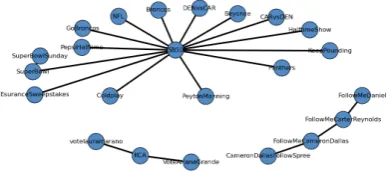
Hashtag co-occurrences help reveal such related hashtags, and hashtag-graph based topic models have been found to enhance the semantic relations displayed by standard topic model techniques (Wang et al., 2014). Fig-ure 1 displays the 20 most co-occurring hash-tags in a co-occurrence network for the Su-per Bowl corpus. Three clusters of tags emerge, with Super Bowl related hash-tags forming the largest. Related topics and terms become more apparent when displayed in a co-occurrence graph like this, with Keep-Pounding and SB50 being the 8th most co-occurring hashtag pair, and the artists Be-yonce and Coldplay appearing in the Su-per Bowl cluster since they Su-performed during the halftime show. The graph also indicates EsuranceSweepstakes to be related to Super Bowl, and indeed the company Esurance run an ad during the match, encouraging people to tweet using the hashtagEsuranceSpeestakes.
Another cluster consists of the three
hash-Figure 1: Hashtag co-occurrence network
tags votelauramarano, KCAand VoteAriana-Grande. KCA is an abbreviation of Kid’s Choice Awards, an annual award show where people can vote for their favorite television, movie and music acts, by tweeting the hash-tagKCAwith a specific nominee-specific vot-ing hashtag (e.g.,VoteArianaGrande).
4 Topic Modeling Experiments
Extending the studies of the previous section, a set of experiments related to topic modeling were conducted, comparing a standard LDA topic model to a hashtag-aggregated model, and comparing two author-topic models.
4.1 Hashtag-aggregated topic model
A pooling technique that involves aggregating tweets sharing hashtags was applied, the as-sumption being that tweets that share hashtags also share underlying topics. The main goal of this method is the same as for the Author-topic model and other pooling techniques; alleviat-ing the disadvantages of short documents by aggregating documents that are likely to share latent topics. Some restrictions were intro-duced: onlysingle-hashtagtweets were used, and only hashtags that appeared in at least 20 of the documents in the corpus.
[image:5.595.304.500.104.190.2]un-Topic #7 Topic #21 Topic #24 Topic #34 revivaltour new purposetourboston trump selenagomez soundcloud justinbieber hillary whumun news boston bernie wtf video one realdonaldtrump getting favorite best will boyfriend sounds tonight clinton bitch health yet greysanatomy mad blessed shows vote resulted efc bitcoin president blend mealamovie redsox people
Table 2: Four topics after hashtag aggregation
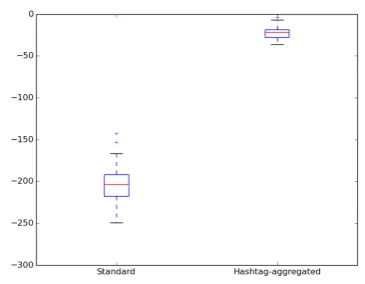
derstanding of the underlying topics conveyed in the tweets, and aggregating tweets sharing hashtags can produce more coherence than a topic model generated by single tweets as doc-uments. The UMass coherence scores for the topics in this topic model are also much higher than for standard LDA, as shown in Figure 2.
4.2 Author-topic model experiments
Tweets from six popular Twitter users were obtained through the Twitter API, selecting users known for tweeting about different top-ics, so that the results would be distinguish-able. Barack Obama would be expected to tweet mainly about topics related to poli-tics, while the astrophysicist Neil deGrasse Tyson would assumingly tweet about science-related topics. The themes communicated by Obama and Donald Trump ought to be sim-ilar, both being politicians, while the inven-tor Elon Musk ought to show similarities with Tyson. Tweets from two pop artists, Justin Bieber and Taylor Swift, were also included and expected not to share many topics with the other users. To obtain tweets reflecting the author’s interests and views, all retweets and quote tweets were discarded, as well as tweets containing media or URLs. Two ap-proaches to author topic-modeling were com-pared, based on Rosen-Zvi et al. (2004) and on Hong and Davison (2010), respectively.
Figure 2: Coherence score of LDA topic model vs. hashtag-aggregated topic model
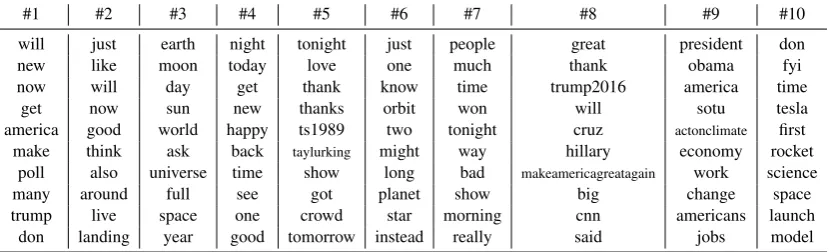
Ten topics were generated from the Rosen-Zvi et al. (2004) author-topic model, each topic being represented by the 10 most prob-able words. The resulting topics are reason-ably coherent, and can be seen in Table 3. The quality of an author-topic model can be measured in its ability to accurately portray the user’s interests. A person that has knowl-edge of which themes and topics a user usu-ally talks about, should be able to recognize the user by their topic distribution. Eight per-sons were shown topic distributions such as the one in Figure 3 without knowing which user it belonged to, and asked to identify the users based on the topic distributions.
All participants managed to figure out which topic distribution belonged to which author for all author’s, except the distributions of Taylor Swift and Justin Bieber, which were very similar, both having Topic 4 and 5 as most probable. The remaining author’s had easily recognizable topic distributions, which was confirmed by the experiment.
[image:6.595.91.287.100.223.2]ag-#1 #2 #3 #4 #5 #6 #7 #8 #9 #10 will just earth night tonight just people great president don
new like moon today love one much thank obama fyi
now will day get thank know time trump2016 america time
get now sun new thanks orbit won will sotu tesla
america good world happy ts1989 two tonight cruz actonclimate first make think ask back taylurking might way hillary economy rocket
poll also universe time show long bad makeamericagreatagain work science
many around full see got planet show big change space
[image:7.595.92.507.102.228.2]trump live space one crowd star morning cnn americans launch don landing year good tomorrow instead really said jobs model
Table 3: The ten topics generated for the Rosen-Zvi et al. (2004) author-topic model
Figure 3: Topic distribution for Obama
gregated tweets for each user. Furthermore, new tweets for each author (which were not part of the training data) were downloaded, and the topic distribution inferred for each of the new tweets. Finally, the topic distribution for each user was calculated as the average topic distribution over all new tweets written by that user. Since a low number of topics produces too many topics containing the same popular words, 50 topics were used instead of the 10 in the previous experiments.
An example of the resulting topic mixtures for the authors can be seen in Figure 4, with the most probable topics for each of the au-thors tabulated in Table 4. As opposed to the previous topic mixtures, these topic mixtures generally had one topic that was much more probable than the remaining topics. There-fore, the diversity in the language by each author might not be captured as well by this model. On the other hand, the most probable
Figure 4: Obama’s aggregated topics
topic for each author generally describes the author with a high precision. It is therefore easier to distinguish Justin Bieber from Taylor Swift than it was in the previous experiment.
5 Discussion and conclusion
A topic modeling system for modeling tweet corpora was created, utilizing pooling tech-niques to improve the coherence and inter-pretability of standard topic models. The re-sults indicate that techniques such as author aggregating and hashtag aggregation generate more coherent topics.
spar-#0 (Obama) #20 (Musk) #26 (Tyson) #35 (Trump) #43 (Bieber) #19 (Swift)
president tesla earth will thanks tonight
obama will moon great love ts1989
america rocket just thank whatdoyoumean taylurking
sotu just day trump2016 mean just
actonclimate model one just purpose love
time launch time cruz thank thank
work good sun hillary lol crowd
economy dragon people new good night
americans falcon space people great now
change now will makeamericagreatagain see show
Table 4: The most probable topic for the six authors inferred from aggregated topic distribution
sity of tweets is likely the cause of this; the documents do not contain enough words to produce sufficient term co-occurrences. Hong and Davison (2010) found that 50 topics pro-duced the optimal results for their author-topic model, although the optimal number of top-ics dependents on the diversity of the cor-pora. Thus k values of 10 and 50 were used in the experiments, with 50 for large corpora where a diverse collection of documents was expected.
Hashtag co-occurrences were used to di-vulge latent networks of topics and events in a collection of tweets. A hashtag aggregat-ing technique was shown to mitigate the neg-ative impacts sparse texts have on the coher-ence of a topic model. Hashtag aggregation technique is especially interesting, as it uti-lizes a specific metadata tag that is not present in standard documents. A hashtag aggregated topic model produced a much better coher-ence than the standard LDA variation for the same corpus; this is also consistent with recent research on topic models for microblogs. Two Author-topic models were used in our exper-iments, one using the Rosen-Zvi et al. (2004) topic model and the aggregated author-topic model proposed by Hong and Davison (2010), both seeming to produce interpretable topics. It is worth noting that there is no standard-ized methods for evaluating topic models, as
most quantitative ways try to estimate human judgement. Moreover, there is no precise def-inition of a gold standard for topic models, which makes the task of comparing and rank-ing topic models difficult. A combination of a computational method and human judgement was therefore used in the evaluations.
References
David M Blei, Andrew Y Ng, and Michael I Jor-dan. 2003. Latent Dirichlet Allocation. In
the Journal of Machine Learning Research, vol-ume 3, pages 993–1022, MIT, Massachusetts, USA. JMLR. org.
David M. Blei. 2012. Probabilistic Topic Models. In Communications of Association for Com-puter Machinery, volume 55, New York, NY, USA, April. ACM.
William Boag, Peter Potash, and Anna Rumshisky. 2015. TwitterHawk: A Feature Bucket Based Approach to Sentiment Analysis. In Proceed-ings of the 9th International Workshop on Se-mantic Evaluation (SemEval 2015), pages 640– 646, Denver, Colorado, June. Association for Computational Linguistics.
Fazli Can and Esen A. Ozkarahan. 1990. Concepts and Effectiveness of the Cover-coefficient-based Clustering Methodology for Text Databases. InACM Transitional Database Systems, volume 15, pages 483–517, New York, NY, USA, December. Association for Computer Machinery.
Jonathan Chang, Sean Gerrish, Chong Wang, Jor-dan L Boyd-Graber, and David M Blei. 2009. Reading tea leaves: How humans interpret topic models. In Advances in neural information processing systems, pages 288–296, Vancouver, British Columbia.
Derek Greene, Derek O’Callaghan, edi-tor="Calders Toon Cunningham, Pádraig", Floriana Esposito, Eyke Hüllermeier, and Rosa Meo, 2014. How Many Topics? Stability Analysis for Topic Models, pages 498–513. Springer Berlin Heidelberg, Berlin, Heidelberg. Liangjie Hong and Brian D. Davison. 2010. Em-pirical Study of Topic Modeling in Twitter. In Proceedings of the First Workshop on So-cial Media Analytics, SOMA ’10, pages 80–88, New York, NY, USA. ACM.
Olessia Koltsova and Sergei Koltcov. 2013. Map-ping the public agenda with topic modeling: The case of the Russian LiveJournal. InPolicy & Internet, volume 5, pages 207–227, Russia. Jey Han Lau, Nigel Collier, and Timothy
Bald-win. 2012. On-line Trend Analysis with Topic
Models:\# Twitter Trends Detection Topic Model Online. In Proceedings of COLING 2012: Technical Papers, pages 1519–1534, pages 1519–1534, Mumbai, India.
David Mimno, Hanna M. Wallach, Edmund Tal-ley, Miriam Leenders, and Andrew McCallum. 2011. Optimizing semantic coherence in topic models. InProceedings of the Conference on Empirical Methods in Natural Language Pro-cessing, EMNLP ’11, pages 262–272, Strouds-burg, PA, USA. Association for Computational Linguistics.
Brendan O’Connor, Ramnath Balasubramanyan, Bryan R Routledge, and Noah A Smith. 2010. From Tweets to Polls: Linking Text Sentiment to Public Opinion Time Series. In Interna-tional Conference on Web and Social Media, volume 11, pages 1–2, Washington DC, USA. Nataliia Plotnikova, Micha Kohl, Kevin Volkert,
Andreas Lerner, Natalie Dykes, Heiko Emer, and Stefan Evert. 2015. KLUEless: Po-larity Classification and Association. In Pro-ceedings of the 9th International Workshop on Semantic Evaluation (SemEval 2015), Erlan-gen, Germany. Friedrich-Alexander-Universitat Erlangen-Nurnberg.
Xiaojun Quan, Chunyu Kit, Yong Ge, and Sinno Jialin Pan. 2015. Short and sparse text topic modeling via self-aggregation. In
Proceedings of the 24th International Confer-ence on Artificial IntelligConfer-ence, IJCAI’15, pages 2270–2276. AAAI Press.
Michal Rosen-Zvi, Thomas Griffiths, Mark Steyvers, and Padhraic Smyth. 2004. The Author-topic Model for Authors and Docu-ments. In Proceedings of the 20th Confer-ence on Uncertainty in Artificial IntelligConfer-ence, UAI ’04, pages 487–494, Arlington, Virginia, United States. AUAI Press.
Pranav Waila, VK Singh, and Manish K Singh. 2013. Blog text analysis using topic modeling, named entity recognition and sentiment classi-fier combine. InAdvances in Computing, Com-munications and Informatics (ICACCI), 2013 International Conference on, pages 1166–1171, Mysore, India. IEEE.
Y. Wang, J. Liu, J. Qu, Y. Huang, J. Chen, and X. Feng. 2014. Hashtag Graph Based Topic Model for Tweet Mining. In 2014 IEEE In-ternational Conference on Data Mining, pages 1025–1030, Shenzhen, China, Dec.
Jianshu Weng, Ee-Peng Lim, Jing Jiang, and
Qi He. 2010. TwitterRank: Finding Topic-sensitive Influential Twitterers. In Proceed-ings of the Third ACM International Conference on Web Search and Data Mining, WSDM ’10, pages 261–270, New York, NY, USA. ACM.