Indirect genetic effects in behavioural ecology –––––––––––––––––––– Page 1 of 41
Indirect Genetic Effects in Behavioural Ecology:
Does Behaviour Play a Special Role in Evolution?
Nathan W. Bailey,a Lucas Marie-Orleach,a Allen J. Mooreb
aSchool of Biology, University of St Andrews, St Andrews, Fife KY16 9TH, UK
bDepartment of Genetics, Department of Entomology, University of Georgia, Athens, GA
30602 USA
Address correspondence to: N.W. Bailey. E-mail: [email protected].
Running header: Indirect Genetic Effects in Behavioural Ecology
Keywords: behavioural plasticity, interacting phenotype, interaction coefficient psi, sexual conflict, sexual selection, social behaviour
Indirect genetic effects in behavioural ecology –––––––––––––––––––– Page 2 of 41
ABSTRACT
1
Behaviour is rapidly flexible and highly context-dependent, which poses obvious challenges 2
to researchers attempting to dissect its causes. However, over a century of unresolved debate 3
has also focused on whether the very flexibility and context-dependence of behaviour lends it 4
a unique role in the evolutionary origins and patterns of diversity in the Animal Kingdom. 5
Here we propose that both challenges can benefit from studying how indirect genetic effects 6
(IGEs: the effects of genes expressed in one individual on traits in another individual) shape 7
behavioural phenotypes. We provide a sketch of the theoretical framework that grounds IGEs 8
in behavioural ecology research and focus on recent advances made from studies of IGEs in 9
areas of behavioural ecology such as sexual selection, sexual conflict, social dominance, and 10
parent-offspring interactions. There is mounting evidence that IGEs have important 11
influences on behavioural phenotypes associated with these processes, such as sexual signals 12
and preferences and behaviours which function to manipulate interacting partners. IGEs can 13
also influence both responses to selection and selection itself, and considering IGEs refines 14
evolutionary predictions and provides new perspectives on the origins of seemingly 15
perplexing behavioural traits. A key unresolved question, but one that has dominated the 16
behavioural sciences for over a century, is whether behaviour is more likely than other types 17
of traits to contribute to evolutionary change and diversification. We advocate taking 18
advantage of an IGE approach to outline falsifiable hypotheses and a general methodology to 19
rigorously test this frequently proposed, yet still contentious, special role of behaviour in 20
Indirect genetic effects in behavioural ecology –––––––––––––––––––– Page 3 of 41
“Thus, behavior being especially plastic, behavior must often take the lead in 22
evolution.” Mary Jane West-Eberhard (2003), p. 180 23
24
INTRODUCTION
25
Is behaviour special?
26Those who study animal behaviour are often motivated by the observation that behaviours 27
can appear to be counterintuitive, making it necessary to dissect and reveal their costs and 28
benefits, plus the trade-offs inherent in long-lived organisms. This has often been approached 29
using an optimality framework, which defines evolutionarily stable outcomes under such 30
conditions (Parker and Maynard Smith 1990). Classic examples of counter-intuitive 31
behaviours that have been studied using optimality include sexual cannibalism, conspicuous 32
sexual signalling, altruism, and aggression. However, this framework has a potential 33
limitation. Optimality treats such behaviours as an emergent property of many underlying, 34
potentially unknown or even unknowable, mechanistic influences on different constituent 35
traits – an approach that Alan Grafen (1984) described as a phenotypic gambit, where the 36
necessary mechanisms including genetics are assumed to allow unconstrained evolution to an 37
optimum. Ignored causal influences range from molecular signalling pathways, to 38
morphological structures, to nervous connections, to environmental context. Thus, the 39
phenotypic gambit has significant limitations (Moore and Boake 1994; Golmulkiewicz 1998; 40
Hadfield et al. 2007; Rubin 2016), not the least of which is ignoring evolutionary dynamics 41
on the way to an equilibrium (regardless of whether it is reached). It is perhaps ironic that 42
behaviour appears to be one of the least suited types of traits to study using this framework 43
(Roff 1996; Fawcett et al. 2013). This may be due in part to the high degree of reversibility 44
Indirect genetic effects in behavioural ecology –––––––––––––––––––– Page 4 of 41
social interactions. 46
It may be that the simultaneous integration of many different causal factors is what 47
makes behaviour such a challenging phenotype to study mechanistically: behaviour can be 48
highly reversible, variable, inconsistent, contextual and ephemeral. Yet, the complexity of 49
inputs to behaviour may also contribute to its alleged special nature. For well over a century, 50
its flexibility and environmental sensitivity have been invoked to support a special role in 51
evolution, for example by biasing the direction of evolutionary responses (Baldwin 1902), 52
exposing new variation to the action of selection (Wcislo 1989), acting as a pacemaker that 53
regulates the rate of diversification (Mayr 1963), disproportionately leading genetic evolution 54
(West-Eberhard 2003, Zuk et al. 2014, Robinson and Barron 2017) or inhibiting evolution 55
(Huey et al. 2003, Price et al. 2003). Unusual roles for plasticity and behaviour have also 56
been invoked to argue for reformulating the fundamental structure of evolutionary theory as 57
we know it, an assertion that has provoked scepticism and contentious debate (Laland et al. 58
2014). Arguments for behaviour’s special role in evolution often invoke mechanisms such as 59
genetic assimilation, accommodation, or shifting plasticity thresholds to link non-genetic 60
behavioural variation to longer-term genetic evolution. Such processes have theoretical 61
backing (e.g., Lande 2009, Chevin and Lande 2015), and some empirical support (e.g. 62
Waddington 1953, Badyaev 2009, Sikkink et al. 2014). Verbal arguments have suggested that 63
the link between behaviour and evolution is expected to be strongest in circumstances where 64
behaviour is sensitive to variation in the social environment (e.g., Bateson 2004), and social 65
effects have been proposed to play a correspondingly greater role in behavioural evolution in 66
species with highly complex social interactions, such as the eusocial Hymenoptera 67
(Linksvayer 2015). 68
In this article, we describe how behavioural ecologists are increasingly adopting a 69
Indirect genetic effects in behavioural ecology –––––––––––––––––––– Page 5 of 41
or IGEs—to be a part of the environmental context that shapes animal behaviour. We explore 71
how IGE frameworks provide behavioural ecologists with tools to improve optimality 72
predictions and obtain more focused solutions to research challenges, for example by better 73
understanding the causes of behavioural variation within and between species. We suggest 74
that empirically examining the role of IGEs in shaping behaviour will provide important 75
insights for the field of behavioural ecology. Beyond this, however, we suggest a 76
methodological approach using IGEs to rigorously test whether behaviour does, or does not, 77
play a unique role in evolution. 78
79
BEHAVIOUR AND IGEs
80
The reversibility, context-dependence, and sensitivity of behaviour
81Competing definitions of behaviour abound, but one commonly accepted defining 82
characteristic is that behaviour entails a response to environmental stimulus (Levitis et al. 83
2009). Thus, flexibility or plasticity is an inherent property. This flexibility has led to the 84
well-known debate over nature and nurture, where simple causes (genes) are rightly viewed 85
as insufficient explanations for the expression of a behavioural phenotype. Of course, this 86
reflects a false dichotomy (both nature and nurture must contribute for any trait to exist) but it 87
also reflects a sense that there is inherent complexity in behaviour that may not exist in other 88
phenotypes. Incorporating IGEs allows nature to be nurture as well, resolving some of these 89
concerns (Moore et al. 1997, McGlothlin et al. 2010). Social interactions induce IGEs, which 90
partly explains why the flexible properties of behaviour make it prone to unexpected 91
evolutionary dynamics or phenotypic equilibria that can appear non-adaptive. The apparent 92
susceptibility of behavioural phenotypes to social influences could make them especially 93
prone to IGEs, providing a testable, though presently hypothetical, evolutionary genetic 94
Indirect genetic effects in behavioural ecology –––––––––––––––––––– Page 6 of 41
96
What are, and are not, IGEs?
97A framework for studying behaviour was specifically developed to incorporate genetics and 98
further refine the evolutionary understanding of traits identified as fundamental in 99
behavioural ecology – the Interacting Phenotype approach (Moore et al. 1997, 1998). This 100
approach incorporates IGEs, and it recognizes that many of the attributes that make 101
understanding behavioural evolution difficult arise from behaviour expressed in social 102
interactions. This characteristic is part of what generalises and extends IGE models from 103
maternal effects, which are a specific case of IGEs (Wolf et al. 1998, McAdam et al. 2014). 104
IGEs result in altered evolutionary trajectories (Moore et al. 1997, McGlothlin et al. 105
2010). Examples where social environments and IGEs are predicted to affect trait expression 106
and evolution involve interacting phenotypes such as communication, signalling, aggression, 107
dominance, learning, sexual conflict and sexual selection (Moore et al. 1998, Bleakley et al. 108
2010, Wolf and Moore 2010). But despite the intended connection to behavioural ecology, 109
research on IGEs has until recently been concentrated in the fields of quantitative and 110
behavioural genetics. From such studies, we know that variation in the social environment 111
animals experience can generate evolutionary feedbacks mediated by IGEs if the social 112
environment consists of genetically varying individuals; such feedbacks arise because the 113
environment itself can evolve (Moore et al. 1997, Bailey 2012). The strength and direction of 114
IGEs can also evolve over time and across populations (Chenoweth et al. 2010, Bailey and 115
Zuk 2012, Kazancioğlu et al. 2012, Edenbrow et al. 2017), and associated social selection is 116
predicted to vary accordingly (McGlothlin et al. 2010). In recent years, IGEs have been 117
incorporated into animal and plant breeding studies to more accurately predict evolutionary 118
responses in agriculturally valuable traits, such as growth rate, thermal tolerance, and 119
Indirect genetic effects in behavioural ecology –––––––––––––––––––– Page 7 of 41
2014; Muñoz et al. 2014; Alemu et al. 2016; Baud et al. 2017). A substantial literature 121
explores the mathematical approaches used to study IGEs. For general overviews see 122
Bleakley et al. (2010), Wolf and Moore (2010), and McAdam et al. (2014); for a treatment of 123
quantitative modelling and parameter estimation issues, see Bijma (2010, 2014). 124
IGEs do not require a conceptually new entity. These are additive genetic effects in 125
individuals that contribute to a social environment that affects the trait of another (focal) 126
individual, and which can itself evolve. As noted by Mary Jane West-Eberhard (1979 p. 228) 127
when discussing social evolution and extravagant characters, “… a change improving 128
competitive ability is always favored… Each successive improvement sets a new standard 129
which the next can profitably surpass. This is due to the fact that conspecific rivals are an 130
environmental contingency that can itself evolve. In that respect social evolution is 131
comparable to the coevolution of predator-prey, parasite-host interactions…”. Thus 132
evolutionary biologists have long recognized social environments as providing novel 133
evolutionary dynamics. Because of IGEs, contributions to social traits can covary genetically, 134
even when the genes act in different individuals. It is this covariance that results in unusual 135
evolutionary dynamics. When an individual expresses a behaviour, that phenotype 136
reflects the inherent properties of the individual (e.g. physiological state, genes, experiences, 137
and learning) as well as external abiotic and biotic influences. However, when the 138
environment is social, then genetic differences amongst these interacting individuals 139
contribute to differences in the social environment, creating a heritable environmental effect . 140
In other words, genes and the environment are confounded. Heritable social effects create 141
non-linear evolutionary dynamics when incorporated into evolutionary models (Moore et al. 142
1997, McGlothlin et al. 2010). When specific phenotypes are being studied, the interaction 143
coefficient, psi (𝜓), describes the importance of the interaction for the phenotype that is 144
Indirect genetic effects in behavioural ecology –––––––––––––––––––– Page 8 of 41
interaction reduces trait expression, 𝜓 < 0, but where traits are increased in expression 146
because of the social interaction, 𝜓 > 0. Box 1 illustrates the concept and highlights recent 147
studies that have estimated 𝜓 or its multivariate counterpart, 𝚿. 148
149
The importance of timing and sequence in social interactions
150The timescale over which individual phenotypes change because of IGEs influences the 151
outcome of evolutionary dynamics, depending on the number and frequency of social 152
interactions (McGlothlin et al. 2010, Saltz 2013, Schneider et al. 2016; Anderson et al. 2017, 153
Edenbrow et al. 2017). In addition, the phenotypic equilibrium for a trait affected by IGEs is 154
determined partly by the whether the IGE is reciprocal or not (i.e. the same trait influences its 155
own expression in focal and partner individuals, as in aggressive escalations, versus a focal 156
trait that is affected by a different trait in an interacting partner, as in maternal care). When 157
IGEs are particularly strong and reciprocal, theoretical arguments have predicted that the trait 158
equilibria of phenotypes involved become unstable, possibly leading to increasingly extreme 159
phenotypic fluctuations, oscillations, or even the disintegration of social groups (Trubenová 160
et al. 2015). 161
The influence of timing of social interactions has been considered most extensively in 162
the context of agonistic encounters and animal contests. For example, aggressive conflicts 163
between groups of green woodhoopoes (Phoeniculus purpureus) that occur in the morning 164
generate long-term effects that increase social bonding behaviours within groups later in the 165
evening, such as allopreening and roosting (Radford and Fawcett 2014). Experience of same-166
sex contests in juvenile female burying beetles (Nicrophorus vespilloides) increases 167
reproductive output later in life, possibly as a result of increased post-hatching brood care, 168
regardless of the outcome of the contest (Pilakouta et al. 2016). Learning from social 169
Indirect genetic effects in behavioural ecology –––––––––––––––––––– Page 9 of 41
environment can be temporally separated from individual encounters. Learned mate 171
preferences are now commonly studied (Dukas 2005, Verzijden et al. 2012), and when such 172
changes in female mating behaviour involve IGEs, their impact on sexual selection and 173
diversification can be significant (Bailey and Moore 2012). 174
Time-delays between when a social interaction occurs and a focal individual’s 175
phenotype changes will affect the phenotypic trait values that are ultimately available to the 176
action of selection. Time-courses of IGEs can be linked to underlying physiological and 177
neuronal processes that shape trait expression, and vary widely. IGEs can influence “slow-178
changing state variables”, such as metabolism-dependent body growth, in addition to “fast-179
changing state variables”, such as near-instantaneous behavioural adjustment during an 180
agonistic encounter (Niemalä and Santostefano 2015). Examples of both are readily found in 181
the literature. For example, IGEs on growth in pigs arising from behavioural phenotypes such 182
as aggressive biting are not only documented, but have been successfully selected in artificial 183
breeding programs (Camerlink et al. 2013, 2014). In contrast, isogenic focal Drosophila
184
melanogaster males vary in how much they physically tap interacting partners of different 185
genotypes with their prothoracic legs during bouts of interaction lasting only minutes, a 186
behaviour that might reflect gustatory sampling or aggression (Bailey and Hoskins 2014). 187
Not only the timing of socially plastic responses underlying IGEs, but when during life any 188
fitness effects of those changes are manifested, will ultimately impact evolutionary dynamics 189
shaping behaviour (Schneider et al. 2016). If the phenotypic effects of IGEs are invisible to 190
selection, they will not contribute to evolutionary dynamics. 191
192
IGEs IN BEHAVIOURAL ECOLOGY RESEARCH
193
Improving optimality predictions using IGEs
194Indirect genetic effects in behavioural ecology –––––––––––––––––––– Page 10 of 41
insights over approaches based on the phenotypic gambit. Optimality has provided a useful 196
framework for making predictions in experimental animal behaviour research programmes. 197
Understanding causes of variation is a cornerstone of behavioural ecology, taught in 198
undergraduate courses and featured in canonical texts (Davies et al. 2012). Yet optimality 199
assumes a population has reached an evolutionarily stable state. This represents a limitation 200
for behaviour that has been suggested to reflect ignorance of mechanisms such as genetics 201
(Moore and Boake 1994). Animal behaviours can often appear counter-intuitive or non-202
adaptive at first blush (Bailey 2013), and the extent to which dissecting the underlying causal 203
mechanisms of behaviour can enlighten us about its ultimate causes represents a persistent 204
tension within the field (Tinbergen 1963, Mayr 1961, Laland et al. 2011). The theoretical 205
framework of IGEs provides one way of reconciling optimality predictions and variable 206
behaviour. In the remaining sections, we describe how IGEs have been detected in 207
behavioural studies to date, what insights have been gained, and why behavioural ecology 208
studies can benefit from including IGEs in the toolkit of “proximate causes” of behavioural 209
variation. We finish by proposing that behavioural ecologists can use IGEs as a powerful 210
conceptual tool to inform, with quantitative predictions and data, the debate about whether 211
behaviour is a unique sort of trait with emergent properties making it difficult to characterise 212
genetically, but at the same time lending it a special role in evolution. 213
214
Theoretical insight into the influence of IGEs on behaviour
215The role of the social environment in shaping behaviour has been a dominant theme in 216
behavioural ecology studies, and there is a growing interest in incorporating mechanisms into 217
such studies (Hoffman et al. 2014), including IGEs .The question is whether considering a 218
given behaviour as susceptible to genes expressed in social partners lends insight to our 219
Indirect genetic effects in behavioural ecology –––––––––––––––––––– Page 11 of 41
genotypes with varying degrees of sensitivity to the social environment against one another in 221
a series of quantitative genetic models, to assess the contribution of heritable variation in the 222
environment on evolutionary rates. They found that heritable components of the environment, 223
IGEs, can generate runaway evolution when they become linked with genetic variants that 224
control responses to that social environment. Rapid coevolutionary dynamics are a specific 225
consequence of responses to genes in the social environment, rather than responses to abiotic 226
environments. 227
Rapid evolution can become runaway. Bailey and Moore (2012) examined the 228
evolution of sexual signals and mating preferences and found that a key determinant of 229
whether IGEs accelerate or retard sexual trait elaboration is the sign and magnitude of the 230
interaction coefficient 𝜓, which alters the influence of trait-preference genetic covariance 231
during runaway co-evolution. Accumulation of genetic covariances between sexual traits and 232
preferences are a fundamental property of Fisher’s original model of sexual selection (Fisher 233
1915, 1958), but incorporating IGEs counterintuitively suggested that trait-preference 234
covariances can be smaller than expected while still allowing runaway to occur. This finding 235
may help to reconcile a pervasive lack of evidence for expected trait/preference genetic 236
covariances in empirical studies (Greenfield et al. 2014). IGEs have also been modelled in 237
sexual conflict scenarios, and when strong, they are predicted to stimulate rapid evolutionary 238
proliferation of adaptations and counter-adaptations above standard predicted rates (Moore 239
and Pizzari 2005). 240
Evolutionary dynamics that can arise through IGEs address two issues affecting 241
commonly studied traits in behavioural ecology such as ornaments, mate preferences and 242
armaments. The first is that IGEs might provide an evolutionary genetic mechanism for the 243
prediction that such traits are labile in varying social environments, which has been 244
Indirect genetic effects in behavioural ecology –––––––––––––––––––– Page 12 of 41
Kozak and Boughman 2008, 2009; Bailey et al. 2010; Bailey 2011; Rebar et al. 2011, 2016; 246
Auld et al. 2016; Rebar and Rodríguez 2016). Thus, IGEs allow the flexibility we see in 247
social behaviour to be consistent with standard evolutionary theory. The second is that they 248
refine our expectations of what is an optimal behaviour in circumstances where IGEs are 249
expected, enabling a better explanation of seemingly perplexing traits. Empirical research is 250
now beginning to put these ideas to the test. 251
252
Empirical evidence for IGEs in behavioural ecology research
253Explicitly considering IGEs in behavioural studies provides a more accurate understanding of 254
what causes behavioural variation, and in some cases can fundamentally change our 255
interpretation of those causes. IGEs for sexual traits such as signals and female mating 256
preferences have now been documented in several invertebrate systems, and in a smaller 257
number of studies, have been demonstrated to evolve. In Drosophila melanogaster, IGEs 258
exerted through social interactions alter the composition of sexually selected male cuticular 259
hydrocarbons (CHCs) (Kent et al. 2008). In the related species D. serrata, the genotype of 260
interacting females has been found to explain nearly a fifth of the variance in male CHC 261
profiles (Petfield et al. 2005), and the expression of two methyl-branched alkanes important 262
for sexual signalling in males can be artificially evolved under different female social 263
environments (Chenoweth et al. 2010). In one strain of the lesser waxmoth Achroia grisella, 264
male body mass and the pulse-pair rate and peak amplitude of ultrasonic advertisement songs 265
were found to be affected by IGEs (Danielson-François et al. 2009). In different populations 266
of the field cricket Teleogryllus oceanicus, female choosiness in mating trials is affected 267
differently by the previous experience of singing males or silence, suggesting population-268
level variation in the interaction coefficient 𝜓 for these traits (Bailey and Zuk 2012). 269
Indirect genetic effects in behavioural ecology –––––––––––––––––––– Page 13 of 41
Signor et al. 2017). In the hermaphroditic flatworm Macrostomum lignano, there is striking 271
heterogeneity in the presence, strength and direction of IGEs on multiple morphological and 272
behavioural traits with expected roles in sexual conflict, such as gonad size and copulation 273
latencies (Marie-Orleach et al. 2017). Macrostomum lignano performs an intriguing 274
behaviour after copulation in which individuals apply their pharynx on top of their own 275
sperm storage organ and appear to suck it (Schärer et al. 2004, Vizoso et al. 2010). This 276
behaviour is facultative and thought to be involved in removing from storage some 277
components of the recently received ejaculate. Optimality models not considering IGEs 278
would predict that sperm recipients suck only when it is beneficial to them, e.g. when they do 279
not need extra sperm for fertilisation. However, the propensity to suck depends to some 280
extent on the genetics of the sperm donor, which opens the possibility for manipulation of the 281
partner’s suck behaviour through prostate gland secretions (Orleach et al. 2013, Marie-282
Orleach et al. 2017). Thus, this behaviour would appear counterintuitive, or non-optimal, if 283
IGEs are not considered. Other examples exist in the field of animal breeding, in which 284
programs considering IGEs have been shown to improve the response of selection for various 285
traits of interest to breeders (e.g., growth rates in pigs, or plumage condition in laying hens) 286
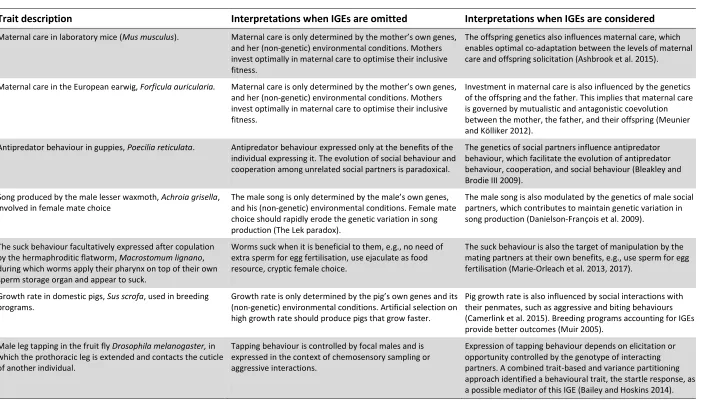
(Camerlink et al. 2013, 2015, Brinker et al, 2014). In Table 1, we provide additional 287
examples illustrating how considering IGEs can modify our interpretations of a behaviour’s 288
causes, and reveal unsuspected evolutionary forces influencing their expression. 289
In laboratory mice, a cross-fostering experiment demonstrated that offspring genotype 290
influences maternal care behaviours, providing a genetic mechanism mediating the evolution 291
of parent-offspring conflict (Ashbrook et al. 2015). As these were lab mice, the researchers 292
mapped genomic loci that might play a role in mediating those effects, providing clues about 293
causal offspring behaviours, such as solicitation, to which mothers responded. In D.
294
Indirect genetic effects in behavioural ecology –––––––––––––––––––– Page 14 of 41
duration, illustrating that it is not solely under female control (Edward et al. 2014). 296
Nevertheless, other female traits that would be expected to be susceptible to sexual conflict 297
dynamics such as egg production showed no IGEs (Edward et al. 2014). Another D.
298
melanogaster study recovered a significant effect of male partner identity on female 299
fecundity, consistent with a male IGE affecting female fitness components (Tennant et al. 300
2014). Male IGEs affecting female fecundity appear to be exerted through male mitonuclear 301
epistasis in seed beetles (Callosobruchus maculatus), suggesting a complex interplay 302
between organelle-specific IGEs and sexual conflict (Immonen et al. 2016). 303
Non-sexual social behaviours are also impacted by IGEs. Normally the purview of 304
inclusive fitness theory and kin selection, behaviours critical to the functioning of animal 305
societies are increasingly being studied from the viewpoint of interacting phenotypes and 306
IGEs (Linksvayer 2006, Linksvayer 2015, Linksvayer and Wade 2016). In Pogonomyrmex
307
californicus, a harvester ant, variation in the social composition of founding groups of queens 308
in cooperative colonies determines behavioural outcomes in aggression and brood care 309
phenotypes (Clark and Fewell 2013). IGEs have been documented across a range of 310
additional social traits, including paternal care (Head et al. 2012), social dominance (Moore 311
et al. 2002, Wilson et al. 2011), agonistic encounters (Wilson et al. 2009; Santostefano et al. 312
2016), group antipredator behaviour (Bleakley et al. 2009, Edenbrow et al. 2017), and 313
breeding date in birds (Germain et al. 2016). In the mosquitofish Gambusia holbrooki, direct 314
genetic effects (DGEs) influence the number of social partners that males of different colour 315
morphs encounter, illustrating how DGEs and IGEs can covary (Kraft et al. 2016), a critical 316
parameter influencing evolutionary dynamics (Bijma 2014). 317
IGEs are also relevant to the expression of behaviours within interspecific and multi-318
trophic interactions. Interspecific IGEs can have a wider impact on the evolution of 319
Indirect genetic effects in behavioural ecology –––––––––––––––––––– Page 15 of 41
the genotype of a parasitoid wasp Aphidius ervi influences whether infected aphids 321
(Acyrthosiphon pisum) remain on or abandon their host plant, and dictate the final location of 322
death of aphids who choose to remain (Khudr et al. 2013). Male treehoppers (Enchenopa
323
binotata) use substrate-borne vibratory communication as a sexual signal, and the genotypes 324
of plants used as vibratory substrates affects both the expression of male signals and female 325
mating decisions (Rebar and Rodríguez 2014a, b). Genotypic variation among substrate 326
plants also mediates the phenotypic covariance of the treehoppers’ sexual trait and preference 327
(Rebar and Rodríguez 2015). 328
329
TESTING BEHAVIOUR’S “SPECIAL ROLE” IN EVOLUTION
330
Behavioural susceptibility to IGEs
331Until now, we have documented how IGEs can affect the expression of commonly studied 332
behaviours, helping to explain unexplained variation. It is also important to consider how 333
behavioural ecology studies can inform the broader evolutionary implications of IGEs. Are 334
behaviours especially prone to responding to IGEs in a way that accelerates, decelerates or 335
otherwise modifies evolutionary trajectories? Over the past several decades, the field of 336
behavioural ecology has shown how exquisitely sensitive animal behaviour is to the social 337
environment, even in species that typically spend their lives in asocial states. In addition, 338
there is increasing evidence that IGEs affect many behaviours, and thus processes, that 339
behavioural ecologists study. But is behaviour unique in this respect? Some would argue yes: 340
part of the call for an extended evolutionary synthesis relies on the intuition that the extreme 341
responsiveness of behaviour to the environment and unexpectedly rapid evolutionary change 342
requires a new evolutionary explanation (Laland et al. 2011, 2014, 2015). However, IGEs and 343
interacting phenotype theory provide an explanation for extreme plasticity and variability, for 344
Indirect genetic effects in behavioural ecology –––––––––––––––––––– Page 16 of 41
social environments, that is fully consistent with standard evolutionary theory. 346
347
What proportion of V
Pis V
E(social)?
348
The starting point for predicting which traits in focal individuals are most likely to contribute 349
to evolutionary dynamics through IGEs—and testing whether behavioural traits are 350
systematically over-represented in this category—is to establish whether any of the traits in 351
question respond to variation in the social environment. If so, then this is an interacting 352
phenotype. The insight that behaviour can be affected by social interactions may be obvious, 353
but traits such as morphology also respond to variable social environments, often through 354
density-dependent or maternal effects. Secondly, we can ask whether genetic heterogeneity 355
among individuals affects the contributions of the social environment to phenotypes. If so, 356
then IGEs exist. The relative importance of IGEs can be measured against the contributions 357
of DGEs. Studies that have quantified IGEs using either variance partitioning or trait-based 358
approaches on multiple phenotypes have tended to find heterogeneity across assayed traits in 359
their responsiveness to genes in the social environment. For example, ca. 18% of heritable 360
variation in growth rate in the flour beetle Tribolium castaneum was influenced by IGEs, 361
while no such influence was documented for other life-history traits in the same study (Ellen 362
et al. 2015). A trait-based analysis of five antipredator and social behaviours in the guppy 363
Poecilia reticulata found evidence for reciprocal IGEs on all traits, but only a limited number 364
of non-reciprocal IGEs, and their directions and magnitudes varied (Bleakley et al. 2009). In 365
the latter study, the extent of schooling behaviour in focal individuals was negatively related 366
to the tendency of social partners to remain near a model, whereas the amount of time a focal 367
individual spent in proximity was positively related to agitation behaviour in interacting 368
partners. 369
Indirect genetic effects in behavioural ecology –––––––––––––––––––– Page 17 of 41
particularly susceptible to IGEs is to systematically compare different types of traits. The 371
variance-partitioning approach (Box 2) can quantify the amount of phenotypic variance 372
associated with different sources using standard quantitative genetic approaches. 373
Environmental influences on a given trait’s expression can be subdivided into effects of the 374
physical environment and those of the social environment (Moore et al. 1997; Bijma 2014). 375
Standardizing trait values is necessary if traits are measured in units, but there are no 376
restrictions on the types of traits that can be measured. The key question is whether the 377
partitioning differs for behavioural traits versus other traits such as morphology, life history, 378
or physiological attributes. 379
Nested hypotheses can be used to interrogate this question: can we first reject the null 380
hypothesis that there are no environmental influences on trait expression (i.e. plasticity – this 381
requires testing in multiple environments)? Next, can we reject the null hypothesis that there 382
are no effects of the social environment on trait expression (i.e., interacting phenotypes – this 383
requires testing over variable social environments)? If an interacting phenotype exists, can we 384
reject the null hypothesis that there are no IGEs arising from that social environment effect 385
(IGEs– this requires pedigrees or breeding designs to identify genetic effects)? In the final 386
analysis, a proportion of explained variance can be assigned at each level of this hierarchical 387
model. The process can be iterated for a panel of different traits, marrying the ability of the 388
trait-based interacting phenotype approach to interrogate specific phenotypes with the ability 389
of the variance partitioning approach to estimate relative contributions of any IGEs. An 390
important consideration is to avoid biasing the outcome when selecting such a panel of traits; 391
for example, by focusing on behaviours known to be particularly labile. 392
Partitioning variance for a panel of randomly-chosen traits can seem a daunting task, 393
but a recent study examining the effects of IGEs on health and disease factors in lab mice, 394
Indirect genetic effects in behavioural ecology –––––––––––––––––––– Page 18 of 41
Baud et al. (2017) assayed over 100 phenotypes related to health and disease after housing 396
mice of different genotypes together. In their first experiment using two inbred lines of mice, 397
the authors detected IGEs in 11 out of 50 phenotypes assayed. In a separate experiment with 398
an outbred population, the authors detected IGEs in 43 out of 117 traits assayed, and in 8 of 399
those 43, IGEs explained a greater proportion of variance than DGEs (Baud et al. 2017). The 400
design of the experiment did not enable a conclusion regarding the likelihood of behavioural 401
traits experiencing IGEs versus other sorts of traits, owing to the non-random selection of 402
assayed phenotypes . 403
IGEs in more than one phenotype allow estimates of the multivariate matrix of 404
interaction coefficients, 𝚿 (e.g. Bleakley and Brodie III 2009, Marie-Orleach et al. 2017), 405
and identification of candidate interacting phenotypes underlying ‘hidden’ IGEs by 406
comparing values of ψ across multiple traits (Bailey and Hoskins 2014). It might be similarly 407
possible to test hypotheses about the role of behaviour in evolution in a more trait-aware 408
fashion, using comparisons of ψ. However, the field still lacks a systematic comparison of 409
amounts of variance explained across different categories of traits. Such studies could use 410
panels of inbred lines (e.g. Fuller and Hahn 1996, Bailey and Hoskins 2014, Baud et al. 411
2017), or pedigreed populations (e.g. Wilson et al. 2009, Germain et al. 2016). Experimental 412
evolution approaches would also allow an assessment of how IGEs versus DGEs contribute 413
to selection responses, which could be used to test the evolutionary potential of different 414
types of traits. Work that explicitly tests whether behavioural traits are more often subjected 415
to IGEs would inform debate in behavioural ecology over the role of behaviour as a 416
phenotypic ‘arena’ in which sexual selection, conflict, and dominance are enacted in animals, 417
and ultimately address the question of whether IGEs exerted through behaviour are 418
particularly important—or not—in leading evolutionary change. 419
Indirect genetic effects in behavioural ecology –––––––––––––––––––– Page 19 of 41
SUMMARY AND RECOMMENDATIONS
421
Accounting for the influence of genes on the social environment can improve optimality 422
predictions that might be otherwise thwarted by the complex, flexible, multivariate nature of 423
most behaviours (Table 1). Just as Hamilton’s Rule provided a gene-centric impetus for better 424
optimality predictions about altruism, kin selection, animal societies, group selection, etc., we 425
suggest that considering IGEs in the social environments of animals, broadening social to 426
include any interaction, will facilitate a better understanding of the costs and benefits of 427
behaviour that appears unusual, improbable, or inexplicable. Behavioural ecologists are just 428
beginning to use the framework of IGEs to test how genes expressed in interacting social 429
partners affect expression of behaviours in a variety of contexts, but models suggest that 430
IGEs should matter in sexual selection, sexual conflict, the maintenance of dominance 431
hierarchies, and evolution of sociality. IGEs can lead to quantifiably more rapid responses to 432
selection. As we have reviewed, these efforts resolve mismatches between predicted and 433
observed genetic architectures of secondary sexual traits and mating preferences, informing 434
the paradox of the lek, and providing quantitative tests about the number and nature of 435
sexually antagonistic adaptations and counter-adaptations. The nascent empirical literature on 436
IGEs in behavioural ecology indicates that formulating hypotheses and predictions that 437
incorporate genetic effects in interacting social partners can similarly enhance the abilities of 438
behavioural ecologists to test causes of behavioural variation. 439
The field of behavioural ecology has an opportunity to capitalize on a well-developed 440
quantitative genetic framework to inform a longstanding debate about the unusual role of 441
behaviour in evolution. Are behavioural traits more susceptible to IGEs compared with 442
morphology, life history, and physiology? Depending on the answer to that question, 443
systematically examining whether different types of interacting behavioural phenotypes are 444
Indirect genetic effects in behavioural ecology –––––––––––––––––––– Page 20 of 41
cause unique evolutionary effects. Susceptibility to IGEs may drive distinctive evolutionary 446
dynamics in behaviours involved in, for example, conflict, cooperation, or reproductive 447
interactions. We consider it to be an intriguing possibility that behaviour might play a unique 448
role in ‘leading evolution’, but despite over a century of intense interest, this debate is 449
unresolved. IGEs provide behavioural ecologists with a means for putting this idea to the test 450
with falsifiable hypotheses, quantitative predictions, and hard data. 451
452
FUNDING
453
We gratefully acknowledge funding to NWB from the Natural Environment Research 454
Council (NE/I027800/1), to LMO from the Swiss National Science Foundation 455
(P2BSP3_158842), and to AJM from the National Science Foundation (IOS-1326900). 456
457
REFERENCES
458
Alemu SW, Berg P, Janss L, Bijma P. 2016. Estimation of indirect genetic effects in group-459
housed mink (Neovison vison) should account for systematic interactions either due to 460
kin or sex. J Anim Breed Genet. 133:43-50. 461
Anche MT, de Jong MCM, Bijma P. 2014. On the definition and utilization of heritable 462
variation among hosts in reproduction ratio R0 for infectious diseases. Heredity.
463
113:364-374. 464
Anderson BB, Scott A, Dukas R. 2017. Indirect genetic effects on the sociability of several 465
group members. Anim Behav. 123:101-106. 466
Ashbrook DG, Gini B, Hager R. 2015. Genetic variation in offspring indirectly influences the 467
quality of maternal behaviour in mice. eLIFE. 4:e11814.
468
Auld HL, Ramnarine IW, Godin J-GJ. 2016. Male mate choice in the Trinidatian guppy is 469
Indirect genetic effects in behavioural ecology –––––––––––––––––––– Page 21 of 41
Doi:10.1093/beheco/arw170. 471
Badyaev AV. 2009. Evolutionary significance of phenotypic accommodation in novel 472
environments: an empirical test of the Baldwin effect. Phil Trans R Soc Lond B. 473
364:1125-1141. 474
Bailey NW. 2011. Mate choice plasticity in the field cricket Teleogryllus oceanicus: effects 475
of social experience in multiple modalities. Behav Ecol Sociobiol. 65:2269-2278. 476
Bailey NW, Gray B, Zuk M. 2010. Acoustic experience shapes alternative mating tactics and 477
reproductive investment in male field crickets. Curr Biol. 20:845-849. 478
Bailey NW. 2013. Evolution of apparently non-adaptive behavior. In: The Princeton Guide to 479
Evolution (Losos JB, editor-in-chief). Princeton University Press. Princeton, NJ. 480
Bailey NW, Hoskins JL. 2014. Detecting cryptic indirect genetic effects. Evolution. 68:1871-481
1882. 482
Bailey NW. 2012. Evolutionary models of extended phenotypes. Trends Ecol Evol. 27:561-483
569. 484
Bailey NW, Moore AJ. 2012. Runaway sexual selection without genetic correlations: social 485
environments and flexible mate choice initiate and enhance the Fisher process. 486
Evolution 66:2674-2684. 487
Bailey NW, Zuk M. 2012. Socially flexible female choice differs among populations of the 488
Pacific field cricket: geographical variation in the interaction coefficient psi (ψ). Proc 489
R Soc Lond B. 279:3589-3596. 490
Baldwin JM. 1902. Development and Evolution. Macmillan, New York. 491
Bateson P. 2004. The active role of behaviour in Evolution. Biology and Philosophy. 19:283-492
298. 493
Baud A, Mulligan MK, Cesale FP, Ingels JF, Bohl CJ, Callebert J, Launay J-M, Krohn J, 494
Indirect genetic effects in behavioural ecology –––––––––––––––––––– Page 22 of 41
contributes to health and disease. PLoS Genet. 13:e1006498. 496
Bijma P. 2010. Estimating indirect genetic effects: precision of estimates and optimum 497
design. Genetics. 186:1-16. 498
Bijma P. 2014. The quantitative genetics of indirect genetic effects: a selective review of 499
modelling issues. Heredity. 112:61-69. 500
Bleakley BH, Brodie III ED. 2009. Indirect genetic effects influence antipredator behaviour 501
in guppies: estimates of the coefficient of interaction psi and the inheritance of 502
reciprocity. Evolution. 63:1796-1806. 503
Bleakley BH, Wolf JB, Moore AJ. 2010. The quantitative genetics of social behaviour. In 504
Social Behaviour: Genes, Ecology and Evolution. (Székely T, Moore AJ, Komdeur J, 505
Eds) Pp. 29-54. Cambridge University Press, Cambridge. 506
Brinker T, Bijma P, Visscher J, Rodenburg TB, Ellen ED. 2014. Plumage condition in laying 507
hens: genetic parameters for direct and indirect effects in two purebred layer lines. 508
Genet Select Evol 46:33. 509
Camerlink I, Bolhuis JE, Duijvesteijn N, van Arendonk JAM, Bijma P. 2014. Growth 510
performance and carcass traits in pigs selected for indirect genetic effects on growth 511
rate in two environments. J Anim Sci. 92:2612-2619. 512
Camerlink I, Turner SP, Bijma P, Bolhuis JE. 2013. Indirect genetic effects and housing 513
conditions in relation to aggressive behaviour in pigs. PLoS ONE. 8:e65136. 514
Camerlink I, Ursinus WW, Bijma P, Kemp B, Bolhuis JE. 2015. Indirect genetic effects for 515
growth rate in domestic pigs alter aggressive and manipulative biting behaviour. 516
Behav Genet. 45:117-126. 517
Chenoweth SF, Rundle HD, Blows MW. 2010. Experimental evidence for the evolution of 518
indirect genetic effects: changes in the interaction effect coefficient, psi (Ψ), due to 519
Indirect genetic effects in behavioural ecology –––––––––––––––––––– Page 23 of 41
Chevin L-M, Lande R. 2015. Evolution of environmental cues for phenotypic plasticity. 521
Evolution. 69:2767-2775. 522
Clark RM, Fewell JH. 2013. Social dynamics drive selection in cooperative associations of 523
ant queens. Behav Ecol. 25:117-123. 524
Costa e Silva J, Potts BM, Bijma P, Kerr RJ, Pilbeam DJ. 2013. Genetic control of 525
interactions among individuals: contrasting outcomes of indirect genetic effects 526
arising from neighbour disease infection and competition in a forest tree. New Phytol. 527
197:631-641. 528
Danielson-François AM, Zhou Y, Greenfield MD. 2009. Indirect genetic effects and the lek 529
paradox: inter- genotypic competition may strengthen genotype × environment 530
interactions and conserve genetic variance. Genetica. 136:27-36. 531
Davies NB, Krebs JR, West SA. 2012. An Introduction to Behavioural Ecology. (4th ed.)
532
Wiley-Blackwell, Chichester. 533
Drown DM, Wade MJ. 2014. Runaway coevolution: adaptation to heritable and nonheritable 534
environments. Evolution. 68:3039-3046. 535
Dukas R. 2005. Learning affects mate choice in female fruit flies. Behav Ecol. 16:800-804. 536
Edenbrow M, Bleakley BH, Darden SK, Tyler CR, Ramnarine IW, Croft DP. 2017. The 537
evolution of cooperation: interacting phenotypes among social partners. American 538
Naturalist 189: 630-643. 539
Edward DA, Poissant J, Wilson AJ, Chapman T. 2014. Sexual conflict and interacting 540
phenotypes: a quantitative genetic analysis of fecundity and copula duration in 541
Drosophila melanogaster. Evolution. 68:1651-1660. 542
Ellen ED, Peeters K, Verhoeven M, Gols R, Harvey JA, Wade MJ, Dicke M, Bijma P. 2016. 543
Direct and indirect genetic effects in life-history traits of flour beetles Tribolium
544
Indirect genetic effects in behavioural ecology –––––––––––––––––––– Page 24 of 41
Fawcett TW, Hamblin S, Giraldeau L-A. 2013. Exposing the behavioral gambit: the 546
evolution of learning and decision rules. Behav Ecol. 24:2-11. 547
Fisher RA. 1915. The evolution of sexual preference. Eugen Rev. 7:184-192. 548
Fisher RA. 1958. The Genetical Theory of Natural Selection. 2nd ed. Dover Press: New York. 549
Fuller JL, Hahn ME. 1976. Issues in the genetics of social behaviour. Behav Genet 6: 391-550
406. 551
Garcia-Gonzalez F, Simmons LW, Tomkins JL, Kotiaho JS, Evans JP. 2012. Evolution 552
66:2341-2349. 553
Genung MA, Bailey JK, Schweitzer JA. 2013. The Afterlife of Interspecific Indirect Genetic 554
Effects: Genotype Interactions Alter Litter Quality with Consequences for 555
Decomposition and Nutrient Dynamics. PLoS ONE. 8:e53718. 556
Genung MA, Bailey JK, Schweitzer JA. 2013. Belowground interactions shift the relative 557
importance of direct and indirect genetic effects. Ecol Evol. 3:1692-1701. 558
Germain RR, Wolak ME, Arcese P, Losdat S, Reid JM. 2016. Direct and indirect genetic and 559
fine-scale location effects on breeding date in song sparrows. J Anim Ecol. 85:1613-560
1624. 561
Golmulkiewicz R. 1998. Game theory, optimization, and quantitative genetics. Pp. 283-319 562
in Dugatkin, L. A. and H. K. Reeve (eds) Game Theory and Animal Behavior. Oxford 563
University Press, New York. 564
Grafen A. 1984. Natural selection, kin selection and group selection. In: Behavioural
565
Ecology: An Evolutionary Approach, 2nd edition (Krebs JR, Davies NB eds) pp. 62-566
84. Blackwell Scientific, Oxford. 567
Greenfield MD, Alem S, Limousin D, Bailey NW. 2014. The dilemma of Fisherian sexual 568
selection: mate choice for indirect benefits despite rarity and overall weakness of trait-569
Indirect genetic effects in behavioural ecology –––––––––––––––––––– Page 25 of 41
Hadfield JD, Nutall A, Osorio D, Owens IPF. 2007. Testing the phenotypic gambit: 571
phenotypic, genetic and environmental correlations of colour. J Evol Biol. 20:549-572
557. 573
Hansen TC, Pélabon C, Houle D. 2011. Heritability is not evolvability. Evol Biol. 38:258-574
277. 575
Head ML, Berry LK, Royle NJ, Moore AJ. 2012. Paternal care: direct and indirect genetic 576
effects of fathers on offspring performance. Evolution. 66:3570-581. 577
Hoffman HA, Beery AK, Blumstein DT, Couzin ID, Earley RL, Hayes LD, Hurd PL, Lacey 578
EA, Phelps SM, Solomon NG, Taborsky M, Young LJ, Rubenstein DR. 2014. An 579
evolutionary framework for studying mechanisms of social behavior. Trends Ecol 580
Evol 29:581-589. 581
Huey RB, Hertz PE, Sinervo B. 2003. Behavioral driver versus behavioral inertia in 582
evolution: a null model approach. Am Nat. 161:357-366. 583
Immonen E, Collet M, Goenaga J, Arnqvist G. 2016. Direct and indirect genetic effects of 584
sex-specific mitonuclear epistasis on reproductive ageing. Heredity. 116:338-347. 585
Kazancioğlu E, Klug H, Alonzo SH. 2012. The evolution of social interactions changes 586
predictions about interacting phenotypes. Evolution. 66:2056-2064. 587
Kent C, Azanchi R, Smith B, Formosa A, Levine JD. 2008. Social context influences 588
chemical communication in D. melanogaster males. Curr Biol. 18:1384-1389. 589
Khudr MS, Oldekop JA, Shuker DM, Preziosi RF. 2013. Parasitoid wasps influence where 590
aphids die via an interspecific indirect genetic effect. Biol Lett. 9:20121151. 591
Kozak GM, Boughman JW. 2008. Experience influences shoal member preference in a 592
species pair of sticklebacks. Behav Ecol. 19:667-676. 593
Kozak GM, Boughman JW. 2009. Learned conspecific mate preference in a species pair of 594
Indirect genetic effects in behavioural ecology –––––––––––––––––––– Page 26 of 41
Kraft B, Williams E, Lemakos VA, Travis J, Hughes KA. 2016. Genetic color morphs in the 596
eastern mosquitofish experience different social environments in the wild and 597
laboratory. Ethology. 122:869-880. 598
Laland KN, Sterelny K, Odling-Smee J, Hoppitt W, Uller T. 2011. Cause and effect in 599
biology revisited: is Mayr’s proximate-ultimate dichotomy still useful? Science. 600
334:1512-1516. 601
Laland KN, Uller T, Feldman M, Sterelny K, Müller GB, Moczek A, Jablonka E, Odling-602
Smee J, Wray GA, Hoekstra HE, Futuyma DJ, Lenski RE, Mackay TFC, Schluter D, 603
Strassmann JE. 2014. Does evolutionary theory need a rethink? Nature. 514:161-164. 604
Laland KN, Uller T, Feldman M, Sterelny K, Müller GB, Moczek A, Jablonka E, Odling-605
Smee J. 2015. The extended evolutionary synthesis: its structure, assumptions and 606
predictions. Proc Roy Soc Lond B. 282:20151019. 607
Lande R. 2009. Adaptation to an extraordinary environment by evolution of phenotypic 608
plasticity and genetic assimilation. J Evol Biol. 22:1435-1446. 609
Levitis DA, Lidicker Jr WZ, Freund G. 2009. Behavioural biologists don’t agree on what 610
constitutes behaviour. Anim Behav. 78:103-110. 611
Linksvayer TA. 2006. Direct, maternal, and sibsocial genetic effects on individual and colony 612
traits in an ant. Evolution. 60:2552-2561. 613
Linksvayer TA. 2015. Chapter eight – the molecular and evolutionary genetic implications 614
of being truly social for the social insects. Adv Insect Physiol. 48:271-292. 615
Linksvayer TA, Wade MJ. 2016. Theoretical Predictions for Sociogenomic Data: The Effects 616
of Kin Selection and Sex-Limited Expression on the Evolution of Social Insect 617
Genomes. Frontier Ecol Evol. 4:65.
618
Lorenz K. 1941. Comparative studies of the motor patterns of Anatinae. TFranslated by 619
Indirect genetic effects in behavioural ecology –––––––––––––––––––– Page 27 of 41
Marie-Orleach L, Janicke T, Schärer L. 2013. Effects of mating status on copulatory and 621
postcopulatory behaviour in a simultaneous hermaphrodite. Anim Behav. 85:453-461. 622
Marie-Orleach L, Vogt-Burri N, Mouginot P, Schlatter A, Vizoso DB, Bailey NW, Schärer L. 623
2017. Indirect genetic effects and sexual conflicts: Partner genotype influences 624
multiple morphological and behavioral reproductive traits in a flatworm. Evolution. 625
71:1232-1245. 626
Mayr E. 1961. Cause and effect in biology. Science. 134:1501-1506. 627
Mayr E. 1963. Animal species and evolution. Belknap Press, Cambridge, MA. 628
Mayr E. 1974. Behavior programs and evolutionary strategies: Natural selection sometimes 629
favors a genetically “closed” behavior program, sometimes an “open” one. Am Sci. 630
62:650-659. 631
McAdam AG, Garant D, Wilson AJ. 2014. The effects of others’ genes: maternal and other 632
indirect genetic effects. In: Quantitative Genetics in the Wild (Eds: Charmantier A, 633
Garant D, Kruuk LEB). Oxford University Press, Oxford, UK. 634
McGlothlin, JW, Brodie III ED. 2009. How to measure indirect genetic effects: the 635
congruence of trait-based and variance-partitioning approaches. Evolution. 63:1785-636
1795. 637
McGlothlin JW, Moore AJ, Wolf JB, Brodie III ED. 2010. Interacting phenotypes and the 638
evolutionary process. III. Social evolution. Evolution. 64:2558-2574. 639
Meunier J, Kölliker M. 2012. Parental antagonism and parent-offspring co-adaptation interact 640
to shape family life. Proc R Soc Lond B. 279:3981-3988. 641
Moore AJ, Boake CRB. 1994. Optimality and evolutionary genetics: Complementary 642
procedures for evolutionary analysis in behavioural ecology. Trends Ecol Evol. 9:69-643
72. 644
Indirect genetic effects in behavioural ecology –––––––––––––––––––– Page 28 of 41
process: I. Direct and indirect genetic effects of social interactions. Evolution. 646
51:1352-1362. 647
Moore AJ, Haynes KF, Preziosi RF, Moore PJ. 2002. The evolution of interacting 648
phenotypes: genetics and evolution of social dominance. Am Nat. 160:S186-S197 649
Moore AJ, Pizzari T. 2005. Quantitative genetic models of sexual conflict based on 650
interacting phenotypes. Am Nat. 165:S88-S97. 651
Moore AJ, Wolf JB, Brodie III ED. 1998. The influence of direct and indirect genetic effects 652
on the evolution of behavior: Social and sexual selection meet maternal effects. Pp. 653
22-41 in: Maternal Effects as Adaptations. Mousseau TA, Fox CW (eds.). Oxford 654
Univ. Press, Oxford. 655
Mousseau, TA, Roff DA. 1987. Natural selection and the heritability of fitness components. 656
Heredity. 59:181-187. 657
Muir WM. 2005. Incorporation of competitive effects in forest tree or animal breeding 658
programs. Genetics. 170:1247-1259. 659
Muñoz NJ, Antilla K, Chen Z, Heath JW, Farrell AP, Neff BD. 2014. Indirect genetic effects 660
underlie oxygen-limited thermal tolerance within a coastal population of chinook 661
salmon. Proc R Soc Lond, B. 281:20141082. 662
Niemelä PT, Santostefano F. 2015. Social carry-over effects on non-social behavioral 663
variation: mechanisms and consequences. Front Ecol Evol. 3:49. 664
Parker GA, Maynard Smith J. 1990. Optimality theory in evolutionary biology. Nature. 665
348:27-33. 666
Petfield D, Chenoweth SF, Rundle HD, Blows MW. 2005. Genetic variance in female 667
condition predicts indirect genetic variance in male sexual display traits. Proc Natl 668
Acad Sci USA. 102:6045-6050. 669
Indirect genetic effects in behavioural ecology –––––––––––––––––––– Page 29 of 41
contest outcome on female reproductive decisions and offspring fitness. Am Nat. 671
188:319-328. 672
Price TD, Qvarnström A, Irwin DE. 2003. The role of phenotypic plasticity in driving genetic 673
evolution. Proc R Soc Lond B. 270:1433-1440. 674
Rebar D, Barbosa F, Greenfield MD. 2016. Acoustic experience influences male and female 675
pre- and postcopulatory behaviors in a bushcricket. Behav Ecol. 27:434-443. 676
Rebar D, Rodríguez RL. 2014a. Trees to treehoppers: genetic variation in host plants 677
contributes to variation in the mating signals of a plant-feeding insect. Ecol Lett. 678
17:203-210. 679
Rebar D, Rodríguez RL. 2014b. Genetic variation in host plants influences the mate 680
preferences of a plant- feeding insect. Am Nat. 184:489-499. 681
Rebar D, Rodríguez RL. 2015. Insect mating signal and mate preference phenotypes covary 682
among host plant genotypes. Evolution. 69:602-610. 683
Rebar D, Rodríguez RL. 2016. Males adjust their signalling behaviour according to 684
experience of male signals and male-female signal duets. J Evol Biol. 29:766-776. 685
Rebar D, Zuk M, Bailey NW. 2011. Mating experience in field crickets modifies pre- and 686
postcopulatory female choice in parallel. Behav Ecol. 22:303-309. 687
Radford AN, Fawcett TW. 2014. Conflict between groups promotes later defense of a critical 688
resource in a cooperatively breeding bird. Curr Biol. 24:2935-2939. 689
Robinson GE, Barron AB. 2017. Epigenetics and the evolution of instincts. Science 356:26-690
27. 691
Roff DA. 1996. The evolution of genetic correlations: an analysis of patterns. Evolution. 692
50:1392-1403. 693
Rubin H. 2016. The phenotypic gambit: selective pressures and ESS methodology in 694
Indirect genetic effects in behavioural ecology –––––––––––––––––––– Page 30 of 41
Saltz JB. 2013. Genetic composition of social groups influences male aggressive behaviour 696
and fitness in natural genotypes of Drosophila melanogaster. Proc R Soc Lond B. 697
280:20131926. 698
Santostefano F, Wilson AJ, Aray-Ajoy Y, Dingemanse NJ. 2016. Interacting with the enemy: 699
indirect effects of personality on conspecific aggression in crickets. Behav. Ecol. 700
27:1235-1246. 701
Schärer L, Joss G, Sandner P. 2004. Mating behaviour of the marine turbellarian 702
Macrostomum sp.: these worms suck. Mar Biol. 145: 373-380. 703
Schneider J, Atallah J, Levine JD. 2016. Social structure and indirect genetic effects: genetics 704
of social behaviour. Biol Rev. doi: 10.1111/brv.12267 705
Signor SA, Abbasi M, Marjoram P, Nuzhdin SV. 2017. Social effects for locomotion vary 706
between environments in Drosophila melanogaster females. Evolution. 71:1765-707
1775. 708
Sikkink KL, Reynolds RM, Ituarte CM, Cresko WA, Phillips PC. 2014. Rapid evolution of 709
phenotypic plasticity and shifting thresholds of genetic assimilation in the nematode 710
Caenohabditis remanei. G3. 4:1103- 1112. 711
Tennant HM, Sonser EE, Long TAF. 2014. Variation in male effects on female fecundity in 712
Drosophila melanogaster. J Evol Biol. 27:449-454. 713
Tinbergen N. 1963. On aims and methods in ethology. Z Tierpsych. 20:410-433. 714
Trubenová B, Hager R. 2014. Social selection and indirect genetic effects in structured 715
populations. Evol Biol. 41:123-133. 716
Verzijden MN, ten Cate C, Servedio MR, Kozak GM, Boughman JW, Svensson EI. 2012. 717
The impact of learning on sexual selection and speciation. Trends Ecol Evol. 27:511-718
519. 719
Indirect genetic effects in behavioural ecology –––––––––––––––––––– Page 31 of 41
derived from sexual conflict thinking. Biol J Linn Soc. 99:370-383. 721
Waddington CH. 1953. Genetic assimilation of an acquired character. Evolution. 7:118-126. 722
Wcislo WT. 1989. Behavioral environments and evolutionary change. Annu Rev Ecol Syst. 723
20:137-169. 724
West-Eberhard MJ. 1979. Sexual selection, social competition, and evolution. Proc Am Phil 725
Soc. 123:222-234. 726
West-Eberhard MJ. 1989. Phenotypic plasticity and the origins of diversity. Annu Rev Ecol 727
Syst. 20:249-278. 728
West-Eberhard MJ. 2003. Developmental plasticity and evolution. Oxford University Press, 729
Oxford. 730
Wilson AJ, Gelin U, Perron M-C, Réale D. 2009. Indirect genetic effects and the evolution of 731
aggression in a vertebrate system. Proc R Soc Lond, B. 276:533-541. 732
Wilson AJ, Morrissey MB, Adams MJ, Walling CA, Guinness FE, Pemberton JM, Clutton-733
Brock TH, Kruuk LEB. 2011. Indirect genetics effects and evolutionary constraint: an 734
analysis of social dominance in red deer, Cervus elaphus. J Evol Biol. 24:772-783. 735
Wolf JB, Brodie ED III, Cheverud JM, Moore AJ, Wade MJ. 1998. Evolutionary 736
consequences of indirect genetic effects. Trends Ecol Evol. 13:64-69. 737
Wolf JB, Moore AJ. 2010. Interacting phenotypes and indirect genetic effects: a genetic 738
perspective on the evolution of social behavior. Pp. 225-245 in: Evolutionary 739
Behavioral Ecology. Westneat DF, Fox CW (eds). Oxford University Press 740
Zuk M, Bastiaans E, Langkilde T, Swanger E. 2014. The role of behaviour in the 741
Indirect genetic effects in behavioural ecology –––––––––––––––––––– Page 32 of 41 Box 1. The interaction coefficient, 𝝍: a standardized estimator of IGEs when traits are
743
known a priori.
744 745
Trait-based approaches for estimating IGEs focus on how previously identified traits interact, 746
and therefore require more emphasis on a priori hypotheses. Focal and interacting behaviours 747
are frequently known in advance in behavioural ecology studies, which may account for the 748
increasing popularity of estimating 𝜓. Other resources provide detailed mathematical 749
treatment of 𝜓 and guidance on how to estimate it (e.g. Bleakley et al. 2010, Schneider et al. 750
2016), so we confine our remarks to a brief conceptual overview highlighting the importance 751
of the parameter (and its multivariate counterpart, 𝚿) plus several recent studies that have 752
estimated it. 753
A significant advantage of estimating 𝜓, as opposed to utilising the variance-754
partitioning approach of quantifying IGEs outlined in Box 2, is that it does not necessarily 755
require detailed genetic information. The parameter was originally derived as an analogue of 756
the maternal effect coefficient, m, and can be estimated by regressing standardized 757
phenotypic values of focal genotypes on the trait values of their interacting partners (Moore 758
et al. 1997). If trait values are mean centred with unit variance prior to entry into such a 759
model, then 𝜓𝑖𝑗 is the partial regression coefficient describing how trait i in focal individuals
760
covaries with trait j in interacting partners. The resulting estimates of 𝜓 range from [-1,1] and 761
indicate both the magnitude and direction of IGEs. Reciprocal trait interactions occur when 762
the same trait is examined in both individuals, and the matrix 𝚿reflects all pairwise and 763
reciprocal trait interactions when more than one trait is measured. Thus, IGEs can be 764
quantified conveniently in studies where it is possible to manipulate genotypes using different 765
strains or inbred lines. Even when strains or lines are not readily available, as often occurs in 766
Indirect genetic effects in behavioural ecology –––––––––––––––––––– Page 33 of 41
partners can be used, for example by taking advantage of naturally-occurring alternative 768
phenotypes with a genetic basis (e.g. Bailey and Zuk 2012). An equation adapted from two 769
recent studies (Marie-Orleach 2017, Signor et al. 2017), derived originally from Moore et al. 770
(1997), is illustrative: 771
772 773
Eqn. 1.1 774
775 776
This model describes how the expression of a trait in a focal individual, 𝑧𝑖, is affected by 777
IGEs caused by interaction with social partners, 𝑧′𝑗. For every trait j in the interacting partner,
778
the magnitude and direction of IGEs on trait i in the focal individual can be estimated by 𝜓𝑖𝑗. 779
Studies of behaviour can often take advantage of distinct genetic strains or inbred lines, and 780
one way to measure line-specific values of 𝜓 is to run separate models for each line (e.g. 781
Signor et al. 2017). In the example above, however, estimates of 𝜓𝑖𝑗 are modelled 782
simultaneously for different focal lines by examining the interaction between a main effect of 783
focal line, 𝑙, and 𝑧′𝑗 for each interacting trait. Errors and intercepts are given by 𝜀𝑖 and 𝛼𝑖, 784
respectively. More complex models can be built upon this framework, for example 785
multivariate formulations in which relationships between multiple focal and interacting traits 786
𝑧𝑖1…𝑚 and 𝑧′𝑗1…𝑚 can be captured by an 𝑚 × 𝑚 matrix (a square matrix when the same suite of 787
traits is measured in both focal and interacting individuals; the diagonal entries representing 788
reciprocal trait interactions): 789