
Authentication Techniques for MANET using Security
against Malicious Attack
Uday Shankar Choudhary
1, Dinesh Kumar Sahu
21, 2
Department of Computer Science & IT, SRK University Bhopal M.P., India
Abstract: The MANET is the collection of mobile hosts that communicate with each other without any infrastructure. The security vulnerabilities of the routing protocols may be unprotected against attacks by the malicious nodes. The malicious attacks are maintained the integrity and absorbing all data packets in the network. Mobile Ad-hoc networks are a collection of mobile hosts that communicate with each other without any infrastructure. Due to security vulnerabilities of the routing protocols, wireless ad hoc networks may be unprotected against attacks by the malicious nodes. In this research we have gone through the routing security issues of MANETs, described the cooperative Malicious nodes attack that can be mounted against a MANET and proposed a feasible solution for it in the AODV protocol. The proposed solution can be applied to a) Identify malicious nodes in a MANET; and b) Discover secure paths from source to destination by avoiding malicious nodes acting routing misbehavior. The ML security scheme is better than the existing security scheme in MANET but the proposed hop based security scheme is better than the ML scheme and provides secure communication among mobile nodes. Also we showed that the effect of packet delivery ratio and throughput has been detected in case of attack. There is reduction in Packet Delivery Ratio and Throughput. In Malicious nodes attack all network traffics are redirected to a specific node or from the malicious node causing serious damage to network and nodes as shown in the result of the simulation.
The energy efficient utilization of node is also the important issue in MANET. In Future we also work out on effect of attack on Node Energy, location based routing and Multicast routing protocols.
Keywords: Security, Malicious Attack, Routing, IDS.
I. INTRODUCTION
We talked about the issue of secure steering in Mobile Ad Hoc Networks and different issues required all the while. We some time ago thought about of the Intrusion Detection components anticipated in the writing for MANETs.
In the writing overview, we examined distinctive sorts of ways to deal with Intrusion Detection in MANETs. Separately of the techniques works best for an accepted kind of assault, for a particular situation. The vast majority of the issues function admirably for Intrusion Detection one-bounce away. There are not various scattered answers speaking Intrusion Detection where it counts. In the following part, we talk about our way to deal with the issue of interruption discovery in MANETs as for arrangement number alteration assault and bundle dropping assault.
II. RELATED WORK
The few Intrusion Detection in MANETs applications as compared to other domains. Reported their experience in trying to automatically Past research in dealing with this problem can be described with the following approaches:
A. Method to ensure in inconsistency of permit Bout in portable specially appointed Network abuse Digital Signature [1]. They
contemporaneous a gadget that is advantageous in interruption of empty assault in portable impromptu net is affirmation of computerized marks of association hubs by accepting hub therefore of each genuine hub inside the system contains the advanced mark of each extraordinary real hubs of same system.
B. Denial of Service Attack in AODV and intensifier; Acquaintance choices Withdrawal to style Detection Engine for Intrusion
Detection System in Mobile Ad-hoc Network. Amid this work Denial of Service, assault is connected inside the system, confirms square measure gathered to style interruption location motor for painter Intrusion Detection System (IDS).
C. Countermeasures against Multicast Attacks on Enhanced-On Demand Multicast Routing Protocol in MANETs. This work
focuses on raising the Secure Enhanced-On Demand Multicast Routing Protocol (EODMRP) to protect it against flooding and district assaults.
III. OVERVIEW OF PROPOSED APPROACH
In Intrusion location framework (IDS) , each hub needs two extra little estimated tables; one to keep last-bundle grouping numbers for the last parcel sent to each hub and the other to keep last-parcel arrangement numbers for the last parcel gotten from each hub (from hub through hub). The sender communicates the RREQ bundle to its neighbors. At the point when this RREQ touch the objective, it will select a RREP to the source, and this RREP will contain the last-parcel arrangement numbers set up from this source.
Create mobile Node = N; //Mobile Nodes
Sender Nodes = S; // S € N ;
Destination Nodes = D; // D € N;
Routing Protocol = AODV; Set Simulation Time = T While ( S send RREQ_B) {
rtable -> insert(rtable->rt_nexthop);
Add extra filed to rtable (next_hop , Through) //both value 1 , 0 formate If( (next_hop = true) && (through == true) && (send_D_pkt==true))
{
True route ; }
Elseif (next_hop = false)&&(through == false) {
In previous No data and route through that hop;
Insert into ->rtable; // for route to destination if shortest path }
Else if ((next_hop = true)&&(through == false) && (send_D_pkt==true)) // identified Probability factor based on data receiving {
In previous No data through that hop; But exist in rtable enetry ; //Check reliability if next hop(next_hop is unrelaible);
{
Block that Hop ; } else
{
Send RREQ_B till the Destination } }
Else {
Send_RREQ_B to next other hop ; Search destination D; }
}
A. Classification
Techniques for Security against Malicious Attack
Dim gap assaults is a vigorous assault kind that bring about dropping of messages. Hostile hub introductory consents to forward bundles therefore} neglects to attempt to so. Toward the begin the hub acts legitimately and replays genuine RREP messages to hubs that start RREQ message. Along these lines, it assumes control over the causation parcels.
Black Hole Attacks contrasted with Gray Hole Attacks is that malevolent hubs never send genuine control messages at first. Toward do a dark gap event, evil hub sits tight for neighboring hubs to send RREQ messages. At the point when the devilish hub gathers, a RREQ message, without review its steering table, specifically sends a false RREP message giving a course to focus over itself, exchange a high grouping number to settle in the directing table of the casualty hub, before different hubs send a genuine one.
IV. RESULTS/ DISCUSSION
[image:3.612.166.447.228.446.2]In this chart the execution examination of aggressor misconduct is assessed regarding misfortune rate. The assailant misfortune rate is consistently debases with deference of time and most minimal is 14% toward the finish of reproduction
Figure 1 Malicious nodes Loss Analysis
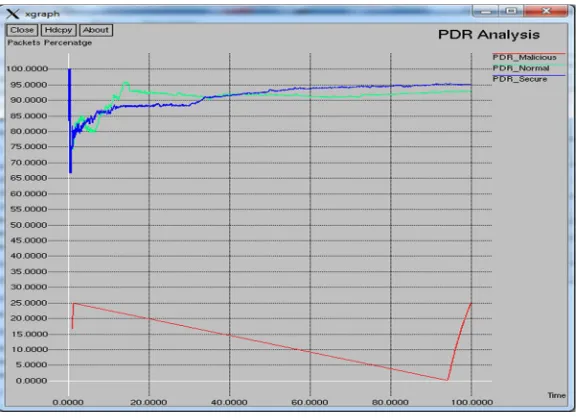
In this plan the bundles rate is tallied of real parcels sends by sender at current time to recipient.
Figure 2 PDR Performance analysis
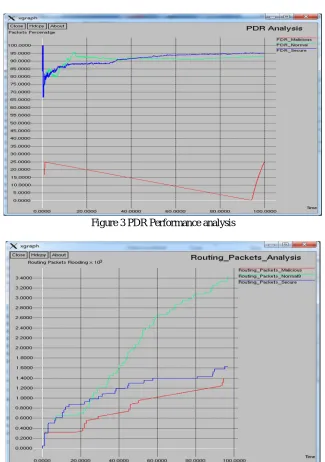
[image:3.612.162.450.482.691.2]Figure 3 PDR Performance analysis
Figure 4 Routing Packets Flooding analysis
V. CONCLUSION / FUTURE WORK
Mobile Ad-hoc networks are a collection of mobile hosts that communicate with each other without any infrastructure. Due to security vulnerabilities of the routing protocols, wireless ad hoc networks may be unprotected against attacks by the malicious
nodes. In this research we have gone through the routing security issues of MANETs, described the cooperative Malicious nodes
attack that can be mounted against a MANET and proposed a feasible solution for it in the AODV protocol. The proposed solution can be applied to a) Identify malicious nodes in a MANET; and b) Discover secure paths from source to destination by avoiding malicious nodes acting routing misbehavior. The ML security scheme is better than the existing security scheme in MANET but the proposed hop based security scheme is better than the ML scheme and provides secure communication among mobile nodes. Also we showed that the effect of packet delivery ratio and throughput has been detected in case of attack. There is reduction in Packet Delivery Ratio and Throughput. In Malicious nodes attack all network traffics are redirected to a specific node or from the malicious node causing serious damage to network and nodes as shown in the result of the simulation.
REFERENCES
[1] W. Li, A. Joshi, and T. Finin, “Coping with node misbehaviors in ad hoc networks: A multi-dimensional trust management approach,” in Proceedings of the
Eleventeenth International Conference on Mobile Data Management, 2010. MDM ’10. IEEE Computer Society, May 2010.
[2] J. Cho, A. Swami, and I. Chen, “A survey on trust management for mobile ad hoc networks,” Communications Surveys Tutorials, IEEE, vol. PP, no. 99, pp.
1 –22, 2010.
[3] G. Theodorakopoulos and J. S. Baras, “Trust evaluation in ad-hoc networks,” in WiSe ’04: Proceedings of the 3rd ACM workshop on Wireless security.
New York, NY, USA: ACM, 2013, pp. 1–10.
[4] W. Li, J. Parker, and A. Joshi, “Security through collaboration and trust in manets,” ACM/Springer Mobile Networks and Applications (MONET), pp. 1–11,
2014 (Online First).
[5] A. Patwardhan, A. Joshi, T. Finin, and Y. Yesha, “A data intensive reputation management scheme for vehicular ad hoc networks,” in Proceedings of the 3rd
Annual International Conference on Mobile and Ubiquitous Systems - Workshops, Mobiquitous ’06., July 2015, pp. 1–8.
[6] P. Michiardi and R. Molva, “Core: a collaborative reputation mechanism to enforce node cooperation in mobile ad hoc networks,” in Proceedings of the IFIP
TC6/TC11 Sixth Joint Working Conference on Communications and Multimedia Security. Deventer, The Netherlands, The Netherlands: Kluwer, B.V., 2015, pp. 107–121.
[7] Y. Zhang and W. Lee, “Intrusion detection in wireless ad-hoc networks,” in MobiCom ’00: Proceedings of the 6th annual international conference on Mobile
computing and networking. New York, NY, USA: ACM, 2015, pp. 275–283.
[8] S. Marti, T. J. Giuli, K. Lai, and M. Baker, “Mitigating routing misbehavior in mobile ad hoc networks,” in MobiCom ’00: Proceedings of the 6th annual
international conference on Mobile computing and networking. New York, NY, USA: ACM, 2015, pp. 255–265.
[9] S. Buchegger and J.-Y. Le Boudec, “Performance analysis of the confidant protocol,” in MobiHoc ’02: Proceedings of the 3rd ACM international
symposium on Mobile ad hoc networking & computing. New York, NY, USA: ACM, 2016, pp. 226–236.
[10] Y.-A. Huang and W. Lee, “A cooperative intrusion detection system for ad hoc networks,” in SASN ’03: Proceedings of the 1st ACM workshop on Security
of ad hoc and sensor networks. New York, NY, USA: ACM, 2018, pp. 135–147.
[11] S. Buchegger and J.-Y. Le Boudee, “Self-policing mobile ad hoc networks by reputation systems,” IEEE Communications Magazine, vol. 43, no. 7, pp. 101–
107, July 2018.
[12] P.-W. Yau and C. J. Mitchell, “Security vulnerabilities in ad hoc networks,” in Proceedings of the 7th International Symposium on Communication Theory
![FABRICATION OF NOVEL ANTICANCER POLYOXOMETALATE [CoW11O39(CpTi)]7 CHITOSAN NANO COMPOSITE, ITS TOXICITY REDUCTION AND SUSTAINED RELEASE](data:image/gif;base64,R0lGODlhAQABAIAAAP///wAAACH5BAEAAAAALAAAAAABAAEAAAICRAEAOw==)