The SoNLP-DP System in the CoNLL-2015 shared Task
Fang Kong Sheng Li Guodong Zhou
School of Computer Science and Technology, Soochow University, China Gangjiang Road 333#, Suzhou, Jiangsu of China 215006
[email protected] [email protected] [email protected]
Abstract
This paper describes the submitted dis-course parsing system of the natural language group of Soochow University (SoNLP-DP) to the CoNLL 2015 shared task. Our System classifies discourse lations into explicit and non-explicit re-lations and uses a pipeline platform to conduct every subtask to form an end-to-end shallow discourse parser in the Penn Discourse Treebank (PDTB). Our system is evaluated on the CoNLL-2015 Shared Task closed track and achieves the 18.51% in F1-measure on the official blind test set.
1 Introduction
Discourse parsing determines the internal struc-ture of a text via identifying the discourse relations between its text units and plays an important role in natural language understanding that benefits a wide range of downstream natural language ap-plications, such as coherence modeling (Barzilay and Lapata, 2005; Lin et al., 2011), text summa-rization (Lin et al., 2012), and statistical machine translation (Meyer and Webber, 2013).
As the largest discourse corpus, the Penn Dis-course TreeBank (PDTB) corpus (Prasad et al., 2008) adds a layer of discourse annotations on the top of the Penn TreeBank (PTB) corpus (Mar-cus et al., 1993) and has been attracting more and more attention recently (Elwell and Baldridge, 2008; Pitler and Nenkova, 2009; Prasad et al., 2010; Ghosh et al., 2011; Kong et al., 2014; Lin et al., 2014). Different from another famous discourse corpus, the Rhetorical Structure The-ory(RST) Treebank corpus(Carlson et al., 2001), the PDTB focuses on shallow discourse relations either lexically grounded in explicit discourse con-nectives or associated with sentential adjacency. This theory-neutral way makes no commitment to
any kind of higher-level discourse structure and can work jointly with high-level topic and func-tional structuring (Webber et al., 2012) or hierar-chial structuring (Asher and Lascarides, 2003).
Although much research work has been con-ducted for certain subtasks since the release of the PDTB corpus, there is still little work on con-structing an end-to-end shallow discourse parser. The CoNLL 2015 shared task (Xue et al., 2015) evaluates end-to-end shallow discourse parsing systems for determining and classifying both ex-plicit and non-exex-plicit discourse relations. A par-ticipant system needs to (1)locate all explicit (e.g., ”because”, ”however”, ”and”.) discourse connec-tives in the text, (2)identify the spans of text that serve as the two arguments for each discourse con-nective, and (3) predict the sense of the discourse relations (e.g., ”Cause”, ”Condition”, ”Contrast”). In this paper, we describe the system submis-sion from the NLP group of Soochow university (SoNLP-DP). Our shallow discourse parser con-sists of multiple components in a pipeline archi-tecture, including a connective classifier, argu-ment labeler, explicit classifier, non-explicit clas-sifier. Our system is evaluated on the CoNLL-2015 Shared Task closed track and achieves the 18.51% in F1-measure on the official blind test set. The remainder of this paper is organized as fol-lows. Section 2 presents our shallow discourse parsing system. The experimental results are de-scribed in Section 3. Section 4 concludes the pa-per.
2 System Architecture
In this section, after a quick overview of our sys-tem, we describe the details involved in imple-menting the end-to-end shallow discourse parser.
2.1 System Overview
A typical text consists of sentences glued together in a systematic way to form a coherent discourse.
Referring to the PDTB, shallow discourse parsing focus on shallow discourse relations either lexi-cally grounded in explicit discourse connectives or associated with sentential adjacency. Differ-ent from full discourse parsing, shallow discourse parsing transforms a piece of text into a set of discourse relations between two adjacent or non-adjacent discourse units, instead of connecting the relations hierarchically to one another to form a connected structure in the form of tree or graph.
Specifically, given a piece of text, the end-to-end shallow discourse parser returns a set of dis-course relations in the form of a disdis-course con-nective (explicit or implicit) taking two arguments (clauses or sentences) with a discourse sense. That is, a complete end-to-end shallow discourse parser includes:
• connective identification, which identifies all connective candidates and labels them as whether they function as discourse connec-tives or not,
• argument labeling, which identifies the spans of text that serve as the two arguments for each discourse connective,
• explicit sense classification, which predicts the sense of the explicit discourse relations after achieving the connective and its argu-ments,
• non-explicit sense classification, for all ad-jacent sentence pairs within each paragraph without explicit discourse relations, which classify the given pair into EntRel, NoRel, or one of the Implicit/AltLex relation senses.
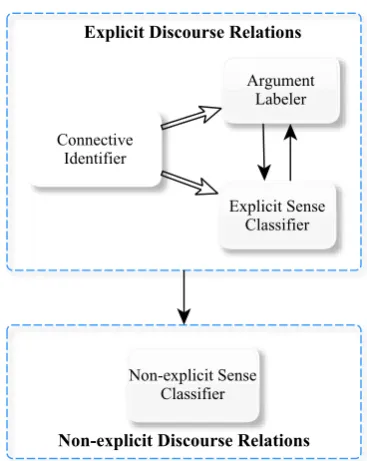
Figure 1 shows the components and the rela-tions among them. Different from the traditional approach (i.e., Lin et al. (2014)), considering the interaction between argument labeler and explicit sense classifier, co-occurrence relation between explicit and non-explicit discourse relations in a text, our system does not employ a complete se-quential pipeline framework.
2.2 Connective Identification
[image:2.595.324.508.67.298.2]Our connective identifier works in two steps. First, the connective candidates are extracted from the given text referring to the PDTB. There are 100 types of discourse connectives defined in the PDTB. Then every connective candidate is
Figure 1: Framework of our end-to-end shallow discourse parser
checked whether it functions as a discourse con-nective.
Pitler and Nenkova (2009) showed that syntac-tic features extracted from constituent parse trees are very useful in disambiguating discourse con-nectives. Followed their work, Lin et al. (2014) found that a connective’s context and part-of-speech (POS) are also helpful. Motivated by their work, we get a set of effective features, includes:
• Lexical: connective itself, POS of the con-nective, connective with its previous word, connective with its next word, the location of the connective in the sentence, i.e., start, mid-dle and end of the sentence.
• Syntactic: the highest node in the parse tree that covers only the connective words (dominate node), the context of the dominate node1, whether the right sibling contains a
VP, the path from the parent node of the con-nective to the root of the parse tree.
Besides, we observed that the syntactic class of the connective2 and connective modifier (such as 1We use POS combination of the parent, left sibling and right sibling of the dominate node to represent the context. When no parent or siblings, it is marked NULL.
apparently, in large part, etc.) give a very strong indication of its discourse usage. So we introduce both as two additional features.
2.3 Argument Labeling
The argument labeler needs to label the Arg1 and Arg2 spans for every connective determined by connective identifier. Following the work of Kong et al. (2014), we employ the constituent-based ap-proach to argument labeling by first extracting the constituents from a parse tree are casted as argu-ment candidates, then determining the role of ev-ery constituent as part of Arg1, Arg2, or NULL, and finally, merging all the constituents for Arg1 and Arg2 to obtain the Arg1 and Arg2 text spans respectively.
Specifically, similar to semantic role labeling (SRL), we use a simple algorithm to prune out those constituents that are clearly not arguments to the connective in question. The pruning algorithm works recursively in preprocessing, starting from the target connective node, i.e. the lowest node dominating the connective. First, all the siblings of the connective node are collected as candidates. Then we move on to the parent of the connective node and collect its siblings. This progress goes on until we reach the root of the parse tree.
After extracting the argument candidates, a multi-category classifier is employed to determine the role of every argument candidate (i.e., Arg1, Arg2, or NULL) with features reflecting the prop-erties of the connective, the candidate constituent and relationship between them. Features include,
• Connective related features: connective it-self, its syntactic category, its sense class.3
• Number of left/right siblings of the connec-tive.
• The context of the constituent. We use POS combination of the constituent, its parent, left sibling and right sibling to represent the con-text. When there is no parent or siblings, it is marked NULL.
• The path from the parent node of the connec-tive to the node of the constituent.
• The position of the constituent relative to the connective: left, right, or previous.
3In training stage, we extract the gold sense class from the annotated corpus. And in testing stage, the sense classifica-tion will be employed to get the automatic sense.
2.4 Explicit sense classification
After a discourse connective and its two arguments are identified, the sense classifier is proved to de-cide the sense that the relation conveys.
Although the same connective may carry differ-ent semantics under differdiffer-ent contexts, only a few connectives are ambiguous (Pitler and Nenkova, 2009). Following the work of Lin et al. (2014), we introduce three features to train a sense classi-fier: the connective itself, its POS and the previous word of the connective.
Besides, since we observed that various relative positions (i.e., Arg1 precedes Arg2, Arg2 precedes Arg1, Arg2 is embedded within Arg1, or Arg1 is embedded within Arg2) are helpful for sense clas-sification, we includes the relative position as an additional feature.
2.5 Non-explicit sense Classification
Referring to the PDTB, the non-explicit relations4
are annotated for all adjacent sentence pairs within paragraphs. So non-explicit sense classification only considers the sense of every adjacent sen-tence pair within a paragraph without explicit dis-course relations.
Our non-explicit sense classifier includes seven traditional features:
Verbs: Following the work of Pitler et al. (2009), we extract the pairs of verbs from the given adjacent sentence pair (i.e., Arg1 and Arg2). Besides that, the number of verb pairs which have the same highest VerbNet verb class (Kipper et al., 2006) is included as a feature. the average length of verb phrases in each argument, and the POS of main verbs are also included.
Polarity:This set of features record the number ofpositive,negated positive,negativeandneutral words in both arguments and their cross-product. The polarity of every word in arguments is de-rived from Multi-perspective Question Answering Opinion Corpus(MPQA) (Wilson et al., 2005). In-tuitively, polarity features would help recognize Comparison relations.
Modality:We include a set of features to record the presence or absence of specific modal words (i.e., can, may, will, shall, must, need) in Arg1 and Arg2, and their cross-product. The intuition
behind this feature set is that the Contingency re-lations seem to have more modal words.
Production rules: According to Lin et al. (2009), the syntactic structure of one argument may constrain the relation type and the syntactic structure of the other argument. Three features are introduced to denote the presence of syntactic ductions in Arg1, Arg2 or both. Here, these pro-duction rules are extracted from the training data and the rules with frequency less than 5 are ig-nored.
Dependency rules: Similar with Production rules, three features denoting the presence of de-pendency productions in Arg1, Arg2 or both are also introduced in our system.
Fisrt/Last and First 3 words: This set of fea-tures include the first and last words of Arg1, the first and last words of Arg2, the pair of the first words of Arg1 and Arg2, the pair of the last words as features, and the first three words of each argu-ment.
Brown cluster pairs:We include the Cartesian product of the Brown cluster values of the words in Arg1 and Arg2. In our system, we simply take 100 Brown clusters provided by CoNLL shared task.
Besides, we introduce two features which de-scribe the automatic determined connective list contained by Arg1 and Arg2, respectively, to cap-ture the co-occurrence relationship between non-explicit and non-explicit discourse relations.
3 Experimentation
We train our system on the corpora provided in the CoNLL-2015 Shared Task and evaluate our sys-tem on the CoNLL-2015 Shared Task closed track. All our classifiers are trained using the OpenNLP maximum entropy package5 with the default
pa-rameters (i.e. without smoothing and with 100 it-erations). We firstly report the official score on the CoNLL-2015 shared task on development, test and blind test sets. Then, the supplementary sults provided by the shared task organizes are re-ported.
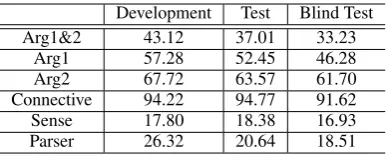
In Table 1, we present the official results of our system performances on the CoNLL-2015 devel-opment, test and blind test sets, respectively. From the results, we can find that,
• For Connective identification, our system achieved satisfactory results.
5http://maxent.sourceforge.net/
Development Test Blind Test Arg1&2 43.12 37.01 33.23
Arg1 57.28 52.45 46.28
Arg2 67.72 63.57 61.70
Connective 94.22 94.77 91.62
Sense 17.80 18.38 16.93
[image:4.595.320.514.61.139.2]Parser 26.32 20.64 18.51
Table 1: the official F1 score of our system.
• For argument labeling, the performance of Arg2 is better than Arg1 and the performance gaps are more than 10% in F1-measure. And the combined results of Arg1 and Arg2 ex-tractor reduced so much in comparison with the performance of Arg1 or Arg2.
• For sense classification, there is a lot of room to improve.
• For the overall parser performance, obvi-ously, a lot of work is needed for end-to-end discourse parsing before practical appli-cation.
Arg1&2 Arg1 Arg2 Sense Parser Dev ExpnonExp 34.6749.94 38.6762.13 74.3762.37 20.187.37 29.7823.54 Test ExpnonExp 30.2142.38 34.0257.71 74.4854.95 20.596.77 25.3016.97
Blind ExpnonExp 30.4235.87 36.4349.87 73.0451.07 17.365.24 22.9514.35
Table 2: the supplementary F1 score of our sys-tem.
In Table 2, we reported the supplementary re-sults provided by the shared task organizes on the development, test and blind test sets. These ad-ditional experiments investigate the performance of our shallow discourse parsing for explicit and non-explicit relations separately. From the results, we can find that the sense classification for both explicit and non-explicit discourse relations are the biggest obstacles to the overall performance of discourse parsing.
4 Conclusion
[image:4.595.304.555.388.464.2]Acknowledgements
This research is supported by Key project 61333018 and 61331011 under the National Natu-ral Science Foundation of China, Project 6127320 and 61472264 under the National Natural Science Foundation of China.
References
Nicholas Asher and Alex Lascarides. 2003. Logics of
Conversation. Cambridge Unversity Press.
Regina Barzilay and Mirella Lapata. 2005. Model-ing local coherence: An entity-based approach. In
Proceedings of the 43rd Annual Meeting of the As-sociation for Computational Linguistics.
Lynn Carlson, Daniel Marcu, and Mary Ellen Okurowski. 2001. Building a discourse-tagged cor-pus in the framework of rhetorical structure theory. InProceedings of Second SIGdial Workshop on Dis-course and Dialogue.
Robert Elwell and Jason Baldridge. 2008. Discourse connective argument identification with connective specific rankers. InSecond IEEE International Con-ference on Semantic Computing.
Sucheta Ghosh, Richard Johansson, Giuseppe Ric-cardi, and Sara Tonelli. 2011. Shallow discourse parsing with conditional random fields. In Proceed-ings of the 5th International Joint Conference on Natural Language Processing.
Karin Kipper, Anna Korhonen, Neville Ryant, and Martha Palmer. 2006. Extending verbnet with novel
verb classes. In Fifth Internal Conference on
Lan-guage Resources and Evaluation.
Fang Kong, Hwee Tou Ng, and Guodong Zhou. 2014. A constituent-based approach to argument labeling
with joint inference in discourse parsing. In
Pro-ceedings of the 2014 Conference on Empirical Meth-ods in Natural Language Processing.
Ziheng Lin, Min-Yen Kan, and Hwee Tou Ng. 2009. Recognizing implicit discourse relations in the Penn
Discourse Treebank. In Proceedings of the 2009
Conference on Empirical Methods in Natural Lan-guage Processing.
Ziheng Lin, Hwee Tou Ng, and Min-Yen Kan. 2011. Automatically evaluating text coherence using dis-course relations. InProceedings of the 49th Annual Meeting of the Association for Computational Lin-guistics.
Ziheng Lin, Chang Liu, Hwee Tou Ng, and Min-Yen Kan. 2012. Combining coherence models and ma-chine translation evaluation metrics for
summariza-tion evaluasummariza-tion. InProceedings of the 50th Annual
Meeting of the Association for Computational Lin-guistics.
Ziheng Lin, Hwee Tou Ng, and Min-Yen Kan. 2014. A
PDTB-styled end-to-end discourse parser. Natural
Language Engineering, 20(2):151–184.
Mitchell P. Marcus, Beatrice Santorini, and Mary Ann Marcinkiewicz. 1993. Building a large annotated
corpus of English: The Penn Treebank.
Computa-tional Linguistics, 19(2):313–330.
Thomas Meyer and Bonnie Webber. 2013. Implicita-tion of discourse connectives in (machine)
transla-tion. InProceedings of the Workshop on Discourse
in Machine Translation.
Emily Pitler and Ani Nenkova. 2009. Using syntax to disambiguate explicit discourse connectives in text. In Proceedings of the ACL-IJCNLP 2009 Confer-ence Short Papers.
Rashmi Prasad, Nikhil Dinesh, Alan Lee, Eleni Milt-sakaki, Livio Robaldo, Aravind Joshi, and Bonnie Webber. 2008. The Penn Discourse TreeBank 2.0. InProceedings of the LREC 2008 Conference. Rashmi Prasad, Aravind Joshi, and Bonnie Webber.
2010. Exploiting scope for shallow discourse
pars-ing. In Proceedings of the Seventh International
Conference on Language Resources and Evaluation. Bonnie Webber, Marcus Egg, and Valia Kordoni. 2012.
Discourse structure and language technology.
Natu-ral Language Engineering, 18(4):437–490, 10. Theresa Wilson, Janyce Wiebe, and Paul Hoffmann.
2005. Recognizing contextual polarity in
phrase-level sentiment analysis. InProceedings of Human
Language Technology Conference and Conference on Empirical Methods in Natural Language Pro-cessing.
Nianwen Xue, Hwee Tou Ng, Sameer Pradhan, Rashmi Prasad, Christopher Bryant, and Attapol Ruther-ford. 2015. The conll-2015 shared task on
shal-low discourse parsing. InProceedings of the