Joint Learning for Coreference Resolution with Markov Logic
Yang Song1, Jing Jiang2, Wayne Xin Zhao3, Sujian Li1, Houfeng Wang1
1Key Laboratory of Computational Linguistics (Peking University) Ministry of Education,China 2School of Information Systems, Singapore Management University, Singapore
3School of Electronics Engineering and Computer Science, Peking University, China {ysong, lisujian, wanghf}@pku.edu.cn, [email protected], [email protected]
Abstract
Pairwise coreference resolution models must merge pairwise coreference decisions to gen-erate final outputs. Traditional merging meth-ods adopt different strategies such as the best-first method and enforcing the transitivity con-straint, but most of these methods are used independently of the pairwise learning meth-ods as an isolated inference procedure at the end. We propose a joint learning model which combines pairwise classification and mention clustering with Markov logic. Experimen-tal results show that our joint learning tem outperforms independent learning sys-tems. Our system gives a better performance than all the learning-based systems from the CoNLL-2011 shared task on the same dataset. Compared with the best system from CoNLL-2011, which employs a rule-based method, our system shows competitive performance.
1 Introduction
The task of noun phrase coreference resolution is to determine which mentions in a text refer to the same real-world entity. Many methods have been pro-posed for this problem. Among them the mention-pair model (McCarthy and Lehnert, 1995) is one of the most influential ones and can achieve the state-of-the-art performance (Bengtson and Roth, 2008). The mention-pair model splits the task into three parts: mention detection, pairwise classification and mention clustering. Mention detection aims to iden-tify anaphoric noun phrases, including proper nouns, common noun phrases and pronouns. Pairwise clas-sification takes a pair of detected anaphoric noun
phrase candidates and determines whether they re-fer to the same entity. Because these classification decisions are local, they do not guarantee that can-didate mentions are partitioned into clusters. There-fore a mention clustering step is needed to resolve conflicts and generate the final mention clusters.
Much work has been done following the mention-pair model (Soon et al., 2001; Ng and Cardie, 2002). In most work, pairwise classification and mention clustering are done sequentially. A major weak-ness of this approach is that pairwise classification considers only local information, which may not be sufficient to make correct decisions. One way to address this weakness is to jointly learn the pair-wise classification model and the mention cluster-ing model. This idea has been explored to some extent by McCallum and Wellner (2005) using con-ditional undirected graphical models and by Finley and Joachims (2005) using an SVM-based super-vised clustering method.
In this paper, we study how to use a different learning framework, Markov logic (Richardson and Domingos, 2006), to learn a joint model for both pairwise classification and mention clustering un-der the mention-pair model. We choose Markov logic because of its appealing properties. Markov logic is based on first-order logic, which makes the learned models readily interpretable by humans. Moreover, joint learning is natural under the Markov logic framework, with local pairwise classification and global mention clustering both formulated as weighted first-order clauses. In fact, Markov logic has been previously used by Poon and Domingos (2008) for coreference resolution and achieved good
results, but it was used for unsupervised coreference resolution and the method was based on a different model, the entity-mention model.
More specifically, to combine mention cluster-ing with pairwise classification, we adopt the com-monly used strategies (such as best-first clustering and transitivity constraint), and formulate them as first-order logic formulas under the Markov logic framework. Best-first clustering has been previously studied by Ng and Cardie (2002) and Bengtson and Roth (2008) and found to be effective. Transitivity constraint has been applied to coreference resolution by Klenner (2007) and Finkel and Manning (2008), and also achieved good performance.
We evaluate Markov logic-based method on the dataset from CoNLL-2011 shared task. Our ex-periment results demonstrate the advantage of joint learning of pairwise classification and mention clus-tering over independent learning. We examine best-first clustering and transitivity constraint in our methods, and find that both are very useful for coref-erence resolution. Compared with the state of the art, our method outperforms a baseline that repre-sents a typical system using the mention-pair model. Our method is also better than all learning systems from the CoNLL-2011 shared task based on the re-ported performance. Even with the top system from CoNLL-2011, our performance is still competitive.
In the rest of this paper, we first describe a stan-dard pairwise coreference resolution system in Sec-tion 2. We then present our Markov logic model for pairwise coreference resolution in Section 3. Exper-imental results are given in Section 4. Finally we discuss related work in Section 5 and conclude in Section 6.
2 Standard Pairwise Coreference Resolution
In this section, we describe standard learning-based framework for pairwise coreference resolution. The major steps include mention detection, pairwise classification and mention clustering.
2.1 Mention Detection
For mention detection, traditional methods include learning-based and rule-based methods. Which kind of method to choose depends on specific dataset. In
this paper, we first consider all the noun phrases in the given text as candidate mentions. With-out gold standard mention boundaries, we use a well-known preprocessing tool from Stanford’s NLP group1 to extract noun phrases. After obtaining all the extracted noun phrases, we also use a rule-based method to remove some erroneous candidates based on previous studies (e.g. Lee et al. (2011), Uryupina et al. (2011)). Some examples of these erroneous candidates include stop words (e.g. uh,hmm), web addresses (e.g. http://www.google.com), numbers (e.g. $9,000) and pleonastic “it” pronouns.
2.2 Pairwise Classification
For pairwise classification, traditional learning-based methods usually adopt a classification model such as maximum entropy models and support vec-tor machines. Training instances (i.e. positive and negative mention pairs) are constructed from known coreference chains, and features are defined to rep-resent these instances.
In this paper, we build a baseline system that uses maximum entropy models as the classification algo-rithm. For generation of training instances, we fol-low the method of Bengtson and Roth (2008). For each predicted mention m, we generate a positive mention pair between m and its closest preceding antecedent, and negative mention pairs by pairingm
with each of its preceding predicted mentions which are not coreferential with m. To avoid having too many negative instances, we impose a maximum sentence distance between the two mentions when constructing mention pairs. This is based on the in-tuition that for each anaphoric mention, its preced-ing antecedent should appear quite near it, and most coreferential mention pairs which have a long sen-tence distance can be resolved using string match-ing. During the testing phase, we generate men-tion pairs for each menmen-tion candidate with each of its preceding mention candidates and use the learned model to make coreference decisions for these men-tion pairs. We also impose the sentence distance constraint and use string matching for mention pairs with a sentence distance exceeding the threshold.
1
2.3 Mention Clustering
After obtaining the coreferential results for all men-tion pairs, some clustering method should be used to generate the final output. One strategy is the single-link method, which single-links all the mention pairs that have a prediction probability higher than a threshold value. Two other alternative methods are the best-first clustering method and clustering with the tran-sitivity constraint. Best-first clustering means that for each candidate mention m, we select the best one from all its preceding candidate mentions based on the prediction probabilities. A threshold value is given to filter out those mention pairs that have a low probability to be coreferential. Transitivity con-straint means that if a and b are coreferential and
bandcare coreferential, thenaandcmust also be coreferential. Previous work has found that best-first clustering and transitivity constraint-based cluster-ing are better than the scluster-ingle-link method. Finally we remove all the singleton mentions.
3 Markov Logic for Pairwise Coreference Resolution
In this section, we present our method for joint learning of pairwise classification and mention clus-tering using Markov logic. For mention detection, training instance generation and postprocessing, our method follows the same procedures as described in Section 2. In what follows, we will first describe the basic Markov logic networks (MLN) framework, and then introduce the first-order logic formulas we use in our MLN including local formulas and global formulas which perform pairwise classification and mention clustering respectively. Through this way, these two isolated parts are combined together, and joint learning and inference can be performed in a single framework. Finally we present inference and parameter learning methods.
3.1 Markov Logic Networks
Markov logic networks combine Markov networks with first-order logic (Richardson and Domingos, 2006; Riedel, 2008). A Markov logic network con-sists of a set of first-order clauses (which we will re-fer to asformulasin the rest of the paper) just like in first-order logic. However, different from first-order logic where a formula represents a hard constraint,
in an MLN, these constraints are softened and they can be violated with some penalty. An MLN M is therefore a set ofweighted formulas{(ϕi, wi)}i,
whereϕiis a first order formula andwiis the penalty
(the formula’s weight). These weighted formulas define a probability distribution over sets of ground atoms or so-called possible worlds. Lety denote a possible world, then we definep(y)as follows:
p(y) = 1
Zexp
( ∑
(ϕi,wi)∈M
wi
∑
c∈Cnϕi
fcϕi(y)
)
. (1)
Here eachc is a binding of free variables in ϕi to
constants. Eachfcϕirepresents a binary feature
func-tion that returns 1 if the ground formula we get by replacing the free variables inϕi with the constants
incunder the given possible worldy is true, and 0 otherwise.nϕi denotes the number of free variables
of a formulaϕi.Cnϕiis the set of all bindings for the
free variables inϕi. Z is a normalization constant.
This distribution corresponds to a Markov network where nodes represent ground atoms and factors rep-resent ground formulas.
Each formula consists of a set of first-order predi-cates, logical connectors and variables. Take the fol-lowing formula as one example:
(ϕi, wi) :headMatch(a, b)∧(a̸=b)⇒coref(a, b).
The formula above indicates that if two different candidate mentions a and b have the same head word, then they are coreferential. Hereaandbare variables which can represent any candidate men-tion, headMatch and coref are observed predicate and hidden predicate respectively. An observed predicate is one whose value is known from the ob-servations when its free variables are assigned some constants. A hidden predicate is one whose value is not known from the observations. From this exam-ple, we can see thatheadMatchis an observed pred-icate because we can check whether two candidate mentions have the same head word. corefis a hid-den predicate because this is something we would like to predict.
3.2 Formulas
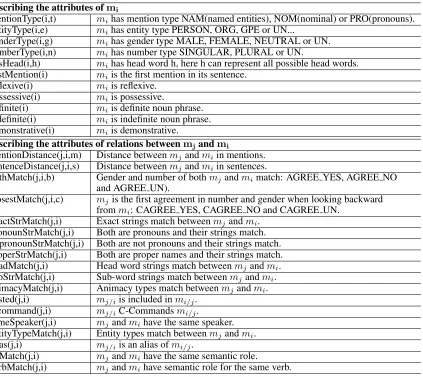
describing the attributes ofmi
mentionType(i,t) mihas mention type NAM(named entities), NOM(nominal) or PRO(pronouns).
entityType(i,e) mihas entity type PERSON, ORG, GPE or UN...
genderType(i,g) mihas gender type MALE, FEMALE, NEUTRAL or UN.
numberType(i,n) mihas number type SINGULAR, PLURAL or UN.
hasHead(i,h) mihas head word h, here h can represent all possible head words.
firstMention(i) miis the first mention in its sentence.
reflexive(i) miis reflexive.
possessive(i) miis possessive.
definite(i) miis definite noun phrase.
indefinite(i) miis indefinite noun phrase.
demonstrative(i) miis demonstrative.
describing the attributes of relations betweenmjandmi
mentionDistance(j,i,m) Distance betweenmjandmiin mentions.
sentenceDistance(j,i,s) Distance betweenmjandmiin sentences.
bothMatch(j,i,b) Gender and number of bothmjandmimatch: AGREE YES, AGREE NO
and AGREE UN).
closestMatch(j,i,c) mjis the first agreement in number and gender when looking backward
frommi: CAGREE YES, CAGREE NO and CAGREE UN.
exactStrMatch(j,i) Exact strings match betweenmjandmi.
pronounStrMatch(j,i) Both are pronouns and their strings match. nopronounStrMatch(j,i) Both are not pronouns and their strings match. properStrMatch(j,i) Both are proper names and their strings match. headMatch(j,i) Head word strings match betweenmjandmi.
subStrMatch(j,i) Sub-word strings match betweenmjandmi.
animacyMatch(j,i) Animacy types match betweenmjandmi.
nested(j,i) mj/iis included inmi/j.
c command(j,i) mj/iC-Commandsmi/j.
sameSpeaker(j,i) mjandmihave the same speaker.
entityTypeMatch(j,i) Entity types match betweenmjandmi.
alias(j,i) mj/iis an alias ofmi/j.
srlMatch(j,i) mjandmihave the same semantic role.
[image:4.612.104.527.58.435.2]verbMatch(j,i) mjandmihave semantic role for the same verb.
Table 1: Observed predicates.
pairwise classification, because the decisions are lo-cal, we use a set of local formulas. For mention clustering, we use global formulas to implement best-first clustering or transitivity constraint. We naturally combine pairwise classification with men-tion clustering via local and global formulas in the Markov logic framework, which is the essence of “joint learning” in our work.
3.2.1 Local Formulas
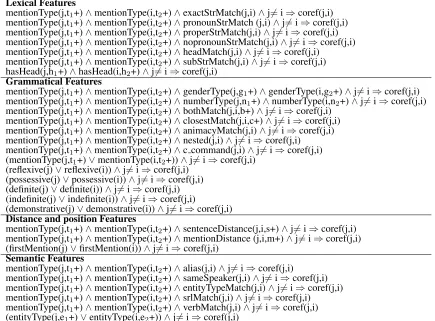
A local formula relates any observed predicates to exactly one hidden predicate. For our problem, we define a list of observed predicates to describe the properties of individual candidate mentions and the relations between two candidate mentions, shown in Table 1. For our problem, we have only one hidden predicate, i.e. coref. Most of our local formulas are
from existing work (e.g. Soon et al. (2001), Ng and Cardie (2002), Sapena et al. (2011)). They are listed in Table 2, where the symbol “+” indicates that for every value of the variable preceding “+” there is a separate weight for the corresponding formula.
3.2.2 Global Formulas
Lexical Features
mentionType(j,t1+)∧mentionType(i,t2+)∧exactStrMatch(j,i)∧j̸=i⇒coref(j,i)
mentionType(j,t1+)∧mentionType(i,t2+)∧pronounStrMatch (j,i)∧j̸=i⇒coref(j,i)
mentionType(j,t1+)∧mentionType(i,t2+)∧properStrMatch(j,i)∧j̸=i⇒coref(j,i)
mentionType(j,t1+)∧mentionType(i,t2+)∧nopronounStrMatch(j,i)∧j̸=i⇒coref(j,i)
mentionType(j,t1+)∧mentionType(i,t2+)∧headMatch(j,i)∧j̸=i⇒coref(j,i)
mentionType(j,t1+)∧mentionType(i,t2+)∧subStrMatch(j,i)∧j̸=i⇒coref(j,i)
hasHead(j,h1+)∧hasHead(i,h2+)∧j̸=i⇒coref(j,i)
Grammatical Features
mentionType(j,t1+)∧mentionType(i,t2+)∧genderType(j,g1+)∧genderType(i,g2+)∧j̸=i⇒coref(j,i)
mentionType(j,t1+)∧mentionType(i,t2+)∧numberType(j,n1+)∧numberType(i,n2+)∧j̸=i⇒coref(j,i)
mentionType(j,t1+)∧mentionType(i,t2+)∧bothMatch(j,i,b+)∧j̸=i⇒coref(j,i)
mentionType(j,t1+)∧mentionType(i,t2+)∧closestMatch(j,i,c+)∧j̸=i⇒coref(j,i)
mentionType(j,t1+)∧mentionType(i,t2+)∧animacyMatch(j,i)∧j̸=i⇒coref(j,i)
mentionType(j,t1+)∧mentionType(i,t2+)∧nested(j,i)∧j̸=i⇒coref(j,i)
mentionType(j,t1+)∧mentionType(i,t2+)∧c command(j,i)∧j̸=i⇒coref(j,i)
(mentionType(j,t1+)∨mentionType(i,t2+))∧j̸=i⇒coref(j,i)
(reflexive(j)∨reflexive(i))∧j̸=i⇒coref(j,i) (possessive(j)∨possessive(i))∧j̸=i⇒coref(j,i) (definite(j)∨definite(i))∧j̸=i⇒coref(j,i) (indefinite(j)∨indefinite(i))∧j̸=i⇒coref(j,i)
(demonstrative(j)∨demonstrative(i))∧j̸=i⇒coref(j,i) Distance and position Features
mentionType(j,t1+)∧mentionType(i,t2+)∧sentenceDistance(j,i,s+)∧j̸=i⇒coref(j,i)
mentionType(j,t1+)∧mentionType(i,t2+)∧mentionDistance (j,i,m+)∧j̸=i⇒coref(j,i)
(firstMention(j)∨firstMention(i))∧j̸=i⇒coref(j,i) Semantic Features
mentionType(j,t1+)∧mentionType(i,t2+)∧alias(j,i)∧j̸=i⇒coref(j,i)
mentionType(j,t1+)∧mentionType(i,t2+)∧sameSpeaker(j,i)∧j̸=i⇒coref(j,i)
mentionType(j,t1+)∧mentionType(i,t2+)∧entityTypeMatch(j,i)∧j̸=i⇒coref(j,i)
mentionType(j,t1+)∧mentionType(i,t2+)∧srlMatch(j,i)∧j̸=i⇒coref(j,i)
mentionType(j,t1+)∧mentionType(i,t2+)∧verbMatch(j,i)∧j̸=i⇒coref(j,i)
[image:5.612.90.525.62.383.2](entityType(j,e1+)∨entityType(i,e2+))∧j̸=i⇒coref(j,i)
Table 2: Local Formulas.
Best-First constraint:
coref(j, i)⇒ ¬coref(k, i) ∀j, k < i(k̸=j) (2)
Here we assume that coref(j,i) returns true if can-didate mentions j andi are coreferential and false otherwise. Therefore for each candidate mentioni, we should only select at most one candidate mention
jto return true for the predicatecoref(j,i)from all its preceding candidate mentions.
Transitivity constraint:
coref(j, k)∧coref(k, i)∧j < k < i⇒coref(j, i) (3)
coref(j, k)∧coref(j, i)∧j < k < i⇒coref(k, i) (4)
coref(j, i)∧coref(k, i)∧j < k < i⇒coref(j, k) (5)
With the transitivity constraint, it means for given mentions j, k and i, if any two pairs of them are coreferential, then the third pair of them should be also coreferential.
We use best-first clustering and transitivity con-straint in our joint learning model respectively. De-tailed comparisons between them will be shown in Section 4.
3.3 Inference
We use MAP inference which is implemented by In-teger Linear Programming (ILP). Its objective is to maximize a posteriori probability as follows. Here we usexto represent all the observed ground atoms and y to represent the hidden ground atoms. For-mally, we have
ˆ
y= arg max y
p(y|x)≃arg max y
s(y, x),
where
s(y, x) = ∑
(ϕi,wi)∈M
wi
∑
c∈Cnϕi
fcϕi(y, x). (6)
the problem can be easily solved using ILP. Detailed introduction about transforming ground Markov net-works in Markov logic into an ILP problem can be found in (Riedel, 2008).
3.4 Parameter Learning
For parameter learning, we employ the online learner MIRA (Crammer and Singer, 2003), which establishes a large margin between the score of the gold solution and all wrong solutions to learn the weights. This is achieved by solving the quadratic program as follows
min∥wt−wt−1 ∥. (7)
s.t. s(yi, xi)−s(y′, xi)≥L(yi, y′) ∀y′ ̸=yi, (yi, xi)∈D
Here D = {(yi, xi)}Ni=1 represents N training in-stances (each instance represents one single docu-ment in the dataset) andtrepresents the number of iterations. In our problem, we adopt 1-best MIRA, which means that in each iteration we try to findwt
which can guarantee the difference between the right solutionyiand the best solutiony′(i.e. the one with
the highest score s(y′,xi), equivalent toyˆin Section
3.3)) is at least as big as the loss L(yi, y′), while
changingwt−1 as little as possible. The number of false ground atoms ofcorefpredicate is selected as loss function in our experiments. Hard global straints (i.e. best-first clustering or transitivity con-straint) must be satisfied when inferring the besty′
in each iteration, which can make learned weights more effective.
4 Experiments
In this section, we will first describe the dataset and evaluation metrics we use. We will then present the effect of our joint learning method, and finally dis-cuss the comparison with the state of the art.
4.1 Data Set
We use the dataset from the CoNLL-2011 shared task, “Modeling Unrestricted Coreference in OntoNotes” (Pradhan et al., 2011)2. It uses the En-glish portion of the OntoNotes v4.0 corpus. There are three important differences between OntoNotes
2
http://conll.cemantix.org/2011/
and another well-known coreference dataset from ACE. First, OntoNotes does not label any singleton entity cluster, which has only one reference in the text. Second, only identity coreference is tagged in OntoNotes, but not appositives or predicate nomi-natives. Third, ACE only considers mentions which belong to ACE entity types, whereas OntoNotes considers more entity types. The shared task is to automatically identify both entity coreference and event coreference, although we only focus on entity coreference in this paper. We don’t assume that gold standard mention boundaries are given. So we develop a heuristic method for mention detection. See details in Section 2.1.
The training set consists of 1674 documents from newswire, magazine articles, broadcast news, broad-cast conversations and webpages, and the develop-ment set consists of 202 docudevelop-ments from the same source. For training set, there are 101264 mentions from 26612 entities. And for development set, there are 14291 mentions from 3752 entities (Pradhan et al., 2011).
4.2 Evaluation Metrics
We use the same evaluation metrics as used in CoNLL-2011. Specifically, for mention detection, we use precision, recall and the F-measure. A men-tion is considered to be correct only if it matches the exact same span of characters in the annotation key. For coreference resolution, MUC (Vilain et al., 1995), B-CUBED (Bagga and Baldwin, 1998) and CEAF-E (Luo, 2005) are used for evaluation. The unweighted average F score of them is used to com-pare different systems.
4.3 The Effect of Joint Learning
System Mention Detection MUC B-cube CEAF Avg
R P F R P F R P F R P F F
MLN-Local 62.52 74.75 68.09 56.07 65.55 60.44 65.67 72.95 69.12 45.55 37.19 40.95 56.84 MLN-Local+BF 65.74 73.2 69.27 56.79 64.08 60.22 65.71 74.18 69.69 47.29 40.53 43.65 57.85 MLN-Local+Trans 68.49 70.32 69.40 57.16 60.98 59.01 66.97 72.90 69.81 46.96 43.34 45.08 57.97
MLN-Joint(BF) 64.36 75.25 69.38 55.47 66.95 60.67 64.14 77.75 70.29 50.47 39.85 44.53 58.50 MLN-Joint(Trans) 64.46 75.37 69.49 55.48 67.15 60.76 64.00 78.11 70.36 50.63 39.84 44.60 58.57
Table 3: Comparison between different MLN-based systems, using 10-fold cross validation on the training dataset.
constraint. TheMLN-Joint system is a joint model for both pairwise classification and mention cluster-ing. It can combine either best-first clustering or en-forcing transitivity constraint with pairwise classifi-cation, and we denote these two variants of MLN-Joint asMLN-Joint(BF) and MLN-Joint(Trans) re-spectively.
To compare the performance of the various sys-tems above, we use 10-fold cross validation on the training dataset. We empirically find that our method has a fast convergence rate, to learn the MLN model, we set the number of iterations to be 10.
The performance of these compared systems is shown in Table 3. To provide some context for the performance of this task, we report the median average F-score of the official results of CoNLL-2011, which is 50.12 (Pradhan et al., 2011). We can see thatMLN-Local achieves an average F-score of 56.84, which is well above the median score. When adding best-first or transitivity constraint which is independent of pairwise classification, MLN-Local+BFandMLN-Local+Transachieve better re-sults of 57.85 and 57.97. Most of all, we can see that the joint learning model (MLN-Joint(BF) or MLN-Joint(Trans)) significantly outperforms inde-pendent learning model (MLN-Local+BF or MLN-Local+Trans) no matter whether best-first clustering or transitivity constraint is used (based on a paired 2-tailed t-test withp < 0.05) with the score of 58.50 or 58.57, which shows the effectiveness of our pro-posed joint learning method.
Best-first clustering and transitivity constraint are very useful in Markov logic framework, and bothMLN-LocalandMLN-Jointbenefit from them. For MLN-Joint, these two clustering methods re-sult in similar performance. But actually,
transi-tivity is harder than best-first, because it signifi-cantly increases the number of formulas for con-straints and slows down the learning process. In our experiments, we find thatMLN-Joint(Trans)3is much slower than MLN-Joint(BF). Overall, MLN-Joint(BF)has a good trade-off between effectiveness and efficiency.
4.4 Comparison with the State of the Art
In order to compare our method with the state-of-the-art systems, we consider the following systems. We implemented a traditional pairwise coreference system using Maximum Entropy as the base classi-fier and best-first clustering to link the results. We used the same set of local features in MLN-Joint. We refer to this system asMaxEnt+BF. To replace best-first clustering with transitivity constraint, we have another system named asMaxEnt+Trans. We also consider the best 3 systems from CoNLL-2011 shared task. Chang’s system uses ILP to perform best-first clustering after training a pairwise corefer-ence model. Sapena’s system uses a relaxation label-ing method to iteratively perform function optimiza-tion for labeling each menoptimiza-tion’s entity after learning the weights for features under a C4.5 learner. Lee’s system is a purely rule-based one. They use a battery of sieves by precision (from highest to lowest) to it-eratively choose antecedent for each mention. They obtained the highest score in CoNLL-2011.
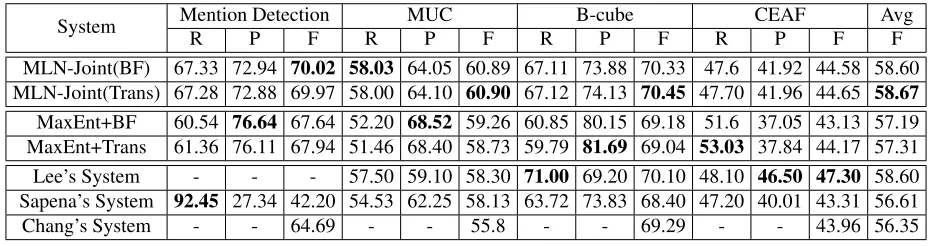
Table 4 shows the comparisons of our system with the state-of-the-art systems on the development set of CoNLL-2011. From the results, we can see that our joint learning systems are obviously better than
3
System Mention Detection MUC B-cube CEAF Avg
R P F R P F R P F R P F F
MLN-Joint(BF) 67.33 72.94 70.02 58.03 64.05 60.89 67.11 73.88 70.33 47.6 41.92 44.58 58.60 MLN-Joint(Trans) 67.28 72.88 69.97 58.00 64.10 60.90 67.12 74.13 70.45 47.70 41.96 44.65 58.67
MaxEnt+BF 60.54 76.64 67.64 52.20 68.52 59.26 60.85 80.15 69.18 51.6 37.05 43.13 57.19 MaxEnt+Trans 61.36 76.11 67.94 51.46 68.40 58.73 59.79 81.69 69.04 53.03 37.84 44.17 57.31
[image:8.612.73.541.59.182.2]Lee’s System - - - 57.50 59.10 58.30 71.00 69.20 70.10 48.10 46.50 47.30 58.60 Sapena’s System 92.45 27.34 42.20 54.53 62.25 58.13 63.72 73.83 68.40 47.20 40.01 43.31 56.61 Chang’s System - - 64.69 - - 55.8 - - 69.29 - - 43.96 56.35
Table 4: Comparisons with state-of-the-art systems on the development dataset.
MaxEnt+BF and MaxEnt+Trans. They also out-perform the learning-based systems of Sapena et al. (2011) and Chang et al. (2011), and perform com-petitively with Lee’s system (Lee et al., 2011). Note that Lee’s system is purely rule-based, while our methods are developed in a theoretically sound way, i.e., Markov logic framework.
5 Related Work
Supervised noun phrase coreference resolution has been extensively studied. Besides the mention-pair model, two other commonly used models are the entity-mention model (Luo et al., 2004; Yang et al., 2008) and ranking models (Denis and Baldridge, 2008; Rahman and Ng, 2009). Interested readers can refer to the literature review by Ng (2010).
Under the mention-pair model, Klenner (2007) and Finkel and Manning (2008) applied Integer Lin-ear Programming (ILP) to enforce transitivity on the pairwise classification results. Chang et al. (2011) used the same ILP technique to incorporate best-first clustering and generate the mention clusters. In all these studies, however, mention clustering is com-bined with pairwise classification only at the infer-ence stage but not at the learning stage.
To perform joint learning of pairwise classifi-cation and mention clustering, in (McCallum and Wellner, 2005), each mention pair corresponds to a binary variable indicating whether the two men-tions are coreferential, and the dependence between these variables is modeled by conditional undirected graphical models. Finley and Joachims (2005) pro-posed a general SVM-based framework for super-vised clustering that learns item-pair similarity mea-sures, and applied the framework to noun phrase
coreference resolution. In our work, we take a differ-ent approach and apply Markov logic. As we have shown in Section 3, given the flexibility of Markov logic, it is straightforward to perform joint learning of pairwise classification and mention clustering.
In recent years, Markov logic has been widely used in natural language processing problems (Poon and Domingos, 2009; Yoshikawa et al., 2009; Che and Liu, 2010). For coreference resolution, the most notable one is unsupervised coreference resolution by Poon and Domingos (2008). Poon and Domin-gos (2008) followed the entity-mention model while we follow the mention-pair model, which are quite different approaches. To seek good performance in an unsupervised way, Poon and Domingos (2008) highly rely on two important strong indicators: appositives and predicate nominatives. However, OntoNotes corpus (state-of-art NLP data collection) on coreference layer for CoNLL-2011 has excluded these two conditions of annotations (appositives and predicate nominatives) from their judging guide-lines. Compared with it, our methods are more ap-plicable for real dataset. Huang et al. (2009) used Markov logic to predict coreference probabilities for mention pairs followed by correlation cluster-ing to generate the final results. Although they also perform joint learning, at the inference stage, they still make pairwise coreference decisions and clus-ter mentions sequentially. Unlike their method, We formulate the two steps into a single framework.
Search Optimization (LaSO) framework. Rahman and Ng (2009) proposed to learn a cluster-ranker for discourse-new mention detection jointly with coreference resolution. Denis and Baldridge (2007) adopted an Integer Linear Programming (ILP) for-mulation for coreference resolution which models anaphoricity and coreference as a joint task.
6 Conclusion
In this paper we present a joint learning method with Markov logic which naturally combines pairwise classification and mention clustering. Experimental results show that the joint learning method signifi-cantly outperforms baseline methods. Our method is also better than all the learning-based systems in CoNLL-2011 and reaches the same level of perfor-mance with the best system.
In the future we will try to design more global constraints and explore deeper relations between training instances generation and mention cluster-ing. We will also attempt to introduce more predi-cates and transform structure learning techniques for MLN into coreference problems.
Acknowledgments
Part of the work was done when the first author was a visiting student in the Singapore Manage-ment University. And this work was partially sup-ported by the National High Technology Research and Development Program of China(863 Program) (No.2012AA011101), the National Natural Science Foundation of China (No.91024009, No.60973053, No.90920011), and the Specialized Research Fund for the Doctoral Program of Higher Education of China (Grant No. 20090001110047).
References
Amit Bagga and Breck Baldwin. 1998. Algorithms for scoring coreference chains. InThe First International Conference on Language Resources and Evaluation Workshop on Linguistics Coreference, pages 563–566. Eric Bengtson and Dan Roth. 2008. Understanding the value of features for coreference resolution. In
EMNLP.
K. Chang, R. Samdani, A. Rozovskaya, N. Rizzolo, M. Sammons, and D. Roth. 2011. Inference pro-tocols for coreference resolution. In CoNLL Shared
Task, pages 40–44, Portland, Oregon, USA. Associa-tion for ComputaAssocia-tional Linguistics.
Wanxiang Che and Ting Liu. 2010. Jointly modeling wsd and srl with markov logic. In Chu-Ren Huang and Dan Jurafsky, editors,COLING, pages 161–169. Tsinghua University Press.
Koby Crammer and Yoram Singer. 2003. Ultraconserva-tive online algorithms for multiclass problems. Jour-nal of Machine Learning Research, 3:951–991. III Hal Daum´e and Daniel Marcu. 2005. A large-scale
exploration of effective global features for a joint en-tity detection and tracking model. InHLT ’05: Pro-ceedings of the conference on Human Language Tech-nology and Empirical Methods in Natural Language Processing, pages 97–104, Morristown, NJ, USA. As-sociation for Computational Linguistics.
Pascal Denis and Jason Baldridge. 2007. Joint determi-nation of anaphoricity and coreference resolution us-ing integer programmus-ing. InHuman Language Tech-nologies 2007: The Conference of the North Ameri-can Chapter of the Association for Computational Lin-guistics; Proceedings of the Main Conference, pages 236–243, Rochester, New York, April. Association for Computational Linguistics.
Pascal Denis and Jason Baldridge. 2008. Specialized models and ranking for coreference resolution. In
EMNLP, pages 660–669.
Jenny Rose Finkel and Christopher D. Manning. 2008. Enforcing transitivity in coreference resolution. In
ACL (Short Papers), pages 45–48. The Association for Computer Linguistics.
T. Finley and T. Joachims. 2005. Supervised clustering with support vector machines. InInternational Con-ference on Machine Learning (ICML), pages 217–224. Shujian Huang, Yabing Zhang, Junsheng Zhou, and Jia-jun Chen. 2009. Coreference resolution using markov logic networks. InProceedings of Computational Lin-guistics and Intelligent Text Processing: 10th Interna-tional Conference, CICLing 2009.
M. Klenner. 2007. Enforcing consistency on coreference sets. InRANLP.
Heeyoung Lee, Yves Peirsman, Angel Chang, Nathanael Chambers, Mihai Surdeanu, and Dan Jurafsky. 2011. Stanford’s multi-pass sieve coreference resolution sys-tem at the conll-2011 shared task. InProceedings of the Fifteenth Conference on Computational Natural Language Learning: Shared Task, pages 28–34, Port-land, Oregon, USA, June. Association for Computa-tional Linguistics.
Xiaoqiang Luo. 2005. On coreference resolution perfor-mance metrics. In Proc. of HLT/EMNLP, pages 25– 32.
Andrew McCallum and Ben Wellner. 2005. Conditional models of identity uncertainty with application to noun coreference. InAdvances in Neural Information Pro-cessing Systems, pages 905–912. MIT Press.
J. McCarthy and W. Lehnert. 1995. Using decision trees for coreference resolution. InProceedings of the 14th International Joint Conference on Artificial Intel-ligence.
Vincent Ng and Claire Cardie. 2002. Improving machine learning approaches to coreference resolution. In Pro-ceedings of the ACL, pages 104–111.
Vincent Ng. 2010. Supervised noun phrase coreference research: The first fifteen years. InACL, pages 1396– 1411. The Association for Computer Linguistics. Hoifung Poon and Pedro Domingos. 2008. Joint
unsu-pervised coreference resolution with markov logic. In
EMNLP, pages 650–659.
Hoifung Poon and Pedro Domingos. 2009. Unsuper-vised semantic parsing. InEMNLP, pages 1–10. Sameer Pradhan, Lance Ramshaw, Mitchell Marcus,
Martha Palmer, Ralph Weischedel, and Nianwen Xue. 2011. Conll-2011 shared task: Modeling unrestricted coreference in ontonotes. In Proceedings of the Fif-teenth Conference on Computational Natural Lan-guage Learning: Shared Task, pages 1–27, Portland, Oregon, USA, June. Association for Computational Linguistics.
Altaf Rahman and Vincent Ng. 2009. Supervised models for coreference resolution. InProceedings of EMNLP, pages 968–977.
Matthew Richardson and Pedro Domingos. 2006. Markov logic networks. Machine Learning, 62(1-2):107–136.
Sebastian Riedel. 2008. Improving the accuracy and ef-ficiency of map inference for markov logic. InUAI, pages 468–475. AUAI Press.
Emili Sapena, Llu´ıs Padr´o, and Jordi Turmo. 2011. Re-laxcor participation in conll shared task on coreference resolution. In Proceedings of the Fifteenth Confer-ence on Computational Natural Language Learning: Shared Task, pages 35–39, Portland, Oregon, USA, June. Association for Computational Linguistics. Wee Meng Soon, Hwee Tou Ng, and Chung Yong Lim.
2001. A machine learning approach to coreference resolution of noun phrases. Computational Linguis-tics, 27(4):521–544.
Olga Uryupina, Sriparna Saha, Asif Ekbal, and Massimo Poesio. 2011. Multi-metric optimization for coref-erence: The unitn / iitp / essex submission to the 2011
conll shared task. InProceedings of the Fifteenth Con-ference on Computational Natural Language Learn-ing: Shared Task, pages 61–65, Portland, Oregon, USA, June. Association for Computational Linguis-tics.
Marc B. Vilain, John D. Burger, John S. Aberdeen, Den-nis Connolly, and Lynette Hirschman. 1995. A model-theoretic coreference scoring scheme. InMUC, pages 45–52.
Xiaofeng Yang, Jian Su, Jun Lang, Chew Lim Tan, Ting Liu, and Sheng Li. 2008. An entity-mention model for coreference resolution with inductive logic program-ming. In ACL, pages 843–851. The Association for Computer Linguistics.