The CoNLL-2009 Shared Task:
Syntactic and Semantic Dependencies in Multiple Languages
Jan Hajiˇc⋆ Massimiliano Ciaramita† Richard Johansson‡ Daisuke Kawahara⋄ Maria Ant`onia Mart´ı⋆⋆ Llu´ıs M`arquez⋆† Adam Meyers⋆‡ Joakim Nivre⋆⋄ Sebastian Pad´o⋄⋆
Jan ˇStˇep´anek⋆ Pavel Stra ˇn´ak⋆ Mihai Surdeanu‡⋆ Nianwen Xue‡‡ Yi Zhang‡⋄
⋆: Charles University in Prague,{hajic,stepanek,stranak}@ufal.mff.cuni.cz †: Google Inc.,[email protected]
‡: University of Trento,[email protected]
⋄: National Institute of Information and Communications Technology,[email protected] ⋆⋆: University of Barcelona,[email protected]
⋆†: Technical University of Catalonia, Barcelona,[email protected] ⋆‡: New York University,[email protected]
⋆⋄: Uppsala University and V¨axj¨o University,[email protected] ⋄⋆: Stuttgart University,[email protected]
‡⋆: Stanford University,[email protected] ‡‡: Brandeis University,[email protected] ‡⋄: Saarland University,[email protected]
Abstract
For the 11th straight year, the Conference on Computational Natural Language Learn-ing has been accompanied by a shared task whose purpose is to promote natural language processing applications and evaluate them in a standard setting. In 2009, the shared task was dedicated to the joint parsing of syntac-tic and semansyntac-tic dependencies in multiple lan-guages. This shared task combines the shared tasks of the previous five years under a unique dependency-based formalism similar to the 2008 task. In this paper, we define the shared task, describe how the data sets were created and show their quantitative properties, report the results and summarize the approaches of the participating systems.
1 Introduction
Every year since 1999, the Conference on Com-putational Natural Language Learning (CoNLL) launches a competitive, open “Shared Task”. A common (“shared”) task is defined and datasets are provided for its participants. In 2004 and 2005, the shared tasks were dedicated to semantic role label-ing (SRL) in a monollabel-ingual settlabel-ing (English). In
2006 and 2007 the shared tasks were devoted to the parsing of syntactic dependencies, using corpora from up to 13 languages. In 2008, the shared task (Surdeanu et al., 2008) used a unified dependency-based formalism, which modeled both syntactic de-pendencies and semantic roles for English. The CoNLL-2009 Shared Task has built on the 2008 re-sults by providing data for six more languages (Cata-lan, Chinese, Czech, German, Japanese and Span-ish) in addition to the original English1. It has thus naturally extended the path taken by the five most recent CoNLL shared tasks.
As in 2008, the CoNLL-2009 shared task com-bined dependency parsing and the task of identify-ing and labelidentify-ing semantic arguments of verbs (and other parts of speech whenever available). Partici-pants had to choose from two tasks:
• Joint task (syntactic dependency parsing and semantic role labeling), or
• SRL-only task (syntactic dependency parses have been provided by the organizers, using state-of-the art parsers for the individual lan-guages).
1
There are some format changes and deviations from the 2008 task data specification; see Sect. 2.3
In contrast to the previous year, the evaluation data indicated which words were to be dealt with (for the SRL task). In other words, (predicate) disambigua-tion was still part of the task, whereas the
identi-fication of argument-bearing words was not. This
decision was made to compensate for the significant differences between languages and between the an-notation schemes used.
The “closed” and “open” challenges have been kept from last year as well; participants could have chosen one or both. In the closed challenge, systems had to be trained strictly with information contained in the given training corpus; in the open challenge, systems could have been developed making use of any kind of external tools and resources.
This paper is organized as follows. Section 2 de-fines the task, including the format of the data, the evaluation metrics, and the two challenges. A sub-stantial portion of the paper (Section 3) is devoted to the description of the conversion and develop-ment of the data sets in the additional languages. Section 4 shows the main results of the submitted systems in the Joint and SRL-only tasks. Section 5 summarizes the approaches implemented by partic-ipants. Section 6 concludes the paper. In all sec-tions, we will mention some of the differences be-tween last year’s and this year’s tasks while keeping the text self-contained whenever possible; for details and observations on the English data, please refer to the overview paper of the CoNLL-2008 Shared Task (Surdeanu et al., 2008) and to the references men-tioned in the sections describing the other languages.
2 Task Definition
In this section we provide the definition of the shared task; after introducing the two challenges and the two tasks the participants were to choose, we con-tinue with the format of the shared task data, fol-lowed by a description of the evaluation metrics used.
For three of the languages (Czech, English and German), out-of-domain data (OOD) have also been prepared for the final evaluation, following the same guidelines and formats.
2.1 Closed and Open Challenges
Similarly to the CoNLL-2005 and CoNLL-2008 shared tasks, this shared task evaluation is separated into two challenges:
Closed Challenge The aim of this challenge was to compare performance of the participating systems in a fair environment. Systems had to be built strictly with information contained in the given training cor-pus, and tuned with the development section. In addition, the lexical frame files (such as the Prop-Bank and NomProp-Bank for English, the valency dictio-nary PDT-Vallex for Czech etc.) were provided and may have been used. These restrictions mean that outside parsers (not trained by the participants’ sys-tems) could not be used. However, we did provide the output of a single, state-of-the-art dependency parser for each language so that participants could build a SRL-only system (using the provided parses as inputs) within the closed challenge (as opposed to the 2008 shared task).
Open Challenge Systems could have been devel-oped making use of any kind of external tools and resources. The only condition was that such tools or resources must not have been developed with the an-notations of the test set, both for the input and output annotations of the data. In this challenge, we were interested in learning methods which make use of any tools or resources that might improve the per-formance. The comparison of different systems in this setting may not be fair, and thus ranking of sys-tems is not necessarily important.
2.2 Joint and SRL-only tasks
In 2008, systems participating in the open challenge could have used state-of-the-art parsers for the syn-tactic dependency part of the task. This year, we have provided the output of these parsers for all the languages in an uniform way, thus allowing an or-thogonal combination of the two tasks and the two challenges. For the SRL-only task, participants in the closed challenge simply had to use the provided parses only.
are computed for various combinations of parsers and SRL methods across the tasks and challenges.
2.3 Data Format
The data format used in this shared task has been based on the CoNLL-2008 shared task, with some differences. The data follows these general rules:
• The files contain sentences separated by a blank line.
• A sentence consists of one or more tokens and the information for each token is represented on a separate line.
• A token consists of at least 14 fields. The fields are separated by one or more whitespace char-acters (spaces or tabs). Whitespace charchar-acters are not allowed within fields.
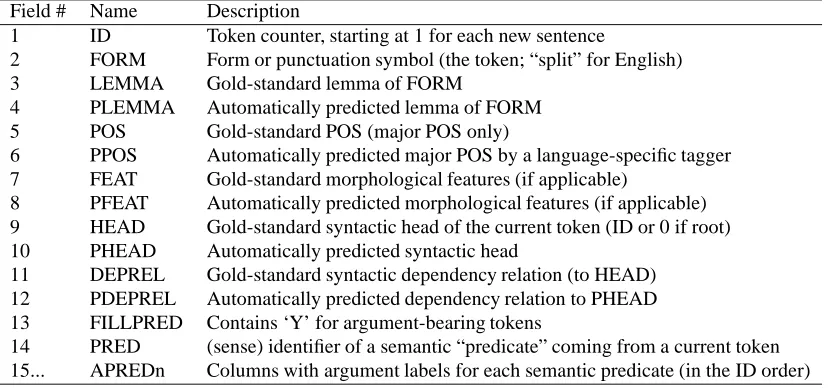
The data is thus a large table with whitespace-separated fields (columns). The fields provided in the data are described in Table 1. They are identical for all languages, but they may differ in contents; for example, some fields might not be filled for all the languages provided (such as the FEAT or PFEAT fields).
For the SRL-only task, participants have been provided will all the data but the PRED and APREDs, which they were supposed to fill in with their correct values. However, they did not have to determine which tokens are predicates (or more precisely, which are the argument-bearing tokens), since they were marked by ‘Y’ in the FILLPRED field.
For the Joint task, participants could not (in ad-dition to the PRED and APREDs) see the gold-standard nor the predicted syntactic dependencies (HEAD, PHEAD) and their labels (DEPREL, PDE-PREL). These syntactic dependencies were also to be filled by participants’ systems.
In both tasks, participants have been free to use any other data (columns) provided, except the LEMMA, POS and FEAT columns (to get more ‘re-alistic’ results using only their automatically pre-dicted variants PLEMMA, PPOS and PFEAT).
Besides the corpus proper, predicate dictionaries have been provided to participants in order to be able to properly match the predicates to the tokens in the
corpus; their contents could have been used e.g. as features for the PRED/APREDs predictions (or even for the syntactic dependencies, i.e., for filling in the PHEAD and PDEPREL fields).
The system of filling-in the APREDs follows the 2008 pattern; for each argument-bearing token (predicate), a new APREDn column is created in the order in which the predicate token is encountered within the sentence (i.e., based on its ID seen as a numerical value). Then, for each token in the sen-tence, the value in the intersection of the APREDn column and the token row is either left unfilled (if the token is not an argument), or a predicate-argument label(s) is(are) filled in.
The differences between the English-only 2008 task and this year’s multilingual task can be briefly summarized as follows:
• only “split”2lemmas and forms have been pro-vided in the English datasets (for the other lan-guages, original tokenization from the respec-tive treebanks has been used);
• rich morphological features have been added wherever available;
• syntactic dependencies by state-of-the-art parsers have been provided (for the SRL-only task);
• multiple semantic labels for a single token have been allowed (and properly evaluated) in the APREDs columns;
• predicates have been pre-identified and marked in both the training and test data;
• some of the fields (e.g. theAPREDx) and val-ues (ARG0→A0etc.) have been renamed.
2.4 Evaluation Measures
It was required that participants submit results in all seven languages in the chosen task and in any of (or both) the challenges. Submission of out-of-domain data files has been optional.
The main evaluation measure, according to which systems are primarily compared, is the Joint task,
2
Field # Name Description
1 ID Token counter, starting at 1 for each new sentence
2 FORM Form or punctuation symbol (the token; “split” for English)
3 LEMMA Gold-standard lemma of FORM
4 PLEMMA Automatically predicted lemma of FORM
5 POS Gold-standard POS (major POS only)
6 PPOS Automatically predicted major POS by a language-specific tagger
7 FEAT Gold-standard morphological features (if applicable)
8 PFEAT Automatically predicted morphological features (if applicable)
9 HEAD Gold-standard syntactic head of the current token (ID or 0 if root)
10 PHEAD Automatically predicted syntactic head
11 DEPREL Gold-standard syntactic dependency relation (to HEAD)
12 PDEPREL Automatically predicted dependency relation to PHEAD
13 FILLPRED Contains ‘Y’ for argument-bearing tokens
14 PRED (sense) identifier of a semantic “predicate” coming from a current token
[image:4.612.101.518.58.252.2]15... APREDn Columns with argument labels for each semantic predicate (in the ID order)
Table 1: Description of the fields (columns) in the data provided. The values of columns 9, 11 and 14 and above are not provided in the evaluation data; for the Joint task, columns 9–12 are also empty in the evaluation data.
closed challenge, Macro F1score. However, scores
can also be computed for a number of other condi-tions:
• Task: Joint or SRL-only • Challenge: open or closed
• Domain: in-domain data (IDD, separated from training corpus) or out-of-domain data (OOD)
Joint task participants are also evaluated separately on the syntactic dependency task (labeled attach-ment score, LAS). Finally, systems competing in both tasks are compared on semantic role labeling alone, to assess the impact of the the joint pars-ing/SRL task compared to an SRL-only task on pre-parsed data.
Finally, as an explanatory measure, precision and recall of the semantic labeling task have been com-puted and tabulated.
We have decided to omit several evaluation fig-ures that were reported in previous years, such as the percentage of completely correct sentences (“Exact Match”), unlabeled scores, etc. With seven lan-guages, two tasks (plus two challenges, and the IDD/OOD distinction), there are enough results to get lost even as it is.
2.4.1 Syntactic Dependency Measures
The LAS score is defined similarly as in the pre-vious shared tasks, as the percentage of tokens for
which a system has predicted the correct HEAD and DEPREL columns. The unlabeled attachment score (UAS), i.e., the percentage of tokens with correct HEAD regardless if the DEPREL is correct, has not been officially computed this year. No precision and recall measures are applicable, since all systems are supposed to output a single dependency with a single label (see also below the footnote to the description of the combined score).
2.4.2 Semantic Labeling Measures
The semantic propositions are evaluated by con-verting them to semantic dependencies, i.e., we cre-ate n semantic dependencies from every predicate to itsnarguments. These dependencies are labeled with the labels of the corresponding arguments. Ad-ditionally, we create a semantic dependency from each predicate to a virtual ROOT node. The latter dependencies are labeled with the predicate senses. This approach guarantees that the semantic depen-dency structure conceptually forms a single-rooted, connected (but not necessarily acyclic) graph. More importantly, this scoring strategy implies that if a system assigns the incorrect predicate sense, it still receives some points for the arguments correctly as-signed. For example, for the correct proposition:
verb.01: A0, A1, AM-TMP
verb.02: A0, A1, AM-LOC
receives a labeled precision score of 2/4 because two out of four semantic dependencies are incorrect: the dependency to ROOT is labeled 02instead of 01
and the dependency to theAM-TMPis incorrectly la-beledAM-LOC. Using this strategy we compute pre-cision, recall, and F1scores for semantic
dependen-cies (labeled only).
For some languages (Czech, Japanese) there may be more than one label in a given argument position; for example, this happens in Czech in special cases of reciprocity when the same token serves as two or more arguments to the same predicate. The scorer takes this into account and considers such cases to be (as if) multiple predicate-argument relations for the computation of the evaluation measures.
For example, for the correct proposition:
v1f1: ACT|EFF, ADDR
the system that generates the following output for the same argument tokens:
v1f1: ACT, ADDR|PAT
receives a labeled precision score of 3/4 because the PAT is incorrect and labeled recall 3/4 be-cause the EFF is missing (should the ACT|EFF and ADDR|PAT be taken as atomic values, the scores would then be zero).
2.4.3 Combined Syntactic and Semantic Score We combine the syntactic and semantic measures into one global measure using macro averaging. We compute macro precision and recall scores by aver-aging the labeled precision and recall for semantic dependencies with the LAS for syntactic dependen-cies:3
LM P =Wsem∗LPsem+ (1−Wsem)∗LAS (1)
LM R=Wsem∗LRsem+ (1−Wsem)∗LAS (2)
where LM P is the labeled macro precision and
LPsemis the labeled precision for semantic
depen-dencies. Similarly, LM R is the labeled macro re-call and LRsem is the labeled recall for semantic
dependencies. Wsem is the weight assigned to the
3We can do this because the LAS for syntactic
dependen-cies is a special case of precision and recall, where the predicted number of dependencies is equal to the number of gold depen-dencies.
semantic task.4 The macro labeled F1score, which
was used for the ranking of the participating sys-tems, is computed as the harmonic mean ofLM P
andLM R.
3 Data
The unification of the data formats for the various languages appeared to be a challenge in itself. We will briefly describe the processes of the conversion of the existing treebanks in the seven languages of the CoNLL-2009 shared task. In many instances, the original treebanks had to be not only converted format-wise, but also merged with other resources in order to generate useful training and testing data that fit the task description.
3.1 The Input Corpora
The data used as the input for the transformations aimed at arriving at the data contents and format de-scribed in Sect. 2.3 are dede-scribed in (Taul´e et al., 2008), (Xue and Palmer, 2009), (Hajiˇc et al., 2006), (Surdeanu et al., 2008), (Burchardt et al., 2006) and (Kawahara et al., 2002).
In the subsequent sections, the procedures for the data conversion for the individual languages are de-scribed. The data has been collected by the main organization site and checked for format errors, and repackaged for distribution.
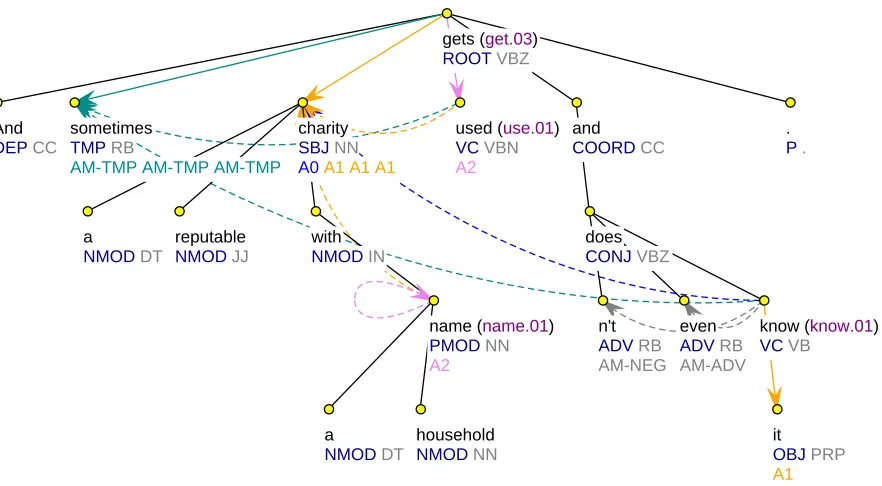
There were three packages of the data distributed to the participants: Trial, Training plus Develop-ment, and Evaluation. The Trial data were rather small, just to give the feeling of the format and languages involved. A visual representation of the Trial data was also created to make understanding of the data easier. Any data in the same format can be transformed and displayed in the Tree Editor TrEd5(Pajas and ˇStˇep´anek, 2008) with the CoNLL 2009 Shared Task extension that can be installed from within the editor. A sample visualization of an English sentence after its conversion to the shared task format (Sect. 2.3) is in Fig. 1.
Due to licensing requirements, every package of the data had to be split into two portions. One portion (Catalan, German, Japanese, and Spanish data) was published on the task’s webpage for
down-4
$QG '(3&&
VRPHWLPHV 7035%
D
102''7
UHSXWDEOH 102'
--FKDULW\ 6%-11
ZLWK 102',1
D
102''7
KRXVHKROG 102'11
QDPH QDPH
302'11 JHWV JHW
52279%=
XVHG XVH
9&9%1
DQG &225'&&
GRHV &21-9%=
QW $'95%
HYHQ $'95%
NQRZ NQRZ
9&9%
LW 2%-353
3
$0703$0703$0703
$$$$
$
$
$01(*
$0$'9
$
[image:6.612.92.533.61.304.2]
Figure 1: Visualisation of the English sentence “And sometimes a reputable charity with a houshold name gets used and doesn’t even know it.” (Penn Treebank, wsj 0559) showing jointly the labeled syntactic and semantic
depen-dencies. The basic tree shape comes from the syntactic dependencies; syntactic labels and POS tags are on the 2nd
line at each node. Semantic dependencies which do not follow the syntactic ones use dotted lines. Predicate senses
in parentheses (use:01, ...) follow the word label. SRLs (A0,AM-TMP, ...) are on the last line. Please note that
multiple semantic dependencies (e.g., there are four for charity: A0←know, A1←gets, A1←used, A1←name)
and self-dependencies (name) appear in this sentence.
load, the other portion (Czech, English, and Chinese data) was invoiced and distributed by the Linguistic Data Consortium under a special agreement free of charge.
Distribution of the Evaluation package was a bit more complicated, because there were two types of the packages - one for the Joint task and one for the SRL-only task. Every participant had to subscribe to one of the two tasks; subsequently, they obtained the appropriate data (again, from the webpage and LDC).
Prior to release, each data file was checked to eliminate errors. The following test were carried out:
• For every sentence, number of PREDs rows matches the number of APREDs columns.
• The first line of each file is never empty, while the last line always is.
• The first character on a non-empty line is al-ways a digit, the last one is never a whitespace.
• The number of empty lines (i.e. the number of sentences) equals the number of lines begin-ning with “1”.
• The data contain no spaces nor double tabs.
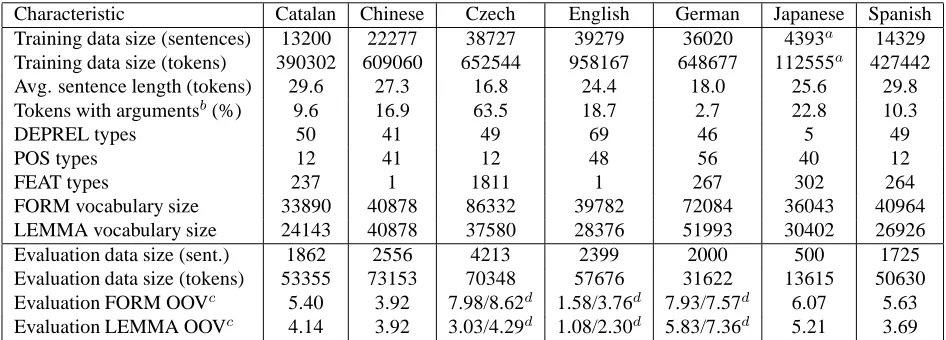
Some statistics on the data can be seen in Ta-bles 2, 3 and 4. Whereas the training sizes of the data have not been that different as they were e.g. for the 2007 shared task on multilingual dependency parsing (Nivre et al., 2007)6, substantial differences existed in the distribution of the predicates and ar-guments, the input features, the out-of-vocabulary rates, and other statistical characteristics of the data. Data sizes have been relatively uniform in all the datasets, with Japanese having the smallest dataset
6
containing data for SRL annotation training. To compensate at least for the dependency parsing part, an additional, large Japanese corpus with syntactic dependency annotation has been provided.
The average sentence length, the vocabulary sizes for FORM and LEMMA fields and the OOV rates characterize quite naturally the properties of the re-spective languages (in the domain of the training and evaluation data). It is no surprise that the FORM OOV rate is the highest for Czech, a highly inflec-tional language, and that the LEMMA OOV rate is the highest for German (as a consequence of keeping compounds as a single lemma). The other statistics also reflect (to a large extent) the annotation speci-fication and conventions used for the original tree-banks and/or the result of the conversion process to the unified CoNLL-2009 Shared Task format.
Starting with the POS and FEAT fields, it can be seen that Catalan, Czech and Spanish use only the 12 major part-of-speech categories as values of the POS field (with richly populated FEAT field); En-glish and Chinese are the opposite extreme, disre-garding the use of the FEAT field completely and coding everything as a POS value. While for Chi-nese this is quite understandable, English follows the PTB tradition in this respect. German and Japanese use relatively rich set of values in both the POS and FEAT fields.
For the dependency relations (DEPREL), all the languages use a similarly-sized set except for Japanese, which only encodes the distinction be-tween a root and a dependent node (and some in-frequent special ones).
Evaluation data are over 10% of the size of the training data for Catalan, Chinese, Czech, Japanese and Spanish and roughly 5% for English and Ger-man.
Table 3 shows the distribution of the five most fre-quent dependency relations (determined as part of the subtask of syntactic parsing). With the exception of Japanese, which essentially does not label depen-dency relations at this level, all the other languages show little difference in this distribution. For exam-ple, the unconditioned probability of “subjects” is almost the same for all the six other languages (be-tween 6 and 8 percent). The probability mass cov-ered by the first five most frequent DEPRELs is also almost the same (again, except for Japanese),
sug-gesting that the labeling task might have similar dif-ficulty7. The most skewed one is for Czech (after Japanese).
Table 4 shows similar statistics for the argument labels (PRED/APREDs); it also adds the average number of arguments per “predicate” token, since this is part of the SRL task8. It is apparent from the comparison of the “Total” rows in this table and Ta-ble 3 that the first five argument labels cover more that their syntactic counterparts. For example, the arguments A0-A4 account for all but 3% of all ar-guments labels, whereas Spanish and Catalan have much more rich set of argument labels, with a high entropy of the most-frequent-label distribution.
3.2 Catalan and Spanish
The Catalan and Spanish datasets (Taul´e et al., 2008) were generated from the AnCora corpora9 through an automatic conversion process from a constituent-based formalism to dependencies (Civit et al., 2006). AnCora corpora contain about half million words for Catalan and Spanish annotated with syntactic and semantic information. Text sources for the Cata-lan corpus are EFE news agency (∼75Kw), ACN Catalan news agency (∼225Kw), and ‘El Peri´odico’ newspaper (∼200Kw). The Spanish corpus comes from the Lexesp Spanish balanced corpus (∼75Kw), the EFE Spanish news agency (∼225Kw), and the Spanish version of ‘El Peri´odico’ (∼200Kw). The subset from ‘El Peri´odico’ corresponds to the same news in Catalan and Spanish, spanning from January to December 2000.
Linguistic annotation is the same in both lan-guages and includes: PoS tags with morphologi-cal features (gender, number, person, etc.), lemma-tization, syntactic dependencies (syntactic func-tions), semantic dependencies (arguments and the-matic roles), named entities and predicate semantic classes (Lexical Semantic Structure, LSS). Tag sets are shared by the two languages.
If we take into account the complete PoS tags,
7Yes, this is overgeneralization since this distribution does
not condition on the features, dependencies etc. But as a rough measure, it often correlates well with the results.
8
A number below 1 means there are some argument-bearing words (often nouns) which have no arguments in the particular sentence in which they appear.
Characteristic Catalan Chinese Czech English German Japanese Spanish
Training data size (sentences) 13200 22277 38727 39279 36020 4393a 14329
Training data size (tokens) 390302 609060 652544 958167 648677 112555a 427442
Avg. sentence length (tokens) 29.6 27.3 16.8 24.4 18.0 25.6 29.8
Tokens with argumentsb(%) 9.6 16.9 63.5 18.7 2.7 22.8 10.3
DEPREL types 50 41 49 69 46 5 49
POS types 12 41 12 48 56 40 12
FEAT types 237 1 1811 1 267 302 264
FORM vocabulary size 33890 40878 86332 39782 72084 36043 40964
LEMMA vocabulary size 24143 40878 37580 28376 51993 30402 26926
Evaluation data size (sent.) 1862 2556 4213 2399 2000 500 1725
Evaluation data size (tokens) 53355 73153 70348 57676 31622 13615 50630
Evaluation FORM OOVc 5.40 3.92 7.98/8.62d 1.58/3.76d 7.93/7.57d 6.07 5.63
Evaluation LEMMA OOVc 4.14 3.92 3.03/4.29d 1.08/2.30d 5.83/7.36d 5.21 3.69
Table 2: Elementary data statistics for the CoNLL-2009 Shared Task languages. The data themselves, the original treebanks they were derived from and the conversion process are described in more detail in sections 3.2-3.7. All evaluation data statistics are derived from the in-domain evaluation data.
aThere were additional 33257 sentences (839947 tokens) available for syntactic dependency parsing of Japanese; the type and
vocabulary statistics are computed using this larger dataset.
bPercentage of tokens with FILLPRED=‘Y’.
cPercentage of FORM/LEMMA tokens not found in the respective vocabularies derived solely from the training data. dOOV percentage for in-domain/out-of-domain data.
DEPREL Catalan Chinese Czech English German Japanese Spanish
sn 0.16 COMP 0.21 Atr 0.26 NMOD 0.27 NK 0.31 D 0.93 sn 0.16
spec 0.15 NMOD 0.14 AuxP 0.10 P 0.11 PUNC 0.14 ROOT 0.04 spec 0.15
Labels f 0.11 ADV 0.10 Adv 0.10 PMOD 0.10 MO 0.12 P 0.03 f 0.12
sp 0.09 UNK 0.09 Obj 0.07 SBJ 0.07 SB 0.07 A 0.00 sp 0.08
suj 0.07 SBJ 0.08 Sb 0.06 OBJ 0.06 ROOT 0.06 I 0.00 suj 0.08
Total 0.58 0.62 0.59 0.61 0.70 1.00 0.59
Table 3: Unigram probability for the five most frequent DEPREL labels in the training data of the CoNLL-2009 Shared Task is shown. Total is the probability mass covered by the five dependency labels shown.
APRED Catalan Chinese Czech English German Japanese Spanish
arg1-pat 0.22 A1 0.30 RSTR 0.30 A1 0.37 A0 0.40 GA 0.33 arg1-pat 0.20
arg0-agt 0.18 A0 0.27 PAT 0.18 A0 0.25 A1 0.39 WO 0.15 arg0-agt 0.19
Labels arg1-tem 0.15 ADV 0.20 ACT 0.17 A2 0.12 A2 0.12 NO 0.15 arg1-tem 0.15
argM-tmp 0.08 TMP 0.07 APP 0.06 AM-TMP 0.06 A3 0.06 NI 0.09 arg2-atr 0.08
arg2-atr 0.08 DIS 0.04 LOC 0.04 AM-MNR 0.03 A4 0.01 DE 0.06 argM-tmp 0.08
Total 0.71 0.91 0.75 0.83 0.97 0.78 0.70
[image:8.612.71.544.58.228.2]Avg. 2.25 2.26 0.88 2.20 1.97 1.71 2.26
AnCora has 280 different labels. Considering only the main syntactic categories, the tag set is reduced to 47 tags. The syntactic tag set consists of 50 dif-ferent syntactic functions. Regarding semantic ar-guments, we distinguish Arg0, Arg1, Arg2, Arg3, Arg4, ArgM, and ArgL. The first five tags are num-bered from less to more obliqueness with respect to the verb, ArgM corresponds to adjuncts. The list of thematic roles consists of 20 different labels: AGT (Agent), AGI (Induced Agent), CAU (Cause), EXP (Experiencer), SCR (Source), PAT (Patient), TEM (Theme), ATR (Attribute), BEN (Beneficiary), EXT (Extension), INS (Instrument), LOC (Loca-tive), TMP (Time), MNR (Manner), ORI (Origin), DES (Goal), FIN (Purpose), EIN (Initial State), EFI (Final State), and ADV (Adverbial). Each argument position can map onto specific thematic roles. By way of example, Arg1 can be PAT, TEM or EXT. For Named Entities, we distinguish six types: Organiza-tion, Person, LocaOrganiza-tion, Date, Number, and Others.
An incremental process guided the annotation of AnCora, since semantics depends on morphosyntax, and syntax relies on morphology. This procedure made it possible to check, correct, and complete the previous annotations, thus guaranteeing the final quality of the corpora and minimizing the error rate. The annotation process was carried out sequentially from lower to upper layers of linguistic description. All resulting layers are independent of each other, thus making easier the data management. The ini-tial annotation was performed manually for syntax, semiautomatically in the case of arguments and the-matic roles, and fully autothe-matically for PoS (Mart´ı et al., 2007; M`arquez et al., 2007).
The Catalan and Spanish AnCora corpora were straightforwardly translated into the CoNLL-2009 shared task formatting (information about named entities was skipped in this process). The resulting Catalan corpus (including training, development and test partitions) contains 16,786 sentences with an av-erage length of 29.59 lexical tokens per sentence. Long sentences abound in this corpus. For instance, 10.73% of the sentences are longer than 50 tokens, and 4.42% are longer than 60. The corpus con-tains 47,537 annotated predicates (2.83 predicates per sentence, on average) with 107,171 arguments (2.25 arguments per predicate, on average). From the latter, 73.89% correspond to core arguments and
26.11% to adjuncts. Numbers for the Spanish cor-pus are comparable in all aspects: 17,709 sentences with 29.84 lexical tokens on average (11.58% of the sentences longer than 50 tokens, 4.07% longer than 60); 54,075 predicates (3.05 per sentence, on aver-age) and 122,478 arguments (2.26 per predicate, on average); 73.34% core arguments and 26.66% ad-juncts.
The following are important features of the Cata-lan and Spanish corpora in the CoNLL-2009 shared task setting: (1) all dependency trees are projective; (2) no word can be the argument of more than one predicate in a sentence; (3) semantic dependencies completely match syntactic dependency structures (i.e., no new edges are introduced by the semantic structure); (4) only verbal predicates are annotated (with exceptional cases referring to words that can be adjectives and past participles); (5) the corpus is segmented so multi-words, named entities, temporal expressions, compounds, etc. are grouped together; and (6) segmentation also accounts for elliptical pro-nouns (there are marked as empty lexical tokens ‘_’ with a pronoun POS tag).
Finally, the predicted columns (PLEMMA, PPOS, and PFEAT) have been generated with the FreeLing Open source suite of Language Analyz-ers10. Accuracy in PLEMMA and PPOS columns is above 95% for the two languages. PHEAD and PDEPREL columns have been generated using MaltParser11. Parsing accuracy (LAS) is above 86% for the the two languages.
3.3 Chinese
The Chinese Corpus for the 2009 CoNLL Shared Task was generated by merging the Chinese Tree-bank (Xue et al., 2005) and the Chinese Proposition Bank (Xue and Palmer, 2009) and then converting the constituent structure to a dependency formalism as specified in the CoNLL Shared Task. The Chi-nese data used in the shared task is based on ChiChi-nese Treebank 6.0 and the Chinese Proposition Bank 2.0, both of which are publicly available via the Linguis-tic Data Consortium.
The Chinese Treebank Project originated at Penn and was later moved to University of Colorado at
10
Boulder. Now it is the process of being to moved to Brandeis University. The data sources of the Chi-nese Treebank range from Xinhua newswire (main-land China), Hong Kong news, and Sinorama Maga-zine (Taiwan). More recently under DARPA GALE funding it has been expanded to include broadcast news, broadcast conversation, news groups and web log data. It currently has over one million words and is fully segmented, POS-tagged and annotated with phrase structure. The version of the Chinese Treebank used in this shared task, CTB 6.0, includes newswire, magazine articles, and transcribed broad-cast news 12. The training set has 609,060 tokens, the development set has 49,620 tokens, and the test set has 73,153 tokens.
The Chinese Proposition Bank adds a layer of se-mantic annotation to the syntactic parses in the Chi-nese Treebank. This layer of semantic annotation mainly deals with the predicate-argument structure of Chinese verbs and their nominalizations. Each major sense (called frameset) of a predicate takes a number of core arguments annotated with numeri-cal labels Arg0 through Arg5 which are defined in a predicate-specific manner. The Chinese Proposi-tion Bank also annotates adjunctive arguments such as locative, temporal and manner modifiers of the predicate. The version of the Chinese Propbank used in this CoNLL Shared Task is CPB 2.0, but nominal predicates are excluded because the annotation is in-complete.
Since the Chinese Treebank is annotated with constituent structures, the conversion and merging procedure converts the constituent structures to de-pendencies by identifying the head for each con-stituent in a parse tree and making its sisters its de-pendents. The Chinese Propbank pointers are then shifted from the entire constituent to the head of that constituent. The conversion procedure identifies the head by first exploiting the structural information in the syntactic parse and detecting six broad cate-gories of syntactic relations that hold between the head and its dependents (predication, modification,
complementation, coordination, auxiliary, and flat)
and then designating the head based on these rela-tions. In particular, the first conjunct of a
coordina-12
A small number of files were taken out of the CoNLL shared task data due to conversion problems and time con-straints to fix them.
tion structure is designated as the head and the heads of the other conjuncts are the conjunctions preced-ing them. The conjunctions all “modify” the first conjunct.
3.4 Czech
For the training, development and evaluation data, Prague Dependency Treebank 2.0 was used (Hajiˇc et al., 2006). For the out-of-domain evaluation data, part of the Czech side of the Prague Czech-English Dependency Treebank (version 2, under construc-tion) was used13, see also ( ˇCmejrek et al., 2004). For
the OOD data, no manual annotation of LEMMA, POS, and FEAT existed, so the predicted values were used. The same conversion procedure has been applied to both sources.
The FORM column was created from the form
element of the morphological layer, not from the “token” from the word-form layer. Therefore, most typos, errors in word segmentation and tokenization are corrected and numerals are normalized.
The LEMMA column was created from the
lemma element of the morphological layer. Only the initial string of the element was used, so there is no distinction between homonyms. However, some components of the detailed lemma explanation were incorporated into the FEAT column (see below).
The POS column was created form the morpho-logical tag element, its first character more pre-cisely.
The FEAT column was created from the remain-ing characters of thetagelement. In addition, the special feature “Sem” corresponds to a semantic fea-ture of the lemma.
For the HEAD and DEPREL columns, the PDT analytical layer was used. The DEPREL was taken from the analytic function (the afun node at-tribtue). There are 27 possible values forafun el-ement: Pred,Pnom,AuxV,Sb,Obj,Atr, Adv,
Atv, AtvV, Coord, Apos, ExD, and a number of auxiliary and “double-function” labels. The first nine of these are the “most interesting” from the point of view of the shared task, since they relate to semantics more closely than the rest (at least from the linguistic point of view). The HEAD is a pointer to its parent, which means the PDT’sordattribute
(within-sentence ID / word position number) of the parent. If a node is a member of a coordination or apposition (is_memberelement), its DEPREL obtains the _M suffix. The parenthesis annotation (is_parenthesis_rootelement) was ignored. The PRED and APREDs columns were created from the tectogrammatical layer of PDT 2.0 and the valency lexicon PDT-Vallex according to the follow-ing rules:
• Every line corresponding to an analytical node referenced by a lexical reference (a/lex.rf) from the tectogrammatical layer has a PRED value filled. If the referring non-generated tectogrammatical node (is_generatednot equal to 1) has a valency frame assigned (val_frame.rf), the value of PRED is the identifier of the frame. Otherwise, it is set to the same value as the LEMMA column.
• For every tectogrammatical node, a corre-sponding analytical node is searched for:
1. If the tectogrammatical node is not generated and has a lexical reference (a/lex.rf), the referenced node is taken.
2. Otherwise, if the tectogrammatical node has a coreference (coref_text.rfor
coref_gram.rf) or complement refer-ence (compl.rf) to a node that has an analytical node assigned (by 1. or 2.), the assigned node is taken.
APRED columns are filled with respect to the following correspondence: for a tectogrammatical node P and its effective child C with functor F, the column for P’s corresponding analytical node at the row for C’s corresponding analytical node is filled with F. Some nodes can thus have several functors in one APRED column, separated by a vertical bar (see Sect. 2.4.2).
PLEMMA, PPOS and PFEAT were gener-ated by the (cross-trained) morphological tagger MORCE (Spoustov´a et al., 2009), which gives full
combined accuracy (PLEMMA+PPOS+PFEAT)
slightly under 96%.
PHEAD and PDEPREL were generated by the (cross-trained) MST parser for Czech (Chu– Liu/Edmonds algorithm, (McDonald et al., 2005)),
which has typical dependency accuracy around 85%.
The valency lexicon, converted from (Hajiˇc et al., 2003), has four columns:
1. lemma (can occur several times in the lexicon, with different frames)
2. frame identifier (as found in the PRED column)
3. list of space-separated actants and obligatory members of the frame
4. example(s)
The source of the out-of-domain data uses an extended valency lexicon (because of out-of-vocabulary entries). For simplicity, the extended lexicon was not provided; instead, such words were not marked as predicates in the OOD data (their FILLPRED was set to ‘_’) and thus not evaluated.
3.5 English
The English corpus is almost identical to the cor-pus used in the closed challenge in the CoNLL-2008 shared task evaluation (Surdeanu et al., 2008). This corpus was generated through a process that merges several input corpora and converts them from the constituent-based formalism to dependencies. The following corpora were used as input to the merging procedure:
• Penn Treebank 3 – The Penn Treebank 3 cor-pus (Marcus et al., 1994) consists of hand-coded parses of the Wall Street Journal (test, development and training) and a small subset of the Brown corpus (W. N. Francis and H. Kucera, 1964) (test only).
dependencies between NE tokens, e.g., we cre-ate a NAME dependency from Mary to Smith given the NE mention Mary Smith.
• Proposition Bank I (PropBank) – The Prop-Bank annotation (Palmer et al., 2005) classifies the arguments of all the main verbs in the Penn Treebank corpus, other than be. Arguments are numbered (Arg0, Arg1, . . .) based on lexical entries or frame files. Different sets of argu-ments are assumed for different rolesets. De-pendent constituents that fall into categories in-dependent of the lexical entries are classified as various types of adjuncts (ArgM-TMP, -ADV, etc.).
• NomBank – NomBank annotation (Meyers et al., 2004) uses essentially the same framework as PropBank to annotate arguments of nouns. Differences between PropBank and NomBank stem from differences between noun and verb argument structure; differences in treatment of nouns and verbs in the Penn Treebank; and dif-ferences in the sophistication of previous re-search about noun and verb argument structure. Only the subset of nouns that take arguments are annotated in NomBank and only a subset of the non-argument siblings of nouns are marked as ArgM.
The complete merging process and the conversion from the constituent representation to dependencies is detailed in (Surdeanu et al., 2008).
The main difference between the 2008 and 2009 version of the corpora is the generation of word lem-mas. In the 2008 version the only lemmas pro-vided were predicted using the built-in lemmatizer in WordNet (Fellbaum, 1998) based on the most fre-quent sense for the form and the predicted part-of-speech tag. These lemmas are listed in the 2009 corpus under the PLEMMA column. The LEMMA column in the 2009 version of the corpus contains lemmas generated using the same algorithm but us-ing the correct Treebank part-of-speech tags. Addi-tionally, the PHEAD and PDEPREL columns were generated using MaltParser14, similarly to the open challenge corpus in the CoNLL 2008 shared task.
14
http://w3.msi.vxu.se/∼nivre/research/ MaltParser.html
3.6 German
The German in-domain dataset is based on the an-notated verb instances of the SALSA corpus (Bur-chardt et al., 2006), a total of around 40k sen-tences15. SALSA provides manual semantic role annotation on top of the syntactically annotated TIGER newspaper corpus, one of the standard Ger-man treebanks. The original SALSA corpus uses se-mantic roles in the FrameNet paradigm. We con-structed mappings between FrameNet frame ele-ments and PropBank argument positions at the level of frame-predicate pairs semi-automatically. For the frame elements of each frame-predicate pair, we first identified the semantically defined PropBank Arg-0 and Arg-1 positions. To do so, we annotated a small number of very abstract frame elements with these labels (Agent, Actor, Communicator as Arg-0, and Theme, Effect, Message as Arg-1) and per-colated these labels through the FrameNet hierar-chy, adding further manual labels where necessary. Then, we used frequency and grammatical realiza-tion informarealiza-tion to map the remaining roles onto higher-numbered Arg roles. We considerably sim-plified the annotations provided by SALSA, which use a rather complex annotation scheme. In partic-ular, we removed annotation for multi-word expres-sions (which may be non-contiguous), annotations involving multiple frames for the same predicate (metaphors, underspecification), and inter-sentence roles.
The out-of-domain dataset was taken from a study on the multi-lingual projection of FrameNet annota-tion (Pado and Lapata, 2005). It is sampled from the EUROPARL corpus and was chosen to maxi-mize the lexical coverage, i.e., it contains of a large number of infrequent predicates. Both syntactic and semantic structure were annotated manually, in the TIGER and SALSA format, respectively. Since it uses a simplified annotation schemes, we did not have to discard any annotation.
For both datasets, we converted the syntactic TIGER (Brants et al., 2002) representations into de-pendencies with a similar set of head-finding rules used for the preparation of the CoNLL-X shared task German dataset. Minor modifications (for the
con-15
version of person names and coordinations) were made to achieve better consistency with datasets of other languages. Since the TIGER annotation allows non-contiguous constituents, the resulting dependencies can be non-projective. Secondary edges were discarded in the conversion. As for the automatically constructed features, we used Tree-Tagger (Schmid, 1994) to produce the PLEMMA and PPOS columns, and the Morphisto morphol-ogy (Zielinski and Simon, 2008) for PFEAT.
3.7 Japanese
For Japanese, we used the Kyoto University Text Corpus (Kawahara et al., 2002), which consists of approximately 40k sentences taken from Mainichi Newspapers. Out of them, approximately 5k sen-tences are annotated with syntactic and semantic de-pendencies, and are used the training, development and test data of this year’s shared task. The remain-ing sentences, which are annotated with only syntac-tic dependencies, are provided for the training cor-pus of syntactic dependency parsers.
This corpus adopts a dependency structure repre-sentation, and thus the conversion to the CoNLL-2009 format was relatively straightforward. How-ever, since the original dependencies are annotated on the basis of phrases (Japanese bunsetsu), we needed to automatically convert the original annota-tions to word-based ones using several criteria. We used the following basic criteria: the words except the last word in a phrase depend on the next (right) word, and the last word in a phrase basically depends on the head word of the governing phrase.
Semantic dependencies are annotated for both verbal predicates and nominal predicates. The se-mantic roles (APRED columns) consist of 41 sur-face cases, many of which are case-marking post-positions such as ga (nominative), wo (accusative) and ni (dative). Semantic frame discrimination is not annotated, and so the PRED column is the same as the LEMMA column. The original corpus contains coreference annotations and inter-sentential seman-tic dependencies, such as inter-sentential zero pro-nouns and bridging references, but we did not use these annotations, which are not the target of this year’s shared task.
To produce the PLEMMA, PPOS and PFEAT columns, we used the morphological analyzer
JU-MAN16and the dependency and case structure an-alyzer KNP17. To produce the PHEAD and PDE-PREL columns, we used the MSTParser18.
4 Submissions and Results
Participants uploaded the results through the shared task website, and the official evaluation was per-formed centrally. Feedback was provided if any for-mal problems were encountered (for a list of checks, see the previous section). One submission had to be rejected because only English results were pro-vided. After the evaluation period had passed, the results were anonymized and published on the web.
A total of 20 systems participated in the closed challenge; 13 of them in the Joint task and seven in the SRL-only task. Two systems participated in the open challenge (Joint task). Moreover, 17 systems provided output in the out-of-domain part of the task (11 in the OOD Joint task and six in the OOD SRL-only task).
The main results for the core task - the Joint task (dependency syntax and semantic relations) in the context of the closed challenge - are summarized and ranked in Table 5.
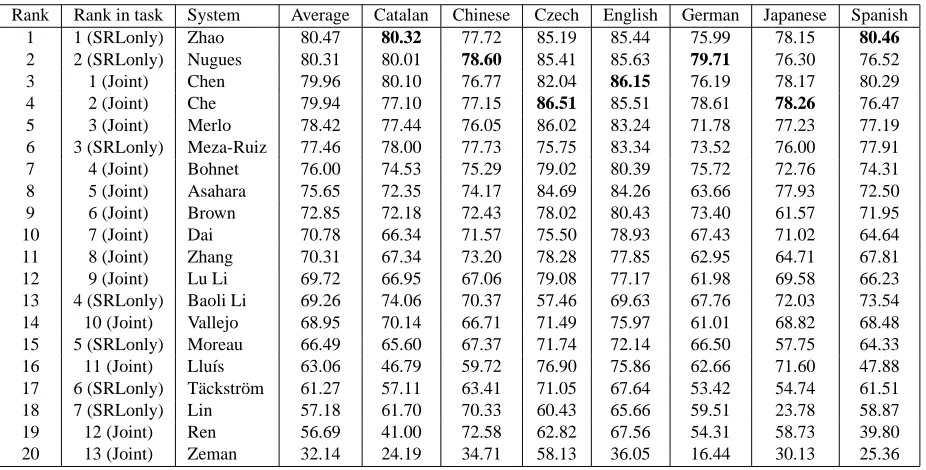
The largest number of systems can be compared in the SRL results table (Table 6), where all the sys-tems have been evaluated solely on the SRL perfor-mance regardless whether they participated in the Joint or SRL-only task. However, since the results might have been influenced by the supplied parser, separate ranking is provided for both types of the systems.
Additional breakdown of the results (open chal-lenge, precision and recall tables for the semantic labeling task, etc.) are available from the CoNLL-2009 Shared Task website19.
5 Approaches
Table 7 summarizes the properties of the systems that participated in the closed the open challenges.
16
http://nlp.kuee.kyoto-u.ac.jp/ nl-resource/juman-e.html
17
http://nlp.kuee.kyoto-u.ac.jp/ nl-resource/knp-e.html
18http://sourceforge.net/projects/
mstparser
Rank System Average Catalan Chinese Czech English German Japanese Spanish 1 Che 82.64 81.84 76.38 83.27 87.00 82.44 85.65 81.90 2 Chen 82.52 83.01 76.23 80.87 87.69 81.22 85.28 83.31 3 Merlo 82.14 82.66 76.15 83.21 86.03 79.59 84.91 82.43 4 Bohnet 80.85 80.44 75.91 79.57 85.14 81.60 82.51 80.75 5 Asahara 78.43 75.91 73.43 81.43 86.40 69.84 84.86 77.12 6 Brown 77.27 77.40 72.12 75.66 83.98 77.86 76.65 77.21 7 Zhang 76.49 75.00 73.42 76.93 82.88 73.76 78.17 75.25 8 Dai 73.98 72.09 72.72 67.14 81.89 75.00 80.89 68.14 9 Lu Li 73.97 71.32 65.53 75.85 81.92 70.93 80.49 71.72 10 Llu´ıs 71.49 56.64 66.18 75.95 81.69 72.31 81.76 65.91 11 Vallejo 70.81 73.75 67.16 60.50 78.19 67.51 77.75 70.78 12 Ren 67.81 59.42 75.90 60.18 77.83 65.77 77.63 57.96 13 Zeman 51.07 49.61 43.50 57.95 50.27 49.57 57.69 48.90
Table 5: Official results of the Joint task, closed challenge. Teams are denoted by the last name (first name added only where needed) of the author who registered for the evaluation data. Results are sorted in descending order of the
language-averaged macro F1score on the closed challenge Joint task. Bold numbers denote the best result for a given
language.
Rank Rank in task System Average Catalan Chinese Czech English German Japanese Spanish 1 1 (SRLonly) Zhao 80.47 80.32 77.72 85.19 85.44 75.99 78.15 80.46 2 2 (SRLonly) Nugues 80.31 80.01 78.60 85.41 85.63 79.71 76.30 76.52 3 1 (Joint) Chen 79.96 80.10 76.77 82.04 86.15 76.19 78.17 80.29 4 2 (Joint) Che 79.94 77.10 77.15 86.51 85.51 78.61 78.26 76.47 5 3 (Joint) Merlo 78.42 77.44 76.05 86.02 83.24 71.78 77.23 77.19 6 3 (SRLonly) Meza-Ruiz 77.46 78.00 77.73 75.75 83.34 73.52 76.00 77.91 7 4 (Joint) Bohnet 76.00 74.53 75.29 79.02 80.39 75.72 72.76 74.31 8 5 (Joint) Asahara 75.65 72.35 74.17 84.69 84.26 63.66 77.93 72.50 9 6 (Joint) Brown 72.85 72.18 72.43 78.02 80.43 73.40 61.57 71.95 10 7 (Joint) Dai 70.78 66.34 71.57 75.50 78.93 67.43 71.02 64.64 11 8 (Joint) Zhang 70.31 67.34 73.20 78.28 77.85 62.95 64.71 67.81 12 9 (Joint) Lu Li 69.72 66.95 67.06 79.08 77.17 61.98 69.58 66.23 13 4 (SRLonly) Baoli Li 69.26 74.06 70.37 57.46 69.63 67.76 72.03 73.54 14 10 (Joint) Vallejo 68.95 70.14 66.71 71.49 75.97 61.01 68.82 68.48 15 5 (SRLonly) Moreau 66.49 65.60 67.37 71.74 72.14 66.50 57.75 64.33 16 11 (Joint) Llu´ıs 63.06 46.79 59.72 76.90 75.86 62.66 71.60 47.88 17 6 (SRLonly) T¨ackstr¨om 61.27 57.11 63.41 71.05 67.64 53.42 54.74 61.51 18 7 (SRLonly) Lin 57.18 61.70 70.33 60.43 65.66 59.51 23.78 58.87 19 12 (Joint) Ren 56.69 41.00 72.58 62.82 67.56 54.31 58.73 39.80 20 13 (Joint) Zeman 32.14 24.19 34.71 58.13 36.05 16.44 30.13 25.36
Table 6: Official results of the semantic labeling, closed challenge, all systems. Teams are denoted by the last name (first name added only where needed) of the author who registered for the evaluation data. Results are sorted in
descending order of the semantic labeled F1score (closed challenge). Bold numbers denote the best result for a given
language. Separate ranking is provided for SRL-only systems.
The second column of the table highlights the over-all architectures. We used + to indicate that the components are sequentially connected. The lack of a +sign indicates that the corresponding tasks are performed jointly.
It is perhaps not surprising that most of the obser-vations from the 2008 shared task still hold; namely, the best systems overall do not use joint learning or
optimization (the best such system was placed third in the Joint task, and there were only four systems where the learning methodology can be considered “joint”).
[image:14.612.110.502.55.213.2] [image:14.612.75.538.283.518.2]when comparing Table 7 with the Tables 5 and 6).
6 Conclusion
This year’s task has been demanding in several re-spects, but certainly the most difficulty came from the fact that participants had to tackle all seven lan-guages. It is encouraging that despite this added af-fort the number of participating systems has been almost the same as last year (20 vs. 22 in 2008).
There are several positive outcomes from this year’s enterprise:
• we have prepared a unified format and data for several very different lanaguages, as a basis for possible extensions towards other languages and unified treatment of syntactic depenndecies and semantic role labeling across natural lan-guages;
• 20 participants have produced SRL results for all seven languages, using several different methods, giving hope for a combined system with even substantially better performance;
• initial results have been provided for three lan-guages on out-of-domain data (being in fact quite close to the in-domain results).
Only four systems tried to apply what can be de-scribed as joint learning for the syntactic and seman-tic parts of the task. (Morante et al., 2009) use a true joint learning formulation that phrases syntactico-semantic parsing as a series of classification where the class labels are concatenations of syntactic and semantic edge labels. They predict (a), the set of syntactico-semantic edge labels for each pair of to-kens; (b), the set of incoming syntactico-semantic edge labels for each individual token; and (c), the existence of an edge between each pair of tokens. Subsequently, they combine the (possibly conflict-ing) output of the three classifiers by a ranking ap-proach to determine the most likely structure that meets all well-formedness constraints. (Llu´ıs et al., 2009) present a joint approach based on an exten-sion of Eisner’s parser to accommodate also seman-tic dependency labels. This architecture is similar to the one presented by the same authors in the past edition, with the extension to a second-order syn-tactic parsing and a particular setting for Catalan
and Spanish. (Gesmundo et al., 2009) use an in-cremental parsing model with synchronous syntac-tic and semansyntac-tic derivations and a joint probability model for syntactic and semantic dependency struc-tures. The system uses a single input queue but two separate stacks and synchronizes syntactic and se-mantic derivations at every word. The synchronous derivations are modeled with an Incremental Sig-moid Belief Network that has latent variables for both syntactic and semantic states and connections from syntax to semantics and vice versa. (Dai et al., 2009) designed an iterative system to exploit the inter-connections between the different subtasks of the CoNLL shared task. The idea is to decom-pose the joint learning problem into four subtasks – syntactic dependency identification, syntactic de-pendency labeling, semantic dede-pendency identifica-tion and semantic dependency labeling. The initial step is to use a pipeline approach to use the input of one subtask as input to the next, in the order speci-fied. The iterative steps then use additional features that are not available in the initial step to improve the accuracy of the overall system. For example, in the iterative steps, semantic information becomes avail-able as features to syntactic parsing, so on and so forth.
Despite these results, it is still not clear whether joint learning has a significant advantage over other approaches (and if yes, then for what languages). It is thus necessary to carefully plan the next shared tasks; it might be advantageous to bring up a sim-ilar task in the future once again, and/or couple it with selected application(s). There, (we hope) the benefits of the dependency representation combined with semantic roles the way we have formulated it in 2008 and 2009 will really show up.
Acknowledgments
Tasks.
We would also like to thank organizers of the pre-vious four shared tasks: Sabine Buchholz, Xavier Carreras, Ryan McDonald, Amit Dubey, Johan Hall, Yuval Krymolowski, Sandra K ¨ubler, Erwin Marsi, Jens Nilsson, Sebastian Riedel and Deniz Yuret. This shared task would not have been possible with-out their previous effort.
We also acknowledge the support of the M ˇSMT of the Czech Republic, projects MSM0021620838 and LC536; the Grant Agency of the Academy of sciences of the Czech Republic 1ET201120505 (for Jan Hajiˇc, Jan ˇStˇep´anek and Pavel Straˇn´ak).
Llu´ıs M`arquez and M. Ant`onia Mart´ı partici-pation was supported by the Spanish Ministry of Education and Science, through the OpenMT and TextMess research projects (TIN2006-15307-C03-02, TIN2006-15265-C06-06).
The following individuals directly contributed to the Chinese Treebank (in alphabetic order): Meiyu Chang, Fu-Dong Chiou, Shizhe Huang, Zixin Jiang, Tony Kroch, Martha Palmer, Mitch Marcus, Fei Xia, Nianwen Xue. The contributors to the Chi-nese Proposition Bank include (in alphabetic order): Meiyu Chang, Gang Chen, Helen Chen, Zixin Jiang, Martha Palmer, Zhiyi Song, Nianwen Xue, Ping Yu, Hua Zhong. The Chinese Treebank and the Chinese Proposition Bank were funded by DOD, NSF and DARPA.
Adam Meyers’ work on the shared task has been supported by the NSF Grant IIS-0534700 “Structure Alignment-based MT.”
We thank the Mainichi Newspapers for the per-mission of distributing the sentences of the Kyoto University Text Corpus for this shared task.
References
Sabine Brants, Stefanie Dipper, Silvia Hansen, Wolfgang Lezius, and George Smith. 2002. The TIGER tree-bank. In Proceedings of the Workshop on Treebanks and Linguistic Theories, Sozopol.
Aljoscha Burchardt, Katrin Erk, Anette Frank, Andrea Kowalski, Sebastian Pad ´o, and Manfred Pinkal. 2006. The SALSA corpus: a German corpus resource for lexical semantics. In Proceedings of the 5th Interna-tional Conference on Language Resources and Evalu-ation (LREC-2006), Genoa, Italy.
Xavier Carreras. 2007. Experiments with a
higher-order projective dependency parser. In Proceedings of EMNLP-CoNLL 2007, pages 957–961, June. Prague, Czech Republic.
Montserrat Civit, M. Ant`onia Mart´ı, and N´uria Buf´ı.
2006. Cat3LB and Cast3LB: from constituents to
dependencies. In Proceedings of the 5th
Interna-tional Conference on Natural Language Processing, FinTAL, pages 141–153, Turku, Finland. Springer Ver-lag, LNAI 4139.
Qifeng Dai, Enhong Chen, and Liu Shi. 2009. An it-erative approach for joint dependency parsing and se-mantic role labeling. In Proceedings of the 13th Con-ference on Computational Natural Language Learning (CoNLL-2009), June 4-5, Boulder, Colorado, USA. June 4-5.
Jason Eisner. 2000. Bilexical grammars and their cubic-time parsing algorithms. In Harry Bunt and Anton Nijholt, editors, Advances in Probabilistic and Other Parsing Tehcnologies, pages 29–62. Kluwer Academic Publishers.
Christiane Fellbaum, editor. 1998. WordNet: An Elec-tronic Lexical Database. The MIT Press, Cambridge. Andrea Gesmundo, James Henderson, Paola Merlo, and
Ivan Titov. 2009. A latent variable model of syn-chronous syntactic-semantic parsing for multiple
lan-guages. In Proceedings of the 13th Conference on
Computational Natural Language Learning (CoNLL-2009), June 4-5, Boulder, Colorado, USA. June 4-5. Jan Hajiˇc, Jarmila Panevov´a, Zdeˇnka Ureˇsov´a, Alevtina
B´emov´a, Veronika Kol´aˇrov´a- ˇRezn´ıˇckov´a‘, and Petr
Pajas. 2003. PDT-VALLEX: Creating a
Large-coverage Valency Lexicon for Treebank Annotation. In J. Nivre and E. Hinrichs, editors, Proceedings of The Second Workshop on Treebanks and Linguistic Theo-ries, pages 57–68, Vaxjo, Sweden. Vaxjo University Press.
Jan Hajiˇc, Jarmila Panevov´a, Eva Hajiˇcov´a, Petr Sgall, Petr Pajas, Jan ˇStˇep´anek, Jiˇr´ı Havelka, Marie
Mikulov´a, and Zdenˇek ˇZabokrtsk ´y. 2006. Prague
De-pendency Treebank 2.0.
Daisuke Kawahara, Sadao Kurohashi, and Kˆoiti Hasida.
2002. Construction of a Japanese relevance-tagged
corpus. In Proceedings of the 3rd International
Conference on Language Resources and Evaluation (LREC-2002), pages 2008–2013, Las Palmas, Canary Islands.
Xavier Llu´ıs, Stefan Bott, and Llu´ıs M`arquez. 2009.
A second-order joint eisner model for syntactic and
semantic dependency parsing. In Proceedings of
M. P. Marcus, B. Santorini, and M. A. Marcinkiewicz.
1994. Building a large annotated corpus of
en-glish: The penn treebank. Computational Linguistics, 19(2):313–330.
Llu´ıs M`arquez, Luis Villarejo, M. Ant`onia Mart´ı, and Mariona Taul´e. 2007. SemEval-2007 Task 09: Mul-tilevel semantic annotation of catalan and spanish. In Proceedings of the 4th International Workshop on Semantic Evaluations (SemEval-2007), pages 42–47, Prague, Czech Republic.
M. Ant`onia Mart´ı, Mariona Taul´e, Llu´ıs M`arquez, and
Manu Bertran. 2007. Anotaci´on semiautom´atica
con papeles tem´aticos de los corpus CESS-ECE. Procesamiento del Lenguaje Natural, SEPLN Journal, 38:67–76.
Ryan McDonald, Fernando Pereira, Jan Hajiˇc, and Kiril Ribarov. 2005. Non-projective dependency parsing
using spanning tree algortihms. In Proceedings of
NAACL-HLT’05, Vancouver, Canada, pages 523–530. A. Meyers, R. Reeves, C. Macleod, R. Szekely, V. Zielin-ska, B. Young, and R. Grishman. 2004. The
Nom-Bank Project: An Interim Report. In NAACL/HLT
2004 Workshop Frontiers in Corpus Annotation, Boston.
Roser Morante, Vincent Van Asch, and Antal van den Bosch. 2009. A simple generative pipeline approach to dependency parsing and semantic role labeling. In Proceedings of the 13th Conference on Computational Natural Language Learning (CoNLL-2009), Boulder, Colorado, USA. June 4-5.
Joakim Nivre, Johann Hall, Sandra K¨ubler, Ryan Mc-Donald, Jens Nilsson, Sebastian Riedel, and Deniz Yuret. 2007. The conll 2007 shared task on depen-dency parsing. In Proceedings of the EMNLP-CoNLL 2007 Conference, pages 915–932, Prague, Czech Re-public.
Sebastian Pado and Mirella Lapata. 2005. Cross-lingual projection of role-semantic information. In Proceed-ings of the Human Language Technology Conference and Conference on Empirical Methods in Natural Lan-guage Processing (HLT/EMNLP-2005), pages 859– 866, Vancouver, BC.
Petr Pajas and Jan ˇStˇep´anek. 2008. Recent advances in a feature-rich framework for treebank annotation. In The 22nd International Conference on Computational Linguistics - Proceedings of the Conference (COL-ING’08), pages 673–680, Manchester.
M. Palmer, D. Gildea, and P. Kingsbury. 2005. The Proposition Bank: An annotated corpus of semantic roles. Computational Linguistics, 31(1):71–106. Helmut Schmid. 1994. Probabilistic part-of-speech
tag-ging using decision trees. In Proceedings of Interna-tional Conference on New Methods in Language Pro-cessing.
Drahom´ıra ”Johanka” Spoustov´a, Jan Hajiˇc, Jan Raab, and Miroslav Spousta. 2009. Semi-supervised train-ing for the averaged perceptron POS tagger. In Pro-ceedings of the European ACL Cenference EACL’09, Athens, Greece.
Mihai Surdeanu, Richard Johansson, Adam Meyers, Llu´ıs M`arquez, and Joakim Nivre. 2008. The CoNLL-2008 shared task on joint parsing of syntactic and se-mantic dependencies. In Proceedings of the 12th Con-ference on Computational Natural Language Learning (CoNLL-2008), pages 159–177.
Mariona Taul´e, Maria Ant`onia Mart´ı, and Marta Re-casens. 2008. AnCora: Multilevel Annotated Corpora for Catalan and Spanish. In Proceedings of the 6th International Conference on Language Resources and Evaluation (LREC-2008), Marrakesh, Morroco.
Martin ˇCmejrek, Jan Cuˇr´ın, Jan Hajiˇc, Jiˇr´ı Havelka,
and Vladislav Kubo ˇn. 2004. Prague Czech-English Dependency Treebank: Syntactically Anntoated Re-sources for Machine Translation. In Proceedings of the 4th International Conference on Language Re-sources and Evaluation (LREC-2004), pages 1597– 1600, Lisbon, Portugal.
W. N. Francis and H. Kucera. 1964. Brown Corpus Man-ual of Information to accompany A Standard Corpus of Present-Day Edited American English, for use with Digital Computers. Revised 1971, Revised and Am-plified 1979, available at www.clarinet/brown. R. Weischedel and A. Brunstein. 2005. BBN pronoun
coreference and entity type corpus. Technical report, Lin- guistic Data Consortium.
Nianwen Xue and Martha Palmer. 2009. Adding seman-tic roles to the Chinese Treebank. Natural Language Engineering, 15(1):143–172.
Nianwen Xue, Fei Xia, Fu Dong Chiou, and Martha Palmer. 2005. The Penn Chinese TreeBank: Phrase Structure Annotation of a Large Corpus. Natural Lan-guage Engineering, 11(2):207–238.