Original Article
Age-specific reference range of prostate-specific
antigen in a population-based single-center
study in the north of China
Li-Bin Nan, Xiao-Tao Yin, Fang-Long Li, Zhi-Qiang Shao, Yong Xu, Gang Guo, Jie Tang, Jiang-Ping Gao, Xu Zhang
Department of Urology, Chinese People’s Liberation Army General Hospital, Beijing 100853, China
Received August 30, 2017; Accepted January 5, 2018; Epub February 15, 2018; Published February 28, 2018
Abstract: The goal of this study was to explore the relationship between age and serum prostate-specific antigen (PSA) levels in a healthy population in northern China and to establish the normal age-specific PSA reference
levels. Clinical data were collected from healthy men who underwent routine health check-ups from July 2009 to
September 2015. The enrolled men were classified into six groups by 10-year intervals, namely 30-39, 40-49,
50-59, 60-69, 70-79, and 80-89. Correlations between age and normal PSA levels were analyzed. The 95th percentile
range of each group was determined as the corresponding normal references of age-specific PSA, which were then
compared with other studies from China and Western countries. A total of 24,194 men were included in this study. Serum PSA level was positively correlated with age (r=0.27, P<0.001). Normal serum PSA upper levels in each age group were 1.79 ng/mL, 1.92 ng/mL, 2.63 ng/mL, 4.41 ng/mL, 6.20 ng/mL, and 6.54 ng/mL, respectively. Age was correlated with normal serum PSA levels in general. Our results showed that the normal upper limit of
age-specific PSA, of a population in northern China, was lower than that in Taiwan and in other Western countries.
Keywords: Age, prostate cancer, prostate-specific antigen
Introduction
Prostate cancer (PCa) is the second most com-mon cancer of men worldwide and greatly threatens men’s health [1]. Although PCa inci-dence is lower in China than in western coun-tries [2], it has an increasing trend with the extension of lifespan, changing of dietary hab-its, and the improvement of screening [3]. Therefore, the prognosis for patients with PCa would improve from early diagnosis and treat-ment. As one of the most commonly involved tumor markers in prostate cancer studies, prostate-specific antigen (PSA) is extensively used in the screening of prostate cancer [4]. Currently, 4 ng/mL of PSA is accepted as the upper limit for the normal reference value for prostate screening in most countries. But vari-ous studies have shown that age was a signifi-cant factor that affects the range of normal PSA levels [5-8]. Oesterling et al. [9] first estab-lished the age-specific PSA normal range based on the white population, in 1993. In addition to
affects the normal PSA range. The reference of normal PSA levels utilized in China was derived from studies on the white population, which may not be appropriate for the Chinese popula-tion. According to some studies [5-7, 10], Asians have a relatively low upper limit of normal PSA, compared with both white and black popula-tions at the same age. Moreover, people from the same race, but living in different areas, may have different normal ranges of age-specific PSA. Even though some researchers had devel-oped some preliminary age-specific PSA refer-ence in some areas in China, the results were not able to be tested in a large area and large population for reliability. This study aims to establish a reference range of normal age-spe-cific PSA in northern China, through a larger population group without prostate cancer.
Materials and methods
Selection criteria
Army General Hospital, data were collected from our database of 30 to 89 year-old men from the north area, who underwent routine health check-ups in our hospital from July 2009 to September 2015. In this study, the north area refers to north China and northeast China [11]. Abnormal PSA levels were defined as the concentration >4 ng/mL, abnormal percent free PSA (% fPSA) was defined as <0.16, abnor-mal PSA density (PSAD) was defined as >0.15 [12]. Abnormal transrectal ultrasonography (TRUS) findings were defined as capsular irreg-ularity, deformation, or existence of a hypoecho-ic region/nodule. Inclusion criteria: (1) serum PSA level ≤4 ng/mL, TRUS normal; (2) 4 ng/mL < serum PSA level ≤10 ng/mL, TRUS and % fPSA and PSAD normal; (3) % fPSA and/or PSAD abnormal with negative prostate biopsy result; (4) 10 ng/mL < serum PSA level ≤20 ng/mL, negative prostate biopsy result. Exclusion crite-ria: (1) history of prostate cancer/surgery; (2) taking androgen antagonists, urinary tract infe- ction, prostatitis, massage of prostate, cystos-copy, or prostate biopsy before the PSA test; (3) serum PSA level >20 ng/mL because of the gre- ater probability of undetected prostate cancer. Prostate biopsy criteria: (1) serum PSA level ≤4 ng/mL, TRUS abnormal; (2) 4 ng/mL < serum PSA level ≤10 ng/mL, % fPSA and/or PSAD abnormal; (3) serum PSA level >10 ng/mL.
Diagnostic equipment and method
Serum total PSA (tPSA) levels and free PSA (fPSA) levels were measured by LIAISON-XL, DiaSorin (Italy) chemiluminesence. TRUS was performed with Acuson Sequoia 512 (Siemens Medical Solutions USA). Prostate volume (PV) was measured via TRUS, before prostate biop-sy. PV was defined by measuring the height (H), width (W), and length (L) of the prostate from two selected orthogonal views and was calcu-lated using the ellipsoid volume formula: PV (ml)=0.52 × W (cm) × H (cm) × L (cm) [13]. % fPSA was calculated by dividing fPSA (ng/ml) by tPSA (ng/ml). PSAD (ng/ml/ml) was calculated by dividing tPSA (ng/ml) by PV (ml). TRUS-guided 12-core needle biopsies were per-formed. All patients had signed the informed consent before taking the prostate biopsy.
Statistical analysis
The results in this study were analyzed using SPSS software (version 17.0, Chicago, USA). R software (version 3.3.1, Auckland, NZL) was
used for serum PSA percentiles graphing. Subjects were divided into six age groups by 10-year intervals, namely, 30-39, 40-49, 50-59, 60-69, 70-79, 80-89. The descriptive statistics, including the mean, standard devia-tion (SD), median, interquartile range (IQR, 75 th-25 th), 5th, 25th, 75th, and 95th percentiles of the serum PSA level were calculated for each 10-year age group. The 95th percentile values were determined as the upper limits of each 10-year age group for the serum PSA levels. Spearman’s rank correlation coefficients were calculated to measure the association between serum PSA and age and Kruskal-Wallis ANOVA was used to compare differences of serum PSA level among each 10-year age group. The Kolmogorov-Smirnov test showed that the dis-tribution differed significantly from the Gau- ssian curve for the total age group. Asymmetry was evaluated by calculation of the coefficients of skewness. P<0.05 was considered statisti-cally significant for all of the statistical ana- lyses.
Results
Basic information
Out of the 24,685 men, (1) serum PSA level ≤4 ng/mL, TRUS abnormal, 1,539 cases. (2) 4 ng/ mL < serum PSA level ≤10 ng/mL, % fPSA abn- ormal, 167 cases, PSAD abnormal, 58 cases, both % fPSA and PSAD abnormal, 23 cases. (3) serum PSA level >10 ng/mL, 544 cases. 2285 cases had prostate biopsy (9.26%), and 491 cases were diagnosed with PCa (1.99% of all screening, 21.49% of all prostate biopsy). The remaining 24,194 cases, who had no evidence of prostate cancer by any of the diagnostic tests, formed the study population on which the results of this study are based (Figure 1).
Distribution of serum PSA levels
were statistically significant (χ2=1927.074,
P<0.001).
Correlation analysis of age and serum PSA levels
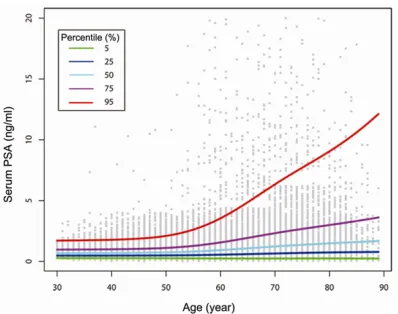
[image:3.612.91.525.70.235.2]Serum PSA level was positively correlated with age in general (r=0.27, P<0.001). Specifically, the serum PSA level positively correlated with age in age groups, 50-59, 60-69, 70-79. Correlation was not significant in age groups 30-39, 40-49, 80-89. There was no significant change in the median and IQR of serum PSA level up to 50 years, and a gradual increase was observed in men older than 50 years (Table 2, Figure 2).
[image:3.612.92.524.285.405.2]Figure 1. Flow chart of this study.
Table 1. Distribution of serum PSA levels according to age
Age (years)
Subjects (n(%)) Serum PSA level (ng/ml) Percentile value
PSA≤4 ng/ml PSA>4 ng/ml Total Mean ± SD Median 25th, 75th IQR 5th, 95th 30-39 1906 (99.9) 2 (0.1) 1908 (7.9) 0.81±0.58 0.67 0.46/1.01 0.55 0.28/1.79 40-49 7476 (99.9) 9 (0.1) 7485 (31.0) 0.86±0.61 0.7 0.49/1.05 0.56 0.28/1.92 50-59 7131 (98.8) 87 (1.2) 7218 (29.8) 1.06±1.20 0.78 0.51/1.23 0.72 0.27/2.63 60-69 3823 (93.4) 272 (6.6) 4095 (16.9) 1.67±2.14 1.03 0.59/1.89 1.3 0.26/4.41 70-79 2328 (86.5) 363 (13.5) 2691 (11.1) 2.27±2.68 1.4 0.72/2.81 2.09 0.25/6.20 80-89 695 (87.2) 102 (12.8) 797 (3.3) 2.22±2.34 1.5 0.73/2.91 2.18 0.14/6.54 Total 23359 (96.5) 835 (3.5) 24194 (100) 1.25±1.60 0.82 0.52/1.36 0.84 0.27/3.46
PSA=prostate-specific antigen; SD=standard deviation; IQR=interquartile range.
Table 2. Correlation analysis of age and serum PSA levels Serum PSA
levels
Age (years)
30-39 40-49 50-59 60-69 70-79 80-89 Total r -0.023 0.017 0.083 0.105 0.043 -0.061 0.27
P 0.313 0.133 <0.001 <0.001 <0.001 0.083 <0.001
PSA=prostate-specific antigen.
Serum PSA levels among Chinese, different regions, and different races
Normal serum PSA upper levels in each age group were 1.79 ng/mL (30-39 years), 1.92 ng/mL (40-49 years), 2.63 ng/mL (50-59 years), 4.41 ng/mL (60-69 years), 6.20 ng/mL (70-79 years), and 6.54 ng/mL (80-89 years). This shows serum PSA levels (95th percentile) among Chinese dif-ferent regions. As for all age groups, serum PSA levels in Taiwanese were higher than those in this study, and Shaanxi was the lowest (Table 3). Among different races, serum PSA levels in White, Black, and Latino were higher than those in this study (Table 4).
Discussion
[image:3.612.90.381.450.505.2]and to establish the normal reference of age-specific PSA levels. Digital rectal examination (DRE) and abnormal prostate-specific antigen, on routine screening, were independently asso-ciated with clinically significant prostate cancer and prostate cancer specific mortality [14]. DRE remains as the simplest method of assess-ing patients for prostate cancer and can usually find large prostate nodules, but small lesions located on both sides of the peripheral zone or near the transitional zone of the prostate were not easily found. As PSA is highly sensitive to prostate cancer detection, a TRUS-guided sys-tematic prostate biopsy has been the gold stan-dard method for the detection of prostate can-cer [15]. It has been widely used as a screening and a follow-up procedure for patients with prostate cancer in China because it is an eco-nomical way to accurately observe the internal structure and condition of the prostate and to monitor blood flow changes [16]. In addition, TRUS can detect lumps or nodules that DRE cannot.
[image:4.612.90.289.70.227.2]PSA is a type of serine protease produced by prostate epithelial cells. Prostate volume deter-mines the production of PSA in population with no clinical evidence of prostate cancer [9]. This study showed that over the entire age range, serum PSA level was directly correlated with age (r=0.27, P<0.001), which was in parallel with previous studies [5-8, 17, 18]. The factor most likely to be responsible for the increase in serum PSA concentration with advancing age was concomitant increase in the size of the prostate gland. Further, as men age, normal physiological barriers of prostate glands that Figure 2. Serum prostate-specific antigen (PSA) per -centiles in different ages.
keep PSA in the prostatic duct system, may become more permeable and allow PSA to enter the general circulation via the capillaries and lymphatics [9]. Our results showed that serum PSA level did not increase linearly. More specifically, the median and IQR increased gradually after 50 years old. The studies of He et al. [5] and Ku et al. [18] arrived at a similar conclusion. Histologically, the incidence of benign prostatic hyperplasia (BPH) increases with age, and usually begins at the age of 40 [19]. Autopsy data have shown prostatic enlargement in 40%, 55%, and 80% of men 50-59, 60-69, and 70-79 years of age, respec-tively [20]. Given the observed association between age and the increase in serum PSA level in normal individuals, it was necessary to determine normal serum PSA level according to each age interval, making it age-specific.
Only age groups 50-59, 60-69, and 70-79 had positive correlation between age and serum PSA level out of all of the age groups. There was no significant correlation between age and serum PSA level in those below 50 or above 80 years old. Serum PSA level was affected by ejaculation [21] and physical activities [22]. There was no correlation between age and serum PSA level in age groups 30-39, 40-49, which might be explained by the intensity of these factors. Serum total testosterone was decreased at age less than 60 years, and did not significantly reduce at age more than 60 years [23]. A direct correlation between serum testosterone levels and serum PSA level was reported in BPH patients [24]. The androgen level decreased with aging and its influence on prostatic cells might explain the lack of correla-tion between age and serum PSA levels for the above 80 years old group. Another plausible reason was the inherent problem of the small numbers in the 80-89 age group in the present study, and it might not represent the actual clinical findings. Therefore, not only the increase of age could cause the elevation of PSA level but also a series of factors could affect the serum PSA level. Therefore, all of these factors should be considered in prostate cancer screening.
respective-Table 3. Serum PSA levels among Chinese different regions (ng/ml, 95th percentile, subject number)
Age (years) Taiwanese[6] Shanghai[7] Shaanxi[5] Shandong[8] Beijing[25] Present study
20↓ 1.712 (17) - - - -
-20-29 1.796 (360) - 1.20 (77) - -
-30-39 1.836 (1442) -690 1.21 (189) 1.89 (1135) - 1.79 (1908) 40-49 2.167 (2333) 2.15 (1880) 1.23 (233) 2.19 (3700) 1.565 (46) 1.92 (7485) 50-59 3.329 (2258) 3.20 (2255) 2.35 (177) 2.88 (2859) 2.920 (312) 2.63 (7218) 60-69 5.114 (880) 4.1 (1800) 3.20 (265) 4.42 (1075) 4.113 (536) 4.41 (4095) 70-79 6.237 (440) 5.37 (1797) 3.39 (155) 6.52 (589) 5.711 (414) 6.20 (2691) 80-89 6.613 (93) - - - 7.285 (264) 6.54 (797)
Total 471 8422 1096 9358 1572 24194
[image:5.612.91.522.85.219.2]PSA=prostate-specific antigen.
Table 4. Serum PSA levels among different races (ng/ml 95th percentile, subject number)
Age (years) White[9] Black[10] Latino[10] Japanese[17] Korean[18] Present study
20-29 - - - - 2.25 (225)
-30-39 - - - - 2.35 (1867) 1.79 (1908)
40-49 2.5 (165) 2.7 (1377) 2.0 (139) 2.0 (47) 2.36 (3934) 1.92 (7485) 50-59 3.5 (144) 4.4 (1582) 4.5 (313) 3.0 (64) 2.96 (1941) 2.63 (7218) 60-69 4.5 (94) 6.7 (1112) 5.5 (302) 4.0 (106) 3.78 (295) 4.41 (4095) 70-79 6.5 (68) 7.7 (414) 6.8 (146) 5.0 (69) 7.49 (35) 6.20 (2691)
80-89 - - - 6.54 (797)
Total 471 4485 900 286 8297 24194
PSA=prostate-specific antigen.
ly, but were similar to Japanese and Korean. This might be due to several major reasons: First, the differences among races could have affected the PSA levels [10]; Second, dietary habits differ greatly, as in people in East Asia ingest mainly grains and vegetables, while Western people commonly have high-fat and high-caloric foods; Third, prostate biopsy was mostly performed based on research from western countries where the serum PSA level was documented as higher than 4 ng/mL. This study followed the principle of Chinese expert consensus on prostate biopsy [12], which sug-gested a prostate biopsy when the serum PSA level is higher than 10 ng/mL. % fPSA, PSAD, and such tools were utilized to determine the necessity of performing a prostate biopsy for those with PSA level of 4-10 ng/mL, to reduce unnecessary invasive procedures, which pos-sibly missed a few subjects with prostate can-cer at the time; Fourth, the data of our current study were not derived from a community-based population, but came from the same hospital, which was a retrospective single-cen-ter study; Fifth, there were differences in mea-surement systems and analytical methods.
Previous studies [5-8, 25]indicated the differ-ences of age-specific PSA level existed within the same race as well. The upper limit of age-specific PSA from our study was similar to that in Beijing, Shanghai, and the Shandong area, while lower than the results of the Taiwan area. All above-mentioned study results were higher than those in the Shaanxi area. Those results confirmed that, even within the same race, nor-mal age-specific PSA level might differ due to climate, dietary habits, living environment, geo-graphical conditions, etc.
[image:5.612.91.523.265.384.2]these groups were 1.79 ng/mL, 1.92 ng/mL, and 2.63 ng/mL, respectively. Simply utilizing 4 ng/mL as the upper limit to diagnose prostatic cancer for these age groups would potentially lower the diagnostic sensitivity. On the other hand, 6.6%, 13.5%, and 12.8% of subjects in age groups 60-69, 70-79, and 80-89 had serum PSA levels higher than 4 ng/mL. The upper limits of serum PSA levels of these three groups were 4.41 ng/mL, 6.20 ng/mL, and 6.54 ng/mL, which were all beyond 4.0 ng/mL. Utilizing 4 ng/mL as the reference for these age groups would increase unnecessary prostate biopsies. Reissig et al. [26] found that the use of age-specific references resulted in an 8% increase in biopsies, and an 8% increase in detected cancers in men aged 45-59 years, whereas 21% fewer biopsies would have been performed in men aged 60-75 years, with 4% of cancers not detected. Our study indicated that establishing the references of normal age-spe-cific levels would increase the sensitivity of serum PSA testing in the younger population, which would detect more potentially curable early organ-confined prostate cancer. It is more appropriate to employ age-specific PSA refer-ences, than using the single cutoff of 4.0 ng/ mL for men in all age groups.
The current study has several limitations. First, the data of the current study were not derived from a community-based population. Yet, in the Department of Health Examination of our hos-pital, most visitors were healthy people who came for routine health check-ups, which was quite different from the out-patients suffering from diseases. Urinary and infectious diseases were excluded. Thus, the bias was decreased to the minimum by selecting the subjects in the Department of Health Examination instead of out-patients. Second, this study was a single-center retrospective research, further study derived from multi-centers should be per-formed to minimize the bias. Third, a certain level of bias might have caused by the lack of digital rectal examination in the screening pro-cess of prostate cancer.
In summary, age was positively correlated with serum PSA levels in general. The serum PSA level started to increase significantly after 50 years of age. Normal values of age-specific PSA levels might vary among races or even within the same race, but residing in different areas.
Our results showed that the normal upper age-specific PSA level of population in northern China is lower than in Taiwan and in other Western countries.
Address correspondence to: Dr. Jiang-Ping Gao, Department of Urology, Chinese People’s Liberation Army General Hospital, Fuxing Street, 28 Haidian District, Beijing 100853, China. Tel: +86-10-6684- 8141; Fax: +86-10-66848141; E-mail: jpgao@163. com
References
[1] Siegel R, Naishadham D, Jemal A. Cancer sta-tistics, 2013. CA Cancer J Clin 2013; 63: 11-30.
[2] Center MM, Jemal A, Lortet-Tieulent J, Ward E, Ferlay J, Brawley O, Bray F. International varia-tion in prostate cancer incidence and mortality rates. Eur Urol 2012; 61: 1079-92.
[3] Chen W, Zheng R, Baade PD, Zhang S, Zeng H, Bray F, Jemal A, Yu XQ, He J. Cancer statistics in China, 2015. CA Cancer J Clin 2016; 66: 115.
[4] Heidenreicha A, Bellmunt J, Bolla M, Joniau S, Mason M, Matveev V, Mottet N, Schmid HP, van der Kwast T, Wiegel T, Zattoni F; European Association of Urology. EAU guidelines on pros-tate cancer. part 1: screening, diagnosis, and treatment of clinically localized disease. Eur Urol 2014; 65: 124-37.
[5] He D, ang M, Chen X, Gao Z, He H, Zhau HE, Wang W, Chung LW, Nan X. Ethnic differences
in distribution of serum prostate-specific anti -gen: a study in a healthy chinese male popula-tion. Urology 2004; 63: 722-6.
[6] Lin KJ, Pang ST, Chang YH, Wu CT, Chuang KL, Chuang HC, Chuang CK. Age-related reference
levels of serum prostate-specific antigen
among Taiwanese men without clinical evi-dence of prostate cancer. Chang Gung Med J 2010; 33: 182.
[7] Liu ZY, Sun YH, Xu CL, Gao X, Zhang LM, Ren
SC. Age-specific PSA reference ranges in chi -nese men without prostate cancer. Asian J An-drol 2009; 11: 100-3.
[8] Yuan XD, Dong ZG, Zhang H, Lin HY, Song XH, Niu ZH, Fu Q, Liu S, Sun ZJ, Lü JJ. Distribution
of serum prostate-specific antigen in chinese
healthy men: a population-based study. Chin Med J (Engl) 2011; 124: 1189-92.
[9] Oesterling JE, Jacobsen SJ, Chute CG, Guess HA, Girman CJ, Panser LA, Lieber MM. Serum
prostate-specific antigen in a
community-based population of healthy men.
Establish-ment of age-specific reference ranges. JAMA
[10] Deantoni EP, Crawford ED, Oesterling JE, Ross CA, Berger ER, McLeod DG, Staggers F, Stone
NN. Age- and race-specific reference ranges for prostate-specific antigen from a large com -munity-based study. Urology 1996; 48: 234-9. [11] Luo J, Du P, Samat A, Xia J, Che M, Xue Z. Spa-tiotemporal pattern of PM2.5 Concentrations
in mainland china and analysis of its influenc -ing factors us-ing geographically weighted re-gression. Sci Rep 2017; 7: 40607.
[12] YH S. Chinese expert consensus on prostate biopsy. Chin J Urol 2016; 37: 241-4.
[13] Hong SJ, Ko WJ, Kim SI, Chung BH. Identifica -tion of baseline clinical factors which predict medical treatment failure of benign prostatic hyperplasia: an observational cohort study. Eur Urol 2003; 44: 94-9.
[14] Halpern JA, Shoag JE, Mittal S Oromendia C, Ballman KV, Hershman DL, Wright JD, Shih YT,
Nguyen PL, Hu JC. Prognostic significance of digital rectal examination and prostate specific
antigen in the prostate, lung, colorectal, and ovarian cancer screening arm. J Urol 2017; 197: 363-368.
[15] Ochiai A. Changes in the roles of transrectal ultrasonography for the diagnosis of prostate cancer. J Med Ultrason (2001) 2017; 44: 1-2. [16] Lee F, Littrup PJ, Kumasaka GH, Borlaza GS,
Mcleary RD. The use of transrectal ultrasound in the diagnosis, guided biopsy, staging and screening of prostate cancer. Radiographics 1987; 7: 627-44.
[17] Oesterling JE, Kumamoto Y, Tsukamoto T, Gir-man CJ, Guess HA, Masumori N, Jacobsen SJ,
Lieber MM. Serum prostate-specific antigen in
a community-based population of healthy Jap-anese men: lower values than for similarly-aged white men. Br J Urol 1995 ; 75: 347-53.
[18] Ku JH, Ahn JO, Lee CH, Lee NK, Park YH, Byun SS, Kwak C, Lee SE. Distribution of serum
prostate-specific antigen in healthy korean men: influence of ethnicity. Urology 2002; 60:
475-9.
[19] Berry SJ, Coffey DS, Walsh PC, Ewing LL. The development of human benign prostatic hyper-plasia with age. J Urol 1984; 132: 474-9. [20] Ziada A, Rosenblum M, Crawford ED. Benign
prostatic hyperplasia: an overview. Urology 1999; 53: 1-6.
[21] Tarhan F, Demir K, Orçun A, Madenci OC. Effect
of ejaculation on serum prostate-specific anti -gen concentration. Int Braz J Urol 2016; 42: 472-8.
[22] Kratz A, Lewandrowski KB, Siegel AJ, Sluss PM, Chun KY, Flood JG, Lee-Lewandrowski E. Effect of marathon running on total and free serum
prostate-specific antigen concentrations. Arch
Pathol Lab Med 2003; 127: 345-8.
[23] Liu Z, Liu J, Shi X, Wang L, Yang Y, Tao M. Dy-namic alteration of serum testosterone with aging: a cross-sectional study from Shanghai, china. Reprod Biol Endocrinol 2015; 13: 111. [24] Rong MA. The study of serum testosterone
concentration in different aged men. Chinese Journal of Geriatrics 2004; 23: 549-550 [25] Xin L, Jie W, Zhang SX, Qian L. Reference
rang-es of age-related prostate-specific antigen in
men without cancer from Beijing area. Iran J Public Health 2013; 42: 1216.
[26] Reissigl A, Pointner J, Horninger W, Ennemoser O, Strasser H, Klocker H, Bartsch G.