Adjustment Problems of Retired Working and Non Working Women on Rural and
Research Scholar
ARTICLE INFO ABSTRACT
The present study was undertaken to find and compare the adjustment problems of retired working and non working women on rural and urban
using purposive cum stratified sampling technique. Old Age adjustment inventory developed by Shamshad Hussain and Jasbir Kour was uses for data collection. The data was subjected to sta
Mean, Standard Deviation, and ‘t’ test. It was found that retired working and non
significantly on adjustment problems. Retired working women seems to have more adjustment problems as compared to non
problems of retired working and non working women, rural group was found more adjusted than urban group.
INTRODUCTION
Old age has become a complex phenomenon. The transition into old age creates many problems for those individuals who have not prepared themselves for what best may be called as “later maturity”. Old age is considered the final period of life. It is an obvi
every individual has to pass through this stage. Physiologically, old age may be said to have arrived to an individual when general decline or debilitating diseases have resulted in extreme frailty, displacement or invalidism. Psychologically, the mental processes have slowed down and the individual turns to self contemplation, retrospection and concern over the meaning of life. Saxeena (1963
age is the man’s most paradoxical and contradictory stages of life. It is a time when life’s last question arises with full intensity allowing no illusions and demanding solutions to what is unreasonable”. During this phase when a woman is entering old age, she has to face many problems relating to her physical conditions, mental efficiency, psychological weakness, social isolation etc. A retired working women who has worked through all her life, faces another traumatic experience as soon as she reacts to the stage of retirement. The structure of working women as home maker and women who work outside the home, are quite different in early and midlife. Different values and economic constraints have prompted initial selection between the two choices. It is quite unrealistic to assume that every older woman who retires from the labor force will j
full time household role and live happily thereafter. Married women who have worked for a comfortable time experience major life changes upon retirement. Removal of daily schedules after retirement clearly produces major life changes, whether or not these changes are viewed in a positive and negative light. Lopata,
“retirement for women, traditionally at least, represented a less drastic shift in rules, since domestic roles after supplemented work roles”. Adjustment is a process by which an individual learns certain ways of behavior through which he enters into a relationship of
*Corresponding author:[email protected]
ISSN: 0975-833X
Article History:
Received 24th November, 2012 Received in revised form 15th December, 2012 Accepted 22th January, 2013 Published online 14th February, 2013
Key words:
Adjustment Problems, Retired Working Women, Non Working Women, Rural and Urban Background.
RESEARCH ARTICLE
Adjustment Problems of Retired Working and Non Working Women on Rural and
Urban Background
*Aashiq Ahmad Thoker
Research Scholar
faculty of Education University of Kashmir (India)
ABSTRACT
The present study was undertaken to find and compare the adjustment problems of retired working and non working women on rural and urban background. 200 retired working and non
using purposive cum stratified sampling technique. Old Age adjustment inventory developed by Shamshad Hussain and Jasbir Kour was uses for data collection. The data was subjected to sta
Mean, Standard Deviation, and ‘t’ test. It was found that retired working and non
significantly on adjustment problems. Retired working women seems to have more adjustment problems as compared to non-working women. Further, it was found that locality has significant impact on adjustment problems of retired working and non working women, rural group was found more adjusted than urban group.
Copy Right, IJCR, 2013, Academic Journals
Old age has become a complex phenomenon. The transition into old age creates many problems for those individuals who have not prepared themselves for what best may be called as “later maturity”. Old age is considered the final period of life. It is an obvious fact that every individual has to pass through this stage. Physiologically, old age may be said to have arrived to an individual when general decline or debilitating diseases have resulted in extreme frailty, displacement , the mental processes have slowed down and the individual turns to self contemplation, retrospection 1963) remarked “Old age is the man’s most paradoxical and contradictory stages of life. It ife’s last question arises with full intensity allowing no illusions and demanding solutions to what is unreasonable”. During this phase when a woman is entering old age, she has to face many problems relating to her physical conditions, mental efficiency, psychological weakness, social isolation etc. A retired working women who has worked through all her life, faces another traumatic experience as soon as she reacts to the stage of retirement. The structure of working women as home maker and women who work outside the home, are quite different in early and midlife. Different values and economic constraints have prompted initial selection between the two choices. It is quite unrealistic to assume that every older woman who retires from the labor force will just resume her full time household role and live happily thereafter. Married women who have worked for a comfortable time experience major life changes upon retirement. Removal of daily schedules after retirement r or not these changes are
Lopata, (1966) argues
“retirement for women, traditionally at least, represented a less drastic shift in rules, since domestic roles after supplemented work by which an individual learns certain ways of behavior through which he enters into a relationship of
harmony with his environment. Thus, he tried to lead a life acceptable to society. In its simplest form the term adjustment means that we should accommodate ourselves in order to fit certain demands of our environment. It also deals with how we make such accommodations and how successful we will be in finding solut of our problems. Different researchers have conducted studies on working and non working women. Some have related to perception, role playing, employment, education, adjustment etc.
Paramjeet (2003) remarked “adjustment to retirement may o
difficult for individuals as it requires adopting a new life style, characterized by decreasing income and increased free time”.
and Parthasarathy (1999) found that there are several factors which
influence adjustment after retirement: as type
income and emotional support of family, purpose in life, attitude towards work, social interaction, and activities undertaken during post retirement phase. Lack and Mack
marital adjustment and employed
significant differences between the marital adjustment of working and non working women. Richardson and Kittery
study on educated working women and found that double responsibility which married working
face difficulties in meeting demands of both professions and family there was a clash of personal interests between the spouses, which have experienced by a majority of the respondents.
Saxena (1990) conducted a study of pattern
working and non working women and found that retired working and non working women have been seen to have different adjustment patterns. Browing and Bond (1987
(men and women) found that health,
social activities were significant factors that influence the adjustment after retirement. It was also found that adjustment was also determined to a large extent by the retir
(1970) pointed out a number of w poor adjustment. Rafiq Tabasum
adjustment and values of old age people in Kashmir and found that
International Journal of Current Research
Vol. 5, Issue, 02, pp.388-394, February, 2013
INTERNATIONAL
Adjustment Problems of Retired Working and Non Working Women on Rural and
of Kashmir (India)
The present study was undertaken to find and compare the adjustment problems of retired working and non-background. 200 retired working and non-working women were selected by using purposive cum stratified sampling technique. Old Age adjustment inventory developed by Shamshad Hussain and Jasbir Kour was uses for data collection. The data was subjected to statistical treatment by using Mean, Standard Deviation, and ‘t’ test. It was found that retired working and non-working women differ significantly on adjustment problems. Retired working women seems to have more adjustment problems as women. Further, it was found that locality has significant impact on adjustment problems of retired working and non working women, rural group was found more adjusted than urban group.
, Academic Journals. All rights reserved.
harmony with his environment. Thus, he tried to lead a life acceptable to society. In its simplest form the term adjustment means that we should accommodate ourselves in order to fit certain demands of our environment. It also deals with how we make such accommodations and how successful we will be in finding solutions Different researchers have conducted studies on working and non working women. Some have related to perception, role playing, employment, education, adjustment etc. Shyadan and ) remarked “adjustment to retirement may often be difficult for individuals as it requires adopting a new life style, characterized by decreasing income and increased free time”. Rao ) found that there are several factors which influence adjustment after retirement: as type of job, health condition, income and emotional support of family, purpose in life, attitude towards work, social interaction, and activities undertaken during
Lack and Mack (1949) conducted a study on
marital adjustment and employed wife and found that there was no significant differences between the marital adjustment of working
Richardson and Kittery (1991) conducted a
study on educated working women and found that double responsibility which married working women expressed that they face difficulties in meeting demands of both professions and family there was a clash of personal interests between the spouses, which have experienced by a majority of the respondents.
) conducted a study of pattern of adjustment of retired working and non working women and found that retired working and non working women have been seen to have different adjustment 1987) conducted a study on 140 retirees (men and women) found that health, income, re-employment and social activities were significant factors that influence the adjustment after retirement. It was also found that adjustment was also determined to a large extent by the retirees. Raghani and Singh pointed out a number of weakness with regard to good and
Rafiq Tabasum (2006) conducted a study on
adjustment and values of old age people in Kashmir and found that
there is significant difference between male and female old age subjects, in all the areas of adjustment, viz. home, health, social, marital and emotional. Bhat. R.K. (2007) a comparative study of adjustment of rural and urban working women in Kashmir and found that rural working women and urban working women differ significantly on their overall areas of adjustment. Lateef, S. (2010) studied adjustment problems of male and female retirees in District Shopian and Pulwama and found that there is significant difference between male and female retirees in their adjustment pattern.
Christine A.P (2003) studied professional women’s retirement and
found that adjustment to retirement for professional women may be enhanced by utilizing work related skills, maintained activities and related skills. Samuel O.S (2006) investigated the relationship of retirement context and psychological factors and findings indicate that retirement status, job challenges, financial situation, physical health, social support separately predicted psychological well being of retires. In nutshell, related studies are important in drawing out conclusions and provide hypothesis and measures future research. It also gives a way to accumulate knowledge for the beginners and an experienced research. Accordingly the present investigator formulated a research problem which reads as:
Statement of the problem
Adjustment Problems of Retired Working and Non Working Women on Rural and Urban Background.
Objectives
The following objectives have been formulated for the present investigation.
1. To study and compare the adjustment problems of retired working and non – working women on:
a) Health aspect, b) Home aspect, c) Social aspect, d) Marital aspect, e) Emotional aspect,
f) Financial aspect.
2. To study and compare the adjustment problems of rural and urban retired working and non-working women.
Hypothesis
The following hypotheses have been formulated for the present investigation:
1) Retired working and non working women differ significantly in various areas of adjustment as:
a) Health aspect, b) Home aspect, c) Social aspect, d) Marital aspect, e) Emotional aspect,
f) Financial aspect.
2) Locality has a significant effect on adjustment pattern of retired working and non working women.
Delimitation of the study
The study was delimited to the following:
1. The study was delimited to three Districts of Kashmir valley namely Srinagar, Shopian and Pulwama only.
2. The age group of the respondents was ranging from 60-80 years.
METHODOLOGY
Keeping in view the research evidences, objectives and hypotheses, the researcher found it suitable to go through descriptive survey method, through which data was collected.
Sample
[image:2.595.86.449.480.755.2]The sample for the present study was selected from the three districts of Kashmir valley-Shopian, Pulwama and Srinagar by using purposive cum stratified sampling technique. The present investigation involves retired working women (N=100) and non-working women (N=100).
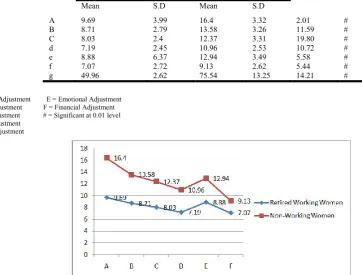
Table 1.1: Showing significance of difference between the mean scores of Retired working women and non-working women on level of adjustment (N=100 each)
AA Retired Working Women Non Working Women ‘t’-Value Result/s
Mean S.D Mean S.D
A 9.69 3.99 16.4 3.32 2.01 #
B 8.71 2.79 13.58 3.26 11.59 #
C 8.03 2.4 12.37 3.31 19.80 #
d 7.19 2.45 10.96 2.53 10.72 #
e 8.88 6.37 12.94 3.49 5.58 #
f 7.07 2.72 9.13 2.62 5.44 #
g 49.96 2.62 75.54 13.25 14.21 #
Index
AA= Areas of Adjustment E = Emotional Adjustment
A = Health Adjustment F = Financial Adjustment B = Home Adjustment # = Significant at 0.01 level C = Social Adjustment
D = Marital Adjustment
Tools for Data Collection
The data for the present study was collected with the help of Old Age adjustment inventory developed by Shamshad Hussain and Jasbir Kour. This scale consists 125 items, which gives the global picture of once adjustment pattern.
Statistical Techniques Employed
Information gathered was put to suitable statistical analysis by computing Mean, S.D and test of significance (t-test).
Analysis and Interpretation of Data
In order to find out the difference between the mean scores of retired working women and non working women on various areas of adjustment viz, health, home, social, marital, emotional, financial and overall adjustment, the information presented in Table 1.1 (Fig.1) reveals that both the groups of women differ significantly in various areas of adjustment. From these results it is revealed that non – working women as compared to working women are seen to have no complaint in their health adjustment though with retired ones it was a complaint. It is observed that retired working women feel perplexed when they experience ill health. It was further observed that retired working women forget things very quickly than non-working women. In home adjustment the ‘t’ value came out to be 11.59 which is significant at 0.01 level of confidence. This means that the two groups differ significantly in their home adjustment. Non – working women are reported to have no domestic maladjustment (M=13.58). Whereas with retired working women it was a problem (M=8.71).In social adjustment the ‘t’ value came out to be 19.80 which is significant at 0.01 level of confidence. This means that the two groups (working and non working women) differ significantly in their level of adjustment.
Further, the difference favours non– working group of women. It has been found that non working women consider that they are respected in their families and society and seem to feel happy on coming guests to their home. Coming to the area of marital adjustment, the two groups seem to differ significantly at 0.01 level of confidence (‘t’ = 10.72). This can be inferred that the two groups working and non – working women differ significantly in their marital adjustment. Further, the mean difference goes in favour of non-working women (M=2.45). It can be revealed that non-working women have positive personal experience with their family members than retired working women (M=7.19). In emotional adjustment the calculated ‘t’ value is reported to be 5.58 which seems to be significant at 0.01 level of confidence. It can be inferred that working and non working women differ significantly in their emotional adjustment. Further, the mean difference goes in favour of non working women (M=12.94). It can be revealed that retired working women experience emotional disturbance and imbalances. In financial adjustment, the ‘t’ value came out to be 5.44 which is significant at 0.01 level of confidence. This means that the two groups working and non working women differ significantly in their financial adjustment. Further, the difference in mean goes in favour of non-working women. It can be inferred that retired working women experience behavioural complexes due to their retirement. In overall adjustment the ‘t’ value came out to be 14.21 which is significant at 0.01 level of confidence. This means that the two groups working and non working women differ significantly in their overall adjustment. Further, the difference in mean goes in favour of non-working women. The results are in line with the investigation carried out by other researchers (Saxena 1993, Hussain and Singh 1995).
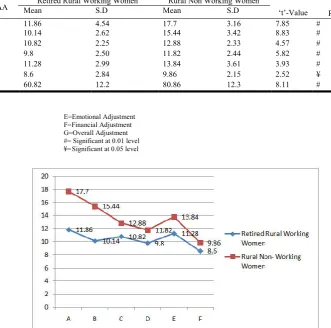
[image:3.595.124.456.438.766.2]A quick glance at Table 1.2 (Fig. 2) indicates the significance of difference between the mean scores of retired rural working and non-working women on various areas of adjustment. The ‘t’ value has been found to be significant in all six areas of adjustment.
Table 1.2: ShowingSignificance of difference between the mean scores of Retired Working and Non-Working Women (Rural Group) on various
areas of Adjustment (N=50 each)
AA Retired Rural Working Women Rural Non Working Women
‘t’-Value Results
Mean S.D Mean S.D
A 11.86 4.54 17.7 3.16 7.85 #
B 10.14 2.62 15.44 3.42 8.83 #
C 10.82 2.25 12.88 2.33 4.57 #
d 9.8 2.50 11.82 2.44 5.82 #
e 11.28 2.99 13.84 3.61 3.93 #
[
f 8.6 2.84 9.86 2.15 2.52 ¥
g 60.82 12.2 80.86 12.3 8.11 #
Index
AA=Areas of Adjustment E=Emotional Adjustment
A=Health Adjustment F=Financial Adjustment
B=Home Adjustment G=Overall Adjustment
C=Social Adjustment #= Significant at 0.01 level
D=Marital adjustment ¥=Significant at 0.05 level
From the results it is reported that in health adjustment rural non – working women have exhibited a higher mean score (M=17.7) than retired rural working women (M=11.86). The calculated ‘t’ value is reported to be as 7.85 which is significant at 0.01 level of confidence. This can be inferred that the two groups under discussion differ significantly in their health adjustment. Further, this can be stated that non-working women (rural) have better health adjustment than urban retired working women. Further, it can be stated that rural non-working women consider that they are less physically weak. Rural retired working women feel perplexity due to sickness and lack of sleep. In home adjustment the calculated ‘t’ value has come out to be 8.83 which is significant at 0.01 level of confidence .This shows that the two groups (retired rural working women and rural non-working women) differ significantly in home adjustment. Further, the difference in mean goes in favour of rural non working women. It is further stated that rural non-working women have better home adjustment (M=15.44) than rural retired working women (M=10.14).
It can be further interpreted that rural non – working women feel better affection with their family members than retired rural working women. In social adjustment the ‘t’ value has come out to be 4.57, which is significant at 0.01 level of significance. This shows that the two groups, retired rural working and rural non – working women, differ significantly in their social adjustment. Further, the difference in mean goes in favour of rural non-working women (M=12.88). It is further stated that rural non-working women have better social adjustment than rural retired working women. It is revealed that no change in social adjustment is reported among rural non – working women during their life cycle. In marital adjustment the ‘t’ value has come out to be 5.82 which is significant at 0.01 level of confidence. This shows that the two groups retired rural working and rural non-working women differ significantly in their marital adjustment.
Further, the difference in mean goes in favour of rural non – working women. It is further stated that rural non-working women have better marital adjustment (M=11.82) than rural retired working women (M=9.08). It can be further inferred that rural retired working women share less personal experiences with their family members than rural non – working women. In emotional adjustment the ‘t’ value came out to be 3.93 which is significant at 0.01 level of confidence. This shows that the rural retired working women (M=13.84) and rural non – working women (M=11.28) differ significantly in their emotional adjustment. Further, the difference in mean goes in favour of rural non-working women. It is further stated that rural non – working women experience better emotional adjustment than retired rural working women. It seems to be that retired rural working women become more anxious and sad than rural non – working women. In financial adjustment the ‘t’ value has been found to be 2.52 which is significant at 0.05 level of confidence.
[image:4.595.135.463.290.608.2]This shows that the two groups, (retired rural working women and rural non – working women) differ significantly in their financial adjustment. Further, the difference goes in favour of rural non – working women. It is further stated that rural non-working women (M=9.86) have better financial adjustment than retired rural working women (M=8.6). In over all adjustment the ‘t’ value has come out to be 8.11 which is significant at 0.01 level of confidence. This means that retired rural working women and rural non – working women differ significantly in their overall adjustment. Further, the difference in mean goes in favour of rural non-workings women. It is further stated that rural non-working women have better adjustment than retired rural working women in the all areas of adjustment. It is found that rural working women exhibit inferiority complex, shares less personal experience, complaint about less sleep than rural non-
Table 1.3: Showing significance of difference between the mean scores of retired working and non-working women (Urban) on various areas of Adjustment (N=50 each)
AA Retired Urban Working Women Urban Non Working Women
‘t’ Value Result/s
Mean S.D Mean S.D
A 8. 52 3. 44 15.01 6.28 6.58 #
B 7.28 2.96 12.07 3.10 9.06 #
C 6.04 2.61 11.80 4.31 9.54 #
d 5.03 2.40 10.00 2.61 10.00 #
e 6.42 3.38 12.00 3.38 5.58 #
f 5.54 2.96 8.4 3.02 4.84 #
g 39.1 12.0 70.2 14.28 11.8 #
Index
AA=Areas of Adjustment E=Emotional Adjustment
A=Health Adjustment F=Financial Adjustment
B=Home Adjustment G=Overall Adjustment
C=Social Adjustment #= Significant at 0.01 level
D=Marital adjustment
working women. The results are in the line with the studies carried out by (Bhat, 2007) whose findings indicate that there is a significant difference between adjustment pattern of rural and urban working women. Table 1.3 (Fig. 3) shows significance of difference between the mean scores of retired urban working and non – working women with respect different areas of adjustment. The results revealed that: in health adjustment the ‘t’ value has come at to be 6.58 which is significant at 0.01 level of confidence. This means that two groups retired urban working and urban non-working differ significantly in their health adjustment. Further, this can be stated that difference in mean goes in favour of urban non-working women. It can be stated that urban non-working women have better health adjustment than retired urban working women. It can be inferred that urban non-working women depend less upon medicine as compared to retired urban working women. In home adjustment the calculated ‘t’ value is reported to be as 9.06 which is significant at 0.01 level of confidence. Further, it can be interpreted that urban non-working women seem to be have better home adjustment as compared to retired urban working women. It was observed that urban non-working women engage themselves in domestic activities in order to avoid loneliness. In social adjustment the ‘t’ value has come out to be 9.54 which is significant at 0.01 level of confidence. This means that the two groups retired urban working women and urban non working women differ significantly in their social adjustment. Further, the difference in mean goes in favour of urban non – working women .It is further stated that urban non-working women have better adjustment than retired urban working women. The results revealed that retired urban working women consider that their social circle is decreasing day by day.In marital adjustment the ‘t’ value came out to be 10.00 which is significant at 0.01 level of confidence. This means that the two groups retired urban working women and urban non - working women differ significantly in their marital adjustment. Further, the difference in mean goes in favour of urban working women. Besides, it can be stated that urban non-working women have better marital adjustment than urban retired working women.
It was further revealed that urban non-working women think that their marital adjustment is incomplete without their life partner. In emotional adjustment the ‘t’ value came out to be 8.51 which is significant at 0.01 level of confidence. This means that the two groups retired urban working women and urban non – working women differ significantly in their emotional adjustment. Further, the mean difference goes in favour of urban non-working women. This means that urban non-working women (M=12.0) have better adjustment than retired urban working women (M=6.42). Retired urban working women are found emotionally unstable as compared to urban non-working women. In financial adjustment the ‘t’ value came out to be 4.84 which is significant at 0.01 level of confidence. This means that the two groups retired urban working women and urban non-working women differ significantly in their financial adjustment. Further, the difference in mean goes in favour of urban non-working women which means that urban non-working women(M=8.4) have better financial adjustment than retired urban working women (M=5.54). In overall adjustment the ‘t’ value has come out to be 11.8 which is significant at 0.01 level of confidence. This means that the two groups retired urban working and urban non – working women differ significantly in their overall adjustment. Further, the difference in mean goes in favour of urban non – working women. It is further stated that urban non-working women (M=14.28) have better overall adjustment than retired urban working women (M=12.02). The results revealed that retired urban working women feel inferiority complex, become sad and anxious, share less personal experience than urban non-working women. The results are supported by Nayeema, (2008) whose findings indicate that urban non – working women are highly adjusted than urban working women.
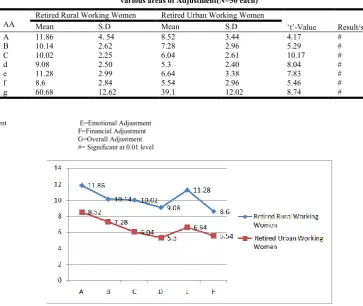
[image:5.595.112.476.445.751.2]The data in Table 1.4 (Fig. 4) reveal the significance of difference between mean scores of retired rural working women and retired urban working women with respect to different areas of adjustment. The results indicates that: In health adjustment the ‘t’ value has come out to be 4.17 which is significant at 0.01 level of confidence. This means that the two groups i.e., retired rural and retired urban
Table 1.4: Showing significance of difference between the mean scores of Retired Rural-working women and Urban Retired working women on various areas of Adjustment(N=50 each)
AA
Retired Rural Working Women Retired Urban Working Women
‘t’-Value Result/s
Mean S.D Mean S.D
A 11.86 4. 54 8.52 3.44 4.17 #
B 10.14 2.62 7.28 2.96 5.29 #
C 10.02 2.25 6.04 2.61 10.17 #
d 9.08 2.50 5.3 2.40 8.04 #
e 11.28 2.99 6.64 3.38 7.83 #
f 8.6 2.84 5.54 2.96 5.46 #
g 60.68 12.62 39.1 12.02 8.74 #
Index
AA=Areas of Adjustment E=Emotional Adjustment
A=Health Adjustment F=Financial Adjustment
B=Home Adjustment G=Overall Adjustment
C=Social Adjustment #= Significant at 0.01 level
D=Marital adjustment
working women differ significantly in their health adjustment. Further, the difference in mean goes in favour of retired rural working women. Thus, it can be stated that retired rural working women have better health adjustment than retired urban working women. In home adjustment the ‘t’ value came out to be 5.29 which is significant at 0.01 level of confidence. This means that the two groups of retired working women (rural and urban) differ significantly in their home adjustment. Further, the difference in mean goes in favour of retired rural working women. Thus, it can be stated that retired rural working women (M=10.14) have better home adjustment than retired urban working women (M=7.28). In social adjustment the ‘t’ value has been found to be 10.17 which is significant at 0.01 level of confidence, This can be inferred that the two groups of retired working women (rural and urban) differ significantly in their social adjustment. Further, the difference in mean goes in favour of retired rural working women. Thus, it can be stated that retired rural working women (M=10.02) have better social adjustment than retired urban working women (M=6.04). In marital adjustment the ‘t’ value has come out to be 8.04 which is significant at 0.01 level of confidence. This means that the two groups of retired working women (rural and urban) differ significantly in their marital adjustment. Further, the difference in mean goes in favour of retired rural working women.
This means that retired rural working women (M=9.08) have better marital adjustment than retired urban working women (M=5.3). In emotional adjustment the calculated ‘t’ value has come out to be 7.83 which is significant at 0.01 level of confidence. This means that the two groups rural retired working women and retired urban working women differ significantly in their emotional adjustment. Further, the difference in mean goes in favour of retired rural working women. Thus, it can be stated that retired rural working
women (M=11.28) are emotionally balanced than the retired urban working women (M=6.48). In financial adjustment the ‘t’ value came out to be 5.46 which is significant at 0.01 level of confidence. This means that the two groups retired rural working women and retired urban working women differ significantly in their financial adjustments. Further, the difference in mean goes in favour of rural retired working women. Thus, retired rural working woman (M=8.6) have better financial adjustment than retired urban working women (M=5.54).
In overall adjustment the ‘t’ value came out to be 8.74 which is significant at 0.01 level of confidence. This means that the two groups of retired working women (rural and urban) differ significantly in overall adjustment. Further, the difference in mean goes in favour of retired rural working women. This means that retired rural working women (M=60.68) have high level of adjustment as compared to urban non-working women (M=39.1). The results are supported by Nayeema, (2008) and Bhat, (2007) whose findings indicate that there is a significant difference in adjustment pattern of rural and urban working women. Further rural and urban working women differ significantly in their adjustment pattern.
Table 1.5 (Fig. 5)shows significance of difference between the mean scores of rural and urban non working women in different areas of adjustment. The results revealed that: in health adjustment the ‘t’ value came out to be 6.47 which is significant at 0.01 level of confidence. This can be said that the two groups differ significantly in home adjustment. Further, the mean difference goes in favour of rural non-working women. Thus, it can be stated that rural non- working women (M=17.7) have better adjustment than urban non-working women (M=15.1). In home adjustment the ‘t’ value has been
Table 1.5: Showing significance of difference between the mean –scores of Rural non-working and Urban non-working women on various areas of Adjustment (N=50 each)
AA
Rural Non Working Women Urban Non Working Women
‘t’-Value Result/s
Mean S.D Mean S.D
A 17.7 3. 16 15.01 6.28 2.65 #
B 15.44 3.42 12.72 3.10 6.47 #
C 12.88 2.33 11.80 4.31 1.5 #
d 11.82 2.44 10.00 2.61 3.58 #
e 13.84 3.61 12.00 3.38 2.60 #
f 9.86 2.15 8.4 3.02 2.32 #
g 80.86 12.13 70.22 14.28 4.10 #
Index
AA=Areas of Adjustment E=Emotional Adjustment
A=Health Adjustment F=Financial Adjustment
B=Home Adjustment G=Overall Adjustment
C=Social Adjustment #= Significant at 0.01 level
[image:6.595.128.465.358.664.2]D=Marital adjustment
reported to be 6.47 which is significant at 0.01 level of confidence. Thus, it can be reported that rural non-working women (M=15.44) seem to have better home adjustment as compared to urban non-working women (M=12.72). It was found that urban non-non-working women to some extent hesitate in narrating the personal problems with their family members. In social adjustment the “t’ value came out to be 1.5 which is not significant at any level of confidence. Further, it can be stated that there is no significant difference between rural and urban non-working women in social adjustment. In marital adjustment the ‘t’ value came out to be 3.58 which is significant at 0.01 level of confidence. .This means that the two groups rural and urban non – working women differ in their marital adjustment. Further, the difference in mean goes in favour of rural non – working women. Thus, it can be stated rural non – working women have better marital adjustment than urban non – working women. In emotional adjustment the ‘t’ has come out to 2.60 which is significant at 0.05 level of confidence. This means that the two groups rural and urban non-working women differ significantly in their emotional adjustment. Further, the difference in mean goes in favour of rural non – working women. Thus, it can be stated that rural non-working women (M=13.84) are capable of establishing a better emotional adjustment than urban non – working women (M=12.04). It was further found that urban non-working women feel frightened while hearing the death of any relative and they remain always in fear. In financial adjustment the ‘t’ value came out to be 2.32 which is significant at 0.05 level of confidence. This means that the two groups rural and urban non working women differ significantly in their financial adjustment. Further, the difference in mean goes in favour of rural non-working women. Thus, it can be stated that rural non-working women (M=9.86) have better financial adjustment than urban non-working women (M=8.4). In overall adjustment the ‘t’ value is reported to be 4.01 which seems to be significant at 0.01 level of confidence. This means that the two groups rural and urban non-working differ significantly in their overall adjustment. Further, the difference in mean goes in favour of rural non-working women. Thus, it can be stated that rural non working women (M=80.86) have better overall adjustment than urban non – working women (M=70.22). It is further revealed that urban non-working women describe old age as disease, feel perplex when they experience deteriorative or sick.
REFERENCES
Browing, K. and Bond, J.J. (1987): Satisfaction in Retirement.
Canadian House Economic Journal, 39 18-20.
Bunch, M. B. (1991): Forth Survey of Research in Education Vol. I. NCERT, 1983 New Delhi.
Christine A. Price (2003): Professional women retirement adjustment: The Experience of Reestablishing Order. Journal of Ageing Studied, Department of Human Development and Family Science. Ohio University, 151 Cambal Hall, 1787 Neil Allenue Columbus.
Hussain, M.G and Sing (1975): Adjustment Pattern of Pre-retired and Retired People in Return to Family System, Ageing and Society. Indian Journal and Generotology, Ed-5, No.1-2. Kumar, R.B (2007): A Comparative Study of Adjustment of Rural
and Urban Working Women in Kashmir, Unpublished Ph.D.
Thesis University of Kashmir.190006.
Lack, M. (1990): Engendering Adjustment or Adjusting Gender; Some New Approached to Women and Development In African IDS Discussion Paper.
Lateef, S. (2010). Adjustment Problems of Male and Female Retirees in District Shopian and Pulwama. Unpublished M. Ed.
Dissertation University of Kashmir.190006.
Lopata, H.Z. (1966): The Life Cycle of Social Rules of the Housewives: Sociology and Social research, Van, Nostrand,
Renhold. pp. 235-239.
Rafiq Tabasum. (2006): Study of Adjustment and Values of Old Age People in Kashmir. An Unpublished Ph. D. Thesis
University of Kashmir. 190006.
Raghani and Singhi (1990): Adjustment Problems of Retired Person:
International journal of Aging and Human Development. 39
(3) 209-231.
Ramamurti, P.U. (1969): A Study of Certain Socio-Economic Variables as Related to Adjustment in Old age, Journal of
Psychological Research, Vol.14, pp. 91-94.
Rao and Parthasarathy (1999): Effects of Retirement on Eating and Weight Change: An analysis of Gender Difference Department of Psychiatry, University of California.
Richardson, V, and Kittery K.M. (1991): Adjustment to Retirement: Continuity Vs. Discontinuity. International Journal of Ageing
and Human Development. 32151-169.
Samuel o. Salami (2006): Relationship of Retirement Context and Psychological Factors Journal of Women and Aging: Department of Guidance and Counseling, Kampala international university.
Shamshad and Jasbir (1990): The Old Age Adjustment Inventory (SJOAI) National Psychological Corporation 4/230 Kachiri Ghat Agra-28004 India.
Shydan singhi and Paramjeet ,K. (2003) Standing Adjustment to Retirement: International Journal of Gerontology vol.1 12-14.