Aware Trust-Based Personalized Services
OTEBOLAKU, Abayomi <http://orcid.org/0000-0002-4320-9061> and LEE,
Gyu Myoung
Available from Sheffield Hallam University Research Archive (SHURA) at:
http://shura.shu.ac.uk/24430/
This document is the author deposited version. You are advised to consult the
publisher's version if you wish to cite from it.
Published version
OTEBOLAKU, Abayomi and LEE, Gyu Myoung (2018). A Framework for Exploiting
Internet of Things for Context-Aware Trust-Based Personalized Services. Mobile
Information Systems, 2018, 1-24.
Copyright and re-use policy
See
http://shura.shu.ac.uk/information.html
Research Article
A Framework for Exploiting Internet of Things for Context-Aware
Trust-Based Personalized Services
Abayomi Otebolaku
and Gyu Myoung Lee
Department of Computer Science, Faculty of Engineering and Technology, Liverpool John Moores University, Liverpool, UK
Correspondence should be addressed to Abayomi Otebolaku; [email protected] Received 27 September 2017; Accepted 16 January 2018; Published 5 April 2018
Academic Editor: Floriano Scioscia
Copyright © 2018 Abayomi Otebolaku and Gyu Myoung Lee. This is an open access article distributed under the Creative Commons Attribution License, which permits unrestricted use, distribution, and reproduction in any medium, provided the original work is properly cited.
In the last years, we have witnessed the introduction of the Internet of Things (IoT) as an integral part of the Internet with billions of interconnected and addressable everyday objects. On one hand, these objects generate a massive volume of data that can be exploited to gain useful insights into our day-to-day needs. On the other hand, context-aware recommender systems (CARSs) are intelligent systems that assist users to make service consumption choices that satisfy their preferences based on their contextual situations. However, one of the key challenges facing the development and deployment of CARSs is the lack of functionality for providing dynamic and reliable context information required by the recommendation decision process. Thus, data obtained from IoT objects and other sources can be exploited to build CARSs that satisfy users’ preferences, improve quality of experience, and boost recommendation accuracy. This article describes various components of a conceptual IoT-based framework for context-aware personalized recommendations. The framework addresses the weakness whereby CARSs rely on static and limited contexts from user’s mobile phone by providing additional components for reliable and dynamic context information, using IoT context sources. The core of the framework consists of a context classification and reasoning management and a dynamic user profile model, incorporating trust to improve the accuracy of context-aware personalized recommendations. Experimental evaluations show that incorporating context and trust into personalized recommendation process can improve accuracy.
1. Introduction
The Internet of Things is an emerging global Internet-based information infrastructure, which is now positioned as the de facto platform for ubiquitous sensing and personalized service delivery. It promises a new information in-frastructure in which all objects around us are connected to the Internet, possessing the capability to communicate with one another with minimal conscious interventions [1–3]. IoT allows people and things to connect at anytime, and anywhere, with anything and anyone, ideally using any network to facilitate global exchange and delivery of in-telligent and relevant services [2]. It is the new Internet where things and humans become addressable and readable counterparts [4]. The IoT infrastructure consists of het-erogeneous physical and virtual objects that can cooperate on social interactions, where each entity is capable of producing or consuming intelligent services [5]. With this revolutionary and innovative development, it is now
possible for our everyday objects to understand our needs: what we want or prefer and where and when we need them. However, for practical deployment of intelligent applica-tions on this infrastructure, one of the associated problems that need to be addressed is how to find relevant services. A recent and an excellent proposal is context-aware recom-mendation system that exploits contextual information obtained from devices to learn the user preferences to provide services of interest [6]. CARSs are an extension of traditional recommendation systems, which are generally categorized into three main types: the collaborative filtering (CF) [7], the content-based filtering (CBF) [8, 9], and the hybrid recommendation (HR) systems [10]. On one hand, the traditional CF systems rely on the similarity (or the so-called correlation) between each pair of service consumers, who have consumed or rated the same items, to predict preferences of the target user. If the system predicts the preferences of the target user accurately, then it can suggest relevant and interesting services that the target user has not Volume 2018, Article ID 6138418, 24 pages
yet seen or consumed. On the other hand, the CBF systems use information about the user’s consumption history to provide new and relevant services that the user has not yet seen or consumed. The hybrid recommender system is a combination of both CF and CBF, where the strengths of both are harnessed to address their peculiar weaknesses. The most important step therefore in the recommendation pro-cess, depending on the recommendation algorithm, is either the determination of the target user’s neighbors and the aggregation of the preference information of each neighbor to generate a predicted preference or the determination of services that are similar to the ones the target user has consumed in the past. Note that, in the case of collaborative recommendation, every neighbor must have rated some services in order to participate in the preference prediction process. This means that if none of the neighbors has rated the service, the rating prediction cannot be computed. This problem is referred to as cold start problem [11]. Similarly, one key problem of CBF is overspecialization. An over-specialized CBF system always tends to suggest items or services that are similar to those consumed in the past by the user. However, these problems have been addressed by various excellent proposals [6]. And of late, context-aware recommendation techniques have been proposed and extensively explored with success [6, 12, 13]. The tradi-tional recommendation systems consider user preferences and assume that these preferences do not change as users move from one location to another engaging in various activities. However, in addition to user preferences, CARSs use contextual information such as location, activities, environment situations, traffic information, device char-acteristics, and network conditions to provide relevant recommendations according to the user preferences in those contextual situations. Despite their widely reported success, CARSs are limited in the type of contextual in-formation they can use and the knowledge they can infer from such context information. In addition, even though CARSs have been explored to understand diverse prefer-ences of users to suggest relevant services [14], neverthe-less, apart from the user’s mobile phones, some existing CARSs have not taken into consideration other context sources such as everyday objects with which users interact in the IoT environment. Therefore, we argue that existing CARSs lack the adequate capability to provide dynamic and flexible context information required for making dynamic and intelligent recommendation decisions. Thus, the IoT is a novel computing paradigm for developing a new ubiquitous and pervasive network of addressable inter-connected heterogeneous everyday objects [14] that can provide dynamic sources of context information. Since IoT objects interact with the environment and other objects, for example, object-to-object and object-to-human interactions sharing vast volume of data, value-added services based on these data can be delivered to users, providing impressive user experience. The IoT possesses the potentials to take context awareness to the next level considering that massive and dynamic data coming from diverse IoT objects can be exploited, via available software interfaces, to build more dynamic and intelligent CARSs [4].
An IoT-based infrastructure is a potential platform to address CARS context problem because it provides an im-portant infrastructure to collect information from various objects that users interact with. This context information can then be exploited to address many challenges of context-aware personalized recommendation systems. There are two main advantages of IoT as a solution to CARS problem. Firstly, IoTprovides ubiquitous sensing functionality allowing better understanding of object and human environments. This understanding can be used to gain useful insights into user preferences in a way traditional recommendation ap-proaches, including CARS, have not been able to achieve. Secondly, as illustrated in Figure 1, IoT also allows, for ex-ample, collaborative recommendation algorithms, to exploit social characteristics of IoT objects to learn about those ob-jects or humans with similar interests and preferences. However, collecting data, such as context data, from IoT devices poses a new challenge in terms of security and re-liability. Thus, trust management is emerging as a powerful tool that can be used to address reliability of not only context data itself but also that of context providers, context in-formation consumers, users, and services [5, 15–18].
The aim of this article is fourfold as illustrated by the high-level functional architecture of the proposed system in Figure 2:
(1) It proposes a conceptual context-aware framework that can collect, analyze, and infer high-level context information from IoT objects. The high-level context is a complex contextual information obtained by combining more than one atomic context using cognitive reasoning or machine intelligence; for ex-ample, from “activity�walking” and “location�gym,” a more complex context such as “walking to the gym” or “walking in the gym” can be inferred.
(2) It provides suggestions to users based on their current and historical context information, taking into account the contextual preferences of the users. (3) It proposes an extended contextual profile model for entities to manage their service consumption preferences.
(4) It presents how trust can be incorporated into context-aware personalized recommendations.
through trust evaluation, is also presented. Finally, we discuss how to incorporate contexts and trust information to improve the relevance of recommendations. The contribution of the current article is a conceptual framework for the provisioning of relevant service recommendations in IoT-based infrastructure.
In Section 2, we discuss background and related work. Section 3 presents the proposed system and its components. In Section 4, we present the experimental setup, evaluations, and results. In Section 5, we discuss the results and provide some insights about our findings. In Section 6, we conclude the article and discuss the future direction of our work.
2. Background and Related Work
2.1. Recommender Systems: Traditional Approaches. Con-sidering the overwhelming volume of information generated by billions of devices today, the information overload problem cannot be overemphasized [19]. To address this so-called “information overload problem,” in which information consumers spend invaluable time to find relevant services
due to the humongous volume of myriad available alter-natives, personalized recommendation techniques have been extensively explored to deliver such relevant services to users according to their personal interests [6, 13, 20–23]. The traditional recommendation systems take information about items and users and process this information to suggest items of interest to target users. In [24], Resnick and Varian define recommender systems as systems that provide rec-ommendations to people by aggregating and directing them to the appropriate recipients.
Burke [10] define recommendation system as “any sys-tem that produces individualized recommendations as output or has the effect of guiding the user in a personalized way to interesting and useful objects in a large space of possible options.” This definition is much broader than the one given by Resnick and Varian [24], in which they essentially define a recommendation system as a collaborative system. In [12], Adomavicius and Tuzhilin provide a formal and widely cited definition of RSs, covering all types of traditional RSs; thus, “. . . Let C be the set of all users and let S be the set of all possible items that can be recommended. Let u be a utility
Other users and objects
Information gathering
Trusted data
IoT-based recommendations
Feedback
Target user and his/her devices Recommendations
Figure1: A high-level view of IoT-based recommendation system.
IoT entities
Recommendations Feedback
Trust-based context-aware recommendation processes
Context information Trust information
(score) Entity preferences
function that measures the usefulness of item s to user c, that is, u: C×S→R,where R is a totally ordered set (e.g., non-negative integers or real numbers within a certain range). Then, for each userc∈C, we want to choose such items′∈S
that maximizes the user’s utility.” Ricci et al. [13] also define RSs “as software tools and techniques, providing suggestions for items to be of use to a user. The suggestions relate to various decision-making processes such as what items to buy, what music to listen to or what online news to read.” They have also been exploited to help movie (e.g., Netflix) and music (e.g., Last.fm) lovers make informed decisions on the best and interesting movies or music they prefer to watch or listen to, respectively. Large and leading online industrial service providers such as Yahoo, IMDB, YouTube, and Facebook have deployed RSs as part of their services.
Nevertheless, conventional recommendation systems as defined above have focused on suggesting services to users, based on the information about the service items the user has consumed in the past, designated as content-based filtering (CBF) [9], or using information about those items that other like-minded users have consumed, designated as collaborative-based filtering (CF) [12]. Sometimes, the combination of these techniques, which is designated as hybrid recommendation, is used to push relevant services to users [10]. The core task of a traditional RS is to predict the subjective rating a user would give to an item he/she has not yet seen. Normally, to realize this task, they exploit either the ratings given by friends of the user to services consumed in the past to predict his/her preference for an item he/she has not yet consumed as shown in Figure 3 or they explore the content of the candidate items and the preferences stored in the profile of the target user. Essentially, a recommendation system takes as inputs user information and the description of items and processes the inputs to produce as outputs items likely to be of interest to the user. Additionally, to improve the relevance of future recommendations, a recommendation system learns the user’s “likeness” (via feedback information) of the recommended items (Figure 1).
Even though recommendation techniques have been developed to provide users with relevant services from very large corpus of information items, however, their main ob-jective is the explicit service suggestion that is relevant to the user preferences; without considering that, such preferences are dynamic and change according to the user’s contexts [11, 20, 25]. In addition, the recommendation is made when the user explicitly requests for the RS assistance, and the system does not expect that the user’s preferences would change with contexts such as time, activities, and locations. However, users generally prefer certain items in certain contexts. For example, a user who prefers horror and adventure movies would not want to watch horror movies while with his/her two-year-old daughter. Thus, Adoma-vicius et al. [21] introduced context dimensions into the recommendation systems by extending the traditional 2D (user×item) recommendations to multidimensional rec-ommendation systems (user×item×context), now known as context-aware recommendation systems.
Since the introduction of contexts into recommen-dation systems, research in context-aware personalized
recommendations has explored contexts extensively for its potentials to improve the relevance of recommenda-tions and thus improve the user’s quality of experience and recommendation accuracy [6, 11, 21]. Nevertheless, CARSs lack the capability to consider context information from various sensing objects in the mobile environments. IoT devices provide new dimension and capability that can be exploited by CARSs for flexible and dynamic access to various context information characterizing not only the user and his/her consumption environment but also the objects in such an environment.
2.2. Context-Aware IoT-Based Recommendation Frame-works. Software frameworks are designed to provide some additional layers of abstraction suitable for specific types of applications [26]. In the IoT environment, there is a limited research work exploiting and integrating IoT and recom-mendation systems to provide relevant services in this newly emerging ubiquitous environment [4, 14, 23, 27]. Generally, in the design and development of frameworks for CARSs, diverse contextual information has been used, for example, location, time, weather information, environment conditions such as temperature, illumination, and noise level, device characteristics, and network conditions. This information is usually collected from the mobile devices, especially smart-phones [20]. However, relying only on context information obtained from mobile phones to provide service recom-mendations in the ubiquitous environment limits the ability of the system to truly learn the preferences of users as their contextual situations and environment conditions change. Often, the system cannot obtain context information when mobile users do not carry their mobile phones especially at night or when the device has run out of power. Useful contextual information might not be readily captured because in ubiquitous environments, context is dynamic and user preferences change according to the changing contextual situations. Thus, it is important to capture context information from other objects in the user’s consumption environments. This gap can be bridged by exploring the potentials of IoT-based context sensing [2]. It allows dynamic, flexible, and seamless sensing of context data whether the user is with his/her device or not. In this section, we review some existing recommendation systems based on IoT context sensing.
In the literature, only limited work is available providing comprehensive frameworks for personalized service recom-mendations in IoT. The COMPOSE project [28] proposed an innovative framework for building smart and context-aware mobile applications. It utilizes the cloud computing infra-structure and IoT technologies to provide seamless integration of smart objects and external services for delivering scalable resources for data and application management in the IoT environment. Essentially, the framework consists of tools that enable end-to-end development and deployment of context awareness by providing functionality for collecting contextual information on smart devices, functionality for communica-tion with external resources, and an infrastructure for hosting data storage and processing.
scheme for IoT-based interactive digital signage, which can be deployed in urban spaces to engage anonymous viewers. The framework was developed using the hybrid recommendation algorithm, combining both content- and collaborative-based recommendation techniques. In the framework, context in-formation is provided by IoT sensing and context data pre-processing modules. What is not clear from this work is how to manage contextual preferences of these “anonymous viewers” to provide personalized recommendations according to their preferences and contexts.
Among other proposals that attempt to address the concern in [23] is the one presented in [14] by Mashal et al. They proposed a recommender system for suggesting ser-vices, which are relevant to users’ preferences according to the contextual information obtained from IoT objects. They developed a weighted undirected tripartite graph-based ser-vice recommendation algorithm for delivering contextual personalized services. Another interesting and an excellent work with similar direction is the one presented in [4] by Hussein et al. They have proposed a social Internet of Things (SIoT) based intelligent recommendation frame-work that was developed on top of the SIoT context in-frastructure, which uses cognitive reasoning mechanisms on context elements obtained from SIoT sensing objects. They developed ontologies for inferring user or object contextual situations. They emphasized and developed a task navigator algorithm that matches situational goals against the quo-tidian task ontology to determine which tasks match the situational goals and which smart services can fulfill such tasks. Similar to this proposal, the main goal of our pro-posal in this article is to provide a generic framework for personalized service recommendations, adapted to the target users according to their contextual situations and environment conditions obtained from IoT devices.
In [27], Saleem et al. proposed a concept for exploiting the SIoT for service recommendations among various IoT
applications. The authors highlight how the SIoT can be used to provide recommendations by presenting an interesting sample application scenario. Whilst being an excellent proposal that intends to exploit opportunities provided by the thing-to-thing and thing-to-human social relationships of the Internet of things, it is not clear how they will exploit IoT and CARS to provide context-aware per-sonalized recommendations. In [22], the authors proposed a novel algorithm for providing venue recommendations that include information sourced from IoT, Web services, and applications, as well as social networks (SNs) in the context of IoT. The proposed algorithm, according to the authors, also considers qualitative attributes and semantic information of the venues (e.g., price and atmosphere), the profile and habits of the user for whom the recommendation is generated, and the opinions of the user’s influencers.
These solutions are some of the excellent proposals using IoT-based contextual information to develop intelligent and adaptive service recommendations. These proposals show that recommendation systems are effective tools for solving information overload problems, especially in the newly emerging IoT infrastructure. However, judging from the analysis above, some key issues still need to be addressed. Apart from some areas pointed out above, these systems lack the capability to improve future recommendations to users based on their experience of the current consumption. It means they lack the means to collect feedbacks from users and use these feedbacks to better understand the user preferences. Thus, the conceptual framework developed in this article provides a bridge between those proposals that do not provide means to personalize and improve service recommendations by developing a reliable contextual profile model able to learn user preferences from their ever-changing contextual situa-tions, environment condisitua-tions, and feedbacks. The framework has been designed not only with the flexibility to allow implementation of new recommendation algorithms but also
s4
s5
s6
…
sn
s1
s2
s3
Target user
u1
u2
um
…
Figure3: Users 1, 2, and 3 are similar to the target user considering their consumption history (s1–s3). Based on this knowledge, CF will
to accommodate the extension of the traditional recom-mendation algorithms by using IoT-based context sensing. It also proposes the incorporation of a trust management component to enforce the reliability of context in-formation sources as well as those users who consume services provided by the system. Thus, instead of having the CARSs with (user×items×contexts)dimensions, we now have user×items×items×trustdimensions.
3. Proposed System Framework
[image:7.600.316.546.72.228.2]3.1. Overview of the Proposed System Architecture. In this section, we present an overview of the proposed conceptual framework for context-aware personalized service delivery in IoT. The predicted deployment of billions of devices and their global access require layered architecture for the management of information from the physical devices to the cloud computing [1–3]. IoT will take the concept of Ambient Intelligence to the next level as it supports the concrete realization of building a digital ecosystem that is fully aware of the environments without conscious human intervention [14, 26, 29]. To realize such technological development, some key features must be present: (1) the IoT-based systems should be adaptive, and they should change in response to contextual situations. (2) They should be dynamic by an-ticipating preferences of entities or users. (3) They should be context aware to recognize the environment, objects, or entity’s situational contexts. (4) The IoT-based systems should support tailoring of services to the users’ contextual preferences, and (5) the sources of information and in-formation itself must be reliable. Thus, we propose trust as a means for improving the reliability of personalized rec-ommendations by using feedback from users to compute trust after consuming services in specific contexts.
Firstly, we give a high-level overview of a typical IoT platform, such as the one being developed by the Wise-IoT project consortium [30]. Wise-IoT project is an EU H2020 funded project, being executed by leading European research and academic institutes and their counterparts in South Korea. Wise-IoT aims to provide a worldwide interoperable IoT that utilizes a large variety of different IoT systems and combines them with contextualized information from various data sources. Such an IoT platform can be viewed broadly as a three-layered architecture as illustrated in Figure 4. Thus, the first layer of the architecture is the sensor or physical layer where many heterogeneous IoT devices are deployed. These devices can communicate with each other, using standardized connectivity such as Wi-Fi, 3GPP, 3G/4G, Bluetooth, ZigBee, and LoRaWAN (supporting low-power connectivity) based on such standards as OneM2M. The OneM2M standard is a global IoTstandard that addresses communication issues for a common IoT service layer and interoperability on the IoT connectivity layer [31]. This sensor layer is also responsible for the IoT management.
The second layer is the contextual information management layer and can be considered as the cloud layer responsible for the acquisition, aggregation, and processing of context data. Furthermore, low-level context data from the physical layer are preprocessed for cognitive inference
purposes using various techniques such as data mining or machine-learning algorithms as well as semantic web models for context reasoning, consisting of a context knowledge base and query and inference engines [32, 33]. One of the current and popular implementations of this layer is the FIWARE context broker, which is based on the NGSI standard [17]. FIWARE provides the capabilities to obtain IoT context data in addition to context information obtained directly from the user’s mobile devices. Nevertheless, presently, these context brokers such as the one developed in the FIWARE project, do not provide the capability for context classification and knowledge processing and logical inference [31]. The last and the upper most layer is the application layer where context information is exploited to deliver intelligent ser-vices. Different kinds of applications can be deployed at this layer, for example, car parking or route recommendation applications.
Similarly, the framework proposed in this article is a three-layer architecture as illustrated in Figure 5. The three layers align with the two layers of Figure 4. The first layer in Figure 5 consists of those components that provide the functionality for dynamic context sensing, context recognition, context information distribution, cognitive context reasoning, and context information model. In the second layer, we have the context-aware trust-based personalization-related com-ponents. Among these components are the trust (evaluation) manager, which is responsible for computing trustworthiness of an entity of the platform [16]. We also have a contextual profile model, recommendation manager, feedback manager, and contextual profile manager. The contextual profile model is responsible for learning the entity’s preferences in contexts of service consumption. The recommendation manager is responsible for using the contextual preferences to filter candidate services and suggest the most relevant ones to the users. The recommendation manager manages the selection of recommendation techniques or algorithms to use during the filtering process. The feedback manager is responsible for using implicit or explicit feedback obtained from users after consuming recommended services. The IoT context infor-mation access and processing (CIAP) layer comprises various components for context sensing, recognition, cognitive context reasoning, and context broker for context distribution.
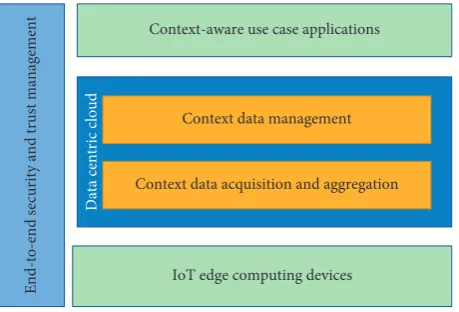
End-to-end security and trust management
Context-aware use case applications
Data centric cloud
Context data management
Context data acquisition and aggregation
IoT edge computing devices
3.2. Context Information Access and Processing. This section introduces the context awareness component (as illustrated in Figure 6) that we have designed, for deployment on the IoT platform to process context data obtained from IoT context brokers and other IoT platforms such as the FIWARE broker [31]. Each of these components will be discussed in the next sections. The framework consists of various processing modules to be incorporated into our trust-based platform for intelligent service delivery in the IoT environment [16]. The context framework has been designed to provide the capability for high-level context classification, using machine learning and ontologies for context classification, semantic processing, and reasoning. In [34], we have described in detail context sensing, context classification, and reasoning using the neural network algo-rithm and various statistical features to identify the context in IoT. In this section, we only provide various steps for context classification and reasoning. However, we extend the concepts developed in that paper by providing here the cognitive model of context information and inference using ontol-ogies, reasoners, and Semantic Web Rule Language (SWRL) [35]. Figure 7 illustrates the relationships between IoT
sensing, cognitive context management, and intelligent IoT-based applications. Figure 8 illustrates an example of how the context framework can infer high-level contexts (watching TV) from raw data accelerometer, GPS, and so on directly obtained from sensors.
3.2.1. Context Sensing and Preprocessing. The ability of a system to identify contextual situations and to make in-formed decisions is one of the most important functions of any context-aware system. However, sensors emit data that are in low-level formats, which are not suitable for decision-making by mobile applications [36]. Context recognition process collects raw data from sensors and transforms them into information that can be used to build intelligent ap-plications. To provide an accurate context information about service consumers, the proposed framework uses the context recognition process to identify contextual information such as user activities, from smartphone-embedded and IoT sensors (obtained in the form of Web Services APIs from IoT platforms). The framework’s sensing module gathers events from these sensors such as accelerometer, gyroscope, Application services
Movie recommendations
Application-specific data
Trust data
Trust manager
Entity profile model
Content-based recommendations
Collaborative recommendations
Hybrid recommendations
Recommendation historical data
Recommendation data manager
Reco
mmenda
tio
n
alg
o
ri
th
m
s
C
o
n
text a
n
d en
ti
ty p
ro
fi
le ma
nag
er
Feedback manager
Context management: context sensing, context recognition, context distribution, and
context reasoning Entity profile
data
Context sensing Context
recognition Context broker
Context
reasoning and inference Context model
IoT devices and sensors
IoT devices and sensors
IoT context information access and processing
IoT devices and sensors Context data and
knowledge
News recommendations
Music recommendations
Route recommendations
Other service recommendations
(e.g., health and tourism)
Personalized service recommendations
Trust-based IoT sensing
IoT sensors
Raw IoT sensor data
Feature vectors
Extracted features Sliding windows Feature extraction
Context filtering Co
n
text da
ta p
rep
ro
ces
sin
g
Time domain, frequency domain,
and so on
Context learning
Learning model testing
Context classification
Context knowledge base
High-level contexts/ contextual situations
Personalized intelligent service delivery
Users
Figure6: Context recognition processes of the proposed framework.
Application layer
IoT sensing layer
Context management layer
Trust and security management
Context-aware intelligent applications
Query engine Context knowledge base
Context representation
Context recognition
Context brokers
Context provider
IoT sensors Inference engine
OWL ontologies
rotation vector, orientation, proximity, microphone, light sensors, and other sensing devices, preprocesses the data, and then uses classification algorithm(s) to derive a more meaningful context information. It collects sample data from each sensor in predetermined time intervals over-lapping the next predetermined time space. In the data-preprocessing phase, the framework removes the data outliers [34, 36]. This is achieved by eliminating samples from the beginning and ending of each example to reduce the influence of noise in the streams of sensor data.
3.2.2. Feature Extraction. The user’s dynamic contexts, such as activities, occur in relatively long period, in seconds or minutes, compared to the sampling rate of the sensors. This sampling rate usually does not provide sufficient data to de-scribe user activities. Therefore, activities are usually identified on time window basis rather than sampling rate basis [37]. Comparing a series of time windows to identify activities is almost impossible even if the signals being compared come from the same user performing the same activity context [13]. The feature extraction process addresses this problem by fil-tering relevant data and obtaining quantitative data from each time window. Many approaches have been explored in liter-ature such as statistical and structural properties of the sensor signals. Structural features such as Fourier transform are quite complex and require more computational resources [37]. This may not be ideal for an energy-starved smart device. On the other hand, statistical features are simple and require less computational resources. Thus, this process uses simple labeled statistical features (e.g., range, maximum, minimum, mean, and standard deviation), which have been validated in our previous work to be very effective to discriminate between time windows [34, 36]. These features are extracted into feature vectors that are then used in the next process.
3.2.3. Context Classification. After extracting the time window features from the raw sensor signals, without de-riving the context knowledge from them, the example fea-tures are limited in how they can be used. The context
classification uses supervised machine learning algorithms such as the neural network (NN) to derive high-level context from the statistical features. Details of the modeling and evaluations can be found in [34]. These models are in-tegrated into the recognition service to obtain independent future activities and contexts of the users.
3.2.4. High-Level Context/Contextual Situations: Context Inference. The context information obtained from context recognition and classification processes is not able to provide cognitive meaning of complex context information, in ad-dition to not being able to recognize complex context in-formation. Thus, it is important to develop a cognitive model based on semantic web technologies that can infer higher-level contextual situation from these individual contexts as illustrated in Figure 7. For example, it is important to know what a user is presently doing, when, and where he/she is doing it. Nevertheless, without relating this information to provide a more high-level contexts, this information will not be useful to the application. This is one of the weaknesses of some of the existing work. The proposed context framework thus uses the knowledge-based model on top of the clas-sification process to relate different atomic context in-formation to obtain contextual inin-formation at a higher semantic level. For example, having known that a user sitting at home is in the living room, if we know that the TV is on, then it is important to relate this information and conclude that the user is watching TV. For example, having known that a user located at home is sitting in the living room, if we know that her TV is on, then it is important to relate this information and conclude that the user is watching TV. The user is watching TV, obtained from sitting, home, living room, TV, and so on, is inferred using the knowledge-based cognitive process. The details of this process can be found in [35, 36]. It can also determine complex context such as a user is “jogging at the sport arena.” This kind of information is crucial to offering rich quality of experience to users.
(1) Ontology Concepts. In this section, we introduce the design of the ontology model in the proposed framework for the inference of higher or complex contextual information from the atomic context classified by the context recognition model. To infer higher-level or complex contextual situation from the recognized and classified contexts from the pre-vious section, we have developed semantic web-based on-tology reasoning for context in the IoT environment. As illustrated in Figure 9, we have provided some important concepts from which the ontology was designed and de-veloped. To infer high-level contexts from those concepts, context reasoners and context rules have been used. The conceptual context framework incorporates nine generic in-terrelated concepts, which were defined for providing context information for the context-aware media recommendation domain. Eight of the core concepts are based on our previous context representation model in [35] but now extended to incorporate trust as an additional concept that relates with other core concepts as a property.
The ontology is being developed using OWL DL with adequate provision for adaptation decisions, relying on
Application Carisa is watching TVSituational context: Application
High-level contexts Living room
Home Home map Sitting TV on
Low-level context/raw sensor data Sensor (GPS)
data: lat 37.687064 long –22.049645
Sensor (accelerometer)
x: 0.0383072, y: 2.68151, z: 8.65743 blaster [0,1]Sensor: IR
various rule-based mechanisms, which support an automatic knowledge inference from contextual information [38, 39]. The cognitive model has been designed as a two-layered model consisting of lower and upper layers representing upper and lower domain ontologies as illustrated in Figure 10. The first layer is the primary or upper domain ontology with 9 core concepts: User, Device, Environment, Service, Activity, Time, Trust,Adaptation,and Network. The concepts in this domain are generic and are valid for many application scenarios. The second layer incorporates specific domain ontologies, integrating reasoning and rules for inferring contexts specific to each domain. The specific or lower domain ontology is designed based on the combination of user specific activities and locations and other contextual situations. For example, the userhome domain activityand the related contexts determine contextual information that characterizes the user’s activities when at home. Figure 11 illustrates the relationships between semantic concepts, the building blocks of the proposed cognitive context reasoning model, ontology, and the SWRL-based context model. We define the primary concepts of the context model as follows: User: the central focus of any context-aware recom-mendation system is the user. In these systems, information such as location, activities, and preferences is very crucial to building a system that adapts to the user’s needs. This contextual information influences the user’s preferences for service consumption, and therefore, when recommending service items to the user, it is important that this information be incorporated into the recommendation process.
Time: the time concept is primarily used to capture the “when question” of the other concepts. Time duration, start time, end time, and so on are some of the elements of this concept. These elements of the time concept are used to infer, for instance, high-level time information such as weekdays or weekends which is subsequently used in ad-dition to location information to infer a user’s contextual situation including her activity contexts.
Device: the characteristics and capabilities of IoT devices can have significant impact on the personalized
recommendation process. The device characteristics can be used to adapt recommendations to the user’s device.
For example, the device battery level can be used to determine the appropriate format to present recommended items. In fact, it may present the item such as streaming video in a format that requires less power such as in text form. If the battery level is low, the recommendation system could decrease the brightness or lower the spatiotemporal resolution of the content in case of an audiovisual content. In addition, this concept also describes the capabilities of the devices.
Environment: another important concept of the ontology is the natural environment. This concept influences the kind of items users would prefer to consume depending on the environmental condition or situational contexts. It provides information about the environment in which a user interacts with the recommendation system or his device. There are two groups of fundamental concepts related to the envi-ronment concepts: location, including logical (e.g., city and street) and physical (e.g., GPS coordinates), and environ-ment conditions (e.g., noise level, illumination, and weather information). For example, information about the current weather can be used to provide more relevant media rec-ommendations to users, that is, the category and genre of contents preferred by the users can be influenced by weather information.
Activity: user activities can be used in addition to the other context information by the recommendation process, given that they have a strong impact on the preferences and needs of mobile users, as previously stated. As explained in the previous sections, to address this problem, low-level data obtained from device-embedded sensors are channeled to a context recognition model running on the device, which recognizes high-level activity being performed by the user. To relate this activity information, as illustrated in Figure 12, with other contextual information, an activity concept was designed as part of the ontology.
Network: the network concept describes the conditions and characteristics of the network connection of the user User
Activity Time
OWL ontologies
Service
Recognized contexts
Context
reasoners Context rules knowledge baseContext Context inference &rule specifications Concepts and
properties
Tr
us
t
Adaptation
Device/terminal Environment Network
device. It describes such aspects as the network maximum bandwidth, network minimum guaranteed bandwidth, error rate, network delay formation, and currently available net-work bandwidth.
These characteristics can be used either to enhance a minimum level of quality of media consumption or even to help to decide between different versions of the same media item. Service: information about candidate services, for example, multimedia content such as streaming movies, to recommend is also an important concept. The most important features of the class are the metadata and the presentation format of the service. From this concept, let us
take a streaming movie as an example, from which in-formation about the genre, titles, and so on can be obtained. This information could be used in the recommendation process to filter important characteristics of the audiovisual content, such as video-audio formats and so on.
Adaptation: the adaptation concept describes the presentation of the service items based on the device characteristics, environment conditions, network conditions, and so on [20, 35]. The adaptation concept relates to other concepts such as the environment, device, network, time, and so on. The concept can be used to define rules to determine when and how a service should be delivered. For example, if
Trust
Trust
Trust
Trust
Trust
Trust
Trust
Activity Service
Device
environmentFor
hasTime
Time User
Location
hasLocation
hasCondition environmentFor
environmentFor
environmentFor
Environment conditions Environment
Figure11: Relationship between the framework ontology concepts and trust. Context information
Activity Device Network Time Environment Adaptation Trust
Lower domain ontologies Upper domain ontologies
Traffic domain
Office domain Home domain
User Service
the network condition such as bandwidth is very poor while delivering a streaming movie in HD, the adaptation decision could decide to deliver the content in formats that consume less computational resources.
Trust: trust has been used as a measure of confidence that an entity will behave in an expected manner despite the lack of the capability to monitor or control the environment in which it operates [5]. Trust is an important concept as we enforce confidence in items being suggested to the target users. In our framework, trust is used to enforce confidence of the target users in the recommendations that are provided in the given contexts. In the semantic model, trust is used as a property of other concepts (Figure 11), whereby every concept has an associated trust property and it is measured based on the feedback obtained from users after consuming services in specific contextual situation.
(2) Cognitive context reasoning using SWRL. The knowledge-based or cognitive context model incorporates reasoning mechanisms based on two methods. The first method is the inherent ontology reasoning mechanism that is responsible for checking class/concept consistency and implied relationships. This method uses the inference engine such as Pellet or Jena to provide functionality for checking the consistency of ontologies, computing the classification hierarchy, explaining inferences, and answering queries [41]. The second method is based on the Semantic Web Rule Language (SWRL) [42, 43]. Because OWL does not provide the mechanisms for expressing all relations between con-cepts in the ontology model, OWL has been extended with SWRL to allow inferring new knowledge from multiple facts or conditions at the same time by providing mechanisms for expressing complex relations. For example, OWL cannot express the relation between a child and married parents
because it does not have the mechanism to express the relation between individuals with which an individual has relations. For instance, OWL cannot relate that a user, say Ana, is the child of the married parents James and Comfort. Neverthe-less, with SWRL, this can be expressed in the follow-ing way:user(?u)∧hasParent(?u,?f)∧hasSpouse(?f,?m)→ childOfMarriedParents(?u). This specification adds rules to OWL ontologies, while also providing an extra layer of expressivity and the capability to infer additional information from an OWL knowledge base. Basically, SWRL consists of antecedent and consequent parts, which in turn consist of positive connections of atoms. Informally, SWRL can provide high-level reasoning in the following form:if all atoms in the antecedent are true, then all the consequents of the rule must be true or vice versa. Besides, SWRL comes with built-in unary predicates for describing relations between classes and data types, binary predicates for data properties, and some n-ary predicates such as arithmetic operators to compute desired behaviors. For example, it is easier using SWRL to infer if Ana, in the previous example, is an adult or not using these built-in predicates as follows: user(?u)∧hasAge(?u,?age)∧swrl:
greaterThan(?age,18)→adult(?u). Likewise, by combining time and location data, the type of the device, and whether the user is accompanied or not, as well as user activity, the system will be able to infer the situational contexts of the user, for example,Ana is sitting at home.
In listings 1–3 of Figure 13, we provide some examples of specific domain rules supported by the context ontology model. Listing 1 is an example that infers that the user is indoor, sitting at home, and on a weekend. In listing 2, the user is in outdoor in the office walking, whereas in listing 3, the user is indoor, sitting in the office. Using this contextual information, personalization systems can be designed to Sitting
Standing
Lying
Walking
Running
stillActivity
motionActivity
isStillAndMotionActivity
Driving
Jogging
StandingInVehicle
SittingInVehicle SittingInBus
Environment Activity detectedBy
activityOf
performedIn Device
User
Still
Still_Motion Motion
recommend relevant service items that suit these specific contextual situations and preferences of the user [40].
3.3. Trust Evaluation. TheTrust Evaluationaggregates trust-related information and feedback obtained from users whenever they consume services in specific contexts to derive an evaluation for the trustworthiness of context data. Such evaluation for the trustworthiness supports decision-making of users. The trust evaluation is done using the following key modules as illustrated in Figure 14:
(i) Trust Data Collection and Preprocessing: the data collection implements the trust data collection agents using the available interfaces or APIs pro-vided by the IoT platform data access layer such as the FIWARE [44] context broker or other REST interfaces, to collect or gather trust-related data. The data could be opinions of entities (users) as feed-backs on services consumed and so on.
(ii) Trust Feature Computation: the feature computa-tion is responsible for computing/extracting fea-tures from the collected trust-related data. It also preprocesses the collected data to eliminate erro-neous or repetitive and other irrelevant data for trust indicators’ evaluation.
(iii) Trust Data Store: this module is responsible for storing trust-related data and the history of inter-actions between entities of the IoT platform. Addi-tionally, this historical data store stores trust scores for the entities of the platform. Any trust score consumers, for example, recommendation manager, can interact with the trust data store via a web service interface, or via the Wise-IoT data access component such as the FIWARE broker to request such data. (iv) Trust Indicator Computation: trust indicator
com-putation implements one of the functionalities of the trust evaluation, realized based on the REK model [16]. It is responsible for calculating trust indicators such as experience, reputation, and knowledge. (v) Trust Score Evaluator: this implements the REK
model, the main module responsible for evaluating and generating trust scores for IoT entities of the frame-work. The trust evaluator computes the trust score or
index from the combination of trust indicators, for example, experience, reputation, and knowledge.
In summary, the trust evaluation module subscribes to the IoT context broker. Whenever a user submits a feedback about the service he/she has just consumed, the feedback manager sends the feedback information to the trust com-ponent (TC), using the provided API. Details of mechanisms for trust score computation can be found in [16].
3.4. Contextual Entity Profiling. We define a user as any entity that has the capability to provide and consume services be it data or any other information service. In this section, we present a profile/preference model capable of using the user’s contextual situation, preferences, and other related infor-mation to personalize and deliver relevant services.
3.4.1. Contextual User Preference Definition. The user profile describes preferences of a user in the form of a summary, normally based on the history of the user’s actions such as consumption or provisioning of services [9]. The contextual user profile service (CUPS), based on our previous work in [11, 20], summarizes the user’s service consumptions into a limited set of categories. Categories can be characterized by one or more services, and such services can be characterized by many properties or attributes. Several services can be associated with one or more service categories. In addition, the profiling model incorporates contextual dimension, associating one or more inferred context with each category-service-property relationship, with each context having an associated trustworthiness score. Thus, we have category-service-property-context-trust concept, presenting each user profile as a five-level tree, as shown in Figure 15, and the root of the tree represents the entity or user’s optional information such as entity ids, timestamp, and so on. The first level of nodes corresponds to the service category; the second level represents the services associated with the specific service category; the third level contains the attributes of a given category-service. This level provides the service item’s context, characterizing at a finer detail, the consumed service, and thus the preferences of the user. A limited set of properties is used for each service to obtain a good compromise between suf-ficient degree of characterization of service (hence, sufficient ability to make distinctions) and reasonable dimensions of the
Listing 1
Context:hasUserId (?user, ?userId) context:atHome (?user, ?location) context:weekEndAtLocation(?location, ?weekend)
Context:locationTimeIs (?location, ?time) context:isMorning(?location, ?time) context:inIndoorLocation (?user, "true")
Context:hasUserActivity (?derived, ?activity) context:hasHomeLocationActivity (?user, ?sitting)
Context:hasUserId (?user, ?userId) context:atOffice (?user, ?location) context:weekDayAtLocation (?location, ?weekday)
Context:locationTimeIs (?location, ?time) context:isEvening(?location, ?time) context:inOutdoorLocation (?user, "true")
context:hasOfficeLocationActivity (?user, ?walking) Context:hasUserActivity (?derived, ?activity)
Context:hasUserId (?user, ?userId) context:atOffice (?user, ?location) context:weekDayAtLocation (?location, ?weekday)
Context:locationTimeIs (?location, ?time) context:isEvening(?location, ?time) context:inOutdoorLocation (?user, "true")
context:hasOfficeLocationActivity (?user, ?sitting) Context:hasUserActivity (?derived, ?activity)
Listing 2
Listing 3
user profile. The leaf nodes provide information about the contexts (where the user preferences have been expressed) and associated trust score representing trustworthiness of the context information. Leaf nodes have four numerical fields (type, trust score, intensity, and lifetime), whereas all other nodes have only the type field. In the leaves, the types rep-resent the type of context. The introduced concepts in the user profile, the intensity, trust score (as an extension), and lifetime, track the user’s contextual consumption history, allowing incorporation of the trustworthiness of the contextual situa-tion wherein the users consume services.
Using these weighted parameters, the system can de-termine the services that are important and relevant to the target user based on his/her contextual preferences with some
measure of confidence. The intensity provides information about the number of times the user has consumed items of that category-service-attribute in that specific context. The intensity (the dynamic preference of the user) of those ele-ments belonging to the item’s content tis calculated by summing up the products (weight×lifetime) of all their oc-currences. The intensity value of the retained elements at this level is obtained by visiting their child nodes in a breadth-first traversal. The same applies to the retained elements of the category level. The intensity of the ele-ments that belong to the genre level is the largest value of their children. Accordingly, these values are obtained by performing a depth-first traversal. This way, the user profile can handle any category of services, for example, services IoT applications
IoT context broker Trust management component
Trust indicator computation (REK)
Trust index and value evaluation Experience, knowledge,
reputation Trust feature
computation
Trust data collection and preprocessing
Trust data
(e.g., feedback rating) Trust score/index Local trust data store
Honesty, similarity, cooperativeness, and so on
Figure14: Trust computation component.
Entity (e.g., user, object) Entity
s1 s3 sn s1 s2 sn
sa1 sa2 san sa1 sa2 san
sc1 sc2 scn sc1 sc2 scn
t1 t2 tn t1 tn t1
ca2 can
ca1
Service category (ca)
Service (s)
Service attribute (sa)
Service context (sc)
Trust and reputation (T and R)
providing multimedia items such as movie, news, and music to name a few.
The intensity (the dynamic preference of the user) is computed by summing up the product (weight×lifetime×trust score), given in (4), of all their occurrences.
Pri�
ni�1(weight×lifetime×trust) (1)
3.4.2. Entity Profile Definition. LetEbe the set ofNthings or entities, and entities can be humans (users), objects, or devices. Each entityE�e1, e2,. . ., enis defined bymset of optional
demographic attributesA�A1, A2, A3,. . ., Amand a set of preferences Pr(ui) �pr1,pr2,pr3,. . .,prir, where each
preference Primof user a is further defined by a set of attributes
SA�sa1,sa2,sa3,. . .,sap. Furthermore, we have a set of
high-level context information SC�sc1,sc2,sc3,. . .,scn
associated with each preference Pri.
In the above definitions, context SC has a very complex structure, which reflects the nature of the difficulties in ac-curately representing context information. However, in this paper, it is assumed that the context information is defined by a structure that allows atomic contexts to be related in a way that allows high-level contextual information to be inferred, that is, a three-layer structure of inferring from low-level sensor data, a high-level atomic context formation, which can be related to another context in-formation to arrive at a higher-level semantic context information. For instance, from the above definition, an entityeiwhereei∈E�e1, e2, e3,. . ., enis defined by a set of demographic information A�{entityId, Name, etc.}, by a set of preferences Pr�pr1,pr2,pr3,. . .,prn. Each service
is classified into a category Ca�cr1,cr2,cr3,. . .,crn. Each
category is characterized by a set of services
S�s1, s2, s3,. . ., sn, and each service is characterized by
a set of attributes Sa�sa1,sa2,sa3,. . .,san. In addition,
each context scidefined above is associated with the set Tr�
tr1,. . .,trn
of trust. The trust value defines the confidence of the user in services recommended to his/her in that context. The model of the user preference can then be built in a general form as follows:
Y�f(X1, X2, X3,. . ., Xn), where X1, X2, X3,. . ., Xn
represent the profile information such as the set of service attributes,A, and preferences, Pr, characterized by the sets S,Ca,and SC with associated trust values Tr. Y is the dependent variable (representing user preference) to be predicted, and function f is the predictive function as provided in Section 3.4.3. For example, we can predict the services that useruiwill like to consume using this model. This model can be defined such that we can have context-based user preferences, context-aware trust-context-based user preferences, and user preferences without context and trust information as defined in (2)–(4), respectively.
Yct�fct X1C1T1, X2C2T2,. . ., XnCnTn, (2)
Yc�fc X1C1, X2C2, X3C3,. . ., XnCn, (3)
Y�f X1, X2, X3,. . ., Xn. (4)
These models can be used to build the contextual user profile and can also be switched to build the traditional user profile.
The parameters ci�1,. . ., ci�n represent the contextual informationti�1,. . ., ti�n;fc,fct, andfare the functions for retrieving users’ contextual preferences, user context-aware trust-based preferences, and ordinary user preferences, re-spectively. As (2)–(4) illustrate, the profile model can be used to learn the user profile in three modes. It works in the contextual mode and in the noncontextual or traditional mode to determine the user preferences with and without using contextual information, respectively. The traditional mode (non-contextual mode) is executed in situations where the user’s contextual information is not available or when it is difficult or impossible to acquire. In this mode, an entire profile considering the user consumption history (if any) is used. Alternatively, it could use the consumption history of users who have similar preferences to the current user to learn the target user’s preference. The default mode is the contextual mode in which the user’s contextual information is used to learn the user’s preferences. The contextual mode allows us to incorporate trust information of the context information, and thus, the ability to evaluate the preferences is not only based on contexts but also based on the trust information of the contexts.
information nor measures how long a user has spent during the consumption of any service, for example. Measuring time spent on recommended items as argued by Bjelica [42] may lead to wrong conclusions. Thus, rather than measuring time spent when consuming content, we used a combination of the contextual user profile learning model and the context in which users respond to recommendation either by clicking or not (e.g., the device’s screen) to learn the user’s feedback on the recommended items. It then extracts implicit information about such items to learn whether users like or dislike such items by assigning what we call relevance values to the extracted information, such as category of the content and its genre, taking into consideration the contextual situation of the user at that given time. The system automatically assigns these relevance values in two numeric formats as illustrated in (5)–(7) consisting of weight w and lifetime c parameters. Equation (5) represents positive feedback, whereas (6) rep-resents negative feedback. Equation (7) is used as a decay function, which updates the preferences as the elapses.
An intensitywijrepresents the relevance of a service with the preference pri belonging to the contextual situation C
that entityeiconsumes in contextCi. Whenever the context awareness model detects that the entity is in a contextCi, for
a continuous period of time [0, T], the reasoner finds the preference of services1, s2, s3,. . ., sn, whose contextual sit-uations match the present contextual situation of the entity; then, weights wici∈[0,1] are associated with this service preference, which at time Tare updated as follows:
wici�wi−1ci−1 + c α−wi−1ci−1, i�1,2,3,. . ., n. (5)
Then, for those servicesb1, b2, b3,. . ., bnwith associated weights w1b1, w2b2, w3b3,. . ., wnbn not consumed by the user, these weights are updated as follows:
wici�wi−1ci−1 −c α−wi−1ci−1, i�1,2,3,. . ., n, (6)
wherecis a learning parameter whose value is obtained by
c�1− t
45
5
. (7)
α∈[0,1]and its value is set to 1 in (5) and 0 in (6). Equation (7) was derived so that certain attributes in the user profile that represent items that have not been seen for a long period (note that we have considered the long period to be 30 days) will eventually have no impact on the preference evaluation. However, unlike our previous solution in [11], where the weightwiprovides information on the number of times the user has consumed items in specific contexts, here wi represents the trust tri of context of consumption
com-puted from feedback information obtained from users. The lifetime parameter, c, provides an indication of the time elapsed since the last consumption occurred. Its value is set to 1 when the user consumes a service that belongs to a category-service-attribute of Figure 14 and periodically decrements it if the consumed service does not belong to such category-service-attribute. Smaller values indicate that the user has lost interest in that type of service, regardless of the value of its weight or contexts. We also use this value to determine if a trustworthiness can be considered valid or not.
For example, in practice, it allows to give more importance to contexts of items consumed recently and less to those con-sumed long time ago. The factorαhas a value in the range
[0,1], assigning less or more importance to new category-service-attribute. For newly created category-service-attribute,
αassumes the value of 1; otherwise its value, determined based on experiments, is set at 0.5. The value of−1 is used to indicate that the user has rejected or not preferred a service item with those properties.
Thelifetimeparameter as explained earlier is set to 1 for matching items in the user profile, by assigning the value 0 to the factort. The factortrepresents the number of days elapsed since the last time the user has consumed an item with the characteristics described by the profile. With (7), the relative importance of the category-service-propertyof an item con-sumed by a user remains above 0.9 in the first 30 days after it has been visited, rapidly decreasing to zero after that period (nonnegative values are automatically converted to zero). For all othercategory-service-attributein the user profile, the update of the lifetime parameter is performed by linearly increasing the value oft. Thus, category-service-attribute of a service that has been consumed before but has not been seen or consumed for a long period will have either low or no impact on the user preference evaluation. Also, note that the trust score influences the relevance of a given service.
3.5. Incorporating Trust as an Extension of the Context-Aware Recommendation Process. In this section, we demonstrate how trust can be incorporated into context-aware collabo-rative recommendations. The process of incorporating trust into the recommendation system, especially context-aware collaborative recommendations, is in three key important steps, namely, building entity profile, generating entity trust, and predicting service preferences for the target user.
3.5.1. Building Entity Profile. Generally, this process involves associating user preferences with contexts in which such preferences have been expressed. As discussed in Section 3.3, every time a user consumes a service, information such as the context of consumption, relevance of that service in such a context, which is given as rating provided by the user after consuming the service or through an implicit means, and the computed trust score for the given context is captured in the user profile. Also, the user profile is updated using a relevance feedback mechanism explained in Section 3.4.3 Thus, the context, the preference, the relevance feedback, and other information about the consumed service will make up the entity or user profile.
3.5.2. Trust Score Computation. The second step, which involves how the trust score is computed for any entity such as the context of a user, is beyond the scope of the current paper. However, Jayasinghe et al. have provided computational models for trust computation in [16], in-terested readers can check the reference for details. However, the trust score for a given context of con-sumption is computed using the implicit or explicit rating information obtained from the relevance feedback process, and this score is associated with the context, service, and preference of the service for a given user in every con-sumption session.
3.5.3. Generating Predicted Preference. In this section, we illustrate how trust can be used to generate predicted preference for a given item or service for a target user.
In a typical collaborative recommendation system, the goal is to predict rating (preference) of the target users based on the similarity of other users with similar taste. This concept has been extended in context-aware collaborative recommendation where the goal is to first determine users who prefer certain items in a similar context and then exploit this information to predict the preferences of the target user in such contexts [11]. Thus, in a traditional collaborative recommendation, typically the Pearson Correlation Co-efficient (PCC) is used to find the degree of linear re-lationships between two entities. In this article, we modified the PCC to incorporate contexts. This means that the degree of linear relationships between two entities takes their contexts into account. Thus, the similarity between an entity vand its neighboruin contextccan be defined by the PCC equation as follows:
wv,u,c�
m
i�1pv,i,x−pvpu,i,c−pu
σvσu
. (8)
Using this equation, the CARSs can combine the sim-ilarity between the relative preferences of usersvandufor the same item in contextcfor all the items they have both consumed and preferred in that context or other similar contexts. Usually, it generates one of the two values: +1 or −1. +1 means that usersvanduhave similar taste, and−1 means that they have dissimilar taste.
After obtaining the similarity betweenvandu, CARSs process the profiles of all friends ofv, that is, those users who have similar taste as t