Representing and Reasoning with the Internet of
Things: a Modular Rule-Based Model for Ensembles
of Context-Aware Smart Things
S. W. Loke
1,∗1DepartmentofComputerScienceandInformationTechnology,LaTrobeUniversity, KingsburyDrive,VIC
3086,Australia
Abstract
Context-aware smart things are capable of computational behaviour based on sensing the physical world, inferring context from the sensed data, and acting on the sensed context. A collection of such things can form what we call athing-ensemble, when they have the ability to communicate with one another (over a short range network such as Bluetooth, or the Internet, i.e. the Internet of Things (IoT) concept), sense each other, and when each of them might play certain roles with respect to each other. Each smart thing in a thing-ensemble might have its own context-aware behaviours which when integrated with other smart things yield behaviours that are not straightforward to reason with. We present Sigma, a language of operators, inspired from modular logic programming, for specifying and reasoning with combined behaviours among smart things in a thing-ensemble. We show numerous examples of the use ofSigmafor describing a range of behaviours over a diverse range of thing-ensembles, from sensor networks to smart digital frames, demonstrating the versatility of our approach. We contend that our operator approach abstracts away low-level communication and protocol details, and allows systems of context-aware things to be designed and built in a compositional and incremental manner.
Receivedon 10 November, 2015;acceptedon 6 February, 2016;publishedon 09 March, 2016
Keywords: smart artifacts; context-aware artifacts; operator language; compositionality; Internet-of-Things (IoT) Copyright © 2016 S.W. Loke, licensed to EAI. This is an open access article distributed under the terms of the Creative Commons Attribution license (http://creativecommons.org/licenses/by/3.0/), which permits unlimited use,distributionandreproductioninanymediumsolongastheoriginalworkisproperlycited.
doi:10.4108/eai.9-3-2016.151113
Introduction
Due to developments in pervasive computing and embedded systems, there has been a growing number of types and varieties ofsmart things, which are capable of computationally based behaviours, communicating
with each other over the Internet1 or over short
range networks, and sensing the physical world [4, 30]; they can have context-aware behaviours [41], and are becoming even cloud-enabled [22]. These things can then intelligently respond to the context or situation they sense, via some computation. Smart things might also be everyday objects (e.g., vases, books, picture frames, furniture, clothings, etc)2 endowed
∗
Corresponding author. Email:[email protected]
1http://www.theinternetofthings.eu
2The e-gadgets model view everyday objects as components, see
http://www.extrovert-gadgets.net/
with embedded processors, intelligent sensors, mobile devices with sensors, appliances [26], or simply new types of devices [48].
A number of paradigms have been employed to program such things, including Web service based
methods,3 that assume each device has an embedded
Web server that receives and responses to invocations, UPnP service styles,4 JINI,5 and peer-to-peer based styles such as JXTA,6 and various visual editors such as [21,25, 38]. For some time now, we have seen the application of rule-based programming for behaviours of collections of smart things, such as [24,25,49,50],7
3See http://docs.oasis-open.org/ws-dd/ns/dpws/2009/01 and [31]
4See http://www.upnp.org/
5See http://www.jini.org/wiki/Main_Page
6See https://jxta.dev.java.net/
7Others are https://www.onx.ms/ and http://appinventor.mit.edu/
on
C
ontext-aware Systems and Applications
though such work generally do not consider reasoning with groups of rules. Basically, context information gathered via sensors are reasoned with and appropriate action taken based on these rules.
The general structure of smart things, sensing, reasoning and acting [33] corresponds to context-aware mobile computing systems as early as 1994 [43], and in fact, many context-aware systems do have that general structure.
However, when a collection of such smart things are put together, and if they can sense and react to each other, it is not easy to reason about the collective behaviour of the ensemble, and it is not easy to determine what will happen as a result of combining such smart things.
Following the design philosophy first introduced
in [36] and also used in [35], in this paper, we
elaborate on an approach (and formalism), which we
call Sigma, to represent compositions (or collections)
of smart things that can sense their environment and context and act in response to what they sense. The formalism comprises a language of operators, inspired by modular logic programming [12], for composing systems, the advantage of using operators being to encapsulate the cooperation between systems, leaving it to the implementation to realize that cooperation. The compositions are not necessarily physical compositions of the things (e.g., if the things are vases, a composition here does not necessarily mean gluing the things together), but rather, are compositions of their representations. Such compositions specify how things may cooperate in their sensing and acting; we call a collections of things that can communicate with each other, and whose behaviours are composed, a thing-ensemble. Note that our view of cooperation here is the idea of a set of devices working together complementarily for a purpose, and coordinated
to achieve an effect via a set of operators with
predefined semantics, not autonomous cooperation as in multiagent systems research. It should be noted that a thing-ensemble is, hence, different from an arbitrary set of appliances or sensors, in that we assume that the things in the ensemble can interact with each other, in the way we describe later.
We show how a variety of thing-ensembles can be represented, ranging from the smart living room applications, sensor networks to smart digital frames, and their behaviours specified. We use the term
ensembles to emphasize that the things are in some kind of coordinated relationship with each other in order to fulfill their own tasks or end-user specified tasks, and things typically play different roles in such a cooperation. Moreover, this paper deals with the formalism to specify such compositions but not the implementation details.
The twofold purpose of our formalism for represent-ing and reasonrepresent-ing with threpresent-ing-ensembles is as follows:
• Abstraction. We present a set of operators that provides well-defined compositions of smart context-aware things. This enables reasoning about what collective behaviours could emerge when an ensemble of such smart things interact or are composed. While this may seem constraining (restricted to the collection of operators we have), we present a small set of operators which can be used to model interactions in a range of scenarios, showing that even a small set of operators can be quite expressive and useful.
• Incremental and compositional design for the Internet of Things.We also argue for the need of a design approach that provides a means to build or extend thing-ensembles in an incremental manner, i.e., new things can be added to a collection, and new composed behaviours attainable without considerable developer effort, or considerable change to the existing thing-ensemble. The idea is that smart context-aware behaviours of a collections of smart things (and/or computer devices) can be effectively “grown” over time. While in a different context, a parallel of this idea is McCarthy’s notion ofelaboration tolerance
(especially, additive types of elaborations), which is “the ability to accept changes to a person’s or a computer program’s representation of facts about a subject without having to start all over.”8 In our case, it is the addition of new smart things (e.g., new computational nodes, storage, sensors, appliances, etc) to an existing system (a collection of smart things), without needing to start over or redesigning the whole system. Our examples in a range of scenarios demonstrate this idea where the behaviour of each thing is simply modelled as a module of rules. There are pragmatic advantages of this since if old devices can be combined with newly added devices, then reuse of the old devices in the presence of the new is facilitated, or if newly added devices can override (or suppress) the functionality of older devices in a well-defined manner, then the new behaviour can be better understood.
The contributions of this paper are twofold:
• Theoretically, the Sigma formalism serves as a
basis for a unified model of cooperating thing-ensembles that act on an understanding of their situations. We seek to expose and formalize the
8http://www-formal.stanford.edu/jmc/elaboration/elaboration.html
2
EAI
European Alliance for InnovationEAI Endorsed Transactions on Context-aware Systems and Applications
underlying structure of a diverse range of thing-ensembles, which might seem rather different on the surface, but in fact, have common structure and behaviour. The fact that these operators can be defined which capture how different systems of context-aware things work together in different contexts suggests the generality of the operators and emphasizes the common features of these systems.
• Practically, the Sigma formalism (perhaps with
syntactic sugar if needed) can be used in two ways:
– as a specification language for designing
context-aware IoT applications [41, 47,
58]; the formalism encourages a modular approach to the problem, and also allows incremental development where an existing system can be modelled and then, add-ons can be represented and combined with the existing system via suitable operators; a smart thing can be modelled as a rule-base but then implemented in hardware, or it can be a softwareprogrammable device -our approach is agnostic to this, and
– as a scripting language for programming behaviours of cooperating context-aware things, where the combined behaviour is embedded within the operators, thereby pro-viding a high-level of abstraction, without the programmer needn’t to deal with under-lying protocols; but an interpreter for the operators would need to be implemented first.
In the next section, we present a brief overview of operators we will use in composing behaviours of things. Then, we will describe scenarios of thing-ensembles. Related work is then reviewed, and finally, we conclude with future work.
Sigma
Operators for Composing Context-Aware
Systems
Context-Aware Systems
We use the operator language and abstract model of context-aware systems from [36], but extend the repertoire of operators here. We use the term context-aware systemto refer to three categories of systems:
• systems comprising only of sensors,
• systems with sensors and context interpretation components, and
• systems with sensors, context interpretation components, and situation reasoners.
The above components are explained below.
The general model of a context-aware systemRis a triple of the form (Σ,Π,Θ).Σ is a finite set of sensors where each sensor σi is a function which senses a part
of the world (in which the sensor is situated at the
time) W ∈W and produces a set of sensor readings
G∈G, i.e.σi :W→G. We letWandGremain opaque
as our discussions do not require their details, but explicit and precise definitions could be given for them;
also, in our case, we assume that the sensors Σ are
attached to (or part of) the particular smart thing (e.g., a vase embedded with touch sensors and a microphone). Often, we will write reading(σi) =G to denote when
reading from the sensorσi has valueG.
In this paper, a context-aware system can map to a thing with sensing, networking and computational capabilities. Or a context-aware system might comprise a thing and associated software and hardware that tracks the thing and provides context-aware behaviour associated with the thing.
The interpreterΠcan then be defined as a mapping from sensor readingsGto some context (e.g., a symbolic
location such as a room number) C∈C (which we
assume are concepts grounded in some ontology such
as SOUPA9 and CONON [52], or other ontologies as
surveyed in [7, 57]), i.e., Π⊆(G×C). So, given W ∈ W, and suppose Σ={σ1, . . . , σn}, and σ1(W) =G1, . . ., σn(W) =Gn (for Gi ∈G), then Π can be applied to
interpret eachGi to obtain a set of contexts{C1, . . . , Cn},
denoted by Π(Gi) =Ci (taken here to mean (Gi, Ci)∈
Π). We will also often write the mapping (Gi, Ci)∈Π
as a rule of the form (Gi ⇒Ci)∈Π, for readability.
The situation reasoner Θ is a relation mapping sets of contexts or situations to situations, i.e. Θ⊆(℘(C∪ S)×S), where S is a set of situations (again, which
we assume grounded in some ontology). We will also often write the mapping ({C1, . . . , Ck, S1, . . . , Sl}, S)∈Θ
as ({C1, . . . , Ck, S1, . . . , Sl} ⇒S)∈Θ, for readability.
Examples of aggregating context to infer situations can be found in the literature [2,16,56,57]. Our model makes the distinction between the notions of context
and situation following the work such as [17, 32],
where context information is used to “characterize the situation of an entity,” modelled viaΘ. While we do not commit to any ontology here, in practice, we assume that systems do return inferred contexts or situations using concepts from a “well-known” ontology in order to facilitate interoperability.
Moreover, we define the relation denoted by `
between systems and pairs of the form (W , S) where W ∈W and S is some situation, such that R`(W , S)
if and only ifRrecognizesS when sensing part of the worldW, or alternatively, if one placesRin the part of
the worldW whereS is happening,S will be detected byR.Rmay be in a worldW whereSis not happening, but as soon asShappens, it detects it.
A situation that is recognized by a system is then either computed from contexts (recognized by some sensors and the interpreter) and other situations (if any) viaΘ. This meaning of the relation`can be expressed
recursively as follows in a rule written in the form
premises conclusion:
({C1, . . . , Cm, S1, . . . , Sk} ⇒S)∈Θ,
for somem, where for eachCi,i∈ {1, . . . , m}, Π(σ(W)) =Ci, for someσ∈Σ,
and for somek, where for eachSi,i∈ {1, . . . , k},
(Σ,Π,Θ)`(W , Si)
(Σ,Π,Θ)`(W , S) (one−system)
We represent context recognition by a systemR, i.e., R`(W , C) for some contextC, whereΠ(σ(W)) =C, for
someσ ∈Σ.
Sigma
Operators on Context-Aware Systems
The Sigma operators on context-aware systems form
a small language of Sigma expressions, given by the
following EBNF syntax:
Q ::= R|Q+Q|QQ|QQ E ::= Q|E⊕E|E⊗E
The Sigma expressions defined by Q only are called
Q-expressions and those defined by E are called E -expressions. The idea is that, given a thing-ensemble, i.e., a collection of context-aware things, the Sigma operators can be used to define different compositions of things from this collection. For example, given a thing-ensemble of three system {R1, R2, R3}, different
Sigma expressions can be defined over them, such as
R1+R2+R3 and R1⊕(R2+R3). Moreover, for these expressions to be meaningful, there must be some way for the Ris to interact with each other, in the
way that we define below. We distinguish between the thing-ensemble and theSigmaexpressions defined over (perhaps some subset of the) things in the thing-ensemble, since each Sigmaexpression describes only
one way (among many) in which the things can work together.
Informally, the meaning of the operators are as follows, extending our relation`given above. The union
of two context-aware systems used in attempting to recognizeC (or a situationS), denoted byR1⊕R2`C, means that contextC (or situationS withR1⊕R2`S) is recognized either usingR1orR2, succeeding if either succeeds. Note that this can be nondeterministic but
one could employ short-circuit evaluation in practice, that is, tryR1first and only on failure try withR2.
Below,Ccan be replaced byS. Theintersectionof two context-aware systems used in attempting to recognize C, denoted by R1⊗R2`C, means that context C is recognized using both R1 and R2, succeeding if both succeeds.
The tight-union of two context-aware systems used in attempting to recognizeC, denoted by R1⊗R2`C, means that contextCis recognized using bothR1cand R2 working in a tightly coupled combined manner (as we define below).
Therestriction of two context-aware systems used in attempting to recognize C, denoted by R1R2`C, means that contextCis recognized using rules fromR! andR2with joint conditions (as we define below). The idea is that the rules in the situation reasoner would have joint conditions. For example, ifR1= (Σ1,Π1,Θ1) and R2= (Σ2,Π2,Θ2), whenever (S1⇒S)∈Θ1, where
S1⊆(S∪C) andS ∈S, and also (S2⇒S)∈Θ2(in other
words, both Θ1 and Θ2 have a rule for S), then we join their conditions when applying the rules to infer S, i.e. we must use joint condition rules of the form (S1∪S2⇒S) to infer S. This generalizes to three or
more systems, say with R3 having (S3, S)∈Θ3, we
have (S1∪S2∪S3⇒S). Note that this is different from
intersection in that with intersection ofR1andR2, each independently try to inferS, whereas with restriction, R1andR2can share sensors and context interpretation, and even situation reasoning rules, but at any step, the rules for a corresponding situation must be joined in their conditions.
Theoverriding unionof one context-aware system by another in attempting to recognizeC, denoted byR1 R2`C, means that the rules of R1 takes precedence over those of R2 whenever the same situation is being considered. For example, ifR1 = (Σ1,Π1,Θ1) andR2= (Σ2,Π2,Θ2), whenever (S1⇒S)∈Θ1, whereS1⊆(S∪ C) and S∈S, and also (S2⇒S)∈Θ2 (in other words,
bothΘ1andΘ2have a rule forS), then we use the rule from R1 only, i.e. (S1⇒S), and ignore any others for
the same situation (of the form (S2⇒S)) fromΘ2. This
operator is inspired by the notion of input suppression from Brook’s subsumption architecture [13], as we illustrate below.
The operators ⊕ and ⊗ corresponds to logical “or”
and“and” respectively, and operators inQ-expressions can be rewritten as single systems with contents from the component systems in the way given by the operational semantics of the operators below. In an implementation of these operators, it may not be possible to physically take the actual constituent components and combine them, but in fact, appropriate (e.g., Web service) interfaces can be used by each component to expose their sensors, interpreter and situation reasoner components, and then calls are
4
EAI
European Alliance for InnovationEAI Endorsed Transactions on Context-aware Systems and Applications
made to these interfaces to emulate effectively a single virtual system (the virtual system represented by aQ -expression).
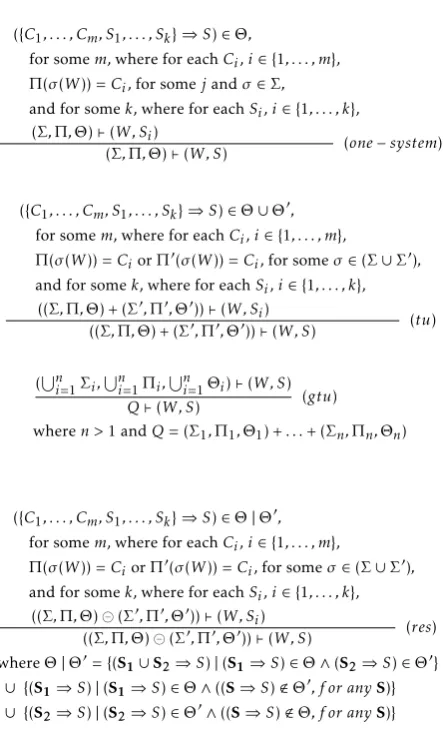
The rules in Figures 1 and 2 provide the operational
semantics, defining the modified relation ` more
precisely. Note that in rules (one−system), (tu), (res)
and (ovr),m and k could be zero for a given member ofΘ, in which case, there is no context or situation in the antecedent.
({C1, . . . , Cm, S1, . . . , Sk} ⇒S)∈Θ,
for somem, where for eachCi,i∈ {1, . . . , m}, Π(σ(W)) =Ci, for somejandσ∈Σ,
and for somek, where for eachSi,i∈ {1, . . . , k},
(Σ,Π,Θ)`(W , Si)
(Σ,Π,Θ)`(W , S) (one−system)
({C1, . . . , Cm, S1, . . . , Sk} ⇒S)∈Θ∪Θ0,
for somem, where for eachCi,i∈ {1, . . . , m},
Π(σ(W)) =CiorΠ0(σ(W)) =Ci, for someσ∈(Σ∪Σ0),
and for somek, where for eachSi,i∈ {1, . . . , k},
((Σ,Π,Θ) + (Σ0,Π0,Θ0))`(W , Si)
((Σ,Π,Θ) + (Σ0,Π0,Θ0))`(W , S) (tu)
(Sn
i=1Σi,Sni=1Πi,Sni=1Θi)`(W , S)
Q`(W , S) (gtu)
wheren >1 andQ= (Σ1,Π1,Θ1) +. . .+ (Σn,Πn,Θn)
({C1, . . . , Cm, S1, . . . , Sk} ⇒S)∈Θ|Θ0,
for somem, where for eachCi,i∈ {1, . . . , m},
Π(σ(W)) =CiorΠ0(σ(W)) =Ci, for someσ∈(Σ∪Σ0),
and for somek, where for eachSi,i∈ {1, . . . , k},
((Σ,Π,Θ)(Σ0,Π0,Θ0))`(W , Si)
((Σ,Π,Θ)(Σ0,Π0,Θ0))`(W , S) (res)
whereΘ|Θ0={(S1∪S2⇒S)|(S1⇒S)∈Θ∧(S2⇒S)∈Θ0} ∪ {(S1⇒S)|(S1⇒S)∈Θ∧((S⇒S)<Θ0, f or anyS)} ∪ {(S2⇒S)|(S2⇒S)∈Θ0∧((S⇒S)<Θ, f or anyS)}
Figure 1. Overview ofSigma operators and associated rules -part 1.
In the rule for tight-union (tu), we can observe a tighter coupling of the three components of sensors, interpreter and situation reasoner compared to union, in that a tight-union composition behaves as an integrated system at all three levels (white-box integration), whereas the union employs multiple systems but each as a blackbox. While the rule specifies that the union of the corresponding components (union of sensors, union of interpreters and union of situation reasoners) are employed in recognizing a situation
(Sn
i=1Σi,Sni=1Πi,|ni=1Θi)`(W , S)
Q`(W , S) (gres)
wheren >1 andQ= (Σ1,Π1,Θ1). . .(Σn,Πn,Θn)
({C1, . . . , Cm, S1, . . . , Sk} ⇒S)∈Θ / Θ0,
for somem, where for eachCi,i∈ {1, . . . , m},
Π(σ(W)) =CiorΠ0(σ(W)) =Ci, for someσ∈(Σ∪Σ0),
and for somek, where for eachSi,i∈ {1, . . . , k},
((Σ,Π,Θ)(Σ0,Π0,Θ0))`(W , Si)
((Σ,Π,Θ)(Σ0,Π0,Θ0))`(W , S) (ovr)
whereΘ / Θ0={(S1⇒S)|(S1⇒S)∈Θ∧(S2⇒S)∈Θ0} ∪ {(S1⇒S)|(S1⇒S)∈Θ∧((S⇒S)<Θ0, f or anyS)} ∪ {(S2⇒S)|(S2⇒S)∈Θ0∧((S⇒S)<Θ, f or anyS)}
(Sn
i=1Σi,Sni=1Πi, /ni=1Θi)`(W , S)
Q`(W , S) (govr)
wheren >1 andQ= (Σ1,Π1,Θ1). . .(Σn,Πn,Θn)
E ` (W , S)
(E⊕E0
) ` (W , S) (union1)
E 0 (W , S) and E0 ` (W , S)
(E⊕E0
) ` (W , S) (union2)
E ` (W , S) and E0 ` (W , S)
(E⊗E0
) ` (W , S) (intersection)
Figure 2. Overview ofSigma operators and associated rules -part 2.
(or context), this happens conceptually, and does not necessarily imply the actual integration of software components. Tight-union has represents a type of interaction among two systems. The generalized form of tight-union to n-ary is given by the rule (gtu). Note that (gtu) with two operands is equivalent to (tu). Restriction represents another type of interaction among two systems, similar to tight-union, but where rules to infer the same situation must be joined in their conditions. The generalized form of restriction ton-ary is given by the rule (gres). Note that (gres) with two operands is equivalent to (res).
needed. Note that costs are added up for evaluations. The rules above can be used in a backward-chaining fashion to determine if a particular context or situation currently holds. For example, (R1+R2)`(W , S) deter-mines if situationSholds in worldWwith respect to the composition (R1+R2), by pattern matching. The rules can also be used in as a query to ask what contexts or situations currently hold (or are happening), if S is a variable instead of a given situation. For example, (R1+R2)`(W , S?) asks what situations may be happen-ing with respect to (R1+R2), resulting in one or more possible instantiations forS? (we denote a variable by an identifier post-fixed by a “?”).
Acomposite context-aware systemis formed by using the above language of operators to compose context-aware systems.
Action Systems
We define another category of systems called action
systems which takes situations or context recognized from context-aware system(s) and map those situations or context to actions. Similar to context-aware systems, we can define operators on action systems. An action systemMis modelled simply as a relation between sets of context and situations, and actions, i.e. M⊆ ℘(S∪ C∪ {false})×A, where A is a set of actions.10 The idea is that the context and situations are conditions that must be satisfied before the action is taken. For some action system M, S∈℘(S∪C), and a∈A, we
will write mappings of the form (S, a)∈M as (S⇒ a)∈M, for readability. We will also often use the
constantfalseto represent a condition that can never be satisfied. Actions with thefalsecondition will never be performed - this will be useful in compositions to inhibit behaviours as we show later.
Sigma
Operators on Action Systems
We also haveSigmaexpressions on collections of action systems. We define four operators on action systems:
a-union (denoted by “∪”), a-intersection (denoted by
“∩”), a-restriction (denoted by “|”), and a-overriding
(denoted by “/”), as follows. Given two action
systems M1 and M2, M1∪M2 is simplify the set-theoretic union of the corresponding relations, and the intersection M1∩M2 is the set-theoretic intersection of the corresponding relations. The purpose of a-restriction is to cater for cases where different situations or contexts map to the same actions, and the intention is to aggregate (or “and”-ing) the situations or contexts rather than simply “or”-ing them. For example, suppose
10We use relation rather than function for greater generality, allowing
non-determinism but do not discuss specifically how to deal with non-determinism here.
we have M1 ={({s1, s2} ⇒a1),({s6} ⇒a3)} and M2=
{({s3, s4} ⇒a1),({s5} ⇒a2)}. Then, forming the union
gives {({s1, s2} ⇒a1),({s3, s4} ⇒a1),({s5} ⇒a2)}, which
means that actiona1can be triggered either by{s1, s2}or
{s3, s4}. However, suppose we wish to state thata1is to
be triggered by{s1, s2, s3, s4}, ors1∧s2∧s3∧s4. We do
this by usinga-restriction, which is defined as follows:
M1|M2= {(S1∪S2⇒a)|(S1⇒a)∈M1∧(S2⇒a)∈M2} ∪ {(S1⇒a)|(S1⇒a)∈M1∧((S2⇒a)<M2, f or anyS2)} ∪ {(S2⇒a)|(S2⇒a)∈M2∧((S1⇒a)<M1, f or anyS1)}
Then, when M1={({s1, s2} ⇒a1),({s6} ⇒a3)} and M2={({s3, s4} ⇒a1),({s5} ⇒a2)}, we have
M1|M2={({s1, s2, s3, s4} ⇒a1),({s6} ⇒a3),({s5} ⇒a2)}
Thea-restrictionoperator allows a newly added system to possibly inhibit an existing system since it adds new conditions for triggering an action, and is similar to output inhibition from Brook’s subsumption architecture [13], as we illustrate below.
The operator a-overriding allows the rules of one
system to override those of another, but only with regards to actions found in both systems, i.e. suppose M1has precedence overM2, then
M1/ M2= {(S1⇒a)|(S1⇒a)∈M1∧(S2⇒a)∈M2}
∪ {(S1⇒a)|(S1⇒a)∈M1∧((S2⇒a)<M2, f or anyS2)} ∪ {(S2⇒a)|(S2⇒a)∈M2∧((S1⇒a)<M1, f or anyS1)}
Such an operator allows a newly added action system to override the behaviour of a previous system.
Acomposite action systemis formed as a composition of action systems using the above operators (e.g., (M1∪ M2)∩M3).
Context-Aware Action Systems
Acontext-aware action systemis then a pair (E, M), com-prising a (possibly composite) context-aware systemE
and an action system M (which also may be
compos-ite). But to be meaningful, the situations which trigger actions inM should be infer-able by E, for otherwise, certain actions inMwill never be triggered. Hence, for a valid context-aware action system, at minimum, we also require that for any (S⇒a)∈M, for any situation S ∈S, we haveE`(W , S), for some conceivableW, i.e.,
as long as there is the right sensor readings (with the judgement of the system designer). We call this the
validation property.
Expressions formed using the Sigma operators are
called Sigma expressions, and corresponds to some
composite system.
6
EAI
European Alliance for InnovationEAI Endorsed Transactions on Context-aware Systems and Applications
Scenarios of Using
Sigma
: Thing-Ensembles and
Sigma
expressions
In this section, we illustrate the use of our formalism to model a range of systems from different domains. In each example, we first identify component context-ware systems and action systems, and then describe how they can be composed to form the desired system.
An Illustrative Example: Triggering the Television
We consider an example now of using our operators to incrementally build a system. The system we intend to build is an automatic turn TV on system, where a user Sengsits down on an armchair (in front of a television) and the television is automatically turned on.
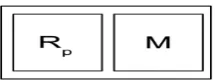
We start with a basic version of the system which has sensors in the armchair to detect Seng’s weight and then infer the situation that Seng is on the chair, afterwhich this is mapped to the action of turning on the television. We can describe this system, calling it P = (Rp, M),
whereRpis the triple ({weight_sensor},Πp,Θp), where
(0reading(weight_sensor) = 650 ⇒ seng_on_chair)∈Πp
that is, if the reading on the chair’s weight sensor is 65, we interpret this to mean Seng is sitting on the chair, and
Θp={({seng_on_chair} ⇒seng_ready_f or_tv)}
which states that Seng sitting on that chair implies he is ready to watch television. AndM only has one rule which maps Seng ready for television to the action of turning on the television, i.e.
M ={({seng_ready_f or_tv} ⇒turn_on_tv)}
Figure 3 depicts this system.
Figure 3. A context-aware action system for the basic version.
Now, there are various shortcomings to such a basic system, namely, when someone else sits on the chair with the same weight as Seng. To further confirm Seng’s presence, we can attach an RFID system to the chair that can identify Seng (assume to have an ID of “0101”, for example sake) as being nearby. We define this system as Rq= ({RFID_sensor},Πq,Θq}), where
(0reading(RFID_sensor) = 01010⇒ seng_detected)∈Πq
and
Θq={({seng_detected} ⇒seng_ready_f or_tv)}
which states that Seng detected by this RFID reader implies he is ready to watch television.
Then, we can form the new composite system Rp
Rq, using rule (gres), so that:
RpRq= ({weight_sensor, RFID_sensor},Πp∪Πq,Θp|Θq)
where
Θp|Θq={({seng_on_chair, seng_detected} ⇒
seng_ready_f or_tv)}
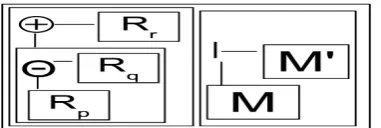
Figure 4 depicts the extended context-aware action system (RpRq, M). If we instead wanted to model
suppression, i.e., to have the rules ofRq precede over
Rp, we can useRqRpwhich uses only the rule in Θq
and ignores that inΘp.
Figure 4. A context-aware action system for the extended version.
Now suppose, a friend of mine invented a head and eye (i.e., gaze) tracking system which can detect if a person is actually looking at the television and determines how long the person does so continuously, and the idea is that a person expresses the intention to watch television by staring at the television continuously for at least 4 seconds.
We provide an abstract description of the
sys-tem as the following context-aware syssys-tem Rr =
({gaze_sensor, tv_sensor},Πr,Θr), where
{(0reading(gaze_sensor) = 40 ⇒ person_gazing_tv),
(0reading(tv_sensor) = 00 ⇒ tv_of f)} ∈Πr
and
Θr={({person_gazing_tv, tv_of f} ⇒person_want_tv_on)}
We also have the action system on the television that uses this triggerM0given by:
M0 ={({person_want_tv_on} ⇒turn_on_tv)}
Now, considering that it would be useful to combine M0withMin order to better regulate how the television
is switched on, we use the operator a-restriction,
forming
Figure 5 depicts the extended (valid) context-aware action system
((RpRq)⊕Rr, M|M
0
)
Figure 5. A context-aware action system for the extended (valid) version.
For testing purposes, perhaps we may want to disable
M. We can then use a-overriding in the composition
M0 / M, which only takes the rule inM0into account. Or if we wanted to “or” the triggers for the turning on the television, we would usea-union
((RpRq)⊕Rr, M ∪ M
0
)
A key idea of our operator-based approach is not only that different semantics of composite systems can be easily stated using different expressions, thereby clarifying their differences, but also, that our approach enables incremental extensions to an existing system while preserving the existing systems. We can define a composite system without altering the definitions of its constituent systems. The advantage is, of course, that different compositions can be formed from the same constituent systems.
We an use the overriding union on context-aware
systems to have a new system suppress the rules of another, or usea-overridingora-restrictionto effectively inhibit (depending on sensor readings) the action triggers of a system.
Our approach also separates the context-aware system from the action system, in order to provide greater modularity, requiring only that the validation property be satisfied when combining a context-aware system with an action system.
Modelling Sensor Networks
We can use our formalism to model sensor networks, with sensors only having context interpretation, i.e. of the form (Σ,Π,∅).
Consider a sensor network comprising a collection of nodes (each with a camera and temperature sensor) distributed throughout the fringe of a neighbourhood, the purpose of which is to detect approaching bush fires. We also assume each node has a position.
A node Ni, at position pi, denoted by Ni.pi is
represented by a context-aware system of the form
({camera, temp_sensor},Πi,∅)})
where
{(0reading(camera) =f lame0 ⇒f ire_seen),
(0reading(temp_sensor)≥700⇒hot)} ⊆Πi
Each node would have its owncameraandtemp_sensor though notationally, we don’t distinguish among them (if need be, we could use camerai and temp_sensori).
Assuming a sensor network Nof nnodes distributed
at different locations, we can represent this by the composition⊕n
i=1Ni(pi) (or we write this as⊕N, where
N={Ni|i∈ {1, . . . , n}}). And we could pose queries such
asN`f ire_seen? which will return true if fire is seen
at any one location. A query such as (N2⊕N3⊕N6)` f ire_seen? asks if a fire is seen at nodes 2, 3 or 6. Effectively, we can use our formalism to pose queries to selected sensors or to different parts of the sensor network or modify the semantics slightly to return the node where fire is seen.
However, over the same physical sensor network, one could define different compositions, relating to
different possible “behaviours” being sought. For
example, what would the composition ⊗N mean?
Physically, the sensor network is not changed, but⊗N` f ire_seenis true when fire is seen in all locations.
Extending nodes and the sensor network.
Now, let us consider adding m sensor nodes to the
sensor network for nodes Nn+1 to Nn+m. The above
compositions then extend to then+mnodes easily. Let
M={Ni|i∈ {m+ 1, . . . , n+m}}. Then, determining if
((⊗N)⊗(⊕M))`f ire_seen
is true asks if fire is seen in all of thennodes and in any of the newmnodes.
We can add a fire inference engine to each node Fi,
denoted by (∅,∅,Θi), where Θi has only one rule that
aggregates the context to infer the situation that a fire occurs:
Θi ={({f ire_seen, hot} ⇒f ire)}
Such a component Fi might correspond to a physical
component (later) attached to each of the sensors. Then, letN Fi =Ni+Fi represent an extended node,
N Fi `f ire is true when for nodei,f ireis inferred. A
composition such as ⊕NF`f iredenotes if this is true
for any nodeN Fi in the setNF.
Now, we want to add smoke sensor nodes with an inference component, denoted byNi0, where
Ni0 = ({smoke_detector},Π0
i,Θ
0
i)})
8
EAI
European Alliance for InnovationEAI Endorsed Transactions on Context-aware Systems and Applications
where
{(0reading(smoke_detector) =yes0⇒smoke_present), (0reading(smoke_detector) =no0⇒smoke_absent)} ⊆Π0
i
and
Θ0i ={({smoke_present} ⇒f ire)}
And a network of smoke sensor nodes comprising a set ofksuch nodes, denoted byS, can be distributed in the same areas as the earliern+mnodes.
A query on the composition such as (⊕S)⊗(⊕NF))` f ireis true if both the smoke sensor network and the previous sensor network confirms there is a fire. But the composition does not take into account the locations of nodes explicitly.
Composing aN Fi node with a smoke detector node
Nj0 can be represented, such as Nij =N FiN
0
j which
denotes a nodeNij = (Σij,Πij,Θij), where:
Σij ={camera, temp_sensor, smoke_detector}
and
{(0reading(smoke_detector) =yes0⇒smoke_present), (0reading(smoke_detector) =no0⇒smoke_absent), (0reading(camera) =f lame0⇒f ire_seen),
(0reading(temp_sensor)≥700⇒hot)} ⊆Πij
and
Θij ={({f ire_seen, hot, smoke_present} ⇒f ire)}
Note thatNij might comprise two physically separated
nodesN Fi andN0jbut abstractly, it can be represented
as (conceptually) one node.
Context Attributes for Context-Aware Systems. If we associate a set of context attributes (e.g., location, power available, etc) to each node, denoted using the notation < node > . < property >, and form predicates over these properties, we an define sets of nodes.
For example, the following is the set P of extended nodes within distancerofherewith high power levels:
P={N Fi|N Fi.power=high
∧ dist(N Fi.location, here)≤r
∧ i∈ {1, . . . , n+m}}
We can then define compositions on these notes such as⊕P. We can also define a set of high powered smoke
sensor nodes in the same area:
P0={N0
i |N
0
i.power=high
∧ dist(N0
i.location, here)≤r
∧ i∈ {1, . . . , k}}
A query on the composition such as (⊕P0)⊗(⊕P))` f ireis true if bothP andP0confirms there is a fire in the same area (but only as defined by the distance rfrom here). Finer grained areas can, of course, be defined such as a band given byr0≤dist(< node > .location, here)≤ r, for some distancer0≤r.
Summary.What we have shown here are expressions to represent extensions of a sensor network in different ways as well as to represent abstract sensor nodes (which might be physically composed from two or more nodes). They serve as a notation to formally and precisely represent different sensor networks (or different parts of a sensor network) but yet can provide a basis for operational meaning of queries.
Tiling Cooperative Digital Picture Frames
We consider modelling a collection of digital picture frames on a wall; we assume that each digital picture frame has a unique identifier and can sense if another digital picture frame is near it, in four directions: above it, to the left of it, to the right of it and below it. Then, according to what each picture frame thinks of its relative position, each picture frame then show a particular picture. We assume that it is possible to change the position of the frames - that they are fastened to the wall by the owner and they can be repositioned.
Each digital picture frameFi (assuming 1≤i≤9) is
modelled as a context-aware action system with a frame sensor (for sensing another frame in four directions which returns a subset of {above, below, lef t, right}
depending on what is sensed) of the formFi = (Ri, Mi),
whereRi = (Σi,Πi,Θi) with
Σi ={f rame_sensori}
and
{(0above∈reading(f rame_sensori)0⇒f rame_abovei), (0below∈reading(f rame_sensori)0⇒f rame_belowi), (0lef t∈reading(f rame_sensori)0⇒f rame_lef ti), (0right∈reading(f rame_sensori)0 ⇒f rame_righti), (0above<reading(f rame_sensori)0⇒ ¬f rame_abovei),
(0below<reading(f rame_sensori)0⇒ ¬f rame_belowi),
(0lef t<reading(f rame_sensori)0⇒ ¬f rame_lef ti),
and
Θi={({f rame_lef ti, f rame_righti} ⇒hor_lineari), ({¬f rame_belowi} ⇒bottom_endi),
({¬f rame_abovei} ⇒top_endi),
({¬f rame_righti} ⇒right_endi),
({¬f rame_lef ti} ⇒lef t_endi),
({f rame_abovei, f rame_belowi} ⇒ver_lineari)}
andMiis of the form:
{({hor_lineari} ⇒show_hlinei),({ver_lineari} ⇒show_vlinei),
({bottom_endi} ⇒show_bottom_capi),({top_endi} ⇒show_top_capi),
({right_endi} ⇒show_right_capi),({lef t_endi} ⇒show_lef t_capi)}
Note that a frame might show multiple caps at the same time depending on what frames it (not) detects, e.g., a frame that is right ended and left ended at the same time might show both a right cap and a left cap at the same time. Each frame works independently and what emerges is the overall pattern. The frames do not need to communicate with each other, but merely to sense each other’s proximity.
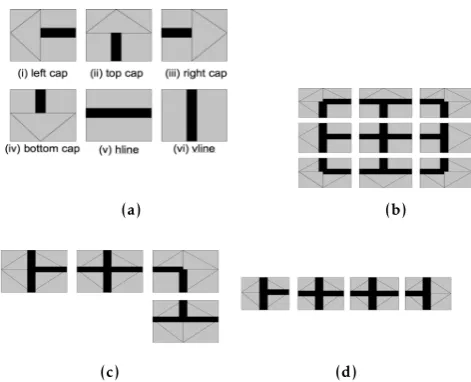
Figure 6 gives the idea of how the rules would result in the different patterns being displayed.
(a) (b)
(c) (d)
Figure 6. Patterns from rules. (a) shows each of the six display objects.
(b) shows a 3x3 configuration of nine frames and the pattern displayed according to the above rules.
(c) shows the pattern for an L-shaped configuration of four frames according to the rules above.
(d) shows the pattern for a horizontal configuration of four frames.
Next we add a particular frame that can gather information from all other frames (assuming four frames) and so detect the overall arrangement of all the frames (including itself), including horizontally
linear, and vertically linear. The frame is denoted by F0= (R0, M0), whereR0 = (∅,∅,Θ0), whereΘ0contains 12
rules as follows
({hor_lineari, right_endj, lef t_endk, hor_linearl} ⇒
conf ig_horizontal)∈Θ0
fori, j, k, l ∈ {1,2,3,4}, i, j, k, lall different
since any of the four frames can be in the situation hor_linear,right_end orlef t_endat a time, and at any time, when the frames are lined up horizontal, two of them will behor_linearand oneright_endand another lef t_end, and for vertical configuration, another 12 rules as follows
({ver_lineari, bottom_endj, top_endk, ver_linearl} ⇒ conf ig_vertical)∈Θ0
fori, j, k, l∈ {1,2,3,4}, i, j, k, l all different
AndM0then voices out which configuration the system detects as follows:
{({conf ig_vertical} ⇒say_vertical),
({conf ig_horizontal} ⇒say_horizontal)}
The combined valid context-aware action system comprising components fromF1, F2, F3, F4 andF
0
is of the form
(R1+R2+R3+R4+R
0
, M1∪M2∪M3∪M4∪M
0
)
Each Mi does its action as before but M0 also utilizes
“inputs” from theRis andR0 to perform actions. Here,
the idea is thatF0
can be added to theFis without the
Fis needing to change.
For aesthetic reasons, one might want to add new digital frames to the system, that will alter (and subtract from) the behaviour of an existing composite system. For example, suppose we add new “inhibitor” frames that will prevent certain shapes from ever being displayed. Consider a frame Fiinh= ((∅,∅,∅), Mi
inh−hline)
with no context-aware system but has an action system Minhi −hlinewhich is an inhibitor for frameFi, preventing
the frame from ever showing a horizontal line, of the form:
{({false} ⇒show_hlinei)}
So, the system (Ri, Mi |Minhi −hline) has a rule of the form
{({hor_lineari,false} ⇒show_hlinei)}
which will never be satisfied, and so, the show_hlinei
action will never be performed regardless of the what sensor readings are received.
10
EAI
European Alliance for InnovationEAI Endorsed Transactions on Context-aware Systems and Applications
Incidentally, new tailored operators on frames can be defined based on theSigmaoperators. For example, we can define an operatoron frames with the semantics:
F1F2= (R1⊕R2, M1|M2)
whereF1= (R1, M1) andF2= (R2, M2). Then, we have:
Fi Finhi = (Ri⊕(∅,∅,∅), Mi |Minhi −hline)
forming the (virtual) frame (or pair of frames) which has restricted display compared toFi alone.
Smarter Cars and Urban Awareness
There has been interesting developments in using sensors to monitor city and urban environments.
The MIT SENSEable Real Time Rome project11 used
cellphones and GPS devices to discover movements patterns of people and transportation systems in Rome, enabling usage of streets and neighbourhoods to be tracked and visualized. The more recent SENSEable CURRENTcity12 project is working on visualizing the real-time dynamic behaviours of cities including traffic jams and gatherings. The Cityware initiative13 has a project to monitor the paths of tourists using GPS tracking.
There is also other work towards monitoring, in real-time, traffic behaviour to provide, in advance, information about traffic jams on roads. The notion of crowd sensing and understanding events in the city provides insight into life in the city for its inhabitants and tourists. There is also work towards supporting place-based awareness leading towards what we call “legible places”, places that can be “read” and “queried” like a book.
Modern cars will be equipped increasingly with sensors from rain sensors, pedestrian sensing, adaptive cruise control to parking sensors. Pedestrians can carry sensors which cars can pick up to ensure that cars don’t hit them. Cars can sense and detect approaching emergency vehicles and react accordingly. Accurate GPS (up to the metre) can help cars in manouvres such as lane change and overtaking. Cars could become aware of nearby parking slots and busy intersections. There is a need for context-aware action systems to work together, the car (as a whole if viewed as a context-aware action system, with its subsystems), and the sensors in the environment of the car.
We illustrate a scenario of car using sensors in the urban environment to become better aware of where vehicular and people crowds are. We imagine a future
11http://senseable.mit.edu/realtimerome/
12http://www.currentcity.org/
13http://www.cityware.org.uk; see Digital Footprints project.
urban environment which has sensors to detect crowds of people and heavy traffic streets. And the car is able to detect these sensors, connect to them and acquire information about crowds (of people or vehicles) within a preset radius from the current position of the car. Such information might then be displayed on the car’s computer on a map indicating nearby crowds. Let this capability of a context-aware car be represented as an action system with a rule that gets the crowd at a
position pos and displays that, represented by M=
{({crowd_at(pos)}, display_crowd(pos))}. A crowd sensor
embedded in the urban environment is represented by context-aware systems of the form
R=({crowd_sensor},
{(0reading(crowd_sensor) =pos0 ⇒ crowd_at(pos))},
∅)
And the (R, M) represents the overall (distributed) system, comprising a component on the car and a component in the stationary urban environment. When the car detects another crowd sensing system in the infrastructure in the vicinity, say R0 in the same form asR, it can employ this system, whether to confirm the crowd position, i.e. we have (R⊗R0, M), or to provide
new crowd positions (R⊕R0
, M). The car itself might have sensors, represented by the context-aware system R00which can be combined with infrastructure sensors: (R⊕R0⊕R00, M).
Meta-Programming with Sigma Expressions. It is
possible to embed Sigmaexpressions into a
program-ming language, in order to form new compositions at run-time, especially when the set of available context-aware systems might change over time, e.g., upon dis-covery of new systems.
With the smart car example earlier, consider a simple event-driven program that can discover the presence of context-aware systems in the vicinity, and recomputes a composition based on discovered context-aware systems. LetR00
be the car’s own context-aware system, and M, the car’s action system. We also introduce an operator that takes a context-aware action system E, and executes it (i.e., gets the sensor readings, performs reasoning, and determines if any action should be taken, and executes the action), denoted byexecute[E].
Note that there are two ways that Sigma expressions
can be executed, in the forward-chaining (data-driven) style as in execute[E], or using a backward-chaining query style where, given a situation, determine if the situation is occurring of the formE`S?.
loop
initiate discovery of context-aware systems
Rd:= discovered context-aware systems