http://dx.doi.org/10.4236/jcc.2014.29006
SCP-Trust Reasoning Strategy Based on
Preference and Its Service Composition
Process of Context-Aware Process
Xiaona Xia, Jiguo Yu, Baoxiang Cao
School of Computer Science, Qufu Normal University, Rizhao, China
Email: [email protected]
Received May 2014
Abstract
Before providing services to the user, user preference considerations are the key conditions to achieve the self-adaptive decision-making about service selection and composition process, which is the flexible concerned aspect provided by massive cloud computing environment data. Mean- while, during the whole services’ providing process, achieving the capturing and forming of ser- vice aggregation units’ topology logic, building the context environment’s process-aware of service composition, ensuring the trust and adaptation among service aggregation units, which are the important reasons to express timely requirement preference. This paper designs SCP-Trust Rea- soning strategy about the integration of user preference and trust, with process algebra, it is to achieve the context process-aware logic for service composition process, in order to improve the autonomous optimization and evolution of service implementation system.
Keywords
Preferences, Trust Reasoning, Context-Aware Process, Service Composition, Service Aggregation Unit
1. Introduction
1.1. Service and Cloud Technology
quired by users, seriously, it causes the lack of information and destruction.
1.2. Related Work
Zeng et al. [4] proposed a global optimization method based on integer rules, with the help of context require- ment, one optimal implementation path was selected; Ardagna and Pernic [5] concerned the global and local is- sues about services selection; Yu and Lin [6] used the requirement optimization and result of knapsack problem to achieve composition services selection; Korkmaz and Krunz [7] put forward a kind of heuristic composition services selection options; Driven by architecture implementation goal, Canfora et al. [8] used genetic algo- rithms to solve services selection process; Fan Xiaoqin et al. [9] designed a kind of discrete particle swarm algo- rithm to improve services’ response capacity about timely requirement.
2. Preferences Requirement Principle
Based on the preference right re-determine method of rough sets [10] [11], capturing preference process is built in the platform, and does the grasping and learning timely during the interaction between users and services, that is the pre-conditions about preferences and services.
Definition 1 (Preference Knowledge Supporting System). Four-tuple pS=
(
U A V f, , ,)
stands for this sys- tem. U is the non-empty finite object set; A is the non-empty finite attribute set, A=CD, CD=φ. C is the condition attribute set, D is decision-making supporting attribute set; V =α∈AVα, Vα is range ofα
(
α
∈A)
; f U: × →A V is a information function, it might give the information domain for every preference attribute.Definition 2 (Weight Re-measure of Preference attribute): Supposing X ⊂U is one subset of attribute,
i
x∈U is a specific description, after adding specific value xi in X, the weight of service selection is improved,
the greater of improving degree, xi is more important for X preferences, the important degree of attribute of xi for
X is defined as:
( )
( )
( )
1 i
i
X x
x i
X
pos U pSig x
pos U =
If P and Q is the equivalence relationship in U, the positive domain of P for Q is denoted as posp Q
( )
,( )
X U Qposp Q PX
⊂
=
, P means that all classified results might be collected in the preference object sets of rela-tionship Q according to U P/ .
Objective preference weight is described as:
( )
( )
1 i
i
i n
x i i
pSig x pG
pSig x
=
=
∑
Objective weight is basic value, the comprehensive weight will be gotten:
( )
( ) (
1) ( )
pI
ω
=α ω
Q + −α
pGω
, 0≤ ≤α 1α
is experience factor of preference, 0≤ ≤α 1 expresses the preference degree for subjective and objective weight in selecting services, the greaterα
, the more important is the ensured requirement branch; the smallerα
, the implementation of requirement cares for objective weight more. When α=1, the selection process only thinks about current requirement goals, does not do the cognitive exhibition; if α=0, it is needed to consider objective weight and be aware of the learning and evolution analysis about requirement goals.3. Preference-Driven Trust Relationship and Evaluation
In order to extend and deepen the cognitive range of service customer SC, thereby enhancing complex synergy and the accuracy of service scheduling in different platforms, and increasing cross-organizational the effective- ness of service selection and composition.
Assume that service provider of SP about service customer A of SC is
[
SP SP1, 2,,SPm]
, if the number of1,1 1,2 1,3 1,
2,1 2,2 2,3 2,
1.. ,1..
,1 ,2 ,3 ,
,1 ,2 ,3 ,
... ... ... ... ... ... ... ... ... ... ... ... ... ...
r r r r
m
r r r r
m n
A m r r r r
i i i i m
r r r r
n n n n m
SQ SQ SQ SQ
SQ SQ SQ SQ
SQ
SQ SQ SQ SQ
SQ SQ SQ SQ
= (1)
Every element in matrix SQA Br, is the evaluation vector of the different service times, which is equivalent to
( 1) ( 2) ( 3) ( )
, , , , , , , , ,
r t t t tx
A B A B A B A B A B
SQ = SQ SQ SQ SQ , the same time, every element of vector SQA Br, is also a multidimen-
sional vector, when it is expressed as 1,( ) 2,( ) 3,( ) ,( )
, , , , , , , , ,
tj tj tj tj v tj
A B A B A B A B A B
SQ = SQ SQ SQ SQ , represents that SQtjA B, is
one v-dimensional vector.
In matrix SQA1..,1..nm, r,1, r,2, r,3, , r,
j j j j m
SQ SQ SQ SQ
express QoS of m service provider entities for this set of
values might be recognized as m SP service providers in line with the actual target values, it might verify whether other SC service customer reflect QoS of SP service providers, furthermore, it might reduce its trust values:
( 1) ( 2) ( 3) ( )
, , , , , , , , ,
r t t t tx
A B A B A B A B A B
SQ = SQ SQ SQ SQ
This formula represents QoS of SC service entity A for SP service provider B. Take any one element from 1..
,1..
n A m
SQ , SQC Br, = SQC B( 1)t, ,SQC B( 2)t, ,SQC B( 3)t, ,,SQC B( )tx, , this formula QoS of SC service customer C for SP service provider B, because SC service customer C really completes its own evaluation, so that, it might justify the trust of SC service customer C according to the differences’ evaluation of SC service customer for SP service provid- er B. From SQA Br, and SQC Br, , the evaluation vector of SC service customer A and SC entity C for SP service provider B about tj moment:
1,( ) 2,( ) 3,( ) ,( )
, , , , , , , , ,
tj tj tj tj v tj
A B A B A B A B A B
SQ = SQ SQ SQ SQ (2)
1,( ) 2,( ) 3,( ) ,( )
, , , , , , , , ,
tj tj tj tj v tj
C B C B C B C B C B
SQ = SQ SQ SQ SQ (3)
Combining with the preferences analysis of the second part, the evaluation difference based on preferences is derive:
(
)
( )
,( ) , , , , , 1 , , , vB tj k tj k tj
A C m A B C B
k
A C B tj pI
ω
ω
Q Q=
∆ = ∆ = ⋅
∑
− (4)Further, the ratio of the difference in value of the trust might be calculated as:
,( ) ,( ) ,
, , ,
1
v
B tj B tj k tj
A C A C m A B
k
Q
ϕ
ω
=
= ∆
∑
(5),( ) ,( )
, 1 ,
B tj B tj
A C A C
C = + Λ − ψ ⋅∂ (6)
In Formula (6), ∂ represents the component of gradient, “ ” expresses arithmetic modulo, Λ is con- stant value. When difference is smaller that threshold constant Λ, it means credible, the smaller the difference value, the higher the trust. When the difference value is greater than Λ, it means incredible, its trust values is negative. Thus through SP entity B, about SP service provider SC entity C, the trust evaluation of SP service customer A has the information evaluation vector:
,( 1) ,( 2) ,( )
, , , , , , ,
B B t B t B tx
A C A C A C A C
C = C C C (7)
Through the trust level method, if the trust evaluation CA CB tj,,( )≥0, trust density value is 1, and 0 otherwise.
requirement preference is the premise, the trust evaluation fA CB, of other n SC is equivalent to
( )
(
, , , , ,)
B B B
A C A C A C
1 2 3
,1 ,1 ,1 ,1
1 2 3
,2 ,2 ,2 ,2
1..
,1.. 1 2 3
, , , ,
1 2 3
, , , ,
... ... ... ... ... ... ...
... ... ... ... ... ...
...
m
j j j j
m
j j j j
n
A m m
j j j j j j j j
n
j m j m j m j n
f f f f
f f f f
f
f f f f
f f f f
=
(8)
4.
SCP-TP
(Service Composition Preference-Trust Reasoning)
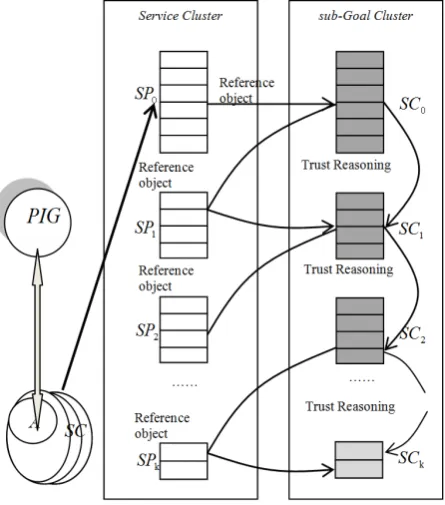
SCP-TP is described as the follows: according to goal’s preferences, service entity SA might reduces its own trust relationship, which is showed as the interaction relationship between SA and SC0, the whole interaction ac- cepts the preference-driven effect of PIG (Platform Implementation Goal). SA is one set of SP entities interacted with SC entities A, SC0 is one set of SC entities interacted with SP entities in SA set. Because the preference im- plementation condition led by goal’s changing is the trust logic of SP of SPk in Figure 1, which might gotten by
the indirect trust relationship by PIG.
Trust reasoning and process-aware in Figure 1 is described as follows:
1) Preferences of platform goal and real-time user requirement is mapped for PIG (related characterization described in the paper has been assigned), PIG realization is attributed to cluster logic set of SC service custom- er entity A. The serialization process of A is submitted by SP0, and does a series of reasoning that SC0 cluster set is the starting point, to get the trust value for SP1 cluster set.
2) Besides SC0 cluster set, SC interacted with SP1 cluster also introduces the reasoning and process-aware with SC1 cluster. Contrasting SC0 cluster and SC1 cluster about the difference of SP1 cluster, reduces the trust results of SC1. In this process, SP cluster entity is viewed as the reference of SC trust evaluation and reduces SC1 trust. In this way, trust reasoning and service goal might reduce SP1 cluster and SC1 cluster.
3) According to the second step of this process, further reasoning, it might get QoS weight of SPk cluster that
its trust coincides with preferences.
[image:4.595.204.427.452.705.2]SC0 driven by PIG has n entities, there are z entities in SC1, SP0 has m entities, SP1 is with y entities. Prefer- ence QoS evaluation matrix of SP1 set related to PIG is described as:
1,1 1,2 1,3 1,
2,1 2,2 2,3 2,
1.. 0,1..
,1 ,2 ,3 ,
,1 ,2 ,3 ,
... ... ... ... ... ... ... ... ... ... ... ... ... ...
r r r r
y
r r r r
y y
n r r r r
j j j j y
r r r r
n n n n y
Q Q f Q
Q f f f
Q
Q f f f
f f f f
= (9)
Corresponding to QoS of SP entities adjusted by PIG, it might get the trust evaluation of n SC entities in SC0 set according to above reasoning and aware:
(
)
(
)
(
)
(
) (
)
(
)
(
)
(
)
(
)
(
)
1,1 1,1 1,1 1,2 1,2 1,2 1, 1, 1,
2,1 2,1 2,1 2,2 2,2 2,2 2, 2, 2,
1.. 0,1..
,1 ,1 ,1 ,2 ,2 ,2 ,2 ,2 ,
,1 ,1 ,1 ,2
, , , , ... , , , , , , ... , , ... ... ... ... , , , , ... , , ... ... ... ... , ,
y y y
y y y
y n
i i i i i i i i i y
n n n n
f f f
f f f
T
f f f
f f
α β γ α β γ α β γ
α β γ α β γ α β γ
α β γ α β γ α β γ
α β γ α
=
(
,β γn,2, n,2)
... f(
αn,2,β γn,2, n y,)
(10) 1.. 0,1.. y n
Q matrix represents QoS evaluation of SC0 about SP1, 1.. 1,1..
y z
Q matrix represents QoS evaluation of SC1 about SP1. Further might be obtained:
1,1 1,2 1,3 1,
2,1 2,2 2,3 2,
1.. 1,1..
,1 ,2 ,3 ,
,1 ,2 ,3 ,
... ... ... ... ... ... ... ... ... ... ... ... ... ...
r r r r
y
r r r r
y y
z r r r r
i i i i y
r r r r
z z z z y
Q Q Q Q
Q Q Q Q
Q
Q Q Q Q
Q Q Q Q
= (11)
This process is described as:
Step 1: Calculate the evaluation values of E and F for SP entity H, then reduce the trust of E about F, the evaluation difference value of H at ti moment is
(
)
( ) , ,
, , ,
1
, , ,
i i i
u
H t k t k t
E F i m E H F H
k
E F H t Q Q
η
η
ϖ
=
= =
∑
− (12)Step 2: According to the above reasoning and PIG adjustment of SC and SP, it might reduce and get the trust about services’ participation:
( ) ( ) ,
, , ,
1
i I i
u
H t H t k t
E F E F m E H
k
PIG Q
ϕ
η
ϖ
=
= ⋅
∑
(13)( ) ( )
, 1 ,
i I H t
H t
E F E F
T = + Λ − ϕ ⋅σ (14)
The goal trust of service entity E and F during selecting and compositing of SP entity H scheduling by PIG is:
3
1 2 ( ) ( )
( ) ( )
, , , , , , , , , v
H t H t H t H t
H
E F E F E F E F E F
T = T T T T (15)
(
)
1(
)
2(
)
3(
)
(
)
, , , , , , , , , , , , , , , , , , ,
H y
E F E F E F E F E F
f α β γ = f α β γ f α β γ f α β γ f α β γ (16)
ty, it is showed as the right matrix structure in Formula (17).
(
)
(
)
(
)
,1 ,1 ,1
1 2
,1 ,2 ,1
1 2
,2 ,2 ,2
,2 ,2 ,2
1 2
, 1 , 1 , 1 , 1 , 1 , 1
1 2 , , , , , , , , , , ,
idir idir idir
j j j
v
j j j
idir idir idir v
j j j
j j j
v idir idir idir
j j j j j j j j j j j j
v
j z j z j z idir
j z j f
f f f
f
f f f
f f f f
f f f
f
α β γ
α β γ
α β γ
α β − − − − − − ⇒
(
)
, , , idir idir z γj z (17)
Based on the above results, the trust calculation reasoning model driven by preferences between service pro- viders and service customers about PIG is Formula (18):
(
)
(
)
(
)
(
)
(
)
(
)
(
)
1,1 1,1 1,1 1,2 1,2 1,2 1, 1, 1,
2,1 2,1 2,1 2,2 2,2 2,2 2, 2, 2,
,1 ,1 ,1
, , , , , , , , ,
, , , , , , , , ,
, , ,
idir idir idir idir idir idir idir idir idir
z z z
idir idir idir idir idir idir idir idir idir
z z z
idir idir idir
n n n
f f f
f f f
f
α β γ α β γ α β γ
α β γ α β γ α β γ
α β γ
(
,2, ,2, ,2)
, ,(
, , , , ,)
idir idir idir idir idir idir
n n n n z n z n z
α β γ α β γ
(18)
The first line of Formula (18) is corresponding to the first column of the right part in Formula (18), that ex- presses the corresponding trust evaluation of some service customer entity SC for every entity in SC1 set. Ac- cording to the above logical derivation process, SC0 is the starting point, SP1 deduces trust value of SC0 for SC1, then, SC0 is as the starting point, SP2 deduces trust value for SC2, it might get the trust about SCk in Figure 1.
Through the above derivation process, we might obtain the QoS acquisition approach of QoS that there SP in- teracted with SC indirectly, and QoS evaluation model that direct interaction trust is precondition and user pre- ferences are the important factors adjusted by PIG.
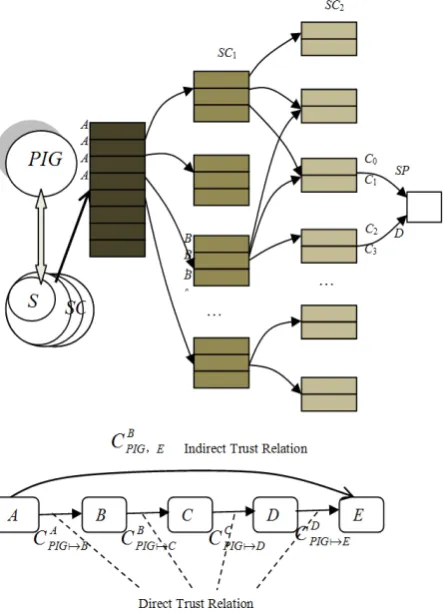
The trust and process-aware in Figure 1, according the above analysis and argumentation, temporary indirect trust about service selection and composition might get the transformation and indirect transition in Figure 2. This process might be described as: first, SC entity S might get the trust relationship of SC0. Secondly, according to the forward reasoning, it might get SP0 entity D adjusted by PIG. Based on service composition and PIG, transition relationship of trust in Figure 2 achieves other indirect transition routing of trust.
5. Service Composition Process Based on Process-Aware
Process topology and implementation semantic logic of CAPT, this part gives CCML description. <CCML: Composition>
<CCML: sequence> <!--read channel-->
<!--get PIG implementation decision-making-->
<CCML: Capture the activities about PIG, which are managed in some way> <!--read service transition channel based on the goal of some activity-->
<CCML: readChannel Channel=“PIG_channelName” Service=“PIG_serviceName” action=“PIG_actionName”
port=“portName”>
<!--implement one service activity-->
<!--process-aware logic of PIG reads the context requirement and implement from corresponding service reg- ister channel. -->
<!--read service register channel-->
<CCML: readReg reg=“PIG_registerName” Service=“PIG_ServcieName” action=“PIG_actionName” port=
“portName”>
<CCML: execute action=“PIG_actionName” Service=“PIG_serviceName”> <!--write channel-->
<CCML: writeChannel Channel=“PIG_channelName” Service=“PIG_serviceName” action=“PIG_actionName”
Figure 2. Transformation and transition of trust.
<!--write service register channel-->
<CCML: writeReg reg=“PIG_registerName” Service=“PIG_ServcieName” action=“PIG_actionName” port=
“portName”>
<CCML: execute action=“PIG_actionName” Service=“PIG_serviceName”> </CCML: sequence>
</CCML: composition>
6. Conclusions
Thinking about preferences of service selection and composition, this paper analyzes and argues the trust rea- soning strategies and implementation measures of service flow platform. For goal preferences and topology ef- fectiveness, this paper designs and achieves process-aware approach that PIG is the main adjustment mechanism, then gives the algorithm and adjustment platform logic for actual implementation case.
In processing of problems, timely goal preferences of goal and trust reasoning of flow are the key problem in service computing and cloud computing, PIG fully considers goal preferences and topology trust, and reduces SCP-strategy logic, and achieves the context process-aware logic and implementation process. Through actual case’s R&D and optimal project of platform, it improves the autonomous optimization and evolution capacity of service flow.
Acknowledgements
References
[1] Zhang, J.-L. and Fan, Y.-S. (2010) Service-Oriented Enterprise and Business Ecosystem. Computer Integrated Manu-facturing Systems, 16, 1751-1759.
[2] Xu, L.-D., Liu, H.-M., Wang, S., et al. (2009) Modeling and Analysis Techniques for Cross-Organizational Workflow Systems. Systems Research and Behavioral Science, 26, 367-389. http://dx.doi.org/10.1002/sres.978
[3] Armbrust, M., Fox, A., Griffith, R., et al. (2010) A View of Cloud Computing. Communications of the ACM, 53, 50- 58. http://dx.doi.org/10.1145/1721654.1721672
[4] Zeng, L.Z., Benatallah, B., Hgu, A.H.H., et al. (2004) QoS-Aware Middleware for Web Services Composition. IEEE Trans on Software Engineering, 30, 311-327. http://dx.doi.org/10.1109/TSE.2004.11
[5] Ardagna, D. and Pernici, B. (2005) Global and Local QoS Guarantee in Web Service Selection. Proceedings of Busi- ness Process Management Workshops, Springer, Berlin, 32-46.
[6] Yu, T. and Lin, K. (2005) Service Selection Algorithms for Composing Complex Services with Multiple Qos Con- straints. Proceedings of the 3rd International Conference on Service Oriented Computing, Springer, Berlin, 130-143. [7] Kormza, T. and Krunz, M. (2001) Multi-Constrained Optimal Path Selection. Proceedings of the 20th Joint Conference
of IEEE Computer and Communications, Piscataway, 834-843.
[8] Canfora, G., Penta, M.D., Esposito, R., et al. (2005) An Approach for QoS-Ware Service Composition Based on Ge- netic Algorithms. Proceedings of the 2005 Conference on Genetic and Evolutionary Computation, ACM, New York, 1069-1075.
[9] Fan, X.Q., Jiang, C.J., Fang, X.W., et al. (2010) Dynamic Web Service Selection Based on Discrete Particle Swarm Optimization. Journal of Computer Research and Development, 47, 147-156.
[10] Beynon, M. (2001) Reduces within the Variable Precision Rough Sets Model: A Further Investigation. European Journal of Operational Research, 134, 592-605. http://dx.doi.org/10.1016/S0377-2217(00)00280-0