FairShares Model
RIDLEY-DUFF, Rory <http://orcid.org/0000-0002-5560-6312>, SOUTHCOMBE, Cliff and DICKINS, Nicci
Available from Sheffield Hallam University Research Archive (SHURA) at:
http://shura.shu.ac.uk/6635/
This document is the author deposited version. You are advised to consult the publisher's version if you wish to cite from it.
Published version
RIDLEY-DUFF, Rory, SOUTHCOMBE, Cliff and DICKINS, Nicci (2013). FairShares Model. FairShares Association Ltd..
Copyright and re-use policy
See http://shura.shu.ac.uk/information.html
FairShares Brand and Model
a new model for self-governing social
enterprises operating under Company and
Co-operative Law.
Prepared By
Dr Rory Ridley-Duff
Cliff Southcombe
Nicci Dickins
FairShares Association
FairShares Brand and Model
Version 1.2a, 16th February 2013Licensed to the FairShares Association by Rory Ridley-Duff and Cliff Southcombe under a Creative Commons 3.0 Licence.
This document is provided ‘as is’ under a Creative Commons Licence. It can be freely distributed providing it is not amended.
FairShares Articles of Association (and other documents referred to in this document) can be shared and adapted for either your own or commercial use, providing the following copyright notice and acknowledgements appears in the adapted versions, and they are made available under the same Creative Commons Licence.
© FairShares Association Ltd, 2013
Creative Commons 3.0: Attribution, Share Alike
If you upload any FairShares documentation to a website, the following code will display the appropriate copyright notice and attributions. You can cut/paste the following code.
<a rel="license" href="http://creativecommons.org/licenses/by-sa/3.0/deed.en_GB"><img alt="Creative Commons Licence" style="border-width:0" src="http://i.creativecommons.org/l/by-sa/3.0/88x31.png" /></a><br /><span xmlns:dct="http://purl.org/dc/terms/" property="dct:title">The FairShares Model</span> by <span xmlns:cc="http://creativecommons.org/ns#" property="cc:attributionName">The FairShares Association</span> is licensed under a <a rel="license" href="http://creativecommons.org/licenses/by-sa/3.0/deed.en_GB">Creative Commons Attribution-ShareAlike 3.0 Unported License</a>.
No warranty is provided that they are suitable for your situation. They are provided to stimulate and inform innovation in co-operative, mutual and social enterprise development, to inform practice, and to stimulate new thinking about the
democratisation of management, ownership and governance.
Professional advice is recommended to help you adapt the FairShares Model and Articles of Association to your specific needs and circumstances. The FairShares Association would be happy to help you find a consultant appropriate to your needs.
Model Articles of Association, financial forecasting spread sheets and other helpful documents can be downloaded from the FairShares Wiki by members of the FairShares Association.
UseFul URLs
www.fairshares-association.com
www.fairshares.wikispot.org
FairShares Model: Brand Guidelines
Version 1.2a, 16th February 2013.Introduction
The FairShares Model is a brand and concept advanced by The FairShares Association to assist the creation of FairShares Enterprises. At the heart of the brand is the definition of social enterprise established by Social Enterprise Europe Ltd based on:
Specifying social purpose(s) and evaluating impact(s) in a trading organisation;
Ethical review of product/service choices and the way they are delivered;
Integration of primary stakeholders into ownership, governance and management. In the FairShares Model, primary stakeholders are regarded as:
Producers and employees (i.e. those who do the work of the organisation)
Consumer and service users (i.e. those who depend on its products and services).
If a FairShares Enterprise does not integrate producers, employees, consumers or users into ownership, governance and management, it is not conforming to the FairShares Brand
guidelines. Founder members and investors are regarded as secondary stakeholders if they do not work on, or depend on, the goods and services that the enterprise creates.
On Ownership, Governance and Management, a FairShares Enterprise will:
recognise founder members and enfranchise them through Founder Shares; recognise providers of labour and enfranchise them through Labour Shares; recognise users/customers and enfranchise them through User Shares;
recognise creators and providers of financial capital by enfranchising them through
Investor Shares (in companies) and Investor Accounts (in co-operatives).
On Intellectual Property (IP), a FairShares Enterprise will:
give individual and group credit to members who create IP;
agree a Creative Commons licence for the use of members’ IP;
prevent the transfer of IP ownership from members to the FairShares Enterprise except where this is the express wish of the IP creator(s);
manage members’ IP as an Intellectual Commons.
Brand Variants
All FairShares Enterprises issue Founder Shares and manage an Intellectual Commons:
A FairShares social enterprise also issues Labour, User and Investor Shares;
A FairShares social co-operative also issues Labour and User Shares, and creates Investor Accounts;
A FairShares employee-owned social enterprise also issues Labour and Investor Shares;
A FairShares worker co-operative also issues Labour Shares and creates Investor Accounts;
A FairShares user-owned social enterprise also issues User and Investor Shares;
Brand Principles
The brand can be used by FairShares Companies, Co-operative Societies and Consultancies to communicate:
wealth and power sharing with primary stakeholders;
ethical review of the choice of goods/services offered;
ethical review of production and retailing processes;
specification of social purpose(s) and auditing of social impact(s);
a social democratic model for the ownership, governance and management of capital. The FairShares Model is licensed to the FairShares Association by Rory Ridley-Duff and Cliff Southcombe using a Creative Commons licence:
© FairShares Association Ltd, 2013
Creative Commons 3.0: Attribution, Share Alike.
All variants and adaptations of the FairShares model must acknowledge the copyright of the FairShares Association in the above format, and new adaptations must carry the same Creative Commons licence.
Brand Identity
For use by FairShares Social Enterprises (Companies) and Social Co-operatives that have multi-stakeholder ownership and governance that includes both labour and users.
For use by FairShares Enterprises where workers or users maintain majority control.
Logos for printed and electronic use available in PNG and JPG formats.
Brand Value and Social Auditing
To use this brand, a FairShares Enterprise should be able to answer following questions:
What is the social purpose of this enterprise? How is the social impact of this enterprise assessed?
Who are the enterprise s primary stakeholders? How do the ownership, governance and management systems ensure an equitable distribution of wealth and power amongst primary stakeholders?
What values and principles guide the choices of goods and services offered?
The Concept of a FairShares Enterprise
Imagine a company where the knowledge creation model of Wikipedia is combined with the governance model of the John Lewis Partnership and the values and principles of the Co-operative Group? This is the FairShares Model. It is an approach that contributes to a society in which every adult can become a member-owner of the organisation(s) for which they work, from which they regularly buy goods, and from which they receive social
services. In short, it envisages a society in which every adult becomes a co-owner of the organisations on which they, their family and their community depend.
This document describes the FairShares Model for self-governing co-operatives, mutuals and social enterprises in England and Wales. It is possible to adapt this model in any country that allows the registration of joint-stock companies and/or co-operatives with different classes of share.
Who is this document for?
The concept of a FairShares Enterprise will appeal to any person or organisation wishing to create (or support the creation of) self-governing co-operatives and social enterprises. This document will interest: co-operative members; co-operative development agencies; employee-ownership support organisations; social entrepreneurs; co-operative and social enterprise development workers; community development workers; policy makers on economic regeneration; government bodies, mutual societies, charities and private businesses that want to create social enterprises. It may also interest social investors / public authorities looking for models that support equity investment in the social economy.
Central to the concept of a FairShares Enterprise is power and wealth sharing. This makes it an excellent model for joint venture creation involving social, public and private bodies and the people who create and deliver goods and services. It has a heritage linked to the development of co-operative and employee-owned businesses, particularly ventures where those who do the work wish to share power with primary stakeholders.
This model will not be of interest to entrepreneurs seeking to accumulate and then privatise wealth (unless their medium/long-term goal is sharing that wealth with their workforce and wider community). It will not be attractive to financial investors / funders who require control rights and/or the privatisation of IP before making an investment.
What are the Key Assumptions behind a FairShares Enterprise?
Most organisation structures are not designed with the goal of power and wealth sharing in mind: structures are fixed at incorporation and changed only if a situation demands it. Typically, one set of interests (i.e. founding entrepreneur(s), charitable/social objects, financial investors, consumers, workers) are given priority. A FairShares Enterprise anticipates changes that take place over time and is designed to give a voice to the interests of different stakeholders as they become important for sustainability. By facilitating co-operative governance, the enterprise is in a better position to maximise its potential for power and wealth sharing.An enterprise usually starts when one or more founder members - by design or by accident - come up with an idea for a product or service. Founders act as entrepreneurs to
Private Sector (For-Profit) Norms – The Company Limited By Shares
In the private sector, founding entrepreneurs normally acquire all share capital in a CLS, become the directors of the enterprise, and start to recruit employees to operationalize their idea. In an unadapted CLS, employees are subordinated in law to the interests of shareholders and directors. They are not (usually) invited to become legal members of the organisation (i.e. company members) or contribute to decision-making outside their
specialist area of expertise.
The intellectual property created by employees is acquired by their employer and is controlled by a company board of directors and executive managers. Where a single person (or small group of people) is majority shareholder, s/he gains control of the intellectual property created by employees and the wealth it generates. In this way, the design of private companies widens the wealth gap between those who own/govern the enterprise and those who sell their labour to it. This leads to widespread poverty even in the wealthiest and most advanced western economies.
Voluntary Sector (Non-Profit) Norms – The Company Limited By Guarantee
A typical response to the social problems created by economies based on privatised wealth and power is to create a charity or ‘non-profit’ company using a Company Limited by
Guarantee (CLG). This form of incorporation involves the specification of charitable or social objects that define the purpose(s) of the enterprise. Founders reframe themselves as trustee-directors responsible for ensuring that resources acquired are used to pursue those purposes.
CLGs do not issue share capital so trustee-directors give up personal rights to the wealth created by the enterprise. Their role (in law) is one of ensuring that any funds raised are used to further the charitable (or social) objectives defined in their Articles of Association. As in a CLS, they can employ staff to pursue their social goals. Employees are not
(usually) members of a CLG and they are legally subordinate to the trustee-directors. Employees still give up the intellectual property they create: it is acquired by the charitable or non-profit organisation which is then entitled to derive wealth from it and use it to pursue charitable or social objects.
Social Economy Norms – The Co-operative Society / Mutual Company
Is it necessary to choose between these two models? In the last 20 years, three bodies of knowledge and practice suggest it is not. Firstly, there has been a big increase in socially responsible use of corporate assets (CSR). Secondly, there has been a renaissance in the co-operative movement, a reminder that democratically controlled enterprises that do not reproduce the above dichotomy are sustainable, scalable and relevant. Importantly, the internet has reduced the costs associated with democratic governance, making
co-operative and mutual enterprises much more viable. Lastly, there has been a growing number of enterprises identifying themselves as ‘social’, deploying business models and institutional arrangements that improve human well-being through their trading strategies and ownership structures. Fairtrade is a large scale international example of this.
institutionalise a division between producers and consumers on the one hand, and entrepreneurs and investors on the other. This division is a product of employees and customers (users) being unable to secure representation for their interests when the wealth created by their interactions is allocated to new projects. As wealth in a market economy is created by the interactions of producers and customers, their exclusion from governance and ownership makes no social, political or economic sense.
A FairShares Enterprise addresses this issue by building in mechanisms from the outset to distribute financial and social capital to the stakeholders who are needed to sustain it. Spreading power and wealth as it accumulates inhibits the emergence of unaccountable elites. It contributes to a society in which wealth and power is fairly shared.
The FairShares Model achieves power and wealth sharing by implementing the Co-operative Values and Principles of successful co-operative, mutual and social enterprises:
1) Governance processes recognise both individuals and interest groups, following (and extending) the 1st, 2nd and 3rd ICA co-operative principles of open membership, democratic member control and member economic participation.
Founders become members and have their participation rights in governance protected. Membership is then extended through Labour, User and InvestorShares
to any natural or legal person who: a) continuously provides labour; b) continuously
trades with the Company; and c) is willing to invest equity capital for a period of time.
As share capital is allocated to entrepreneurial, labour, trading and financial contributions, financial investment ceases to be the sole basis for company membership. Personal rights replace property rights as the rationale for
membership, and group rights are balanced with individual rights to change power relations in governing bodies.
2) Knowledge production and sharing processes create an intellectual
commons with IP belonging to its creator(s) and licensed to the Company or Co-operative by its members. This implements ICA principles 4 – 7:
autonomy and independence; member and public education; co-operation amongst co-operators/co-operatives; concern for community.
The Creative Commons Licence that enables knowledge sharing on Wikipedia also
underpins the FairShares approach to IP. Members’ IP is licensed by its creators to the FairShares Enterprise using a Creative Commons licence. This ensures IP can be used by the enterprise and its members, but does not involve a transfer of ownership from the creator(s) to the enterprise. This has the effect of creating an
Figure 1 – Shareholdings in a FairShares Company
Founder Shares: issued at par value to founder members, non-transferable, one vote per
shareholder in General Meetings; forfeited on death, bankruptcy or insolvency; cancelled without payment on winding up.
Labour (creation, trading and distribution of IP, products and services) Investors (provision of investment and working capital to develop the the enterprise)
Labour Shares: issued at par value to investors of labour,
non-transferable, one vote per shareholder; forfeited on death, bankruptcy or insolvency, cancelled without payment on winding up.
Investor Shares: issued at a 'fair price' to
investors of equity capital and/or
unremunerated labour; one vote per
shareholder in General Meetings; transfer and redemption rights.
Can acq
uire Can acq
uire
Labour / User
Shareholders Investor Shareholders
Founders (entrepreneurial labour) Users (user/buyer of goods)
User Shares: issued at par value* to natural or legal persons who use company products and services, non-transferable, one vote per shareholder; forfeited on death, bankruptcy or insolvency, cancelled without payment on winding up.
become
* par value shares do not vary in value .
To spread capital and achieve open membership, the Articles of Association define Founder, Labour, User and Investor Shares:
Founders Shares are linked to a stewardship role, to ensure the socio-economic goals of the founders influence decision-making;
Labour Shares are linked to a continuous working role in (or for) the organisation, creating and trading the products and services on which the organisation depends. Labour shareholders derive income from their Labour Shares;
User Shares are linked to a customer / service user role, continually using or buying the products and services offered by the organisation. User shareholders derive income from their User Shares.
Investor Shares represent the financial interest that investors, the workforce and customers develop as the enterprise increases its capacity to generate wealth. Investor shares represent members’ interest in the wealth they have created, but which has not been distributed to them. Dividends are paid on Investor Shares.
By default, all voting is on a one-person, one-vote basis irrespective of the number of shares held, or the number of shareholder groups to which a person belongs. However, when a special
resolution is required, a person’s vote will be counted in each shareholder group to which they belong because a special resolution requires majority support from each group to pass.
To create an intellectual commons, members allow commercialisation of their IP: when a person creates IP, they may choose to license it to a FairShares Enterprise
(whether he/she is a member or not); but
if the IP was produced by a member as part of a labour or supply contract paid for by the Enterprise, then the IP creator must license it to the Enterprise (this can be enshrined in employment or supply contracts); the Enterprise has an exclusive right
to commercialize the IP for the duration of the IP creators’ period of membership. after an IP creator leaves an Enterprise, the Enterprise retains a non-exclusive right
to commercialize all of the IPs which the creator had previously licensed to the Enterprise.
after an IP creator leaves an Enterprise, the creator retains a non-exclusive right to all of the IPs which they had previously created, including those IPs which were produced as part of labour or supply contracted and paid for by the Enterprise.
These IP arrangements promote the socialisation, rather than the privatisation, of intellectual property.
Some Limitations
Under these rules, it may be harder (in the short term) to secure grants from charitable or public sources, or from investors who do not wish to support democratic (one-person, one vote) co-operative governance. They are suitable for employee and/or community
ownership where social entrepreneurs want to spread wealth and power and harness the power of a membership model in raising both financial and social capital. As Investor Shares can be traded with mutual institutions defined in the Articles of Association, investors can design an exit route from the outset.
How does a FairShares Enterprise Evolve?
The development model below creates a framework for understanding how an enterprise (constituted under Company Law) can evolve from a start-up venture to a fully developed FairShares Company1. It combines mutual ownership and co-operative governance to achieve long term sustainability. However, it is not necessary to create all the institutions at the outset (indeed survival might be compromised by trying to do so) so long as the direction of travel and institutions that will be needed are known in advance
This model assumes that entrepreneurs will be more attracted to the FairShares Model if both social and financial rewards are available, and that they will be able to realise a ‘fair
share’ of the value their entrepreneurial efforts create. In doing so, a social rather than private enterprise pathway is outlined, in which value is carefully shared rather than privately accumulated, culminating in the mutualisation of private shareholdings. An exit route characterised by a gradual conversion to mutual ownership replaces the conventional exit route of a public floatation or private sale.
After the efforts of the founders to establish a profitable enterprise bear fruit, the model outlines the establishment (and use) of trusts and mutuals to buy Investors Shares from founders, producers and customers. This provides them with equitable returns for past efforts without privatising the wealth they have created.
1
Development takes place in three phases:
Phase 1 – Informal Democracy
Phase 2 – Embryonic Democratic Model
Phase 3 – Social Democracy / Co-operative Governance
Phase 1 – Informal Democracy
During this phase, social entrepreneur(s) (or a group of founding members) establish a company using their own financial resources and/or easily accessible grant/loan finance.
a) Established by: founder members/social entrepreneur(s)
b) Share Allocation: all founders receive one Founder Share. All founders working in the enterprise receive Labour Shares in proportion to their labour. All founders contributing risk finance receive Investor Sharesin proportion to their capital contribution.
c) Characterised by: entrepreneurial group with informal consultation and feedback mechanisms. General Meetings and dialogue between all staff with no discrete governing body.
d) Ends when: it is no longer possible to run the company effectively through a combination of interactive communications and General Meetings. The pressure to move to Phase 2 will being to grow when the number of members exceed 8, particularly when both Labour and User Shares have been issued to new members.
e) Shared Prosperity: within a year of starting new employees receive Labour Shares (upon completion of their probation). After one year of continuous trading or use of services User Shares can be issued. By default, labour and user shareholders receive 70% of any distributed surplus (35% to each group). The remaining 30% of profits is used to provide dividend payments to investor shareholders (which can be taken as additional shares to maximise reinvestment) and assist the purchase of Investor Shares for labour and user shareholders in proportion to existing labour / user shareholdings.
[image:11.595.144.461.481.755.2]f) Funded By: founders subscribing capital, grants, debt finance.
Figure 2 – Initial Shareholdings in a FairShares Company
General Meetings
Labour shareholders
Investor shareholders Founders
Phase 2 – Embryonic Democratic Model
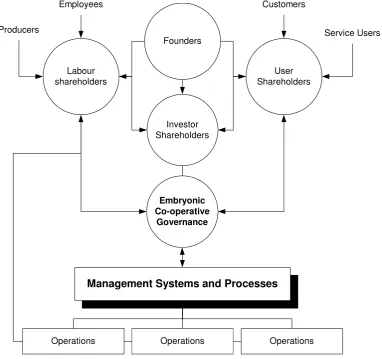
In this phase, new employees (and regular suppliers) begin to acquire Labour and Investor Shares. User shareholders begin to acquire Investor Shares. More involvement and participation in governance is practised. The enterprise experiments with democratic governance models and practices, but founder-led / manager-led consultations are likely to remain dominant in policy development / strategic management. Separate processes develop as people begin to specialise in governance, management and operations. Social auditing arrangements are put in place.
a) Established by: founders, second generation of employees / producers, first generation of user shareholders.
b) Characterised by: development of work teams and embryonic governing bodies for founders, labour and user shareholders, and investors. General Meetings involve new labour and user shareholders.
c) Ends when: financial and growth thresholds are met (typically somewhere between 20 – 50 members, set in Articles of Association).
d) Shared Prosperity: Number of labour and user shareholders increase. More labour and user shareholders begin to acquire Investor Shares. Labour shareholders, producers and customers offered opportunities to buy Investor Shares. Work begins on establishing institutions to redeem (trade) Investor Shares amongst members.
[image:12.595.120.503.374.733.2]g) Funded By: capital from new and existing members; debt finance.
Figure 3 – Evolution of Shareholdings in a FairShares Company
Embryonic Co-operative
Governance Labour
shareholders
User Shareholders Founders
Employees
Producers
Customers
Service Users
Management Systems and Processes
Operations Operations Operations
Investor Shareholders
Phase 3 – Social Democracy / Co-operative Governance
In this phase, democratic structures are established, ownership and surplus sharing arrangements are formalised, wealth and assets are locked into the community under the philosophy of ‘distributism’. Mutual organisations are created to manage social wealth.
a) Established by: reaching the size threshold set at incorporation in the Articles of Association. b) Characterised by:
i) elections to governing bodies drawn from the pool of founders, labour, user and investor shareholders
ii) the creation of forums for debate by (and between) founder, labour, user and investor shareholders
iii) administrative systems for allocating Labour Shares to new employees (and producers) iv) administrative systems that allocate User Shares to established customers/services users v) administrative systems that allocate Investor Shares to labour shareholders, customers and
service users who have established long-term relationships with the company; vi) management systems to organise issues of Investor Shares to raise risk capital;
vii)democratic systems to decide how to allocate mutual funds to employee benefit and social investment projects.
c) Shared Prosperity: through the issue of Labour and User Shares to new members so that they start to share in the issue of investor shares; through increasing the number of Investor Shares transferred into mutual ownership.
d) Funded By: issues of Investor Shares, members’ capital contributions, loan finance (if needed). e) Secured By: mutualisation of investor shareholdings as members leave, retire or become
[image:13.595.125.492.420.767.2]insolvent/bankrupt.
Figure 4 – Finalisation of Institutions in a FairShares Company
Democratic Co-operative
Governance Labour
shareholders
User Shareholders Founders
Elections Elections
Employees
Producers
Customers
Service Users
Management Systems and Processes
Operations Operations Operations
Investor Shareholders
Mutual society / company to manage social and/or charitable
investments Mutual society /
company to manage employee
benefits.
How do Shareholders Access Wealth?
Share Types When are they issued? When do they change value? When are they cancelled?
Founder Shares
Created at the start
At incorporation only Never When a founder asks for them to be cancelled, or when they are forfeited on death, bankruptcy, insolvency or winding up.
Labour Shares
Created when working begins.
On the anniversary of an agreement to supply labour
Never – but holding them determines the issue of investor shares and payment of dividends.
On the termination of an agreement provide labour, or when they are forfeited on death, bankruptcy, insolvency or winding up.
User Shares
Created when trading begins (if appropriate).
On the anniversary of an agreement to trade goods/services.
Never – but holding them determines the issue of investor shares and payment of dividends.
On the termination of an agreement to trade goods/services, death, bankruptcy, insolvency or winding up.
Investor Shares / Accounts
Created when surpluses generated / capital contributed.
When Labour/User shareholders invest capital and/or when capital gains and surpluses are allocated to Labour/User Shareholders.
At the end of each year when the company is valued and sets a
new fair price .
On death, unless they were earlier transferred to a mutual for employee, community or public benefit.
A system for members to recover capital they have invested (both directly and indirectly) and receive a share of any additional value that has accrued as a result of enterprise development combines the co-operative and private sector systems of entrepreneurial reward. Past mutual models have been premised on the assumption that members will not necessarily want to recover their capital. This argument weakens over time as members sustain their efforts to create wealth and sometimes need to realise it to survive personal and family crises.
As labour investments increase, so the concept of ‘fair shares’ becomes more important. The idea that new members should gradually build up their entitlement to a share of rewards is a product of experience in both worker and consumer co-operatives. The idea that residual value (the unallocated wealth created by the efforts of all members past and present) should be
distributed to all members (or passed to / shared with charitable institutions) is well established in co-operative economics.
In the last 50 years, the increasing use of employee benefit trusts, charitable trusts and various mutual enterprises to purchase / redeem members’ shares has largely solved the puzzle of how to sustain an entrepreneurial culture in employee-owned and mutual enterprises over long periods of time. Various approaches have been recommended: redemption after a fixed period (5 – 10 years), share purchases upon leaving or retiring, allocations of shares to trusts. For this purpose, 50% of reserves are held as a Redemption Fund to pay for the creation of mutual organisations and transfer of shares. By default, a FairShares Company has 5 years to work on the creation of the mutual institutions that will redeem members’ shareholdings (as this is the period after they can exercise their transfer rights).
How Can These Ideas be Applied to Practice?
Application in a Worker Cooperative or Co-owned Company
In a worker cooperative the emphasis is on issuing Labour Shares to those contributing labour (employees and suppliers with open-ended supply contracts), then allocating profits as Investor Shares in proportion to labour shareholdings annually. By default, 35% of surpluses are distributed to Labour shareholders. As Labour Shares are issued at a nominal cost of £1, there is no barrier to becoming a labour shareholder. Those
contributing more labour receive larger rewards. Many successful co-owned businesses use a similar incentive system whereby share distributions based on annual profitability contribute to an entrepreneurial culture with a highly committed workforce (St Luke’s Advertising Agency and School Trends are oft-cited examples).
No up-front contributions are necessary as the investor shareholdings are generated as a by-product of creating a profitable trading enterprise. However, capital contributions help reduce the cost of capital for investment. Staff can increase their investor shareholdings by buying additional shares, or can be required to buy shares upon joining. At School Trends Ltd, for example, staff must buy a shareholding equal to 5% of their starting salary after one year of service (with a cap set at 5% of share capital). At Gripple, staff buy £1000 of shares upon joining (funded by a loan if necessary). In the Mondragon Co-operative Corporation, a person makes a capital contribution equal to two month’s salary, funded by a bank loan if necessary.
Model rules for a FairShares Worker Co-operative / Employee-Owned Social Enterprise exist for situations where founders do not wish (or see any benefit) from issuing User Shares. This increases the distribution of surpluses to Labour Shareholders.
Application in a User (Consumer) Cooperative
In a user cooperative, the key goal is to benefit the people who trade or use the enterprise’s products/services. It is particularly appropriate for co-operative ventures
where there is ‘production for use’ rather than ‘production for market’ (such as
tenant-owned/run housing, food co-operatives, and educational projects). User Shares are issued when a user is accepted as a member (usually after trading/using the organisation’s products or services for a fixed period of time). Investor Shares are issued when the enterprise generates profits or when members subscribe capital. Dividends are paid to user shareholders based on the value of products/services they have traded.
In some cases, labour and user shareholders may not be totally distinct groups (for example, members of a housing co-operative, food co-operative, community shop / pub may contribute labour to run them while also buying its goods/services). In these cases, a judgement is needed about the effect of issuing both User and Labour shares.
Application in a Cooperative Consortium / Marketing Cooperative
In a cooperative consortium, Founder Shares can be issued to individuals or organisations who establish the consortium. Labour Shares can be issued to members in proportion to the amount of labour they supply, User Shares can be issued to members who contract to purchase goods and services, and Investor Shares can be issued to members in proportion to the capital contributions they make. This way, dividends are paid to members for labour, user and capital investments. The collective interests of the founders are protected
through the voice reserved for Founder Shares in decision-making and governance.
The workforce can participate by acquiring Labour and Investor Shares in their own right following the mechanisms for allocating Labour Shares decided in General Meeting. By way of example, they might be allocated as follows: 10 shares per FTE equivalent member of staff (this allows for fractional work – 1 share = 0.5 days a week, 2 shares = 1 day a week etc.); one share per 100 hours of (volunteer) labour provided; one share per £10k of labour provided. Any equitable system agreed by members is valid.
Where Did These Ideas Come From?
The FairShares model owes a debt to studies of Yugoslav2 labour-managed firms by Jaroslav Vanek (1970), and subsequent work of David Ellerman (1982, 1990, 2005), Shann Turnbull (1994, 1995, 2002) and David Erdal (2000, 2009, 2011). Most draw on successful models of worker and employee-ownership, particularly the Mondragon Co-operative Corporation (see Whyte and Whyte, 1991; Ridley-Duff, 2010). The immediate antecedent, however, is the work of Guy Major and Gavin Body on a
‘Democratic Business’ model (Major, 1996, 1998; Major and Boby, 2000). This was
developed further by Dr Rory Ridley-Duff at Computercraft Ltd, First Contact Software Ltd, New Horizons Music Ltd, Social Exchange Ltd, before becoming embedded in teaching materials at Sheffield Business School (see Ridley-Duff and Bull, 2011).
Major and Boby’s model rules were promoted to co-operative and private businesses in the period 1999 - 2002. Ridley-Duff developed their ideas through joint work with Peter Beeby and Rick Norris (School Trends Ltd) during his PhD study (see Ridley-Duff, 2010). The idea of combining internal (direct) membership with external collective ownership (including trust-based ownership) is derived from discussion documents at the Employee Share Ownership Center in the US and Employee Ownership Association in the UK. This attempts to re-create in UK / US Company Law arrangements similar to the successful Mondragon Co-operative Corporation (MCC) (see Brown, 2006; Erdal, 2011).
Ridley-Duff’s PhD (2007, 2010) advanced communitarian pluralismand a ‘surplus sharing’ iteration of Major and Boby’s democratic business model. This was checked by a
professor of Corporate Law at Sheffield Hallam University in light of the (then) forthcoming Companies Act 2006. The model was revised again in January, October and December 2009 to reflect further changes in UK Company Law. In 2010, clarifications of the way
rules can be used to support the development of ‘solidarity co-operatives’ and ‘cooperative
consortia’ were made. Minor changes were made in March 2010 followed discussions with Connie Thorpe and Morgan Killick (a Business Link social enterprise advisor and award winning social entrepreneur in the Yorkshire and Humber region of the UK). These
changes focused on making the model rules more attractive to potential social investors.
Other important influences include the NewCo Model prepared by Bill Barker and Morgan Killick at the Sheffield Community Economic Development Unit, and particularly the
2
developments at ESP Projects Ltd that combined shares with co-operative and private sector characteristics to satisfy different constituencies. The Stakeholder Model prepared by Geof Cox for the Common Cause Foundation, and the Somerset Rules prepared by Somerset Co-operative Services have also influenced teaching and debate amongst post-graduate students of co-operative and social enterprise (see Ridley-Duff, 2012a). Each of these models – developed independently – influenced the FairShares model by embracing multi-stakeholder democratic principles when incorporating an enterprise (see Brown, 2006). They confirm a broad interest across the social economy in the concept of a solidarity enterprise that binds together the interests of different stakeholders to create a social economy (see McDonnell et al., 2012; Atherton et al., 2012; Birchall, 2012).
The final pieces of this puzzle were put in place after discussions about intellectual property and worker alienation at the School for Democratic Socialism (held between September 2011 – May 2012 in Sheffield). This influenced collaborative work between Rory Ridley-Duff at Sheffield Business School and Cliff Southcombe at Social Enterprise Europe. At the School for Democratic Socialism, the success of Wikipedia was debated, and a subsequent discussion paper on Creative Commons Licensing was circulated to school participants, The Co-operative Group and Co-operative Party (Ridley-Duff, 2012b). This paper proposed Wikipedia’s approach to Intellectual Property (IP) become the basis of a bond amongst co-operative members. The creators of IP licence it to their enterprise using Creative Commons Licences, but do not transfer ownership. Individuals and groups, therefore, share IP with other workforce members without becoming alienated from IP they create. If worker members grant exclusive commercial exploitation rights to the
Co-operative/Social Enterprise for which they work full-time (and non-exclusive rights after they leave, of if they work part-time), a fuller expression of co-operative and social
enterprise values and principles becomes possible. Importantly, it ends the alienation that
occurs when members of the workforce cannot control the ‘fruits of their labour’.
Ridley-Duff and Southcombe (2012) have embedded a ‘socialisation’ perspective in the delivery of Co-operative and Social Enterprise Schools organised by Sheffield Business School, Social Enterprise Yorkshire & Humber, Social Enterprise Europe and Co-operative Business Consultants. Co-operative and Social Enterprise Support Ltd has been created to take forward this collaboration and promote the FairShares Company Model to
co-operatives, mutuals and other aspiring social enterprises.
About the Authors
Rory Ridley-Duff is course leader for the MSc Co-operative and Social Enterprise Management degree at Sheffield Hallam University. He was a founding subscriber of
Social Enterprise London, and eventually became lead author for the world’s first
authoritative textbook on social enterprise (Understanding Social Enterprise: Theory and Practice, Sage Publications). He regularly publishes academic articles.
Cliff Southcombe is managing director of Social Enterprise Europe Ltd, a development agency that has operated for over 20 years from the north of England. In addition to delivering courses at Hull and Sheffield Hallam Universities, Cliff has an international profile through project work for the British Council and European Union. He is currently an elected representative on the board of Euclid, a European network of Third Sector leaders.
Rory and Cliff jointly won ‘Top Research and Knowledge Transfer Paper in Conference’ at the 34th Institute of
Small Business and Entrepreneurship (ISBE) Conference in 2011 for a paper titled The Social Enterprise Mark: a
critical review of its conceptual dimensions. The FairShares Model continues their work to highlight the value of
References
Atherton, J., Birchall, J., Mayo, E. and Simon, G. (2012) Practical Tools for Defining Co-operative and Mutual Enterprises, Manchester: Co-operatives UK, http://www.uk.coop/sites/default/files/co-operative_id.pdf, accessed 1st October 2012.
Birchall, J. (2012) “A member-owned business approach to the classification of co-operatives and mutuals”, in McDonnell, D. and Macknight, E. (eds) (2012), The Co-operative Model in Practice,
Glasgow: Co-operative Education Trust, pp. 67-82.
Brown, J. (2006) “Equity finance for social enterprises”, Social Enterprise Journal, 2(1): 73-81. Ellerman, D. (1984) “Entrepreneurship in the Mondragon Co-operatives”, Review of Social Economy,
42(3): 272-294.
Ellerman, D. (1990) The Democratic Worker-Owned Firm: A New Model for East and West, Boston: Unwin Hyman.
Ellerman, D. (2005) Helping People Help Themselves: From the World Bank to an Alternative Philosophy of Development Assistance, Ann Arbor: University of Michigan Press.
Erdal, D. (2000) The Psychology of Sharing: An Evolutionary Approach, unpublished PhD Thesis, University of St Andrews.
Erdal, D. (2009) Local Heroes: How Loch Fyne Oysters Embraced Employee Ownership and Business Success, London: Penguin.
Erdal, D. (2011) Beyond the Corporation: Humanity Working: London: The Bodley Head
McDonnell, D., MacKnight, E. and Donnelly, H. (2012) Democratic Enterprise: Ethical Business for the 21st Century, Available at SSRN: http://ssrn.com/abstract=2041159 or
http://dx.doi.org/10.2139/ssrn.2041159.
Major, G. (1996) “Solving the under-investment and degeneration problems of worker co-ops”, Annals of Public and Co-operative Economics, 67: 545-601.
Major, G. (1998) “The Need for NOVARS (Non-Voting Value Added Sharing Renewable Shares)”, Journal of Co-operative Studies, 31(2): 57-72.
Major, G., Boby, G. (2000) Equity Devaluation, The Rarity of Democratic Firms, and “Profit Shares”, www.democraticbusiness.co.uk/vanekps.html
Ridley-Duff, R. J. and Bull, M. (2011) Understanding Social Enterprise: Theory and Practice, London: Sage Publications.
Ridley-Duff, R. J. and Southcombe, C. (2012) “The Social Enterprise Mark: a critical review of its conceptual dimensions”, Social Enterprise Journal, 8(3): 178-200.
Ridley-Duff, R. J. (2007) “Communitarian perspectives on social enterprise”, Corporate Governance: An International Review, 15(2): 382-392.
Ridley-Duff, R. J. (2010) “Communitarian governance in social enterprises: case evidence from the Mondragon Co-operative Corporation and School Trends Ltd”, Social Enterprise Journal, 6(2): 125-145.
Ridley-Duff, R. J. (2012a) “New frontiers in democratic self-management”, in McDonnell, D. and
Macknight, E. (eds), The Co-operative Model in Practice, Glasgow: Co-operative Education Trust, pp. 99-117.
Ridley-Duff, R. J. (2012b) Creative Commons, discussion paper for the School for Democratic Socialism
and Co-operative Party.
Turnbull, S. (1994), “Stakeholder democracy: redesigning the governance of firms and bureaucracies”, Journal of Socio-Economics, 23(3): 321-360.
Turnbull, S. (1995) “Innovations in corporate governance: The Mondragon Experience”, Corporate Governance: An International Review, 3(3): 167-180.
Turnbull, S. (2002) A New Way to Govern: Organisations and Society after Enron, London: New Economics Foundation.