metal-organic papers
m1070
Danielle M. Bequeathet al. [Fe2(C5H5)2(C22H32)] doi:10.1107/S160053680501367X Acta Cryst.(2005). E61, m1070–m1072
Acta Crystallographica Section E Structure Reports Online
ISSN 1600-5368
1,12-Diferrocenyldodecane at 100 K
Danielle M. Bequeath, Richard L. Porter, Michael W. Lufaso, Timothy R. Wagner, Rachel L. Kusnic, Matthias Zeller and Larry S. Curtin*
Department of Chemistry, Youngstown State University, 1 University Plaza, Youngstown, OH 44555-3663, USA
Correspondence e-mail: [email protected]
Key indicators
Single-crystal X-ray study
T= 100 K
Mean(C–C) = 0.002 A˚
Rfactor = 0.026
wRfactor = 0.075
Data-to-parameter ratio = 25.9
For details of how these key indicators were automatically derived from the article, see http://journals.iucr.org/e.
#2005 International Union of Crystallography Printed in Great Britain – all rights reserved
1,12-Diferrocenyldodecane, [Fe2(C5H5)2(C22H32)], was
synthesized from ferrocene and 1,12-dodecanedioyl chloride, followed by Clemmensen reduction. The single-crystal struc-ture was determined at 100 K by X-ray diffraction and the spectroscopic and cyclic voltammetric data of 1,12-diferrocenyldodecane and its precursor are reported.
Comment
Ferrocene-containing compounds have been extensively studied due to their unique structural and electrochemical properties. Ferrocenes have also been investigated with regard to their potential applications in chemical sensing, redox catalysts, ferromagnetism and self-assembled monolayers (Togni & Hayashi, 1995; Sawamura & Ito, 1992; Nicolosiet al., 1994; Sammakia et al., 1995; Beer et al., 1993; Zhang et al., 1995; Chidsey et al., 1990; Creager & Rowe, 1997) As an intermediate in the synthesis of self-assembled monolayers with multiple redox centers, 1,12-diferrocenyldodecane, (1), was synthesized via Clemmensen reduction of its precursor 1,12-diferrocenyldodecane-1,12-dione, (2), and its solid-state structure was established by X-ray diffraction at 100 K.
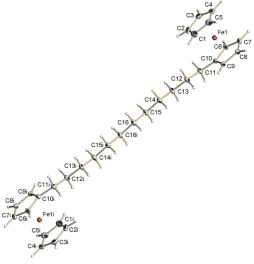
1,12-Diferrocenyldodecane crystallizes in the monoclinic space groupP21/cwith two molecules in the unit cell (Fig. 1).
The center of each molecule is located on a crystallographic inversion center halfway between C16 and C16i [symmetry code: (i) x+ 1,y+ 1,z+ 2]. The dodecane chain forms an extended zigzag chain. All torsion angles in the chain are close to 180 [between 175.70 (6) for C12 C14 C16 and
179.39 (6)for C14 C16 C15i
].
The C—C single bonds of the dodecane chain close to the ferrocene unit alternate slightly; the C10—C11 bond length between the ferrocene unit and the first methylene C atom is 1.501 (1) A˚ and that of C11—C12 is 1.529 (1) A˚. All other C— C bond distances within the dodecane chain are identical within experimental error: 1.525 (1), 1.525 (1), 1.526 (1), 1.523 (1) and 1.525 (2) A˚ for C12—C13, C13—C14, C14—C15, C15—C16, and C16—C16i, respectively. The bond distances within the ferrocene units are unexceptional, with the unsubstituted ring having basically identical C—C bond distances of 1.424 (2) A˚ , and C—C distances of the substituted
ring being between 1.429 (2) and 1.433 (2) A˚ .
The Fe1 Fe1i distance within one molecule is 18.7196 (9) A˚ in the solid state. The closest Fe Fe distances between different molecules are 6.3972 (3) A˚ for Fe1 Fe1ii [symmetry code: (ii) x, 1
2y, z+ 1
2] and 7.1275 (3) A˚ for
Fe1 Fe1iii[symmetry code: (iii)x,3
2y, z+ 1 2].
Experimental
1,12-Diferrocenyldodecane-1,12-dione, (2), was synthesized from ferrocene and 1,12-dodecanedioyl chlorideviathe method of Chidsey
et al.(1990) and was reduced to the title compound, (1), by Clem-mensen reduction, as described by Creager & Rowe (1997). Ferro-cene (35.00 g, 0.188 mmol) was dissolved at 273 K in CH2Cl2
(250 ml). 1,12-Dodecanedioyl chloride (25.00 g, 0.0935 mmol) was added and the resulting solution was stirred for 5 min. Anhydrous AlCl3(27.50 g, 0.207 mmol) was added and the solution was allowed
to warm to room temperature and stirred for 1.5 h. De-ionized water (300 ml) was added dropwise and the mixture was stirred for an additional 1.5 h. The organic phase was washed with five portions of de-ionized water, then three times with brine, and dried over an-hydrous sodium sulfate. The solvent was removed in vacuo. The crude product was purifiedviacolumn chromatography on silica with 80/20% hexanes/ethyl acetate as the eluent. The second band to elute (RF = 0.75) contained the desired product, (2), in 12.2% yield. 1
H NMR (400 MHz, CDCl3):1.322 [m, 12H, (CH2)6], 1.701 (m, 4H,
COCH2CH2), 2.692 (t, 4H, COCH2), 4.194 (s, 10H, C5H5), 4.487 (t,
4H, C5H4), 4.780 (t, 4H, C5H4). MS: calculated for (1 +
) 566m/z, found 566m/z. CV [1.6 mm diameter Pt disc working, Pt wire counter, non-aqueous Ag/Ag+ reference electrodes, 1.0 mM (2), 0.1M {(n– C4H9)N}ClO4in CH3CN]: reversible single, two-electron oxidation
centered atE= +266 mV. 1,12-Diferrocenyldodecane-1,12-dione, (2)
(9.02 g, 0.0158 mol), dissolved in toluene (800 ml), was mixed with freshly prepared zinc/mercury amalgam [mercuric chloride (1.06 g, 0.039 mol), zinc dust (15.79 g, 0.024 mol), de-ionized water (30 ml) and 12.1MHCl (40 ml)] and was refluxed under static argon for 20 h. Two additional 30 ml portions of 12.1M HCl were added with an addition funnel after 6 and 12 h under reflux. Upon cooling, the organic phase was washed three times with de-ionized water and three times with brine, and was dried over anhydrous sodium sulfate. The solvent was removedin vacuo. The crude product was purified
via column chromatography on silica with 75/25% hexanes/ethyl acetate as the eluent. The first band to elute (RF= 0.9) contained the
desired product, viz. 1,12-diferrocenyldodecane, (1). 1H NMR
(400 MHz, CDCl3): 1.199 [m, 16H, (CH2)8], 1.417 (m, 4H,
CpCH2CH2), 2.228 (t, 4H, CpCH2), 3.976 (s, 4H, C5H4), 3.996 (s, 4H,
C5H4), 4.032 (s, 10H, C5H5). MS: calculated for (2
+) 538m/z, found
538m/z. CV [1.6 mm diameter Pt disc working, Pt wire counter, non-aqueous Ag/Ag+ reference electrodes, 1.0 mM (1), 0.1M {(n–
C4H9)N}ClO4in CH3CN]: reversible single, two-electron oxidation
centered atE=25 mV. Single crystals of (1) were grown from a 75/
25% hexanes/ethyl acetate solution by slow evaporation.
Crystal data
[Fe2(C5H5)2(C22H32)] Mr= 538.36
Monoclinic,P21=c a= 16.0203 (9) A˚ b= 7.5367 (4) A˚ c= 11.1773 (6) A˚ = 103.597 (1)
V= 1311.73 (12) A˚3 Z= 2
Dx= 1.363 Mg m 3 MoKradiation Cell parameters from 6072
reflections = 2.7–30.5
= 1.12 mm1 T= 100 (2) K Block, red
0.470.290.25 mm
Data collection
Bruker SMART APEX CCD diffractometer
!scans
Absorption correction: multi-scan (SADABSinSAINT-Plus; Bruker, 2003)
Tmin= 0.644,Tmax= 0.75 15 135 measured reflections
3988 independent reflections 3769 reflections withI> 2(I) Rint= 0.018
max= 30.5 h=22!22 k=10!10 l=15!15
Refinement
Refinement onF2 R[F2> 2(F2)] = 0.026 wR(F2) = 0.075 S= 1.07 3988 reflections 154 parameters
H-atom parameters constrained
w= 1/[2(F
o2) + (0.0461P)2
+ 0.3363P]
whereP= (Fo2+ 2Fc2)/3
(/)max= 0.001 max= 0.45 e A˚
3 min=0.37 e A˚
3
All H atoms were placed in calculated positions, with a C—H bond distance of 0.99 (methylene) or 1.00 A˚ (Cp), and were refined with isotropic displacement parameters 1.2 times Ueq of the parent C
atom. The s.u. values of the cell parameters are taken from the software, recognizing that the values are unreasonably small (Herb-stein, 2000).
Data collection:SMART(Bruker, 2002); cell refinement:SAINT
-Plus(Bruker, 2003); data reduction:SAINT-Plus; program(s) used to solve structure:SHELXTL(Bruker, 2000); program(s) used to refine structure:SHELXTL; molecular graphics:SHELXTL; software used to prepare material for publication:SHELXTL.
metal-organic papers
Acta Cryst.(2005). E61, m1070–m1072 Danielle M. Bequeathet al. [Fe
[image:2.610.44.298.72.336.2]2(C5H5)2(C22H32)]
m1071
Figure 1LSC was supported by a YSU Research Professorship (1996–1997) and by Youngstown State University Research Council Grants (Nos. 961, 10-2001 and 06-98), and the diffractometer was funded by NSF grant No. 0087210, by Ohio Board of Regents grant CAP-491, and by YSU.
References
Beer, P. D., Crowe, D. B., Ogden, M. I., Drew, M. G. B. & Main, B. (1993).J. Chem. Soc. Dalton Trans.pp. 2107–2116.
Bruker (2000). SHELXTL. Version 6.10. Bruker AXS Inc., Madison, Wisconsin, USA.
Bruker (2002). SMART for WNT/2000. Version 5.630. Bruker AXS Inc., Madison, Wisconsin, USA.
Bruker (2003). SAINT-Plus. Version 6.45. Bruker AXS Inc., Madison Wisconsin, USA.
Chidsey, C. E. D., Bertozzi, C. R., Putvinski, T. M. & Mujsce, A. M. (1990).J. Am. Chem. Soc.112, 4301–4306.
Creager, S. E. & Rowe, G. K. (1997).J. Electroanal.Chem.420, 291–299. Herbstein, F. H. (2000).Acta Cryst.B56, 547–557.
Nicolosi, G., Patti, R., Morrone, R. & Piatelli, M. (1994). Tetrahedron Asymmetry,5, 1639–1642.
Sammakia, T., Latham, H. A. & Schaad, D. R. (1995).J. Org. Chem.60, 10–11.
Sawamura, M. & Ito, Y. (1992).Chem. Rev.92, 857–871.
Togni, A. & Hayashi, T. (1995). Editors.Ferrocenes: Homogeneous Catalysis, Organic Synthesis, Materials Science. Weinheim, Germany: Verlag Chemie.
Zhang, L., Godinez, L. A., Lu, T., Gokel, G. W. & Kaifer, A. E. (1995).Angew. Chem. Int. Ed. Engl.34, 235–237.
metal-organic papers
m1072
Danielle M. Bequeathet al. [Fesupporting information
sup-1 Acta Cryst. (2005). E61, m1070–m1072
supporting information
Acta Cryst. (2005). E61, m1070–m1072 [https://doi.org/10.1107/S160053680501367X]
1,12-Diferrocenyldodecane at 100
K
Danielle M. Bequeath, Richard L. Porter, Michael W. Lufaso, Timothy R. Wagner, Rachel L.
Kusnic, Matthias Zeller and Larry S. Curtin
1,12-Diferrocenyldodecane
Crystal data [Fe2(C5H5)2(C22H32)] Mr = 538.36
Monoclinic, P21/c a = 16.0203 (9) Å b = 7.5367 (4) Å c = 11.1773 (6) Å β = 103.597 (1)° V = 1311.73 (12) Å3 Z = 2
F(000) = 572 Dx = 1.363 Mg m−3
Mo Kα radiation, λ = 0.71073 Å Cell parameters from 6072 reflections θ = 2.7–30.5°
µ = 1.12 mm−1 T = 100 K Block, red
0.47 × 0.29 × 0.25 mm
Data collection
Bruker SMART APEX CCD diffractometer
Radiation source: fine-focus sealed tube Graphite monochromator
ω scans
Absorption correction: multi-scan
(SADABS in SAINT-Plus; Bruker, 2003) Tmin = 0.644, Tmax = 0.75
15135 measured reflections 3988 independent reflections 3769 reflections with I > 2σ(I) Rint = 0.018
θmax = 30.5°, θmin = 2.6° h = −22→22
k = −10→10 l = −15→15
Refinement Refinement on F2
Least-squares matrix: full R[F2 > 2σ(F2)] = 0.026 wR(F2) = 0.075 S = 1.07 3988 reflections 154 parameters 0 restraints
Primary atom site location: structure-invariant direct methods
Secondary atom site location: difference Fourier map
Hydrogen site location: inferred from neighbouring sites
H-atom parameters constrained w = 1/[σ2(F
o2) + (0.0461P)2 + 0.3363P]
where P = (Fo2 + 2Fc2)/3
(Δ/σ)max = 0.001
Δρmax = 0.45 e Å−3
Δρmin = −0.37 e Å−3
Special details
supporting information
sup-2 Acta Cryst. (2005). E61, m1070–m1072
Refinement. Refinement of F2 against ALL reflections. The weighted R-factor wR and goodness of fit S are based on F2,
conventional R-factors R are based on F, with F set to zero for negative F2. The threshold expression of F2 > σ(F2) is used
only for calculating R-factors(gt) etc. and is not relevant to the choice of reflections for refinement. R-factors based on F2
are statistically about twice as large as those based on F, and R- factors based on ALL data will be even larger.
Fractional atomic coordinates and isotropic or equivalent isotropic displacement parameters (Å2)
x y z Uiso*/Ueq
Fe1 0.150648 (8) 0.456529 (18) 0.201472 (12) 0.01482 (6)
C15 0.47083 (7) 0.47571 (14) 0.82064 (9) 0.01875 (18)
H15A 0.4867 0.3492 0.8170 0.022*
H15B 0.5188 0.5479 0.8051 0.022*
C10 0.27129 (6) 0.56166 (13) 0.25528 (9) 0.01603 (17)
C13 0.40387 (7) 0.47918 (15) 0.59021 (9) 0.01925 (19)
H13A 0.4164 0.3517 0.5819 0.023*
H13B 0.4546 0.5474 0.5800 0.023*
C11 0.34316 (6) 0.50312 (15) 0.35980 (9) 0.01843 (17)
H11A 0.3958 0.5688 0.3551 0.022*
H11B 0.3542 0.3755 0.3493 0.022*
C12 0.32668 (7) 0.53082 (14) 0.48777 (9) 0.01899 (19)
H12A 0.3126 0.6571 0.4975 0.023*
H12B 0.2765 0.4589 0.4953 0.023*
C14 0.39067 (7) 0.51228 (15) 0.71907 (9) 0.01973 (18)
H14A 0.3434 0.4357 0.7321 0.024*
H14B 0.3731 0.6373 0.7251 0.024*
C9 0.20809 (7) 0.69370 (13) 0.25968 (9) 0.01905 (18)
H9 0.2025 0.7604 0.3347 0.023*
C16 0.45963 (7) 0.51663 (15) 0.94941 (9) 0.01907 (18)
H16A 0.4124 0.4426 0.9656 0.023*
H16B 0.4426 0.6425 0.9526 0.023*
C6 0.25518 (7) 0.49900 (15) 0.13089 (9) 0.01910 (18)
H6 0.2888 0.4055 0.0994 0.023*
C7 0.18182 (7) 0.59061 (15) 0.06002 (9) 0.02098 (19)
H7 0.1555 0.5728 −0.0296 0.025*
C8 0.15281 (7) 0.71108 (14) 0.13960 (10) 0.02141 (19)
H8 0.1023 0.7925 0.1159 0.026*
C4 0.05170 (7) 0.28888 (15) 0.12628 (10) 0.0237 (2)
H4 0.0224 0.2800 0.0370 0.028*
C2 0.14696 (9) 0.24562 (18) 0.31325 (12) 0.0354 (3)
H2 0.1960 0.2000 0.3786 0.043*
C3 0.12559 (8) 0.19140 (15) 0.18762 (13) 0.0290 (2)
H3 0.1570 0.1013 0.1493 0.035*
C5 0.02764 (7) 0.40330 (18) 0.21393 (11) 0.0273 (2)
H5 −0.0215 0.4888 0.1969 0.033*
C1 0.08646 (9) 0.3764 (2) 0.32950 (11) 0.0347 (3)
supporting information
sup-3 Acta Cryst. (2005). E61, m1070–m1072
Atomic displacement parameters (Å2)
U11 U22 U33 U12 U13 U23
Fe1 0.01573 (9) 0.01515 (9) 0.01276 (8) −0.00131 (4) 0.00170 (5) 0.00044 (4)
C15 0.0205 (4) 0.0223 (5) 0.0124 (4) 0.0036 (3) 0.0016 (3) −0.0006 (3)
C10 0.0169 (4) 0.0178 (4) 0.0126 (4) −0.0021 (3) 0.0017 (3) −0.0005 (3)
C13 0.0195 (4) 0.0241 (5) 0.0123 (4) 0.0046 (3) 0.0000 (3) −0.0010 (3)
C11 0.0170 (4) 0.0232 (4) 0.0138 (4) 0.0021 (4) 0.0011 (3) −0.0016 (4)
C12 0.0168 (4) 0.0262 (5) 0.0126 (4) 0.0017 (3) 0.0005 (3) −0.0009 (3)
C14 0.0193 (4) 0.0262 (5) 0.0126 (4) 0.0026 (4) 0.0017 (3) −0.0002 (3)
C9 0.0219 (4) 0.0158 (4) 0.0173 (4) −0.0007 (3) 0.0003 (3) −0.0020 (3)
C16 0.0209 (5) 0.0236 (5) 0.0118 (4) 0.0036 (4) 0.0019 (3) 0.0002 (3)
C6 0.0200 (4) 0.0247 (4) 0.0129 (4) −0.0025 (4) 0.0044 (3) −0.0011 (4)
C7 0.0242 (5) 0.0235 (5) 0.0137 (4) −0.0043 (4) 0.0014 (3) 0.0032 (4)
C8 0.0239 (5) 0.0161 (4) 0.0205 (4) −0.0003 (3) −0.0023 (4) 0.0025 (3)
C4 0.0191 (4) 0.0255 (5) 0.0249 (5) −0.0063 (4) 0.0020 (4) −0.0025 (4)
C2 0.0329 (6) 0.0331 (6) 0.0335 (6) −0.0139 (5) −0.0059 (5) 0.0180 (5)
C3 0.0244 (5) 0.0169 (5) 0.0437 (7) −0.0049 (4) 0.0039 (4) 0.0014 (4)
C5 0.0199 (5) 0.0331 (6) 0.0308 (6) −0.0048 (4) 0.0097 (4) −0.0032 (5)
C1 0.0375 (6) 0.0475 (8) 0.0212 (5) −0.0200 (6) 0.0111 (5) −0.0010 (5)
Geometric parameters (Å, º)
Fe1—C2 2.0312 (11) C12—H12A 0.9900
Fe1—C7 2.0351 (10) C12—H12B 0.9900
Fe1—C3 2.0368 (11) C14—H14A 0.9900
Fe1—C6 2.0373 (10) C14—H14B 0.9900
Fe1—C1 2.0401 (12) C9—C8 1.4297 (14)
Fe1—C8 2.0424 (10) C9—H9 1.0000
Fe1—C10 2.0441 (10) C16—C16i 1.525 (2)
Fe1—C9 2.0454 (10) C16—H16A 0.9900
Fe1—C4 2.0468 (10) C16—H16B 0.9900
Fe1—C5 2.0476 (11) C6—C7 1.4310 (15)
C15—C16 1.5232 (14) C6—H6 1.0000
C15—C14 1.5260 (14) C7—C8 1.4234 (16)
C15—H15A 0.9900 C7—H7 1.0000
C15—H15B 0.9900 C8—H8 1.0000
C10—C9 1.4287 (14) C4—C3 1.4246 (17)
C10—C6 1.4331 (13) C4—C5 1.4247 (16)
C10—C11 1.5009 (14) C4—H4 1.0000
C13—C14 1.5248 (14) C2—C1 1.424 (2)
C13—C12 1.5252 (14) C2—C3 1.4248 (19)
C13—H13A 0.9900 C2—H2 1.0000
C13—H13B 0.9900 C3—H3 1.0000
C11—C12 1.5287 (14) C5—C1 1.4232 (18)
C11—H11A 0.9900 C5—H5 1.0000
supporting information
sup-4 Acta Cryst. (2005). E61, m1070–m1072
C2—Fe1—C7 156.12 (6) C11—C12—H12A 109.1
C2—Fe1—C3 41.00 (6) C13—C12—H12B 109.1
C7—Fe1—C3 120.54 (5) C11—C12—H12B 109.1
C2—Fe1—C6 120.43 (5) H12A—C12—H12B 107.9
C7—Fe1—C6 41.15 (4) C13—C14—C15 113.19 (9)
C3—Fe1—C6 106.86 (5) C13—C14—H14A 108.9
C2—Fe1—C1 40.94 (6) C15—C14—H14A 108.9
C7—Fe1—C1 161.47 (6) C13—C14—H14B 108.9
C3—Fe1—C1 68.91 (6) C15—C14—H14B 108.9
C6—Fe1—C1 156.06 (5) H14A—C14—H14B 107.8
C2—Fe1—C8 161.55 (6) C10—C9—C8 108.61 (9)
C7—Fe1—C8 40.86 (4) C10—C9—Fe1 69.50 (6)
C3—Fe1—C8 156.14 (5) C8—C9—Fe1 69.41 (6)
C6—Fe1—C8 68.92 (5) C10—C9—H9 125.7
C1—Fe1—C8 124.54 (6) C8—C9—H9 125.7
C2—Fe1—C10 106.53 (4) Fe1—C9—H9 125.7
C7—Fe1—C10 69.41 (4) C15—C16—C16i 113.55 (11)
C3—Fe1—C10 123.95 (5) C15—C16—H16A 108.9
C6—Fe1—C10 41.11 (4) C16i—C16—H16A 108.9
C1—Fe1—C10 120.40 (5) C15—C16—H16B 108.9
C8—Fe1—C10 69.23 (4) C16i—C16—H16B 108.9
C2—Fe1—C9 124.35 (5) H16A—C16—H16B 107.7
C7—Fe1—C9 68.83 (4) C7—C6—C10 108.37 (9)
C3—Fe1—C9 161.33 (5) C7—C6—Fe1 69.35 (6)
C6—Fe1—C9 68.69 (4) C10—C6—Fe1 69.70 (6)
C1—Fe1—C9 107.39 (5) C7—C6—H6 125.8
C8—Fe1—C9 40.94 (4) C10—C6—H6 125.8
C10—Fe1—C9 40.90 (4) Fe1—C6—H6 125.8
C2—Fe1—C4 68.76 (5) C8—C7—C6 107.95 (9)
C7—Fe1—C4 107.18 (4) C8—C7—Fe1 69.84 (6)
C3—Fe1—C4 40.83 (5) C6—C7—Fe1 69.51 (6)
C6—Fe1—C4 124.46 (4) C8—C7—H7 126.0
C1—Fe1—C4 68.65 (5) C6—C7—H7 126.0
C8—Fe1—C4 120.93 (4) Fe1—C7—H7 126.0
C10—Fe1—C4 161.36 (4) C7—C8—C9 107.88 (9)
C9—Fe1—C4 156.52 (4) C7—C8—Fe1 69.30 (6)
C2—Fe1—C5 68.73 (5) C9—C8—Fe1 69.64 (6)
C7—Fe1—C5 124.47 (5) C7—C8—H8 126.1
C3—Fe1—C5 68.74 (5) C9—C8—H8 126.1
C6—Fe1—C5 161.62 (5) Fe1—C8—H8 126.1
C1—Fe1—C5 40.75 (5) C3—C4—C5 108.04 (10)
C8—Fe1—C5 107.47 (5) C3—C4—Fe1 69.21 (6)
C10—Fe1—C5 156.13 (4) C5—C4—Fe1 69.67 (6)
C9—Fe1—C5 121.19 (5) C3—C4—H4 126.0
C4—Fe1—C5 40.72 (5) C5—C4—H4 126.0
C16—C15—C14 113.63 (9) Fe1—C4—H4 126.0
C16—C15—H15A 108.8 C1—C2—C3 108.13 (11)
supporting information
sup-5 Acta Cryst. (2005). E61, m1070–m1072
C16—C15—H15B 108.8 C3—C2—Fe1 69.71 (7)
C14—C15—H15B 108.8 C1—C2—H2 125.9
H15A—C15—H15B 107.7 C3—C2—H2 125.9
C9—C10—C6 107.19 (9) Fe1—C2—H2 125.9
C9—C10—C11 126.73 (9) C4—C3—C2 107.85 (11)
C6—C10—C11 126.05 (9) C4—C3—Fe1 69.96 (6)
C9—C10—Fe1 69.60 (6) C2—C3—Fe1 69.29 (7)
C6—C10—Fe1 69.19 (6) C4—C3—H3 126.1
C11—C10—Fe1 127.90 (7) C2—C3—H3 126.1
C14—C13—C12 113.53 (9) Fe1—C3—H3 126.1
C14—C13—H13A 108.9 C1—C5—C4 108.03 (11)
C12—C13—H13A 108.9 C1—C5—Fe1 69.34 (7)
C14—C13—H13B 108.9 C4—C5—Fe1 69.61 (6)
C12—C13—H13B 108.9 C1—C5—H5 126.0
H13A—C13—H13B 107.7 C4—C5—H5 126.0
C10—C11—C12 114.74 (8) Fe1—C5—H5 126.0
C10—C11—H11A 108.6 C5—C1—C2 107.95 (11)
C12—C11—H11A 108.6 C5—C1—Fe1 69.91 (6)
C10—C11—H11B 108.6 C2—C1—Fe1 69.20 (7)
C12—C11—H11B 108.6 C5—C1—H1 126.0
H11A—C11—H11B 107.6 C2—C1—H1 126.0
C13—C12—C11 112.31 (8) Fe1—C1—H1 126.0
C13—C12—H12A 109.1