2639
Domain Adaptive Dialog Generation via Meta Learning
Kun Qian
Univeristy of California, Davis
Zhou Yu
Univeristy of California, Davis
Abstract
Domain adaptation is an essential task in dia-log system building because there are so many new dialog tasks created for different needs every day. Collecting and annotating train-ing data for these new tasks is costly since it involves real user interactions. We propose a domain adaptive dialog generation method based on meta-learning (DAML). DAML is an end-to-end trainable dialog system model that learns from multiple rich-resource tasks and then adapts to new domains with mini-mal training samples. We train a dialog sys-tem model using multiple rich-resource single-domain dialog data by applying the model-agnostic meta-learning algorithm to dialog do-main. The model is capable of learning a competitive dialog system on a new domain with only a few training examples in an effi-cient manner. The two-step gradient updates in DAML enable the model to learn general features across multiple tasks. We evaluate our method on a simulated dialog dataset and achieve state-of-the-art performance, which is generalizable to new tasks.
1 Introduction
Modern personal assistants, such as Alexa and Siri, are composed of thousands of single-domain task-oriented dialog systems. Every dialog task is different, due to the specific domain knowl-edge. An end-to-end trainable dialog system re-quires thousands of dialogs for training. How-ever, the availability of the training data is usu-ally limited as real users have to be involved to obtain the training dialogs. Therefore, adapting existing rich-resource data to new domains with limited resource is an essential task in dialog sys-tem research. Transfer learning (Caruana,1997a; Bengio,2012;Cohn et al.,1994;Mo et al.,2018), few-shot learning (Salakhutdinov et al., 2012;Li et al., 2006; Norouzi et al., 2013; Socher et al.,
2013) and meta-learning (Finn et al., 2017) are introduced in solving such data scarcity problem in machine learning. Because every dialog do-main is very different from each other, general-ize information from rich-resource domains to an-other low resource domain is difficult. There-fore, only a few studies have tackled domain adap-tive end-to-end dialog training methods (Zhao and Esk´enazi, 2018). We propose DAML based on meta-learning to combine multiple dialog tasks in training, in order to learn general and transferable information that is applicable to new domains.
Zhao and Esk´enazi (2018) introduces action matching, a learning framework that could re-alize zero-shot dialog generation (ZSDG), based on domain description, in the form of seed re-sponse. With limited knowledge of a new do-main, the model trained on several rich-resource domains achieves both impressive task comple-tion rate and natural generated response. Rather than action matching, we propose to use model-agnostic meta-learning (MAML) algorithm (Finn et al., 2017) to perform dialog domain adapta-tion. The MAML algorithm tries to build an inter-nal representation of multiple tasks and maximize the sensitivity of the loss function when applied to new tasks, so that small update of parameters could lead to large improvement of new task loss value. This allows our dialog system to adapt to new domain successfully not only with little target domain data but also in a more efficient manner.
the target domain, movie information search. By modifying Sequicity (Lei et al.,2018), a seq2seq encoder-decoder network, improving it with a two-stage CopyNet (Gu et al., 2016), we imple-ment the MAML algorithm to achieve an optimal initialization using dialog data from source do-mains. Then, we fine-tune the initialization to-wards the target domain with a minimal portion of dialog data using normal gradient descent. Fi-nally, we evaluate the adapted model with test-ing data also from the target domain. We outper-form the state-of-the-art zero-shot baseline, ZSDG (Zhao and Esk´enazi,2018), as well as other trans-fer learning methods (Caruana,1997b). We pub-lish the code on the github1.
2 Related Works
Task-oriented dialog systems are developed to assist users to complete specific tasks, such as booking restaurant or querying weather informa-tion. The traditional method to build a dialog sys-tem is to train modules separately (Chen et al., 2017) such as: natural language understanding (NLU) (Deng et al., 2012;Dauphin et al., 2014; Hashemi et al.), dialog state tracker (Henderson et al., 2014), dialog policy learning (Cuay´ahuitl et al., 2015;Young et al., 2013) and natural lan-guage generation (NLG) (Dhingra et al., 2017; Wen et al., 2015). Henderson et al. (2013) in-troduces the concept of belief tracker that tracks users’ requirements and constraints in the dialog across turns. Recently, more and more works combine all the modules into a seq2seq model for the reason of easier model update. Lei et al.(2018) has introduced a new end-to-end di-alog system, sequicity, constructed on a two-stage CopyNet (Gu et al., 2016): one for the belief tracker and another one for the response genera-tion. This model has fewer number of parameters and trains faster than the state-of-the-art baselines while outperforming baselines on two large-scale datasets.
The traditional paradigm in machine learning research is to train a model for a specific task with plenty of annotated data. Obviously, it is not reasonable that large amount of data is still re-quired to train a model from scratch if we already have models for similar tasks. Instead, we want to quickly adapt a trained model to a new task with a small amount of new data. Dialog adaptation
1https://github.com/qbetterk/sequicity.git
has been explored in various dimensions. Shi and Yu(2018) introduces an end-to-end dialog system that adapts to user sentiment. Mo et al. (2018) andGenevay and Laroche(2016) also trains a user adaptive dialog systems using transfer learning. Recently, effective domain adaptation has been in-troduced for natural language generation in dia-log systems (Tran and Nguyen,2018;Wen et al., 2016). Some domain adaptation work has been done on dialog states tracking (Mrkˇsi´c et al.,2015) and dialog policy learning (Vlasov et al., 2018) as well. However, there is no recent work about domain adaptation for a seq2seq dialog system, except ZSDGZhao and Esk´enazi(2018). ZSDG is a zero-shot learning method that adapts action matching to adapt models learned from multiple source domains to a new target domain only using its domain description. Different from ZSDG, we propose to adapt meta-learning to achieve similar domain adaption ability.
Meta-learning aims at learning new tasks with few steps and little data based on well-known tasks. One way to realize meta-learning is to learn an optimal initialization that could be adapted to new task accurately and quickly with little data (Vinyals et al.,2016;Snell et al.,2017). An-other way to learn the learning progress is to train a meta-learner to optimize the optimizer of origi-nal network for updating parameters ( Andrychow-icz et al.,2016;Grant et al.,2018). Meta-learning has been applied in various circumstances such as image classification (Santoro et al.,2016;Finn et al.,2017), machine translation (Gu et al.,2018), robot manipulation (Duan et al.,2016;Wang et al., 2016), etc. We propose to apply meta-learning al-gorithm on top of the sequicity model to achieve dialog domain adaptation. Specifically, we chose the recently introduced algorithm, model-agnostic meta-learning(MAML) (Finn et al., 2017), be-cause it generalizes across different models. This algorithm is compatible with any model optimized with gradient descent, such as regression, clas-sification and even policy gradient reinforcement learning. Moreover, this algorithm outperforms other state-of-the-art one-shot algorithms for im-age classification.
3 Problem Formulation
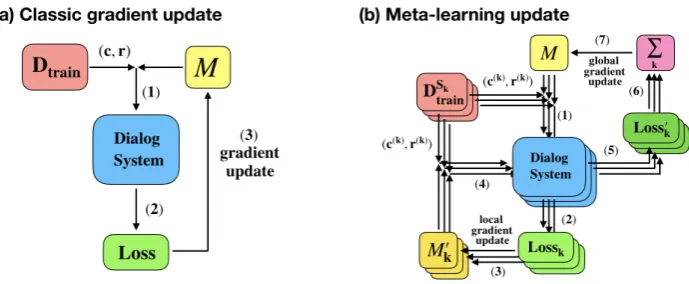
differ-Figure 1: (a) shows the classical gradient update steps. (b) shows how we use MAML to update model with gradient descent. The index numbers suggest the processing order of each step.
ent source domains, we have the training data in each source domainSk, denoted as:
DSk
train={(c
(k)
n , rn(k), Sk), n= 1...N}, k= 1...K
we also denote the data in the target domainT as:
DtrainT ={(cTn, rTn, T), n= 1...N0}
whereN0 << N andN0 is only1%ofN in our setting.
During the training process, we generate a model
Msource:C×Sk→R
whereC is the set of context andR is the set of system responses.
For the adaptation, we fine-tune the model Msource with target domain training data DtrainT
and obtain a new model Mtarget. Our primary goal is to learn a model that could perform well in the new target domain:
Mtarget :Ctarget×T →Rtarget
4 Proposed Methods
We first introduce how to combine the MAML al-gorithm and the sequicity model. As illustrated in the Figure1, the typical gradient descent includes (1) combining training data and initialized model, (2) computing the objective loss and then (3) us-ing the loss to update the model parameters. How-ever, with MAML, there are two gradient update steps. (1) We first combine the initialized model Mwith training data(c(k), r(k))from each source domainSkseparately. (2) For each dialog domain, we calculate the lossLosskand them use it to up-date every new temporary domain modelM0
k. (4)
Again we use the data (c(k), r(k)) from each do-main and its corresponding temporarily updated domain modelM0
kto calculate a new lossLoss0k in each domain, (6) then sum all the new domain loss to obtain the final loss. (7) Finally, we use the final loss to update the original modelM.
In the following part, we describe the imple-mentation details of the MAML algorithm and the sequicity model separately. As illustrated in Algo-rithm 1, sequicity model is used to combine nat-ural language understanding (NLU), dialog man-aging and response generation in a seq2seq fash-ion, while meta-learning is a method to adjust loss function value for better optimization. αandβ in the algorithm are the learning rate. As mentioned in Section 3, c denotes the context and is the in-put to the model at each turn. In order to use the sequicity model, we formatcas{Bt−1, Rt−1, Ut} at time t, whereBt−1 is the previous belief span
at timet−1,Rt−1is the last system response and
Ut is the current user utterance. Sequicity model introduces belief spans to store values of all the informable slots and also record requestable slot names through the history. In this way, rather than put all the history utterances into a RNN to ex-tract context features, we directly deal with the slots stored in the belief span as the representation of all history contexts. The belief span is more accurate and simple to represent the history con-text and needed to be updated in every turn. The informable and requestable slots are stored in the same span, but with different labels to avoid am-biguity. The context at time t = 1 contains an empty set as the former belief span B0, and an
empty string as the previous system responseR0
[image:3.595.123.468.66.208.2]trans-Algorithm 1DAML
Input: dataset on source domainDtrainS ;α;β
Output: optimal meta-learned model
Randomly initialize model M
whilenot donedo
forSk ∈Source Domaindo Sample datac(k)fromDStrain
M0k=M −α∇MLSk(M, c
(k))
EvaluateLSk(M 0
k, c(k)) end for
M ← M −β∇MPS
kLSk(M 0
k, c(k)) end while
Function loss functionL(M, c) returncross-entropy(M(c))
Function M(c(k)={B(k)
t−1, R (k)
t−1, U (k)
t })
h=Encoder(Bt(−k)1, Rt(k−)1, Ut(k))
Bt=BspanDecoder(h)
Rt=ResponseDecoder(h, B(tk), m
(k)
t ) returnRt
ferable than others. This suggests that some in-ternal features can be applied to multiple dialog domains rather than a single domain.
Since MAML is compatible with any gradient descent based model, we denote the current gener-ative dialog model asM, which can be randomly initialized. According to the algorithm, for each source domainSk, certain size of training data is sampled. We input the training data (c(k), r(k)) into sequicity model and obtain generated system response. We adopt cross-entropy as the loss func-tion for all the domains:
LSk(M, c(k), r(k)) =
|r(k)| X
j=1
r(jk)·logPM(rj(k))
For each source domain Sk, We use gradient de-scent to update and get a temporary model.
M0k ← M −α∇MLSk(M, c
(k), r(k))
To be consistent with (Finn et al.,2017), we only update the model for one step. In this way, we have an updated model in each source domain, one step away from M. We may consider multiple steps of gradient update in the future work. Then, we compute the loss based on the updated model with the same training data in each source domain:
Loss=LSk(M0k, c(k), r(k))
After this step, we have meta loss value in each do-main. We sum up the updated loss value from all source domains as the objective function of meta-learning:
min
M Meta-Loss= minM
X
Sk
LSk(M0k, c(k), r(k))
Finally, we update the model to minimize the meta objective function:
M ← M −β∇M
X
Sk
LSk(M 0
k, c(k), r(k))
Unlike common gradient, in MAML, the objective loss we use to update model is not calculated di-rectly from the current modelM0k, but from the temporary modelM0
k. The idea behind this oper-ation is that the loss calculated from the updated model is obviously more sensitive to the changes in original domains, so that we learn more about the common internal representations of all source domains rather than the distinctive features of each domain. Then in the adaptation step, since the ba-sic internal representation has already been cap-tured, the model is sensitive to the unique features of the new domain. As a result, one or a few gra-dient steps and minimum amount of data are re-quired to optimize the model to the new domain.
The sequicity model is constructed based on a single seq2seq model incorporating copying mechanism and belief span to record dialog states. Given a contextcin the form of{Bt−1, Rt−1, Ut}, the belief spanBtat time tis extracted based on the previous belief spanBt−1at timet−1, the
his-tory responseRt−1at timet−1and the utterance
Utat timet:
Bt=seq2seq(Bt−1, Rt−1, Ut)
Then, we generate system response based on both context and belief span extracted before:
Rt=seq2seq(Bt−1, Rt−1, Ut|Bt, mt)
mt is a simple label that helps generate the re-sponse. It checks whether or not requested in-formation is available in the database with con-straints stored in Bt. mt has three possible val-ues: no match, exact match and multiple match.
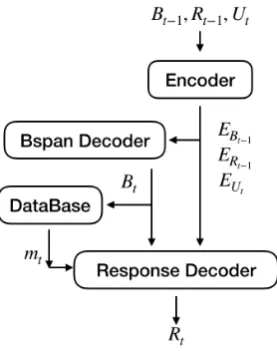
Figure 2: Structure of dialog system
end the conversation. mt = “multiple matches” means there are multiple items matches all the constraints, so more constraints are needed to re-duce the range of search in the backend database. So the system will then output a question to elicit more information.
The structure is illustrated in Figure 2and it is compatible with any seq2seq model. To have a simple architecture, we adopt the basic encoder-decoder structure. Both encoder and encoder-decoder em-ploy GRU with attention mechanism. The re-sponse is generated using belief span and utterance at the current time. To simplify the model, we let the belief extractor and response generator share the same encoder. So we reformulate the equa-tions into:
h=Encoder(Bt−1, Rt−1, Ut)
Bt=BspanDecoder(h)
Rt=ResponseDecoder(h, Bt, mt) We also need to apply the third attention-based GRU for the response decoding.
Because the response and the utterance usually share some word tokens, the sequicity model also incorporates copy-attention mechanism. Origi-nally, to decode an encoded vector, the model uses softmax to obtain a probability over vocabulary
Pvocab(v) where v ∈ V. With copy-attention, the decoder not only considers the word genera-tion probability distribugenera-tion over vocabulary, but also the likelihood of copy the word from input se-quencePcopy(v)wherev ∈ V ∪UtandUtis the current user utterance in the input contextc. Then the total probability of wordv atith token in the output sequence is calculated by summing these
two probabilities (normalization is performed af-ter the summation):
Pi(v) = (1−g)·Pivocab(v)+g·P copy
i (v), v∈V∪Ut
The copy probability is calculated similarly inGu et al. (2016) and is different for belief span de-coder and response dede-coder.
For the belief span decoder, the copy probability is calculated as:
Picopy(v) = 1
Z |Ut|
X
j:uj=v eψ(uj)
whereZis a normalization factor anduj is thejth word tokens in the utteranceUt. We only add the component whenuj is the same as the target word
v. ψ(uj)is computed by:
ψ(uj) =σ((hencj )TW)hdecj
wherehencj is the hidden state in the encoder for thejth word as input,hdecj is the hidden state in the belief span decoder and W ∈ Rd×d is the
copy-attention weight.
For the response decoder, we apply the copy at-tention on the recently generated belief span Bt rather than utteranceUt:
Picopy(v) = 1
Z0 |Bt|
X
j:bj=v eψ(bj)
ψ(bj) =σ((hdecj )TW)hdecj
where both hidden states come from belief span decoder.
5 Experiment
We first introduce the dataset and the metrics used to evaluate our models. Then, we describe models evaluated in the experiments and their implemen-tation details.
5.1 Dataset
same slot type and sentence generation templates as the restaurant task but a different slot vocabu-lary. Similarly, restaurant-style has the same slots but different natural language generation (NLG) templates compared to the restaurant domain.
We choose restaurant, weather and bus as source domains, denoted as following the exper-iment setting of ZSDG in (Zhao and Esk´enazi, 2018). For each source domain, we have 900, 100, 500 conversations for training, validation and testing correspondingly, each of which has 9 turns and each utterance has 13 word tokens on aver-age. The rest three domains are for evaluation, which are considered as target domains. The seed response used in ZSDG is a set of system utter-ances and corresponding labels. To achieve a fair comparison, we use dialog data of the same size for adaptation training. We generate 9 dialogs (1% of source domain) for each domain’s adap-tation training, each averagely contains about 8.4 turns. So for each target domain, we assume we have around 76 system response, which is smaller than the 100 seed response, ZSDG used as do-main description. For testing, we use 500 dialogs for each target model. Movie is chosen to be the new target domain for evaluation. Because movie has completely different NLG templates and dia-log structure, sharing very few common traits with the source domains at the surface level.
To avoid any random results in this few-shot learning setting, we report the average of ten ran-dom runs for all results. For further exploring the property of the proposed method, we have also generated one dialog for the one-shot experiment, 45 dialogs (5% of the size in source domain), 90 dialogs (10% of the size in source domain) study the adaptation efficiency of our methods.
5.2 Metrics
There are three main metrics in our experiments: BLEU score, entity F1 score and adapting time. The first two are the most important and persua-sive metrics used inFinn et al.(2017) has exhaus-tively demonstrated the MAML’s fast adaptation speed to new tasks. It could even achieve amaz-ing performance with one step of gradient update incorporating with halfcheetah and ant. We would also like to count the number of epochs for adapta-tion to compare the adaptaadapta-tion speed between our methods and the baseline of transfer learning.
• BLEUWe use BLEU score (Papineni et al.,
2002) to evaluate the quality of generated response sentences since generating natural language is also part of the task.
• Entity F1 Score For each dialog, we com-pare the generated belief span and the Oracle one. Since belief span contains all the slots that constraints the response, this score also checks the completeness of tasks.
• Adapting Time We count the number of epochs during the adaptation training. We only compare the adaptation with the data of the same size.
5.3 Baseline Models
To evaluate the effectiveness of our model, we compare DAML with the following two baselines: • ZSDG (Zhao and Esk´enazi, 2018) is the state-of-the-art dialog domain adaptation model. This model strengthens the LSTM-based encoder-decoder with an action match-ing mechanism. The model samples 100 la-beled utterances as domain description seeds for domain adaptation.
• Transfer learningis applied on the sequic-ity model as the second baseline. We train the basic model by simply mixing all the data from source domains and then following Fig-ure1(a) to update the model. We also enlarge the vocabulary with the training data in tar-get domain. Besides, we implement one-shot learning version of this model by only using one target domain dialog for adaptation, as a comparison with the one-shot learning case of DAML.
5.4 Implementation details
For all experiments, we use the pre-trained GloVe word embedding (Pennington et al.,2014) with a dimension of 50. We choose the one-layer GRU networks with a hidden size of 50 to construct the encoder and decoder. The model is optimized us-ing Adam (Kingma and Ba, 2014) with a learn-ing rate of 0.003. We reduce the learnlearn-ing rate to half if the validation loss increases. We set the batch (Ioffe and Szegedy,2015) size to 32 and the dropout (Zaremba et al.,2014) rate to 0.5.
6 Results and Analysis
In Domain ZSDG Transfer DAML Transfer-oneshot DAML-oneshot
BLEU 70.1 51.8 51.8 51.1 53.7
Entity F1 79.9 88.5 91.4 87.6 91.2
Epoch - 2.7 1.4 2.2 1.0
Unseen Slot ZSDG Transfer DAML Transfer-oneshot DAML-oneshot
BLEU 68.5 43.3 (46.3) 41.7 (46.3) 40.8 (43.9) 40.0 (41.8) Entity F1 74.6 78.7 (78.5) 75 (79.2) 70.1 (67.7) 72.0 (73.0)
Epoch - 2.6 (2.4) 4.8 (3.4) 3.2 (2.6) 5.0 (3.0)
Unseen NLG ZSDG Transfer DAML Transfer-oneshot DAML-oneshot
BLEU 70.1 30.6 (32.4) 21.5 (26.0) 20.0 (21.5) 19.1 (19.1) Entity F1 72.9 82.2 (85.0) 77.5 (82.4) 82.8 (86.2) 69.0 (86.4)
Epoch - 3.2 (3.0) 3.2 (2.1) 12.3 (20.3) 4.7 (5.7)
New Domain ZSDG Transfer DAML Transfer-oneshot DAML-oneshot
BLEU 54.6 30.1 32.7 21.5 22.4
Entity F1 52.6 64.0 66.2 55.9 59.5
[image:7.595.127.470.60.227.2]Epoch - 5.6 4.5 14.2 5.8
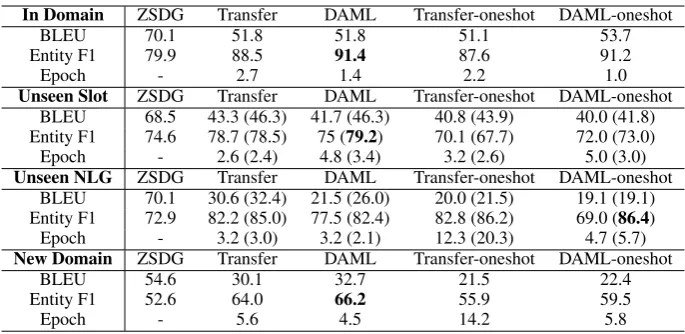
Table 1: DAML outperforms both ZSDG and transfer learning when given similar target domain data. Even the one-shot DAML method achieves better results than ZSDG. Values in parenthesis are the results of the model with an extra step of fine-tuning on the restaurant domain in training. “In Domain” uses all three source domains (restaurant, weather andbus), while “New Domain” refers to themoviedomain. “Unseen Slot” and “Unseen NLG” correspond torestaurant-slotandrestaurant-styleseparately.
restaurant, weather and bus domains as “In Do-main” data since they are in the same domains as what we use to train. The data from movie domain is denoted as “New Domain” as it is unseen in training data. “Unseen Slot” and “Unseen NLG” represent restaurant-slot and restaurant-style do-mains correspondingly. To keep a fair compari-son, both Transfer and DAML use 1% of source domain data (9 dialogs, in total 76 system re-sponses), which is equal to the seed response that Zhao and Esk´enazi (2018) uses. We found that both transfer learning and DAML obtain better results than ZSDG. Especially for the “New Do-main”, DAML achieves the entity F1 score of 66.2,25.8%relative improvement compared with ZSDG. As for “In Domain” testing, DAML also obtains14.4%improvement beyond ZSDG. How-ever, our method does not get large improvement in the “Unseen slot” and “Unseen NLG” domains. We notice that these two domains are actually gen-erated from one of the source domain (restaurant domain). So, even though the slots or templates are changed, they should still share some features with the original domain data. If we could take advantage of the original restaurant domain, the result should be improved. Following this intu-ition, in the “Unseen slot” domain and the “Un-seen NLG” domain, we first fine-tune the model obtained from DAML with the original restaurant data in training, and then we do further fine-tune with the adaptation data. The results are further improved and presented in the parenthesis in Ta-ble 1. We see that in most cases, fine-tuning on
restaurant data increases both the BLEU score and entity F1 score on the “Unseen Slot” and “Unseen NLG” domain.
Finn et al.(2017) emphasizes that meta-learning obtains decent results with extremely small size of data, even in the one-shot cases. To verify this claim, we perform a one-shot version of the DAML training along with one-shot transfer learn-ing by only uslearn-ing one target domain dialog. The result shows that even the one-shot case of DAML outperforms the ZSDG baseline in all cases except “Unseen slot” in entity F1. For the “Unseen NLG” domain, the DAML one-shot case even obtains the highest score. Considering DAML one-shot also having out-standing performance when adapted to “In Domain,” this suggests that the “Unseen NLG” domain is relatively close to the “In Domain.” And nearly every model achieves a similarly high score by fine-tuning the model which is already adapted to the “In Domain” data. Since the score of “In Domain” is already extremely high, we assume the model have learned the common features well. We also mention in the Sec 4 that MAML is sensi-tive to the new knowledge. Given that the model already learns the common features well ,in the one-shot setting, the model focuses on learning the unique features of the target domain, while the set-ting with 1% adaptation data still partially focus on some common features.
adapt-ing to the “In Domain.” Even for the “New Do-main,” DAML only uses5.8epochs on average to converge, which is only 40% of epochs used in transfer learning. The epoch numbers in the Ta-ble1are not integers because all the results in our experiment are the average value of results from ten random runs, explained in Sec5.1. Therefore, we conclude DAML is more efficient compared with simple transfer learning.
DAML’s success mainly comes from three pos-sible reasons. The first is the CopyNet mecha-nism. The copy model directly copy and output word tokens from the context, contributing to the high entity F1 score. The belief span also helps to improve the performance. With the belief span, we no longer need to extract slots from all the his-tory utterances in each turn. Instead, we only need the previous slots, stored in belief span, that the copy model could directly deal with. This allows us to simplify our framework and improve the per-formance. Finally, the meta-learning allows our model to learn inner features of the dialog across different domains.
movie Transfer DAML
Entity F1 64.0 66.2
BLEU 30.1 32.7
restaurant Transfer DAML
Entity F1 80.7 82.1
BLEU 46.1 47.9
bus Transfer DAML
Entity F1 60.0 61.9
BLEU 32.0 35.9
weather Transfer DAML
Entity F1 79.1 80.4
[image:8.595.311.524.148.257.2]BLEU 38.9 43.3
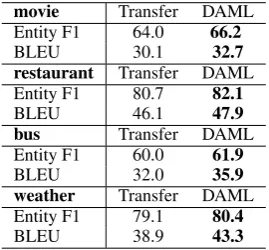
Table 2: Performance on different dialog domains
We also change different tasks used in source and target data to validate the robustness of our model. We use the leave-one-out approach to com-pare the difference between movie, restaurant, bus and weather domains. When we choose one of them as the target domain, we use the other three as the source domains. The size of the dataset (1% target data for adaptation) and model hyperparam-eters are keeping the same as the main experiment described above. We observe in the table 2, the restaurant domain achieves both the highest en-tity F1 score and the highest BLEU score, which means it is the easiest domain to adapt to. The bus domain receives the lowest entity F1 score and the movie domain holds the second lowest one, as well as the lowest BLEU score. This demonstrates
[image:8.595.114.249.386.511.2]that the movie domain is really a hard domain for adaptation and is worth being chosen as the target domain. Among all combinations, DAML outper-forms the transfer learning algorithms in both En-tity F1 and BLEU.
Figure 3: The system performance improves when the size of the target data increases. Even the one-shot learning setting achieves decent performance.
In addition, we investigate the impact of using different amount of target domain data on system performance. We use the best model trained on restaurant, bus and weather and test on the movie domain. The size of target data varies from one dialog in one-shot learning to 10% of the data, which is 90 dialogs. Figure3 shows the system performance positively correlates with the amount of training data available in the target domain. We observe that both entity F1 and BLEU scores nearly converge when4%of the data is used. Al-though 4%is three times the size of the seed re-sponse used inZhao and Esk´enazi(2018), we no-tice that even the one-shot case of our model out-performs ZSDG in the new domain. This demon-strates our method’s capability to achieve good performance with only little target data.
Although the DAML has demonstrated out-standing performance in dialog domain adapta-tion, it still cannot perfectly adapt to a new do-main, especially when there is out of domain words in new domain, denoted as unk. If unk
lies in the utterance, such as“system: Movie from what country?” “user: Movie fromunk.”System can hardly extract the needed slot since it does not recognize the surface form of the slot, even if we recognize theunkas the entity. Ifunkappears in the belief span, when our system uses copy model to generate the new belief span based on the pre-vious one, it is hard to handle theunktoken.
oh no, in 70s.” In this case, our system success-fully adds only70sto the belief span, mainly be-cause the adverbinsuggests 70sis a year. How-ever, the system keeps the original slot year, lead-ing to a no match result. Moreover, in the case
“that’s wrong. i love western ones.”, our system is confused on what the pronoun“ones”refers to. So it does not recognize“western”is a dialog slot. 7 Conclusion and Future Work
We propose a domain adaptive dialog generation method based on meta-learning(DAML). We also construct an end-to-end trainable dialog system that utilizes a two-step gradient update to obtain models that are more sensitive to new domains. We evaluate our model on a simulated dataset with multiple independent domains. DAML reaches the state-of-the-art performance in Entity F1 com-pared with a zero-shot learning method and a transfer learning method. DAML is an effective and robust method for training dialog systems with low-resources.
The DAML also provides promising potential extension, such as applying DAML on reinforce-ment learning-based dialog system. We also plan to adapt DAML to multi-domain dialog tasks.
References
Marcin Andrychowicz, Misha Denil, Sergio Gomez, Matthew W Hoffman, David Pfau, Tom Schaul, Brendan Shillingford, and Nando De Freitas. 2016. Learning to learn by gradient descent by gradient de-scent. InAdvances in Neural Information Process-ing Systems, pages 3981–3989.
Yoshua Bengio. 2012. Deep learning of representa-tions for unsupervised and transfer learning. In Pro-ceedings of ICML Workshop on Unsupervised and Transfer Learning, pages 17–36.
Rich Caruana. 1997a. Multitask learning. Mach. Learn., 28(1):41–75.
Rich Caruana. 1997b. Multitask learning. Machine learning, 28(1):41–75.
Hongshen Chen, Xiaorui Liu, Dawei Yin, and Jiliang Tang. 2017. A survey on dialogue systems: Recent advances and new frontiers. ACM SIGKDD Explo-rations Newsletter, 19(2):25–35.
David Cohn, Les Atlas, and Richard Ladner. 1994. Im-proving generalization with active learning. Ma-chine learning, 15(2):201–221.
Heriberto Cuay´ahuitl, Simon Keizer, and Oliver Lemon. 2015. Strategic dialogue manage-ment via deep reinforcemanage-ment learning. CoRR, abs/1511.08099.
Yann Dauphin, G¨okhan T¨ur, Dilek Z. Hakkani-T¨ur, and Larry P. Heck. 2014. Zero-shot learning and clus-tering for semantic utterance classification. CoRR, abs/1401.0509.
Li Deng, G¨okhan T¨ur, Xiaodong He, and Dilek Z. Hakkani-T¨ur. 2012. Use of kernel deep convex net-works and end-to-end learning for spoken language understanding. 2012 IEEE Spoken Language Tech-nology Workshop (SLT), pages 210–215.
Bhuwan Dhingra, Lihong Li, Xiujun Li, Jianfeng Gao, Yun-Nung Chen, Faisal Ahmed, and Li Deng. 2017. End-to-end reinforcement learning of dia-logue agents for information access. InACL.
Yan Duan, John Schulman, Xi Chen, Peter L. Bartlett, Ilya Sutskever, and Pieter Abbeel. 2016. Rl$ˆ2$: Fast reinforcement learning via slow reinforcement learning.CoRR, abs/1611.02779.
Chelsea Finn, Pieter Abbeel, and Sergey Levine. 2017. Model-agnostic meta-learning for fast adaptation of deep networks.CoRR, abs/1703.03400.
Aude Genevay and Romain Laroche. 2016. Transfer learning for user adaptation in spoken dialogue sys-tems. InAAMAS.
Erin Grant, Chelsea Finn, Sergey Levine, Trevor Darrell, and Thomas Griffiths. 2018. Recasting gradient-based meta-learning as hierarchical bayes.
arXiv preprint arXiv:1801.08930.
Jiatao Gu, Zhengdong Lu, Hang Li, and Victor O. K. Li. 2016. Incorporating copying mech-anism in sequence-to-sequence learning. CoRR, abs/1603.06393.
Jiatao Gu, Yong Wang, Yun Chen, Kyunghyun Cho, and Victor O. K. Li. 2018. Meta-learning for low-resource neural machine translation. CoRR, abs/1808.08437.
Homa B Hashemi, Amir Asiaee, and Reiner Kraft. Query intent detection using convolutional neural networks.
Matthew Henderson, Blaise Thomson, and Jason D. Williams. 2014. The third dialog state tracking chal-lenge. 2014 IEEE Spoken Language Technology Workshop (SLT), pages 324–329.
Matthew Henderson, Blaise Thomson, and Steve Young. 2013. Deep neural network approach for the dialog state tracking challenge. In Proceedings of the SIGDIAL 2013 Conference, pages 467–471.
Diederik P Kingma and Jimmy Ba. 2014. Adam: A method for stochastic optimization. arXiv preprint arXiv:1412.6980.
Wenqiang Lei, Xisen Jin, Min-Yen Kan, Zhaochun Ren, Xiangnan He, and Dawei Yin. 2018. Sequic-ity: Simplifying task-oriented dialogue systems with single sequence-to-sequence architectures. In Pro-ceedings of the 56th Annual Meeting of the Associa-tion for ComputaAssocia-tional Linguistics (Volume 1: Long Papers), pages 1437–1447. Association for Compu-tational Linguistics.
Fei-Fei Li, Rob Fergus, and Pietro Perona. 2006. One-shot learning of object categories. IEEE transac-tions on pattern analysis and machine intelligence, 28(4):594–611.
Kaixiang Mo, Yu Zhang, Shuangyin Li, Jiajun Li, and Qiang Yang. 2018. Personalizing a dialogue sys-tem with transfer reinforcement learning. In Thirty-Second AAAI Conference on Artificial Intelligence.
Nikola Mrkˇsi´c, Diarmuid O S´eaghdha, Blaise Thom-son, Milica Gaˇsi´c, Pei-Hao Su, David Vandyke, Tsung-Hsien Wen, and Steve Young. 2015. Multi-domain dialog state tracking using recurrent neural networks. arXiv preprint arXiv:1506.07190.
Mohammad Norouzi, Tomas Mikolov, Samy Bengio, Yoram Singer, Jonathon Shlens, Andrea Frome, Greg S Corrado, and Jeffrey Dean. 2013. Zero-shot learning by convex combination of semantic embed-dings. arXiv preprint arXiv:1312.5650.
Kishore Papineni, Salim Roukos, Todd Ward, and Wei-Jing Zhu. 2002. Bleu: a method for automatic eval-uation of machine translation.
Jeffrey Pennington, Richard Socher, and Christo-pher D. Manning. 2014. Glove: Global vectors for word representation. InEmpirical Methods in Nat-ural Language Processing (EMNLP), pages 1532– 1543.
Ruslan Salakhutdinov, Joshua Tenenbaum, and Anto-nio Torralba. 2012. One-shot learning with a hi-erarchical nonparametric bayesian model. In Pro-ceedings of ICML Workshop on Unsupervised and Transfer Learning, pages 195–206.
Adam Santoro, Sergey Bartunov, Matthew Botvinick, Daan Wierstra, and Timothy P. Lillicrap. 2016. Meta-learning with memory-augmented neural net-works. InICML.
Weiyan Shi and Zhou Yu. 2018. Sentiment adaptive end-to-end dialog systems.CoRR, abs/1804.10731.
Jake Snell, Kevin Swersky, and Richard Zemel. 2017. Prototypical networks for few-shot learning. In Ad-vances in Neural Information Processing Systems, pages 4077–4087.
Richard Socher, Milind Ganjoo, Christopher D Man-ning, and Andrew Ng. 2013. Zero-shot learning through cross-modal transfer. In Advances in neu-ral information processing systems, pages 935–943.
Van-Khanh Tran and Le-Minh Nguyen. 2018. Adver-sarial domain adaptation for variational neural lan-guage generation in dialogue systems. InCOLING.
Oriol Vinyals, Charles Blundell, Timothy Lillicrap, Daan Wierstra, et al. 2016. Matching networks for one shot learning. InAdvances in neural informa-tion processing systems, pages 3630–3638.
Vladimir Vlasov, Akela Drissner-Schmid, and Alan Nichol. 2018. Few-shot generalization across dia-logue tasks.CoRR, abs/1811.11707.
Jane X. Wang, Zeb Kurth-Nelson, Dhruva Tiru-mala, Hubert Soyer, Joel Z. Leibo, R´emi Munos, Charles Blundell, Dharshan Kumaran, and Matthew Botvinick. 2016. Learning to reinforcement learn.
CoRR, abs/1611.05763.
Tsung-Hsien Wen, Milica Gasic, Dongho Kim, Nikola Mrksic, Pei hao Su, David Vandyke, and Steve J. Young. 2015. Stochastic language generation in dia-logue using recurrent neural networks with convolu-tional sentence reranking. InSIGDIAL Conference.
Tsung-Hsien Wen, Milica Gasic, Nikola Mrksic, Lina Maria Rojas-Barahona, Pei hao Su, David Vandyke, and Steve J. Young. 2016. Multi-domain neural network language generation for spoken dia-logue systems. InHLT-NAACL.
Steve J. Young, Milica Gasic, Blaise Thomson, and Ja-son D. Williams. 2013. Pomdp-based statistical spo-ken dialog systems: A review. Proceedings of the IEEE, 101:1160–1179.
Wojciech Zaremba, Ilya Sutskever, and Oriol Vinyals. 2014. Recurrent neural network regularization.
arXiv preprint arXiv:1409.2329.
Tiancheng Zhao and Maxine Esk´enazi. 2018. Zero-shot dialog generation with cross-domain latent ac-tions.CoRR, abs/1805.04803.
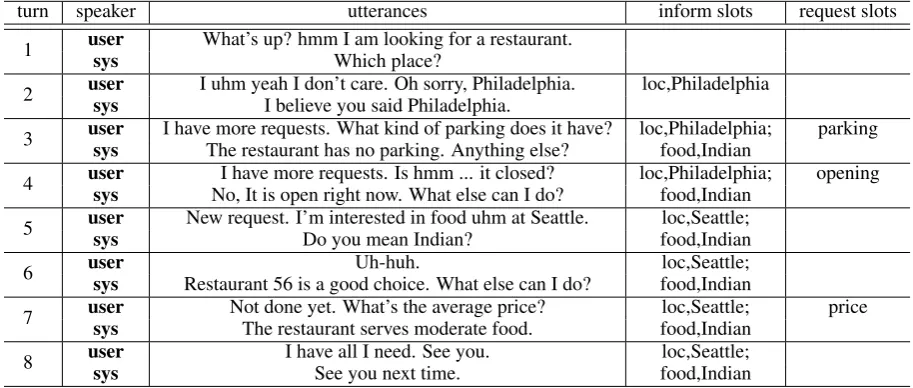
A SimDial Dataset Example
turn speaker utterances inform slots request slots
1 user What’s up? hmm I am looking for a restaurant.
sys Which place?
2 user I uhm yeah I don’t care. Oh sorry, Philadelphia. loc,Philadelphia
sys I believe you said Philadelphia.
3 user I have more requests. What kind of parking does it have? loc,Philadelphia; parking
sys The restaurant has no parking. Anything else? food,Indian
4 user I have more requests. Is hmm ... it closed? loc,Philadelphia; opening
sys No, It is open right now. What else can I do? food,Indian
5 user New request. I’m interested in food uhm at Seattle. loc,Seattle;
sys Do you mean Indian? food,Indian
6 user Uh-huh. loc,Seattle;
sys Restaurant 56 is a good choice. What else can I do? food,Indian
7 user Not done yet. What’s the average price? loc,Seattle; price
sys The restaurant serves moderate food. food,Indian
8 user I have all I need. See you. loc,Seattle;
[image:11.595.70.527.305.499.2]sys See you next time. food,Indian