[201000166]
Teaching Quantum Mechanics Using qCraft
Author:
Micha¨el ChristiaanVAN DENENK [s1004654]
Supervisors: Dr. H. H. LEEMKUIL Dr. H.VAN DERMEIJ
Abstract . . . 5
Introduction 6 Background . . . 6
Content . . . 6
Development approach . . . 7
Analyses 8 Context Analysis . . . 8
Needs Assessment . . . 8
Learning Environment . . . 9
Learner Analysis . . . 10
Task Analysis . . . 11
Learning goal . . . 11
Teaching strategies . . . 12
Prerequisite analysis . . . 12
Learning objectives . . . 13
Test specifications . . . 14
Focus Group Evaluation . . . 14
Design 15 Conclusions from the Analysis . . . 15
Method of Delivery . . . 16
Requirements for the Method of Delivery . . . 16
Minecraft . . . 17
qCraft . . . 18
Comparison of different methods of delivery . . . 18
Design Principles . . . 19
Framework for the Instruction . . . 20
Supplantive and Generative Instruction . . . 20
Types of Learning . . . 21
Framework . . . 21
Development 23 Aesthetic design . . . 23
Sections of the Map . . . 23
Formative Evaluation 28 Method for the Micro-Evaluation . . . 28
Research Approach . . . 28
Analysis of the results . . . 31
Results of the Micro-Evaluation . . . 32
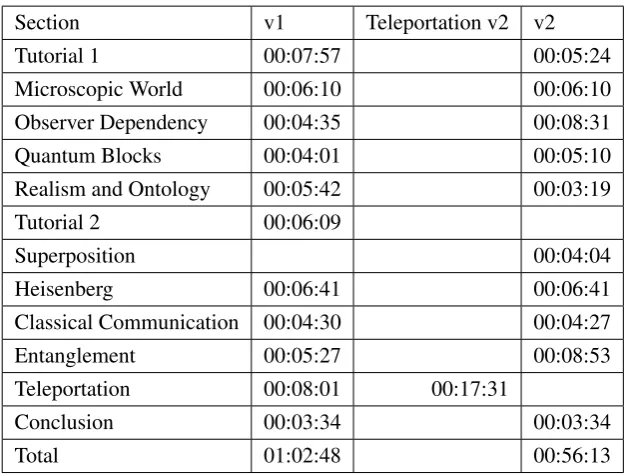
Durations . . . 33
Observations from Evaluating the Initial Instruction . . . 33
Rapid Prototyping . . . 36
Observations from Evaluating the Final Instruction . . . 40
Interviews . . . 40
Typology . . . 45
Conclusion and Discussion 47 References 49 Appendices 52 Generic Model 53 Topics Mentioned in Literature 54 Topical Domains 57 Prerequisite Graph of the Topical Domains 59 Learning Objectives 60 Learning Objectives and Standards 64 Expanded Events of Instruction 70 Initial Framework for the Instruction 71 Minecraft Tutorial . . . 71
Introduction . . . 72
Body . . . 73
Conclusion . . . 83
Framework for the Second Version of the Quantum Teleportation Experiment 85 Final Framework 87 Minecraft Tutorial . . . 87
Introduction . . . 87
Body . . . 88
Conclusion . . . 97
Settings 99
Floor Plans 100
Evaluation Matchboard 103
Abstract
Background
In the Netherlands, quantum mechanics always used to be a topic which schools themselves could choose to teach or not to teach. The only skill students had to know for the Centraal Eindexamen (the national central exams at the end of high school) which comes close to quantum mechanics is to elucidate the photoelectric effect and the wave-particle duality, mentioned within point 20 under subdomain E3 (Laan, 2013). However, one of the changes in the Centraal Eindexamen of 2016 was the addition of domain F1, which is called Quantum world (Groenen et al., 2014). For this subdomain the candidate has to be able to apply the wave-particle duality and the uncertainty principle of Heisenberg, and to explain the quantisation of energy levels in some examples with a simple quantum physical model. In order to give all candidates a chance of passing this subdomain, schools have to alter their programs in order to meet the expectations of the Centraal Eindexamen.
However, when searching the internet using the search machine Google concerning the implemen-tation of quantum mechanics in Dutch high schools, the quantity and the quality of the results are very low. There are also no results to be found in the Dutch papers. An example is the Dutch site http://www.quantumuniverse.nl/, where teachers can find a small amount of brief courses on fundamen-tal quantum mechanics, and where the forums only have 5 discussions, of which 4 are just started threads from the site administrator.
Upon finding this information, an expert was consulted to confirm this conjecture. The expert was researching the implementation of quantum mechanics on middle schools, and she also a first degree physics teacher. She stated that within her school there were no initiatives to bring this topic in their classrooms, and that their school was no exception as well.
The fact that next year domain F1 has to be fully implemented and taught to all vwo students who chose physics as an examination subject is therefore slowly turning into a sword of Damocles. This stresses the urgency for the development of new course material.
Content
Quantum mechanics is not the easiest topic to introduce into physics education. The subject is very counterintuitive, and still poses headaches to many physicists today. The great physicist Richard Feyn-man is known for saying: “I think I can safely say that nobody understands quantum mechanics” (1965), and this statement still holds. Quantum mechanics is this counterintuitive because it contradicts a lot of axioms we inherited from classical physics. These contradictions are highlighted by an article written by Einstein, Podolsky, and Rosen (1935), which states that the current understanding of quantum mechanics contradict the criterion of reality and the hypothesis of locality.
The other way of teaching quantum mechanics is by teaching the key principles of quantum mechan-ics. A fashion in which this could be achieved is by only considering the perfectly correlating instances. An example of such an instance is quantum teleportation. Zeilinger (2005) explains this phenomenon without having to resort to very complex mathematics, but still explaining the fundamentals of quantum mechanics, such as observer dependency, superposition and quantum entanglement. The instruction will therefore use quantum teleportation to explain these three fundamental principles, so the learner will gain a conceptual understanding of quantum mechanics.
One way of making principles more accessible for the learner is by using an educational game (Wouters & van Oostendorp, 2012). By using games, the content can be visualised, the learner can interact with the content and the content can be structured according to instructional theories. One game which exists to explain the fundamental principles of quantum mechanics is the modification qCraft for the game Minecraft. There are already resources which use qCraft to explain quantum mechanics, devel-oped by the qCraft team. However, they lack use of educational resources like Smith and Ragan (2005). The resources also depend on different external resources, which makes it very complex and causes a lack of structure. Finally, it could make more use of the possibilities within Minecraft, like books presented in the game. Therefore, a new instruction will make an effort to replace these resources with a higher educational value for Dutch middle school students by analysis, using instructional theories and using the recommendations provided by the studied literature. This literature study is included in a separate document.
Development approach
Analyses
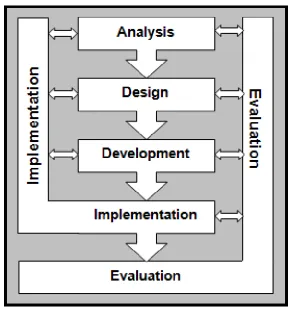
The first step of the Generic Model by Plomp et al. (1992) (see figure 5 on page 53) is Analysis. Smith and Ragan (2005) distinguish three different kinds of analysis: analysing the learner context, analysing the learner and analysing the learning task, which are elaborated in the first three sections. The final section describes the evaluation of the test specifications with an expert.
Context Analysis
Needs Assessment
The problem
In the Netherlands, quantum mechanics always used to be a topic which schools themselves could choose to teach or not to teach. The only skill students had to know for the Centraal Eindexamen (the national central exams at the end of high school) which comes close to quantum mechanics is to elucidate the photoelectric effect and the wave-particle duality, mentioned within point 20 under subdomain E3 (Laan, 2013). However, one of the changes in the Centraal Eindexamen of 2016 was the addition of domain F1, which is called Quantum world (Groenen et al., 2014). For this subdomain the candidate has to be able to apply the wave-particle duality and the uncertainty principle of Heisenberg, and to explain the quantisation of energy levels in some examples with a simple quantum physical model. In order to give all candidates a chance of passing this subdomain, schools have to alter their programs in order to meet the expectations of the Centraal Eindexamen.
However, when searching the internet using the search machine Google concerning the implemen-tation of quantum mechanics in Dutch high schools, the quantity and the quality of the results are very low. There are also no results to be found in the Dutch papers. An example is the Dutch site http://www.quantumuniverse.nl/, where teachers can find a small amount of brief courses on fundamen-tal quantum mechanics, and where the forums are very quiet with only 5 discussions, of which 4 are just started threads from the site administrator.
Upon finding this information, an expert was consulted to confirm this conjecture. The expert was researching the implementation of quantum mechanics on in Dutch secondary education, and is also a first degree physics teacher. She stated that within her school there were no initiatives to bring this topic in their classrooms, and that their school was no exception as well.
Because it involves new instruction, the innovation model will be used for the second part of this needs assessment.
The innovation
The nature of the innovation lies within the change of the Centraal Eindexamen of 2016 in respect to the Centraal Eindexamen of 2015. The new additions within the domain Kwantumwereld outline the new goals of physics education in the Netherlands, and will be the ultimate goals for the students to achieve, and therefore be the ultimate learning goals for the students to achieve. This results in the following learning goals (Groenen et al., 2014, p. 24-25):
”The candidate can:
• describe quantum phenomena in terms of the enclosure of a particle:
– estimate whether quantum phenomena are to expected by comparing the debroglie-wavelength with the order of largeness of the enclosure of the particle;
– apply the uncertainty principle of Heisenberg;
– describe the quantum model of the hydrogen atom and calculate the possible energies of the hydrogen atom;
– describe the quantum model of a particle in a one-dimensional energy well and calculate the possible energies of the particle;
– Bohr radius, zero-point energy.
• describe the quantum-tunnel effect with a simple model and indicate how the chance of tunneling depends on the mass of the particle and the height and width of the energy-barrier,
– minimal in the contexts of: Scanning Tunneling Microscope, alpha-decay.”
These goals confirm what the literature describes about the current appliance of quantum mechan-ics teaching within secondary, namely that often quantum mechanmechan-ics is introduced with great emphasis on learning and practising algorithmic skills (Papaphotis & Tsaparlis, 2008a, 2008b). However, it is also found that high school students show higher interest in the conceptual aspects than the algorithmic aspects (Papaphotis & Tsaparlis, 2008a, 2008b; Levrini & Fantini, 2013). When focusing on the concep-tual aspects, it engages students (Henriksen et al., 2014) and students start asking fundamental questions (McKagan et al., 2008). Furthermore, mathematical oriented approaches might be more common, how-ever, quantum mechanics is regarded to be mathematically challenging (Gianino, 2008; McKagan et al., 2008), and most high school students lack proper background in mathematics at the required level (Dori, Dangur, Avargil, & Peskin, 2014). Because the usual focus on the algorithmic aspects, students often do not learn what instructors want them to learn (Asikainen & Hirvonen, 2014; McKagan et al., 2008), and improved student learning is possible by shifting the focus to conceptual understanding (McKagan et al., 2008).
Therefore, the aim of this instruction is to focus on a conceptual approach instead of a mathematical approach. Then, after the students have a sufficiently conceptual understanding of the material, the concurrent instructions in the curriculum can emphasise the goals stated by the Centraal Eindexamen of 2016, which adds the mathematical layer on top of the conceptual layer and can deepen the understanding of quantum mechanics. In summary, the main goal of this instruction is to provide the student with a conceptual understanding of the different phenomena occurring in the realm of quantum mechanics.
Learning Environment
misconceptions about quantum mechanics, which are comparable to the misconceptions of the students themselves. These misconceptions will be discussed in the learner analysis section on page 10. Ex-perienced teachers who are teaching modern physics are more capable of teaching quantum mechanics (Asikainen & Hirvonen, 2014).
When implementing the instruction, the placement within the already existing curriculum is also important, because the instruction depends on prerequisites from other elements of the curriculum. The main prerequisite is knowledge of Bohr his atom model, because the different particles within this model are the particles on which quantum mechanics apply. This knowledge is taught in Domain E from the centraal eindexamen (Groenen et al., 2014), and because of the prerequisite, it is of upmost importance that this instruction is placed after Domain E in the existing curriculum. As already described in the needs assessment, the conceptual instruction could be followed by instruction of the mathematical aspects of quantum mechanics. Also, various experiments could be taught, which demonstrate the discovery of the various concepts introduced in the instruction and explain the different principles between the concepts. This could for example be the EPR experiment (Kuttner & Rosenblum, 2010; M¨uller & Wiesner, 2002; Velentzas, Halkia, & Skordoulis, 2007), which could lead to critical assessment of the realist and ontologist perceptions on quantum mechanics.
Another important aspect of the instructional environment is the method of delivery (Smith & Ragan, 2005). The recommendations for different aspects of the medium used for the delivery of the instruction entail interactivity, visualisation, the combination of different modes of representation, and the use of computation. By making it able to interact with the medium, it is possible for students to experiment with the different concepts, which gives way to inquiry learning (Adegoke, 2012; Asikainen & Hirvo-nen, 2014; Dori et al., 2014; McKagan et al., 2008). Visualisation is a powerful tool, and can make the matter less abstract (Dori et al., 2014; Henriksen et al., 2014; McKagan et al., 2008). It also is easier to build mental models of quantum mechanics. Levrini and Fantini (2013) warns however against the use of oversimplified visualisations, because pictures are extremely partial and can be misleading. Therefore, it is important that the visualisation does not entail any unnecessary simplified representation of the matter. This combined with other different modes of representation, for example a textual description of the con-cept, makes it possible for the student to complete their mental model (Dori et al., 2014). Finally, the use of computation makes it possible to take away the mathematical complexity from quantum mechanics, making way for a purely conceptual approach (Barnes, Garner, & Reid, 2004; McKagan et al., 2008; Velentzas et al., 2007).
One could combine all these aspects by using simulations, which is also recommended by McKagan et al. (2008). However, teachers often prefer traditional lectures, because that is easier to implement in their classroom (Adegoke, 2012). This difficulty has to be overcome if quantum mechanics is to be implemented successfully in the classroom. Furthermore, it has to be investigated whether the sufficient hardware is available in the learning environment.
Finally, it is important to investigate whether the instruction fits in with the mission and vision of the school, and also the philosophies and taboos that the teachers hold. Therefore, it is advised to find these discrepancies by the means of interviews, in which the school board is asked about their mission and vision, and the teachers about their personal beliefs in regard to quantum mechanics.
In any case, this assignment does not look into the implementation of the instruction yet, so these factors have to be investigated further when embedding the instruction in the context of a specific school.
Learner Analysis
Papaphotis & Tsaparlis, 2008a, 2008b), an often mentioned example of this is that students often mix up the deterministic planetary model with the indeterministic atom model (Dori et al., 2014; Henriksen et al., 2014; Hubber, 2006; M¨uller & Wiesner, 2002; Papaphotis & Tsaparlis, 2008a, 2008b). McKagan et al. (2008) also mentions that it is difficult for students to recognise the scale in which quantum mechanics take place.
Thacker (2003) describes how much knowledge of students consists out of memorised facts, for ex-ample that light is a wave and electrons are particles. When the student then is confronted with new or different information from what they know, they develop new memorised facts instead of creating the right model. This then results in models consistent with fragmented models of microscopic processes, which are often incorrect but self-consistent with a certain experiment (Hubber, 2006; Thacker, 2003). When the student cannot model the fragments anymore, this can result in deep skepticism towards quan-tum mechanics (Barnes et al., 2004; Henriksen et al., 2014; Levrini & Fantini, 2013). M¨uller and Wiesner (2002) has created a long list of exact conceptions students hold about microscopic phenomena, which are too detailed to enlist fully in this article.
The misconceptions described in the studied articles mostly are measured in relation to the teaching material which is currently employed within schools or universities. This material is described in the Topics mentioned in Literature appendix (see page 54), and can generally described as misconceptions in relation to the Rutherford-Bohr model of the atom, and in relation to experiments like the double-slit experiment. However, it would be interesting to investigate the misconceptions in relation to the fundamental concepts of quantum mechanics themselves, for example in relation to elementary particles, superposition, random collapse of the probability function and entanglement. This would give greater insight in the conceptual understanding of students. However, no research has been conducted in these areas thus far.
In conclusion, most of the preconceptions of students prove to be incorrect, stemming often from quantum theory or textbooks. These preconceptions often contain outdated deterministic or realist mod-els. Furthermore, it is difficult for students to understand the scale. Finally, knowledge consists out of memorised facts, which then form fragmented and incorrect but self-consistent models. Conflicts between these models can result in skepticism.
Task Analysis
Learning goal
The main learning goal as specified needs assessment using the innovation model from page 9, the in-struction will pursue provide the student with a conceptual understanding of the different phenomena occurring in the realm of quantum mechanics. This goal will be the main guideline for the information-processing analysis. However, it will not be possible to provide the students with a complete conceptual understanding of quantum mechanics. First of all, even though the scientific community has an under-standing of quantum mechanics, it is not fully complete. Second to that, physics students in secondary education do not have the time needed to gain at least the complete conceptual understanding of quantum mechanics available from the scientific community. Finally, there is not enough time to design an instruc-tion which achieves a complete conceptual understanding, and the time available for this instrucinstruc-tion is also limited. Therefore a choice has to be made in the different topics being taught.
everyday experiences and because of its abstractness, it is difficult for learners to visualise the concepts of quantum mechanics (Henriksen et al., 2014; McKagan et al., 2008). Another factor contributing to the difficulty of quantum mechanics is that it is mathematically challenging (Gianino, 2008; McKagan et al., 2008), it involves mathematical skills that most high school students — even vwo 6 students — do not possess. Because of the difficulties stemming from teaching quantum mechanics, it would be better to teach concentrate on teaching a few topics of quantum mechanics in a way that it can be understood, rather than trying to teach as much as possible in the limited time available.
Teaching strategies
Some of the content-related strategies emphasise the importance of embedding the instruction in real-world contexts, for they help with understanding (McKagan et al., 2008; Thacker, 2003; Dori et al., 2014) and help appreciate the relevance of quantum mechanics (Barnes et al., 2004; Henriksen et al., 2014; McKagan et al., 2008). Furthermore, Thacker (2003) suggests introducing microscopic processes as an integral part of a study of electricity and magnetism. This could help demystify the topic, which also would contribute towards a better understanding (Barnes et al., 2004; M¨uller & Wiesner, 2002). An example of how this can be done is by using the e/m experiment, where the electromagnetic ef-fect is demonstrated by the properties of electrons. Furthermore, the language of physics is important (Henriksen et al., 2014), and should be used carefully (McKagan et al., 2008). The consulted articles all recommend a conceptual approach above a mathematical-oriented approach. Mathematical-oriented ap-proaches might be more common, but most high school students lack proper background in mathematics at the required level (Dori et al., 2014). Barnes et al. (2004) and Henriksen et al. (2014) believe teaching through history of science is believed to be constructive.
Papaphotis and Tsaparlis (2008a) states that critical thinking skills are crucial for understanding quantum mechanics, because students have to investigate the new material in a critical way to build the correct mental models. Active learning also contributes to investigation of the material. Because the students easily build misconception, right feedback is vital to prevent misconceptions and can stimulate students to build correct mental models. Finally, Papaphotis and Tsaparlis (2008a) suggests collabora-tion, which is also suggested by Adegoke (2012) and Barnes et al. (2004). Collaboration could lead to peers providing each other with critical questions and feedback. Especially in the case of female students this could benefit to learning quantum mechanics (Adegoke, 2012).
The frameworks mentioned by different authors are directly or very similar to thought experiments (Asikainen & Hirvonen, 2014; Erduran, 2005; Levrini & Fantini, 2013; Velentzas et al., 2007). Asikainen describes the most elaborated framework for a well-conducted thought experiment, which includes the steps question and general assumptions, description of the features of the system, performance of the thought experiment itself, extraction of the results and drawing conclusions. Erduran (2005) and Levrini and Fantini (2013) also describe a framework, but the steps they mention already overlap with those of Asikainen and Hirvonen (2014).
Prerequisite analysis
magazines. However, for this instruction it will be presumed that they have no knowledge of these concepts, for the reason that they have not been taught in the standard curriculum.
Learning objectives
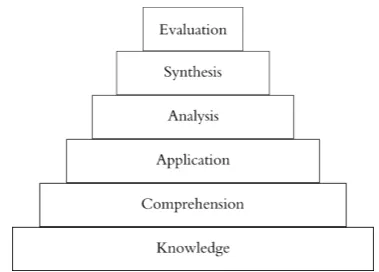
Zeilinger (2005) provides a clear conceptual understanding of some of the phenomena occurring within quantum mechanics. The first step was to summarise this book, so learning objectives could be extracted from this book. This summary was then translated into a unidirectional dependency graph, which means that the different elements of the summary were projected into nodes, and the edges between these ele-ments displayed a logical order of teaching the different eleele-ments. These eleele-ments were then extended by using the taxonomy of Bloom (Bloom, Englehart, Furst, Hill, & Hrathwohl, 1956) (see figure 1). This taxonomy describes six levels of learning objectives, which are Knowledge, Comprehension, Applica-tion, Analysis, Synthesis, and Evaluation. Before a higher level objective can be reached, all lower level relevant to that objectives have to be achieved first. Every level also has his own defined action verbs which have to be used for writing the objective. For example, Knowledge level objectives use action verbs such as ”state” and ”list”, whereas Comprehension level objectives use verbs such as ”explain” and ”differentiate”.
[image:13.595.201.391.383.519.2]Using the taxonomy of Bloom made the different elements better defined and also displayed better in which order the student should master the learning objectives. The graph cannot be easily displayed on a4 format, this is why it was translated to a table which displays each topics and its prerequisite. This table is included in the appendix Learning Objectives on page 60. However, a prerequisite graph has been included in the Prerequisite Graph of the Topical Domains appendix on page??.
Figure 1: The taxonomy of Bloom (Bloom et al., 1956)
36 of the learning objectives fall into the knowledge domain within the taxonomy of Bloom, 15 learning objectives fall into the comprehension domain, 3 learning objectives into the application domain, and 2 objectives into the analysis domain. The reason why most of the learning objectives fall into the knowledge domain is because the topic of quantum mechanics is mainly new to the high school student. Because of this, the student first has to learn a lot of new terms and definitions before he can actually comprehend quantum mechanics, for having knowledge is a prerequisite for an eventual understanding of the concepts. However, the main goal of the instruction is comprehension of the concepts, even if there are only 15 learning objectives within this domain, for comprehension leads to conceptual understanding. Application and Analysis is less relevant, this would be more relevant to principle learning, which would be important for learning the algorithmic aspects of quantum mechanics. Any higher domains cannot be reached, for they require mastery of the application and analysis domain. However, this could be achieved next in the curriculum.
graph of these domains is displayed in figure 7 on page 59, embedded in a curriculum with other topical domains.
Test specifications
The description of the terminal behaviour is already specified in the Learning Objectives appendix on page 60. If a condition is present for the execution of the learning objective, this is already specified as well, most of the time using the word ”given”. However, the standards or criteria for measuring specifying how the learning objective has to be achieved by the student are not yet included in the table. A list with the standards given a certain learning objective has been included, in the Learning Ob-jectives and Standards appendix on page 64. The obOb-jectives are indicated by numbers, and the standards by letters. The standards are formulated as the behaviour the student should display upon measurement of the learning objective. Some of the learning objectives are formulated in such a way that further specification by standards is not necessary, for example learning objective 2: ”The student can state that everything we observe exists out of molecules”. The test specifications can also be used for the screening evaluation (Nieveen, Folmer, & Vielgen, 2012), which will be conducted after the development of the instruction in order to review whether all specifications are met in the instruction (see the Evaluation Matchboard appendix on page 103).
Focus Group Evaluation
Design
Conclusions from the Analysis
There is a wide variety of topics available for quantum mechanics education. It is advisable to start any instruction with the Rutherford-Bohr model of the Atom and its relation to elementary particles, for this is the scale on which quantum mechanics take place. A next step could be introducing the different phenomena which happen on a quantum scale, such as superposition, observer dependency and entanglement. One way to introduce superposition and observer dependency is by using the double-slit experiment. This also teaches about the wave-particle duality of elementary particles. Furthermore, the students could be taught the differences between classical mechanics and quantum mechanics, which are determinism and probabilism, locality and non-locality, and continuous and discrete distances. One way to highlight the strangeness of quantum mechanics is by using the debate between realism and ontology, which emphasises that quantum mechanics are different than a student might think at first. There are also famous thought experiments, for example Schr¨odinger’s cat, which could be used to create different mental models with the students. Finally, there are some mathematical approaches to quantum mechanics, however there is a consensus within educators that a conceptual approach is more effective.
Only a few amount of studies writes about the motivation for teaching quantum mechanics on sec-ondary education. There is however no study which claimed it should not be taught. Reasons why it should be taught are that educated citizens should be acquainted with quantum mechanics and that it is regarded fundamental.
Quantum mechanics is regarded to be a difficult topic, because it is counter intuitive, it contradicts daily experienced locality and determinism, it is regarded to be abstract, it is difficult to visualise and it is mathematically challenging.
Misconceptions about quantum mechanics can arise out of the nature of quantum theory, but also from textbooks and previous instruction. It is important that the information handed to the students are not simplified, because this can lead to misconceptions. Problems also often originate from outdated deterministic or realist models. The students therefore have to be confronted with the fact that their own models cannot be applied in the context of quantum mechanics. Students also find it difficult to recognise the scale in which quantum mechanics take place. Hence, the students should be informed that quantum mechanics take place on the scale of elementary particles. Knowledge of students often consists out of memorised facts, and when confronted with new or different information, new facts are memorised instead of creating right models. This results in fragmented incorrect but self-consistent models. Because of this, the instruction should provide the student with a coherent description of quantum mechanics.
simulations are suggested. Furthermore, critical thinking skills, active learning, feedback and collabora-tive learning could contribute to students building the correct mental models of how quantum mechanics work. Finally, thought experiments are regarded to be very effective for learning quantum mechanics, this entails questions and general assumptions, a description of the features of the system, performance of the thought experiment itself, extraction of the results and drawing conclusions.
In secondary education, instructions often emphasise learning and practising algorithmic skills. This however clashes with the recommendations from the literature, which advocates an emphasis on con-ceptual understanding. It is also found that students show higher interest in concon-ceptual aspects than the algorithmic aspects. Conceptual approaches engage students and probes the student to ask funda-mental questions. Because of the focus on algorithmic aspects, students currently often do not learn what is intended by the developer of the instruction, improved student learning might be possible by shifting the focus to conceptual understanding. This is why the learning objectives are all targeted to-wards a better conceptual understanding of the student, without having to rely on complex mathematics or experiments. The different domains which will be taught are Applications of Quantum Mechanics, Preknowledge, Elementary Particles, Classical Communication, Observation Dependency, Realism and Ontology, Superposition, Entanglement, and the Uncertainty Principle of Heisenberg. These Domains will then be combined within the experiment of Quantum Teleportation.
Method of Delivery
Requirements for the Method of Delivery
The analysis phase provides a couple of recommendations or requirements for the medium used to deliver the instruction:
• The medium should be able to visualise the content;
• The medium should allow interaction;
• The medium should take away the mathematical difficulty, for example by using computation.
• The medium should be able to use different modes of representation;
As already stated within the Analysis chapter, these requirements cannot be reached by relying on traditional means of instruction such as text books, pictures and lectures from a teacher. It is not possible for a student to interact with the contents of a book or with pictures, and lectures from a teacher often entail the teacher standing in front of the class and telling the students about quantum mechanics in a supplantive way. Of course it would be possible for a student to ask questions, but more room for inter-action is needed to be even more successful, and the teacher has not enough time to facilitate interactive learning to every student in a differentiated way.
One of the suggestions from the studied literature entailed using simulations, because these could provide all of the requirements. However, simulations often are related to certain experiments, for ex-ample by simulating the double-slit experiment and providing the student with data such as visuals or numerals. This is in contrast with the requirements from the task analysis, which specify that rather than teaching by means of experiments, the instruction should first teach about the concepts themselves in a more direct way.
are often only intended for entertainment purposes and are only tangentially fit for educational purposes. Most research within game-based learning is conducted on games which are specifically designed to have an educational value. These games often contain explicit formulated learning goals which can be tested by pre- and post-testing. They are designed with the primary goal of education rather than entertainment, and are therefore a subset of Serious Games. This term refers to the set of games designed for a primary goal other than pure entertainment. This goal can be teaching, but also raising awareness about a certain topic or persuading the student to believe something.
One disadvantage for using game-based learning is that it takes a lot of time to develop games in general, and none of the available games can be directly used for teaching the learning objectives speci-fied in the Task Analysis. However, there already exists an easy to use game which can be used to create an environment in which quantum mechanics can be taught on a conceptual level. This engine is qCraft, developed as a modification for the game Minecraft.
Minecraft
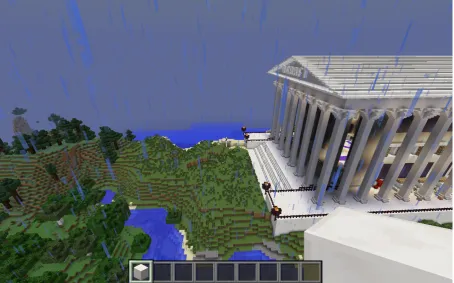
[image:17.595.71.526.410.693.2]Minecraft is a first person sandbox survival game, available for playing both in single-player and multi-player. In the game, the player walks around in a procedurally generated world fully made out of blocks which are one cubic meter in size (see figure 2). The player can control his avatar similar to other first person games, by using the WASD keys for moving and using the mouse for looking around. The unique feature of the game is that the player can place and remove blocks for himself. Each block also has a specific block-type, which gives it a certain appearance and sometimes also a special physical attribute. For example, blocks with the sand block-type always fall down unless being on top of another block. Some blocks also emit a signal, which can be used to trigger certain commands or for example open a door to a room.
Figure 2: A screenshot within the game Minceraft, where a player created structure is placed within the procedurally generated terrain.
can be used to move the player to certain areas in the world or giving the player certain items. There is even a special version of Minecraft for use in classrooms, which is called MinecraftEdu (minecraftedu .com), and it is used by teachers around the world.
qCraft
In order to use Minecraft to players, a certain modification of the game has to be installed. This modifi-cation is also available for MinecraftEdu, which makes it easier to use for teachers. It introduces special types of blocks into the game, which are Observer Dependent Blocks and Quantum Blocks. The Quan-tum Blocks behave in a way similar to elementary particles, which is that every time a QuanQuan-tum Block is observed, it first is in a green ”in-between state” and then takes on one of two block-types at random. An observation takes place every time the player looks at it. For example, if a player looks at a Quantum Block, it can collapse 50% of the time to a gold block-type and 50% of the time to a diamond block-type. The green colour the block takes on before collapsing to either of the two block-types represents the fact that the block is in superposition before measurement.
An Observer Dependent Block has one difference with the Quantum Block, which is that its block-type does not collapse at random, but that the collapse is determined by the angle the block is observed from. This block is added to the game in order to learn the player observer dependency, without also having to explain the random collapse.
Quantum Blocks can also be entangled with each other. This means that every time one of the entangled blocks is observed, all Quantum Blocks their block-type collapse to the same value. Only the boson type of entanglement is implemented yet.
Furthermore, the modification adds a couple of tools to interact with the blocks. It adds two types of goggles, which are the Quantum Goggles and the Anti-Observation Goggles. The Quantum Goggles highlight all of the special blocks by giving it a fluorescent green colour, by which the player can easily identify all of the qCraft blocks present around him. The Anti-Observation Goggles prevent the player from generating observations to the qCraft blocks. Another tool provided by qCraft is the Automatic Observer, which can be activated to generate an observation to the qCraft block attached to the Automatic Observer.
[image:18.595.78.520.605.748.2]Comparison of different methods of delivery
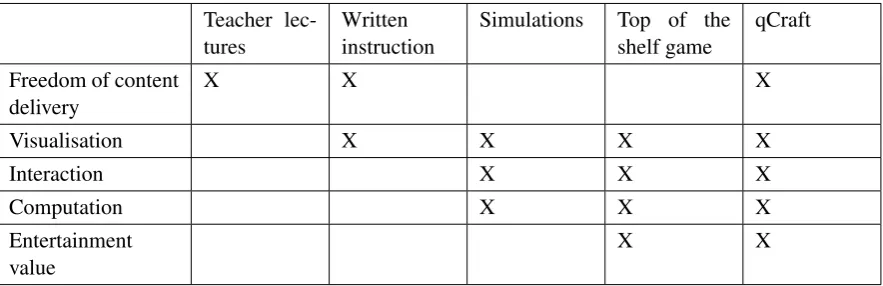
Table 1 was displays the different possibilities of the different methods of delivery. In this table, tra-ditional instruction is split up into teacher lectures and written instruction. Teacher lectures refer to instruction delivered by a teacher standing in front of a classroom. Furthermore, written instruction en-tails instruction delivered on paper, for example by a textbook. The simulations refer only to computer simulations, for example simulations of the double-slit experiment. The term ”top of the shelf game” refers to games already available on the market. qCraft is enlisted separately from other available games.
Teacher lec-tures
Written instruction
Simulations Top of the shelf game
qCraft
Freedom of content delivery
X X X
Visualisation X X X X
Interaction X X X
Computation X X X
Entertainment value
X X
One feature that traditional delivery methods have over typically available computer simulations or games is the freedom of content delivery. This entails the freedom the instructor has to design the instruction in such a way that it meets the requirements and purposes needed in the context of the imple-mentation. For example, if available written instruction is used in a specific context, the instructor can omit certain parts from or add other parts to the instruction. This is the one feature that sets qCraft apart from other available games, for it is possible for the instructor to open Minecraft and adjust the map to meet the needs of the instruction.
In traditional lectures, it is not possible to visualise the concepts within quantum mechanics, because it relies on oral instruction. However, if present, the teacher can make use of sheets in order to visualise the concepts. In written instruction, images can be presented to the students. However, it is not possible to animate the concepts, which is also an important factor of visualisation. Computer simulations and games provide mainly animated visualisation. However, the instructor has to be careful when using visualisation, for it can lead to misconceptions if used incorrectly.
Interaction is more difficult in traditional lectures, and is not possible in written instruction. The only way to provide interaction in a classroom is to answer certain questions the students have about the instruction. Interaction is the core mechanic of computer simulations and games, for it heavily relies on the actions of the student.
When using traditional instruction methods, all computation has to be performed by hand or by using a calculator. The calculator might seem to be an easy way of avoiding the need for computation by hand, but in order to use the calculator the student still needs to be able to understand the mathematical back-ground, and therefore still proves to be a problem for secondary derivatives needed for the Schr¨odinger equation. A computer can take away this problem by doing the computation for the student and thereby leave out the mathematics.
The requirement for multiple modes of representations is not displayed in the table, for this relies on combining multiple methods of delivery in one instruction or curriculum. Teachers often do not only rely on lectures, but also use books and sometimes multimedia as well in order to teach certain information. This is an important aspect for the implementation of the instruction, but not for the choice of a certain method of delivery. However, when developing the instruction, it is important to combine multiple modes if possible.
Finally, computer games tend to have a higher entertainment value than the other methods of delivery. As stated before, it is not the main goal of a serious game to entertain the student. However, it can still help the student to engage itself in the activity, which also could contribute to the learning effect of the instruction.
As can be seen in the table, all of the relevant requirements for the instruction are met within the qCraft modification of Minecraft. Therefore, this instruction will make use of this method of delivery.
Design Principles
Most of the recommendations from the studied literature are already covered by the choice of learning objectives and the choice for qCraft. Other recommendations are not directly relevant to the design of the instruction, for they are recommendations relevant to the implementation of the instruction, which will not be done within this project. However, there are still a couple of recommendations which are still relevant for consideration during the development phase. Therefore, these recommendations have been translated into a list of design principle in the list below.
1. The information handed to the student are not allowed to be simplified, for this can lead to mis-conceptions
2. The language of physics has to be used to teach students the concepts within quantum mechanics
4. Each concept should be transferred to the real-world context of the behaviour of elementary parti-cles
5. The instruction has to be mathematically accessible towards the student and should not require mathematical skills beyond those of physics student within upper secondary education
6. Students have to be triggered to reconsider their realist or deterministic models of physics in the context of quantum mechanics
7. The student has to be asked to extract results from his own observations
8. The student has to be asked to draw conclusions from the extraction of the results
9. The student has to get feedback on the conclusions he has drawn
10. The student has to be triggered into questioning his knowledge of physics based on the conclusions he has drawn from his observations
Design principle 1 is especially relevant when visualising any concepts for the reader. This might be especially relevant when depicting the Rutherford-Bohr model of the Atom, for this easily leads to a conception of an electron orbiting around the nucleus, whereas the electron is just somewhere in the shell and not at a specific location in orbit with a specific speed. A way around this is by using figure 6 on page 54, for this displays only the nucleus and the shell without an electron particle.
To provide the students with handles to internalise the concepts, the terminology of quantum physics will be used as specified in principle 2. The aim of principle 3 is preventing fragmented incorrect but self-consistent models. By connecting and combining the different concepts, the student is able to build one holistic model of quantum mechanics, instead of developing disconnected models about different experiments. A way to connect the concepts is by repeating the concepts, actively explaining the relations between the concepts and finally combining all of the concepts in the teleportation experiment. Another way to connect the different concepts is by relating them all to the behaviour of elementary particles, which is stated in principle 4. This also places the concepts in a context which is familiar to the student, for he already learned about electrons and photons earlier during physics lessons.
The design principle 5 related to the mathematical level is probably already covered by the choice of learning objectives and the choice of medium of delivery. However, it still remains an important requirement for the instruction because most current instructions make the mistake of underestimating the mathematics, and it is therefore included.
Design principle 6 and 10 are important to help the student realise the counterintuitive aspects of quantum mechanics. This can be achieved by asking the student questions about the material and about his own beliefs. Principles 7 and 8 then trigger the students to actively build new mental models about physics. Finally, design principle 9 provides the students with feedback on their newly built mental models, so they can adjust them towards a more correct model.
The design principles not only provide a use during the development of the instruction, but will also be used in a screening evaluation after the development of the instruction (Nieveen et al., 2012) (see the Evaluation Matchboard appendix on page 103).
Framework for the Instruction
Supplantive and Generative Instruction
is also important that the students receive proper feedback on their observations as specified in design principles 2, 3, 4, and 9, therefore scaffolding has to be provided during the feedback event. This can be achieved by providing feedback within books.
Types of Learning
First, the type of learning of the instruction has to be determined (Smith & Ragan, 2005). Normally, only one type of learning forms the base for the whole instruction. However, because there is a variety of content domains, the decision was made to give each domain mentioned in the Topical Domains appendix (see page 57) an own type of learning, albeit that most domains fall within concept learning.
As the name might already suggest, the Preknowledge domain falls within the Declarative Knowl-edge type of learning. Declarative knowlKnowl-edge does not require the student to apply their knowlKnowl-edge but focuses only on memorising the content. This is also the case for the Preknowledge domain, for it only requires the student to memorise the order and structures of the atom. Furthermore, only focusing on the memorised facts is sufficient, for the student is presumed to already know these concepts and rela-tions. The Applications of Quantum Mechanics is also only provided as declarative knowledge, for the applications are merely referenced and not further explained.
The elementary particle however is a new concept, and therefore understanding it falls within the intellectual skills, making this domain the type of concept learning. This entails not only learning the definition of the concept, but also learning to classify examples of the concept by using the definition or learning to differentiate between other concepts.
One might think that the behaviour of elementary particles, which is observation dependency, super-position and entanglement, might fall under principle learning, for the behaviour is something describing the objects and is not being an object itself. However, Smith and Ragan (2005) not only define objects as concepts, but also words such as ”heat” or ”up”. The definition used before also applies to behaviour, for the student still has to learn how to classify certain behaviour or differentiate between different be-haviours.
Realism and Ontology are considered to be concepts as well, for the student has to learn the differ-ence between the two concepts and have to be able to classify certain statements as being realistic or ontological.
The uncertainty principle of Heisenberg however is a principle, as the name already suggests. It defines a relation between the concepts ”uncertainty”, ”location”, ”momentum”, ”speed”, ”greater than or equal to”, and ”reduced Planck constant”. These concepts do not need to be explained separately, for the student should already know them. An exception is the reduced Planck constant, however the student only needs to know that it is a constant which has the value of1.0·10−34, and the concept of a constant should not be difficult for a physics student in upper secondary education. A principle should be comprehended by the student on a relation level, so the student should learn what happens to a variable if the value of the other variable would change. However, the student first needs to be aware of the meaning of the variables before learning the principle itself.
Finally, the teleportation experiment is taught at a procedural level, which means that the student should learn the steps of a procedure and how to perform the procedure.
Framework
Development
After the entire instruction was designed, it now had to be developed. Although most of the decisions were already made during the design phase, there were still some decisions left to be made for the translation of the framework into the game of Minecraft itself. This entails choices for the design for the rooms, tutorials, the main hall and the writing style of the texts. Furthermore, some problems were encountered during the development which needed workarounds.
Aesthetic design
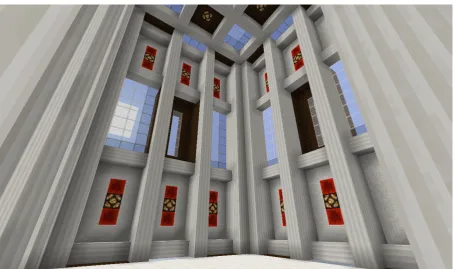
[image:23.595.71.527.362.631.2]The aesthetic design is required to be pleasant for the student, but is also requires to not distract the student from the learning content. The result of these aesthetic design choices is displayed in figure 3.
Figure 3: A screenshot of the design of an empty room, which is used throughout the instruction.
Sections of the Map
Tutorials
Because the instruction is delivered in Minecraft, the student first needs to learn how the avatar can be controlled. In order to teach the student the controls, a tutorial is included at the start before the events of instruction. This tutorial teaches the student on simple movement, jumping, how redstone works, how the messaging system works, how the inventory works and the use of items and books. The goal of the tutorials is to familiarise the student with the mechanics of the game, especially with the controls.
After the student has learned how to operate within Minecraft, the actual instruction begins, starting off with the introduction. The first three events are delivered by a book. Although the attention of the student is already gained during the tutorial, the book still introduces the student to the world of Minecraft in order to direct the attention to the content. The writer also introduces himself as Professor qCraft. Furthermore, the professor establishes the purpose and arouses interest. After that, the student is teleported to the main hall.
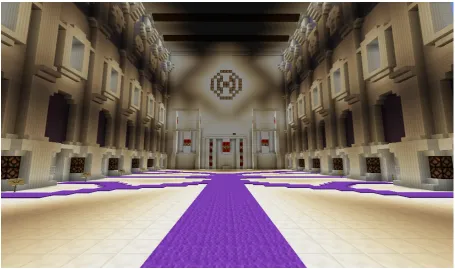
The Main Hall
Between every segment, the student returns to a main hall. This is a room which connects all the different branches of the instruction. Every branch is labeled with a sign, so the student can get a preview on the instruction. Furthermore, every next branch has to be unlocked by completing the previous branch, and the first branch is already unlocked from the beginning. Having different parts of the instruction in different branches allows for more segmenting, for the student needs to spend time in between branches to walk to the next branch. Furthermore, because every branch is labeled, the student can already get a preview of the different branches. Finally, the student is provided a way of tracking his progress within the instruction.
In order to force the student to complete the branches in the order specified within the framework, the student has to unlock every next branch by completing the current branch. This is implemented by a ticket system. To unlock a branch, the student has to insert a ticket into a dropper at the end of the main hall. The dropper then sends the ticket into a system where the ticket is checked, opening the iron door corresponding to the ticket if the ticket is valid. A ticket can be obtained at the end of every branch. The ticket system has two extra bonus practicalities. The student has to spend even more time in between the branches allowing for more segmenting. The student also gets to see the name of the next branch when receiving his ticket, allowing for signalling.
As can be seen in the Initial Framework appendix on page 71, there are ten branches of the instruction accessible from the main hall. These branches correspond to the different topical domains specified on page 57.
Rutherford-Bohr Model of the Atom
The body starts with the Rutherford-Bohr Model of the Atom. This is delivered via one book, and depicted by an illustration on the wall (the same picture as figure 6 on page 54). By providing the picture, the model is represented in multiple ways. The Rutherford-Bohr Model is included in order to activate the prior knowledge of the student, which is done according to the relating learning objectives. After activating the prior knowledge, the student will go through the series of small sub-bodies.
Elementary Particles
Figure 4: A screenshot of the design of the main hall.
Theory of Relativity and Classical Communication
The Theory of Relativity and Classical Communication is also mostly delivered by book. There is also a contraption in the room visualising the concept of communication by two lamps with a signal connecting them, being activated once in a while. This books again starts out with prior knowledge, this time referring to knowledge about the Theory of Relativity. However, it could be the case that the particular student did not get any prior instruction about the theory of relativity, and because of this the information is provided in such a way that these students also still understand the information. After this information, new information is provided about classical communication. Thereafter the book focuses on the fact that classical communication is not instant, for this is relevant later within the Teleportation branch. Finally, the student is tested by having to calculate the time needed for a message to travel 1000 000 m, again providing practice and feedback of declarative knowledge.
Discovery Branches
to the next room. After discovering the mechanic, a book explains what the student should have found, providing feedback, and then it transfers this behaviour to the context of elementary particles.
qCraft Tutorial
After these sub-bodies, another tutorial follows, teaching the student how to use Quantum Goggles, Anti-Observation Goggles and the Automatic Observer. How the goggles can be used is taught by providing the student with the specific goggle and with a book containing information about the goggles. With these items, the student can try the goggles for himself and confirm his ideas about these goggles by reading the book. The room is also scattered with Quantum Blocks, so the student can try to interact with these blocks while using the goggles. After the goggles, the student is confronted by a Quantum Resetter setup, in which he can try to find out how the contraption works. This is then again explained by a book, so the student can confirm his findings.
Realism and Ontology, and Superposition
The next branch teaches the student about Realism and Ontology. By the means of a book, the student is first taught the questions researchers asked themselves upon finding the quantum phenomena. After that, the two interpretations are explained. The student is then asked which interpretation made more sense to him, triggering active and critical learning about different interpretations of the phenomena he witnessed earlier in the discovery branches. This is then followed by a small experiment, in which the student has to trigger a Quantum Resetter hooked up with a Quantum Block while wearing Anti-Observation Goggles, which causes the Quantum Block to remain in the state of superposition. This is then explained to the student in the book, and that this is an ontological interpretation. This emphasises the focus on the fact that quantum mechanics works in a probabilistic way instead of a deterministic way.
Uncertainty Principle of Heisenberg
The ensuing branch presents the Uncertainty Principle of Heisenberg by using pictures on the wall, one picture displaying the entire principle and the other displaying the different variables used within the principle. The student is asked to investigate the pictures first, and then receives instruction about the principle. By having to explore the principle first, the student actively engages in trying to understanding the principle. The instruction then serves as feedback on this understanding. The book then emphasises two implications following from the principle, which is the focus of this section. Furthermore, the student is asked what he would think the realistic and the ontological interpretation of this principle would be, which is followed by the answer. This way, the student actively engages in finding different interpretations of this principle, and is also able to connect the principle to the previous section. Finally, the student is taught about the scale in which the principle takes place, transferring the principle to the context of the real world.
Quantum Teleportation
experiment of why this is not possible. By doing this, the student has to think in a critical way about the possibilities and the limitations of quantum teleportation.
Conclusion
In the conclusion, the professor summarises the content of the instruction by using the teleportation experiment. By doing this, the student can review the different concepts he learned during the instruction and connect them together. The professor also transfers learning by providing information describing where students could learn more about quantum mechanics, giving the students a preview for possible follow-up instruction. Finally, the professor closes the instruction.
Formative Evaluation
At the stage of having fully developed a prototype of the instruction, it can be evaluated. Verloop and Lowyck (2009) enlists two types of evaluation, which are formative evaluation and summative evaluation. A summative evaluation can only take place after the full implementation of the instruction, therefore only a formative evaluation is be conducted.
Nieveen et al. (2012) enlists five evaluation methods, as can be seen in the Evaluation Matchboard appendix on page 103. These are screening, focus group, walkthrough, micro-evaluation and try-out. A focus group evaluation has been conducted already during the analysis phase, described in the Focus Group Evaluation section on page 14. Furthermore, in the Task Analysis section on page 14 it was already specified that a screening would be conducted after the development of the product using the learning objectives, and within the Design Principle section on page 19 it was likewise specified that a screening would be conducted after the development of the product using the design principles. A walkthrough still had to be conducted in order to test the practicality of the instruction, which entailed mostly testing whether the map was functioning correctly. These evaluations were all carried out sequentially and did not produce any significant results, for it was just a test without any new information. The micro-evaluation however will be the main micro-evaluation, because it will provide information about the actual practicality and the actual effectiveness. This evaluation will be elaborated within the following section. The try-out evaluation will not be possible, for it requires implementation of the instruction.
Method for the Micro-Evaluation
Research Approach
Because the instruction will be formatively evaluated and not a summatively, a qualitative approach was chosen over a quantitative approach. This choice was made because qualitative data embeds the results more in context, which makes it more valuable for determining how to alter the instruction. Quantitative data usually proves to be more useful for a summative evaluation, for it is more reliable and can be used to determine the accomplishment of concrete learning objectives. The evaluation will be conducted with individual respondents, which is in contrast with the recommendation for collaborative learning. However, for a first evaluation it is beneficial to limit the amount of variables, which would be increased by collaborative learning.
Research Goal
Research Questions
The main goal of the evaluation is to gain information about the reaction and about the learning of the respondent, and therefore the research question is split up into two questions, which are ”How does the respondent react to the instruction?” and ”What are the conceptions of the respondents about quantum mechanics after the instruction?”, formulated as specified by Baarda, de Goede, and Teunissen (2009).
Action Based Research
In order to enhance the evaluation of the instruction, the decision was made to conduct action based research. This entails not only measuring the reaction and learning, but also making them participate in the improvement of the product. These improvements would then also be implemented in order to enhance the instruction itself, and measuring the effects of the improvements. This way, a more incremental approach is used in enhancing the instruction.
Respondents
Undergraduate students were used as respondents, for these are similar to the target demographic, both in attitudes as in preknowledge, and because of the unavailability of physics students within secondary edu-cation. The properties of these respondents also still aligns with the results from the learner analysis. The preknowledge had to be tested though, for it could be possible to vary from the preknowledge, especially considering technical undergraduate students. As such, a pretest was included in the evaluation.
Concepts Central to the Research
As stated before, the evaluation measures the reaction and the learning of the student. The topics within the evaluation of the learning of the students are parallel to the content domains of the instruction as al-ready defined in the task analysis on page 11. These topics are Elementary Particles, Classical Commu-nication, Observer Dependency, Realism and Ontology, Superposition, Entanglement, the Uncertainty Principle of Heisenberg and Teleportation. The applications of quantum mechanics are disregarded, for these do not contribute to the conceptual understanding of quantum mechanics.
However, for measuring the reaction, new topics are needed. As stated before in the Learner Anal-ysis on page 10, some of the students might already have knowledge of quantum mechanics before the instruction. This influences the results, especially on a learning level. Therefore, the student has to be asked which content was new. Furthermore, the student might experience difficulties with controlling the avatar, with knowing what to do at all times and with the information presented within the game. Difficulty can stem from the language used within the books, but language encompasses more than only the difficulty of understanding it, for example the writing style or the tone used when delivering the text. Next to the text element of the instruction, there is also a gameplay element. These elements do not independent of each other, because a right balance is required between the amount of text and gameplay. Furthermore, learning about quantum mechanics could have a certain philosophical value, and can also have an amusement value. Finally, next to the importance of learning from the instruction, it would also be beneficial if the student would be motivated to learn more about quantum mechanics.
Hence, the topics are:
• Reaction
– New information
– Difficulty
– Language
– Use of Minecraft
– Philosophical value
– Amusement value
– Excitement about quantum mechanics • Learning
– Elementary Particles
– Classical Communication
– Observer Dependency
– Realism and Ontology
– Superposition
– Entanglement
– the Uncertainty Principle of Heisenberg
– Teleportation
Methods of Data Gathering
There are different methods of data gathering available, which are document analysis, observation and interviews. Document analysis entails the study of already available material in order to learn something about the current setting of the topic. In the case of this instruction, data could be gathered by analysing other available teaching material or documents describing how to teach quantum mechanics. However, this aspect is already covered, both in what to teach from Zeilinger (2005) and as in the current experi-ence with teaching by consulting the literature. An observation will be conducted, for the behaviour of the respondent during the instruction could provide insights in what areas of the instruction should be improved, which is essentially the goal of the instruction. However, the main results will be provided by interviews, for by conducting interviews the student is able to voice opinions about the instruction. Furthermore, the student could even get involved by improving the map by being asked how it could be improved. Finally, the student can be tested on comprehension of the instruction. By using interviews instead of testing, the student can also explain the difficulties for thinking of the correct answer. Finally, the student can be helped if needed, so the understanding can be measured on a deeper and more thor-ough level. In contrast to a test, the interviews cannot be used to validate the instruction, this is however not the goal of a formative evaluation.
Pretest
Observation
The purpose of the observation used for this evaluation is to observe the behaviour of the respondent, but also to get a direct reaction of the respondent to the different components of the instruction. The observation scheme contained different sections corresponding to the branches of the instruction. Within each section, there was a line to note the duration of completing this section and a text area for observation notes. The choice for its free form was made because the reaction of the respondents were hard to predict. Noting the time could provide to be useful for comparing the lengths of the different segments with each other, comparing the different students with each other and looking at the effect of the alterations between the different versions of the instruction. The role of the researcher was to interfere with the instruction as little as possible and thereby preventing observation-bias, but providing help when needed. The researcher also had to encourage a thinking out loud protocol with the respondent, for this allowed him to get a more visible reaction from the respondents.
Interviews
Finally, the interviews are conducted. Because the interviews are conducted face to face and intended to let the interviewee provide reactions or understanding without obstruction, the interview would be open. However, to still have coherence between the interviews and to make sure the interviewee had to respond to all of the knowledge domains of quantum mechanics, a choice was made for a topic inter-view. The topics were already specified in the Concepts Central to the Research section. Furthermore, because the micro-evaluation is conducted with individual respondents, the interviews will also be held on an individual basis. This also has the advantage that the respondent feels more secure with regard to comprehension of the material, and with regard to the freedom of expression of opinions (Baarda et al., 2009).
For measuring the understanding of the respondent, associative and projective techniques were used. This was done by asking the respondent to tell everything about a certain concept, and when stuck the interviewer would help. For example, if the respondent forgot the exact term for the light particle, the interviewer would help by saying ”photon”, and the respondent could continue explaining.
Analysis of the results
Data Preparation
Three tables were generated from the information gained from the pretest and observation. The first table contained the information of the pretest for each respondent, Furthermore, the time the respondents needed to complete the sections of the instruction were also included in a separate table. Finally, the notes from the observations schemes were organised by the respondent and the section. All interviews were transcribed.
Coding the Transcriptions
learning state. This entails how the information is processed and which parts were useful or irrelevant. Every fragment coded with the Playing Experience of the Student related to all the statements in which the respondent addressed the gameplay elements used throughout the map. Furthermore, the Relevance code is used for fragments stating the opinion of the respondent about the relevance of learning quan-tum mechanics. Finally, Criticism towards Quanquan-tum Mechanics entails asking critical questions towards quantum mechanics or expressing epimistic doubt towards certain theories or interpretations. After the labelling had been finished, the fragments within the labels were ordered by the kind of statement within the fragment. This way it was possible to describe the different statements within the labels.
Results of the Micro-Evaluation
This chapter describes the results from the pretest, from the observation and from the interviews. Fur-thermore, the results were used for rapid prototyping and for making a typology of the different kinds of respondents.
Pretest
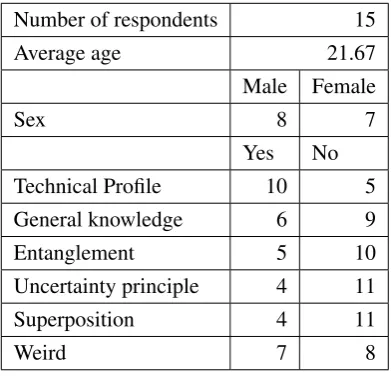
From the pretest, information was gathered about the age of the respondents, their sexes, their high school profile, and their knowledge of and attitudes towards quantum mechanics. A summary of the results of the pretest is displayed in table. There were 15 respondents in total, of which the average age was about 22. A distribution of their age can be found in figure 14 on page 106. The respondents contained a fair distribution between male and female students with 8 male and 7 female respondents. Furthermore, 10 of the respondents had a technical high school profile. Some of the respondents were international students from Germany, where there is no such thing as a technical high school profile as in the Netherlands. They however did not have had the same level of physics education and therefore they were labelled as not having a technical profile.
Number of respondents 15
Average age 21.67
Male Female
Sex 8 7
Yes No
Technical Profile 10 5
General knowledge 6 9
Entanglement 5 10
Uncertainty principle 4 11
Superposition 4 11
[image:32.595.200.396.445.633.2]Weird 7 8
Table 2: Descriptive statistics displaying the results of the pretest