T H E B R IT IS H L IB R A R Y
BRITISH THESIS SERVICETITLE
AN EXPERT SYSTEM FOR X-R AY ROCKING CURVE ANALYSIS USING ANALOGICAL REASONING.AUTHOR
Richard WilliamHENSON
DEGREE
Ph.DAWARDING
BODY
W arwick University
DATE
1993THESIS
NUMBER
DX182706
THIS THESIS HAS BEEN MICROFILMED EXACTLY AS RECEIVED
The quality of this reproduction is dependent upon the quality of the original thesis submitted for microfilming. Every effort has been made to ensure the highest quality of reproduction. Some pages may have indistinct print, especially if the original papers were poorly produced or if awarding body sent an inferior copy. If pages are missing, please contact the awarding body which granted the degree.
Previously copyrighted materials (journals articles, published texts etc.) are not filmed.
This copy of the thesis has been supplied on condition that anyone who consults it is understood to recognise that it's copyright rests with its author and that no information derived from it may be published without the author's prior written consent.
AN EXPERT SYSTEM FOR X-RAY ROCKING CURVE ANALYSIS
USING ANALOGICAL REASONING
By
Richard William Henson
Submitted for the degree of Doctor of Philosophy
to the Higher Degrees Committee
University of Warwick
Department of Engineering
University of Warwick, Coventry, U. K.
Contents
Contents I
List of figures VIII
List of tables xi
Acknowledgements XIII
Declaration XIV
Summary XV
1 Introduction 1
1.1 Introduction 1
1. 2 Organisation of Thesis 1
1.3 Review of Chapter 2 2
1.4 Review of Chapter 3 2
1. 5 Review of Chapter 4 3
1. 6 Review of Chapter 5 5
1.7 Review of Chapter 6 6
1. 8 Review of Chapter 7 7
1.9 Review of Chapter 8 9
2 Current Expert Systems 9
2. 1 Introduction 9
2.2 The Architecture 10
2. 3 Developments in Artificial Intelligence 12
2.3.1 STRIPS 14
2.3.3 HEARSAY 20
2.3.4 LS-1 23
2.4 Important Developments in Expert Systems 27
2.4.1 MYCIN - a system for medical diagnosis of
Infections 28
2.4.2 INTERNIST - a system for general medical
diagnosis 31
2.4.3 DENDRAL - a system for analysing chemical
compounds 37
2.4.4 MOLGEN - a system to aid in design of
biological experiments 41
2.5 The Role of Expert Systems 44
2.6 Conclusions 45
3 Control without Knowledge 47
3.1 Introduction 47
3. 2 Problem Spaces 47
3. 2 Classification of Problems 49
3.4 Search Strategy 51
3.5 Direction of Search 54
3.6 Heuristic Search 57
3.6.1 Representation 58
3.6.2 Matching Procedure 59
3.6.3 Conflict Resolution 60
3.7 Types of Heuristic Search (Weak Methods) 60
3.7.1 Generate-and-Test 61
3.7.2 Hill Climbing 62
3.7.3 Best First 64
3.8 The Use of Constraints 66
67
3. 9 Conclusions
4 Control with Knowledge 68
4.1 Introduction 68
4.2 Knowledge Representation 68
4.2.1 Logical Representations 69
4.2.2 Semantic Networks 72
4.2.3 Frames 76
4. 2. 4 Production Rules 81
4.2.5 Knowledge Representation Overview 82
4. 3 Methods of Inference 83
4.3.1 Logical Inference 85
4.3.1.1 Non-monotonic Logics 90
4.3.1.2 Automation of Proof 93
4.3.1.3 Resolution 96
4.3.1.4 Reasoning 97
4. 3. 2 Statistical Reasoning 103
4.3.2.1 Bayesian Logic 105
4.3.2.2 Fuzzy Logic 114
4.3.2.3 Dempster Schafer Calculus 116
4. 3. 3 Discussion 120
4.4 Conclusions 122
8 A Prototyp« Export System Shall for
X-Ray Rocking Curve Analysis 123
5. 0 Introduction 124
5.1 What is X-Ray Rocking Curve Analysis 124
5. 1. 1 Diffraction Theories 127
133
5.2 Is X-Ray Rocking Curve analysis a suitable
domain for modelling 139
5.3 A Cognitive Analysis of the Domain 141
5.3.1 Specification of Inputs and Outputs 142
5.3.2 Specification of Search 142
5.3.3 Specification of Inference 143
5.3.4 Specification of Representations 144
5.3.5 Domain Input and Output Characteristics 145
5.3.6 Domain Inference Characteristics 147
5.3.7 Domain Search Characteristics 149
5.3. 8 Domain Representation Characteristics 150
5.4 The Expert System Core 153
5.4.1 Knowledge Base 153
5. 4. 1.1 Frames 155
5.4. 1. 2 Production Rule Knowledge 157
5.4.2 Inference Engine 162
5.4.2.1 Frame Inference Engine (The Agenda) 162
5.4.2.2 The Production Rule Engine 166
5. 4. 2. 3 Demon Logic 171
5. 5 The Prover 175
5.6 Reasoning Methodology 176
5.7 Database 178
5.8 Questions 180
5.8.1 Help 183
5.8.2 How/Why 183
5.9 System Operation 184
5. 10 Conclusions 187
5.1.3 Descriptions of Rocking Curves
6 Knowledge Illcltatlon and
X-Ray Rocking Curve Analysis 186
6. 0 Introduction 188
6. 1 Knowledge Elicitation Methods 189
6. 1.1 Intra-personal Methods 190
6.1.1.1 Interviews 190
6. 1.1.2 Protocol Analysis 193
6.1.1.3 Discussion 195
6. 1. 2 Abstractive Methods 196
6. 1.2.1 Classification 196
6. 1.2.2 Multi Dimensional Scaling 197
6.1.2.3 Concept Sorting 198
6.1.2.4 Goal Decomposition 199
6.1.2.5 Machine Induction 199
6. 1.2.6 Discussion 201
6. 2 The X-Ray Rocking Curve Analysis Interviews 202
6. 2.1 General Analysis 204
6.2.2 Detailed Elicitations 205
6. 2.3 Discussion 206
6.3 A Experimental Feature Extraction Technique 207
6. 3. 1 Concept Formation 208
6.3.2 A Knowledge Elicitation Design Using
Concept Formation 210
6. 3.3 X-Ray Rocking Curve Prototypes 214
6. 4 Procedural Knowledge and X-Ray Rocking
Curve Prototypes 215
6. 5 Method and Results of the Elicitation
Process 217
\
—
6. 5. 2 Experimental Framework II 220
6.5.3 Analysis of Results 225
6. 6 The Impact of Knowledge Elicitation on the
Expert System Design 226
6. 7 Conclusions 230
’ The Development of Deep Reasoning and
Representation in Expert Systems 232
7. 0 Introduction 232
7. 1 Deep Knowledge 234
7. 1. 1 What Constitutes Deep Knowledge in
Expert Systems? 235
7. 1. 1. 1 Problem Solving 236
7. 1. 1.2 Interfacing 236
7. 1. 1.3 System Maintainability 238
7. 1. 1. 4 Knowledge Elicitation 240
7. 1. 1.5 The Design Process 241
7. 1. 1. 6 Consultation Process 242
7. 1.2 Models of Input for a Deep Design Approach 242
7. 1. 2. 1 Learning by Examples 243
7. 1. 2. 2 Memory Structures 244
7. 1. 2. 3 Analogy 245
7. 2 An Expert System Model for Deep Reasoning 247
7. 2. 1 A Re-definition of Problem Solving 248
7. 2. 2 A Model of a Consultation 249
7. 2. 3 How Core fits to the proposed Deep Model 252
7. 3 The Implementation of Deep Expert System 254
7. 3. 1 The Conceptual Database 255
7. 3. 1. 1 Representation 256
//
258 7.3.1.2 Searching for an Object
7.3.2 The Analogical Reasoner 262
7.3.2.1 Control of the Analogical Cycle 263
7.3.2.2 The Control Sequence for
Analogical Reasoning 267
7.3.2.3 Probability Assessments of
Analogical Reasoning 268
7.3.3 The Analogical Processes 272
7.3.3.1 Target Description 273
7.3.3.2 Source Selection 275
7.3.3.3 Mapping 279
7.3.3.4 Evaluation 281
7.3.3.5 Consolidation 285
7.3.3.5.1 Accomodation 286
7.3.3.5.2 Maturation 288
7. 3. 3. 5. 3 Affiliation 291
7.4 The Deep Expert System Shell and the Model 294
7.5 Overview of the X-Ray Rocking Knowledge
and Deep Reasoning 295
7. 6 Conclusions 298
t
Conclusion*
ill
8.0 Overview 299
8.1 Overcoming the Bottleneck of Knowledge
Based Systems 300
8.2 A Search for Deep Knowledge Representation 300
8.3 Results of an Analogical Framework 301
8.4 Implications of Analogical Framework 302
Problem 51 3. 3 3. 4 3. 5 3. 6 4. 1 4. 2 4. 3 4. 4 4. 5 4. 6 4. 7 4. 8 5. 1 5. 2 5. 3 5. 4 5. 5 5. 6 5. 7 5. 8 5. 9 5. 10
The Problem of the Sideways Chaining Method 56
Flow Diagram for Generate-and-Test Heuristic 62
Flow Diagram for Hill Climbing Heuristic 63
Flow Diagram for Best Path Heuristic 65
The Basic Binodal Unit of a Semantic
Network 73
Semantic Network for the Node Deformation 75
A Frame Outline of Concept
Experimental Curve 77
Object Concept for Frame Experimental Curves 79
An Instantiated Frame for Experimental Curve 80
Laws of Re-expression for all Formulae 95
Inferencinq Arc for Interference on Peak 111
Inferencing Net with Multiple Arcs 113
The Optics of Double X-Ray Diffraction 125
A Layered Structure and its Associated
X-Ray Rocking Curve 126
The Demonstration of Bragg’s Law for X-Ray
Diffraction 128
Typical Features in a Rocking Curve 133
Expert System Architecture for X-Ray
Rocking Curve Analysis 154
Nested List Structure of Each Frame 155
A Typical Frame Structure for Expert System 156
Three Rules from the Storage Frame for the
Production Rule Knowledge Base 158
The Structure of a Single Production Rule 159
5.11 The Structure of the Agenda or Controller 163
5.12 The Structure of the Data Dictionary 164
5.13 The Control Cycle for the Agenda and Frames 166
5.14 Example of a Backward Chaining Rule-Tree 168
5.15 The Storage Frame for Demon Logic Rules 171
5.16 An Example Structure of a Single Demon Rule 172
5.17 Example Rule Tree Generated by Demon Logic 174
5.18 Sideways Chaining Method for Expert System 177
5.19 Structure of Database Frame 180
5.20 The Overall Database Entry Structure 181
5.21 An Extract from Question Frame for X-Ray
Rocking Curve Domain 183
6.1 Distribution of Random Dot Prototypes 210
6. 2 Prototype Recall for Expertise 219
6.3 Prototype Categorisation for Expertise 219
6.4 Recall of Each Plot Type Against Feature
Type 224
6.5 Prototype Recall Against Expertise 225
7.1 The Analogical Reasoning Process 247
7.2 Overall Expert System Learning Structure 250
7.3 Schematic of a Deep Expert System
Architecture 254
7.4 Representation of a Two Dimensional
Probability Matrix for Complexity and
Peak-Asymmetry 256
7.5 The Conceptual Database Search Process 260
7.6 The Structure of the Deep Data Dictionary 263
7.7 The Analogical Cycle of Expert System Shell 264
7.8 The Control Process of the Agenda 266
7.9 The Production of a Target Prototype from
the Expert System Core 274
7.10 The Generation of Entry Point into
Conceptual Database from Reduced Feature 276
7.11 Feature Tables for X-Ray Rocking Curve
Domain 278
7.12 Venn Diagram of the Mapping Process 280
7.13 Set Definition for Evaluation Function 282
7.14 Search Tree of Conceptual Database 289
7.15 Constraint Graph for Affiliation Process 293
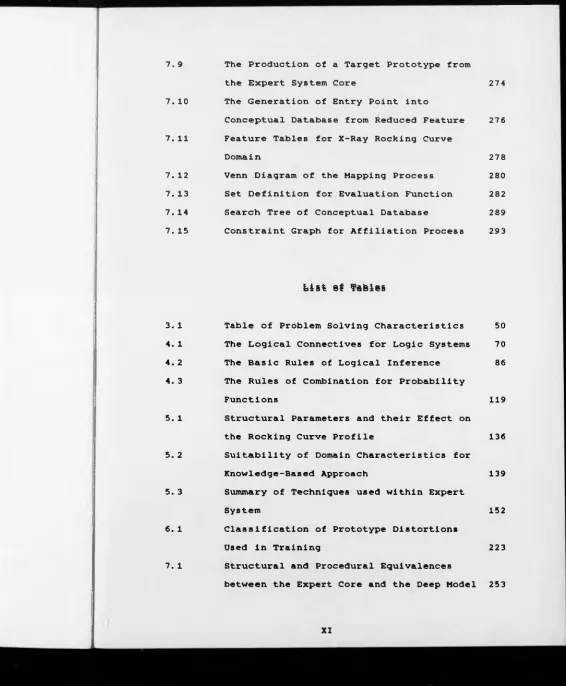
List @f fàfelêl
3.1 Table of Problem Solving Characteristics 50
4.1 The Logical Connectives for Logic Systems 70
4.2 The Basic Rules of Logical Inference 86
4.3 The Rules of Combination for Probability
Functions 119
5.1 Structural Parameters and their Effect on
the Rocking Curve Profile 136
5.2 Suitability of Domain Characteristics for
Knowledge-Based Approach 139
5.3 Summary of Techniques used within Expert
System 152
6.1 Classification of Prototype Distortions
Used in Training 223
7.1 Structural and Procedural Equivalences
[image:13.631.31.597.8.694.2]7. 2
7. 3
XII
The Conditional Application of P(R/T) to
P(E)
Probability of Consolidation given the
Evaluation of Target and Source 285
Acknowledgements
I wish to thank Dr. T. Tjahjadi and Professor K. Bowen for
their constant encouragement and excellent supervision
throughout this project. I would also like to thank the
following participants who provided my experimental and
research data, without which this thesis would not have been
possible: Members of Bebe Scientific Instruments, Durham,
especially Dr. N. Loxley and Professor B. Tanner and Staff
Declaration
The work described in this thesis was carried out in the
Department of Engineering at Warwick University between
February 1989 and August 1993.
Throughout the period of this research programme I have not
registered for any other award of the University of Warwick,
nor with any other degree-awarding body: no material content
in this thesis has been used in any submission for an
academic award.
Finally, my thanks go to the following people with whom I
had many fruitful discussions about Artificial Intelligence:
Terry Warwick and Takis Markomichalis.
Summary
This thesis examines the contribution of an adaptive expert system architecture to the field of X-ray Rocking Curve Analysis. The domain of X-ray Rocking Curve Analysis is used as an example to illustrate how a formal computer architecture can be enhanced through the principles of analogical reasoning to provide a deep knowledge of the domain.
A conventional expert system core holds knowledge of a target problem in the form of frames, production rules and confidence factors. Through logical inference and demon logic, a reasoning cycle instantiates the frame structure and creates a new set of classes that represents the solution to the problem. The solved problem is a linked set of data held within the frame structure and complete knowledge across all domains held in a common on-line datastore.
Knowledge elicitation reveals X-ray Rocking Curve Analysis to be a strongly visual task, which cannot be completely encoded within the expert system core. Through the application of the concept formation methodology, a set of key visual features (peak density, peak count, peak type) have been elicited from the X-ray Rocking Curve domain. The key features are used as a probability index for referencing previously solved problems.
Structurally, the expert system core is embedded in a five staged analogical problem solving cycle consisting of: Targetting - building a description of the current problem; Source Selection - selecting a problem from a set of previously solved problems; Mapping - adding additional reasoning from the source to the target; Evaluation - a mathematical evaluation of the closeness of fit between the selected source and target; and Consolidation - the modification of the source based on the results of the evaluation.
The key features provide the link between the target and source problems, providing a practical solution to isomorphic comaparisons from inexact mapping. Statistical inference is used to enumerate between problems and allow the analogical inferencing to operate without exhaustive computation. A set of consolidative algorithms have been implemented for modifying the source data. It is these alogorithms that give the expert system its adaptive characteristics.
Chapter 1
Aims and Objectives
1.1 Introduction
This thesis outlines the development of an expert system for
X-ray rocking curve analysis. The aim of the research is to
extend the capacity of expert systems by using cognitively
compatible structures within a formal architecture. The focus
of the research will be on knowledge elicitation techniques
for extracting deep knowledge from the domain along with the
analogical structures that support it. The result of this
development is an expert system that has the capacity to adapt
to the ’world' in which it operates by modifying its cognitive
structures. These structures are general and modular, and can
be emptied of knowledge to provide the developer with a shell.
1.2 Organisation of Thesis
This thesis is comprised of eight chapters and four
appendices. Each chapter covers a specific area of expert
systems. The following three chapters cover the technical
aspects of expert system architectures, and the remaining
chapters outline the specifications for a deep expert system.
Appendices one to three cover the details of elicitation from
the domain whilst the remaining appendices list the expert
system's operation.
1.3 Review of Chapter 2
In chapter two a selection of the major technical
contributions to the field of expert systems are discussed.
I
The chapter initially focuses on the underlying techniques
used in the field of artificial intelligence, starting from
the simple application of the stacked planning procedure of
STRIPS, to abstract pre-planning in CRITICS as well as more
complex multi-modal systems of the HEARSAY projects. The
second half of the chapter moves from a general examination of
artificial intelligence, to its application in the formal
architecture of four expert systems. The areas of search
spaces within chemical expert system DENDRAL, planning and
abstraction of the experimental designer MOLGEN, MYCIN and its
handling of uncertainty and the associated statistical
methods, and knowledge representation within INTERNIST, both
medical expert systems, are all discussed, each giving
pointers towards the development of deep systems. The aim of
the chapter is to introduce the reader to important areas for
expert system design.
1.4 Review of Chapter 3
Chapter three looks at problem solving without the use of
knowledge. These heuristics rely on search techniques for
their success, and this is important to expert systems because
there are times when knowledge runs out even though it may
still be possible to solve a problem. Initially, the chapter
looks at the concepts of problem spaces and the classification
of problems. Understanding problem types is necessary because
there are no general problem solving algorithms that are
suitable for all types of problem. The strategy and direction
of search is examined in terms of both its compositional
problem steps or stages and both forward and backward chaining
respectively. These are very general techniques of search and
frequently used in expert systems. For example, chaining of
both types can be used as a mechanism to support an inference
engine, and the problem steps or stages formulation can
employed as the task controller behind agenda control
mechanisms.
Finally, chapter three outlines the heuristic techniques of
search. These are specific algorithms that demand a formal
representation of a problem in order to provide a solution.
Again, expert system architectures employ these techniques,
and indeed so too does the software of this thesis. A reverse
hill climbing strategy based on ’centres of gravity’ is used
to search for problem matches in a database within the expert
system for X-ray rocking curve analysis (see chapter seven).
1.5 R e v i e w of C h a p t e r 4
Chapter four examines problem solving with knowledge. In its
structure, it adopts the expert system convention of dividing
the solution of a problem into a domain independent inference
engine, and a problem specific knowledge representation. The
first part of the chapter is concerned with the various ways
of representing a problem. Four main methods are reviewed:
logic, semantic nets, frames, and production rules, as each of
these has benefits for encoding different types of knowledge,
be it declarative, procedural, conditional, evidential or
strategic. The possibility of a mixed representation is
discussed and this is explored in greater detail at a later
stage in the thesis (see chapter 5). The second half of the
Two broad chapter focuses on inferencing techniques,
approaches are examined; statistical inference and logical
inference. There are a large range of statistical methods, but
the three most important are Bayesian logic, Dempster Shafer
calculus and Fuzzy or Possibility logic. These techniques are
considered important because they capture uncertainty. They
allow a knowledge engineer to ascribe importance to events in
a way that is not possible using logical inference. All three
techniques are reviewed, but a selection of the best for use
in the expert system for X-ray rocking curve analysis
postponed until later in the thesis.
The logical approach to reasoning is examined in the form of
both propositional and predicate logic. These formalisms
capture knowledge in representations that can be solved
mathematically using approaches such as algebraic inference
and resolution. This allows the system to specify the truth of
a statement. The extent to which these methods both provide a
representation and a inferencing structure is discussed. The
programming language PROLOG is an example of this integrated
strategy to problem solving. Extensions to the these types of
logic are briefly discussed, including default logic, modal
logic and autoepistemic logic. Aspects of these formal proof
methods can be included within representations. For example,
inheritance and defaults are included as part of the frame
representations. The cross links of representation and
inference are important in the design of an expert system and
1.6 Review of Chapter 5
Chapter five is concerned with the design and implementation
of a expert system using existing tools and techniques. The
chapter is divided into two parts. Part one examines the
domain of X-ray rocking curve analysis. It describes the
domain in general terms and summarise its main features.
Existing artificial techniques outlined in the previous three
chapters are identified, categorised and then matched to the
requirements of the domain as a set of methods. The problem
structures used within an expert system architecture are
listed and then associated with a method (see Table 5.4). The
aim of this analysis is to produce a high level definition for
an expert system core.
Part two of the chapter describes the design and then the
implementation of an expert system core. It consists of a
mixed representation of frames and production rules, and is
controlled using an agenda. The operation of the system is
based on a overall problem definition which is initially
captured on an agenda as a set of tasks, and from these are
generated sets of sub-tasks. The aim of the core is to
instantiate the declarative structure of the domain, stored in
a frame based model, and use a production rule system to solve
individual tasks fired from the slots within each frame.
Backward chaining is used to drive the production rules and
forward chaining the frame model. Demons are also employed as
'watch-dogs' over the modelling process.
The chapter concludes by stating that the core can be used to
solve X-ray rocking curve problems, but is restricted by the
capacity of the modeller to capture all knowledge in a single
set of production rules and frames. In trying to capture all
knowledge in a single model, the system sacrifices efficiency
at the expense of generality. In terms of depth, the system is
shallow in its operation because . it does not encode the
domain's essential visual nature.
1.7 Review of Chapter 6
Knowledge elicitation is introduced as an important topic in
chapter six. The chapter is divided into three parts. Part one
looks at conventional elicitation technique, part two outlines
the conventional elicitation techniques as applied to X-ray
rocking curve analysis, and part three expresses a new method
of elicitation for visual or iconic knowledge.
In part one knowledge elicitation is divided into two
categories, Intra-personal techniques and abstractive
techniques. Both models are discussed in terms of there
advantages and disadvantages to the domain. In terms of the X-
ray domain, only the intra-personal model is used, the reason
being that a domain specific abstractive technique is
developed in the second half of the chapter. Part two details
the intra-personal techniques used on the domain to extract
knowledge for the core of the expert system. Part three
outlines a formal elicitation technique for X-ray rocking
curve analysis. The technique is based on concept formation
which was first used by Posner and Keele when studying the
formation of ideas from visual images. The elicitation
technique is an adaption of this method with a set number of
assumptions all of which are described in the chapter. Unlike
bas i s to its experimental method and a statistical
)
verification. The aim of the method is to extract key features
from the domain. The importance of these features are that
they are experimentally verified and, therefore, constitute
’deep' knowledge of the domain. The problem remains as two how
to encode this deep knowledge, and this is the purpose of the
next chapter.
1. 8 Review of Chapter 7
Chapter seven examines the contribution of analogical
reasoning to the encoding of deep knowledge within the expert
system environment. The deep knowledge extracted using the
experimental elicitation procedure is encoded into an outer
analogical cycle that matches the current consultation of the
expert system core to a previously encoded set of conceptual
structures.
The chapter begins by briefly outlining second generation
characteristics for expert system behaviour which are flexible
problem solving, complex user interfaces, and good system
maintainability. The key to second generation architectures is
their openness, so that rather than being shells for
knowledge, they are environments for developing knowledge
based systems.
Later in the chapter three schemes of deep knowledge, learning
by example, memory models and analogical reasoning, are
examined. These schemes suggest the nature of deep knowledge.
A continuous model of analogical reasoning (targeting, source
selection, mapping, evaluation and consolidation) is selected
as an appropriate deep structure. A model for a deep
consultation is developed from the continuous analogical model
and fitted to the expert system core. Two consultative cycles
are developed from the deep consultative model, a short term
consultation captured within the expert system core, and a
long term adaptive cycle based on the continuous analogical
model. As the short term cycle is linked via its data
structures to the long term cycle, no one consultation is
necessarily the same as the next. Common solutions converge to
a single mapping between a current problem definition and a
previously resolved solution. Uncommon solutions diverge into
separate mappings.
The rest of the chapter deals with the implementation of the
continuous model and the equations and definitions used. Four
components are identified within the deep architecture, the
expert system core that builds a target description (see
Chapter 5), conceptual search space that encodes a probability
profile of all key features of the problem domain with an
associated data store of past solutions, and an analogical
reasoner that controls the development of the long term cycle.
The chapter ends by summarising the deep model (see Figure
7. 14) and giving an overview of deep knowledge and X-ray
rocking curve analysis.
1.9 Review of Chapter 8
Chapter 8 is the conclusion of the thesis, and examines the
contribution of deep knowledge to the example domain, possible
improvements to the architecture, and future directions for
Chapter 2
Current Expert Systems
2.1 Introduction
Expert system technology is the result of the practical
implementation of research conducted mainly in the field of
artificial intelligence (A.I.). Since the 1960’s, the A. I.
community has been interested in modelling human cognitive
performance, and has been particularly concerned with the
fields of general problem solving (Earnst and Newell 1969;
Smith 1983), visual perception (Guzman 1967; Clowes 1971;
Lowe i987) , language understanding (Erman, Hayes-Roth Lesser
and Reddy 1980), and learning paradigms (Mickalski 1983).
The MIT robot project was the centre of much of this early
research, but failed to produce generalisable results
(Dreyfus 1968). This was reflected by the problems
encountered when trying to move from the artificial "blocks
worlds” to the real world (Michie 1971). What such research
did reveal, however, was the complexity of even the simplest
human tasks. Due to the domain dependant problem solving
requirements of expert systems, research in this area has
tended to be less diverse, not centring on the production of
"world" solutions, instead focusing on modelling specialist
knowledge, covering the topics of knowledge elicitation
(Christine and Izak 1991), knowledge representation (Bobrow
and Collins 1975), inferencing (Winograd 1980), and user
interfaces (Simmons 1986) . Some expert systems attempt to
duplicate human performance, whilst others model the
cognitive processes, and by default, duplicate human
performance. The extent to which an expert system attempts
to model human cognition will depend on the approach taken
by the researcher. At one end of the spectrum will lie a
series of heuristic devices that may or may not reflect
cognitive processes, relying on the external manipulations
of statistical or mathematical algorithms (Reggia, Nau and
Wang 1984), and at the other end of the spectrum will lie
systems that attempt to model cognitive processes and,
thereby, reflect human performance (Keravnou and Washbrook
1989). In the case of these later systems, the duplication
of human performance may or may not be regarded as
advantageous since we are generally very good at qualitative
judgements, but not very good at repeatability or
quantitative judgements (Murrell 1976).
2.2 The Architecture
Part of the reason for the development of expert system
technology was the result of a reaction against the failure
of early A. I. systems to Invent general problem solving
routines. It was found that most A.I. systems were
constrained to the theoretical worlds they were developed
within, and not generalisable to real world problems. It was
also discovered that the encoding of domain specific
knowledge was one way of improving the performance of A. I.
systems, but at the expense of generality. Expert system
technology grew out of this impasse, and there developed an
overall system architecture that was different from the
conventional computer architecture, and comprised of four
a> Knowledge base - containing the domain knowledge.
b) User Interface - translator to/from user/system.
c) Inference Engine - control mechanism.
d) Acquisition Mod. — machine learning strategy.
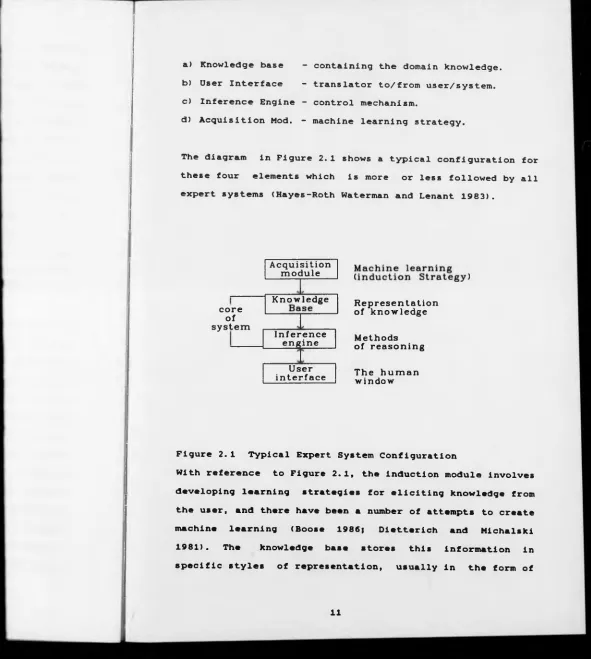
The diagram in Figure 2.1 shows a typical configuration for
these four elements which is more or less followed by all
expert systems (Hayes-Roth Waterman and Lenant 1983).
Figure 2. 1 Typical Expert System Configuration
With reference to Figure 2.1, the induction module involves
developing learning strategies for eliciting knowledge from
the user, and there have been a number of attempts to create
machine learning (Boose 1986j Dietterich and Michalski
1981). The knowledge base stores this information in
specific styles of representation, usually in the form of
A c q u i s i t i o n m o d u l e
c o r e o f s y s t e m
K n o w l e d g e R e p r e s e n t a t i o n o f k n o w l e d g e
I n f e r e n c e
e n g i n e Met hods o f r e a s o n i n g
User
i n t e r f a c e T h e h u m a n w i n d o w
[image:28.630.13.604.15.674.2]one or more of four types (predicate calculus, production
rules, frames, semantic nets). The inferencing methods
utilise the knowledge in the system to produce a control
strategy. In general, a problem is configured as a search
space and two types of search strategy (backward chaining,
forward chaining) applied when trying to solve it. Backward
chaining operates from goal to hypothesis, trying to work
out what information is needed to satisfy a particular goal,
and forward chaining is data driven, trying to match the
data to a hypothesis. The user interface is the final
component of the expert system, and involves the way the
reasoning of the system is explained to the user i.e. the
system justifying its conclusions, and the way the system
reacts to the responses of the system i.e. perhaps fitting
the questioning strategy to the experience of user.
2. 3 Developments in A.I.
Some of the earliest work in the field of A.I. was carried
out as part of the MIT robot project. Co-ordinated research
into a number of areas of A. I. aimed to build machines
capable of behaving in a constrained theoretical world of
blocks similar to way in which a human might behave in their
environments. Particular aspects of perception were
investigated including the transformation of grammar into a
syntactic structure and then a semantic format, the visual
perception of toy blocks, and the solving of problems in
translating the domain into the required format. Simple
colour were used in the theoretical worlds and these served
as indices for the investigation of object composition and
learning paradigms (Winston 1975) . The overall aim of this
and other similar projects was to build a system that first
understood instructions and questions, identified the agents
within the theoretical world and then planned the necessary
actions to transform the world state into the goal state,
upgrading responses to external interactions by modifying
operations based on training examples. These systems
presented a standard procedure for investigating human
performance and highlighted a number of issues, including
the need to develop adequate descriptions of domain specific
knowledge before attempting practical solutions to specific
problems, the critical role played by planning procedures to
organise knowledge within the system, the need to define
individual problem domains in terms of a restricted search
space, and the critical role played by categorisation and
classification for representing knowledge. A number of
important systems contributing to these issues were
developed including:
a) STRIPS - a system for solving multiple goals (Fikes and
Nilsson 1971)
b) NOAH - a system for decomposing planning (Sacerdoti 1975)
c) HEARSAY III - a system for multi-level analysis (Balzer,
Erman, London, and Williams 1980)
d) LSI - a system for learning (Backman 1990)
2.3.1 STRIPS
This was a system designed to solve multiple goal situations
that interact ie. have dependant states. It used the blocks
world as the domain of understanding, and a set of operator
to manipulate a goal stack. Three stack operators were used
to manipulate the stack ADD, DELETE, and PRECONDITION, and a
set of descriptive operators were used to describe the
blocks world and the legal actions within it. The
descriptive operators were the predicates: ON(x,y),
ONTABLE(x ) , HOLDING(x ) , C L E A R (x ) , ARMEMPTY, and actions
were planned using a further four predicates: STACK(x,y),
UNSTACK(x,y), PICKUP(x), PUTDOWN(x). The world consisted of
a series of labelled blocks, a table, and an arm for
manipulating each block one at a time, and the aim of the
system was to represent the world in a computer, identify
the state of the world (the start state), identify a new
representation of the world (the goal state) ie the same
blocks, but in a different configuration, and plan a
sequence of actions using the operators available to
interconnected the two via intermediate states. The goal
stack functioned from the top downwards and the goals at the
top of the stack were identified first, expanded if
necessary and then satisfied before moving sequentially onto
the next goal in the stack. The system stored the results of
each satisfied goal from the goal stack in a database, and
that goal was then removed from the stack. The system
until all were satisfied, the results being sequentially
stored in a database and correspondingly removed from the
stack. An empty stack indicated that the system had planned
a sequence of operations on the blocks, transforming the
start state into the goal state.
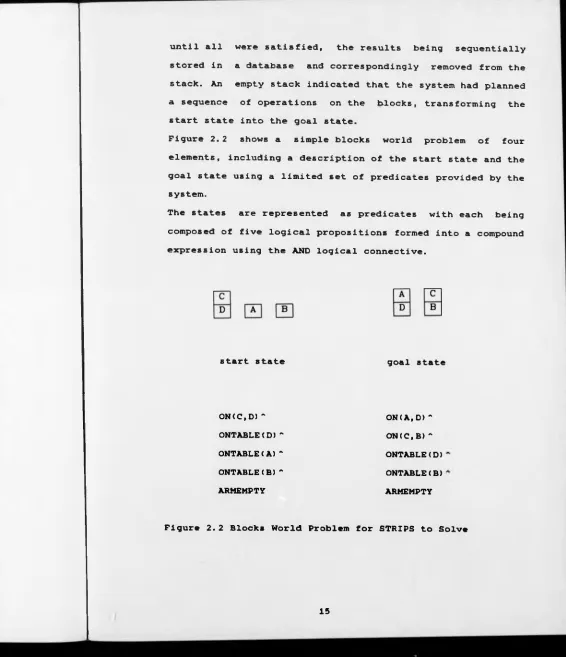
Figure 2.2 shows a simple blocks world problem of four
elements, including a description of the start state and the
goal state using a limited set of predicates provided by the
system.
The states are represented as predicates with each being
composed of five logical propositions formed into a compound
expression using the AND logical connective.
start state goal state
ON(C,D)“
ONTABLE(D)“
ONTABLE < A)“
ONTABLE(B)“
ARMEMPTY
ON(A,D)*
O N (C, B) ~
ONTABLE(D)
ONTABLE(B)
ARMEMPTY
Figure 2.2 Blocks World Problem for STRIPS to Solve
[image:32.627.24.590.12.669.2]The first four propositions describe the blocks world and
the ARMEMPTY condition is a proposition that states that the
system must not be holding an object in either state.
Having described the start and goal states of the problem
the system sub-divides the problem into its individual
propositions. By sub-dividing the problem in this manner
Figure 2.2 shows that sub-goals ONTABLE(B) and ONTABLE(D)
are both satisfied and, therefore, eliminated from the
stack. However, subgoals ”C ” and ”A ” are not satisfied and,
consequently added to the stack. By inserting each of these
unsatisfied goal states into the goal stack, STRIPS defines
a problem to be solved by the system and is then able to
describe what conditions constitute the current state of ”A ”
and ”C" in terms of their relationship to other blocks in
the world. The goal stack is, therefore, activated and
described thus:
O N (A ,0)
O N (C ,B )
ON < C , B ) “ O N ( A , D) ~ O N T A B L E ( D) ~ O N T A B L E ( B)
In this particular goal stack, ON(A,D) and ON(C,B> are both
untrue, and, therefore, the next step for STRIPS is to
transform the start state by trying each of the predicates
on the top goal to see if the goal state can be matched.
These trails continue until such time the stack is empty.
STRIPS shows how predicate logic can be used to plan
operations on decompositional goals, and works effectively
[image:33.634.7.612.15.679.2]necessary operators are defined, and the problem can be
divided into sub-problems. In the STRIPS system the location
of each block is considered an individual problem, but by
linking these via a goal stack it is possible to deal with
interacting goals. In the example illustrated, the stacking
of ”C ” on ”B ” is resolved through the interaction of the
separate goal to CLEAR(D), the clearing of ”D ” being a sub
goal of necessary conditions to satisfy STACK(A,D).
However, there are two problems with this approach. Firstly,
by using predicate logic as the basis for representing
information in the world, abstraction of concepts is
restricted by the logical constraints of this form of
knowledge representation. Secondly, whilst STRIPS
highlighted the importance of planning before action, it
failed to address the full implications of planning
strategy. In this situation, plans are not always formed
into separate parts that can be resolved independently in a
linear fashion, and this is particularly so as a situation
becomes more complex. The skills of an expert are one such
example, and it is often the case that expertise is used in
the absence of information, and under these circumstances it
may be necessary to formulate only partial plans before
proceeding to a final solution. STRIPS makes no attempt to
partially complete a problem, and only proceeds to the next
goal(s) once the problem at the top of the stack has been
solved. The planning principles of STRIPS are, therefore,
insufficient for providing solutions to complex problems.
2. 3.2 NOAH
Nilsson has pointed out that the techniques of STRIPS can be
modified using backward chaining from goal to start state,
pruning the search tree generated to provided a reasonably
sized search space to solve non-linear planning problems
(Nilsson 1980). STRIPS tended to work from the start state
towards the goal, and, therefore, tried to prove the pre
conditions before applying the solution. A stack was used to
organise the processing of the goals and sub-goals which,
whilst adequate for some problems was ineffective for
others.
By introducing an alternative method of 'sets of goals’
rather than 'stacks of goals' it is feasible to choose from
a number of possible goals rather than the top one. However,
in order that the selection process is logical, it is
necessary to introduce a hierarchy to the goal organisation
to differentiate between important goals and inconsequential
goals. It is also important to introduce a tree pruning
algorithm to reduce the number of operators that might apply
to the 'set of goals'. This was previously unnecessary
because the stack sequentially restricted access to the top
goal only.
The use of abstraction could be used to deal with increased
complexity, thereby building operators into larger commands
that only evolve solutions at an initially high level. For
example, a high level command might be TOWER(A,B,C), which
broken down into sub-operators equals
ONTABLE(C)~ON(B,C)~ON(A,B) . Knowing the moves and
quick check of the necessary object states. For example, an
overall plan might be to build several TOWERs and implement
a search strategy geared to maximising the availability of
CLEAR(x) to enable an effective building program. An
alternative strategy would be to apply a priority value to
solving each goal, and a threshold above which search would
be conducted. Plans would be evolved above the threshold,
but none would be evolved below such a threshold. This is
the approach taken by ABSTRIPS, an extension of STRIPS
(Sacerdoti 1974).
NOAH uses similar strategies to those previously outlined,
and employs a programming routine called CRITICS to observe
the plans produced by the system. CRITICS is used to resolve
conflicts when more than one alternative from the set of
goals is available. CRITICS works by placing constraints on
plans, and in terms of the blocks world, highlights
operators whose pre-conditions might undo previously
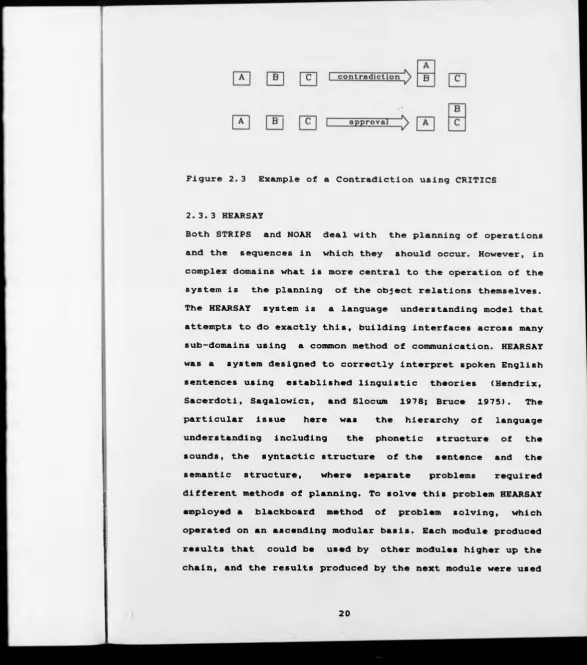
approved operations. For example, if an operation requires a
stack of three objects ”A ” , ”B ” , and "C" then CRITICS will
order the operations such that contradictions arise if
STACK(A,B) occurs before STACK(B,C) when the world goal is
<ON(A,B)'‘ON(B<C) ~ONTABLE<C) ) , and only one block can be
moved at a time, This is shown in Figure 2.3.
CRITICS is also used to eliminate redundant pre-conditions.
This overall approach has been labelled the least-commitment
strategy, and provides a useful insight into the
complexities of planning changes in state within the simple
blocks domain.
Figure 2.3 Example of a Contradiction using CRITICS
2.3.3 HEARSAY
Both STRIPS and NOAH deal with the planning of operations
and the sequences in which they should occur. However, in
complex domains what is more central to the operation of the
system is the planning of the object relations themselves.
The HEARSAY system is a language understanding model that
attempts to do exactly this, building interfaces across many
sub-domains using a common method of communication. HEARSAY
was a system designed to correctly interpret spoken English
sentences using established linguistic theories (Hendrix,
Sacerdoti, Sagalowics, and Slocum 1978; Bruce 1975). The
particular issue here was the hierarchy of language
understanding including the phonetic structure of the
sounds, the syntactic structure of the sentence and the
semantic structure, where separate problems required
different methods of planning. To solve this problem HEARSAY
employed a blackboard method of problem solving, which
operated on an ascending modular basis. Each module produced
results that could be used by other modules higher up the
[image:37.633.9.597.14.680.2]by other modules next in sequence. The results would be
written on the blackboard and these could then be understood
by other modules as evidence for solving their own problems.
The blackboard was constructed along two axes: the y—axis
was the level of analysis dealing with hypotheses about
phonemes to complete sentences, and the X-axis the measure
of time over which the utterance was measured. Figure 2.4
shows a typical utterance and its layout on the blackboard:
Figure 2.4 The HEARSAY Blackboard for Typical Utterance.
As shown in Figure 2.4 the level of analysis is divided into
eight levels:
a) The waveform of the utterance
b) The actual words of the sentence
c) The sound segments
d) The syllable classes
e) Each individual word K.S.
£) Second word K.S.
g) Word sequences
h) Phrases
The operation of the blackboard was performed by a series of
demons, one for each of the eight levels, and these demons
were used to specify which knowledge set to activate given
the current evidence available (what is written on the
blackboard). When information from the various algorithms,
one set of algorithms for each level, was placed on the
blackboard, one or more demons had their conditions
satisfied. The activated demons then prompted their
knowledge set into action, requesting that the blackboard be
analysed. If more than one demon was activated at a time
then a scheduler was used to conduct the search process in
an orderly manner. The scheduler made decisions based on
ratings produced by each activated K.S. and this provided
comparative value that could be used by the scheduler to
decide which demon should analyse the blackboard next. Roth-
Hayes and Lesser (1977) provide details of the scheduler
operation.
HEARSAY'S approach to problem solving differs markedly from
NOAH and STRIPS, especially as it is trying to solve a real
world problem. The contribution of this strategy to problem
a) Providing a method of dealing with multi-levelled
information, some at a low level such as phonetic sounds,
and some at a higher level such as syntactic structure.
b) Suggesting a sophisticated control structure using demon
logic, each demon dedicated to recognising evidence relevant
to its domain of control.
c) Organising knowledge into sets, which is both well
understood mathematically, and an effective way of
structuring knowledge in a ’cognitive’ fashion.
2. 3. 4 LS-I
An important aspect of A.I. applications is the development
of learning paradigms. This process ensures that the
knowledge base of a system is never static and always
capable of being re-defined. An expert's knowledge is also
never static and responsive to the situation, indicating
that the use of learning strategy is an important issue in
expert system design. Learning strategies tend to be of
three types, and all can be regarded as problem solving
strategies applicable to novel rather than encoded
situations:
a) Learning by analogy
b) Learning by generalisation
c) Learning by discovery
Analogical problem solving refers to the mapping together of
elements in a source domain and a target domain. The source
domain refers to the analogical source from which schematic
representations can be formulated for the mapping of the
target, and the target domain refers to the problem state
the requires resolution.
What is of interest here is that experimental evidence shows
that human problem solving tends to use systematic analogies
that map to higher order relations ("suggests” or "caused-
by") in a one-to-one correspondence from source to target
(Lakoff and Johnson 1980).
Learning by generalisation refers to the principle that
learning may be result of the allocation of concepts to
common memory arrays, and that generalisations are the
result of firstly, assigning concepts to the common array
and secondly, drawing on the common characteristics of
members to make generalisations through common association
(Winston 1975s157).
Learning by discovery is different again, and relies on
general problem solving techniques. By discovery, one means
that an entity acquires knowledge that the user or the
designer of the system does not have, and in this sense does
not rely on teaching examples to acquire knowledge. Such
learning paradigms are especially useful in mathematical
domains where knowledge is monotonic and simple to control
(Vere 1975).
The system illustrated here, LS-1, relies on none of the
above strategies, but introduces a fourth method, that of a
learning system for acquiring specific sets of heuristics,
represented as a production rule system, to govern the
application of operator sets to solve domain specific
problems, and the genetic algorithm was used as a method of
search for improving the performance of the system. There
are three functional components of LS-l!
a) A problem solving device - an inference engine for
applying alternative sets of controls heuristics of the
domain task.
b) The critic - an evaluation routine for assessing the
success of a given set of control heuristics, and judging
performance.
c) A learning device - a genetic searching strategy for
generating new heuristics in response to performance.
Figure 2.5 shows how these components fit together to
maintain a knowledge base of m structures, each a candidate
set of control heuristics to solve the domain problem.
Figure 2.5 Schematic of the LS-l
The tasks cyclically loop through the system, refining
performance, and a current hypothesis is generated based on
the results of the problem solver. This process is measured
by the CRITIC which analyses K operator sequences generated
by the rule set. The performance measure is then used by the
genetic algorithm to generate off-spring by crossing,
mutating, or inverting the most promising rule sets to
produce new hybridised rule sets. The hybrids are entered
into the knowledge base of the system and re-used by the
problem solver to produce a new operator sequence for
evaluation.
The success of the genetic algorithm is dependant on
producing a rule set with high granularity. In other words,
the knowledge representation technique must be capable of
reducing the size of the sub-elements in the rule set to a
level that allows operator sequences to be crossed without
corrupting the knowledge. For example, in Figure 2.6a the
cross-over operator is shown producing new off-spring from
two high performance rule sets, Figure 2.6b shows the
inversion operator transforming a single high performance
rule set, and Figure 2.6c shows the mutation operator which
operates in background and occasionally introduces or
substitutes a random rule to ensure that the search process
never reaches a local maxima.
In all figures On must be small to ensure that the break
points in the parent rules occur at the operator boundaries.
The larger On the greater the probability of breaking within
Parents:
Hybrids:
01 02 03 04 05
Rule set 'A'
01 02 03 08 09
Rule set ’C ’
06 07 08 09 010
Rule set ’B
06 07 04 05 010
Rule set ’D
Figure 2. 6a Cross-over of Parent Search Sequences
01 02 03 04 05 01 02 04 05 03
Figure 2. 6b Inversion of Parent Search Sequences
01 02 03 04 05
D
01 02 03 08 05a
Figure 2. 6c Mutation of Parent Search Sequence
2.4 Important Developments in Expert Systems
A number of successful expert systems have been developed,
and MYCIN, INTERNIST, DENDRAL, and MOLGEN are examples of
such systems, with each respectively addressing the
management of uncertainty through the application of Baysian
type logics to medical diagnosis, the use of associative
network representations again for medical diagnosis, the
generate-and-test method for reducing large search spaces in
the identification of chemical structures, and the use of
abstraction to handle large open ended problems of design
for advising on molecular genetic experiments.
2. 4. 1 MYCIN - a system for medical diagnosis of infections
(Shortcliff 1976).
MYCIN is an expert system that has a strongly organised
knowledge base for the identification of infectious
diseases. The systems knowledge is usually incomplete since
the diagnosis of disease is a complex multidimensional
domain with conflicting as well as conciliatory symptoms. To
express these vagaries MYCIN uses certainty factors (CF) as
a measure of belief in the diagnosis of disease, which is
influenced by the conditional probabilities of Bayes’
theorem.
The control structure of MYCIN is based on a simple
production rule system with four components:
a) Facts
b) Production Rules
c) Inference Engine
d) Heuristics for assessing uncertainty
The facts are stored as triples in the form of CONTEXT-
PARAMETER-VALUE: CF. The CONTEXT is an entity expressing
some element in the domain, the PARAMETER is an attribute of
that entity, and the VALUE is an instance of that PARAMETER.
Attached to each triple is a certainty factor and this holds
a value between +/-1 as a likelihood measure of the given
fact. For example, a 30 year old patient could be expressed
•■ l
In this example the context is PATIENT which has a parameter
AGE that has the value 30. One cannot be certain of the
patients age without a birth certificate hence .99.
A production rule system is employed to represent the
knowledge and both forward and backward chaining are used by
the inference engine. The structure of the rules are in the
form of an antecedent and a consequent with a CF attached to
indicate the certainty of the rule when applied to a
problem.
IF antecedent THEN consequent (CF).
The rules are applied in either reasoning direction until
the goal triple(s) is instantiated, and this may require
questioning the user or utilising the domain knowledge or
both.
The inference engine mostly uses backward chaining to reach
the goal, deciding which triple to fire next. The control
knowledge for this decision is store in a context tree, with
the root of the tree forming the starting point from which a
hierarchy of templates or rule groups are formed during a
consultation, with only those rules in the ’rule g r o u p ’
being considered during the reasoning process.
The Heuristics are the final component of MYCIN and are
concerned with calculating the CF of those triples added to
the database, the database being a temporary working memory
for the system during a specific consultation. The CF is
initially calculated as a minimum of the premise for a rule,
the consequently the most unlikely event determines
antecedents certainty. This is then multiplied by the CP of
the consequent or action part of the rule to given a
certainty factor CR. If the triple is new then CR is the new
CF, if not then the original CF of the triple becomes Cl and
a new CF calculated as follows:
CF = CR if triple not in database otherwise:
CF = Cl + CR(l-CI) CR,Cl>0
CF = - ( I Cl I + I CR I (1- (Cl) ) CR, C K O
Cl + CR
CF = --- Cl. CR<0
1 - M I N ( |CII + ICRI)
The problem with CFs is that they can only place hypotheses
into groups of 'most probable' and 'least probable’
diagnosis, and the system has no real mechanism for
selecting the best candidate solution. These doubts have
been raised by Bachanan et al, and they suggest that the
maximal CF value is not necessarily the best hypothesis
(Shortliffe, Buchanan, and Feigenbaum 1979). Further to
this, there is also a tendency for the CFs to converge too
rapidly to one, irrespective of how small the individual CFs
of each rule are. So by successively applying rules with a
generated from large amounts of weak evidence. One solution
to this may be to apply dampening factors to the probability
heuristics, but so far this has not been implemented in
MYCIN.
2.4.2 INTERNIST - a system for general medical diagnosis
(Miller, Pople, and Myers 1982) .
The approach taken by the INTERNIST project differed from
that of MYCIN in that it attempted to diagnose a medical
condition using the same reasoning strategies as medical
experts, making use of the inherent causal relations between
the symptoms and the diseases that manifest them. The aim of
the system was to identify sets of diseases as candidate
hypotheses for explaining the symptoms of the patient, and
use a selection strategy to choose between them. This was an
attempt at automating the decision-making techniques of the
medical practitioner, allowing the system to follow the
disease during its various stages in development. By
contrast, MYCIN would simply register an increasing CF value
for a particular disease entity rather than framing the
diagnosis based on the visible symptoms.
The general approach of INTERNIST was to model human
cognitive processes by specifying two stages in processing,
linking the manifestations of the disease (inflamed liver,
vomiting, anaemia) to specific diseases (hepatitis,
cirrhosis, metastases):
a) Framing the diagnosis, choosing between a set of mutually
exclusive hypotheses.
b) The application of strategy for recalling the diagnosis
by identifying the disease that accounts for most symptoms.
The importance of the INTERNIST approach was that the
expertise of the clinician was classified as a method for
formulating diagnostic tasks, using those tasks to guide
additional data gathering. The project highlighted how the
clinician tended to set-up a programme of investigation very
early on in the consultation even though the probability of
the tasks being correct was very low. It was felt that in
the design of the system, a focus of reasoning gave it clear
guidance in the formulation of hypotheses despite the
probable inaccuracy of the approach taken.
An associative network was used to structure the knowledge
of INTERNIST, and this consisted of a hierarchical
relationship between classified elements in a disease tree.
The FORM_OF relation was used to link the elements together
and an example tree is shown in Figure 2.7.
The top label All-Diseases inherits all the signs, symptoms
and test results exhibited by the patient, whilst further
down the tree the inheritance of these characteristics is
reduced to the classification set, and eventually onto a
specific set of exclusive manifestations exhibited by the
patient, the proviso being that the disease has already been
All Diseases
Liver disease Heart Disease
Cardio-vascular
disease
Kidney Disease
Cardio-vascular
injury
Angina Coronary
thrombosis
Cardio-vascular
infection
Endocarditis
Figure 2.7 Associative Network of INTERNIST Disease Tree
A set of relations is used to link the tree together, and
these act as the control mechanism for INTERNIST. Five
relations are used in the system as follows:
a) EVOKES
This links the signs and symptoms to the diseases that
exhibit these characteristics, and the strength of the
association between each element is given a number between 0
and 5, with 0 indicating no EVOKing strength with the