Vol. 4, Issue 3, March 2015
Lifetime Analysis of a Slotted Aloha-Based
Wireless Sensor Network Using a Cross-Layer
Frame Rate Adaptation Scheme
Vandana Devi
1, Munesh Naik
2PG Student, Dept of ECE , Green Hills Engineering College, Kumarhatti, H.P., India1
Assistant Professor, Dept. of ECE, Green Hills Engineering College, Kumarhatti, H.P., India 2
ABSTRACT
:
A wireless sensor network consists of a large number of nodes spread over a specific area where we want to look after at the changes going on there. A sensor node generally consists of sensors, actuators, memory, a processor and they do have communication ability. All the sensor nodes are allowed to communicate through a wireless medium. The wireless medium may either of radio frequencies, infrared or any other medium, of course, having no wired connection. Many techniques are proposed for energy saving, Clustering is one of them. In this technique, the clusters are formed by clustering of the grouping nodes. The cluster heads are elected periodically such that members of a cluster can communicate with their cluster heads. These cluster heads send data received from its members to a base station. The multi clustering can also be used. RFID is used in it. The cluster head should have to be rotated for the balancing of energy and then there will be equal load on every node.A master node is deployed within sensor network that is synchronized with GPS. Master node gives the timing information to all sensor nodes so they all are synchronized to each other.KEYWORDS: Battery Consumption, Collision, RFID, Clustering, Packet Loss,Frame Rate Adaptation.
I.
INTRODUCTIONA wireless sensor network consists of a large number of nodes spread over a specific area where we want to look after at the changes going on there [8]. A sensor node generally consists of sensors, actuators, memory, a processor and they do have communication ability. All the sensor nodes are allowed to communicate through a wireless medium. The wireless medium may either of radio frequencies, infrared or any other medium, of course, having no wired connection. These nodes are deployed in a random fashion and they can communicate among themselves to make an ad-hoc network. If the node is not able to communicate with other through direct link, i.e. they are out of coverage area of each other, the data can be send to the other node by using the nodes in between them. This property is referred as multi-hoping [13].
Vol. 4, Issue 3, March 2015
All sensor nodes work cooperatively to serve the requests. Generally WSNs are not centralized one as there is peer-to-peer communication between the nodes. So there is no requirement of prior established infrastructure to deploy the network. WSN gives flexibility of adding nodes and removing the nodes as required. But this gives rise to many drastic changes to deal with in the network topology such as updating the path, or the network tree, etc. In a WSN the node that gathers the data information refers to sink. The sink may be connected to the outside world through internet where the information can be utilized within time constraints [7]. In the wireless sensor networks the main problem is limited battery life used by sensor nodes. The size of the sensor nodes is small so constraints are there like battery size, processors, storage for data, these all are small as sensor nodes. So the main focus o n optimizing energy consumption in wireless sensor networks. In WSN a lot of sensed data and routing information has to be sent which often have some time constraints so that the information can be utilized before any mishap occurs, e.g. industrial monitoring machinery monitoring, etc.
In WSN the energy power consumption is much higher in data communication than internal processing. So energy conservation in WSN is needs to be addressed. RFID is also one of the energy efficient protocol which is used for reduce energy consumption. RFID is self organized technology which is based on the radio frequency. In 2nd section, we will do literature survey. In 3rd section we will discuss about RFID in detail. In 4th section we will define proposed methodology. In last section we will discuss experimental results
II.LITERATURE SURVEY
In paper [1] Chae-Seok Lee, Dong-Hyun Kim, and Jong-Deok proposed Reservation Aloha for No Overhearing that is used to inform the tag of its effective communication for eliminate overhearing problem large of energy is reduced due to overhearing is many times larger than consumed effective communication. To eliminate this problem author purpose algorithm (RANO). A tag has information about the time and duration of communication advance because it maintain active mode for kept the sleep mode due to other transmission period. RANO Protocol save the 60 times energy than another protocol.
In paper [2] Norah Tuah, Mahamod Ismail and Ahmad Razani proposed a new technique which is used to elaborate the results from the simulation. The techniques proposed by author is used for energy efficient routing protocol for hetrogenious WSN and compare the HlEACH,EEHC and EECDA .author conclude them which resulted in significant increase in network.
In paper [3] LI Jian-qi, CAO Bin-fang, WANG Li,Wang Wen-Hu they proposed improved clustering routing algorithm which priority to energy efficiency. First, generate cluster head by random competition in the nodes which have advantage in energy; next determine the internal structure of clusters by calculating dynamically tightness coefficient of each cluster, after that, optimize transmission path between cluster heads through improved multi-objective particle swarm algorithm.
In paper [4] Yu Wang, Shuxiang Guo proposed energy efficient and delay tolerant cooperative transmission algorithm which show simulations validate that EDTCT outperforms the store-wait forward way no matter in E2E sleep latency and E2E energy consumption. In particular, our scheme is adaptive to dense network and it works efficiently in low-duty-cycled WSNs
In paper [5] Degan Zhang, Guang Li et.al proposed a method forward aware factor (FAF-EBRM).this method is used for the next hop node selected according to the forward energy density and link weight .The FAF-EBRM compared with LEACH and EEUC. The proposed method balance the energy reduction, function lifetime and provide good quality of service . reduces the probability of successive node breakdown.
Vol. 4, Issue 3, March 2015
In paper [7],Krishna Devi proposed a new adaptive modulation technique which helps to increase the signal strength and reduce bit error rate. In the wireless sensor networks ,the biggest issue is physical length of the nodes. When two nodes are far from each other then they communicate very smoothly whereas when two nodes are close each other then they are not able to communicate due to the physical interference. The deployment of the sensor network also create a problem of congestion and battery consumption. When data is send from source to sink then signal strength became weak due to network interferences. If the signal is weak then it effect the network performance and reliability. so they proposed adaptive modulation technique to reduce bit error rate, energy consumption and signal strength.
III.RADIO FREQUENCY IDENTIFICATION
RFID (Radio Frequency Identification) is a contactless automatic identification skill that is based on radiofrequency. There are usually two types of RFID according to the power source: active RFID and passive RFID [9]. Active RFID is less advantageous than passive RFID in terms of its tag cost, size, and battery management, but more advantages in term of sensing nature, its nature, sensing rate ad sensing distance. RFID is developed so that physical information can be stored and sensed for a long time to improve quality of the system in addition of basic functions. RFID is self organized technology which is based on the radio frequency.
RFID is divided into two categories:- 1) Active RFID
2) Passive RFID
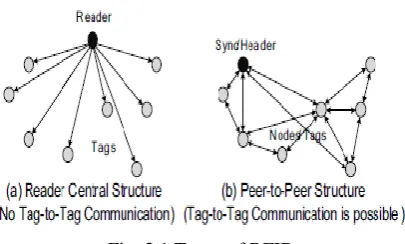
Active RFID/WSN will be performing the availability of tag-to-tag communication.
Active RFID is less advantage than passive due to its tags size, cost, battery management but less advantage in the form of sensing rate, stability, and sensing distance. Active RFID save the energy of tag operate on the tag ID period and data collection period. The active RFID tag uses the radio module to deliver the stored physical information to the reader.
RFID provides the point-to-multipoint (P2MP) Communication structure where the reader controls the tags. To reduce the energy consumption of the tag, the reader controls the energy that the radio module consumes by making the tag operate in the active and sleep periods. The reader transmits a collection command to multiple tags, which deliver the ID to the reader via contention. data collection period, the reader collects the data on the tags that are sensed from the tag ID collection period using their IDs, via the point-to-point(P2P) method.The active period is divided into the tag identification period and data collection period [10]. The id period is called contention period. A reader can be transmitting a command to multiple tag which also deliver id to reader via contention. In the data collection period, the reader collects the data on the tags that are sensed from the tag ID collection period using their IDs, via the point-to-point (P2P) method. Then the sleep command turns off the radio module of the tag from which the data have been collected. This is called the collection period (CP). The reader repeats this process until all the tags within its communication range are collected.
Fig. 3.1 Types of RFID
Vol. 4, Issue 3, March 2015
controls the communication of all the tags.The MAC of WSN has a peer-to-peer communication structure, wherein all nodes control their own communication processes. If all the nodes have to control their own communication processes in WSN, the communication channel must always be in the carrier sensing and the medium must be occupied via RTS/CTS. The occupation of the medium is only for the Tx and Rx nodes, and the rest cannot communicate. If the tags in the active RFID system use carrier sensing, all the tags must conduct carrier sensing as many times as the number of tags to transmit their IDs [12]. This creates tag collection delay, which is an additional source of energy consumption. This may lead to the loss of the basic characteristic of the RFID system that collects tags.
IV.PROPOSED METHODOLOGY
Firstly we deploy the sensor network with infinite sensor nodes. All the sensor nodes are grouped into clusters.According to the sensor nodes these clusters are formed. Each cluster has a cluster head.Cluster heads are chooses by election algorithm. A node in a cluster which has more resources and energy is selected for cluster head. All the nodes forward their data to cluster heads and cluster heads forward the data to their respective destinations. For transmission, route is discovered by AODV routing protocol. The path is established between source and destination. AODV routing protocol discover the virtual paths means dynamic paths. After the path discovered the transmission take place. All the sensor nodes should be synchronized to avoid the packet collision. A master node is deployed within sensor network that is synchronized with GPS. Master node gives the timing information to all sensor nodes so they all are synchronized to each other. By using this technique we will reduce packet collision using GPS system.
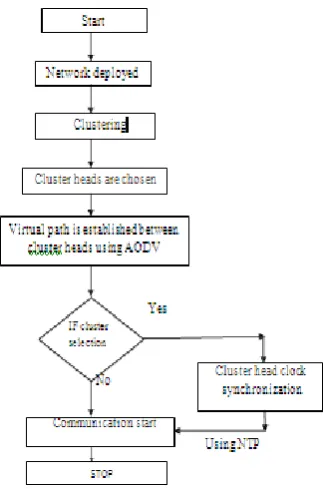
4.1 Flowchart
The flow chart of the proposed work is as given. First of all the sensor nodes are deployed in the fixed size area. Then the clustering of the sensor nodes is done. By using the bully algorithm the cluster head is selected means that node which has the highest energy that will be the cluster head.The virtual paths are selected between the cluster heads. The shortest path is selected by using the reactive AODV protocol. Here to avoid the collision the NTP protocol is used the clock is synchronized on each cluster head.
Vol. 4, Issue 3, March 2015
V.EXPERIMENTAL RESULTS
In the below figure, energy consumption of previous and new technique is shown. The red lines show the energy of previous technique. The green line shows the energy consumption in the new proposed technique. The clocks in the previous technique are not synchronized and fixed path are from source to destination. Due to these two reasons retransmission of the packet are required when packet loss is there in the network. In the new technique clocks are synchronized with master clock. The virtual is established between source and destination. The energy consumption is reduced as shown in red line. This graphs show that proposed technique is efficient than the existing technique.
Fig 5.1 Energy Graph
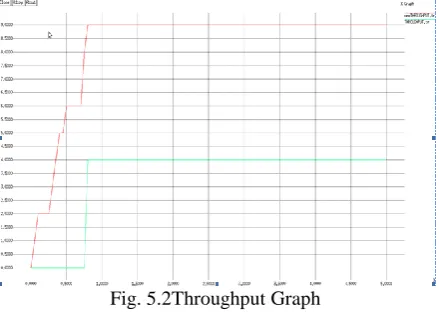
Throughput Graph: The figure illustrated the throughput of the new and previous technique. The green line shows the throughput of the network in previous technique.The throughput of the new technique is shown in red line.The efficiency of the network is enhanced with the clock synchronization.The throughput the network is enhanced through the use of new proposed technique because the packet loss in the network is reduced.
Fig. 5.2Throughput Graph
Vol. 4, Issue 3, March 2015
Fig 5.3 Packet Loss graph
Fig. 5.4 Data size
Data Size:Data size means amount of data send in bytes during transmission. In above figure green line shows data size of new proposed technique which less that than existing technique which is shown with red line in the graph. With new proposed technique data size decreases.
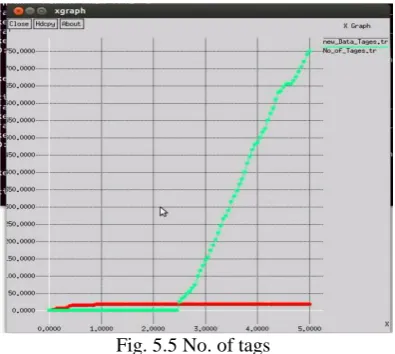
No. of tags:As illustrate in below figure 1.7,red line shows no. of tags in new proposed technique. Green line shows no. of tags of existing technique. It shows that proposed technique is better than existing technique.
Vol. 4, Issue 3, March 2015
VI.CONCLUSION
In wireless sensor networks there is a problem of energy consumption. First of all the sensor nodes are deployed in the fixed size area. Then the clustering of the sensor nodes is done. By using the bully algorithm the cluster head is selected means that node which has the highest energy that will be the cluster head. The virtual paths are selected between the cluster heads.
The shortest path is selected by using the reactive AODV protocol. Here to avoid the collision the NTP protocol is used the clock is synchronized on each cluster head. RFID is used for the channel sensing to avoid the collisions. The master node synchronizes the clock through the GPS (Global Positioning System). The packet loss is avoided by using this technique. Experimental results shows that new proposed methodology decreases packet loss, delay and data size which increases reliability of the network.
REFERENCES
[1] Chae-Seok Lee, Dong-Hyun Kim, and Jong-Deok Kim ” An Energy Efficient Active RFID Protocol to Avoid Overhearing Problem”, IEEE SENSORS JOURNAL, VOL. 14, NO. 1, JANUARY 2014
[2] Nicolas Gouvy,Essia Hamouda, Nathalie Mitton and Dimitrios Zorbas, ” Energy Efficient Multi-Flow Routing in Mobile Sensor Networks”IEEE,2013
[3] Lucas D. P. Mendes, Joel J. P. C. Rodrigues∗ , Athanasios V. Vasilakos , and Liang Zhou,“Lifetime Analysis of a Slotted ALOHA-based Wireless Sensor Network using a Cross-layer Frame Rate Adaptation Scheme”, IEEE, 2012
[4] Yu Cheng, Hongkun Li, Peng-jun Wan, Xinbing Wang “Wireless Mesh Network Capacity Achievable Over the CSMA/CA MAC” in IEEE Transaction on Vehicular Technology, September 2012.
[5] Jakob Salzmann, Ralf Behnke, Dirk Timmermann “Hex-MASCLE – Hexagon based Clustering with Self Healing Abilities” Wireless Communications and Networking Conference (WCNC), pp. 528-533, 2011 IEEE.
[6] Jia Xu,Ning Jin, Xizhong Lou,Ting Peng,Qian Zhou,Yanmin Chen “Improvement of LEACH protocol for WSN” International Conference on Fuzzy Systems and Knowledge discovery (FSKD), pp. 2174-2177, 2012 IEEE.
[7] Archana Bharathidasan, Vijay Anand Sai Ponduru “Sensor Networks: An Overview” Department of computer science, University of California, volume 2, Issue 2, march 2002.
[8] Bilal Abu Bakr, Leszek Lilie “A Quantitative Comparison of Energy Consumption and WSN Lifetime for LEACH and LEACH-SM” International Conference on Distributed Computing Systems Workshops, 2011 IEEE.
[9] Daniele Puccinelli and Martin Haenggi “ Sensor Networks: applications and challenges of ubiquitous sensing”, IEEE circuits and systems magazine, volume 5, Issue 3, pp.19-31,2005.
[10] Dahlila P. Dahnil, Yaswant P. Singh, Chin Kuan Ho “Energy-Efficient Cluster Formation in Heterogeneous Wireless Sensor Networks: A Comparative Study” ICACT, Feb. 2011.
[11] Narottam Chand, “Cooperative Data Caching in WSN”, World Academy of Science, Engineering and Technology 63 2012[12] Xu Li, Amiya Nayak, and Ivan Stojmenovic,” Sink Mobility in Wireless
Sensor Networks”,2003