133
A controller design using Fractional Order Sliding
Mode for Quadcopter
Om Veer Dhakad1
,
Asst. Prof. Vivek Kumar2Student at Amity institute of aerospace engineering1 , Amity University, Noida 1 Amity institute of aerospace engineering2 , Amity University, Noida 2
Email: [email protected] , [email protected] 2
Abstract-This paper incorporates design and synthesis of fractional order sliding mode-based controller for Quadcopter. The Quadcopter having six degrees of freedom is stabilized with respect to parametric uncertainty and provides the great robustness to the quadcopter under disturbances. In comparison to PI based controllers the transient behavior of FOSMC is improved and the impact of same will lead to reduce tracking response error. The designing of FOSMC controller proves it’s optimal and robust behavior that has reduced reachability time, improved transient response and high robustness to disturbances. The controller stability is test by lyapunov stability criteria. To reflect disturbance during simulation the parametric inputs are changed accordingly to check the converge of error sliding surface. The entire controller calculation is exhibited according to the error sliding surface which is based on variable structure dynamics. The controller is further tested through Simulink tool in MATLAB. The results show that FOSMC provide better execution with lower parametric sensitivity and strong withstanding towards parameter varieties and unsettling influences.
Index Terms-Sliding Mode Control, lyapunov stability criteria, Advance Control theory, Simulink MATLAB, Quadcopter (UAV).
1. INTRODUCTION
Quadcopter, also called Unmanned Aerial Vehicles (UAV), Quadrotor or Quadrotor Helicopter, is widely used in various fields, in both civilian markets and military. For external disturbances UAV is vulnerable, nonlinear and unstable. It introduces control dynamics where the vulnerabilities on variable dynamic driving and physical parameters as the automaton make it appealing and testing control issue. Distinctive techniques and systems have prescribed to control Quadcopter. The following methodologies used: [1] Fuzzy Logic (FL) control. [2] Linear quadratic regulator control (LQR). [1-4 ] Proportional Derivative Integral (PID) control.
SMC (Sliding Mode Control) is a clear generous framework which licenses arranging controllers for immediate and for non-linear strategies [6-8]. Sliding Mode Control has ended up being picked one answer for a few, valuable diagrams for control, for instance, equipment contraptions, mechanical self-governance, engineered systems [8, 9]. Sliding Mode Control involves in given two segments: immediately, a violated law control to actualize the misstep vector decision toward oversee, known as sliding surface, in the midst of the accomplishing stage. This section control the trading on a particular sliding surface side condition what's more, when the sliding surface is bound to the misstep vector, by the conditions depicting the sliding surface a corresponding bit of the
controller exhibitions to take after the movement constrained [6].
134 The target of this paper involves in arranging a
FOSMC and applying it by reenactment in a Quadcopter. For vertical take-off and landing (VTOL) plane an ERROR sliding surface is considered, similarly changes in points are done, and incorporate a few aggravations. As needs be, as the sliding surface the controller can be executed utilizing an ERROR controller and including some factor based math the whole controller count is shown on the grounds that: The FOSMC is used to expel structure vulnerabilities and lessen the span of control prattling. . Diverged from customary entire number demand sliding mode control, the high-repeat jabbering of the control information can be made to drastically demoralize. FOSMC is pertinent for both input single-output system and a normal multi-input multi-single-output structure Global quality of the close circle control system can be deductively shown using Lyapunov security theory while Sliding mode control (SMC) any straight sliding surface can guarantee the asymptotic soundness and needed execution of the close circle control structures. Regardless, dull trading input control get causes the settling time of the close circle control system to extend, suggesting that the structure state can't accomplish the adjust point in a constrained time. Furthermore, SMC offers high-repeat chattering of control input, which prompts undesirable loads on control actuators.
The paper is classified as. In Section II Dynamics of Quadcopter, Section IV Fractional order control design, Section V Fractional calculations, Section VI Results, Section VII conclusions
2. DYNAMICS OF QUADCOPTER
Fig. 1, Quadcopter dynamics and axes system
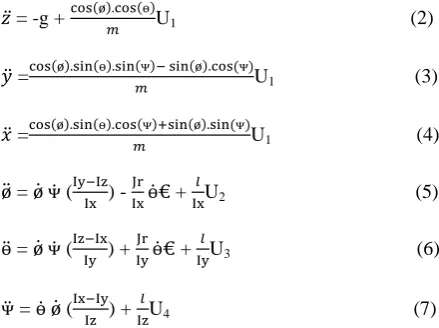
The dynamics and working of the Quadcopter is shown above. The motion equations are;
The Quadcopter has twelve equations of motions, which are following:
X=[x ̇y ̇z ̇ø ̇ɵ ̇ᴪ ̇] (1)
Where, ̇ ̇and ̇are the speed in the x, y, and z axes. ̇ ̇ ̇ Parameters are the Speed for roll, pitch and yaw. x, y and z are the location in the x, y, and z axes. Ø, ᴪ and ɵ are the roll, yaw and pitch angles
̈ = -g + ( ) ( )U1 (2)
̈ = ( ) ( ) ( ) ( ) ( )U1 (3)
̈ = ( ) ( ) ( ) ( ) ( )U1 (4)
̈ = ̇ ̇ (
) -
̇ + U2 (5)
̈ = ̇ ̇ (
) +
̇ + U3 (6)
̈ = ̇ ̇ (
) + U4 (7)
Where, Ix, Iy and Iz are the inertia of the Quadcopter in 'x', 'y' and 'z' individually, Jr is the inertia of the quadcopter and m is the mass of the quadcopter, The info flag U1is the aggregate drag of the copters.U2, U3 and U4 Are the moments for pitch, roll and yaw separately.
3. FRACTIONAL ORDER CONTROL DESIGN
135 Four control conditions are utilized to keep the
quadcopter on the reference an incentive notwithstanding outer aggravations. The flag U1 is utilized to ensure that the elevation takes after the reference esteem, in spite of the fact that the signs U2, U3 and U4 are utilized for control movement, pitch and yaw of the structure. Looking conditions (2-7), we have four input control signals. The action of these data signals makes the quadcopter moves advances, backward, to the other side, to the other side, upwards or down.
As specified some time recently, the sliding surface or choice manage must be chosen. This choice is made in view of execution criteria, because of the sliding surface condition decides the flow of framework. Thus, it will be:
s= ė + λRL Dα-1(sign (e) r) (8)
Where, λ is a tuning design parameter λ > 0.
And sign represents signum function which means for any parameter x is
Signum(x) = {
Taking derivative of equation (12)
ṡ= ë + λRL Dα (sign (e) r) (9)
But, ë = ̈d - ̈ , therefore
ṡ= ( ̈d - ̈ ) + λRL Dα (sign (e) r) (10)
And ṡ = -k sign(s)
Where, k > 0, which gives ṡ ≤ 0 at any value of s, which means system is stable.
Now putting the value of ṡ and ̈ in equation (14)
-k sign(s) = ̈d +g -
( ) ( )
U1 + λRL Dα (sign (e) r)
(11) Rearranging the terms to calculate value of U1
Therefore,
U1= ( ) ( )( ̈d +g + k sign(s) + λRL D α
(sign (e) r)) (12) Similarly from rest of the equations, the values of U2,
U3 and U4 can be determined.
The equations for input signals are given below;
U1 = p (€1 point of the Quadcopter and p is the drag factor. Now from the equations (17), (18), (19) and (20) the €
W is taken as Lyapunov Function which should be positive for stability, now by using error sliding surface “s”
W = s2
This means W > 0, due to square term of sliding surface.
Now, according to the stability criteria ̇ should be negative
̇ = s ̇
= s (-k sign(s))
Where k > 0 for t > 0, this means ̇ < 0 This satisfies the Lyapunov Stability.
4. FRACTIONAL CALCULATIONS
Fractional investigation has been known since the change of the entire number request math, however for a long time, it is assumed as a sole numerical issue. In late decades, fractional examination has transformed into an intriguing subject among systems examinations and control fields.
4.1.Mathematical Analysis of fractional
calculus
136
Dλ aDtλ = {
( )
( ) ∫ ( ) ( )
Where λ is known as order of the system, and the value of λ∈Q, Q is rational numbers and the value of
λ can be in the form of x + i y (complex number), t
and a are the upper and lower limits of the system respectively.
There are two definitions mostly used for fractional integration and differentiation is the Riemann-Liouville (RL) and the Grunwald-Letnikov (GL). The RL definition can be written as
aDtλ f(t) =
( ) ∫ ( ) ( )
Where, the value of λ lies between, n − 1 < λ < n. The GL can be written as-
aDtλ f(t) = ∑ ( )( ) ( )
Now taking the Laplace transformation for fractional-order λ of RL definition and with zero initial condition is given by
L {aDtλ f (t)} = s λ F(s)
Since, the Laplace transform of the function f (t) is
F(s).
Unmistakably, the number of degrees of freedom (DOF) of fractional-order administrator is greater than the whole number order. The superior execution can be acquired by taking best possible decision of order.
4.2. Fractional Differentiator Approximation
This area introduces the Oustaloups recursive estimate calculation. The calculation is utilized to understand the non-number integrator and differentiator squares of FOSMC (Dαand Dα-1). Thus, it will approximate a transfer function form of
H(s) = sr, r ∈[−1, 1], r ∈Q
Now in form of rational transfer function
̂ (s)= C0 ∏ (
)
The frequency range of b < < h, on the basis of
the given algorithm, the parameters which are unknowns of rotational transformation ̂ (s) (i.e., C0, k, and ’k) can be found out by taking recursive
dispersion of complex poles and zeros described by complex recursive components
k = b(
̅̅̅̅)
( )
’k = b(
̅̅̅̅)
( )
C0 = (
̅̅̅̅) ∏ ( )
Where, the order of ̂(s) is 1+2N. For e.g. the fractional differentiator H(s) = s1/2 is the 5-th order approximation, between the range of frequency from
b= 10−4 rad/s to h= 104 rad/s is
̂(s)=
5. RESULTS
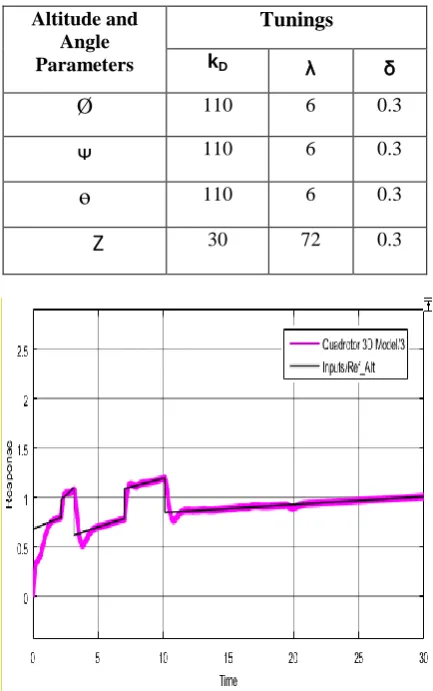
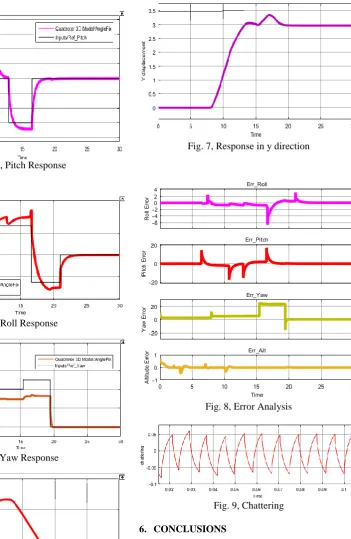
This section demonstrates the execution of FOSMC (ERROR) controller. The following pictures displays the behavior of framework to various set focuses, for example, elevation, points ѱ, ɵ and ϕ. Additionally the framework execution is tried to unsettling influences. The FOSMC controller execution for height attain by the quadcopter, Fig. 2. shows the given outcome. Tuning parameters for controller are
Altitude and Angle Parameters
Tunings
kD λ δ
Ø
110 6 0.3ᴪ
110 6 0.3ɵ
110 6 0.3
Z
30 72 0.3137 Fig. 4, Roll Response
Fig. 5, Yaw Response
Fig. 6, Response in x direction
Fig. 7, Response in y direction
Fig. 8, Error Analysis
Fig. 9, Chattering
6. CONCLUSIONS
138 better execution with little control prattling, yet in
addition strong notwithstanding outer load unsettling influence and parameter varieties. FOSMC controller is optimal and robust controller which has reachability time very less, transient response very fast and removes minor disturbances. As shown in error analysis graphs that all the error tending to zero within finite time, it made error sliding surface to converge smoothly the surface is stable and error is converging proved by Lyapunov Stability.
REFERENCES
1. Deepak Gautam and Cheolkeun Ha. Control of a Quadcopter Smart Self-Tuning Fuzzy Controller Control of a Quadcopter Using a Smart Self-Tuning Fuzzy PID Controller. International Journal of Advanced Robotic Systems. Int. j. adv. robot. syst., 2013, Vol. 10, 380:2013
2. Samir Bouabdallah. "Design and control of quad rotors with application to autonomous flying". Ph.D. Thesis. École Polytechnique Federale de Lausanne. 2007.
3. G. Szafranski, R. Czyba. Different Approaches of PID Control UAV Type Quadcopter. Proceedings of the International Micro Air Vehicles conference 2011 summer edition
4. Lucas M. Argentim, Willian C. Rezende, Paulo E. Santos, Renato A. Aguiar. PID, LQR And LQR-PID On A Quadcopter Platform.
5. C Balas. Modelling and Linear Control of a Quadcopter. MSc Thesis. Cranfield University. School Of Engineering. Academic year 2006-2007
6. Mohd Ariffanan Mohd Basri, Abdul Rashid Husain, Kumeresan A. Danapalasingam . Robust Chattering Free Backstepping Sliding Mode Control Strategy for Autonomous Quadcopter Helicopter. International Journal of Mechanical & Mechatronics Engineering.Vol:14 No. 03, 2014.
7. Camacho, O., Rojas, R., 2000, “A General Sliding Mode
Controller for Nonlinear Chemical Processes”, ASME Transactions, Journal of Dynamic Systems, Measurement and Control, pp 650-655.
8. Zinober, A. S. I., (1994). Variable Structure And Liapunov Control, Spring – Verlag, London.
9. Slotine, J.J., and W. Li, (1991), Applied Nonlinear Control, Prentice-Hall, New Jersey.
10. Utkin, V. I., (1977), “Variable Structure Systems With Sliding Modes”, Transactions of IEEE on Automatic Control, AC – 22, pp. 212 – 222.
11. Abderrahmane KACIMI, Abdellah
MOKHTARI, Benatman KOUADRI. Sliding Mode Control Based on Adaptive Backstepping Approch for a Quadcopter Unmanned Aerial Vehicle. Przegl ˛ad Elektrotechniczny (Electrical Review), ISSN 0033-2097, R. 88 NR 6/2012.
12. H. Bouadi, M. Bouchoucha, and M. Tadjine. Sliding Mode Control based on Backstepping Approach for an UAV Type-Quadcopter. World Academy of Science, Engineering. 13. Benallegue,y A. Mokhtari and L. Fridman.
High-Order Sliding-Mode Observer For A Quadcopter UAV. International Journal Of Robust And Nonlinear Control (in press). 14. Nader Jamali Soufi Amlashi, Mohammad
Rezaei, Hossein Bolandi and Ali Khaki Sedigh. Robust Second Order Sliding Mode Control For A Quadcopter Considering Motor Dynamics. International Journal of Control Theory and Computer Modeling. Vol.4, No.1/2, April 2014.
15. Swarup and Sudhir. Comparison of Quadcopter Performance Using Backstepping and Sliding Mode Control. Proceedings of the 2014 International Conference on Circuits, Systems and Control. and Technology International Journal of Mechanical, Aerospace, Industrial and Mechatronics Engineering Vol:1 No:2, 2007 16. Hakim Bouadi, Sebasti~ao Simoes Cunha,
Antoine Drouin, Felix Mora-Camino. Adaptive Sliding Mode Control For Quadcopter Attitude Stabilization And Altitude Tracking. CINTI 2011, IEEE 12th International Symposium on Computational Intelligence and Informatics, Nov 2011, Budapest, Hungary. pp 449 – 455.
17. M’hammed GUISSER and Hicham