ISSN Online: 2160-8849 ISSN Print: 2160-8830
DOI: 10.4236/ajor.2019.93006 May 21, 2019 109 American Journal of Operations Research
Duality in Solving Multi-Objective Optimization
(MOO) Problems
Chandra Sen
Department of Agricultural Economics, Institute of Agricultural Sciences, Banaras Hindu University, Varanasi, India
Abstract
Multi-Objective Optimization (MOO) techniques often achieve the combina-tion of both maximizacombina-tion and minimizacombina-tion objectives. The study suggests scalarizing the multi-objective functions simpler using duality. An example of four objective functions has been solved using duality with satisfactory results.
Keywords
Duality, Multi-Objective Optimization (MOO), Scalarizing Techniques
1. Introduction
Multi-Objective Optimization helps in making decisions in presence of usually conflicting objectives. Scalarizing techniques have been popularly used for solv-ing multi-objective optimization problems. Several new scalarizsolv-ing techniques
[1]-[11] have been proposed during recent years. These scalarizing techniques are not efficient [12] [13] in optimizing the multiple objectives simultaneously. An improved scalarizing technique is proposed for solving MOO problems. Du-ality can be used to formulate the multi-objective function easier. The present study explains the utility of duality in solving multi-objective optimization problem with a suitable example.
2. Sen’s Multi-Objective Optimization Technique
2.1. Primal Multi-Objective Function
The mathematical form of Sen’s MOO technique [12] [13] is described as: Optimize Z =
[
Max. ,Max. , ,Max. ,Min.Z1 Z2 Zr Zr+1, ,Min. Zs]
Subject to:
AX b= and X ≥0
How to cite this paper: Sen, C. (2019) Duality in Solving Multi-Objective Optimi-zation (MOO) Problems. American Journal of Operations Research, 9, 109-113.
https://doi.org/10.4236/ajor.2019.93006
Received: April 20, 2019 Accepted: May 18, 2019 Published: May 21, 2019
Copyright © 2019 by author(s) and Scientific Research Publishing Inc. This work is licensed under the Creative Commons Attribution International License (CC BY 4.0).
DOI: 10.4236/ajor.2019.93006 110 American Journal of Operations Research The individual optima are obtained by optimizing each objective separately as:
[
1]
optima , , ,2 s
Z = θ θ θ
The Primal Multi-Objective Function is formulated as:
Maximize 1 1
1
r s
j j
j j r
r j Z Z Z
θ
θ
= = + + =∑
−∑
Subject to:AX b= and X ≥0
0
j
θ ≠ for j=1,2, , s.
where, θj is the optimal value of jth objective function.
2.2. Dual Multi-Objective Function
All the objective functions are converted into either maximizing or minimizing form as described below:
Maximize Zj or Minimize Zj
Subject to:
AX b= and X ≥0
The minimization objective function can be converted into maximization ob-jective function by multiplying −1. Similarly the maximization obob-jective can be converted into minimization objective function by multiplying −1. The Multi-Objective Function is formulated as:
Maximize 1
s j j j Z Z
θ
= =∑
orMinimize 1
s j j j Z Z
θ
= =∑
Subject to:AX b= and X ≥0
0
j
θ ≠ for j=1,2, , s.
where, θj is the optimal value of jth objective function.
3. Algorithm of Proposed Technique
Step I: Convert all the objective functions either maximization of minimiza-tion mode.
Step II: Formulate multi-objective function as explained in 2.2
Step III: Optimize the multi-objective function under the same constraints.
4. Multi-Objective Optimization Problem
DOI: 10.4236/ajor.2019.93006 111 American Journal of Operations Research
1 1 2 3 4 5
Max.Z =12500X +25100X +16700X +23300X +20200X
2 1 2 3 4 5
Max.Z =21X +15X +13X +17X +11X
3 1 2 3 4 5
Min.Z =370X +280X +350X +270X +240X
4 1 2 3 4 5
Min.Z =1930X +1790X +1520X +1690X +1720X Subject to:
1 2 3 4 5 4.5
X +X +X +X +X =
1 2X ≥1.0
4 3X ≥1.5
The above problem can be converted with all the four objective functions ei-ther maximization of minimization mode as detailed below:
1 1 2 3 4 5
Max.Z =12500X +25100X +16700X +23300X +20200X
2 1 2 3 4 5
Max. 21Z = X +15X +13X +17X +11X
3 1 2 3 4 5
Max. 370Z = − X −280X −350X −270X −240X
4 1 2 3 4 5
Max. 1930Z = − X −1790X −1520X −1690X −1720X or
1 1 2 3 4 5
Min. 12500Z = − X −25100X −16700X −23300X −20200X
2 1 2 3 4 5
Min. 21Z = − X −15X −13X −17X −11X
3 1 2 3 4 5
Min. 370Z = X +280X +350X +270X +240X
4 1 2 3 4 5
Min. 1930Z = X +1790X +1520X +1690X +1720X
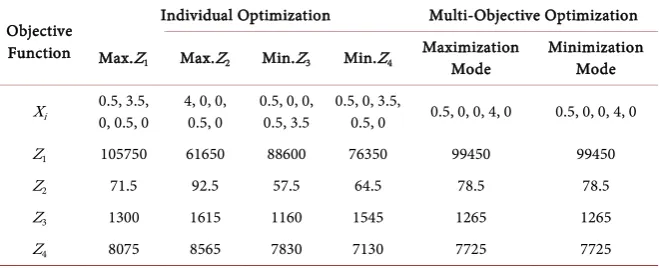
The problem was solved with multi-objective function of both maximization and minimization mode. It is very clear from Table 1 that all the four individual optimizations are all different and do not achieve all the objectives simultane-ously.
[image:3.595.209.539.587.721.2]This necessitates the need of multi-objective optimization. Both the solutions of multi-objective optimization are exactly the same and achieving all the four objectives simultaneously. Hence the multi-objective optimization problems can be solved by formulating multi-objective function after converting all the objec-tive functions in either maximizing or minimizing mode.
Table 1. Individual and multi-objective optimization.
Objective Function
Individual Optimization Multi-Objective Optimization
Max.Z1 Max.Z2 Min.Z3 Min.Z4 Maximization Mode Minimization Mode
Xi 0.5, 3.5, 0, 0.5, 0 4, 0, 0, 0.5, 0 0.5, 0, 0, 0.5, 3.5 0.5, 0, 3.5, 0.5, 0 0.5, 0, 0, 4, 0 0.5, 0, 0, 4, 0
Z1 105750 61650 88600 76350 99450 99450
Z2 71.5 92.5 57.5 64.5 78.5 78.5
Z3 1300 1615 1160 1545 1265 1265
DOI: 10.4236/ajor.2019.93006 112 American Journal of Operations Research
5. Conclusion
One of the important advantages of the duality theory is presented in the paper for solving MOO problems. It is established that duality makes easier the formulation of multi-objective function. However, it is needed only when optimization is done for a set of both maximization and minimization objective functions.
Conflicts of Interest
The author declares no conflicts of interest regarding the publication of this pa-per.
References
[1] Sulaiman, N.A. and Hamadameen, A.-Q.O. (2008) Optimal Transformation Tech-nique to Solve Multi-Objective Linear Programming Problem (MOLPP). Journal of Kirkuk University Scientific Studies, 3, 158-168.
[2] Suleiman, N.A. and Nawkhass, M.A. (2013) Transforming and Solving Mul-ti-Objective Quadratic Fractional Programming Problems by Optimal Average of Maximin & Minimax Techniques. American Journal of Operational Research, 3, 92-98.
[3] Sulaiman, N.A. and Mustafa, R.B. (2016) Using Harmonic Mean to Solve Multi-Objective Linear Programming Problems. American Journal of Operations Research, 6, 25-30. https://doi.org/10.4236/ajor.2016.61004
[4] Sulaiman, N.A. and Mustafa, R.B. (2016) Transform Extreme Point Multi-Objective Linear Programming Problem to Extreme Point Single Objective Linear Program-ming Problem by Using Harmonic Mean. Applied Mathematics, 6, 95-99.
[5] Huma, A., Geeta, M. and Sushma, D. (2017) Transforming and Optimizing Multi-Objective Quadratic Fractional Programming Problem. International Journal of Statistics and Applied Mathematics, 2, 01-05.
[6] Nahar, S. and Alim, A. (2017) A New Statistical Averaging Method to Solve Multi-Objective Linear Programming Problem. International Journal of Science and Research, 6, 623-629.
[7] Huma, A., Modi, G. and Duraphe, S. (2017) An Appropriate Approach for Trans-forming and Optimizing Multi-Objective Quadratic Fractional Programming Prob-lem. International Journal of Mathematics Trends and Technology,50, 80-83. https://doi.org/10.14445/22315373/IJMTT-V50P511
[8] Nawkhass, M.A. and Birdawod, H.Q. (2017) Transformed and Solving Multi-Objective Linear Programming Problems to Single-Objective by Using Cor-relation Technique. Cihan International Journal of Social Science, 1, 30-36. [9] Akhtar, H. and Modi, G. (2017) An Approach for Solving Multi-Objective
Frac-tional Programming Problem and It’s Comparison with Other Techniques. Interna-tional Journal of Scientific and Innovative Mathematical Research, 5, 1-5.
https://doi.org/10.20431/2347-3142.0511001
[10] Nahar, S. and Alim, A. (2017) A New Geometric Average Technique to Solve Multi-Objective Linear Fractional Programming Problem and Comparison with New Arithmetic Average Technique. IOSR Journal of Mathematics (IOSR-JM), 13, 39-52. https://doi.org/10.9790/5728-1303013952
DOI: 10.4236/ajor.2019.93006 113 American Journal of Operations Research Solving Multi-Objective Linear Programming Problem Using Various Kinds of Mean Techniques. Mathematics Letters, 4, 25-33.
https://doi.org/10.11648/j.ml.20180402.11
[12] Sen, C. (2018) Multi Objective Optimization Techniques: Misconceptions and Clarifications. International Journal of Scientific and Innovative Mathematical Re-search, 6, 29-33.