ISSN Online: 2327-5960 ISSN Print: 2327-5952
DOI: 10.4236/jss.2019.75016 May 24, 2019 201 Open Journal of Social Sciences
A Flipped Classroom Designed for the Teaching
of “Network Equipment Configuration and
Management”
Fang Hu
*, Xiao Cai, Xinyu Zhang
Sichuan Staff University of Science and Technology, Chengdu, China
Abstract
To improve the teaching efficiency and quality, we have introduced the flipped classroom to the “network equipment configuration and manage-ment” course. This paper describes in detail the various stages of this teaching mode. A case in our school demonstrates that the flipped classroom which is based on micro course encourages the students to learn in a more active way and improves the teaching quality, thereby effectively solving the obstacles encountered in traditional teaching such as insufficient class hours and inte-raction. This teaching mode enables the course to adapt to the college stu-dents’ learning characters, which are personalized and differentiated.
Keywords
Flipped Classroom, Microlecture
1. Introduction
1.1. Course Information
“Network equipment configuration and management” is a core course for stu-dents who major in computer network technology in our school. The class ar-rangement is quite tight due to plenty of course key points which including the common network equipment introduction, the concept and working principle, the basic and advanced configuration (such as VLAN partition, ACL, NAT, RIP, OSPF, etc.), daily management and maintenance. Students are required to be able to master each key point and manage equipment independently.
1.2. Students Information
We selected 40 students majoring in network technology from the department of How to cite this paper: Hu, F., Cai, X. and
Zhang, X.Y. (2019) A Flipped Classroom Designed for the Teaching of “Network Equipment Configuration and Management”. Open Journal of Social Sciences, 7, 201-208. https://doi.org/10.4236/jss.2019.75016
Received: April 28, 2019 Accepted: May 21, 2019 Published: May 24, 2019
Copyright © 2019 by author(s) and Scientific Research Publishing Inc. This work is licensed under the Creative Commons Attribution International License (CC BY 4.0).
DOI: 10.4236/jss.2019.75016 202 Open Journal of Social Sciences information engineering to participate in the flipped classroom. All students come from Tibet. They are eager to learn, polite, good at singing and dancing, adept at practical ability, but they lack a solid knowledge structure, and therefore have difficulty grasping the essence of course, not to mention applying the learned knowledge [1]. These students are less likely to use online courses for independent learning, and lack necessary information technology capability. Good information technology understanding, learning ability and advanced critical thinking can be cultivated using the flipped classroom.
2. Concepts
2.1. The Flipped Classroom
A flipped classroom is an instructional strategy and a type of blended learning that reverses the traditional learning environment by delivering instructional content, often online, outside of the classroom. It moves activities, including those that may have traditionally been considered homework, into the class-room. In a flipped classroom, students watch online lectures, collaborate in on-line discussions, or carry out research at home while engaging in concepts in the classroom with the guidance of a mentor. The flipped classroom intentionally shifts instruction to a learner-centered model in which class time explores topics in greater depth and creates meaningful learning opportunities, while educa-tional technologies such as online videos are used to “deliver content” outside of the classroom. In a flipped classroom, “content delivery” may take a variety of forms. Often, video lessons prepared by the teacher or third parties are used to deliver content, although online collaborative discussions, digital research, and text readings may be used. It has been shown that the ideal length of the video lesson to be is eight to twelve minutes [2][3][4].
2.2. Microlecture
The term microlecture is not used here to refer to microcontent for microlearn-ing, but to actual instructional content that is formatted for online and mobile learning using a constructivist approach. David M. Penrose (aka the One Minute Professor), an independent instructional designer and eLearning consultant, has articulated the process for creating these microlectures. As stated by [5], these specific lectures are combined with specific activities designed to promote the epistemic engagement of the learner.
2.3. Feasibility of This Mode
Involved forty students have been enrolled for one semester. They are very fa-miliar with each other and cooperate well with teachers in class. The teachers have rich teaching experience, and are adept at all kinds of teaching-auxiliary materials, which provide great help for the design and production of micro courses and the teaching practice of flipped classroom.
DOI: 10.4236/jss.2019.75016 203 Open Journal of Social Sciences very rich, and it is relatively easy to find a case as the object of analysis and dis-cussion, which can provoke students’ learning interest, enabling active learning of students.
3. Preliminary Class Design
3.1. Class Contents
There are abundant teaching contents in this course, and the combination of theory and practice is extraordinarily tight. In accordance with the fact that Ti-betan students generally have a weak learning foundation, we have optimized the teaching schedule. We focus primarily on the basic working principles and configuration of switches and routers, and emphasize the common functions of switches and routers utilized in small to medium enterprises. After simplifying the teaching content, we direct the students to learn in a targeted way, making them concentrate on more practical key points and avoiding the complex con-tents. Cisco Packet Tracer 6.2 is used as network simulation program in experi-mental teaching. Cisco Packet Tracer is a powerful network simulation platform inspiring student to experiment with network behavior and ask “what if” ques-tions. It supplements physical equipment in the classroom by allowing students to create a network with an almost unlimited number of devices, encouraging practice, discovery and troubleshooting.
3.2. Production of Microlecture
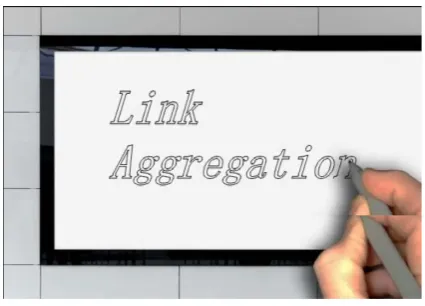
Easy Sketch Pro 3 is adopted as the tool to produce our microlectures. While there are many video products and services available, very few rival Easy Sketch Pro for its ease of use and “drag ‘n’ drop” ability to create Sketch Videos. Its fea-tures include the transition from sketch to live video intros and uploading of us-er’s own music background as well as images. The Camtasia studio 8 is used as the screen recorder and video editor.
3.3. Study Groups
The scientific organization of study groups is the basis of cooperative learning. The dividing principle is that a group should contain students with distinctive and different characteristics and similarity should be observed between any two groups. After understanding each student’s learning ability and personality, the teacher determines the allocation and the group leader. These students are di-vided into 5 groups.
3.4. Class Design
3.4.1. Pre-Class Preparation
DOI: 10.4236/jss.2019.75016 204 Open Journal of Social Sciences
Figure 1. Videos made by easy sketch Pro 3.
each knowledge-point. The Cisco Packet Tracer is used to simulate the network environment to complete the hands-on requirements of the case, and the de-tailed operation is recorded on the screen (see Figure 2).
2) Study materials and documents including teaching courseware, experi-mental manuals, students’ learning task list, test questions and auxiliary mate-rials for students’ self-learning are well prepared.
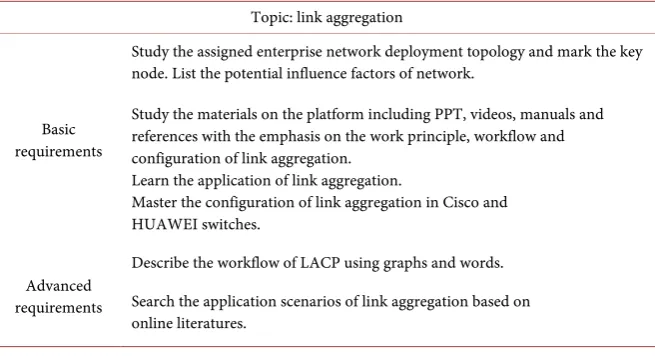
3) Design the learning tasks (for example, the link aggregation task list is shown in Table 1). The task list contains learning contents, learning objectives, knowledge points, watching teaching video (explaining video and operating video), recording difficult points, completing an experiment, completing tests and summarizing.
4) When providing students with all kinds of learning resources that they need, different difficulty levels are set for the key contents, such as basic level, advanced level, extended level, etc. When learning before class, students can look for courseware, videos and other materials suitable for their needs in the learn-ing resource database.
3.4.2. Self-Learning
After receiving the assigned tasks, students can watch the teaching videos up-loaded by teachers anytime and anywhere through the online teaching platform. If students have any questions, they can communicate and discuss with others in the discussion area of the online learning platform. After the completion of re-levant knowledge learning, the test will be carried out on the platform, and the difficult points will be submitted to the teacher. In this stage, teachers regularly answer questions online to provide help for students. Students are encouraged to answer each other’s questions, and bonus points are awarded to those who pro-vide correct answers. At the same time, we also set up a class supervision me-chanism, in which the group leader is responsible for supervising and urging the students to complete the learning tasks, and timely feedback the completion in-formation to the teacher.
DOI: 10.4236/jss.2019.75016 205 Open Journal of Social Sciences (a)
[image:5.595.207.537.71.610.2](b) Figure 2. Videos recorded by the Camtasia studio 8.
DOI: 10.4236/jss.2019.75016 206 Open Journal of Social Sciences
Table 1. Link aggregation task list.
Topic: link aggregation
Basic requirements
Study the assigned enterprise network deployment topology and mark the key node. List the potential influence factors of network.
Study the materials on the platform including PPT, videos, manuals and references with the emphasis on the work principle, workflow and configuration of link aggregation.
Learn the application of link aggregation.
Master the configuration of link aggregation in Cisco and HUAWEI switches.
Advanced requirements
Describe the workflow of LACP using graphs and words.
Search the application scenarios of link aggregation based on online literatures.
3.5. Class Activities
1) Students raise questions and teachers participate in the exploration with students. First, students discuss the pre-class test in groups. The teacher inte-grates the difficult points recorded by the students before class, the discussion hotspots on the network platform, and the key points of the knowledge of this module, extracts the most important ones, and discusses and solves the prob-lems together with the students.
2) Students practice under the guidance of teachers. The teacher divides the project function into several sub-tasks and assigns them to the students. Teach-ers are devoted to guiding students to find solutions to problems, and gradually make them think independently. In this stage, students with insufficient learning ability will be individually tutored to maximize the teaching effect, so as to en-sure that students do not fall behind.
3) Students summarize the class followed by the teachers’ comments. Stu-dents summarize the project function learned in the class. They may demon-strate and explain their fruits by group, sharing ideas and methods to solve problems, expanding their thinks, and promoting learning atmosphere. The teachers then deliver the conclusion remarks and explain the common faults made by beginners.
3.6. Evaluation and Summary
Students summarize the whole learning process, and submit their work and take after-class test, based on which teachers make a preliminary evaluation.
DOI: 10.4236/jss.2019.75016 207 Open Journal of Social Sciences
4. Feedback of the Flipped Classroom
4.1. Effect
The implementation of flipped classroom teaching mode in the course of net-work equipment configuration and management has achieved a series of results. First, flipped classroom requires students to learn theoretical knowledge and complete experiments by themselves before class. Students are in a leading posi-tion in class and they are transformed from passive learning to active learning, which evokes students’ enthusiasm. Second, in view of the teacher’s questions and actual case studies, students need to actively discuss with team members in-cluding determine how to solve the problem and the specific solutions, which can develop the students’ ability of expression, promote the sense of coopera-tion, cultivate critical thinking, and improve the practice ability. Third, the role of the teacher is changed to a director. In class, there is no need to explain the theory too much, and the focus is on the organization of discussions, which is conducive to the improvement of the teacher’s organizational ability. Finally, this teaching mode solves the different requirements of students with different computer levels and teaches students in accordance with their aptitude to a greater extent.
4.2. Problems
In the process of implementing the flipped classroom teaching mode, we also meet with some potential problems. First, subjectively speaking, students gener-ally do not have good self-study habits, and the effect of pre-class work cannot be guaranteed, so their classroom discussion is not active, which affects the effect of flipped classroom to a certain extent. On the other hand, teachers lack expe-rience in organizing class discussions. This requires teachers to study the design and organization of classroom discussion, fully mobilizing the enthusiasm of students. Second, the form of micro courses is relatively simple, lacking of inte-raction, and the amount of test questions is limited. In a big class, the teacher is more difficult to organize, and some students are lazy to think, affecting the teaching effect. Third, all the teaching materials, tests, questionnaires and Q&A feedback in this study are conducted on the school’s online teaching platform. The teaching platform’s self-test questions lack the support of operation ques-tions, and the questionnaire analysis and evaluation method is relatively simple.
5. Conclusion Remarks
DOI: 10.4236/jss.2019.75016 208 Open Journal of Social Sciences
Conflicts of Interest
The authors declare no conflicts of interest regarding the publication of this pa-per.
Supported
This work is supported by the teaching reform project of Sichuan Staff Univer-sity of Science and Technology (Project Number: kzd2018007).
References
[1] Wu, Y. (2012) Analysis of Examination Achievements of Tibetan “9 + 3” Students Majoring in Nursing Specialty. The Science Education Article Collects, No. 2, 141-142. (In Chinese)
[2] Cobb, W. and Wendy, N. (2016) Turning the Classroom Upside Down: Experi-menting with the Flipped Classroom in American Government. Journal of Political Science Education, 12, 1-14. https://doi.org/10.1080/15512169.2015.1063437
[3] Murthy, S. and Naraharisetty, P. (2011) Investigating the Effectiveness of Non-Interactive Video-Based Lectures in e-Learning—Case Study at Master of Science in Informa-tion Technology (MSIT) Program. Journal of Neurochemistry, 61, 979-986.
https://doi.org/10.1109/T4E.2011.31
[4] Herreid, C.F. and Schiller, N.A. (2013) Case Study: Case Studies and the Flipped Classroom. Journal of College Science Teaching, 42, 62-67.