Themed Section : Engineering and Technology
Energy Conservation and Intrusion Detection in Wireless
Sensor Network Using Anaomaly Based Technique on Real
Time Network Traffic
Prof. Ayushi Jaiswal, Ritika Choubey
Shri Ram Institute of Science and Technology, Jabalpur Madhya Pradesh, India
ABSTRACT
This paper will look at the nature and structure of wireless sensor network attacks and the tools, actions and processes that can be used to identify and respond to such attacks. A brief overview examining the anatomy of an attack and the creation of botnets will be presented and the motivation that drives such on-line malicious activity, the type of tools that are used in modern attacks, which is behind these and the impact they have will be discussed. Identifying attack streams and understanding the nature of TCP/IP traffic will be discussed through the use of Wireshark and their operation and contribution to combating malicious network activity will be considered. As a practical, hands-on exercises, participants will be able to simulate a network attack and response scenario by trying to penetrate a remote network while at the same time protecting their own network from attack. This will be done using the tools and techniques discussed earlier and by remotely accessing a real wireless sensor network (WSN) running in the NS-3 Simulator.
Keywords : WSN, NS-3, TCP/IP, Wireshark
I.
INTRODUCTIONInternet is forcing organizations into an era of open and trusted communications. This openness at the same time brings its share of vulnerabilities and problems such as financial losses, damage to reputation, maintaining availability of services, protecting the personal and customer data and many more, pushing both enterprises and service providers to take steps to guard their valuable data from intruders, hackers and insiders. Intrusion Detection System has become the fundamental need for the successful content networking.
IDS provide two primary benefits: Visibility and
Control [1]. It is the combination of these two benefits that makes it possible to create and enforce an enterprise security policy to make the
private computer network secure. Visibility is the ability to see and understand the nature of the traffic on the network while Control is the ability to affect network traffic including access to the network or parts thereof. Visibility is paramount to decision making and makes it possible to create a security policy based on quantifiable, real world data. Control is key to enforcement and makes it possible to enforce compliance with security policy.
1.1. TYPES OF IDS
Depending upon the level of analysis IDS is classified into two major types:
Monitors and analyzes the individual packets passing around a network for detecting attacks or malicious activities happening in a network that are designed to be overlooked by a firewall‟s simplistic filtering rules.
Host based IDS (HIDS):
Examines the activity on individual computer or host on which the IDS is installed. The activities include login attempts, process schedules, system files integrity checking system call tracing etc. Sometimes two kinds of IDS are combined together to form a Hybrid IDS.
II.
REALTED WOK2.1. ANOMALY DETECTION
PRE-PROCESSOR
This module helps to detect network based intrusions which manifests in abnormal network behaviour. It runs in two phases, learning (Training) mode and detection mode. In the learning mode, the module learns the traffic pattern of the entire network and records the corresponding network parameters. Once the learning is over, the network profile is generated using the profiler program. This profile is used to detect the anomalies when the module runs in the detection mode. Figure 13 shows the structure of Anomaly detection pre-processor.
It performs following functionalities: In the Learning mode Measures the network parameters at regular intervals as configured by user Stores these values into a log file at regular interval In the Detection mode Measures the network parameters at regular intervals Reads baselined values from the file Finds statistical deviations (Mean and Variance) Computes values for Hotelling‟s expression and Bayesian discrimination function Triggers the alerts on detecting any abnormalities in the traffic pattern main part of the entire system which is responsible for detecting the attack signatures in the pre-processed packets. The overall system performance directly depends on this module. Some of the main functions handled by this module are listed below. Parses the rules and build an internal data structure that holds the rules in a customized tree structure. Once the tree is built, loads it into memory. Passes traffic through this rule tree for comparing the packet header and data against the rules. (Uses strings matching algorithms) Report to Alert module on packets that have found to be carrying malicious data. If any new rules have been added or if existing rules are modified or deleted then updates the same to the detection engine tree structure. When the application is exited this will clean up all memory allocated for building the detection engine.
III.
PROPOSED WORKwe want to enhanced the time based mechanism and make real time IDS.
[1] An attack on network can be in 5 phases, which are Reconnaissance, Scanning, Gaining access, Maintaining Access and Covering tracks [2]. Identifying the first 2 activities will let the administrator to prevent the attack from doing further damage to the service offered by the network. The attack can be launched in term of fast attack or slow attack.
an attack that takes a few minutes or a few hours to complete [4]. Both of the attack gives a great impact to the network environment due to the security breach. Currently IDS is used as one of the defensive tools in strengthens the network security especially in detecting the first two phases of an attack either in form slow or fast attack. IDS acts as the monitoring tool to capture and analyze the network traffic for any anomalies activity.
Author of [1] used the Novel (Anomaly detection) approach to identify the intrusion (attacks). A novel methodology on detecting fast attack using time based detection technique for intrusion detection system. In this methodology the features capture from the network traffic is computed with respect to the time. The derived time based features from this methodology can help identify fast attack since the detection is based on the number of time the attacker made towards the host in second. Thus focusing in the time based features the early detection of the attack can be achieved and the security personnel can directly do the necessary action to stop further damages.
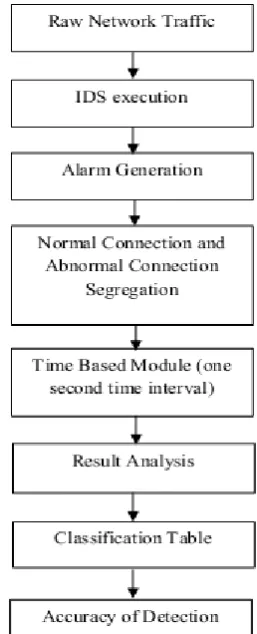
The efficiency of an IDS depends on the decision upon a set of features that the system is going to use for detecting the attacker especially the fast attacks. This is because the mechanism of a fast attack requires only a few seconds and the technique used by the attacker to launch the attack is also different [12]. Figure 2 show the methodology used in time based IDS by [1].
Fig 2. Methodology of time based IDS
We have new idea to detect fast type attack that is the current requirement of an today‟s successful IDS because the today‟s Internet provide very high speed even to home users, so attackers easily attack to target machine if no security major have been adopted.
Following is our major concerned to improve the existing time based technique We used WIRESHARK [13] application to capture the network traffic.
We are also extend our research to different types of protocol used as carrier to launch attack like TCP protocol since TCP protocol is widely used protocol [14] as well as UDP and ARP (to detect MAC spoofing) and our future work will be to prevent DDoS (Distributed Denial of Service) attack .
configuration to distinguish the normal and abnormal behavior of the network traffic.
System Domain
NS-3.20 will be used as a testbed of sensor network with ubuntu14.04.
IV.
SIMULATION AND RESULTOur simulation is on ns-3 and All of are discrete-event network simulator, primarily used in research and teaching. Ns-3 is
free software
, publicly available under the GNU GPLv2 license for research, development, and use.The goal of the ns-3 project is to create an open simulation environment for networking research that will be preferred inside the research community:
Our proposed method will be tested under NS-3.20 on Ubuntu 14.04 system Steps:
Fig. 4.1. Simulation Environment
1. Creating of Sensor Network – For creating sensor network we will use Wi-Fi node of NS-3 which is worked as sensor node.
Then we will create sinks nodes which receive data from sensor node.
2. The number of nodes will be vary (number of sinks nodes are also) and tested under simulation. 3. Types of topology
Two types of topology we will prefer for better approximation of WSN Mobile (sensor moves are roam) Integrated Under different propagation loss model.
4. Routing-
For better results we will use two famous routing protocols of different approach-
a. AODV
5. Energy Model – This is the core thing of our proposed work. For calculating energy node we will apply energy module of NS-3 on each node.
Figure 4.1 Comparison Graph of Captured Trace TCP,HTTP and ARP Protocol
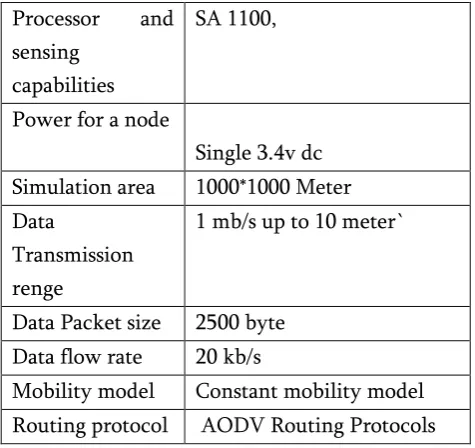
Comparision table of existing work and proposed work as follows:
Processor and sensing
capabilities
SA 1100,
Power for a node
Single 3.4v dc Simulation area 1000*1000 Meter Data
Transmission renge
1 mb/s up to 10 meter`
Data Packet size 2500 byte Data flow rate 20 kb/s
V.
CONCLUSIONThis paper present framework of project, discussed the design and development of “Anomaly based intrusion Detection system in Wireless sensor network(WSN)” which is built on top of a existing open source signature based network IDS, called WIRESHARK so to have both the analysis techniques in a single package Presently, the work caters only to identify and classify the events into normal and attack classes. It can be extended to detect and classify the attacks into multiple attack classes. Dynamic updation of the Anomaly Model can also be considered for future enhancement. Different Analysis techniques like HMM and Fuzzy Logic can also be tried as alternative techniques for anomaly detection.
VI.
REFERENCES[1]. M. Mahoney and P. Chan, “PHAD: Packet header
anomaly detection for identifying hostile network traffic”, Technical report, Florida Tech., technical
report CS-2001-4, April
2017,http://citeseer.ist.psu.edu/mahoney01phad.ht ml
[2]. Mahoney M. and P. Chan, “Learning models of
network traffic for detecting novel attacks",
Technical report, Florida Tech 2017,
http://cs.fit.edu/~mmahoney/paper5.pdf
[3]. D. Barbara, N. Wu and S. Jajodia, “Detecting
Novel Network Intrusions using Bayes
Estimators”, Proceedings of the 1st SIAM International Conference on Data Mining, 2016.
[4]. Jack Koziol, “Intrusion Detection with Snort”,
Pearson publications, 2017
[5]. R. Dan Reid & Nada R. Sanders, “Operations
Management”, 3rd edition., Wiley ,2017
[6]. P. Cisar, S. M Cisar, “Quality Control in Function
of Statistical Anomaly Detection in Intrusion Detection Systems”, SISY 2016 - 4th Serbian-Hungarian Joint Symposium on Intelligent Systems,
[7]. DARPA Intrusion Detection Evaluation, Data Sets
and Documentation, 2016
[8]. Giorgio Giacinto, Fabio Roli, Luca Didaci, ”Fusion
of multiple classifiers for intrusion detection in computer networks”. Pattern Recognition Letters 24(12): 1795-1803 (2016)
[9]. R. Puttini, Z. Marrakchi, and L. Me. “Bayesian
Classification Model for Real Time Intrusion Detection”, in 22th International Workshop on Bayesian Inference and Maximum Entropy Methods in Science and Engineering, 2017.
[10]. A. Hossain, S. Chakrabarti and P.K. Biswas
“Impact of sensing model on wireless sensor network coverage”, IET Wireless Sensor Systems, doi: 10.1049/iet-wss.2011.0101, 2015.
[11]. Cardei, M., Wu, J.: „Energy-efficient coverage
problems in wireless ad hoc sensor
networks‟,Comput. Commun. J., Elsevier Sci., 2016, 29,(4), pp. 413–420
[12]. Tsai, Y.-R.: „Sensing coverage for randomly
distributed wireless sensor networks in shadowed environments‟,IEEE Trans. Veh. Tech., 2016,57, (1), pp. 556–564
[13]. Elfes, A.: „Occupancy grids: a stochastic spatial
representation for active robot perception‟, in Iyenger, S.S., Elfes, A. (Eds.): „Autonomous mobile robots: perception, mapping and navigation‟ (IEEE Computer Society Press, 2016), vol. 1, pp. 60–70
[14]. Liu, B., Towsley, D.: „A study on the coverage of