INTRODUCTION
Recurrent aphthous stomatitis (RAS) is defined as the presence of recurring ulcers confined to the oral mucosa in patients with no other signs or symptoms of underlying disease.The types of oral ulcers are diverse, with a multitude of
Recurrent Aphthous Stomatitis: A Review
T. SRIDHAR, M. ELUMALAI* and B. KARTHIKA
*Department of Pharmacology, Sree Balaji Dental College and Hospital, Bharath University, Chennai, Tamil Nadu, India.
Department of Oral Medcine and Radiology, Priyadharshinii Dental College and Hospital, Thiruvallur, Tamil Nadu, India.
Research Scholar, Bharath University, Selaiyur, Tambaram, Chennai – 600 073, Tamil Nadu, India. *Corresponding author E-mail: [email protected]
(Received: February 25, 2013; Accepted: April 12, 2013)
ABSTRACT
Recurrent Aphthous Stomatitis (RAS) is a disorder characterized by recurring ulcers in the oral mucosa in patients with no other signs of disease. This condition is also called as Sutton’s disease, especially in the case of major, multiple or recurring ulcers. RAS appears to represent several pathological states with similar clinical manifestations, including immunologic disorders, hematologic deficiencies and allergic or psychological abnormalities. This article reviews the
currentdata on the etiopathogenesis, diagnosis and management of RAS.
Key words: Oral ulcers, Aphthous stomatitis, Etiopathogenesis, Sutton’s disease.
associated causes including: physical or chemical trauma, infection from microorganisms, medical conditions or medications, cancerous and nonspecific processes. Once formed, the ulcer may be maintained by inflammation and/or secondary infection. The causes of oral ulcers are diverse
which includes a multitude of factors1 (Table-1).
Table 1: Principal causes of oral ulcers
Solitary ulcer Trauma
Squamous cell carcinoma
Infections (e.g. syphilis, tuberculosis)
Recurrent bouts of one or more ulcers healing Recurrent aphthous stomatitis (RAS)
spontaneously Behcet’s disease
‘Aphthous-like’ ulcers due to systemic disease or drug therapy.
Recurrent erythema multiforme
Single bout of ulceration, preceded by vesicles Viral infections (e.g. herpangina and primary herpetic
and affecting multiple oral sites stomatitis)
Erythema multiforme
Persistent oral ulceration affecting different sites Mucocutaneous disease (e.g. oral lichen planus)
Immunobullous disease (e.g. oral pemphigus) Gastrointestinal disease (e.g. Crohn’s disease) Haematological (e.g. leukaemia)
R A S i s t h e m o s t c o m m o n t y p e o f ulcerative disease of the oral mucosa, and it affects approximately 20% of the general population. Prevalence of RAS varies among different socioeconomic groups and its incidence
is strongly affected by family history2. Age of
presentation is between the second and third decades of life in otherwise healthy individuals. RAS is the most common type of recurrent oral ulceration in the age group of 10 to 19 years. Similar ulcers can be seen in patients with a variety of diseases including systemic lupus er ythematosis, Behcet’s syndrome, iron deficiency anemia and Crohn’s disease. Therefore, RAS patients must be carefully evaluated for associated symptoms to determine whether laboratory evaluation is required.
The worldwide distribution, high frequency and decreased quality of life generated by RAS have resulted in a great deal of research into the etiology and efficient therapy of this disease. However, the etiology of RAS still remains unclear, and the currently available therapy remains inadequate.
DISCUSSION
The exact cause of many aphthous ulcers is unknown, diagnosis is entirely based on history and clinical criteria and no laboratory procedures exist to confirm the diagnosis. Although RAS may be a marker of an underlying systemic illness such as coeliac disease, or may present as one of the features of Behcet’s disease, in most cases no additional body systems are affected, and patients remain otherwise fit and well.
Lack of sleep, illness, physical trauma,
stress, hormonal changes, sudden weight
loss, food allergies, immune system reactions and
deficiencies in vitamin B12, iron, folic acid and
citrus fruits may contribute to their development3-5.
Trauma to the mouth is the most common trigger. Physical trauma, such as that caused by toothbrush abrasions, laceration with sharp or abrasive foods such as toast, potato chips or other objects, accidental biting (particularly common with sharp canine teeth), after losing teeth, or dental
braces can cause aphthous ulcers by breaking the mucous membrane.
Oral aphthous ulcers are also commonly seen in celiac disease and Crohn’s disease. There is no indication that aphthous ulcers are related to menstruation, pregnancy and menopause, however, smokers appear to be affected less often.
Systemic conditions and apthous-like lesions Principal systemic conditions associated with ‘aphthous-like’ ulcers. These frequently start in adulthood with no previous history of oral ulceration. These conditions may mimic aphthous ulcers which
may pose a diagnostic problem4. (Table-2)
Table 2: Systemic conditions and aphthous like lesions Behcet’s disease
Nutritional deficiencies Gastrointestinal disorders
´ Crohn’s disease ´ Ulcerative colitis Cyclical neutropenia
HIV infection MAGIC syndrome FAPA syndrome Drug reactions
Clinical presentation
Aphthous ulcers usually begin with a tingling or burning sensation at the site of the future aphthous ulcer. In a few days, they often progress to form a red spot or bump, followed by an open ulcer.
Minor ulceration
“Minor aphthous ulcers” indicate that the lesion size is between 3 mm (0.1 in)-10 mm (0.4 in). The appearance of the lesion is that of an erythematous halo with yellowish or grayish color. Extreme pain is the obvious characteristic of the lesion. When the ulcer is white or grayish, the ulcer will be extremely painful and the affected lip may swell. They may last about 1 week.
Major ulcerations
Major aphthous ulcers have the same appearance as minor ulcerations, but are greater than 10 mm in diameter and are extremely painful. They usually take more than a month to heal, and
frequently leave a scar. These typically develop after puberty with frequent recurrences. They occur on movable non-keratinizing oral surfaces, but the ulcer borders may extend onto keratinized surfaces. They may last about 10 to 14 days.
Herpetiform ulcerations
This is the most severe form. It occurs more frequently in females, and onset is often in adulthood. It is characterized by small, numerous, 1–3 mm lesions that form clusters. They typically heal in less than a month without scarring. Palliative treatment is almost always necessary.
Table 3: Classification of RAS
Type Features Treatment
Type A RAS episodes lasting for only a few days, *Medication may not be indicated
occurring only a few times a year *Topical anesthetics to relieve pain
Type B *Frequent and painful RAS, lasting *Medication is needed in this type of RAS
between three and 10 days. *Treated by topical corticosteroids or systemic
corticosteroids *The patient might have changed diet and
oral hygiene habits because of the pain
Type C Painful, chronic courses of RAS in which Best treated by topical corticosteroids, systemic
by the time one ulcer heals, another corticosteroids, azathioprine or other
develops. immunosuppressants such as dapsone,
pentoxifylline and sometimes thalidomide
Classification
To help deter mine management strategies, Crispian Scully divided RAS in three
clinical presentations: type A, type B and type C 5.
(Table-3)
Management
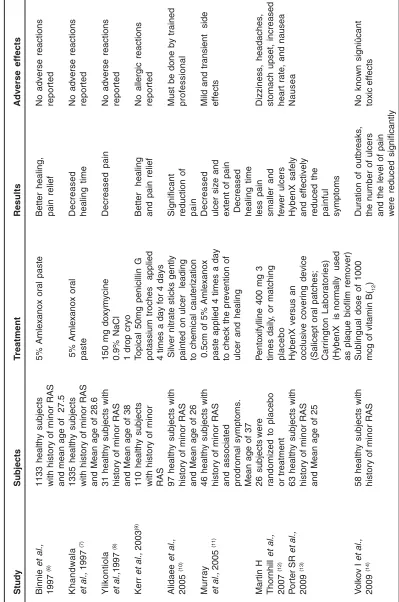
The treatment of recurrent aphthous stomatitis (RAS) still remains nonspecific and is based primarily on empirical data. The goals of therapy include the management of pain and functional impairment by suppressing inflammatory responses, as well as reducing the frequency of recurrences or avoiding the onset of new aphthae. Non therapeutic treatment includes proper maintenance of oral hygiene, trauma prevention, avoidance of certain foods/drinks, use of straws, relaxation techniques. Therapeutic options for RAS
include topical and systemic corticosteroids, topical antibiotics, immunomodulators and others. Numerous randomized control trials have been reported discussing their efficacy in the treatment of RAS (Table-4).
Topical therapy
T
a
ble 4:
Randomiz
ed contr
ol trials f
or RAS (tab
le-4) Study Subjects T re a tment Results Adverse effects Binnie et al., 1133 healthy subjects
5% Amlexanox oral paste
Better healing, No adverse reactions 1997 (6)
with history of minor RAS
pain
relief
reported
and mean age of 27.5
Khandwala
1335
healthy
subjects
5% Amlexanox oral
Decreased N o adverse reactions et al., 1997 (7)
with history of minor RAS
paste
healing time
reported
and Mean age of 28.6
Ylikontiola
3
1
healthy subjects with
150
mg
doxymycine
Decreased pain
No adverse reactions
et al.,
1997
(8)
history of minor RAS
0.9%
NaCl
reported
and Mean age of 38
1 drop cryo Kerr et al., 2003 (9) 110 healthy subjects T
opical 50mg penicillin G
Better
healing
No
allergic
reactions
with history of minor
potassium troches applied and pain relief reported R A S
4 times a day for 4 days
Alidaee et al., 97 healthy subjects with
Silver nitrate sticks gently
Significant
Must be done by trained
2005 (10) history of minor RAS
painted on ulcer leading
reduction
of
professional
and Mean age of 26
to chemical cauterization pain Murray 4 6 healthy subjects with
0.5cm of 5% Amlexanox
Decreased
Mild and transient side
et al.,
2005
(11)
history of minor RAS
paste
applied 4 times a day
ulcer size and
effects
and associated
to
check
the prevention of
extent
of
pain
prodromal
symptoms.
ulcer and healing
Decreased
Mean age of
37 healing time Martin H 26 subjects were P ento xify
lline 400 mg 3
less pain
Dizziness, headaches,
Thornhill
et al.,
randomized to placebo
times daily , or matching smaller and stomach upset, increased 2007 (12) or treatment p lacebo fewer ulcers
heart rate, and nausea
P
o
rter SR
et al.,
63 healthy subjects with
HybenX versus an HybenX safely Nausea 2009 (13)
history of minor RAS
occlusive
covering
device
and
effectively
and Mean age of 25
(Salicept oral patches; reduced the Carrington Laboratories) painful
(HybenX is normally used
symptoms
as plaque biofilm remover)
V olk o v I et al.,
58 healthy subjects with
Sublingual dose of 1000 Duration of outbreaks, No known signiûcant 2009 (14)
history of minor RAS
mcg of vitamin B( 12 )
the number of ulcers
toxic
effects
Other topical preparations that have been shown to decrease the healing time of minor RAS lesions include amlexanox paste and topical tetracycline.
Systemic therapy
Systemic therapy for RAS is usually advised to patients with chronic lesions and multiple
painful lesions. Vitamin B12 is a simple, effective,
and low-risk therapy to prevent recurrent aphthous
stomatitis15. Zinc deficiency has been reported in
people with recurrent aphthous ulcers. Zinc supplementation had reported positive results in
these individuals16.
For patients with major aphthae or severe cases of multiple minor aphthae who do not respond to topical therapy the use of systemic therapy should be considered. Pentoxifylline (PTX) can be used systemically to control ulcers that do not respond to topical medication. PTX is a methylxanthine compound related to caffeine and theophylline. It is used chiefly to treat peripheral vascular disease because it increases the flexibility of red blood cells and enhances blood flow to ischemic limbs. It also increases neutrophil chemotaxis and motility, and decreases the clumping of neutrophils. And it has anti-inflammatory properties by decreasing the production of cytokines and by decreasing the effect of the cytokines on leukocytes. Several reports suggest that PTX is effective in preventing aphthous
ulcers17.
Levamisole is a safe drug. When compared with the placebo, levamisole is not effective in the prophylactic treatment of recurrent aphthous stomatitis. The placebo effect is important in diseases where emotional factors affect
recurrence or expression of symptoms18.
Dapsone(100mg/day) can be used for oral and genital aphthae, however, rapid relapses can
occur after discontinuation of treatment17.
Colchicine is another systemic medication that has been used with success in treating ulcers that are unresponsive to topical medication. Colchicine is an anti-inflammatory agent that limits leukocyte activity by binding to tubulin, a cellular microtubular protein, and, therefore, inhibiting
protein polymerization19. It also inhibits lysosomal
degranulation and increases the level of cyclic AMP, which decreases both the chemotactic and the phagocytic activity of neutrophils.
Alkylating Agents like chlorambucil on orogenital ulcerations in ABD demonstrated a good response when administered at an initial dose of 0.1mg/kg, followed by a low maintenance dose of 2mg/day.
Thalidomide has been shown to reduce the incidence and severity of RAS. The drug was first marketed in Europe in the 1950s as a non-addictive sedative agent, but it was withdrawn from the market nearly 40 years ago after the discovery of its teratogenicity. Several reports have been published reporting positive results when treating severe recurrent ulcers with thalidomide. Thalidomide has many serious adverse effects, including teratogenicity, peripheral neuropathy, and other minor adverse effects, such as dizziness and somnolence. To minimize the risk of teratogenicity, the System for Thalidomide Education Prescribing Safety (S.T.E.P.S.) program has been instituted to
control and monitor the use of thalidomide17.
Application of 5-aminosalicylic acid 5% cream (applying a small amount to cover the aphthae 3 times/day), or a toothpaste containing amyloglucosidase and glucose oxidase can reduce pain and lessen the duration of oral
aphthae17.
CONCLUSION
profile and should be the first line of treatment for recurrent oral stomatitis. Medications such as immunomodulators and other agents like
thalidomide should be used with care. The use of these high end medications should be reserved for treating major, multiple and recurring ulcers.
REFERENCES
1. R. L. Sutton: Pariadenitis mucosa necrotica
recurrens. Journal of Cutaneous and Genito-Urinary Diseases, New-York, 29: 65-71 (1911).
2. Camila de Barros Gallo,I Maria Angela
Martins Mimura,II Norberto Nobuo SugayaI, Psychological stress and recurrent aphthous
stomatitis Clinics 64(6):645-8 (2009).
3. Ship JA, Chavez EM, Doerr PA, Henson BS.
Recurrent aphthous stomatitis. Quintessence Int. 31: 95-112 (2000).
4. Casiglia JM. Recurrent aphthous stomatitis:
etiology, diagnosis, and treatment. Gen Dent 50: 157-66 (2002).
5. Scully C, Gorsky M, Lozada-Nur F. The
diagnosis and management of recurrent aphthous stomatitis: a consensus approach. J Am Dent Assoc. 134: 200-7 (2003).
6. Binnie WH, Curro FA. Amlexanox oral paste:
a novel treatment that accelerates the healing of apthous ulcers. Compend Contin
Educ Dent 18(11): 1116-8, 1120-2, 1124
passim (1997).
7. Atul Khandwala et Al.1996 “5% Amlexanox
new treatment for recurrent minor aphthous ulcers”. Oral Surg Oral Med Oral Pathol Oral Radiol Endod 83: 222-30 (1997).
8. Ylikontiola, L., T. Sorsa, R. Hayrinen-Immonen
and T. Salo, Doxymycine-cyanoacrylate treatment of recurrent aphthous ulcers. Oral. Surg. Oral. Med. Oral. Pathol. Oral. Radiol. Endod., 83: 329-333 (1997).
9. Kerr R. the efficacy and safety of 50 mg
Penicillin G potassium troches for recurrent aphthous ulcers. Oral Surg Oral Med Oral
Radiol Endod 96: 685-694 (2003).
10. Alidaee, M. R., A. Taheri, et al., “Silver nitrate
cautery in aphthous stomatitis: arandomized controlled trial.” Br J Dermatol 153(3): 521-525 (2005).
11. Murray B, McGuinness N, Biagioni P, et al. A
comparative study of the efficiency of Aptheal in the management of recurrent minor apthous ulceration. J Oral Pathol Med 34(7): 413-9 (2005).
12. Martin H. Thornhill, MBBS, PhD; Lorena
Baccaglini, DDS, PhD; Elizabeth Theaker, BDS, MPhil; Michael N. Pemberton, MBBS. A Randomized, Double-blind, Placebo-Controlled Trial of Pentoxifylline for the Treatment of Recurrent Aphthous Stomatitis. Arch Dermatol. 143(4): 463-470 (2007).
13. S R Porter, K Al-Johani, S Fedele, D R Moles.
Randomised controlled trial of the efficacy of HybenX in the symptomatic treatment of recurrent aphthous stomatitis. Oral Diseases 15(2):155-61 (2009).
14. Volkov I, Rudoy I, Freud T, et al. Effectiveness
of vitamin B12 in treating recurrent aphthous
stomatitis: a randomized, double-blind, placebo-controlled trial. J Am Board Fam Med 22: 9-16 (2009).
15. Carrozzo M. Vitamin B12 for the treatment of
recurrent aphthous stomatitis. Evid Based Dent. 10(4): 114-5 (2009).
16. Orbak R, Cicek Y, Tezel A, Dogru Y (2003).
“Effects of zinc treatment in patients with recurrent aphthous stomatitis”. Dent Mater J. 22(1):21-9 (2003).
17. Altenburg A, Zouboulis CC.Current concepts
in the treatment of recurrent aphthous stomatitis. Skin Therapy Lett. 13(7): 1-4 (2008).
18. Weckx LL, Hirata CH, Abreu MA, Fillizolla
VC, Silva OM. Levamisole does not prevent lesions of recurrent aphthous stomatitis: a double-blind placebo-controlled clinical trial, Rev Assoc Med Bras. 55(2):132-8 (2009).
19. Fontes V, Machet L, Huttenberger B, et al.