Overly Aggressive New Guidelines for Lipid Screening
in Children: Evidence of a Broken Process
A new expert panel report1released by the National Heart Lung and Blood Institute (NHLBI) and endorsed by the American Academy of Pediatrics2 recommends universal screening of 9- to 11-year-old children with a nonfasting lipid panel and targeted screening of 2- to 8-year-old and 12- to 16-year-old children with 2 fasting lipid profiles. These guidelines were developed in parallel with adult guidelines due out later this year, using what are described as“ state-of-the art principles of evidence-based medicine.”3 The process is designed with the laudable intentions of improving transparency, keeping recommendations closely tied to the evidence, and indicating where evidence is strong and where guidelines are based on expert opinion. However, we believe that the high evidence grades for the extremely aggressive pediatric lipid recommendations are inaccurate and unjustified and that the conflicts of interest reported by panel members are too substantial to ignore. In short, these guidelines provide evidence that the NHLBI’s new “evidence-based” guideline process did not achieve its goals.
The guidelines we examine here are related to lipid screening, but similar concerns apply to screening children for hypertension dis-cussed in the same NHLBI report.1Many of our concerns are discussed in Chapter 3 of this report, which was omitted from the supplement published inPediatrics2 and appears to have been ignored by the subcommittee that drafted the lipid screening recommendations. Two recent commentaries in JAMA complement our concerns as to the wisdom and appropriateness of these pediatric lipid screening guidelines.4,5
The NHLBI screening recommendations are overly aggressive. The 2- to 8-year-old and 12- to 16-year-old children for whom the panel strongly recommends 2 fasting lipid panels are those who have diabetes, hy-pertension, or a BMI above the 95th percentile; who smoke cigarettes; who have a parent with a total cholesterol level of$240 mg/dL or known dyslipidemia; or who have a parent, grandparent, aunt, or uncle who has had a stroke or coronary artery disease before age 55 for men and 65 for women.2 Approximately 30% to 40% of children will meet the family history criteria for screening,6and many more will qualify for screening based on the other criteria. All of these children will need to go to the laboratory and have their blood drawn before breakfast on 2 occasions for fasting lipid panels (a logistical and emotional challenge for most families). If their low-density lipoprotein cholesterol is$130 mg/dL (as it is in∼10% of unselected girls7 (p. 534), they are to be placed on a special“CHILD-1”diet, and fasting lipid panels are to be repeated every 6 to 12 months indefinitely, even if their lipid values became“ ac-ceptable”to the Expert Panel. Despite the fact that girls have higher lipid levels than boys but are at much lower age-specific cardiovascular
AUTHORS:Thomas B. Newman, MD, MPH,a,bMark J.
Pletcher, MD, MPH,a,cand Stephen B. Hulley, MD, MPHa Departments ofaEpidemiology and Biostatistics,bPediatrics, and cMedicine, School of Medicine, University of California, San
Francisco, California
KEY WORDS
cholesterol, screening, health policy, conflict of interest, lipoprotein
ABBREVIATIONS
CVD—cardiovascular disease
NHLBI—National Heart Lung and Blood Institute
Opinions expressed in these commentaries are those of the authors and not necessarily those of the American Academy of Pediatrics or its Committees.
www.pediatrics.org/cgi/doi/10.1542/peds.2012-0481
doi:10.1542/peds.2012-0481
Accepted for publication May 21, 2012
Address correspondence to Thomas B. Newman, MD, MPH, Department of Epidemiology and Biostatistics, UCSF Box 0560, San Francisco, CA 94143. E-mail: [email protected]
PEDIATRICS (ISSN Numbers: Print, 0031-4005; Online, 1098-4275).
Copyright © 2012 by the American Academy of Pediatrics
FINANCIAL DISCLOSURE:Dr Pletcher has National Institutes of Health funding to support research on targeting of cholesterol-lowering medications for prevention of cardiovascular disease; and Drs Newman and Hulley have indicated they have no
financial relationships relevant to this article to disclose.
FUNDING:No external funding.
COMPANION PAPER:A companion to this article can be found on page 353, and online at www.pediatrics.org/cgi/doi/10.1542/ peds.2012-1137.
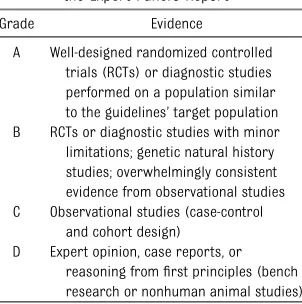
disease (CVD) risk in the ensuing de-cades, a single set of treatment cutoffs is used for both genders; given gender-specific lipid distributions7 (p. 534), implementation of this feature of the panel’s guidelines would lead to more treatment of preschool girls than of teenage boys. Nonetheless, the panel rated these recommendations“Evidence Grade B,” indicating “overwhelmingly consistent evidence from observational studies”(Table 1).
We agree with the panel that there is compelling evidence that cumulative exposure to risk factors such as high low-density lipoprotein cholesterol levels and hypertension in young or middle-aged adults increases the risk of ath-erosclerosis, that treatment of these risk factors in middle-aged and older adults reduces the risk of CVD events, that treatment of high cholesterol in chil-dren with familial hypercholesterolemia can reduce atherosclerotic disease indicators, and that people at higher risk of having these risk factors as adults can be identified by their child-hood levels. The chain of evidence cited by the panel, however, contains weak links, notably the absence of even ob-servational evidence or modeling to estimate the clinical event benefits of screening for and intervening on these risk factors in children. As they put it,“The evidence review supports the concept [emphasis added] that
early identification and treatment of dyslipidemia … will substantially re-duce clinical CVD risk.”However, there is a vast difference between evidence to support a concept and the studies of clinical events, actual benefits and harms over the ensuing decades, that would be needed for these guidelines to qualify as evidence-based.
Importantly, there is also no quantifi -cation or even discussion of many of the harms that might result,8 such as di-etary neuroses, family conflict, and CVD anxiety.9–12There is also no estimate of how many children would be tested with fasting lipid panels, how many would be referred to a registered dietician or lipid specialist, how many extra follow-up visits would be needed, or how many children would ultimately “require” medication. The panel states that the acceptability to parents and children of obtaining fasting lipid levels“is an open question”1 (p. 56). In fact, studies that have addressed acceptability of lipid testing in children find the majority of families do not comply.13–15
Targeted screening with fasting lipid panels was“strongly recommended,” meaning that the panel believes that “the benefits of the recommended ap-proach clearly exceed the harms.”The implication of this recommendation is that clinicians should follow it regard-less of patient preferences unregard-less “a clear and compelling rationale for an alternative approach is present.” It is admittedly difficult to estimate average benefits and weigh those against harms, but such an attempt must be made to be confident that benefits “clearly exceed the harms.” Further-more, although the panel acknowl-edges that the“cost to society at large will likely be a major factor in decisions regarding screening”1 (p. 59), rather than trying to estimate these costs before issuing their guidelines, the recommendations state only that“well considered cost-effectiveness analyses
of childhood [cardiovascular] risk factor screening should be a priority for future research”1 (p. 60). Without these estimates, how can the panel be confident that the guidelines are rea-sonably cost-effective?
It is clear that the specific guidelines of which children to screen and treat are based on expert opinion and notfirmly backed by clinical trials, observational studies, or even modeling. There is nothing inherently wrong with basing guidelines on expert opinion in disease situations for which therapeutic deci-sions must be made when relevant studies have not been done. The present policy, however, proposes an intervention applied to a healthy and asymptomatic population, with an enormous impact on costs and the potential to transform well children into patients with a chronic disease label (“dyslipidemia”). As dis-senting panel member Matthew Gilman wrote, “Because physicians initiate screening for asymptomatic individuals and the harms of screening fall dis-proportionately on the healthy, pri-mum non nocere is paramount.”5 In fact, the panel report states, “a rec-ommendation for universal screening requires a high burden of proof”1 (p. 50), yet the panel seems to have ignored this sensible precept.
The greater a guideline’s reliance on expert opinion, the more important it is to avoid even the appearance of conflict of interest. Yet the majority of panel members, including those responsible for drafting the lipid and lipoprotein chapter, disclosed an extensive assort-ment of financial relationships with companies making lipid-lowering drugs and lipid-testing instruments (Table 2). Accepting money from industry con-stitutes a conflict of interest that is not ameliorated by disclosure. That so many panel members with conflicts of interest were selected to draft the pediatric lipid guidelines undermines the credibility of TABLE 1 Evidence Grading System Used for
the Expert Panel’s Report
Grade Evidence
A Well-designed randomized controlled trials (RCTs) or diagnostic studies performed on a population similar to the guidelines’target population B RCTs or diagnostic studies with minor limitations; genetic natural history studies; overwhelmingly consistent evidence from observational studies C Observational studies (case-control
and cohort design) D Expert opinion, case reports, or
reasoning fromfirst principles (bench research or nonhuman animal studies)
350 NEWMAN et al
at Viet Nam:AAP Sponsored on August 28, 2020
www.aappublications.org/news
both the guidelines and the process through which they were produced.
The guidelines also demonstrate the need to examine the system for grading evidence, particularly for population screening. Although the definition of“A” level evidence clearly specifies the need for randomized trials in relevant
populations, it should be revised to clarify that the trials must be of the in-tervention being recommended and that the endpoints must be clinically mean-ingful. Similarly, the“overwhelmingly consistent evidence from observational studies” must address the specific screening program being recommended,
and the outcomes of these studies must include clinical events. Observational studies that support a concept with evidence relating risk factors to sur-rogate outcomes (such as blood lipid levels) are not sufficient. The US Pre-ventive Health Services Task Force rec-ognized this in recommending that there was insufficient evidence to recommend childhood cholesterol screening.16
Finally, we need to move past the era when experts propose (and organ-izations endorse) guidelines with enor-mous societal costs without making any attempt at estimating cost-effectiveness. The NHLBI Panel is not alone in ignoring this; even the US Preventive Health Services Task Force’s recommendations do not consider (financial) costs.17As a result, any intervention with nonzero benefit may be recommended, regard-less of how much it costs and how much better health might be achieved by investing those resources elsewhere. This is not sustainable.
We need evidence that will allow us to estimate health benefits, risks, and costs of proposed interventions and experts without conflicts of interest to help us synthesize this information. The expert panel’s recommendations on lipid screening fall so far short of this ideal that we hope they will trigger a reexamination of the process through which they were produced.
ACKNOWLEDGMENT
We thank Elizabeth Pelayo for producing the footnotes for Table 2.
REFERENCES
1. Expert panel on integrated guidelines for cardiovascular health and risk reduction in children and adolescents: full report. 2011. Available at: www.nhlbi.nih.gov/guidelines/ cvd_ped/index.htm. Accessed January 5, 2012
2. Kavey R, Simons-Morton DG, de Jesus J; Expert Panel on Integrated Guidelines for Cardiovascular Health and Risk Reduction
in Children and Adolescents; National Heart, Lung, and Blood Institute. Expert panel on integrated guidelines for cardio-vascular health and risk reduction in chil-dren and adolescents: summary report.
Pediatrics. 2011;128(suppl 5):S213–S256 3. Cardiovascular Risk Reduction Guidelines
in Adults: Cholesterol Guideline Update (ATP IV), Hypertension Guideline Update
(JNC 8) Obesity Guideline Update (Obesity 2), Integrated Cardiovascular Risk Reduction Guideline. Background. Available at: www. nhlbi.nih.gov/guidelines/cvd_adult/background. htm. Accessed February 2, 2012
4. Psaty BM, Rivara FP. Universal screening and drug treatment of dyslipidemia in children and adolescents. JAMA. 2012;307 (3):257–258
TABLE 2 Financial Disclosures of the Expert Panel Chair and of the Members of the Subgroup Who Drafted the Lipids and Lipoproteins Chapter of the Integrated Guidelines for Cardiovascular Health and Risk Reduction in Children and Adolescents1
Panel Member Reported Relevant Relationships
Stephen R. Daniels, MD, PhD, Panel Chair
Consultant or advisory board member: Abbott Laboratories,a Merck,bSchering-Ploughc
Funding/grant support for research: National Institutes of Health Peter O. Kwiterovich, MD, Subgroup
Leader
Consultant or advisory board member: Merckb, Schering-Plough,c Pfizer,dSankyo,eLipoScience,fand Astra Zenecag
Speakers bureau: Merck,bSchering-Plough,cPfizer,dSankyo,eKos,h and Astra Zenecag
Grant funding: Pfizer,dMerck,bGlaxoSmithKline,iSankyo,eand Schering-Ploughc
Patrick E. McBride, MD, MPH Consultant or advisory board member: Bristol-Myers Squibbjand Merckb
Speakers bureau: Kos,hMerck,band Pfizerd(none since July 2007) Brian W. McCrindle, MD, MPH Consultant or advisory board member: Abbott Laboratories,a
Bristol-Myers Squibb,jDaichii-Sankyo,kand Rochel Grant Funding: Astra Zeneca,gSankyo,e
Merck,bSchering-Plough,cand the National Institutes of Health
aAbbott Laboratories produces the following relevant medications: ADVICOR (niacin extended-release/lovastatin), CONTROLIP
(fenofibrate; not sold in the United States), NIASPAN (niacin extended release), SIMCOR (simvastatin/niacin extended-release), TriCor (fenofibrate), and TRILIPIX (fenofibric acid). Abbott Laboratories produces the following relevant diagnostic instruments: ARCHITECT ci16200 Integrated System, ARCHITECT ci4100 Integrated System, ARCHITECT ci8200 Integrated System, ARCHITECT i1000SR, ARCHITECT i2000SR, ARCHITECT i4000SR, and AxSYM.
bMerck produces the following relevant medications: MEVACOR (lovastatin), VYTORIN (ezetimibe/simvastatin), ZETIA
(ezetimibe), and ZOCOR (simvastatin).
cSchering-Plough: see Merck.
dPfizer produces the following relevant medications: CADUET (amlodipine besylate/atorvastatin calcium), COLESTID
(micronized colestipol hydrochloride), LIPITOR (atorvastatin calcium), and LOPID (gemfibrozil, USP).
eSankyo produces the following relevant medication: WELCHOL (colesevelam hydrochloride). fLipoScience produces the following relevant product: NMR LipoProfile.
gAstra Zeneca produces the following relevant medication: CRESTOR (rosuvastatin calcium). hKos: see Abbott Laboratories.
iGlaxoSmithKline produces the following relevant medication: LOVAZA (omega-3-acid ethyl esters). jBristol-Myers Squibb produces the following relevant medication: PRAVACHOL (pravastatin sodium). kDaichii-Sankyo: see Sankyo.
lRoche produces the following relevant products: ACCUTREND PLUS System, COBAS c 111 analyzer, COBAS INTEGRA Systems,
COBAS 4000 analyzer series, COBAS 6000 analyzer series, COBAS 8000 modular analyzer series, MODULAR ANAsLYTICS EVO solution, and REFLOTRON Systems.
5. Gillman MW, Daniels SR. Is universal pedi-atric lipid screening justified?JAMA. 2012; 307(3):259–260
6. Haney EM, Huffman LH, Bougatsos C, Freeman M, Steiner RD, Nelson HD. Screen-ing and treatment for lipid disorders in children and adolescents: systematic evi-dence review for the US Preventive Services Task Force.Pediatrics. 2007;120(1). Available at: www.pediatrics.org/cgi/content/full/120/ 1/e189
7. National Cholesterol Education Program (NCEP). National Cholesterol Education Pro-gram (NCEP): highlights of the report of the Expert Panel on Blood Cholesterol Levels in Children and Adolescents.Pediatrics. 1992; 89(3):495–501
8. Woolf SH, Harris R. The harms of screening: new attention to an old concern. JAMA. 2012;307(6):565–566
9. Newman TB, Garber AM. Cholesterol screening in children and adolescents.Pediatrics. 2000; 105(3 pt 1):637–638
10. Newman TB, Browner WS, Hulley SB. The case against childhood cholesterol screen-ing.JAMA. 1990;264(23):3039–3043 11. Lifshitz F, Moses N. Growth failure. A
compli-cation of dietary treatment of hypercholes-terolemia.Am J Dis Child. 1989;143(5):537–542 12. Pugliese MT, Weyman-Daum M, Moses N, Lifshitz F. Parental health beliefs as a cause of nonorganic failure to thrive.Pediatrics. 1987;80(2):175–182
13. Nader PR, Yang M, Luepker RV, et al. Parent and physician response to children’s cho-lesterol values of 200 mg/dL or greater: the Child and Adolescent Trial for Cardiovas-cular Health Experiment.Pediatrics. 1997; 99(5). Available at: www.pediatrics.org/cgi/ content/full/99/5/e5
14. Bachman RP, Schoen EJ, Stembridge A, Jurecki ER, Imagire RS. Compliance with childhood cholesterol screening among members of a prepaid health plan. Am J Dis Child. 1993;147(4):382–385
15. Lannon CM, Earp J. Parents’behavior and attitudes toward screening children for high serum cholesterol levels. Pediatrics. 1992;89(6 pt 2):1159–1163
16. US Preventive Services Task Force. Screening for Lipid Disorders in Children 2007. Avail-able at: www.uspreventiveservicestaskforce. org/uspstf07/chlipid/chlipidrs.htm. Accessed January 18, 2012
17. US Preventive Services Task Force Procedure Manual. Section 5: methods for arriving at a recommendation. Available at: www. uspreventiveservicestaskforce.org/uspstf08/ methods/procmanual5.htm. Accessed February 10, 2012
READING THE NOTE:At the end of each clerkship rotation, I have to read and grade several clinical encounter notes that students write during their graded clinical skills examination. While that does not sound too onerous, it requires an enor-mous amount of time to read, correct, and assign a grade to more than 80 notes every few weeks. I have always wondered if this could be automated. Evidently, it can. As reported inThe New York Times(Business: June 10, 2012), standardized tests administered by the states to high school students at the end of the school year often have an essay-writing component. Grading these typically requires humans to read each one. However, computer software programs have been developed that score the essays at least as well as humans do. In a study sponsored by the Hewlett Foundation, commercially available automated essay-scoring programs produced scores identical to those of human graders. This is a growingfield as the implications are enormous. Most importantly for states, the cost of grading essays can be minimized. Many states, citing the costs in-volved, assess student writing prowess less often than desired. Also, the software can be modified to evaluate almost any writing exercise and can be set up so that lengthy explanations and practice exercises are included in the report to each student. A recent essay-scoring competition offered $60,000 forfirst prize and drew 159 entries. The winning entry used typical computers used in classrooms and small data sets to generate remarkably accurate assessments. While the software is incredible, humans still need to review the essays, as students can potentially game the system by writing factual nonsense that computers cannot easily detect. As for me, I am dumbfounded by thefinding that the average human reader of standardized school essays only spends three minutes on each essay. While I would like to think that I might be a better essay grader than a computer because I spend much more time than that on each note, I suspect that is probably not the case. I think I will investigate one of these programs so I can concentrate on clinical decision making rather than the mechanics of the note.
Noted by WVR, MD
352 NEWMAN et al
at Viet Nam:AAP Sponsored on August 28, 2020
www.aappublications.org/news
DOI: 10.1542/peds.2012-0481 originally published online July 23, 2012;
2012;130;349
Pediatrics
Thomas B. Newman, Mark J. Pletcher and Stephen B. Hulley
a Broken Process
Overly Aggressive New Guidelines for Lipid Screening in Children: Evidence of
Services
Updated Information &
http://pediatrics.aappublications.org/content/130/2/349 including high resolution figures, can be found at:
References
http://pediatrics.aappublications.org/content/130/2/349#BIBL This article cites 13 articles, 7 of which you can access for free at:
Subspecialty Collections
http://www.aappublications.org/cgi/collection/cardiology_sub
Cardiology
following collection(s):
This article, along with others on similar topics, appears in the
Permissions & Licensing
http://www.aappublications.org/site/misc/Permissions.xhtml in its entirety can be found online at:
Information about reproducing this article in parts (figures, tables) or
Reprints
DOI: 10.1542/peds.2012-0481 originally published online July 23, 2012;
2012;130;349
Pediatrics
Thomas B. Newman, Mark J. Pletcher and Stephen B. Hulley
a Broken Process
Overly Aggressive New Guidelines for Lipid Screening in Children: Evidence of
http://pediatrics.aappublications.org/content/130/2/349
located on the World Wide Web at:
The online version of this article, along with updated information and services, is
by the American Academy of Pediatrics. All rights reserved. Print ISSN: 1073-0397.
the American Academy of Pediatrics, 345 Park Avenue, Itasca, Illinois, 60143. Copyright © 2012 has been published continuously since 1948. Pediatrics is owned, published, and trademarked by Pediatrics is the official journal of the American Academy of Pediatrics. A monthly publication, it
at Viet Nam:AAP Sponsored on August 28, 2020
www.aappublications.org/news