University of Pennsylvania
ScholarlyCommons
Publicly Accessible Penn Dissertations
Summer 8-13-2010
Looking Through the Lens of Individual
Differences: Relationships Between Personality,
Cognitive Control, Language Processing, and
Genes
Ranjani Prabhakaran
University of Pennsylvania, [email protected]
Follow this and additional works at:http://repository.upenn.edu/edissertations
Part of theBiological Psychology Commons, and theCognitive Psychology Commons
Recommended Citation
Prabhakaran, Ranjani, "Looking Through the Lens of Individual Differences: Relationships Between Personality, Cognitive Control, Language Processing, and Genes" (2010).Publicly Accessible Penn Dissertations. 426.
Looking Through the Lens of Individual Differences: Relationships
Between Personality, Cognitive Control, Language Processing, and Genes
Abstract
The study of individual differences in cognitive abilities and personality traits has the potential to inform our understanding of how the processing mechanisms underlying different behaviors are organized. In the current set of studies, we applied an individual-differences approach to the study of sources of variation in individuals’ personality traits, cognitive control, and linguistic ambiguity resolution abilities. In Chapter 2, we investigated the relationship between motivational personality traits and cognitive control abilities. The results
demonstrated that individual differences in the personality traits of approach and avoidance predict performance on verbal and nonverbal versions of the Stroop task. These results are suggestive of a
hemisphere-specific organization of approach/avoidance personality traits and verbal/nonverbal cognitive control abilities. Furthermore, these results are consistent with previous findings of hemispheric asymmetry in terms of the distribution of dopaminergic and norephinephrine signaling pathways. In Chapter 3, we
investigated the extent to which the same processing mechanisms are used to resolve lexical and syntactic conflict. In addition, we incorporated a behavioral genetics approach to investigate this commonality at the neurotransmitter level. We explored whether genetic variation in catechol-O-methyltransferase (COMT), a gene that regulates the catabolism of dopamine in prefrontal cortex, is related to individuals’ ability to resolve lexical and syntactic conflict. The results of this study demonstrated that individual differences in the ability to resolve lexical conflict are related to variation in syntactic conflict resolution abilities. This finding supports constraint satisfaction theories of language processing. We also showed that those individuals with the variant of the COMT gene resulting in less availability of dopamine at the synapse tended to have greater difficulty processing both lexical and syntactic ambiguities. These results provide novel evidence that dopamine plays a role in linguistic ambiguity resolution. In sum, the results from the current set of studies reveal how an individual-differences approach can be used to investigate several different factors involved in the context-dependent regulation of behavior.
Degree Type Dissertation
Degree Name
Doctor of Philosophy (PhD)
Graduate Group Psychology
First Advisor
Sharon L. Thompson-Schill
Keywords
Subject Categories
LOOKING THROUGH THE LENS OF INDIVIDUAL DIFFERENCES:
RELATIONSHIPS BETWEEN PERSONALITY, COGNITIVE CONTROL,
LANGUAGE PROCESSING, AND GENES
Ranjani Prabhakaran
A DISSERTATION
in
Psychology
Presented to the Faculties of the University of Pennsylvania
in Partial Fulfillment of the Requirements for the Degree of
Doctor of Philosophy
2010
Supervisor of Dissertation
____________________________________________ Sharon L. Thompson-Schill, Professor, Psychology
Graduate Group Chairperson
____________________________________________ Michael J. Kahana, Professor, Psychology
Dissertation Committee:
Geoffrey K. Aguirre, Assistant Professor, Neurology Michael J. Kahana, Professor, Psychology
Looking Through the Lens of Individual Differences: Relationships between Personality,
Cognitive Control, Language Processing, and Genes
COPYRIGHT
2010
ACKNOWLEDGMENTS
Throughout my six years as a graduate student in the Department of Psychology
at the University of Pennsylvania, I have worked with and gotten to know many
wonderful people.
First, I would like to thank Sharon. She has both guided and supported me
throughout my time at Penn, and she has also inspired me. From her, I have learned the
importance of both paying attention to detail and always thinking about the big picture,
and she is my role model of how those two attributes can be successfully united. As my
interests have evolved over the years, she has given me both guidance and freedom to
help me find my way. I am very grateful to have had the opportunity to work with her.
I would also like to thank my committee members: Mike Kahana, John Trueswell,
who collaborated on the work described in Chapter 3, and Geoff Aguirre. They have
challenged me intellectually and helped me to grow as a scientist. I greatly appreciate
their support and guidance over the years.
I would like to thank Falk Lohoff and his lab (particularly Rachel Hodge and Paul
Bloch) for performing the genotyping for the work described in Chapter 3. Falk has
taught me a great deal about the genotyping methodology, and I thank him for facilitating
the incorporation of genotyping into the work described in this dissertation.
Both current and past members of the Thompson-Schill lab have contributed
every member of the lab deserves thanks, but rather than speaking about each person, I
focus on a few current and past members to whom I am particularly indebted.
David Kraemer is a collaborator on all of the work described in this dissertation.
He has helped me to both design and carry out this work, and his assistance has been
invaluable. Beyond the specifics of this work, his enthusiasm and ability to think
critically and creatively always impress me.
Eiling Yee and Lila Chrysikou have patiently sat with me and talked about issues
pertaining to experimental design, data analysis, and other theoretical and conceptual
issues in cognitive neuroscience. I always learn so much from our conversations, and I
admire their intellect, kindness, and work ethic.
I also have learned a great deal from former members of the Thompson-Schill lab.
In particular, Robyn Oliver, Marina Bedny, Irene Kan, Stacey Schaefer, Jared Novick,
and David January have all been an incredible source of intellectual support for me –
even after they left the Thompson-Schill lab. I thank them for being such excellent role
models. I would also like to thank Marina and David for giving me the stimuli and scripts
for the relatedness judgment and visual world paradigm tasks described in Chapter 3.
I have enjoyed working with undergraduates in the lab. David Nguyen got me
interested in the relationship between mood, social stressors, and cognitive control
abilities, and working with him has certainly shaped my research interests. Working with
David also gave me the chance to learn how to be a mentor, and I thank him for letting
I would like to thank Clement Richard, who programmed the nonverbal Stroop
task, and David Brainard for his advice and help with this task.
I would also like to mention the people with whom I have spent the majority of
my non-work time. I mentioned Robyn Oliver above as a graduate student role model,
and she has also been a really wonderful friend. She and Bernie have enriched my life in
Philadelphia more than I can say. I have also had the best time exploring Philadelphia
with Hannah, Elizabeth, Geena, Ann, Jen, and Rebecca, among others. My best friends
from Brown (Cynthia, Jenn, and Brookes) are incredible people, and I am so thankful to
have them in my life. And last, but most certainly not least, is my family. My parents
and brother have been my most ardent supporters who always believed in me. I am
incredibly fortunate to have them as my family, and their love and support means so
much to me.
I would be remiss not to note the sources of funding that have made all of the
work I have done in graduate school possible. In particular, this research was supported
by a National Science Foundation Graduate Research Fellowship, NIH Grants MH60414
and MH67008, the Searle Scholars Program, and a Ruth L. Kirschstein predoctoral
ABSTRACT
LOOKING THROUGH THE LENS OF INDIVIDUAL DIFFERENCES:
RELATIONSHIPS BETWEEN PERSONALITY, COGNITIVE CONTROL,
LANGUAGE PROCESSING, AND GENES
Ranjani Prabhakaran
Sharon L. Thompson-Schill
The study of individual differences in cognitive abilities and personality traits has the
potential to inform our understanding of how the processing mechanisms underlying
different behaviors are organized. In the current set of studies, we applied an
individual-differences approach to the study of sources of variation in individuals’ personality traits,
cognitive control, and linguistic ambiguity resolution abilities. In Chapter 2, we
investigated the relationship between motivational personality traits and cognitive control
abilities. The results demonstrated that individual differences in the personality traits of
approach and avoidance predict performance on verbal and nonverbal versions of the
Stroop task. These results are suggestive of a hemisphere-specific organization of
approach/avoidance personality traits and verbal/nonverbal cognitive control abilities.
Furthermore, these results are consistent with previous findings of hemispheric
asymmetry in terms of the distribution of dopaminergic and norephinephrine signaling
incorporated a behavioral genetics approach to investigate this commonality at the
neurotransmitter level. We explored whether genetic variation in catechol-O
-methyltransferase (COMT), a gene that regulates the catabolism of dopamine in
prefrontal cortex, is related to individuals’ ability to resolve lexical and syntactic conflict.
The results of this study demonstrated that individual differences in the ability to resolve
lexical conflict are related to variation in syntactic conflict resolution abilities. This
finding supports constraint satisfaction theories of language processing. We also showed
that those individuals with the variant of the COMT gene resulting in less availability of
dopamine at the synapse tended to have greater difficulty processing both lexical and
syntactic ambiguities. These results provide novel evidence that dopamine plays a role in
linguistic ambiguity resolution. In sum, the results from the current set of studies reveal
how an individual-differences approach can be used to investigate several different
TABLE OF CONTENTS
ACKNOWLEDGMENTS ……… iii
ABSTRACT ………... vi
TABLE OF CONTENTS ……….... viii
LIST OF TABLES ……… ix
LIST OF FIGURES ……….. x
CHAPTER 1: GENERAL INTRODUCTION ……… 1
CHAPTER 2: PERSONALITY TRAITS PREDICT COGNITIVE CONTROL ABILITIES ……….. 9
INTRODUCTION………. 10
METHODS ………... 14
RESULTS ………... 20
DISCUSSION ……….. 24
CHAPTER 3: COMMON MECHANISMS UNDERLYING LEXICAL AND SYNTACTIC AMBIGUITY RESOLUTION ………. 36
INTRODUCTION ……….. 37
METHODS ……….. 42
RESULTS ……… 49
DISCUSSION ………. 55
LIST OF TABLES
LIST OF FIGURES
Figure 2.1. Correlations Between Verbal Stroop Percentage RT Conflict Effects
(N=79) and Personality Traits ………. 34
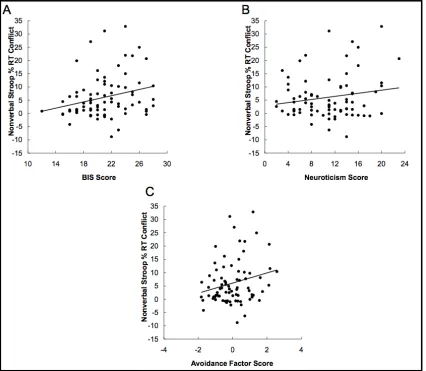
Figure 2.2. Correlations Between Nonverbal Percentage RT Conflict Effects
(N=79) and Personality Traits ………. 35
Figure 3.1. Correlation Between Residual Conflict Scores for Syntactic and Lexical Ambiguity Resolution Tasks ……… 66 Figure 3.2. Correlations Between Syntactic Trials (Proportion of Time Spent Looking
at the Incorrect Goal) and Lexical Trials (Median RT) for (A) Syntactic Ambiguous and Lexical Inconsistent Trials and (B) Syntactic Unambiguous and Lexical Consistent Trials ………. 67 Figure 3.3. Correlations Between Syntactic Trials (Percentage Trials with Looks to
CHAPTER 1: GENERAL INTRODUCTION
That individuals within a species demonstrate variation is hardly a new
observation. In his seminal work, Onthe Origin of Species, Charles Darwin (1859) noted
the following:
No one supposes that all the individuals of the same species are cast in the same
actual mould…These individual differences generally affect what naturalists consider
unimportant parts; but I could show by a long catalogue of facts, that parts which must
be called important, whether viewed under a physiological or classificatory point of
view, sometimes vary in the individuals of the same species. (p. 31)
Despite the recognition that individuals demonstrate variation across behaviors, much of
the research in the field of experimental psychology has viewed human behavior through
the lens of the group. That is, the individual has only been considered in so far as he or
she contributes to the estimate of central tendency for the particular behavior being
studied. The source of variation around this central tendency in individuals’ behaviors
has long been viewed as a source of noise in studies aimed at uncovering the
commonalities across humans (Cronbach, 1957; Kosslyn et al., 2002; Thompson-Schill,
Braver, & Jonides, 2005). By using the group as a means of sculpting psychological
theory, the field of experimental psychology rests on the assumption that individual and
our own in everyday life, this is clearly not the case. Researchers thus run the risk of
drawing erroneous conclusions about the individual. In an introduction to a special issue
of Cognitive, Affective, & Behavioral Neuroscience on the topic of individual-differences
research, Thompson-Schill et al. (2005) cautioned that “in some cases the estimate of the
sample mean might not actually describe anyone very well. Finally, and most
importantly, the mark of a theory’s explanatory power is the degree to which it makes
successful predictions not only about the central tendency of a population, but also about
the individuals within that population” (p.115).
Based on these lines of reasoning, several researchers have advocated for an
approach that employs both a group-based (experimental) and an individual-based
(correlational) view of behavior. Cronbach (1957) urged for such a union, noting that as
a result of combining these approaches, “we will come to realize that organism and
treatment are an inseparable pair and that no psychologists can dismiss one of the other as
error variance” (p. 683). Years later, Kosslyn et al. (2002) stressed the importance of
unifying these two approaches to psychology by providing several examples of how the
study of individual differences can be used to shed light on the processing mechanisms
underlying behavioral phenomena, such as mental imagery (see also Thompson-Schill et
al., 2005). Despite the initial reluctance of the field of experimental psychology, the use
of an individual-differences approach has become more prevalent in recent times in
several domains of psychology, including personality, decision-making, social reasoning,
In the studies described in Chapters 2 and 3, we applied an individual-differences
approach to the study of the following topics. In Chapter 2, we investigated the
interaction between motivational personality traits and cognitive control abilities. In
Chapter 3, we investigated the extent to which the same processing mechanisms are used
to resolve ambiguities across lexical and syntactic domains of language processing.
Furthermore, we incorporated a behavioral genetics approach to investigate this
commonality at the neurotransmitter level. Below, we describe these topics in more
detail as well as the utility of applying an individual-differences approach to their study.
Cognitive control has served as the focus of much research aimed at uncovering
the nature of the processing mechanisms that flexibly guide goal-directed behavior.
Several researchers have used an individual-differences approach to determine the
“atoms” of cognitive control. Miyake and colleagues (e.g. Friedman & Miyake, 2004;
Friedman et al., 2008; Miyake et al., 2000) have found related, yet separable, components
of cognitive control comprising response inhibition (“the ability to inhibit dominant,
automatic, or prepotent responses”), updating (“the ability to monitor incoming
information for relevance to the task at hand and then appropriately update by replacing
old, no longer relevant information with newer, more relevant information”), and
set-shifting (“the ability to flexibly shift back and forth between tasks or mental sets”)
(Friedman et al., 2008, p. 201). A parallel line of individual-differences research
involves the study of affective personality traits related to goal-directed behavior, or
motivational personality traits. Approach, or sensitivity to reward and positive affect,
fundamental dimensions of personality (see Carver, Sutton, & Scheier, 2000; Elliot &
Thrash, 2002). Davidson and colleagues (e.g. Davidson, 1992; Davidson & Fox, 1989;
Sutton & Davidson, 1997) have amassed a great deal of evidence showing that individual
differences in approach and avoidance sensitivity are related to hemispheric asymmetry
of neural activity. Whereas individuals with higher approach sensitivity demonstrate
greater left prefrontal activity, those with higher avoidance sensitivity tend to
demonstrate greater right prefrontal activity.
These lines of research have merged due to the demonstration that personality and
emotion can influence cognitive control abilities (see Gray, 2004 for a review). Emotion
has been viewed as a form of context, such that emotional states and personality traits can
flexibly modulate and guide goal-directed behavior (Gray & Braver, 2002; Revelle,
1993). The study of the interaction between emotion and cognitive control has been used
to shed light on the neural organization of these processing mechanisms. Similar to the
hemispheric asymmetry described above for approach and avoidance sensitivities, several
researchers have suggested that verbal and nonverbal working memory systems are
organized in a hemispheric-specific fashion (e.g. Smith & Jonides, 1999). Although there
is evidence to suggest that approach and avoidance states are differentially associated
with verbal and nonverbal working memory (Gray, 2001; Gray, Braver, & Raichle, 2002;
Shackman et al., 2006), previous studies have tended to use working memory tasks that
tap several different processing mechanisms. Thus, it remains unclear as to whether
The goal of Chapter 2 of this dissertation was to refine our understanding of the
interaction between personality and cognitive control. By using the Stroop task, which
isolates a single cognitive control factor (response inhibition), and manipulating content
domain (verbal/nonverbal), we were able to examine the association between approach
and avoidance with verbal and nonverbal cognitive control abilities. Furthermore, we
investigated approach and avoidance sensitivity at the trait level, in contrast to the state
manipulations employed by Gray and colleagues (2001, 2002). This allowed us to
explore the relationship between variation in performance on one of the most commonly
used tasks in cognitive control research and variation in stable personality characteristics.
This approach builds on the findings that individuals can vary in both personality traits as
well as in their cognitive control abilities and goes beyond these findings to ask how
individual differences in one system are associated with individual differences in the
other.
Whereas the focus of Chapter 2 was elucidating the differences between cognitive
control abilities in verbal and nonverbal domains in terms of their relationships with
personality traits, in Chapter 3 we investigated the extent to which there is commonality
between ambiguity resolution mechanisms. Ambiguity serves as a source of conflict
between competing representations and responses in a variety of domains of cognition.
In language processing, a great deal of research has focused on the processing
mechanisms underlying the resolution of lexical and syntactic ambiguities. Whereas
some researchers have argued that separate mechanisms resolve lexical and syntactic
Pickering, & Traxler, 2001), others have contended that the same processing mechanisms
are used to resolve both types of linguistic ambiguities (e.g. MacDonald, Pearlmutter, &
Seidenberg, 1994; Trueswell & Tanenhaus, 1994). These latter theories, known as
“constraint-satisfaction” or “constraint-based lexicalist” theories of language processing,
propose that syntactic ambiguities are actually ambiguities at the lexical level, and are
thus processed using the same mechanisms. Inherent in this assertion is an
individual-differences prediction: namely, that there should be correlated variation in individuals’
abilities to resolve lexical and syntactic ambiguities. Indeed, this result is necessary to
obtain in order to endorse constraint-satisfaction theories of language processing; yet, this
relationship has not yet been investigated. In an article entitled “Individual Differences
as a Crucible in Theory Construction”, Benton Underwood (1975) outlined the
importance of an individual-differences approach to experimental psychology research.
In particular, Underwood suggested that individual differences should be used as a
necessary component of theory construction and evaluation. Thus, if a theory predicts a
relationship between processes A and B, this is fundamentally an individual differences
prediction. If, in fact, the measure of a subject’s process A turns out to be unrelated (i.e.
shows a zero correlation) to the measure of the subject’s process B, this evidence should
be used to modify, or in some cases, reject the theory. Thus, as an essential test of
constraint-satisfaction theory, Chapter 3 describes our investigation of the relationship
between subjects’ abilities to resolve lexical and syntactic ambiguities.
lexical and syntactic ambiguity resolution tasks, what can we say about how this
mechanism operates? Evidence from recent neuroimaging (e.g. January, Trueswell, &
Thompson-Schill, 2009; Ye & Zhou, 2009) and neuropsychological studies (e.g. Novick,
Kan, Trueswell, & Thompson-Schill, 2009) suggests that more general cognitive control
mechanisms may underlie the resolution of linguistic ambiguities. In Chapter 3, we used
a behavioral genetics approach to further explore this hypothesis. Recent developments
in behavioral genetics have enabled the investigation of individual differences at the level
of the gene. The study of individual differences at multiple levels spanning behavior and
genes allows for a more comprehensive and powerful examination of the sources of
variation in humans. In Chapter 3, we demonstrate how the application of behavioral
genetic techniques to the study of linguistic ambiguity resolution mechanisms illustrates
the commonality across these mechanisms at the neurotransmitter level. In particular, we
explored whether genetic variation in catechol-O-methyltransferase (COMT), a gene
responsible for the regulation of dopamine levels in prefrontal cortex and associated with
variation in cognitive control abilities (see Goldberg & Weinberger, 2004 for a review),
is related to both syntactic and lexical ambiguity resolution abilities. The use of this
approach allowed us to bridge the literatures on genetic variation in COMT, cognitive
control abilities, and the processing mechanisms underlying linguistic ambiguity
resolution. As Underwood (1975) stated, “The whole idea behind behavioral theory is to
reduce the number of independent processes to a minimum; to find that performance on
process is a step toward this long-range goal” (p. 133). The study described in Chapter 3
represents such a step.
In sum, the goal of the studies presented in Chapters 2 and 3 was to use an
individual-differences approach to shed light on the processing mechanisms underlying
CHAPTER 2: PERSONALITY TRAITS PREDICT COGNITIVE CONTROL ABILITIES
Abstract
Previous studies suggest that the personality traits of approach and avoidance impact
cognitive control abilities. However, the nature of this relationship remains unclear. In
the current study, we aimed to address the following two questions: 1) Do approach and
avoidance predict individual differences in a specific cognitive control ability, namely the
ability to respond based on task-relevant information while ignoring task-irrelevant
information, and 2) Are these personality traits differentially associated with verbal and
nonverbal cognitive control abilities? The findings from the current study indicate that
approach and avoidance trait sensitivities predict Stroop performance. Furthermore,
whereas approach sensitivity was predictive of verbal Stroop performance, avoidance
sensitivity was predictive of nonverbal Stroop performance. We discuss these results in
the context of prior literature reporting differential distribution of neurochemical
pathways across the left and right hemispheres and note that the current findings are
Introduction
The relationship between personality traits and behavior has long served as a topic
of interest in psychology. Several researchers have proposed that the motivational
personality traits or “affective styles” (Davidson, 1992) of approach and avoidance serve
as fundamental dimensions of personality and behavior (e.g. Carver, Sutton, & Scheier,
2000; Elliot & Thrash, 2002). Approach motivation refers to behavior toward desired
stimuli, sensitivity to reward cues, and is associated with positive affective states.
Avoidance motivation is characterized by behavior away from aversive stimuli,
sensitivity to punishment cues, and is associated with negative affective states (see
Carver et al., 2000 for a review). Indeed, a great deal of prior animal research suggests
that approach and avoidance constitute core motivational systems guiding behavior that
rely on distinct neural substrates (Gray, 1972; 1990; Schneirla, 1959). The behavioral
activation system (BAS), which facilitates approach behavior and demonstrates
responsivity to reward cues, is thought to be mediated by dopaminergic pathways (Depue
& Collins, 1999). The behavioral inhibition system (BIS), which facilitates avoidance
and is associated with sensitivity to punishment, has been linked to functioning of the
septo-hippocampal system (Gray, 1972).
Much of the evidence for the mapping of BAS and BIS sensitivities onto neural
substrates in humans comes from electroencephalogram (EEG) and neuroimaging studies
demonstrating a relationship between positive affective state and trait variables and
Gable, 2009; Herrington et al., 2005; Sutton & Davidson, 1997; c.f. Coan & Allen, 2003).
This frontal cortical asymmetry has been more specifically related to the distinction
between approach and avoidance motivation in particular, rather than positive and
negative affect in general (e.g. Gable & Harmon-Jones, 2008; Harmon-Jones, 2003).
Additionally, the extent to which positive affective states tap approach motivation has
been found to influence the type of attentional processes recruited in a given task and the
extent of relative left frontal cortical activity (see Harmon-Jones & Gable, 2009; Rowe,
Hirsh, & Anderson, 2007). For example, Rowe, Hirsh, & Anderson (2007) demonstrated
that the inducement of a positive emotional state resulted in increased interference effects
on the flanker task relative to neutral or sad emotional states. From this finding, Rowe et
al. (2007) concluded that positive affective states serve to broaden or increase the scope
of perceptual attention. In contrast, Gable & Harmon-Jones (2008; 2009) have shown
that positive affect high in approach motivation results in a reduced scope of attention,
reflected in reduced focus on global versus local components of stimuli, and increased
relative left frontal activity. These results suggest the importance of motivational
variables in impacting cognitive control abilities (see also Amodio, Master, Yee, &
Taylor, 2008; Gray, 2004; Gray, Braver, & Raichle, 2002; Revelle, 1993).
Previous evidence also suggests that approach and avoidance motivation may be
differentially associated with verbal and nonverbal cognitive control abilities. Gray
(2001) demonstrated that the induction of approach motivational states improved verbal
working memory performance and impaired spatial working memory performance,
and impaired verbal working memory performance (see also Shackman et al., 2006).
Gray (2001) suggested that these selective influences of motivational states on cognitive
control abilities may stem from hemispheric lateralization underlying both
approach/avoidance motivation and verbal/nonverbal working memory. That is, the left
hemisphere may support both verbal working memory and approach motivation, whereas
the right hemisphere may support both nonverbal/spatial working memory and avoidance
motivation (see also Heller & Nitschke, 1997). Although Gray’s (2001) findings provide
intriguing evidence for selective modulation of cognitive control abilities by different
motivational states, they also raise several questions. For example, do approach and
avoidance motivations impact specific cognitive control abilities? The n-back task,
which was used in Gray (2001), taps several different processing mechanisms, including
active maintenance, updating, and response selection (Smith & Jonides, 1997). Thus, the
locus of impact of approach and avoidance sensitivity on verbal and nonverbal cognitive
control abilities requires further investigation.
Additionally, Gray (2001) focused on the role of motivational states in
influencing verbal and nonverbal working memory performance, noting that those
subjects with higher levels of approach and avoidance motivation at the trait level
demonstrated increased effects of the motivational state induction on working memory
performance. In the current study, we sought to determine whether individual differences
in trait motivation, in the absence of state inductions, predict verbal and nonverbal
control systems. Additionally, this finding has the potential to uncover a source of
variability in subjects’ cognitive control abilities, a topic of study for a vast number of
laboratory experiments in cognitive psychology.
Another question raised by previous research concerns the relationship between
other dimensions of personality and cognitive control abilities. Extraversion and
Neuroticism have been proposed as two dimensions of personality that are associated
with positive and negative affect, respectively (Eysenck & Eysenck, 1964). Lieberman
(2000) has suggested that extraverts are characterized by more efficient central executive
processing compared to introverts (c.f. Gray, 2001). These findings raise the question of
whether Extraversion and Neuroticism modulate cognitive control abilities in a selective
fashion, similar to BIS and BAS sensitivity. Furthermore, it has been proposed that the
commonality across different dimensions of personality lies in the distinction between
approach and avoidance motivation (e.g. Elliot & Thrash, 2002; Carver et al., 2000).
Elliot and Thrash (2002) demonstrated that measures of positive affective disposition,
Extraversion, and BAS loaded on a single factor, which they labeled as Approach
Temperament, and measures of negative affective disposition, Neuroticism, and BIS
loaded on a different factor, labeled as Avoidance Temperament. Based on these results,
Elliot and Thrash (2002) suggested that Approach and Avoidance Temperaments
represent core dimensions of personality that guide goal-directed behavior.
The goals of the current study were two-fold. First, we sought to determine
whether individual differences in trait sensitivity to the BIS/BAS and
(Stroop, 1935), which taps a specific cognitive control ability: responding on the basis of
task-relevant information while ignoring task-irrelevant information. Second, we aimed
to determine whether BIS/BAS and Neuroticism/Extraversion trait sensitivity are
differentially predictive of verbal and nonverbal Stroop performance. Based on the
results of Gray (2001) and Elliot & Thrash (2002), we predicted that an Approach factor,
reflecting the commonality across BAS and Extraversion, would predict better verbal
Stroop performance (i.e. smaller conflict effects), whereas an Avoidance factor, reflecting
the commonality across BIS and Neuroticism, would predict better nonverbal Stroop
performance.
Methods
Participants
Seventy-nine participants (26 men, 53 women, ages 18-35) participated in this study.
Data from one additional participant were excluded from all analyses due to at-chance
performance on the nonverbal Stroop task. All subjects were right-handed, native
speakers of English, and were not taking any psychoactive medications. Subjects were
paid at the rate of $10/hour for their participation, and the testing session lasted
approximately 1.5 hours. All subjects gave informed consent prior to participating in the
experiment according to guidelines established by the Institutional Review Board of the
University of Pennsylvania.
Materials
Subjects indicated the font color of a presented color word via button press on a computer
keyboard. Three possible response options were available to the subject: yellow, green,
and blue. A colored square corresponding to each color was affixed to a different key on
the computer keyboard, and subjects were instructed to press the key corresponding to the
appropriate color as quickly and as accurately as possible. Subjects were instructed to
use only their right hand when indicating their response. The verbal Stroop task featured
two main types of trials: congruent and incongruent. For congruent trials, the font color
matched the meaning of the word (e.g. “yellow” presented in yellow font color). Two
types of incongruent trials were included (see Milham et al., 2001). For half of the
incongruent trials, the font color did not match the meaning of the word, although the
word did name a possible response (e.g. “yellow” presented in a blue font color). For the
other half of incongruent trials, color words that were not potential response options (i.e.
“red”, “brown”, “orange”) were presented in yellow, green, or blue (e.g. “red” presented
in a blue font color). The inclusion of two types of incongruent trials was designed to
address experimental questions that are not germane to the goals of the current study.
Thus, all reported results collapse across both types of incongruent trials.
For each trial, subjects were first presented with a fixation cross for 1000 ms.
The stimulus was then presented for 1500 ms, followed by a 500 ms inter-trial interval
consisting of a blank screen. Subjects completed four blocks of each task, where each
block comprised 72 trials: 36 congruent trials and 36 incongruent trials. Trials were
presented in a fixed pseudo-randomized order across all subjects. Subjects also
task in order to familiarize them with the stimuli and task procedures. Stimuli were
presented and responses were collected with E-prime software (Schneider, Eschman, &
Zuccolotto, 2002).
Nonverbal Stroop Task
A novel variant of the nonverbal Stroop task that was originally developed by Pomerantz
(1983) was used in the current study. Subjects viewed a moving square window (global
motion) containing moving dots (local motion) and indicated the direction of (local)
motion of the dots, by pressing either the left or right key of two designated keys on a
computer keyboard. Subjects were instructed to use only their right hand when indicating
their response. The window and dots appeared in black and were presented on a white
background. As in the verbal Stroop task, subjects were presented with two types of
trials: congruent and incongruent. For congruent trials, local and global motion occurred
in the same direction (e.g. window moving to the right containing dots moving to the
right). Two types of incongruent trials were included. For half of the incongruent trials,
local motion occurred in the direction opposite of global motion, which was also a
potential response option (e.g. window moving to the left containing dots moving to the
right). For the other half of incongruent trials, global motion occurred in either the up or
down direction, which were not potential response options (e.g. window moving up
containing dots moving to the right). As for the verbal Stroop task, all reported results
Trial timing parameters and the number of trials in each condition were the same
as for the verbal Stroop task described above. Stimuli were presented and responses were
collected with MATLAB® software (2007a, The Mathworks).
Behavioral Inhibition/Behavioral Activation Scales (BIS/BAS)
Subjects completed the BIS/BAS scales (Carver & White, 1994). These scales were
developed to assess trait sensitivity to the punishment (BIS) and reward (BAS)
responsive systems. The BIS scale consists of 7 items, each of which is designed to
assess individuals’ sensitivity to punishment cues (e.g. “If I think something unpleasant is
going to happen, I get pretty worked up”). The BAS scale consists of a total of 13 items,
each of which assesses individuals’ sensitivity to cues of reward. The BAS scale
comprises three sub-scales: BAS-Drive (4 items; e.g. “When I want something, I usually
go all-out to get it”), BAS-Fun Seeking (4 items; e.g. “I’m always willing to try
something new if I think it will be fun”), and BAS-Reward Responsiveness (5 items; e.g.
“When good things happen to me, it affects me strongly”). Subjects responded using a
scale ranging from 1 (strongly disagree) to 4 (strongly agree). The sums of responses to
items from each scale were used as BIS and BAS scores in further analyses. BAS scores
correspond to the sum of responses to items from the three BAS subscales.
Carver & White (1994) demonstrated the high internal reliability (α ranging from
0.66 – 0.76) and high test-retest reliability (ranging from 0.59-0.69) for these scales.
Additionally, Carver & White (1994) demonstrated the convergent and discriminant
validity of the BIS/BAS scales as well as their predictive power by showing that subjects’
subjects’ BAS scores were predictive of self-reported happiness levels in response to
reward.
Eysenck Personality Inventory (Form A)
Subjects completed Form A of the Eysenck Personality Inventory (Eysenck & Eysenck,
1964), which comprises the following dimensions: Extraversion (24 items, e.g. “Do other
people think of you as being very lively?”), Neuroticism (24 items, e.g. “Would you call
yourself tense or highly strung?”), and Lie (9 items, e.g. “Are all your habits good and
desirable ones?”). The Neuroticism scale was designed to measure subjects’ tendency to
experience negative affect, whereas the Extraversion scale was designed to assess
subjects’ sociability, impulsivity, and activity levels. Subjects responded by pressing
either “1” (yes) or “2” (no). “No” responses were later recoded as “0” for scoring
purposes. The interpretation of the Lie dimension has been the subject of debate (see
Knowles & Kreitman, 1965), and as it does not constitute the focus of the current study,
we report only the results from the Extraversion and Neuroticism scales. Several studies
(e.g. Eysenck & Eysenck, 1964) have demonstrated the high internal reliability (α
ranging from 0.80 – 0.90) and high test-retest reliability (ranging from 0.85 – 0.94) of the
Extraversion and Neuroticism scales.
Procedure
Subjects completed the tasks and questionnaires in the following order: Verbal Stroop,
Nonverbal Stroop, BIS/BAS scales, and the Eysenck Personality Inventory (Form A).
minimize measurement error resulting from participant x task order interactions (e.g.
Friedman & Miyake, 2004; Friedman et al., 2008; Miyake et al., 2000).
Statistical Procedures
Conflict effects were more robust in the first two blocks compared with all four blocks
for the nonverbal Stroop task (t[78] = 3.06, p < 0.01). This is likely due to subjects
becoming more practiced over the course of the nonverbal Stroop task, resulting in
smaller conflict effects across all four blocks of the task. Thus, in order to better assess
the relationship between personality variables and conflict effects, all reported results
include data from only the first 2 blocks for both the verbal and nonverbal Stroop tasks.
For both verbal and nonverbal Stroop tasks, a within-subject trimming procedure
recommended by Wilcox & Keselman (2003) was applied to each subject’s reaction time
(RT) data. For each subject and each condition, RTs whose deviation from the median
was greater than 3.32 times the median absolute deviation were excluded prior to
calculating mean RTs. This procedure resulted in no more than 9.4 % of observations
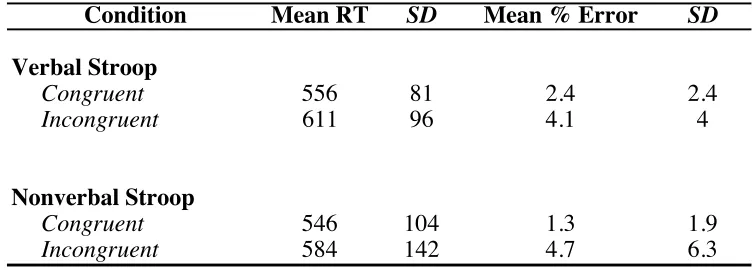
excluded in each condition. Mean RTs and percent error rates for verbal and nonverbal
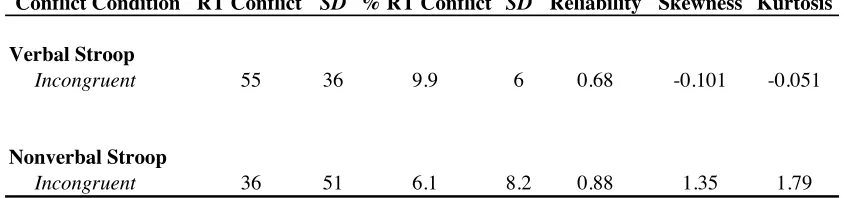
Stroop tasks are presented in Table 2.1. RT conflict effects expressed as difference
scores (incongruent RT – congruent RT) and as percentage RT conflict effects
[(incongruent RT – congruent RT)/congruent RT] are presented in Table 2.2. Only
correct trials were included in all RT analyses.
Due to low error rates for both verbal and nonverbal Stroop tasks, all correlational
analyses were performed on the RT data, which revealed more robust conflict effects.
personality variables on overall speed for congruent and incongruent conditions, all
correlations were calculated using percentage RT conflict effects. In order to improve
normality and reduce the influence of extreme values, an additional trimming procedure
was employed. Observations greater than three standard deviations from the group mean
were replaced with observations three standard deviations from the mean for each
variable included in correlational analyses (see Friedman et al., 2008). No more than 1.3
% of the observations for each variable were affected by this additional trimming
procedure.
Results
BIS/BAS Scales & Eysenck Personality Inventory (Form A)
Means, standard deviations, ranges, reliabilities, and correlations for the BIS, BAS,
Neuroticism, and Extraversion scales are presented in Table 2.3. These values are similar
to those reported in previous studies using these measures (e.g. Carver & White, 1994;
Gray, 2001; Knowles & Kreitman, 1965). BIS and total BAS scores (across all three
subscales) were not significantly correlated, and Neuroticism and Extraversion scores
were also not significantly correlated. In order to ensure the independent contributions of
BIS and BAS scores to Stroop performance, all reported correlations with BIS scores
control for BAS scores (and vice versa). Additionally, in order to present the correlations
with Neuroticism and Extraversion in a parallel fashion to the BIS/BAS results, all
reported correlations with Neuroticism scores control for Extraversion scores (and vice
For the verbal Stroop task, subjects demonstrated significantly longer reaction times
(t[78] = 13.68, p < 0.001) and higher error rates (t[78] = 4.14, p < 0.001) for incongruent
compared to congruent trials. Similarly, for the nonverbal Stroop task, subjects
demonstrated significantly longer reaction times (t[78] = 5.60, p < 0.001) and higher
error rates (t[78] = 5.27, p < 0.001) for incongruent compared to congruent trials.
Verbal Stroop & Personality
We first examined the relationship between reaction times for verbal Stroop congruent
and incongruent conditions with BIS/BAS and Neuroticism/Extraversion scores.
Separate repeated measures ANCOVAs were performed for BIS/BAS and
Neuroticism/Extraversion, with condition (congruent/incongruent) as a within-subjects
factor, and BIS/BAS and Neuroticism/Extraversion scores as covariates. A significant
BAS x condition interaction effect (F[1,76] = 4.10, p < 0.05) and a marginally significant
Extraversion x condition interaction effect (F[1,76] = 3.52, p = 0.064) were found. The
condition x BIS and condition x Neuroticism interaction effects failed to approach
significance (F’s < 1).
In order to examine these interaction effects with BAS and Extraversion further,
correlations were calculated between these personality measures and verbal Stroop
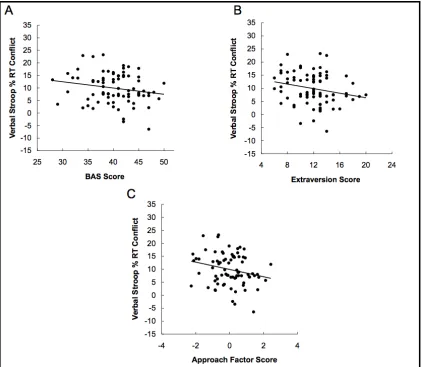
percentage RT conflict effects. A marginally significant negative correlation was found
between verbal Stroop percentage RT conflict and BAS total scores (r= -0.20, p = 0.076)
(Figure 2.1 A)1. Additionally, a significant negative correlation was found between
1 All reported correlations were also calculated without controlling for the relevant personality variables,
Extraversion and verbal Stroop percentage RT conflict effects (r= -0.223, p < 0.05)
(Figure 2.1 B). Thus, those subjects who had higher BAS and Extraversion scores tended
to demonstrate smaller verbal Stroop conflict effects.
Nonverbal Stroop & Personality
As for the verbal Stroop task, separate repeated measures ANCOVAs were performed for
BIS/BAS and Neuroticism/Extraversion, with condition (congruent/incongruent) as a
within-subjects factor, and BIS/BAS and Neuroticism/Extraversion scores as covariates.
A significant BIS x condition interaction effect (F[1,76] = 4.72, p < 0.05) and marginally
significant Neuroticism x condition interaction effect (F[1,76] = 2.92, p = 0.092) were
found. Interestingly, we also found a marginally significant condition x Extraversion
interaction effect (F[1,76] = 3.33, p = 0.072). However, the condition x BAS interaction
effect failed to approach significance (F < 1).
We further investigated the interaction effects with BIS, Neuroticism, and
Extraversion by calculating correlations between these measures and nonverbal Stroop
percentage RT conflict effects. We found a significant relationship between BIS scores
and nonverbal Stroop percentage RT conflict effects (r= 0.25, p < 0.05) (Figure 2.2 A);
however, the correlation between Neuroticism scores and nonverbal Stroop percentage
RT conflict effects failed to reach significance (r= 0.17, p = 0.13) (Figure 2.2 B).
Interestingly, both of these correlations were in the positive direction, indicating that
higher self-reported BIS and Neuroticism predicted larger nonverbal Stroop conflict
effects. We return to potential explanations for these findings in the Discussion section.
A marginally significant negative correlation was also found between Extraversion and
nonverbal Stroop percentage RT conflict effects (r= -0.22, p = 0.053).
Approach/Avoidance Factors & Stroop Performance: Exploratory Factor Analysis
A principal components exploratory factor analysis (EFA) using varimax rotation was
performed on the following six personality variables: BAS-Reward Responsiveness,
BAS-Fun Seeking, BAS-Drive, Extraversion, BIS, and Neuroticism scores.2 Two factors
with eigenvalues greater than 1.0 were obtained. The first factor, on which the BAS
subscales and Extraversion loaded most highly, accounted for 37.28 % of the variance.
The second factor, on which the BIS and Neuroticism scales loaded most highly,
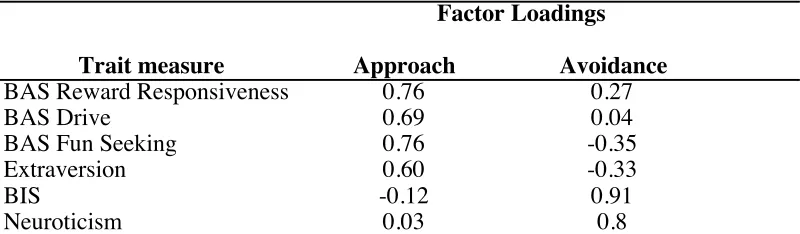
accounted for 25.89 % of the variance. Factor loadings for both factors are presented in
Table 2.4. These results indicate two distinct factors that are similar to the Approach and
Avoidance Temperaments derived by Elliot & Thrash (2002).
We next correlated regression factor scores for the Approach and Avoidance
factors with subjects’ verbal and nonverbal Stroop percentage RT conflict effects. The
Approach factor score predicted smaller verbal Stroop percentage RT conflict effects (r=
-0.24, p < 0.05) (Figure 2.1 C); however, the Approach factor score was not significantly
associated with subjects’ nonverbal Stroop percentage RT conflict effects (r= -0.09, p =
0.42). The Avoidance factor score predicted larger nonverbal Stroop percentage RT
conflict effects (r= 0.23, p < 0.05) (Figure 2.2 C); however, the Avoidance factor score
2 A principal components EFA was also performed using direct oblimin rotation. This EFA yielded highly
was not significantly associated with subjects’ verbal Stroop percentage RT conflict
effects (r= -0.03, p = 0.806). Although this pattern of results is suggestive of
domain-specificity, the strength of these correlations was not significantly different between
verbal and nonverbal Stroop percentage RT conflict effects for the Approach or
Avoidance Factors (p ‘s> 0.12).
Discussion
The previous literature suggests that personality traits influence cognitive control
abilities. However, several of these studies (e.g. Gray, 2001; Gray et al., 2002;
Shackman et al., 2006) have employed the n-back task, which precludes specification of
which processing mechanisms are impacted by different motivational systems. The
current study provides novel evidence indicating that approach and avoidance trait
sensitivities were predictive of performance on the Stroop task, suggesting that these
personality traits are associated with a specific cognitive control ability.
The results of the current study also provide novel evidence indicating that
whereas approach sensitivity was predictive of verbal (and not nonverbal) Stroop
performance, avoidance sensitivity was predictive of nonverbal (and not verbal) Stroop
performance. The association between approach and verbal cognitive control ability, on
the one hand, and avoidance and nonverbal cognitive control ability, on the other hand, is
consistent with a large body of literature on hemispheric differences in affective and
cognitive processing (e.g. Harmon-Jones, 2003; Harmon-Jones & Gable, 2009; Heller &
verbal n-back performance and impaired spatial n-back performance. The opposite
pattern of results was found for avoidance motivational states (c.f. Shackman et al.,
2006). Our results are consistent with Gray (2001) in terms of the association between
approach sensitivity and facilitated performance on a verbal cognitive control task
(although not with the association between approach and impaired nonverbal cognitive
control performance). However, based on Gray (2001)’s findings, we had predicted that
avoidance trait sensitivity would be associated with smaller nonverbal Stroop conflict
effects. That is, if the right hemisphere supports nonverbal processing and an avoidant
motivational style, one might expect that individuals higher in avoidance motivation
might be facilitated on the nonverbal Stroop task. However, our results indicate that
higher avoidance trait sensitivity resulted in larger nonverbal Stroop conflict effects.
What could explain this pattern of results?
One possible explanation stems from previous research suggesting that whereas
the left hemisphere is specialized for local processing, the right hemisphere is specialized
for global, or more holistic, processing (e.g. van Kleeck, 1989; Delis, Robertson, &
Efron, 1986). Furthermore, Volberg & Hübner (2004) have demonstrated that
hemispheric differences are more pronounced in situations of conflict between local and
global dimensions of stimuli. In light of these results, it is important to note that the
nonverbal Stroop task used in the current study involves conflict between local and
global dimensions. In particular, subjects were instructed to report the direction of
motion of local elements (i.e. the moving dots) in the face of interference from global
to larger nonverbal Stroop conflict effects due to increased attention to the global,
irrelevant dimension of the stimulus. This account would lead one to predict that if
subjects were required to focus on the global dimension of a stimulus while ignoring the
local elements, greater avoidance trait sensitivity might be associated with smaller
nonverbal conflict effects. This prediction as well as the relationship between avoidance
trait sensitivity and performance on other nonverbal conflict tasks, including those that do
not feature conflict between local and global dimensions, should be investigated in future
research.
It is important to note that the strength of the correlations between approach and
verbal Stroop conflict effects, on the one hand, and approach and nonverbal Stroop
conflict effects, on the other hand, were not significantly different. Similarly, no
significant difference was found in the strength of correlations between avoidance and
verbal and nonverbal Stroop conflict effects. We do not wish to over-interpret null
results, and it is possible that with a larger sample size, the correlation between approach
and nonverbal Stroop (as well as the correlation between avoidance and verbal Stroop)
may reach significance. Nonetheless, the pattern of results reported in the current study
is suggestive of domain-specificity in the interaction between cognitive and affective
processes. Although the association between approach/avoidance motivation and
verbal/nonverbal cognitive control ability is consistent with previously reported results
pertaining to hemispheric lateralization, the question remains as to what exactly this
differential distribution of neurotransmitter pathways across the right and left
hemispheres. Whereas dopamine levels tend to be higher in the left hemisphere (Glick,
Ross, & Hough, 1982), higher levels of norepinephrine and serotonin have been found in
the right hemisphere (Gottfries, Perris, & Roos, 1974; Oke, Keller, Mefford, & Adams,
1978). This differential activity of neurotransmitter pathways across the left and right
hemispheres has been tied to different modes of attentional processing, which in turn,
have been associated with differential affective and cognitive consequences (see Tucker
& Williamson, 1984 for a review). For example, the greater activity of dopamine
pathways in the left hemisphere has been associated with more tonic forms of attention.
The greater activity of norepinephrine and serotonin pathways in the right hemisphere has
been associated with arousal and a global, receptive mode of information processing.
Furthermore, research in non-human animals has implicated dopaminergic pathways in
mediating extraversion and the BAS, whereas noradrenergic and serotonergic pathways
have been proposed to mediate neuroticism and the BIS (Depue & Collins, 1999; Gray &
McNaughton, 2000; Wallace & Newman, 1997).
In light of these previous findings, Braver, Gray, & Burgess (2008) have proposed
a link between approach sensitivity and a proactive mode of cognitive control, which
involves the active, sustained maintenance of task-relevant information. In contrast,
Braver et al. (2008) have suggested that avoidance sensitivity may be associated with a
reactive mode of cognitive control, which operates in a transient fashion and is triggered
in response to a stimulus. Thus, it is possible that the greater dopamine activity in the left
information, resulting in smaller conflict effects in the domain supported by the left
hemisphere (i.e. verbal). In contrast, the greater activity of the norepinephrine and
serotonergic systems in the right hemisphere may underlie avoidance sensitivity and a
more reactive, global mode of control, resulting in larger conflict effects in the domain
supported by the right hemisphere (i.e. nonverbal). Although the current study was not
designed to explicitly test this hemispheric hypothesis, it appears to be a plausible
explanation for the results of the current study and should be investigated in further
research. Furthermore, given the demonstration of unity and diversity of executive
functions (e.g. Miyake et al., 2000), future studies should investigate whether individual
differences in approach and avoidance are predictive of other cognitive control abilities,
such as updating and set-shifting.
In sum, we found that personality traits are associated with cognitive control
abilities. Higher approach trait sensitivity was associated with increased ability to ignore
task-irrelevant information in the verbal domain, whereas higher avoidance trait
sensitivity was associated with decreased ability to ignore task-irrelevant information in
the nonverbal domain. Furthermore, we have shown that individual differences in
personality traits, in the absence of state manipulations, are associated with individual
differences in cognitive control abilities. By demonstrating the association between
personality traits and a specific cognitive control ability, these results serve to refine our
Table 2.1. Performance Summary for Verbal and Nonverbal Stroop Tasks.
Note. RTs are given in milliseconds. SD corresponds to standard deviation. N = 79 for verbal and nonverbal Stroop tasks.
Condition Mean RT SD Mean % Error SD
Verbal Stroop
Congruent 556 81 2.4 2.4
Incongruent 611 96 4.1 4
Nonverbal Stroop
Congruent 546 104 1.3 1.9
Table 2.2. Conflict Effects for Verbal and Nonverbal Stroop Tasks.
Note. Conflict condition, incongruent trials compared to the congruent condition; RT Conflict, mean reaction time difference scores in milliseconds; % RT Conflict, mean percentage RT conflict ([incongruent-congruent]/congruent); Reliability, split-half (odd-even) correlations for percentage RT conflict effects adjusted with the Spearman-Brown prophecy formula; Skewness and Kurtosis, skewness and kurtosis statistics for
percentage RT conflict effects. SD corresponds to standard deviation. N = 79 for verbal and nonverbal Stroop tasks.
Conflict Condition RT Conflict SD % RT Conflict SD Reliability Skewness Kurtosis
Verbal Stroop
Incongruent 55 36 9.9 6 0.68 -0.101 -0.051
Nonverbal Stroop
Table 2.3. Descriptive Statistics for Self-Report Personality Trait Measures.
Note. BIS = Behavioral Inhibition System; BAS (Total) = Behavioral Activation System (sum of the three BAS subscale scores). Reliability was calculated using Cronbach’s alpha. SD corresponds to standard deviation. N = 79 for verbal and nonverbal Stroop tasks.
** p < 0.05.
Zero-order correlations (r)
Trait measure Range M SD Reliability BIS BAS(Total) Extraversion
BIS 12-28 20.94 3.57 0.81 -
-BAS (Total) 28-50 40.23 4.6 0.8 -0.142 -
Table 2.4. Approach and Avoidance Factor Loadings.
Note. BAS = Behavioral Activation System; BIS = Behavioral Inhibition System. Factor Loadings
Trait measure Approach Avoidance
BAS Reward Responsiveness 0.76 0.27
BAS Drive 0.69 0.04
BAS Fun Seeking 0.76 -0.35
Extraversion 0.60 -0.33
BIS -0.12 0.91
Figure Captions
Figure 2.1. Correlations between verbal percentage RT conflict effects (N = 79) and (A)
BAS total scores (B) Extraversion scores (C) Approach factor scores. Lines shown
indicate trend lines. Corresponding Pearson r coefficients for partial correlations
controlling for relevant personality variables provided in main text.
Figure 2.2. Correlations between nonverbal percentage RT conflict effects (N = 79) and
(A) BIS scores (B) Neuroticism scores (C) Avoidance factor scores. Lines shown
indicate trend lines. Corresponding Pearson r coefficients for partial correlations
CHAPTER 3: COMMON MECHANISMS UNDERLYING LEXICAL AND
SYNTACTIC AMBIGUITY RESOLUTION
Abstract
Within the domain of language processing, an important unresolved question is whether
the same processing mechanisms are involved in lexical and syntactic ambiguity
resolution. The extent to which there is correlated variation in individuals’ abilities to
resolve lexical and syntactic ambiguities as well as the neurochemical underpinnings of
these mechanisms have not yet been investigated. In the current study, subjects were
tested on separate syntactic and lexical ambiguity resolution tasks, and they were also
genotyped for the val158met polymorphism in the catechol-O-methyltransferase (COMT)
gene, involved in prefrontal cortical dopamine regulation. A significant relationship was
found between subjects’ ability to resolve ambiguities across both tasks. In particular,
those subjects who had more difficulty resolving lexical ambiguities also demonstrated
greater difficulty in revising their initial interpretation of syntactically ambiguous
sentences. Furthermore, preliminary evidence suggests that variation in a gene related to
dopamine regulation in prefrontal cortex is related to both lexical and syntactic ambiguity
resolution abilities. These results support constraint-satisfaction models of language
processing and suggest that similar processing mechanisms are employed to resolve both
Introduction
Ambiguity is prevalent in language processing. Consequently, a great deal of prior
research has focused on the mechanisms underlying the resolution of different types of
linguistic ambiguities, with a particular focus on lexical and syntactic ambiguities.
However, these lines of research have largely progressed in a parallel fashion under the
view that lexical and syntactic ambiguities are processed via different mechanisms. In
the current study, we provide evidence that challenges this view and suggests
commonality in processing of lexical and syntactic ambiguities. Below, we first review
the literature on lexical and syntactic ambiguity resolution, as they have been viewed
separately, and then discuss theories that propose a framework in which both types of
linguistic ambiguities are resolved using the same processing mechanisms.
Several researchers have aimed to determine how and at what point in time contextual
information influences lexical ambiguity resolution. Some have supported a modular
view of the lexicon, arguing that all meanings of a lexically ambiguous item are
automatically activated and that context plays a role in lexical selection only after initial
access of multiple meanings (e.g. Conrad, 1974; Lucas, 1987; Onifer & Swinney, 1981;
Prather & Swinney, 1988; Swinney, 1979; Tanenhaus, Leiman, & Seidenberg, 1979). An
alternative view is that context leads to selective access of only the contextually
appropriate meaning (e.g. Glucksberg, Kreuz, & Rho, 1986; Schvaneveldt, Meyer, &
Becker, 1976; Simpson, 1981).
The question of when context influences ambiguity resolution has also featured
path” model, a serial depth-first model, has played a dominant role in the field of research
on syntactic ambiguity resolution. This model proposes that upon encountering a
syntactic ambiguity, a single syntactic structure is considered and that context plays a role
in guiding interpretation only later in processing (e.g. Ferriera & Clifton, 1986; Frazier &
Clifton, 1997; Frazier & Rayner, 1982). According to these models, only the
grammatical structure of the sentence constrains its interpretation initially. If the initial
analysis proves to be incompatible with the information available, only then is an
alternative interpretation of the sentence constructed, incorporating non-syntactic features
(e.g. thematic and discourse) of the input.
The modular nature of serial models, such as the “garden-path model”, can be
contrasted with interactive models, namely “constraint-satisfaction”, or “constraint-based
lexicalist”, models of language processing. According to these theories, language
comprehension functions as an interactive process whereby evidence across several
linguistic representational levels, such as phonology, semantics, and syntax, is combined
in order to arrive at a single interpretation of the linguistic input (e.g. Gibson &
Pearlmutter, 1998; MacDonald, Pearlmutter, & Seidenberg, 1994; Novick, Trueswell, &
Thompson-Schill, 2005; Trueswell & Tanenhaus, 1994). Consistent with this framework,
some studies of lexical ambiguity resolution have demonstrated that context can serve as
a constraint in guiding lexical access (e.g. Duffy, Morris, & Rayner, 1988; Sereno,
Brewer, & O’Donnell, 2003; Swaab, Brown, & Hagoort, 2003; Tabossi, 1988) as well as
2008; St. John & McClelland, 1990; Tanenhaus, Spivey-Knowlton, Eberhard, & Sedivy,
1995; Trueswell, Sekerina, Hill, & Logrip, 1999; Trueswell & Tanenhaus, 1994; c.f.
Clifton et al., 2003; Frazier, 1995; Pickering & Traxler, 1998; van Gompel, Pickering,
Pearson, & Liversedge, 2005 for alternative accounts). Under the constraint-satisfaction
framework, both lexical and syntactic ambiguities are thought to involve ambiguities
concerning lexical representations, where each lexical item is presumed to specify a great
deal of syntactic information, such as verb subcategorization and thematic role
information. Thus, in contrast to serial models of sentence comprehension,
constraint-satisfaction models suggest that lexical and syntactic ambiguities are resolved using the
same processing mechanisms.
Another source of evidence for the commonality underlying lexical and syntactic
ambiguity resolution stems from the neuroimaging and neuropsychological literatures.
Several neuroimaging studies have found greater activation in left ventrolateral prefrontal
cortex (lVLPFC), a region implicated in cognitive control (see Miller & Cohen, 2001 for
a review), during the resolution of syntactic (e.g. January, Trueswell, &
Thompson-Schill, 2009; Mason, Just, Keller, & Carpenter, 2003) and lexical (e.g. Bedny, McGill, &
Thompson-Schill, 2008; Rodd, Davis, & Johnsrude, 2005) ambiguities. Furthermore,
neural co-localization has been shown for syntactic ambiguity resolution as well as
performance on cognitive control tasks, such as the Stroop and flanker tasks (e.g. January
et al., 2009; Ye & Zhou, 2009). Critically, neuropsychological studies have also
demonstrated that damage to lVLPFC results in processing deficits when resolving