Ranking Efficient DMUs Using the Tchebycheff Norm with Fuzzy Data in
DEA
S. H. Mirzaei1,, A. Salehi2
1Department of Mathematics, Islamic Azad University, Arak Branch, Arak, Iran.
2Department of Mathematics, Islamic Azad University, Science and Research, Tehran Branch, Tehran, Iran. A B S T R A C T
In many real applications, the data of production processes cannot be precisely measured. Hence the input and output of Decision Making Units (DMUs) in Data Envelopment Analysis (DEA) may be imprecise or fuzzy-numbered. In original DEA models, inputs and outputs are measured by exact values on a ratio scale, therefore conventional DEA can't easily measure the performance of DMUs and rank them. The researchers have introduced mane deferent model for ranking DMUs by fuzzy number. In this paper, we proposed a new method by using the Tchebycheff norm for ranking DMUs with fuzzy data. We explain our method by numerical example with the triangular fuzzy number. Keywords: Data envelopment analysis, Ranking, Tchebycheff norm, Fuzzy system.
Article history: Received: 28 January 2019 Revised: 03 May 2019 Accepted: 08 June 2019
1. Introduction
Data Envelopment Analysis (DEA) is a powerful approach in measuring efficiency of decision making units with multiple inputs and outputs. DEA was introduced by Charnes et al. [4] and extended by Banker et al. [2]. DEA successfully divides them into two categories, efficient DMUs and inefficient DMUs. One of the main challenges associated with the application of DEA is the difficulty in quantifying some of these input and output factors. In other words, a key to success of the DEA approach is the accurate measure of all factors, including inputs and outputs. However, a production process usually involves complicated inputs and outputs; in that many factors are very difficult to measure in a precise manner. This makes an approach which is able
Corresponding author
E-mail address: [email protected] DOI: 10.22105/riej.2019.169577.1072
International Journal of Research in Industrial
to deal with inexact numbers or numbers in ranges and desirable. One way represented the uncertain values by membership functions of the fuzzy set theory [20]. When some observations are fuzzy, the goal and constraints in the decision process become fuzzy as well. We can find several fuzzy approaches to the assessment of efficiency in the DEA literature. Sengupta [16] was the first to introduce a fuzzy mathematical programming approach where the constraints and objective function are not satisfied crisply. In his paper, a generalization of DEA models is considered for DMUs with multiple inputs and a single output. A fuzzy k-means clustering approach as a means of identifying unusual and/or extreme efficiency behavior is proposed in [14]. In Cooper et al. [5], the imprecise DEA method has been developed. This method permits mixture of imprecisely data within specified bounds and exactly known data. Kao and Liu [11] developed a method to find the membership functions of the fuzzy efficiency scores when some observations are fuzzy numbers. After evaluation DMUs by DEA model may be more than one DMU be efficient. For elimination this problem the ranking models are proposed. Some methods for ranking efficient DMUs with crisp data are proposed. Anderson and Petersen [1] evaluated that a DMUs efficiency possibly exceeds the conventional score 1.0, by comparing the DMU evaluated with a linear combination of other DMUs, while excluding the observations of the DMU evaluated. They tried to discriminate between these efficient DMUs, by using different efficiency scores larger than 1.0. Mehrabian et al. [12] presented the popular of these methods. These methods would have some deficiencies if data have certain structures. There are some methods based on norms. Jahanshahloo et al. [10] introduced an 𝐿1-norm approach that removes
some deficiencies arising from AP and MAJ, but that cannot rank non-extreme DMUs. Also Balf et al. [13] used the Tchebycheff norm for ranking DMUs. All the models that were proposed for ranking DMUs with crisp data aren´t able to ranking DMUs whit fuzzy data, therefore researchers tried to find models for ranking fuzzy DMUs. Jahanshahloo et al. [9] proposed ranking DMUs by L1-norm with fuzzy data in DEA. In this paper, by considering fuzzy DMUs we propose a new method based on Tchebycheff norm for ranking DMUs. Our proposed model is written based on domination between under evaluation DMU and other DMUs those are belong to the
𝑇𝐶′ that 𝑇
𝐶′ obtained by omitting under evaluated DMU from TC (Production Possibility Set (PPS)
of CCR model). This paper consists of the following sections: Preliminary of fuzzy is presented in Section 2, review of ranking models is introduced in Section 3. In Section 4 we present our model, finally, an example with fuzzy data and then the conclusion be given.
2. Preliminaries
2.1. Fuzzy Numbers
Definition 1. A fuzzy number is a fuzzy set like:RI [0,1] which satisfies [8]:
𝜇 is upper semi-continuous.
𝜇(x) = 0 outside some interval[𝑎, 𝑑].
𝜇 (x) is monotonic increasing on [𝑎, 𝑏],
𝜇 (x) is monotonic decreasing on [𝑐, 𝑑],
𝜇 (x) = 1, b x c.
2.2. Distance Measure for Fuzzy Numbers
A fuzzy set 𝐴 = (𝑎1, 𝑎2, 𝑎3, 𝑎4) is called a generalized left right fuzzy numbers (GLRFN) if its
membership function satisfy the following (see [18]):
2
1 2
2 1
2 3
3
3 4
4 3
( ) ,
1 ,
( )
( ) ,
0 ,
a x
L a x a
a a
a x a x
x a
R a x a
a a
else
(1)
Where L and R, are strictly decreasing functions defined on [0, 1] and satisfying the conditions:
( ) ( ) 1 0
L x R x if x , (2)
( ) ( ) 0 0
L x R x if x . (3)
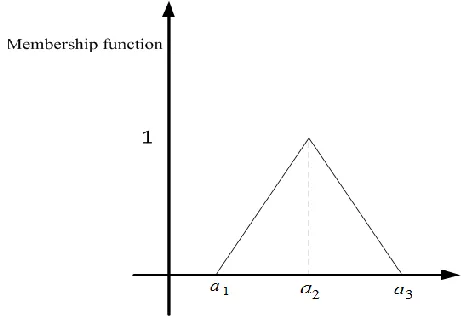
For a2 = a3, we have the classical definition of Left Right Fuzzy Numbers (LRFN) of [7]. As described by [3], Triangular Fuzzy Numbers (TFN) are special cases of GLRFN with
( ) ( ) 1
L x R x x and a2 = a3. A triangular fuzzy number is denoted as Ã= (a1,a2,a3), see Figure 1.
Figure 1. Triangular fuzzy number.
Definition 2. (𝛼-level set or 𝛼-cut). The 𝛼-cut of a fuzzy set 𝐴̃ is a crisp subset of X and is denoted by A
x A( )x
[7].A GLRFN A is denoted as ( ,1 2, ,3 4) A A
L R
A a a a a and an -level interval of fuzzy number A as ( ) ( l( ), u( ))LR
A A A
1
2 2 1
( ) ( ) ( )
l
A
A a a a L
1
3 4 3
( ) ( ) ( )
u
A
A a a a R .
(5)
Let F be the family of the fuzzy numbers on R.
Definition 3. ForA B, F, define the signed distance of A B, as follows (see [18]):
1 0
( , ) ( )[( l( ) l( )) ( u( ) u( ))]
d A B
w A B A B d. (6) Here, w( ) is weighting function thatw : [0,1][0,1]. If1 0
1 ( )
2
w d
then we say thatw( ) is a regular function.Definition 4. ForA B, F, define the ranking of A B, by saying (see [19]): ( , ) 0
( , ) 0
( , ) 0 .
d A B if A B d A B if A B d A B if A B
(7)
Definition 5. Letbe a fuzzy number with-cut representation(L(0),R(0))and let : [0,1] [0,1]
w be a reducing function. Then the value of (with respect to w) is (see [6]):
1 0
( ) ( )[ ( ) ( )]
w
V al
w L R d . (8)Property 1. For a trapezoidal fuzzy number T = (a1, a2, a3, a4) and w( ) it is easy to show that:
3 2 [( 4 3) ( 2 1)]
( )
2 6
a a a a a a
V al T . (9)
Property 2. T is a crisp interval, a4 = a3, a2 = a1. Obviously, a4 - a3 = a2 - a1 = 0 and, hence:
1
1 2
2 1 3
2 3
3 2
( )
0, Otherwise.
A
x a
a x a a a
a x
x a x a
a a
3 2
( ) 2
a a
V al T . (10)
Property 3. T is a triangular fuzzy number, a2 = a3 = v, the vertex of the triangle. In this case
4 1
[( ) ( )]
( )
6
a v v a
V al T v . (11)
2.3. DEA Methodology
Consider n, DMUs use m input to produce s output. Let x ip
0 represent input i of
( 1, , )
p
DMU p n andy ip
0 represents output r of it. Its actual point of operation is given by
xp,yp
x1p,,xmp , y1p,,yrp
and the projected point of 𝐷𝑀𝑈𝑝 is given by , 1 , , , 1 , , .
1 1 1 1
n n n n
X Y jx j j mjx jy j j rjy
j j j j
The Production Possibility Sets (PPS) 𝑇𝑐
is defined as following.
,
| , , 0 , 1,..,1 1
.
n n
T X Y X x Y y j n
j j j j j c
j j
(12)
For evaluation of the efficiency of𝐷𝑀𝑈𝑝, the envelopment form of CCR model in the input
oriented case is as follows model [4].
1 1
1
1
. .
, 1, ,
, 1, ,
0 , 1, ,
0 , 1, ,
0 , 1, , .
m s
i r
i r
n
j ij i ip
j n
j rj r rp
j
j
i
r
Min s s
s t
x s x i m
y s y r s
j n
s i m
s r s
(13)
Definition 6.𝐷𝑀𝑈𝑝 is efficient in model (13) if and only if 𝜃∗= 1 , 𝑠−∗= 0 𝑎𝑛𝑑 𝑠+∗= 0 (* means
the optimal solution).
1
1
1 1
. .
1,..., 1,...,
1,..., .
1
0
s r rp r
m
ip i i
s m
ij
r rj i
r i
r
i
s t
j n
r s
s m
Max u y
v x
y
u v x
u v
(14)
3. Review of Ranking Models
In this subsection, we are going to review AP and MAJ and Tchebycheff norm (L∞) ranking
models in data envelopment analysis.
3.1. AP Model
Anderson and Peterson [1] proposed the supper efficiency model. They omitted the efficient DMU from the PPS, 𝑇𝐶 and Ran CCR model for other units to rank them. Their proposed model
is:
1
1
1
1
1
1
1
. .
, ,...,
, ,...,
0 , ,...,
0 , ,...,
0 , ,..., .
n
j ij i ip j
j p n
j rj r rp j
j p j i r Min
s t
x s x i m
y s y r s
j n
s i m
s r s
(15)For efficient units, 𝜃∗≥ 1 and for inefficient units 0 < 𝜃∗< 1 . This model has two drawbacks. (see [15] ):
AP model may be inefficient for special data in input oriented case.
3.2. MAJ Model
To solve the important drawbacks of AP models, Mehrabian et al. [12], proposed another model for ranking efficient units. Their proposed model is:
1
1 1
1
1
1
. .
, ,...,
, ,...,
0 , ,..., .
n
j ij ip j
j p n
j rj rp j
j p j
Min w
s t
x x w i m
y y r s
j n
(16)
The necessary and sufficient conditions for feasibility of MAJ model is that in evaluating of DMUp, or 𝑦𝑟𝑝= 0, 𝑟 = 1, … , 𝑠 or there exists DMUj, j p such that yrj o(see [12]).
3.3. Tchebycheff Norm Model
Tavares and Antunes [17] were suggested a model for evaluate the efficiency, by Using L1-norm. They have been used Tchebycheff norm in the objective function of ADD model. For ranking extreme efficient DMUs Balf et al. [13] used the Tchebycheff norm for ranking efficient DMUs as follows:
1
1
1,...,
1,...,
1,..., .
. .
,
,
0 ,
p n
p j ij ip j
j p n p rp j rj
j j p j
i m
r s
j n
Min V s t
V x x
V y y
(17)
Note that the model (15) is independent of oriented (input-oriented and output-oriented), therefore, it is a superiority over other existence methods.
4. Our Proposed Model
In this section, we suppose that input and output of DMUs are fuzzy.
Definition 7. Assume that there are a set of n DMUs. Each DMU (j 1, , )n
j has 𝑚 inputs and
𝑠 different output, which are denoted as x (i 1,2, ,m)
assume all input and output are fuzzy data. For ranking extreme efficient 𝐷𝑀𝑈𝑃, first it will be removed from PPS (𝑇𝐶) and then new PPS (𝑇′𝐶) is defined as follows:
1
1, ,j p
' , | , , 0 , 1, , .
n n
C j j j j j
j p j
j
T X Y X X Y Y j n
(18)It is specifying that if 𝐷𝑀𝑈𝑃with coordinates (𝑋̃𝑃, 𝑌̃𝑃) be inside Production Possibility Set (PPS)
then we have:
1 1
λ 0 . . n j j p and n j j p
j j
s t X X Y Y
. (19)But if the 𝐷𝑀𝑈𝑃 (under evaluation unit) lie outside PPS, then we have:
1 1
, , 0 , 1, , .
n n
j j p j j p j
j j
X X Y Y j n
(20)In other word
1 1
, ,
n n
j ij ip j j rp
j j
i x x or r y y
. (21)Now, suppose 𝐷𝑀𝑈𝑃 is outside of PPS. Hence, we want to obtain a point of PPS which dominated
by 𝐷𝑀𝑈𝑃. Thus, we have (22):
1 1
λ 0 . . ,
n n
j j p j j p
j j
s t X X Y Y
. (22)So, the following model is suggested for ranking 𝐷𝑀𝑈𝑃.
. . T ˆ
ˆ
C
P P
s t P
. (23)
Where 𝑃̃ = (𝑥̃𝑝, 𝑦̃𝑝) is the point under evaluation and 𝑃̂ = (∑𝑛𝑗=1𝜆𝑗
𝑗≠𝑝
𝑥̃𝑖𝑗, ∑𝑛𝑗=1𝜆𝑗 𝑦̃𝑟𝑗
𝑗≠𝑝
) is a point in
𝑇̃′𝐶. Note that model (23) is written based on domination between 𝑃̃ and𝑃̂. The objective function of the model (23) is nonlinear. Following, after manipulation, model (23) is converted in a linear model, which can be easily solved. By definition of infinity norm (𝐿∞) that ‖𝑃̃ − 𝑃̂‖∞= 𝑀𝑖𝑛 𝑀𝑎𝑥{|𝑃̃ − 𝑃̂|} the objective of (23) can be rewritten as follows:
ˆ
. . ˆ ' .CMin Max P P s t P T
(24)
1, 1,
, .
, ,
1, , 1,
ˆ
,
, ˆ
j j p j j p
Min Max P P Min Max d P P
n n
Min Max d x x d y y
ip j ij rp j rj
i m r s
(25)Therefore we have:
1, 1,
1,
1,
, , ,
1, , 1, ,
0 1,...,
, 0 1,...,
,
j j p j j p
j j p
j j p
n n
Min Max d x x d y y
ip j ij rp j rj
i m r s
n
d x x i m
j ij ip
n
d y y r s
rp j rj
,0 0 1,...,
,0 0 1,...,
0 , 1,..., , .
j
d x i m
ip
d y r s
rp
j n j p
(26)
1 0 1,..., 1 0 1,..., 1, 1, 1, 1, ( ) ( ) ( ) , ( ) ( ) ( )
l l u u
ip ij ip ij
i m
l l u u
rp rj rp r
j j
j j j
r s
j j p j j p
j j p j j p
Min Max w x x x x d
w y y y
n n n y n d
1 0 1 0 1, 1, 1, 1, . .( ) ( ) ( ) 0 1,...,
( ) ( ) ( ) 0
l l u u
ij ip ij ip
l l u u
rp rj rp
j
rj j
j j
j j p j j p
j j p j j p
s t
w x x x x d i m
w y y y y d
n n n n
1 0 1 0 1,...,( ) ( ) 0 ( ) 0 0 1,...,
( ) ( ) 0 ( ) 0 0 1,...,
0 l u ip ip l u rp rp j r s
w x x d i m
w y y d r s
j 1,..., , n j p.
(27)
We can simply reformulated model (27) with using Definition (5) as model (28).
1, 1,
1,
,
. .
0 1, ,..
j j p j j p
j j p
Min Max V al V al V
n n
x x y V al y
ip j ij al rp j rj
s t
V a n
x x
j l V al i m
V a ij ip y r l p
1,0 1,..,
0 1,...,
0 1,...,
j
j j p
r s
V al i m
n
V al y j rj
x i
V al r
j y s rj
0 , j 1,..., , n j p.
(28)
1, 1, , ( ) j j rjj j p
j j p
Max V al
V al V a
n
x V al x
ip ij
n y
rp l y
(29)then we have
1, 1, 0 0 j j
j j p
j j p n
x x
ip ij
V al V al
V al V al
n y y rp rj
. (30)As was mentioned, we propose the final model (31).
1, 1, 1, 1, 0 0 0 0
j j j j
j j p
j j p
j j p
j j p
n
x x
ip ij
n y
V al V
y rp rj n x x i al
V al V al
V al V al
V al
j ip
n
y y
rp V al r
V al j x ij
Min
0 1,...,
0
0 , 1 ,.. 1,..., . j y rj i m V al j r s
, , n j p.
(31)
In a similar method, we can write the model for Trapezoidal fuzzy number.
5. Numerical Example
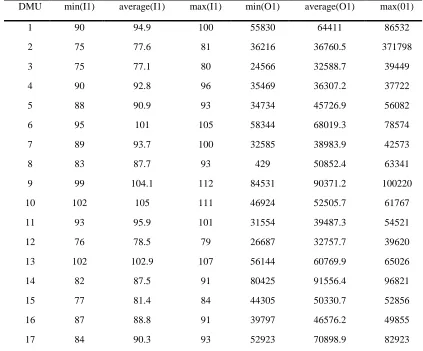
proposed model for 30 branches of social Welfare bureau in Tehran which data of each of these branches was collected in different 18 periods. The conclusions obtained of these observations are explained in following tables. Table 1 introduces the input and output of DMUs.
Table 1. Inputs and outputs.
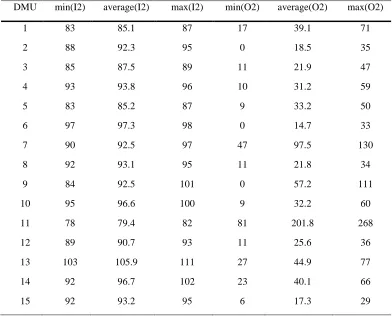
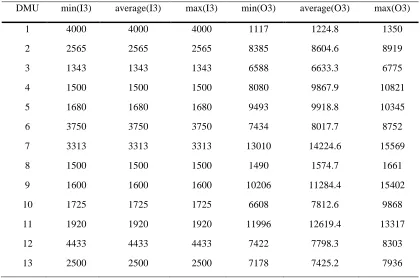
In Tables 2–5 the triangular fuzzy data of these branches is shown.
Table 2. Fuzzy data of the first input and output.
DMU min(I1) average(I1) max(I1) min(O1) average(O1) max(01)
1 90 94.9 100 55830 64411 86532
2 75 77.6 81 36216 36760.5 371798
3 75 77.1 80 24566 32588.7 39449
4 90 92.8 96 35469 36307.2 37722
5 88 90.9 93 34734 45726.9 56082
6 95 101 105 58344 68019.3 78574
7 89 93.7 100 32585 38983.9 42573
8 83 87.7 93 429 50852.4 63341
9 99 104.1 112 84531 90371.2 100220
10 102 105 111 46924 52505.7 61767
11 93 95.9 101 31554 39487.3 54521
12 76 78.5 79 26687 32757.7 39620
13 102 102.9 107 56144 60769.9 65026
14 82 87.5 91 80425 91556.4 96821
15 77 81.4 84 44305 50330.7 52856
16 87 88.8 91 39797 46576.2 49855
17 84 90.3 93 52923 70898.9 82923
Inputs Outputs
(1) Number of the personals (1) Number of the whole insured (2) Number of the
computers
(2) Number of the insurance policy
(3) The area of branch (3) Number of the whole pensioner (4) The amount of whole
DMU min(I1) average(I1) max(I1) min(O1) average(O1) max(01)
18 94 109.2 117 72553 85571.6 98678
19 89 96.5 103 46154 69124.8 89844
20 82 86.8 90 26927 31451.8 37990
21 68 70.6 73 27128 2805.2 29058
22 108 114.8 119 102175 111927.8 129100
23 75 79.7 86 27704 33378.3 36205
24 85 88.6 93 51345 57346 61760
25 96 98.7 103 72915 81096.7 88038
26 73 77.6 83 42887 44066.2 45396
27 100 106.9 112 78068 80831.3 83148
28 96 99.8 105 5865 69577.1 74218
29 67 71.6 76 38054 39330.97 40860
30 86 89.1 93 59846 62360 64784
Table 3. Fuzzy data of the second input and output.
DMU min(I2) average(I2) max(I2) min(O2) average(O2) max(O2)
1 83 85.1 87 17 39.1 71
2 88 92.3 95 0 18.5 35
3 85 87.5 89 11 21.9 47
4 93 93.8 96 10 31.2 59
5 83 85.2 87 9 33.2 50
6 97 97.3 98 0 14.7 33
7 90 92.5 97 47 97.5 130
8 92 93.1 95 11 21.8 34
9 84 92.5 101 0 57.2 111
10 95 96.6 100 9 32.2 60
11 78 79.4 82 81 201.8 268
12 89 90.7 93 11 25.6 36
13 103 105.9 111 27 44.9 77
14 92 96.7 102 23 40.1 66
DMU min(I2) average(I2) max(I2) min(O2) average(O2) max(O2)
16 85 85.4 86 13 29.4 49
17 104 104.4 106 14 20.9 38
18 91 93.7 96 13 26.2 49
19 95 98.4 102 11 20.5 34
20 100 100.4 101 20 60.1 325
21 88 90.9 95 0 18.6 36
22 120 124.1 128 31 49.7 77
23 100 100.2 101 12 29.8 49
24 91 93.3 95 35 62.2 74
25 90 90 90 40 58.7 96
26 81 84.7 88 11 25.3 40
27 101 103.2 106 26 47.3 89
28 87 95.7 99 0 69.3 130
29 77 79.8 86 13 28.7 49
30 90 92.1 94 10 28.2 47
Table 4. Fuzzy data of the third input and output.
DMU min(I3) average(I3) max(I3) min(O3) average(O3) max(O3)
1 4000 4000 4000 1117 1224.8 1350
2 2565 2565 2565 8385 8604.6 8919
3 1343 1343 1343 6588 6633.3 6775
4 1500 1500 1500 8080 9867.9 10821
5 1680 1680 1680 9493 9918.8 10345
6 3750 3750 3750 7434 8017.7 8752
7 3313 3313 3313 13010 14224.6 15569
8 1500 1500 1500 1490 1574.7 1661
9 1600 1600 1600 10206 11284.4 15402
10 1725 1725 1725 6608 7812.6 9868
11 1920 1920 1920 11996 12619.4 13317
12 4433 4433 4433 7422 7798.3 8303
DMU min(I3) average(I3) max(I3) min(O3) average(O3) max(O3)
14 2800 2800 2800 630 734.4 930
15 1630 1630 1630 10247 10321.7 10503
16 1127 1127 1127 7302 7824.9 8322
17 3400 3400 3400 4740 4972.1 5205
18 1304 1304 1304 4279 4918.9 5289
19 4206 4206 4206 825 1212.9 1636
20 1340 1340 1340 14144 14859.7 15907
21 1393 1393 1393 921 944.5 973
22 2191 2191 2191 252 2488.9 3577
23 2140 2140 2140 234 2123.7 2477
24 1231 1231 1231 10157 10399.9 10841
25 1960 1960 1960 4193 4837.4 5869
26 3375 3375 3375 560 609.8 658
27 2540 2540 2540 8769 9359.6 9857
28 1603 1603 1603 8762 12905.5 14155
29 2300 2300 2300 1405 1491.3 1567
30 2930 2930 2930 11143 12184.7 13100
Table 5. Fuzzy data of the fourth input and output.
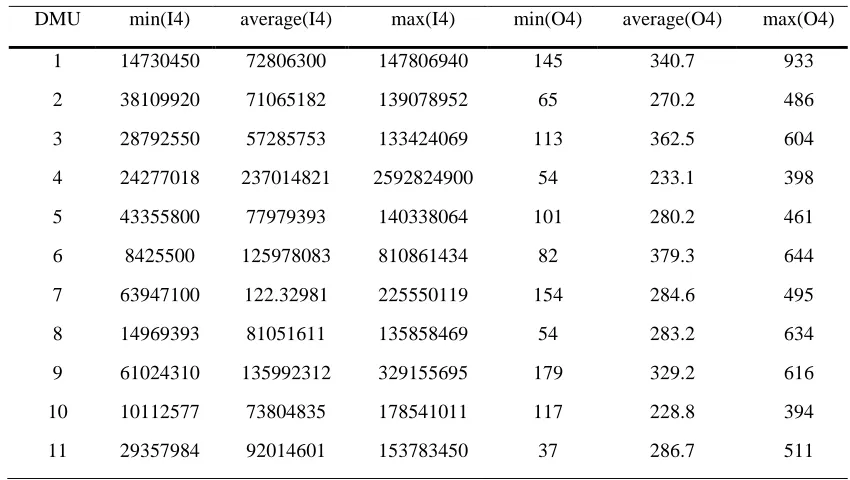
DMU min(I4) average(I4) max(I4) min(O4) average(O4) max(O4)
1 14730450 72806300 147806940 145 340.7 933
2 38109920 71065182 139078952 65 270.2 486
3 28792550 57285753 133424069 113 362.5 604
4 24277018 237014821 2592824900 54 233.1 398
5 43355800 77979393 140338064 101 280.2 461
6 8425500 125978083 810861434 82 379.3 644
7 63947100 122.32981 225550119 154 284.6 495
8 14969393 81051611 135858469 54 283.2 634
9 61024310 135992312 329155695 179 329.2 616 10 10112577 73804835 178541011 117 228.8 394
DMU min(I4) average(I4) max(I4) min(O4) average(O4) max(O4) 12 23106000 75843333 159552000 124 178.2 245 13 17756770 209943256 766788858 185 421.7 1175
14 30082208 76319046 168961589 51 195 391
15 45601750 72848488 158581843 28 145.3 295
16 26931600 112174234 827138457 85 248.9 580 17 17927100 116156884 475649794 43 175.4 286 18 25153373 126784004 389185592 72 187.6 324
19 5504769 81625443 264454915 74 232.1 530
20 48310364 94422470 153138326 190 310.9 444
21 19453875 54336511 105553653 55 233.4 457
22 45229750 97020370 190535604 120 289.1 468
23 45992927 109259866 285338884 156 383 589
24 5099980 80768509 148103734 85 181.3 278
25 52110247 147643177 757564117 112 242 427
26 12922183 69260832 113626397 218 320.8 450 27 21300223 81704431 187012354 134 278.4 679 28 45363108 307643735 931530808 91 197.8 304
29 10617400 72823790 110697939 23 115.5 304
30 57568217 84698270 122615610 122 263.3 406
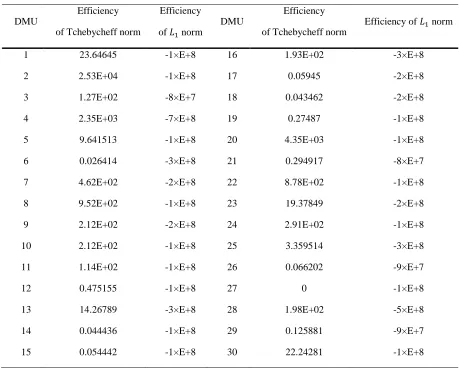
The result of solution of our proposed method and 𝐿1norm proposed by Jahanshahloo et al. [9]
Table 6. The result of ranking. DMU
Efficiency of Tchebycheff norm
Efficiency of 𝐿1 norm
DMU
Efficiency of Tchebycheff norm
Efficiency of 𝐿1 norm
1 23.64645 -1×E+8 16 1.93E+02 -3×E+8
2 2.53E+04 -1×E+8 17 0.05945 -2×E+8
3 1.27E+02 -8×E+7 18 0.043462 -2×E+8
4 2.35E+03 -7×E+8 19 0.27487 -1×E+8
5 9.641513 -1×E+8 20 4.35E+03 -1×E+8
6 0.026414 -3×E+8 21 0.294917 -8×E+7
7 4.62E+02 -2×E+8 22 8.78E+02 -1×E+8
8 9.52E+02 -1×E+8 23 19.37849 -2×E+8
9 2.12E+02 -2×E+8 24 2.91E+02 -1×E+8
10 2.12E+02 -1×E+8 25 3.359514 -3×E+8
11 1.14E+02 -1×E+8 26 0.066202 -9×E+7
12 0.475155 -1×E+8 27 0 -1×E+8
13 14.26789 -3×E+8 28 1.98E+02 -5×E+8
14 0.044436 -1×E+8 29 0.125881 -9×E+7
15 0.054442 -1×E+8 30 22.24281 -1×E+8
You can see that in this table, the 2th and 20st DMUs have the best grade (ranking score) and the 27th DMU has the worst one by our proposed method. And by using 𝐿1 norm you see that in this
table the 3rd and 21st DMUs have the best grade (ranking score) and the 4th DMU has the worst one. Although the result of tow model is different, this does not mean that one model is better or worse than other. The different results are obtained from the two models depend on the definition of each norm. Each organization or company can use each model according to needs and goals.
6. Conclusions
in DEA by using tchebycheff norm; since, inputs and outputs are fuzzy. Therefore, it may be obtained a fuzzy rank for decision making units hence we developed this method for ranking DMUs with fuzzy data. We illustrated our model by a numerical example and compared with fuzzy 𝐿1 norm proposed by Jahanshahloo et al. [9]. We proposed our model for triangular fuzzy
data but this model can develop for other fuzzy data simply.
References
Andersen, P., & Petersen, N. C. (1993). A procedure for ranking efficient units in data envelopment analysis. Management science, 39(10), 1261-1264.
Banker, R. D., Charnes, A., & Cooper, W. W. (1984). Some models for estimating technical and scale inefficiencies in data envelopment analysis. Management science, 30(9), 1078-1092.
Duckstein, L. (1995). Fuzzy rule-based modeling with applications to geophysical, biological, and engineering systems (Vol. 8). CRC press.
Charnes, A., Cooper, W. W., & Rhodes, E. (1978). Measuring the efficiency of decision making units. European journal of operational research, 2(6), 429-444.
Cooper, W. W., Park, K. S., & Yu, G. (1999). IDEA and AR-IDEA: models for dealing with imprecise data in DEA. Management science, 45(4), 597-607.
Delgado, M., Vila, M. A., & Voxman, W. (1998). On a canonical representation of fuzzy numbers. Fuzzy sets and systems, 93(1), 125-135.
DuboisandH, D. (1988). Prade, possibility theory: an approach to computerized processing of uncertainty. New York, NY, USA: Plenum.
Goetschel Jr, R., & Voxman, W. (1986). Elementary fuzzy calculus. Fuzzy sets and systems, 18(1), 31-43.
Jahanshahloo. G. R., Hosseinzadeh Lotfi. F., Shahverdi, R., Adabitabar, M., Rostamy-Malkhalifeh, M., & Sohraiee, S. (2009) .Ranking DMUs by L1-norm with fuzzy data in DEA. Chaos, solitons and fractals,39, 2294–2302.
Jahanshahloo, G. R., Lotfi, F. H., Shoja, N., Tohidi, G., & Razavyan, S. (2004). Ranking using l1-norm in data envelopment analysis. Applied mathematics and computation, 153(1), 215-224.
Kao, C., & Liu, S. T. (2000). Fuzzy efficiency measures in data envelopment analysis. Fuzzy sets and systems, 113(3), 427-437.
Mehrabian, S., Alirezaee, M. R., & Jahanshahloo, G. R. (1999). A complete efficiency ranking of decision making units in data envelopment analysis. Computational optimization and applications, 14(2), 261-266.
Balf, F. R., Rezai, H. Z., Jahanshahloo, G. R., & Lotfi, F. H. (2012). Ranking efficient DMUs using the Tchebycheff norm. Applied mathematical modelling, 36(1), 46-56.
Seaver, B. L., & Triantis, K. P. (1992). A fuzzy clustering approach used in evaluating technical efficiency measures in manufacturing. Journal of productivity analysis, 3(4), 337-363.
Seiford, L. M., & Zhu, J. (1999). Infeasibility of super-efficiency data envelopment analysis models. INFOR: information systems and operational research, 37(2), 174-187.
Sengupta, J. K. (1992). A fuzzy systems approach in data envelopment analysis. Computers & mathematics with applications, 24(8-9), 259-266.
Tavares, G., & Antunes, C. H. (2001). A Tchebycheff DEA model. Working Paper, Rutgers University, 640 Bartholomew Road, Piscataway, NJ 08854-8003.
Tran, L., & Duckstein, L. (2002). Comparison of fuzzy numbers using a fuzzy distance measure. Fuzzy sets and systems, 130(3), 331-341.
Yao, J. S., & Wu, K. (2000). Ranking fuzzy numbers based on decomposition principle and signed distance. Fuzzy sets and systems, 116(2), 275-288.