Assessing the role of insulin-like growth factors and binding
proteins in prostate cancer using Mendelian randomization:
Genetic variants as instruments for circulating levels
Carolina Bonilla1,2, Sarah J. Lewis1,2, Mari-Anne Rowlands1, Tom R. Gaunt1,2, George Davey Smith1,2, David Gunnell1, Tom Palmer3, Jenny L. Donovan1, Freddie C. Hamdy4, David E. Neal4,5, Rosalind Eeles6,7, Doug Easton8, Zsofia Kote-Jarai6, Ali Amin Al Olama8, Sara Benlloch8, Kenneth Muir9,10, Graham G. Giles11,12, Fredrik Wiklund13, Henrik Gr€onberg13, Christopher A. Haiman14, Johanna Schleutker15,16, Børge G. Nordestgaard17, Ruth C. Travis18, Nora Pashayan19,20, Kay-Tee Khaw21, Janet L. Stanford22,23, William J. Blot24, Stephen Thibodeau25, Christiane Maier26,27, Adam S. Kibel28,29, Cezary Cybulski30, Lisa Cannon-Albright31, Hermann Brenner32,33,34, Jong Park35, Radka Kaneva36, Jyotsna Batra37, Manuel R. Teixeira38,39, Hardev Pandha40, the PRACTICAL consortium, Mark Lathrop41,42, Richard M. Martin1,2,43* and Jeff M. P. Holly43,44*
1School of Social and Community Medicine, University of Bristol, Bristol, United Kingdom
2MRC/University of Bristol Integrative Epidemiology Unit, University of Bristol, Bristol, United Kingdom 3Department of Mathematics and Statistics, Lancaster University, Lancaster, United Kingdom 4Nuffield Department of Surgery, University of Oxford, Oxford, United Kingdom
5Surgical Oncology (Uro-Oncology: S4), University of Cambridge, Box 279, Addenbrooke’s Hospital, Hills Road, Cambridge, United Kingdom
Key words:insulin-like growth factors, insulin-like growth factor-binding proteins, prostate cancer, Mendelian randomization, single nucleo-tide polymorphisms, IGFBP3, ProtecT, PRACTICAL, ALSPAC, UKHLS
Abbreviations:BPH: benign prostatic hyperplasia; CV: coefficient of variation; GWAS: genome-wide association study; IBD: identity by descent; ICC: intra-class correlation; IGF: insulin-like growth factor; IGFBP: insulin-like growth factor-binding proteins; IV: instrumental variable; LD: Linkage disequilibrium; MR: Mendelian randomization; PSA: prostate specific antigen; QC: quality control; RIA: radioim-munoassay; SD: standard deviation; SNP: single nucleotide polymorphism; UKHLS: UK Household Longitudinal Study.
Additional Supporting Information may be found in the online version of this article.
For information on how to submit an application for gaining access to EPIC data and/or biospecimens, please follow the instructions at http://epic.iarc.fr/access/index.php, http://www.metadac.ac.uk/data-access-through-metadac/.
R.M.M., S.J.L., G.D.S., D.G. and J.M.P.H. developed the hypotheses and secured funding. C.B., M-AR, T.P. and T.R.G. undertook statistical analyses. C.B., M.-A.R., S.J.L. and R.M.M. wrote the first draft of the paper. M.L. organized the genome-wide genotyping of controls from the ProtecT study. J.L.D., F.C.H. and D.E.N. are PIs of the ProtecT (Prostate testing for cancer and Treatment) study. D.G., J.L.D., F.C.H. and D.E.N. are NIHR Senior Investigators. All authors critically commented on and approved the final submitted version of the paper. Disclosure:TRG: In addition to funding from the UK Medical Research Council the MRC Integrative Epidemiology Unit receives funding from a number of commercial organizations, including Pfizer, Sanofi-Aventis, Astra Zeneca and Merck Sharp & Dohme.
*R.M.M. and J.M.P.H contributed equally to this work
This is an open access article under the terms of the Creative Commons Attribution License, which permits use, distribution and reproduc-tion in any medium, provided the original work is properly cited.
Grant sponsor:World Cancer Research Fund;Grant number:2011/419;Grant sponsor:Cancer Research UK;Grant number:C18281/ A19169;Grant sponsor:MRC and the University of Bristol;Grant number:G0600705, MC_UU_12013/19 (to Integrative Epidemiology Unit (IEU));Grant sponsor:Cancer Research UK;Grant number:C18281/A19169 (to Integrative Cancer Epidemiology Programme);Grant sponsor:National Institute for Health Research (NIHR) (to Bristol Biomedical Research Unit in Nutrition, which is a partnership between University Hospitals Bristol NHS Foundation Trust and the University of Bristol);Grant sponsor:National Institute for Health Research (NIHR) Health Technology Assessment (HTA) Programme (to ProtecT study);Grant number:HTA 96/20/99; ISRCTN20141297;Grant sponsor:European Community’s Seventh Framework Programme (grant agreement n8223175);Grant number:HEALTH-F2-2009–223175) (COGS) (to PRACTICAL and the iCOGS infrastructure);Grant sponsor:Cancer Research UK;Grant numbers:C1287/A10118, C1287/A 10710, C12292/A11174, C1281/A12014, C5047/A8384, C5047/A15007, C5047/A10692, C8197/A16565;Grant sponsor:National Institutes of Health;Grant number:CA128978;Grant sponsor:Post-Cancer GWAS initiative;Grant numbers:1U19 CA148537, 1U19 CA148065 and 1U19 CA148112 - the GAME-ON initiative;Grant sponsor:Department of Defense;Grant number:W81XWH-10–1-0341;Grant sponsors:Canadian Institutes of Health Research (CIHR) for the CIHR Team in Familial Risks of Breast Cancer, Komen Foundation for the Cure, the Breast Cancer Research Foundation and the Ovarian Cancer Research Fund
DOI:10.1002/ijc.30206
History:Received 24 Nov 2015; Accepted 7 Apr 2016; Online 26 May 2016
Correspondence to:Richard Martin, University of Bristol, School of Social and Community Medicine, Canynge Hall, 39 Whatley Road, Bristol BS8 2PS, United Kingdom, Tel:144 117 928 7321, Fax:144 117 928 7236, E-mail: [email protected]
Cancer
Epidemiology
6
The Institute of Cancer Research, 15 Cotswold Road, Sutton, Surrey, SM2 5NG, United Kingdom 7Royal Marsden NHS Foundation Trust, Fulham and Sutton, London and Surrey, United Kingdom 8
Centre for Cancer Genetic Epidemiology, Department of Public Health and Primary Care, University of Cambridge, Strangeways Research Laboratory, Worts Causeway, Cambridge, United Kingdom
9University of Warwick, Coventry, United Kingdom
10Institute of Population Health, University of Manchester, Manchester, M13 9PL, United Kingdom 11The Cancer Council Victoria, 615 St. Kilda Road, Melbourne, Victoria, 3004, Australia
12Centre for Epidemiology and Biostatistics, Melbourne School of Population and Global Health, the University of Melbourne, Victoria, 3010, Australia 13Department of Medical Epidemiology and Biostatistics, Karolinska Institute, Stockholm, Sweden
14Department of Preventive Medicine, Keck School of Medicine, University of Southern California/Norris Comprehensive Cancer Center, Los Angeles, California 15Department of Medical Biochemistry and Genetics, University of Turku, Turku, Finland
16Institute of Biomedical Technology/BioMediTech, University of Tampere and FimLab Laboratories, Tampere, Finland
17Department of Clinical Biochemistry, Herlev Hospital, Copenhagen University Hospital, Herlev Ringvej 75, Herlev, DK, 2730, Denmark 18Cancer Epidemiology Unit, Nuffield Department of Population Health, University of Oxford, Oxford, United Kingdom
19Centre for Cancer Genetic Epidemiology, Department of Oncology, University of Cambridge, Strangeways Research Laboratory, Worts Causeway,
Cambridge, United Kingdom
20Department of Applied Health Research, University College London, 1-19 Torrington Place, London, WC1E 7HB, United Kingdom 21
Forvie Site, Cambridge Institute of Public Health, University of Cambridge, Robinson Way, Cambridge, CB2 0SR, United Kingdom 22Division of Public Health Sciences, Fred Hutchinson Cancer Research Center, Seattle, Washington
23
Department of Epidemiology, School of Public Health, University of Washington, Seattle, Washington 24International Epidemiology Institute, 1455 Research Blvd, Suite 550, Rockville, Maryland
25
Mayo Clinic, Rochester, Minnesota
26Department of Urology, University Hospital Ulm, Germany 27
Institute of Human Genetics, University Hospital Ulm, Germany
28Brigham and Women’s Hospital/Dana-Farber Cancer Institute, 45 Francis Street-ASB II-3, Boston, Massachussets 29
Washington University, St Louis, Missouri
30International Hereditary Cancer Center, Department of Genetics and Pathology, Pomeranian Medical University, Szczecin, Poland 31Division of Genetic Epidemiology, Department of Medicine, University of Utah School of Medicine, Salt Lake City, Utah 32Division of Clinical Epidemiology and Aging Research, German Cancer Research Center (DKFZ), Heidelberg, Germany 33Division of Preventive Oncology, German Cancer Research Center (DKFZ), Heidelberg, Germany
34German Cancer Consortium (DKTK), German Cancer Research Center (DKFZ), Heidelberg, Germany 35Division of Cancer Prevention and Control, H. Lee Moffitt Cancer Center, 12902 Magnolia Dr, Tampa, Florida
36Molecular Medicine Center and Department of Medical Chemistry and Biochemistry, Medical University - Sofia, 2 Zdrave St, Sofia, 1431, Bulgaria 37Australian Prostate Cancer Research Centre-Qld, Institute of Health and Biomedical Innovation and School of Biomedical Sciences, Queensland
University of Technology, Brisbane, Australia 38
Department of Genetics, Portuguese Oncology Institute, Porto, Portugal 39Biomedical Sciences Institute (ICBAS), Porto University, Porto, Portugal 40
The University of Surrey, Guildford, Surrey, GU2 7XH, United Kingdom
41Commissariata L’Energie Atomique, Center National De Genotypage, Evry, France 42
McGill University-Genome Quebec Innovation Centre, Montreal, Canada 43NIHR Bristol Biomedical Research Unit in Nutrition, Bristol, United Kingdom 44
IGFs and Metabolic Endocrinology Group, School of Clinical Sciences North Bristol, University of Bristol, Bristol, United Kingdom
Circulating insulin-like growth factors (IGFs) and their binding proteins (IGFBPs) are associated with prostate cancer. Using genetic variants as instruments for IGF peptides, we investigated whether these associations are likely to be causal. We identified from the literature 56 single nucleotide polymorphisms (SNPs) in the IGF axis previously associated with bio-marker levels (8 from a genome-wide association study [GWAS] and 48 in reported candidate genes). In~700 men without prostate cancer and two replication cohorts (N~900 and~9,000), we examined the properties of these SNPS as instru-mental variables (IVs) for IGF-I, IGF-II, IGFBP-2 and IGFBP-3. Those confirmed as strong IVs were tested for association with prostate cancer risk, low (<7)vs. high (7) Gleason grade, localised vs. advanced stage, and mortality, in 22,936 controls and 22,992 cases. IV analysis was used in an attempt to estimate the causal effect of circulating IGF peptides on prostate cancer. Published SNPs in the IGFBP1/IGFBP3 gene region, particularly rs11977526, were strong instruments for IGF-II and IGFBP-3, less so for IGF-I. Rs11977526 was associated with high (vs. low) Gleason grade (OR per IGF-II/IGFBP-3 level-raising allele 1.05; 95% CI: 1.00, 1.10). Using rs11977526 as an IV we estimated the causal effect of a one SD increase in IGF-II (~265 ng/mL) on risk of highvs. low grade disease as 1.14 (95% CI: 1.00, 1.31). Because of the potential for pleiot-ropy of the genetic instruments, these findings can only causally implicate the IGF pathway in general, not any one specific biomarker.
Cancer
Prostate cancer is the most common male cancer in industri-alised countries, yet there are no established, potentially mod-ifiable risk factors for prevention.1The nutritionally regulated IGFs, and their modulating binding proteins (IGFBPs) play a key role in somatic growth, and activate carcinogenic intra-cellular signalling networks.1 Meta-analyses of epidemiologi-cal studies generally observe positive associations of circulating IGF-I with prostate cancer,2–4but substantial dif-ferences exist between studies.5,6
Such diverse evidence indicates that causation remains to be established. Alternative explanations for the observed asso-ciation of IGF-axis peptides with prostate cancer include: reverse causality, because tumours may promote an endo-crine response7; confounding by dietary,8 nutritional9 and lifestyle10factors; measurement error,11as single serum meas-urements may inadequately reflect long-term exposure; or detection bias,11 occurring, for example, if IGF-I causes symptomatic benign prostatic hyperplasia (BPH) that results in the serendipitous finding of latent cancer on diagnostic biopsy.
Mendelian randomization (MR)12 seeks to establish cau-sality by using genetic variants as proxies for the exposure of interest. Since alleles randomly assort at gamete formation and segregate randomly at conception to generate genotypes, associations between genotypes and outcome are not gener-ally confounded by behavioural or environmental factors and cannot be explained by reverse causation. Genetic variation may also be a better measure of exposure over a lifetime than a single serum measurement, as those with genotypes causing high (or low) IGF levels will have been, in effect, ran-domly allocated to high (or low) IGF levels from birth. To determine causality, MR relies on an association between genetic variant (also known as instrument) and exposure so that the greater the correlation between the two, and thus the more variation in the exposure phenotype explained by the genotype, the more reliable the causal inference. Additionally, the instrument is expected to influence the outcome only via the exposure (i.e., absence of horizontal pleiotropy13) and to be independent from confounders of the relationship between exposure and outcome.
We used an MR approach in an attempt to assess the causal role of the IGF axis in prostate cancer. First, we vali-dated genetic variants previously associated with IGF levels in the literature to confirm reported associations of the SNPs (especially SNPs selected from candidate gene studies), and to assess the potential for pleiotropic effects of the genetic
variants on more than one IGF protein. Second, we per-formed a large case–control study based on an international prostate cancer consortium of >22,000 case/control pairs using the validated polymorphisms.
Material and Methods Study populations
ProtecT (Prostate testing for cancer and Treatment) study. The association of genetic variants with IGF levels was evaluated in the control arm of a case–control study nested within ProtecT, a UK multicentre study to identify localised prostate cancer and evaluate its management in a randomly allocated controlled trial.5 All men without evi-dence of prostate cancer were eligible for selection as con-trols; that is, men with a prostate specific antigen (PSA) test<3 ng/mL, or men with a raised PSA (3 ng/mL) com-bined with at least one negative diagnostic biopsy. Of the 2,766 controls who underwent measures of IGFs in ProtecT5, 700 men also had genome-wide genotype data available (mean age6SD: 62.165.0 years).
Blood samples for IGF measurement in ProtecT were drawn at the time of the PSA test, frozen at2808C within 36 hr, then transferred on dry ice for assay.4Total IGF-I, IGF-II and IGFBP-3 levels were measured by in-house radioimmu-noassay (RIA) and circulating IGFBP-2 was measured using a one-step sandwich ELISA (DSL-10–7100; Diagnostic Sys-tems Laboratories). The intra-class correlations (ICC) for within-assay variability for IGF-I, IGF-II, IGFBP-2 and IGFBP-3 were 0.86, 0.91, 0.95 and 0.88; the ICCs for between-assay variability were 0.66, 0.84, 0.81 and 0.71, respectively.
Genome-wide genotyping of participants was carried out at the Centre National de Genotypage (CNG, Evry, France), using the Illumina Human660W-Quad_v1_A array (Illumina Inc., San Diego, CA). The quality control (QC) process per-formed before imputation excluded individuals on the basis of the following: sex mismatches, minimal (< 0.325) or excessive (> 0.345) heterozygosity, disproportionate levels of individual missingness (> 3%), cryptic relatedness measured as a proportion of identity by descent (IBD>0.1), and insuf-ficient sample replication (IBD<0.8). All individuals with non-European ancestry, and SNPs with a minor allele fre-quency (MAF) below 1%, a call rate of<95% or out of Hardy-Weinberg equilibrium (p<5 3 1027
) were removed. Autosomal genotypic data were imputed using Markov Chain Haplotyping software (MACH v.1.0.16)14 and phased
What’s new?
Circulating insulin-like growth factors (IGF) and their binding proteins have been associated with prostate cancer risk in obser-vational epidemiological studies but it is not clear whether there is a causal relationship with disease. To address this ques-tion, the authors used Mendelian randomizaques-tion, a method that uses genetic variants as proxies for measured exposures. Their results implicate the IGF pathway in general in prostate cancer development but specific biomarkers remain to be determined.
Cancer
haplotype data from European (CEU) individuals (HapMap release 22, Phase II NCBI B36, dbSNP 126) based on 514,432 autosomal SNPs. After imputation, all SNPs with indication of poor imputation quality (r2 hat<0.3) were eliminated. The working dataset consisted of 2,927 individuals (1,136 cases, 1,791 controls) of European ancestry.
Trent Multicenter Research Ethics Committee (MREC) approved both the ProtecT study (MREC/01/4/025), and the associated ProMPT study which collected biological material (MREC/01/4/061). Written informed consent was obtained from all men.
ALSPAC (Avon Longitudinal Study of Parents and
Children). We used ALSPAC to replicate ProtecT findings. ALSPAC is a population-based prospective cohort study of children and their parents. The study is described in detail elsewhere15–17 (http://www.bristol.ac.uk/alspac/). Measure-ment of circulating IGF-I, IGF-II and IGFBP-3 in plasma or serum was carried out as in ProtecT. IGFBP-2 was not meas-ured. The intra- and inter-assay coefficients of variation (CV) were 7.0 and 14.3% for IGF- I, 7.9 and 18.6% for IGF-II, and 6.1 and 8.7% for IGFBP-3.18
Genome-wide association study (GWAS) data for the chil-dren were generated by Sample Logistics and Genotyping Facilities at the Wellcome Trust Sanger Institute (Cambridge, UK) and the Laboratory Corporation of America (Burlington, NC, USA) with support from 23andMe (Mountain View, CA, USA) using the Illumina HumanHap550 quad chip. The mothers were genotyped at CNG using the Illumina Human660W quad array. All individuals of non-European ancestry, ambiguous sex, extreme heterozygosity, cryptic relatedness (IBD>0.1 in children,>0.125 in mothers), high missingness (>3% in children,>5% in mothers) and insuffi-cient sample replication (IBD<0.8) were removed. SNPs with genotyping rate<95%, MAF<1%, or out of Hardy-Weinberg equilibrium (p<5 3 1027 in children, p<1 3 1026 in mothers) were excluded. Genotypic data was subse-quently phased with ShapeIT v2.r644,19 and imputed using IMPUTE v2.2.220 and phased haplotype data from the 1000 Genomes reference panel (phase 1, version 3), based on 465,740 SNPs. The cleaned dataset consisted of 8,237 chil-dren and 8,196 mothers. Up to 400 pregnant women (mean6SD age at delivery: 28.765.4 years) and450 chil-dren at different ages (mean6SD age: 61.860.8 months, 54% male; 7.560.2 years, 54% male; 8.260.1 years, 56% male), as well as500 umbilical cord samples had genotypes and IGF measures for analysis.
Ethical approval for the study was obtained from the ALSPAC Ethics and Law Committee and the Local Research Ethics Committees (http://www.bristol.ac.uk/alspac/research-ers/data-access/ethics/lrec-approvals/#d.en.164120). Written informed consent was obtained from all participants in the study.
Understanding Society: the UK Household Longitudinal Study (UKHLS). SNPs validated in ProtecT were also examined in the UKHLS study, which is a stratified clustered random sample of households, representative of the UK population (https://www.understandingsociety.ac.uk/). Serum IGF-I levels were measured using an electrochemiluminescent immunoas-say on an IDS ISYS analyser. The inter- and intra-asimmunoas-say Cvs. were<14%. No measurements of IGF-II, IGFBP-2 or IGFBP-3 were available.
In total, 10,480 samples were genotyped on the Illumina HumanCoreExome chip (v1.0) at the Wellcome Trust Sanger Institute. Data QC was performed at the sample-level using the following filters: call rate<98%, autosomal heterozygosity outliers (> 3 SD), gender mismatches, duplicates as estab-lished by IBD analysis (PI_HAT>0.9), ethnic outliers. Var-iants with a Hardy-Weinberg equilibrium p values<1024, a call rate below 98% and poor genotype clustering values (<
0.4) were removed, as well as mitochondrial polymorphisms, leaving 518,542 variants. Imputation was performed at the UCL Genetics Institute using Minimac version 5–29-12,21 MaCH14 for phasing, and the 1000 Genomes Project, March 2012, version 3, NCBI build GRCh37/hg19 as a reference sample. The final sample consisted of 9,944 individuals. As UKHLS is a household study we additionally eliminated indi-viduals who were related (> 5%), thus the working sample included 9,237 participants (mean6SD age: 54.1616.1 years, 44% male).
UKHLS is designed and conducted in accordance with the ESRC Research Ethics Framework and the ISER Code of Ethics. The University of Essex Ethics Committee approved waves 1–5 of UKHLS. Approval from the National Research Ethics Service was obtained for the collection of biosocial data by trained nurses in waves 2 and 3 of the main survey (Oxfordshire A REC, Reference: 10/H0604/2).
PRACTICAL Consortium (PRostate cancer AssoCiation group to Investigate Cancer-Associated aLterations in the genome).
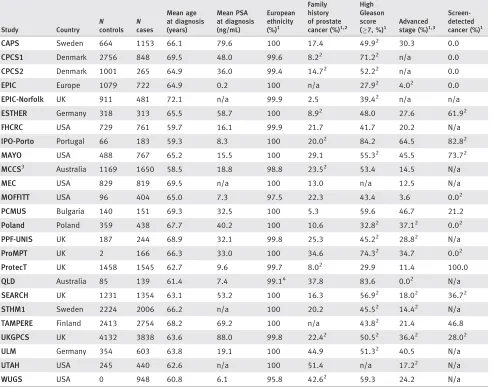
We investigated associations of published IGF-related genetic variants, evaluated as instruments in ProtecT and replicated in ALSPAC and/or UKHLS, with prostate cancer risk, pro-gression and mortality in men from 25 studies contributing to the international PRACTICAL consortium22 (http://practi-cal.ccge.medschl.cam.ac.uk). Seventeen studies were from Europe, six from North America and two from Australia, and comprised population samples of predominantly Euro-pean ancestry22 (Table 1). Data on cancer stage, grade and method of diagnosis were collected by each study using a variety of methods. We categorised cancers as localised (T1 or T2 on TNM staging, or if not available, “localised” on SEER staging) or advanced (T3 or T4, or “regional” or “distant” on SEER staging).
Genotyping of PRACTICAL samples was carried out using an Illumina Custom Infinium genotyping array (iCOGS), designed for the Collaborative Oncological Gene-Environment Study (COGS) (http://www.cogseu.org/) and
Cancer
consisting of 211,155 SNPs.22This array was devised to eval-uate associations of genetic variants with breast, ovarian and prostate cancer (85,278 were specifically chosen for their potential relevance to prostate cancer). A total of 201,598 SNPs passed QC for the European ancestry samples.22 Impu-tation of 17 million SNPs/indels using the 1000 Genomes Project (version 3, March 2012 release) as a reference panel was performed with the program IMPUTE v.2.20 Polymor-phisms with quality information scores of (r2)>0.3 and MAF>0.5 were taken forward for analysis.23 Overall there were 22,992 prostate cancer cases and 22,936 controls with genotype data available.
All studies have the relevant Institutional Review Board approval in each country in accordance with the Declaration of Helsinki.
Identification of genetic variants associated with IGF levels in the literature
We selected single nucleotide polymorphisms (SNPs) associ-ated with circulating IGF levels from the National Human Genome Research Institute-European Bioinformatics Institute (NHGRI-EBI) catalog of genome-wide association studies (GWAS) (https://www.ebi.ac.uk/gwas/) and by conducting a PubMed literature search. All SNPs chosen were associated
Table 1.Clinical characteristics of prostate cancer cases in 25 PRACTICAL studies
Study Country
N controls
N cases
Mean age at diagnosis (years)
Mean PSA at diagnosis (ng/mL)
European ethnicity
(%)1
Family history of prostate
cancer (%)1,2
High Gleason score
(7, %)1
Advanced
stage (%)1,3
Screen-detected
cancer (%)1
CAPS Sweden 664 1153 66.1 79.6 100 17.4 49.92 30.3 0.0
CPCS1 Denmark 2756 848 69.5 48.0 99.6 8.22 71.22 n/a 0.0
CPCS2 Denmark 1001 265 64.9 36.0 99.4 14.72 52.22 n/a 0.0
EPIC Europe 1079 722 64.9 0.2 100 n/a 27.92 4.02 0.0
EPIC-Norfolk UK 911 481 72.1 n/a 99.9 2.5 39.42 n/a n/a
ESTHER Germany 318 313 65.5 58.7 100 8.92 48.0 27.6 61.92
FHCRC USA 729 761 59.7 16.1 99.9 21.7 41.7 20.2 N/a
IPO-Porto Portugal 66 183 59.3 8.3 100 20.02 84.2 64.5 82.82
MAYO USA 488 767 65.2 15.5 100 29.1 55.32 45.5 73.72
MCCS3
Australia 1169 1650 58.5 18.8 98.8 23.52 53.4 14.5 N/a
MEC USA 829 819 69.5 n/a 100 13.0 n/a 12.5 N/a
MOFFITT USA 96 404 65.0 7.3 97.5 22.3 43.4 3.6 0.02
PCMUS Bulgaria 140 151 69.3 32.5 100 5.3 59.6 46.7 21.2
Poland Poland 359 438 67.7 40.2 100 10.6 32.82 37.12 0.02
PPF-UNIS UK 187 244 68.9 32.1 99.8 25.3 45.22 28.82 N/a
ProMPT UK 2 166 66.3 33.0 100 34.6 74.32 34.7 0.02
ProtecT UK 1458 1545 62.7 9.6 99.7 8.02 29.9 11.4 100.0
QLD Australia 85 139 61.4 7.4 99.14 37.8 83.6 0.02 N/a
SEARCH UK 1231 1354 63.1 53.2 100 16.3 56.92 18.02 36.72
STHM1 Sweden 2224 2006 66.2 n/a 100 20.2 45.52 14.42 N/a
TAMPERE Finland 2413 2754 68.2 69.2 100 n/a 43.82 21.4 46.8
UKGPCS UK 4132 3838 63.6 88.0 99.8 22.42 50.52 36.42 28.02
ULM Germany 354 603 63.8 19.1 100 44.9 51.32 40.5 N/a
UTAH USA 245 440 62.6 n/a 100 51.4 n/a 17.22 N/a
WUGS USA 0 948 60.8 6.1 95.8 42.62 59.3 24.2 N/a
N545,928 men.
Information in the table is given for the subset of individuals whose ethnicity was “European” (except for the study’s European ethnicity percentage).
1Percent of cases with data available.
Family history of prostate cancer in a first degree relative.
T3 or T4 on TNM staging, or if not available, “regional” or “distant” on SEER staging.
2
Information missing for>10% of patients.
3MCCS includes Risk Factors for Prostate Cancer Study (RFPCS) and The Early Onset Prostate Cancer Study (EOPCS).
4
Information missing for>10% of individuals.
n/a not available.
Cancer
with IGF concentration at the significance thresholds estab-lished by each study (p<531027 in the discovery GWAS; usuallyp<0.05 in candidate gene studies).
Validation of genetic variants as instruments of IGF levels
The properties of the SNPs as instrumental variables (IV) were assessed in ProtecT controls by examination of: (i) F
statistics (with values lower than 10 taken as evidence of a weak instrument24) and R2 values (the proportion of varia-tion in IGF levels explained by the genetic variant) from the linear regression of each biomarker on the SNP; (ii) associa-tions of the genetic variants with potential confounding fac-tors and other variables (age, PSA at recruitment, body mass index (BMI), height, leg-length, BPH and diabetes); and (iii) possible pleiotropic effects of the variants on more than one IGF peptide.25 The validated genetic instruments were tested for replication in ALSPAC mothers and children, and UKHLS participants.
Statistical analysis
All SNPs were examined for deviation from Hardy-Weinberg equilibrium using the hwsnp function in the statistical pack-age Stata. Linear and logistic regression were used as appro-priate to investigate the effect of SNPs on IGF-I, IGF-II, IGFBP-2, IGFBP-3, PSA and potential confounders. For the validated SNPs we ran meta-analyses across all PRACTICAL studies to evaluate between-study heterogeneity in the associ-ation with prostate cancer risk, Gleason grade (low: <7 vs. high:7) and stage (localised vs. advanced). We computed pooled ORs assuming a fixed-effects model when there was no evidence of heterogeneity (p>0.05), otherwise we used a random-effects model. Logistic regression with robust stand-ard errors, to account for within-study clustering, was per-formed to test for associations of all polymorphisms across the IGFBP1/IGFBP3region and SNPs in other chromosomal regions with the above prostate cancer outcomes.
Linkage disequilibrium (LD) between pairs of variants in the IGFBP-1/IGFBP-3 gene region was calculated with the program LDlink using data for the GBR population (English and Scottish) in Phase 3 of the 1,000 Genomes Project.26 r2
values obtained with LDlink were then used to create an LD plot of the region with the R package LDheatmap (http:// www.R-project.org). Functional consequences of genetic poly-morphisms were predicted using SNPnexus (http://www.snp-nexus.org/).
Survival analysis. Amongst men with prostate cancer, we estimated associations of the validated SNPs with long-term (15-year) survival, examining all-cause and prostate cancer-specific mortality using Cox proportional hazards regression with date at diagnosis as the start date and date at death or final follow-up time-point as the exit date, with robust stand-ard errors to account for within-study clustering.
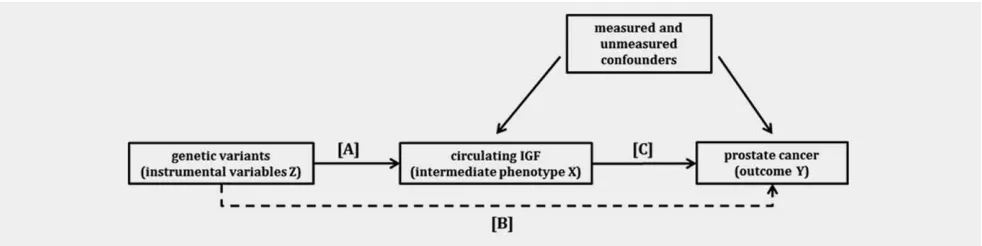
Instrumental variable (IV) analysis. To estimate the causal effect of IGF levels on prostate cancer, we used validated SNPs as the instruments in a two-sample ratio estimator IV analysis27,28 (Fig. 1). The ratio represents the causal log odds ratio of a one unit increase in circulating IGF on the risk of prostate cancer. IV analysis was conducted for the SNPs showing the strongest association with prostate cancer, which were also associated with circulating IGFs in ProtecT, ALSPAC or UKHLS, and the estimates are given per stand-ard deviation (SD) increase in IGF levels.
Adjustments. Principal components reflecting each popula-tion’s genetic structure were included as covariates in the regression models to account for confounding by population stratification. Additional adjustments for age at diagnosis, age at blood sample collection, gestational age and sex were made when appropriate.
Unless otherwise specified, all analyses were carried out in Stata version 13 (StataCorp LP, 2013, College Station, TX).
Figure 1.Directed acyclic graph (DAG) showing the instrumental variable (IV) assumptions underpinning a Mendelian randomization analy-sis of circulating IGF levels with prostate cancer. IV models use associations A and B to estimate the causal effect of IGF on prostate cancer
C (C5B/A). The instrument is assumed not to have a direct effect on the outcome, hence the dashed line is to illustrate that association B
is required for IV estimation. The effect of genotype on the outcome should be mediated only through the intermediate phenotype (no plei-otropy). The numerator of the two sample IV estimator is the log odds ratio from a logistic regression of the outcome (Y) on the instrument (Z) in the PRACTICAL population and the denominator is the beta coefficient from a linear regression of the exposure (X) on the instrument (Z) in the ProtecT or UKHLS population or obtained from the literature.
Cancer
Tab le 2. Ass ociati on of publi shed SNPs w ith IGF bioma rkers in Prot ecT controls Protec T: effe ct on publis hed bioma rkers Protec T: effe ct on other bi omar kers SNP Effect allele/ non-effect allele 1 Pu blished a ssociations Mean differen ce in IGF levels (ng /mL) per effect allele 95% CI p value
Other associations
Tab le 2. Ass ociati on of publi shed SNPs w ith IGF bioma rkers in Prot ecT controls (Con tinue d) Protec T: effe ct on publis hed bioma rkers Protec T: effe ct on other bi omar kers SNP Effect allele/ non-effect allele 1 Pu blished a ssociations Mean differen ce in IGF levels (ng /mL) per effect allele 95% CI p value
Other associations
Results
We identified 56 SNPs that were associated with circulating IGF peptides in GWAS (n58) or candidate gene studies (n548) (Supporting Information Table 1). Most of these SNPs were located in the IGF1 and IGFBP1/IGFBP3 gene regions on chromosomes 12q23.2 and 7p12.3, respectively, and showed associations with IGF-I and IGFBP-3 levels. We could only find one candidate gene study that had examined the relationship of blood IGF-II with genetic polymor-phisms,29 and one that had similarly considered IGFBP-2 concentrations.30
Validation of the association of published SNPs with IGF levels in ProtecT controls
IGF-I, IGF-II and IGFBP-3 blood concentrations were approximately normally distributed, as opposed to IGFBP-2, which was natural log-transformed for analysis. Mean (6
SD) levels are given in Supporting Information Table 2. All SNPs, with the exception of rs3770473 (p<0.0001), con-formed with Hardy-Weinberg equilibrium. Six SNPs in the
IGFBP1/IGFBP3 gene region were strongly associated with circulating IGFs (F-statistic>10),31 individually explaining 2 – 5% of variation in biomarker concentration (Table 2). The genetic variant showing the strongest association, and thus ranking as the best instrument, was rs11977526 (F538, R255%), the lead SNP in a GWAS of IGF-I and IGFBP-3 levels.32Five out of the six SNPs (including rs11977526) were not associated with the IGF biomarker reported in the litera-ture but with IGF-II instead. Only one SNP (rs700752) was consistent with published reports, showing associations with both IGF-I and IGFBP-3 (although it qualified as a strong instrument only for IGFBP-3) (Table 2). Three of the most robustly associated variants (rs11977526, rs1496499, rs700752) had been identified in a GWAS including over 10,000 participants,32 and the remaining three (rs3110697, rs2132571, rs924140) were in strong LD with the first two (Supporting Information Fig. 1).
Other SNPs identified in the same GWAS, but located in different chromosomal regions, were either not associated with the serum concentration of any biomarker (rs4234798, rs7780564 and rs1245541), marginally associated with a bio-marker other than the one reported in the GWAS (rs2153960 with IGFBP-2 instead of IGF-I), or showed an association with the GWAS-reported biomarker (IGFBP-3) but did not satisfy the requirements of a strong instrument (rs1065656) (Table 2).
The validated SNPs were not correlated with potential confounders or PSA, after applying a Bonferroni correction for multiple testing (p values>0.001) (Supporting Informa-tion Table 3).
Replication in ALSPAC
Mean (6SD) levels of IGF-I, IGF-II and IGFBP-3 for moth-ers and children are shown in Supporting Information Table
Tab
le
2.
Ass
ociati
on
of
publi
shed
SNPs
w
ith
IGF
bioma
rkers
in
Prot
ecT
controls
(Con
tinue
d)
Protec
T:
effe
ct
on
publis
hed
bioma
rkers
Protec
T:
effe
ct
on
other
bi
omar
kers
SNP
Effect
allele/
non-effect allele
1
Pu
blished
a
ssociations
Mean
differen
ce
in
IGF
levels
(ng
/mL)
per
effect
allele
95%
CI
p
value
Other associations
Mean
differen
ce
in
IGF
levels
(ng/mL
)
per
effect
allele
95%
CI
p
value
F
R
2
(%)
rs174
643
G/A
IGF
-I
4.24
(
2
1.64
,10.11)
0.16
IGF
BP-2
2
0.05
(
2
0.11
,0.01)
0.09
3.3
0.45
rs117
8436
C/T
IGF
BP-3
188
.47
(45.
27,33
1.67)
0.01
7.1
0.98
rs106
5656
G/C
IGF
BP-3
146
.47
(27.
31,26
5.63)
0.02
5.3
0.73
rs175
59
A/G
IGF
BP-3
100
.90
(
2
74.9
5,276
.75)
0.26
rs118
65665
G/A
IGF
BP-3
164
.35
(
2
40.9
9,369
.68)
0.12
1The
effect
allele
is
expected
to
increase
the
levels
of
biomarkers
reported
in
the
literature.
2IGF-I
adjusted
for
IGFBP-3.
Circulating
IGFBP-2
was
natural
log
transformed.
The
regression
models
were
adjusted
for
age
and
10
principal
components.
IGF-I
N
5
727,
IGF-II
N
5
718,
IGFBP-2
N
5
724,
IGFBP-3
N
5
712.
In
bold,
SNPs
uncovered
in
a
GWAS
of
IGF-I
and
IGFBP-3
levels.
Cancer
2. All SNPs that were strong instruments for IGF-II in Pro-tecT (rs11977526, rs1496499, rs2132571, rs3110697, rs924140) plus two extensively studied functional variants rs2854744 (2202 A/C) and rs2854746 (Gly32Ala) that were not genotyped or imputed in ProtecT and are in strong LD with rs11977526 (r250.66 for rs2854744 and 0.98 for rs2854746 in the UK population), were replicated with respect to IGF-II levels in ALSPAC. The strongest instru-ments were: rs2854746, explaining between 2.5% (in cord blood samples) and 11.4% (in 61 month-old children) of var-iation in IGF-II; and rs11977526, explaining 4.3% of varvar-iation in maternal IGF-II. Unlike in ProtecT, and in agreement with the literature, these SNPs were generally also associated with IGFBP-3 levels, although not as strongly as with IGF-II. The strongest instruments for IGFBP-3 were rs2854746 (R254.9% in mothers), rs1496499 (R256.1% in children) and rs700752 (R254.1% in children) (Supporting Informa-tion Table 4). No strong associaInforma-tions with IGF-I were uncov-ered. SNPs identified in the discovery GWAS, not on 7p12.3, were weakly or not at all (rs7780564) associated with IGF levels (Supporting Information Table 5).
Replication in UKHLS
Mean (6SD) IGF-I concentrations for men and women who participated in UKHLS are shown in Supporting Information Table 2, whilst association results are displayed in Supporting Information Table 4. All SNPs, with the exception of rs2132571, were associated with serum IGF-I. SNPs that were in strong LD (i.e., all excluding rs700752) showed associa-tions consistent with those reported in the literature, although in the literature their effects were adjusted for IGFBP-3 levels, which we could not do in UKHLS as circu-lating IGFBP-3 was not available. Variants rs700752, rs11977526 and rs2854746 qualified as strong instruments for IGF-I levels (F>10) but did not appear to explain much of the variance in the trait. Results for other GWAS-identified variants can be found in Supporting Information Table 5.
Association of validated SNPs with prostate cancer risk and progression in PRACTICAL
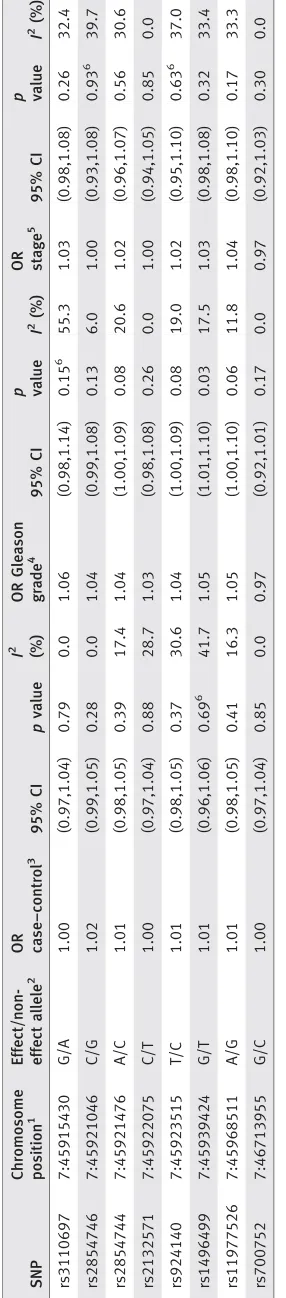
Fixed-effects and random-effects meta-analyses of the eight validated polymorphisms identified stronger associations with prostate cancer grade than with risk or disease stage (Table 3). ). Rs11977526 (the strongest instrument) was associated with high Gleason grade (OR per A allele 1.05; 95% CI: 1.00, 1.10) (Supporting Information Fig. 2). This variant’s A (minor) allele was associated with increased IGF-II levels in ProtecT and ALSPAC, IGFBP-3 levels in the literature and ALSPAC, and with reduced IGF-I levels in UKHLS. Other SNPs in the region in LD with rs11977526 had a similar effect on disease grade (Table 3). The major allele in rs700752, which is asso-ciated with higher IGF-I levels, showed a weakly protective effect with respect to high grade prostate cancer (OR per G allele 0.97; 95% CI: 0.92, 1.01) (Supporting Information Fig. Tab
le 3. SNPs asso ciated with IGF level s in Prot ecT and prostate canc er risk, grade and stage in th e PRACTICAL consortium SNP Chromo som e posi tion 1 Effect/ non-effect allele 2 OR case–c ontrol 3 95% CI p value I 2 (%) OR Gleason gra de 4 95% CI p value I 2 (%) OR stage 5 95% CI p value I 2 (%) rs311 0697 7:4591543 0 G/A 1.00 (0.9 7,1.04) 0.79 0.0 1.06 (0.98,1.14) 0.15 6 55.3 1.03 (0.98,1.08) 0.26 32.4 rs285 4746 7:4592104 6 C/G 1.02 (0.9 9,1.05) 0.28 0.0 1.04 (0.99,1.08) 0.13 6.0 1.00 (0.93,1.08) 0.93 6 39.7 rs285 4744 7:4592147 6 A/C 1.01 (0.9 8,1.05) 0.39 17.4 1.04 (1.00,1.09) 0.08 20.6 1.02 (0.96,1.07) 0.56 30.6 rs213 2571 7:4592207 5 C/T 1.00 (0.9 7,1.04) 0.88 28.7 1.03 (0.98,1.08) 0.26 0.0 1.00 (0.94,1.05) 0.85 0.0 rs924 140 7:4592351 5 T/C 1.01 (0.9 8,1.05) 0.37 30.6 1.04 (1.00,1.09) 0.08 19.0 1.02 (0.95,1.10) 0.63 6 37.0 rs149 6499 7:4593942 4 G/T 1.01 (0.9 6,1.06) 0.69 6 41.7 1.05 (1.01,1.10) 0.03 17.5 1.03 (0.98,1.08) 0.32 33.4 rs119 77526 7:4596851 1 A/G 1.01 (0.9 8,1.05) 0.41 16.3 1.05 (1.00,1.10) 0.06 11.8 1.04 (0.98,1.10) 0.17 33.3 rs700 752 7:4671395 5 G/C 1.00 (0.9 7,1.04) 0.85 0.0 0.97 (0.92,1.01) 0.17 0.0 0.97 (0.92,1.03) 0.30 0.0 Fixed-effects and random-effects meta-analyses adjusted for age and 15 principal components.
1GRCh38.p2. 2The
3). Evidence of association is limited when a Bonferroni cor-rection for multiple testing is applied.
Survival analysis in PRACTICAL
Rs700752 was associated with prostate cancer-specific mortal-ity, with the allele that increases IGF-I and IGFBP-3 levels (major) being associated with a lower risk of death. No other associations with all-cause or prostate cancer-specific mortal-ity were observed, except when considering the non-additive relationship of the genetic variant with survival (Supporting Information Table 6). In the case of SNPs linked to rs11977526 (i.e., rs1496499, rs2854744, rs2854746 and rs924140) heterozygotes exhibited the highest mortality rates, compared to homozygotes. The proportional hazards assumption was not fulfilled for many of the variants (p<0.05).
Instrumental variable analysis
An IV analysis using individual-level data was run for rs11977526 and IGF-II, as it had been genotyped/imputed in both ProtecT and PRACTICAL, and showed associations with circulating IGF-II in ProtecT and prostate cancer grade in PRACTICAL. The estimated causal OR per one SD (265 ng/mL) increase in serum IGF-II was 1.14 (95% CI: 1.00, 1.31) for high (vs. low) grade disease. Similarly, using infor-mation from UKHLS on the association between rs11977526 and IGF-I, we estimated a causal OR of 0.39 (95% CI: 0.14, 1.10) per one SD (50 ng/mL) increase in circulating IGF-I for high Gleason grade cancer.
We used summary data for the association of rs11977526 with IGFBP-3 from the discovery GWAS32 (results from the Framingham Heart Study cohort as the largest study) and its association with Gleason grade in PRACTICAL, to estimate the causal OR per one SD (1000 ng/mL) increase in IGFBP-3 as 1.15 (95% CI: 1.00, 1.32) for high (vs. low) grade disease.
Finally, if rs700752 is employed as an IV for serum IGF-I and IGFBP-3, based on ProtecT findings, the causal estimates regarding prostate cancer-specific mortality were HR 0.72 (95% CI: 0.53, 0.98) per SD increase in IGF-I, and HR 0.76 (95% CI: 0.60, 0.95) per SD increase in IGFBP-3. Considering UKHLS as the source of the SNP-exposure effect, the causal estimate per SD increase in IGF-I levels was lower but com-parable, HR 0.47 (95% CI: 0.29, 0.82).
Further analysis (see Supporting Information Results)
In order to obtain a more complete picture of the IGFBP1/ IGFBP3genetic region and its relationship to prostate cancer, we carried out an analysis of all additional SNPs within these genes that were available in PRACTICAL (n539).
We also examined the association of non-validated SNPs from the discovery GWAS with prostate cancer risk, progres-sion and mortality.
Discussion
We found that variants that had been identified in a GWAS32 and others linked to them, were the strongest instruments for the exposures examined, as expected. Surpris-ingly, in ProtecT most of these variants were strong instru-ments for a related exposure (i.e., IGF-II) and not for the exposure for which they were originally described (i.e., IGF-I and IGFBP-3). The discovery GWAS did not analyse IGF-II or other IGBP proteins besides IGFBP-3, which the authors considered a limitation of their study. Additionally, all the variants that proved to be strong instruments for serum IGFs were located on chromosome 7p12.3 in the IGFBP1/IGFBP3
gene region. This is consistent with the dominant effect of IGFBP-3 on circulating IGF levels. The IGFs are not stored in any tissue but are constitutively secreted from most tissues and stored in a circulating reservoir by forming a ternary complex with IGFBP-3 and an acid labile subunit that extends the circulating half-life of IGFs from 8–12 minutes to 15–18 hr.33
To investigate the discrepancy between our findings in ProtecT and the literature reports, we ran an analysis of SNPs confirmed as strong instruments in ProtecT, in ALSPAC mothers (N 400) and children (N 160–450) who had IGF-I, IGF-II and IGFBP-3 measured, and in 9,000 men and women from the UKHLS with measures of circulating IGF-I. Robust associations of IGFBP1/IGFBP-3
SNPs with IGF-II as well as with IGFBP-3 levels were identi-fied in pregnant women and in children across several ages. None of the SNPs were associated with IGF-I in ALSPAC. However, in UKHLS the majority of these variants showed an association with IGF-I concentration, the most convincing being rs700752.
The remaining GWAS-identified IGF-associated variants on chromosomes 4p16.1, 6q21, 7p21.3, 10q22.1 and 16p13.3 were not strong instruments in ProtecT, ALSPAC or UKHLS. When examined in relation to prostate cancer, the vali-dated IGF instruments showed weak associations with Glea-son grade. The strongest instrument in the literature and in ProtecT, rs11977526 and other SNPs in LD with it were asso-ciated with high (vs. low) grade disease. In addition, a few of the strong instruments validated in this study were associated with all-cause mortality under a non-additive genetic model (on the basis on an earlier report of non-additivity in the relationship of rs11977526 and longevity34). On the other hand, rs700752 exhibited the strongest association with pros-tate cancer-specific mortality under an additive model.
The non-validated instruments from the discovery GWAS32 did not show an association with any prostate can-cer outcome, except for rs2153960, which was associated with aggressiveness and mortality. This SNP lies in the FOXO3
gene, well-known for its relationship with longevity,35 and it is possible that this is driving the association with cancer.
A deeper look into theIGFBP1/IGFBP3region revealed at least two independent signals of association with prostate
Cancer
cancer following the regional LD structure (excluding rs700752): one toward theIGFBP1gene, and one encompass-ing the IGFBP3 gene. The lack of –or marginal- association with IGF-I, IGF-II and IGFBP-3 levels of SNPs in or near
IGFBP1 may mean that these variants are predominantly influencing IGFBP-1 levels. Recently higher circulating IGFBP-1 was found to be associated with lower prostate can-cer risk.4,36It is also conceivable that these signals may all be linked to another, causal signal in the region.
An MR analysis using rs11977526 as the IV, revealed that a large increase in the concentration of IGF-II or IGFBP-3 (1 SD) would increase the likelihood of progression to high grade cancer by approximately 15%, whilst a similar increase in IGF-I levels would be protective against disease progres-sion. Conversely, if rs700752 (a SNP not in LD with, and quite distant from rs11977526) is used as an instrument for IGF levels, a one SD increase in IGF-I or IGFBP-3 would reduce the risk of prostate cancer-specific mortality between 25% and 50%, depending on the genotype-exposure esti-mates considered. Given the association of each SNP with multiple IGF biomarkers the estimates obtained using differ-ent sets of instrumdiffer-ents and exposures could provide fairly different answers.
In summary, we have confirmed the association of genetic variants that lie toward the IGFBP3 end of the IGFBP1/ IGFBP3 region with IGFBP-3 and IGF-I levels, and we have discovered a novel association of some of the same variants with circulating IGF-II, which was observed in both ProtecT and ALSPAC. The differences found in the associations of the polymorphisms with the biomarkers could relate to the cohort composition (for instance, differing age structure or sex proportion), the method of assaying blood concentrations (e.g.,physical vs. chemical dissociation of IGF-I from IGFBPs used in ProtecT/ALSPAC and UKHLS, respectively) or to having reduced statistical power to detect them, as ProtecT and ALSPAC had low numbers of participants with IGF measures.
Our findings have important implications for MR as the SNPs examined have pleiotropic effects on IGF peptides and it will not be possible to isolate the effect of any one bio-marker on an outcome of interest using these instruments. Nevertheless, these variants could be used as strong instru-ments for the more general causal involvement of the IGF axis on a particular trait or disease, which undoubtedly pro-vides valuable information regarding the mechanisms leading to the onset and progression of the condition. Because of the regional pattern of LD and the lack of data on low frequency variants in IGFBP1/IGFBP3 it has not been possible to fully identify the functional polymorphisms responsible for varia-tion in IGF levels, which could have helped better define the instruments for MR. In the future a GWAS on circulating IGFBP-1 might provide useful instruments for this exposure as well.
We have also detected associations of SNPs in IGFBP-1/ IGBP-3 with prostate cancer aggressiveness which suggest a
positive relationship with higher circulating IGF-II and possi-bly IGFBP-3 (this varies depending on the instrument used). On the other hand, results obtained with instruments rs11977526 and rs700752 independently indicate an inverse association of IGF-I levels with Gleason grade and mortality. Although these associations were not very strong it is likely that local IGF levels in the prostate may be more prominent and there may be other determinants of such local levels. It is important to replicate of our findings in a non-overlapping prostate cancer set or using stronger instruments when they become available. Additionally, the association with mortality deserves further scrutiny including a more thorough assess-ment of the underlying genetic model.
Comparison with existing literature on IGF and prostate cancer. Prior studies that have examined the relationship between genetic variants in IGF pathway genes (primarily
IGF1 and IGFBP3) and prostate cancer, some of which also analysed circulating IGF proteins, reported for the most part an association ofIGF1genetic polymorphisms with disease in Europeans, African Americans, Japanese and Chinese.37–42 Two studies, carried out in African American and Korean men, respectively, showed an association of the IGFBP3 SNP rs2854744 with IGFBP-3 levels and prostate cancer risk.43,44 Among the studies conducted in European populations that measured circulating IGF-I and IGFBP-3, some found an association of the SNPs with serum levels but not with pros-tate cancer, and of serum levels with prospros-tate cancer.37,45,46 Some did not find an association of the SNPs with serum lev-els, although both the SNPs and the serum levels were associ-ated with prostate cancer,37,39 and one identified an association of the genetic variants with serum levels but no association of variants or levels with prostate cancer.39
Compared to these studies (with samples sizes ranging from 130 to 6,000 patients and an equivalent number of controls), our study had good power, from a large sample size in PRACTICAL, to accurately estimate the genotype-outcome associations, and obtain precise causal odds ratios.47
A number of observational studies have consistently reported positive associations of circulating IGF-I with pros-tate cancer, but inferences of causality are limited with obser-vational studies.3,4,36 MR is designed to overcome these problems if the exposure is adequately instrumented. Our MR estimates with independent instruments rs11977526 and rs700752 seem to contradict observational studies on the effect of IGF-I on prostate cancer; however replication with, ideally, non-pleiotropic instruments is necessary. Observatio-nal findings for IGFBP-3 have been inconsistent,3,5,6whereas IGF-II and IGFBP-2 have been investigated less frequently.3,4 Regarding IGFBP-3, results based on the strongest instru-ment (rs11977526) are concordant with the positive associa-tion described in the observaassocia-tional literature4,5; however, using another instrument, such as rs700752, suggests a pro-tective effect. Alternatively, assuming our results represent the effect of IGF-II on disease, they are in agreement with
Cancer
previous findings with respect to PSA-detected prostate can-cer, although they found no evidence for an association of this biomarker with cancer grade.4,5
Conclusions
Using MR to establish the causal effects of a modifiable expo-sure, such as IGF levels, on an outcome of interest requires genetic variants that qualify as instruments for the exposure given a set of assumptions. Thus, it is important that strong instruments are valid across populations, particularly as two-sample MR becomes more common. When phenotypes are known to vary significantly with population characteristics it would be desirable to make sure that they are being properly instrumented before engaging in an MR analysis. We have found evidence that the IGF axis contributes to some extent to prostate cancer progression to high grade cancer and mor-tality but the instruments currently available for circulating IGFs do not allow us to pinpoint which biomarker or bio-markers underlie the causal relationship.
Acknowledgements
The authors thank the tremendous contribution of all members of the Pro-tecT study research group, and especially the following who were involved in this research (Prasad Bollina, Sue Bonnington, Lynn Bradshaw, James Catto, Debbie Cooper, Michael Davis, Liz Down, Andrew Doble, Alan Doherty, Garrett Durkan, Emma Elliott, David Gillatt, Pippa Herbert, Peter Holding, Joanne Howson, Mandy Jones, Roger Kockelbergh, Howard Kynaston, Ter-esa Lennon, Norma Lyons, Hing Leung, Malcolm Mason, Hilary Moody, Philip Powell, Alan Paul, Stephen Prescott, Derek Rosario, Patricia O’Sulli-van, Pauline Thompson, Sarah Tidball). They thank Gemma Marsden and Luke Marsden, who processed the blood samples at the biorepository, and Rajeev Kumar, data manager. They also thank the Center National de Genotypage, Evry, France for genotyping the ProtecT samples.
The authors are grateful for the provision of the additional epidemiologi-cal data by the NHS R&D Directorate supported Prodigal study and the ProMPT (Prostate Mechanisms of Progression and Treatment) collabora-tion which is supported by the Nacollabora-tional Cancer Research Institute (NCRI) formed by the Department of Health, the Medical Research Council and Cancer Research UK (G0500966/75466).
The authors are extremely grateful to all the families who took part in the ALSPAC study, the midwives for their help in recruiting them, and the whole ALSPAC team, which includes interviewers, computer and laboratory technicians, clerical workers, research scientists, volunteers, managers, receptionists and nurses. The UK Medical Research Council and the Well-come Trust (Grant ref: 102215/2/13/2) and the University of Bristol provide core support for ALSPAC. GWAS data was generated by Sample Logistics and Genotyping Facilities at the Wellcome Trust Sanger Institute and Lab-Corp (Laboratory Lab-Corportation of America) using support from 23andMe.
The Collaborative Oncological Gene-environment Study (COGS), within which the PRACTICAL consortium was assembled, would not have been possible without the contributions of the following: Per Hall (COGS), Doug-las F. Easton, Paul Pharoah, Kyriaki Michailidou, Manjeet K. Bolla, Qin Wang (BCAC), Andrew Berchuck (OCAC), Rosalind A. Eeles, Douglas F. Easton, Ali Amin Al Olama, Zsofia Kote-Jarai, Sara Benlloch (PRACTI-CAL), Georgia Chenevix-Trench, Antonis Antoniou, Lesley McGuffog, Fer-gus Couch, Ken Offit (CIMBA), Joe Dennis, Alison M. Dunning, Andrew Lee, Ed Dicks, Craig Luccarini and the staff of the Centre for Genetic Epide-miology Laboratory, Javier Benitez, Anna Gonzalez-Neira and the staff of the CNIO genotyping unit, Jacques Simard and Daniel C. Tessier, Francois Bacot, Daniel Vincent, Sylvie LaBoissie`re, Frederic Robidoux and the staff of the McGill University and Genome Quebec Innovation Centre, Stig E. Boje-sen, Sune F. NielBoje-sen, Maren Weischer, Børge G. Nordestgaard and the staff of the Copenhagen DNA laboratory, and Julie M. Cunningham, Sharon A. Windebank, Christopher A. Hilker, Jeffrey Meyer and the staff of the Mayo Clinic Genotyping Core Facility.
The UK Household Longitudinal Study is led by the Institute for Social and Economic Research at the University of Essex and funded by the Eco-nomic and Social Research Council. The data were collected by NatCen.
The authors acknowledge support from the NIHR to the Biomedical Research Centre at The Institute of Cancer Research and The Royal Marsden NHS Foundation Trust.
References
1. Pollak M. Insulin and insulin-like growth factor signalling in neoplasia.Nat Rev Cancer2008; 8: 915–28.
2. Roddam AW, Allen NE, Appleby P, et al. Insu-lin-like growth factors, their binding proteins, and prostate cancer risk: analysis of individual patient data from 12 prospective studies.Ann Intern Med2008; 149:461–71.
3. Rowlands M-A, Gunnell D, Harris R, et al. Circu-lating insulin-like growth factor peptides and prostate cancer risk: a systematic review and meta-analysis.Int J Cancer2009; 124:2416–29. 4. Travis RC, Appleby PN, Martin RM, Holly JM,
Albanes D, Black A, Bueno-de-Mesquita HB, Chan JM, Chen C, Chirlaque M-D, Cook MB, Deschasaux M, et al. A meta-analysis of individ-ual participant data reveals an association between circulating levels of IGF-I and prostate cancer risk.Cancer Res, in press.
5. Rowlands M-A, Holly JMP, Gunnell D, et al. Cir-culating insulin-like growth factors and IGF-binding proteins in PSA-detected prostate cancer: the large case-control study ProtecT.Cancer Res 2012; 72:503–15.
6. Neuhouser ML, Platz EA, Till C, et al. Insulin-like growth factors and insulin-Insulin-like growth factor-binding proteins and prostate cancer risk:
results from the Prostate Cancer Prevention Trial. Cancer Prev Res2013; 6:91–9.
7. Woodson K, Tangrea JA, Pollak M, et al. Serum insulin-like growth factor I: tumor marker or eti-ologic factor? A prospective study of prostate cancer among Finnish men.Cancer Res2003; 63: 3991–4.
8. Young NJ, Metcalfe C, Gunnell D, et al. A cross-sectional analysis of the association between diet and insulin-like growth factor (IGF)-I, IGF-II, IGF-binding protein (IGFBP)22, and IGFBP-3 in men in the United Kingdom.Cancer Causes Con-trol2012; 23:907–17.
9. Kristal AR, Stanford JL. Cruciferous vegetables and prostate cancer risk.Cancer Epidemiol Bio-markers Prev2004; 13:1265
10. Rowlands M-A, Holly JMP, Gunnell D, Gilbert R, Donovan J, Lane JA, Marsden G, Collin SM, Hamdy F, Neal DE, Martin RM. The relation between adiposity throughout the life course and variation in IGFs and IGFBPs: evidence from the ProtecT (Prostate testing for cancer and Treat-ment) study.Cancer Causes Control2010; 21: 1842.
11. Cohen P. Serum insulin-like growth factor-I lev-els and prostate cancer risk-interpreting the evi-dence.J Natl Cancer Inst1998; 90:876–9.
12. Davey Smith G, Ebrahim S. “Mendelian random-ization”: can genetic epidemiology contribute to understanding environmental determinants of disease?Int J Epidemiol2003; 32:1–22. 13. Davey Smith G, Hemani G. Mendelian
random-ization: genetic anchors for causal inference in epidemiological studies.Hum Mol Genet2014; 23:R89–98.
14. Li Y, Willer CJ, Ding J, et al. MaCH: using sequence and genotype data to estimate haplo-types and unobserved genohaplo-types.Genet Epidemiol 2010; 34:816–34.
15. Boyd A, Golding J, Macleod J, et al. Cohort Pro-file: the “children of the 90s”–the index offspring of the Avon Longitudinal Study of Parents and Children.Int J Epidemiol2013; 42:111–27. 16. Fraser A, Macdonald-Wallis C, Tilling K, et al.
Cohort Profile: the Avon Longitudinal Study of Parents and Children: ALSPAC mothers cohort. Int J Epidemiol2013; 42:97–110.
17. Bonilla C, Ness AR, Wills AK, et al. Skin pigmen-tation, sun exposure and vitamin D levels in chil-dren of the Avon Longitudinal Study of Parents and Children.BMC Public Health2014; 14:597
18. Jeffreys M, Northstone K, Holly J, et al. Levels of insulin-like growth factor during pregnancy and
Cancer
maternal cancer risk: a nested case– control study.Cancer Causes Control2011; 22: 945–53.
19. Delaneau O, Marchini J. Integrating sequence and array data to create an improved 1000 Genomes Project haplotype reference panel.Nat Commun2014; 5:3934
20. Howie BN, Donnelly P, Marchini J. A flexible and accurate genotype imputation method for the next generation of genome-wide association stud-ies.PLoS Genet2009; 5:e1000529
21. Howie B, Fuchsberger C, Stephens M, et al. Fast and accurate genotype imputation in genome-wide association studies through pre-phasing.Nat Genet2012; 44:955–9.
22. Kote-Jarai Z, Easton DF, Stanford JL, et al. Multi-ple novel prostate cancer predisposition loci con-firmed by an international study: the
PRACTICAL consortium.Cancer Epidemiol Bio-markers Prev2008; 17:2052–61.
23. Amin Al Olama A, Kote-Jarai Z, Berndt SI, et al. A meta-analysis of 87,040 individuals identifies 23 new susceptibility loci for prostate cancer.Nat Genet2014; 46:1103–9.
24. Lawlor DA, Harbord RM, Sterne JAC, et al. Men-delian randomization: using genes as instruments for making causal inferences in epidemiology. Stat Med2008; 27:1133–63.
25. von Hinke Kessler Scholder S, Davey Smith G, Lawlor DA, et al. Mendelian randomization: the use of genes in instrumental variable analyses. Health Econ2011; 20:893–6.
26. Machiela MJ, Chanock SJ. LDlink: a web-based application for exploring population-specific hap-lotype structure and linking correlated alleles of possible functional variants.Bioinformatics2015 ; btv402.
27. Angrist JD, Krueger AB. The effect of age at school entry on educational attainment: an appli-cation of instrumental variables with moments from two samples.J Am Stat Assoc1992; 87:328–36.
28. Inoue A, Solon G. Two-sample instrumental vari-able estimators.Rev Econ Stat2010; 92:557–61. 29. Petry CJ, Ong KK, Barratt BJ, et al. Common
polymorphism in H19 associated with birthweight and cord blood IGF-II levels in humans.BMC Genet2005; 6:22
30. Terry KL, Tworoger SS, Gates MA, et al. Com-mon genetic variation in IGF1, IGFBP1 and IGFBP3 and ovarian cancer risk.Carcinogenesis 2009; 30:2042–6.
31. Palmer TM, Lawlor DA, Harbord RM, et al. Using multiple genetic variants as instrumental variables for modifiable risk factors.Stat Methods Med Res2012; 21:223–42.
32. Kaplan RC, Petersen A-K, Chen M-H, et al. A genome-wide association study identifies novel loci associated with circulating IGF-I and IGFBP-3.Hum Mol Genet2011; 20:1241–51.
33. Holly JMP, Perks CM. Insulin-like growth factor physiology: what we have learned from human studies.Endocrinol Metab Clin North Am2012; 41:249–63.
34. He Y-H, Lu X, Yang L-Q, et al. Association of the insulin-like growth factor binding protein 3 (IGFBP-3) polymorphism with longevity in Chi-nese nonagenarians and centenarians.Aging (Albany NY)2014; 6:944–51.
35. Martins R, Lithgow GJ, Link W. Long live FOXO: unraveling the role of FOXO proteins in aging and longevity.Aging Cell2015; n/a–n/a. 36. Cao Y, Nimptsch K, Shui IM, et al. Prediagnostic
plasma IGFBP-1, IGF-1 and risk of prostate can-cer.Int J Cancer2015; 136:2418–26.
37. Nam RK, Zhang WW, Trachtenberg J, et al. Comprehensive assessment of candidate genes and serological markers for the detection of pros-tate cancer.Cancer Epidemiol Biomarkers Prev 2003; 12:1429–37.
38. Cheng I, Stram DO, Penney KL, et al. Common genetic variation in IGF1 and prostate cancer risk in the Multiethnic Cohort.J Natl Cancer Inst 2006; 98:123–34.
39. Schumacher FR, Cheng I, Freedman ML, et al. A comprehensive analysis of common IGF1, IGFBP1 and IGFBP3 genetic variation with pro-spective IGF-I and IGFBP-3 blood levels and prostate cancer risk among Caucasians.Hum Mol Genet2010; 19:3089–101.
40. Sarma AV, Dunn RL, Lange LA, et al. Genetic polymorphisms in CYP17 SRD5A2, IGF-1, and IGFBP-3 and prostate cancer risk in African-American men: the Flint Men’s Health Study. Prostate2008; 305:296–305.
41. Tsuchiya N, Wang L, Horikawa Y, et al. CA repeat polymorphism in the insulin-like growth factor-I gene is associated with increased risk of prostate cancer and benign prostatic hyperplasia. Int J Oncol2005; 26:225–31.
42. Qian J, Zhou H, Chen J, et al. Genetic polymor-phisms in IGF-I and IGFBP-3 are associated with prostate cancer in the Chinese population.PLoS One2014; 9:e85609
43. Hernandez W, Grenade C, Santos ER, et al. IGF-1 and IGFBP-3 gene variants influence on serum levels and prostate cancer risk in African-Ameri-cans.Carcinogenesis2007; 28:2154–9. 44. Park K, Kim JH, Jeon HG, et al. Influence of
IGFBP3 gene polymorphisms on IGFBP3 serum levels and the risk of prostate cancer in low-risk Korean men.Urology2010; 75:1516.e1–7. 45. Johansson M, McKay JD, Rinaldi S, et al. Genetic
and plasma variation of insulin-like growth factor binding proteins in relation to prostate cancer incidence and survival.Prostate2009; 69: 1281–91.
46. Gu F, Schumacher FR, Canzian F, et al. Eighteen insulin-like growth factor pathway genes, circulat-ing levels of IGF-I and its bindcirculat-ing protein, and risk of prostate and breast cancer.Cancer Epide-miol Biomarkers Prev2010; 19:2877–87. 47. Pierce BL, Burgess S. Efficient design for
Mende-lian randomization studies: subsample and 2-sample instrumental variable estimators.Am J Epidemiol2013; 178:1177–84.