*Corresponding author
Distribution Network Reconfiguration Based on
Particle Clonal Genetic Algorithm
Yemei Qin
Swan College, Central South University of Forestry and Technology, Changsha, 410004, China
School of Information Science and Engineering, Central South University, Changsha, 410083, China
E-mail: [email protected]
Ji Wang*
School of Information Science and Engineering, Central South University, Changsha, 410083 China
E-mail: [email protected]
Abstract—Distribution network reconfiguration is an
important aspect of automation and optimization of distribution network system. To handle massive binary code infeasible solutions in distribution network reconfiguration, a kind of sequence code is presented in which a loop is a gene and the label of each switch in the loop is the gene value. To solve mutation probability and slow the convergence of clonal genetic algorithm (CGA) in the later stage, in this paper particle clonal genetic algorithm (PCGA) is proposed, in which we build particle swarm algorithm (PSO) mutation operator. PCGA avoids the premature convergence of PSO and the blindness of CGA. It ensures evolution direction and range based on historical records and swarm records. The global optimal solution can be obtained with fewer generations and shorter searching time. Compared with CGA and clonal genetic simulated annealing algorithm (CGSA), IEEE33 and IEEE69 examples show that PCGA can cut the calculation time and promote the search efficiency obviously.
Index Terms—sequence code, distribution network
reconfiguration, infeasible solution, PCGA
I .INTRODUCTION
Distribution network system is an important part of power system which connects power produce with consumers. Distribution network reconfiguration is an important aspect of automation and optimization of the distribution network system. The aim of distribution network reconfiguration is that it can bring big economy and society benefits for enhancing system's security and reliability by changing the open/close status of the connection and section switches under normal or abnormal operations.
Closed loop construction and opened loop running are the distribution network’s characteristic. Distribution network configuration is to bring down the network loss and isolate the fault point and balance the voltage through adjusting the combination status of connection
switches and section switches. Therefore, it is an important way of economic running and reliability of power network.
Recently methods for solving this problem tend to newborn bionic optimizations, such as genetic algorithm (GA), ant swarm algorithm (AA), particle swarm algorithm (PSO), immune algorithm (IA), etc. GA is the most widely applied method among them. The binary-coded GA with mature theory and simple operation is still used largely. However, the calculation precision of this kind of coding isn’t high when it is used to optimize functions, and “combination explosion” is brought about when it is used to optimize combinations. Some scholars improved coding scheme and adopted integer code [1] or real code [2], which enhanced efficiency. But the radial running construction (without loops and without isolate nodes) of distribution network may originate massive infeasible solutions using the different codes as above. This paper gives a loop sequence code method, which can preclude infeasible solutions in the process of configuration.
Based on PSO and CGA principles, this paper puts forward a new algorithm - particle clonal genetic algorithm. This algorithm constructs a new mutation operator - PSO mutation operator, which replaces gene mutation operator of CGA. Based on historical individual and swarm records, PSO mutation operator adjusts the evolution direction and range. These operations can avoid the blindness of CGA mutation, and reduce the probability of devious mutation and enhance the velocity of evolution.
. PARTICLE CLONAL GENETIC ALGORITHM Ⅱ
A. Building PCGA
PCGA is obtained by blending PSO with CGA according to their advantages and shortages, and their advantages and shortages are as the following.
(1) Both of them can be coded with binary, real or sequence.
mutation probability is too small, it is very difficult to find the new individual, and when it is too large, the blindness and random of search turn worse.
PSO converges quickly and requires few experience parameters. The influence of swarm scale is very slight and system behavior is hardly weakened when the number of individual is decreased. But its main shortcoming is premature convergence.
(3) CGA individuals are chosen for the optimal solution through competition, and the whole swarm evenly moves toward the best zone.
PSO seeks for the optimal solution through cooperation instead of competition. Swarm optimal solution sends information to other particles indirectly, and each particle doesn’t share information directly.
(4) CGA individuals aren’t capable of memory and each only reflects its present status. Their evolution ranges and directions can’t be controlled.
PSO individuals (particles) are capable of memory. They can control their evolution ranges and directions based on historical information and present status. Normally, particle can converge to the optimal solution quickly.
(5) CGA operation is indirect and random. Consequently, some newborn individuals are eliminated because of low adaptive degree.
PSO is direct and can automatically adjust optimization ranges and directions based on individual historical optimal solution and swarm historical optimal solution. So the blindness of evolution is avoided.
As a result, PCGA, combining PSO with CGA, can develop respective merits, and compensate opponent defects, and make the process of searching optimal solution efficiency.
B. PCGA operator
There are three operators according to sequence code.
a. CGA Selection Operator
Roulette means, named as adaptive-degree proportion means too, is adopted. It is the most elementary and popular selecting method. The basic idea is that the selection probability of each individual is proportional to adaptive-degree. In this method the chromosome chooses its offspring by the probability. If
N
is the size of the swarm,F
i is the adaptive- degree of individuali
, the selected probability of individuali
is written as∑
==
N j i isi
F
F
P
1
(1)
b. CGA shift operator
It shifts one or more genes which are selected randomly forward or backward in turn. It can be classified into two basic types: single shift operator and multi-shift operator.
c. PSO mutation operator
From elementary PSO formula, this paper builds a PSO mutation operator, which decides mutation direction and range on the basis of particle and swarm historical
optimal solution and the evolution velocity of particle.
Let
x
max,i be the code of historical optimal solutioni
F
max, of particlei
, andX
maxbe the code of swarm historical optimal solutionF
max, and∆
x
max,i be thevelocity. Then
∆
x
max,iof the No. t is given as the following [3]t
x
x
x
t k k i k i ti
[
(
)]
/
2 1 max, max, max,
∑
= −−
=
∆
(2)PSO mutation operator is
∆
+
=
−
+
−
+
∆
=
∆
+ + + 1 max, 1 max 2 2 max, 1 1 max, 1max,
(
)
(
)
t i t i t i t i t i i t i t i
x
x
x
x
X
r
c
x
x
r
c
x
x
ω
(3)where
ω
is the inertia factor,c
1 andc
2 are theweight factors,
r
1 andr
2 are random real numbers from 0 to 1.PSO mutation operator is made up of two parts: one is to predict change range and direction, the other is to execute mutation manipulation concretely. Therefore, PSO mutation operation has the self-study ability, and the prediction before mutation makes that this operation is not a simple random mutation but a mutation with enhancing individual adaptive ability to the environment.
Ⅲ. DISTRIBUTION NETWORK RECONFIGURATION
A. Reconfiguration frame graph
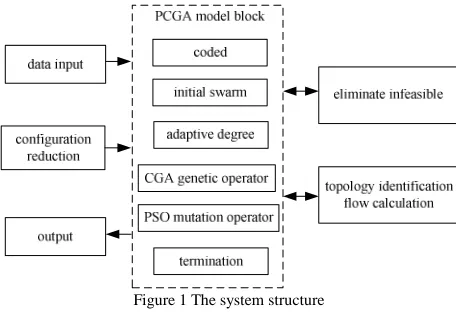
Figure 1 shows the system structure of distribution network reconfiguration. It is mainly made up of PCGA model block and several preparation models.
Reconfiguration should put emphasis on coding and eliminating infeasible solutions and PCGA operators.
Figure 1 The system structure
B. Chromosome coding
Coding scheme is the main factor influencing the efficiency of the intellective optimal algorithm. Distribution network reconfiguration using binary code may generate massive infeasible solutions. So this paper gives a sequence code rule. Compared with binary code, this code is realized easily and the probability of effective codes is high.
(from 1 to the number which is the number of switches of this loop) [4]. This code regards each loop as gene, and the opened switch’s label in counterpart loop as gene value. This value must be positive integer number. The length of chromosome equals to the number of connection switches (the number of loops). Figure 2 is an example of 16-node distribution system. The Nos.10, 12, and 15 switches are connection switches.
F Figure2. IEEE16 distribution system after coding
The loop formed by the No.10 switch (including the Nos.9, 7, 4, and 10 switches) is defined as the first loop. TableⅠclearly shows that the right-hand switch of the connection switch is coded as the No.1 switch and the connection switch itself is the last number in the loop. So the length of chromosome in this distribution system is three. If connection switches in Figure 2 are all opened and other switches are closed, its code is (4 3 5). The code rule covers all switch-combination states, and there are no infeasible solutions, which meets the request of one-to-one mapping between chromosomes and solutions. For the system in Figure 2, there are 60 solutions using the new rule, but according to binary rule, there are 212 solutions whose proportion of infeasible solutions is 98.535% and the majority of calculation is ineffective.
TableⅠ. Switches coding encode
loop 1 2 3 4 5
NO.1 9 7 4 10
NO.2 11 8 12
NO.3 14 13 5 6 15
The code rule above is very convenient for single loop. But for complex distribution system, in which there are common switches between loops, the rule must be researched further. Some infeasible solutions occur after genetic operations because of common switches. Though multi-loop is few, it exists. Reference [5] expounds it clearly. The conclusion is that single loop is a system without common switches among loops; double loop is a system in which there are common parts between every two loops while not common parts every three loops; the loop, in which there are common switches among three or more loops or between any two loops, is defined as multi-loop.
C. Eliminating infeasible solutions
Figure 3 shows some simplified double loops. The No.1 loop consists of A(C)B, and its code of switch
A-B-(C)-A is 1,2; The No.2 loop is comprised of A(D)B, and its code of switch A-B-(D)-A is 2,1. AB is the common part and has different code in each loop, others aren’t common.
Figure3. Four basic combinations of double loop
the path (a path may include several switches) without opened switch.
the path with opened switch
Figure4. 27 basic combinations of triple loop
the path(a path may include several switches) without opened switch.
the path with opened switch
all solutions, the proportion is very small. As a result, the code is valid when two connection switches are not simultaneously on the shared path of two loops.
Simplified formation of triple loop is presented in Figure 4. The No.1 loop is made up of BAOB and its code of the switch B-A-O-B is 1,2,3; OACO are components of the No.2 loop and sequence code of the switch O-A-C-O is 1,2,3; and the No.3 loop is composed of BOCB and its code of the switch B-O-C-B is 1,2,3. AO is the common switch of the No.1 and the No.2 loop, coded with 2 in the No.1 loop and with 1 in the No.2 loop, respectively; CO is the common part of the No.2 and the No.3 loop, coded with 3 in the No.2 and with 2 in the No.3 loop, respectively; and BO is the common part of the No.1 and No.3 loop, coded with 3 in the No.1 loop and with 1 in the No.3 loop, respectively.
There are 27 combinations altogether and their codes are shown in Figure 4. The Nos.8,10,11,12,16,17,19,20, 22,25,and 26 states are infeasible for a loop which breaks the radial construction rule in distribution system; or for an isolated node which destroys the connectivity rule. From these states, two regulations are found: on one hand, the common path of two loops is opened twice, thus a loop occurs; on the other hand, all the common paths of every two loops are opened simultaneously, such as the No.16 and the No.20 states, thus the isolated node O occurs. All infeasible solutions are 11/27 of all solutions. The rule of triple-loop is induced: if common path between two loops is opened twice or more, or all common paths are opened, the solution is infeasible and this chromosome should be excluded.
D. CGA shift operator
Under sequence code, CGA shift operator should be adjusted.
TableⅡ. Shift operator
single shift operator
4 2 3 point_ shift=2 4 1 3 (left) time_ shift=1 4 3 3 (right)
Multi-shift operator
4 2 3 min_ shift=2 4 1 1 (left) max_ shift=3 4 3 5 (right)
(1) Single shift operator: TableⅡshows an example. The point_ shift is a gene (a loop) selected randomly, and the time_ shift is the number of shift. The value of time_ shift should be less than the length of this loop. Besides, the right_ left is a flag, which decides to shift toward the left or the right (by the clockwise or the anticlockwise) in the loop. The code after the shift is sent to a new chromosome.
(2) Multi-shift operator: an example is given in Table
Ⅱ. The min_ shift and max_ shift are two genes selected randomly, which are the beginning and the end gene position of shift operation respectively. They cannot be equal; moreover min_ shift must be less than max_ shift. Or, the former steps are repeated until the requirement is fulfilled. Then all other genes between min_ shift and
max_ shift are shifted by single shift operator, which can insure that every loop has only one opened branch.
E. Reconfiguration step
The operation steps of PCGA are as the following
Step1 initialize the parameters including swarm_ size,
the length of chromosome L, the inertia factor
ω
, theweight factors
c
1 andc
2, and the limit velocitiesmax
v
andv
min.Step2 set the stopping condition q. Step3 yield the first swarm initial_ swarm.
Step4 evaluate individual adaptive degree of present
swarm.
Step5 execute CGA selection and shift operators, and
come into being PSO swarm.
Step6 search the best position of particle pbest and
the best position of swarm gbest.
Step7 execute PSO mutation operator.
Step8 evaluate individual adaptive degree of swarm. Step9 judge whether to satisfy the step2 or not. If it is
yes, let all calculations stop; else return to step5.
Ⅳ. EXAMPLE ANALYSIS
Using the standard IEEE33 and IEEE69 distribution systems (their structures are in appendix) as examples and the least network loss (showed in formula 4) as the objective function, the distribution network is reconfigured.
2 2 2
1 2
1
min
i i i b
i i i b
i
i i i
V
Q
P
R
k
I
R
k
LP
=
∑
=
∑
+
= =
(4)
where Ri is the branch resistance, Pi and Qi are the active power and the inactive power of branch terminal, Vi is terminal node voltage of branch, b is the number of branch, ki is the status variable of switch i, and if ki is 0 , then switch i is open and if ki is 1 , then switch i is close, and Ii is the branch current.
Every parameter is set as: swarm_ size is 30, ωis 0.8, both c1 and c2 both are 2.0, v max and v min are 4.0 and -4.0 respectively, q is 10(no change in the continuous 10 generations), the maximum number of iterations is 103, and flow calculation precision is 10-6.
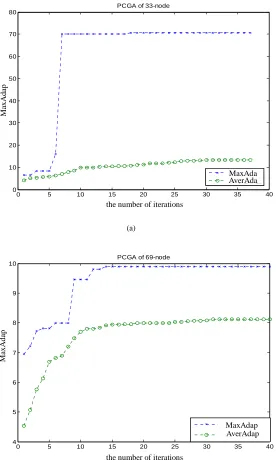
Figure 5 gives the reconfiguration solutions of IEEE33 system (showed in figure 5(a)) and IEEE69 system (showed in figure 5(b)) with PCGA. In the figure, the number of iterations is X axle, and the maximum adaptive degree (MaxAdap) is Y axle. In the figure, the maximum adaptive degree (MaxAdap) and the average adaptive degree (AverAdap) of each generation are marked. From the figure, we also find the number of iterations of PCGA when the optimal solution is obtained. It is only 7 in IEEE33 and 14 in IEEE69. The convergences both are very quickly.
0 5 10 15 20 25 30 35 40 0
10 20 30 40 50 60 70 80
迭迭迭迭
最
最
最
最
最
PCGA of 33-node
最最最最最 平平最最最
(a)
0 5 10 15 20 25 30 35 40
4 5 6 7 8 9 10
迭迭迭迭
最
最
最
最
最
PCGA of 69-node
最最最最最 平平最最最
(b)
Figure 5. The reconfiguration solutions of IEEE33 and IEEE69 system with PCGA CGSA (the Clonal Genetic Simulated Annealing
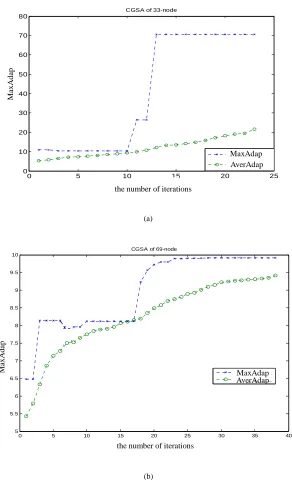
Algorithm), which combines CGA and SA, puts the Metropolis sample rule of the SA into the CGA, and takes this rule as the standard rule through which CGSA can decide if the search converges or not. So the generated chromosome of CGA will become more and more excellent and converge quickly. At the same time, it will not be trapped in local optimal solutions. Figure 6 shows the reconfiguration solution with CGSA, and it is worse than the solution with PCGA.
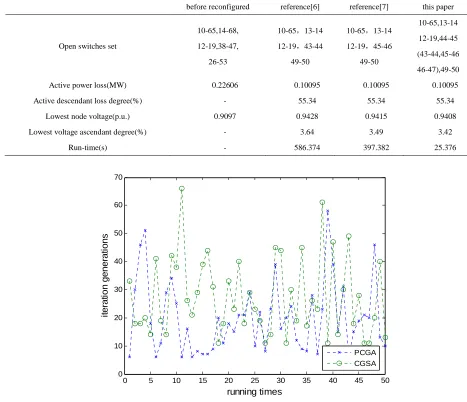
Table Ⅲ and Table Ⅳ prove the feasibility of reconfiguration with PCGA. The active power loss and the node voltage quality can be improved evidently. The loss descends with 29.84% in IEEE33 and 55.34% in IEEE69, respectively,the lowest node voltage ascends
with 5.73% in IEEE33 and 3.42% in IEEE69, respectively. So PCGA is better than CGA and CGSA.
Besides, in IEEE69, several equivalent optimal results occur because nodes 44, 45, and 46 are zero load and the results of opening any one of the switch 43-44, 44-45, 45-46, and 46-47 are same. In order to have a fair comparison, references [6] and [7] showed in Table Ⅲ
and Table Ⅳ are manipulated by using sequence code and setting their initial conditions according to PCGA.
Besides, both CGSA and PCGA in IEEE69 system are manipulated 50 times. Figure 7 shows their number of generations when the optimal solution is obtained. Table Ⅴgives the minimum generations (MinGen), the maximum generations (MaxGen), the average generations (AverGen) and the average time (ATime). the number of iterations
MaxAdap AverAdap
M
ax
A
d
ap
the number of iterations
MaxAda AverAda
M
ax
A
d
0 5 10 15 20 25 0
10 20 30 40 50 60 70 80
迭迭迭迭
最
最
最
最
最
CGSA of 33-node
最最最最最 平平最最最
(a)
0 5 10 15 20 25 30 35 40 5
5.5 6 6.5 7 7.5 8 8.5 9 9.5 10
迭迭迭迭
最
最
最
最
最
CGSA of 69-node
最最最最最 平平最最最
(b)
Figure6. The reconfiguration solutions of IEEE33 and IEEE69 system with CGSA
Table Ⅲ. Reconfiguration solution of IEEE33 based on PCGA
before reconfigured reference[7] this paper
Open switches set
7-20,11-21,8-14,
17-32,24-28
19-20,11-21,11-12,
25-26,7-8
19-20,11-21,11-12,
25-26,7-8
Active power loss(MW) 2.0189 1.4165 1.4165
Active descendant loss degree(%) - 29.84 29.84
Lowest node voltage(p.u.) 0.9133 0.9682 0.9656
Lowest voltage ascendant degree(%) - 6.01 5.73
Run-time(s) - 229.150 12.218
the number of iterations
MaxAdap AverAdap
M
ax
A
d
ap
the number of iterations
MaxAdap AverAdap
M
ax
A
d
Table Ⅳ.Reconfiguration solution of IEEE69 based on PCGA
before reconfigured reference[6] reference[7] this paper
Open switches set
10-65,14-68,
12-19,38-47,
26-53
10-65,13-14 12-19,43-44
49-50
10-65,13-14 12-19,45-46
49-50
10-65,13-14
12-19,44-45
(43-44,45-46
46-47),49-50
Active power loss(MW) 0.22606 0.10095 0.10095 0.10095
Active descendant loss degree(%) - 55.34 55.34 55.34
Lowest node voltage(p.u.) 0.9097 0.9428 0.9415 0.9408
Lowest voltage ascendant degree(%) - 3.64 3.49 3.42
Run-time(s) - 586.374 397.382 25.376
0 5 10 15 20 25 30 35 40 45 50
0 10 20 30 40 50 60 70
running times
it
e
ra
ti
o
n
g
e
n
e
ra
ti
o
n
s
PCGA CGSA
Figure7. Search ability comparison between PCGA and CGSA
TableⅤ. Statistics running 50 times
IEEE69 MinGen MaxGen AverGen ATime(s)
CGSA 11 66 27.3 181.43
PCGA 6 58 19.84 25.93
As expected, PCGA has fewer generations and needs less time than CGA and CGSA, that is, the former has higher search efficiency and better search ability.
Ⅴ. CONCLUSION
(1) Sequence code resolves the multi-loop problem in distribution network reconfiguration, eliminates infeasible solutions, and improve the calculation efficiency.
(2) PCGA not only combines the advantages of CGA and PSO, but also avoids premature convergence of PSO and the blindness of CGA. It can determinate itself evolution direction and range, and ensure global
convergence.
(3) Compared with CGA and CGSA, PCGA need fewer generations and less time when the global optimal solution is obtained.
(4) The standard IEEE33 and IEEE69 examples express that the method in this paper can speed up the process of evolution, and gain the global optimal solution, and enhance the search efficiency.
Appendix
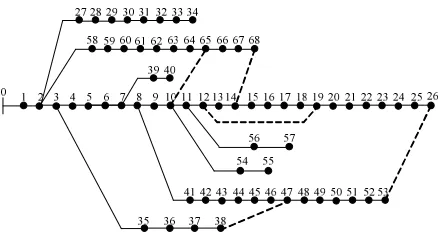
The IEEE33 system and IEEE69 systems [6] and [7] are shown in Figure A and Figure B, respectively.
Figure B 69-node distribution network diagram
References
[1] Fei Tang, Hongfei Teng, “On Scheme Theorem of the Integer-Coded Genetic Algorithm”, Computer Science, China, vol.26,no.6, 1999,pp.54-56.
[2] Guang Shen, Yunping Chen, Dong Liu, “Distribution Network Restoration Based on the Genetic Algorithm with Minimum Spanning Tree Decoding”, Automation of Electric Power Systems, China, vol.21, no.14, 2007, pp. 81-84
[3] Wenyi Wang, Guangjun Qin, Ruoyu Wang, “Research on Genetic Algorithm Based on Particle Swarm Algorithm”, Computer Science, China,vol.34,no.8,2007, pp.145-147 [4] Xiufan Ma, Lizi Zhang, “Distribution Network
Reconfiguration Based on Genetic Algorithm Using Decimal Encoding”, Transactions of China Electrotechnical Society, China, vol.19, no.10, 2004, pp. 65-69
[5] Shouxiang Wang, Chengshan Wang, “A Novel Network Reconfiguration Algorithm Implicitly Including Parallel Searching for Large-Scale Unbalanced Distribution Systems”, Automation of Electric Power Systems, China,vol.24,no.10,2000,pp.34-38
[6] Ji Wang, An Luo, Maojun Li, “The Improved Clonal Genetic Algorithm & Its Application in Reconfiguration of Distribution Networks”, IEEE Power Engineering Society.PSCE2004-Power Systems Conference and Exposition. USA. 2004, pp. 559-604.
[7] Hui Zhou, Ji Wang, An Luo, et al, “Distribution Network Reconstruction Based on the Combination of CGA and SA”, Relay, China,vol.35,no.7,2007,pp.41-45
Yemei Qin received her B.S. in Faculty of
Material and Phoelectronic Physics from Xiangtan University, China, her M.S. in College of Information Science and Engineering from Central South University, China. Now she works in Central South University of Forestry and Technology, China. Her research includes optimization control and building automation. Ms. Qin is a member of China Computer Federation.
Ji Wang obtained his Master degree in