Design of Modulation and Packet Detection in
Body Area Networks
Guoquan Li, Ke Tang, Jinzhao Lin, Yu Pang, Zhangyong Li, Qianneng Zhou, Lu Deng
Chongqing University of Posts and Telecommunications, Chongqing, ChinaEmail: [email protected]
Abstract— In burst communication systems like Body Area Networks (BAN), burst packet should be detected prior to the demodulation of the signal at the receiver. Meanwhile, different modulation and demodulation algorithms may affect the BER performance of the entire system seriously. To satisfy the conditions that BAN nodes or devices have to be small in size and very low in power consumption, algorithm design of modulation and packet detection are very important. Referring to IEEE 802.15.6 BAN standard, theoretical analysis of the modulation and demodulation for π/2-DBPSK andπ/4-DQPSK is carried out first. The two modulations are realized by using two different two-step looking up table respectively and then united to be one by combining the two phase increment tables. By use of the special structure of π/2-DBPSK modulated preamble, packet detection algorithm with low complexity is also carefully designed. Simulation results of BER performance are presented at last. In AWGN channel, both modulations achieve good performance, and performance degradation of π/4-DQPSK happens in multipath channel which may not satisfy the requirements. Adaptive modulation is considered to solve this problem by choosing different modulation scheme according to channel quality.
Index Terms— Body Area Network; Modulation; Demodu-lation; Packet Detection; Bit Error Rate
I. INTRODUCTION
B
ODY Area Network (BAN) is an emerging hot re-search area in short-range wireless communication. It is a communication network which is composed of various network nodes distributed in, on or around human body [1]–[3], including personal terminal, sensors and networking devices. Currently, BAN is mainly used in patient care and physiological parameters measurement [4]–[6]. Through BAN, the measured parameters can be transferred to portable personal electronic devices such as PDA, mobile phones and even remote information center in the hospital for medical care or treatment. Thus it has a very broad application prospect.Digital modulation and demodulation techniques have significant influence on the system bit error rate (BER)
This work was supported in part by the Special Project of Internet of Things from Ministry of Industry and Information Technology, 2013 University Innovation Team Construction Plan Funding Project of Chongqing, the National Science Foundation of China (Grant No. 61102075, 61301124, 61301125), the Chongqing Development Plan of Innovative Young Talents(Grant No. cstc2013kjrc-qnrc0126), the Key Program of Natural Science Foundation of Chongqing (Grant No. CSTC2013JJB40004), the Natural Science Foundation of Chongqing (Grant No. CSTCJJA40011), and the Board of Chongqing Education of Science and Technology Research Project (Grant No. KJ120507 and KJ120503).
performance. As two commonly used modulations, BP-SK and QPBP-SK are easy to be realized, and also have excellent anti-interference ability and strong anti-fading performance [7]. Therefore, they are widely used in short-range wireless communication systems [8]–[10]. Since BAN nodes has to be small, intelligent, low in pow-er consumption and so on, high-complexity techniques should be avoided in the realization. Since BPSK and QPSK has the problem of phase ambiguity, π/2-shift differentially encoded BPSK (π/2-DBPSK) andπ/4-shift differentially encoded QPSK (π/4-DQPSK) are adopted in BAN standard, IEEE 802.15.6 [11]. Both of them can be noncoherently demodulated and thus have low complexity. Moreover, The BAN channel in or around human body is complicated, the modeling of channel characteristics is still under research [12], [13].
For a burst communication system, like BAN, packet should be detected before the signal is modulated and decoded at the receiver. To achieve rapid packet detec-tion, a preamble sequence located in the beginning of a packet, is generally adopted [14]–[18]. Many detectors have been put forward including the energy detector [18] and the cross-correlation detector [17] for the packet detection in AWGN channel. [14] investigates burst pack-et dpack-etection in multipath environment and proposes a cascaded matched filter-autocorrelation (MF-AC) detector to strengthen the detection performance in multi-path channel. However, the preamble of BAN data frame is modulated with π/2-DBPSK and has special structure. Therefore, more information about the preamble can be exploited to reduce the complexity, which is particularly important for low-power-consumption BAN devices.
Considering that little research on the performance and demodulation algorithm has been done in BAN systems, BER of π/2-DBPSK and π/4-DQPSK is theoretically analyzed and simulated based on Monte Carlo statistical method in the paper. A packet detection method special for BAN systems is also proposed and analyzed.
II. ALGORITHM PRINCIPLE
At the transmitter, the phase modulated signal is ex-pressed as
s(t) = Acos (ωct+θ)
= A[cos (ωct) cosθ−sin (ωct) sinθ], (1)
In differential phase modulation mode, the absolute phase θ of the current symbol changes over time and associates with the previous absolute phase. The absolute phase of the symbol at time kis expressed as
θk =θk−1+ ∆θk, (2) so the following equations can be obtained from (2),
cos(θk) = cos(θk−1) cos(∆θ)−sin(θk−1) sin(∆θ), (3)
sin(θk) = sin(θk−1) cos(∆θ) + cos(θk−1) sin(∆θ). (4) According to (3) and (4), current cosine value can be represented by the cosine value of previous symbol phase and phase increment. The signal after I/Q separation is expressed as
Ik = cosθk, Qk= sinθk. (5)
Then (3) and (4) are rewritten as
Ik =Ik−1cos(∆θ)−Qk−1sin(∆θ), (6) Qk=Qk−1cos(∆θ) +Ik−1sin(∆θ). (7) At the demodulator, it is assumed that the local oscillator and transmitter carrier have the same frequency and a fixed phase difference ψso that
Wk = cos(θk−ψ), Zk= sin(θk−ψ). (8)
Usingπ/2-DBPSK modulation, let
ek=Wk−1Zk−WkZk−1= sin ∆θ. (9) If ek >0, then 0 is decided, otherwise it is 1. Using π/4-DQPSK modulation [19], let
fk=WkWk−1−ZkZk−1= cos ∆θ, (10) gk=Wk−1Zk−WkZk−1= sin ∆θ. (11) Iffk>0,gk>0, then00sequence is decided. Similarly, we know 01, 10, 11 are transmitted when fk < 0 and gk > 0, fk > 0 and gk < 0 , fk < 0 and gk < 0 respectively.
III. APPLICATIONS INBAN
A. Modulation
In this paper, we realized the modulation in BAN by looking up the table of absolute phase θ and phase increment ∆θ. As in IEEE 802.15.6 standard, the initial phase is initialized toπ/2. The modulation parameters for 2400-2483.5 frequency band are shown in TABLE.I.π/2 -DBPSK andπ/4-DQPSK are selected respectively [5] ac-cording to the different data rates and packet components. Forπ/2-DBPSK, ∆θ belongs to {π/2,3π/2}. Forπ/4 -DQPSK, ∆θ takes value from{π/4,3π/4,5π/4,7π/4}. Comparing to the traditional BPSK and QPSK, they both have phase change in every symbol time which improves the system performance. The relationship between phase increment ∆θ and information bit b(n) is shown in TABLE.II and TABLE.III.
TABLE II.
π/2-DBPSKPHASE INCREMENT
b(n) ∆θ
0 π/2
1 3π/2
TABLE III.
π/4-DQPSKPHASE INCREMENT
b(2n) b(2n+ 1) ∆θ
0 0 π/4
0 1 3π/4
1 0 7π/4
1 1 5π/4
LetN be the absolute phase number of current symbol, and N0 be the number of previous one. The absolute phaseθof two modulations are shown in TABLE.IV and TABLE.V. According to (6) and (7) , current θ can be decided by the previous one and phase increment. For π/2-DBPSK, if
∆θ=kπ/2(k= 1,3),
then
N =mod(N0+k,4). Forπ/4-DQPSK, if
∆θ=kπ/4(k= 1,3,5,7)
then
N =mod(N0+k,8).
Finally, the modulation process is completed by looking up the two tables.
Seen from TABLE.I,π/2-DBPSK andπ/4-DQPSK are both used in BAN according to the different data rates and packet components. Considering that two modulations are very similar, a united modulation can be constructed with a selection port indicating the specific modulation mode. Combing TABLE.II and TABLE.III, a new table is obtained as TABLE.VI. For π/2-DBPSK, b(2n) and b(2n+ 1)take the same value of the only input informa-tion bit before looking up TABLE.VI.
By using TABLE.VI, π/2-DBPSK seems to be trans-formed to π/4-DQPSK, so the absolute phase obtained from the phase increment ∆θ must take value from
{0, π/4, π/2,3π/4, π,5π/4,3π/2,7π/4} and TABLE.V can still be used to realize the modulation.
TABLE IV. π/2-BPSKABSOLUTE PHASE
N θ Ik Qk
0 0 1 0
1 π/2 0 1
2 π -1 0
TABLE I. MODULATION PARAMETERS
Packet Modulation Symbol rate Code rate Spreading Pulse Information Support
component mode (kbps) (k/n) factor shape data rate (kbps)
PLCP π/2-DBPSK 91.9 19/32 4 SRRC 91.9 Mandatory
PSDU π/2-DBPSK 121.4 51/63 4 SRRC 121.4 Mandatory
PSDU π/2-DBPSK 242.9 51/63 2 SRRC 242.9 Mandatory
PSDU π/2-DBPSK 485.7 51/63 1 SRRC 485.7 Mandatory
PSDU π/4-DQPSK 971.1 51/63 1 SRRC 971.4 Mandatory
TABLE V. π/4-QPSKABSOLUTE PHASE
N θ Ik Qk
0 0 1 0
1 π/4 0.707 0.707
2 π/2 0 1
3 3π/4 -0.707 0.707
4 π -1 0
5 5π/4 -0.707 -0.707
6 3π/2 0 -1
7 7π/4 0.707 -0.707
TABLE VI.
PHASE INCREMENT FORπ/2-DBPSKANDπ/4-DQPSKUNITED MODULATION
selection b(2n) b(2n+ 1) ∆θ
0 0 1 ×
0 1 0 ×
0 0 0 2π/4
0 1 1 6π/4
1 0 0 π/4
1 0 1 3π/4
1 1 0 7π/4
1 1 1 5π/4
B. Packet Detection
In BAN, a preamble is added prior to the PLCP header in order to aid the receiver in packet detection, timing synchronization and carrier-offset recovery. Two unique preambles are defined in order to mitigate false alarms due to networks operating on adjacent channels [11]. Each preamble is constructed by concatenating a length-63 m-sequence with a 010101010101101101101101101 extension sequence. The former sequence is used to im-plement packet detection, coarse-timing synchronization and carrier-offset recovery, while the latter sequence can be used to implement fine-timing synchronization. Mean-while, the preamble is transmitted at the same symbol rate and encoded using the same modulation parameters as defined for the PLCP header in TABLE.I, which means π/2-DBPSK is adopted for the preamble.
Assume that the oversampling rate is M and the
received signal is
rk =Wk+jZk. (12)
Traditionally, the preamble should be recovered from the received modulated signal rk and differential phase is removed at first. However, the difference operation at the receiver will lead to noise enhancement. Therefore, in this paper, local reference sequence is modulated using π/2-DBPSK instead of the difference of received signal. Then the correlation operation is done between rk and modulated local reference sequence, defined as pk. Let
pk=Ak+jBk. (13)
From TABLE.IV, we know that one of the in-phase branchIk and quadrature branch Qk of theπ/2-DBPSK modulated signal must be 0 at any timek. Taking pream-ble sequence ]1 as an example, the following equations can be obtained
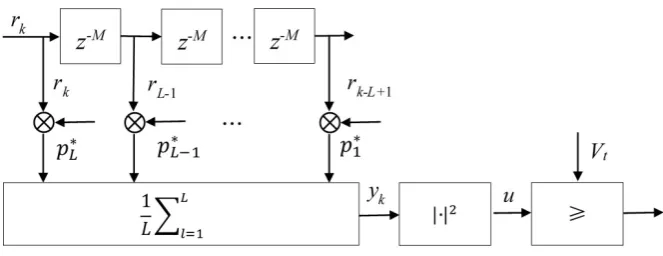
A2n=B2n−1= 0,(n= 1,2,· · · ,31). (14) Calculate the complex correlation of rk and pk as shown in Fig.1, and then the correlation value will be
R= 63 X
l=1
rl×p∗l, (15)
where(·)∗represents the conjugate of a complex number. Combine (12), (13) with (15),
R= 63 X
l=1
(Wl+jZl)(Al−jBl)
= 63 X
l=1
[(WlAl+ZlBl) +j(ZlAl−WlBl)] (16)
LetI0 andQ0 denote the real and imaginary part ofR respectively. By using (14),
I0 = 32 X
n=1
(W2n−1A2n−1+Z2n−1B2n−1)
+ 31 X
n=1
(W2nA2n+Z2nB2n)
= 32 X
n=1
(W2n−1A2n−1) + 31 X
n=1
Figure 1. Packet detection algorithm schematic.
Q0 = 32 X
n=1
(Z2n−1A2n−1−W2n−1B2n−1)
+ 31 X
n=1
(Z2nA2n−W2nB2n)
= 32 X
n=1
(Z2n−1A2n−1)− 31 X
n=1
(W2nB2n) (18)
Since both Ak and Bk takes value 1 or −1, only add or subtract will be enough to calculate (17) and (18) and hence the complexity is very low. Considering thatRis a complex number, the packet can be detected by comparing the energyuas follows with a threshold.
u=|R/63|2
= 1
3969
(I0)2+ (Q0)2
. (19)
IV. SIMULATION ANALYSIS
In this section, BER ofπ/2-DBPSK andπ/4-DQPSK in AWGN channel and multipath Rayleigh fading channel are simulated. Path number for multipath channel is4. The system sampling rate Ts= 1/2.4µs. Mean and variance of Gaussian random variable are0 andδ2
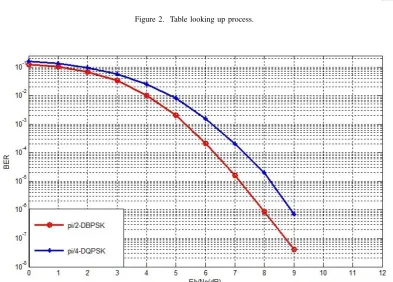
k respectively. At the transmitter, data frame is generated by concate-nating PLCP preamble and PLCP header with random binary sequence and then processed as shown in Fig.2 to realize the modulation. A mod operation is used to avoid the absolute phase exceeding 2π. Finally, I branch and Q branch are obtained by looking up the tables. After receiving the noised I and Q data: Wk and Zk, packet detection and carrier recovery is done first, and then demodulation and decision are applied as (8) to (11) to acquire the random binary sequence. BER Monte Carlo statistics in AWGN channel and multipath channel are shown in Fig.3 and Fig.4 respectively.
Seen from Fig.3, whenEb/N0= 10dB, both modula-tions have BER lower than10−6, which satisfies the gen-eral engineering requirements for data transmission. Al-thoughπ/2-DBPSK obtains1dBgain overπ/4-DQPSK, π/4-DQPSK has approximately double bandwidth effi-ciency [20]. As in Fig.4, when π/2-DBPSK is selected, BER performance in multipath channel deteriorates 2dB over that in AWGN channel. For π/4-DQPSK, it is 2.5dB, and thus may not meet the demands.
In practice, the presence of multipath fading channel is almost inevitable because of complex human body chan-nel [21]. Therefore, adaptive modulation can be consid-ered according to channel quality.π/4-DQPSK switches to π/2-DBPSK automatically when channel deteriorates to obtain good communication quality.
V. CONCLUSIONS
According to IEEE 802.15.6 BAN standard, theoretical research and simulation analysis ofπ/2-DBPSK andπ/4 -DQPSK are carried out based on Monte Carlo statistical method. Packet detection based on the special structure ofπ/2-DBPSK modulated preamble is also designed and proved to be low complexity. Simulations show that both modulations meet the requirements in AWGN channel and π/4-DQPSK obtains approximately double bandwidth efficiency. However, in multipath channel, BER perfor-mance ofπ/4-DQPSK is worse thanπ/2-DBPSK, which may not reach the performance requirements. Considering this, an adaptive modulation strategy can be adopted to choose different modulation with channel fluctuation to keep good communication quality. Based on the special structure of π/2-DBPSK modulated preamble in IEEE 802.15.6 BAN, a packet detection method with low cal-culation complexity is also proposed and analyzed.
ACKNOWLEDGMENT
The authors are grateful to the anonymous referees for their valuable comments and suggestions to improve the presentation of this paper.
REFERENCES
[1] Karaoguz J, ”High rate wireless personal area networks,”
IEEE Comm. Magazine, vol.39, pp. 96-102, Dec. 2001. [2] ”IEEE Standard for Telecommunications and Information
Exchange Between Systems - LAN/MAN Specific Re-quirements - Part 15.3: Wireless Medium Access Control (MAC) and Physical Layer (PHY) Specs for High Rate Wireless Personal Area Networks,” 2007.
[3] I. F. Akyildiz , W. Su , Y. Sankarasubramaniam and E. Cayirci, ”Wireless sensor networks: A survey,”Computer Networks, vol. 38, pp. 393-422 Mar. 2002.
Figure 2. Table looking up process.
Figure 3. BER curve in AWGN channel.
[5] M. Chen , S. Gonzalez , A. Vasilakos , H. Cao and V. C. M. Leung ”Body area networks: A survey,”Mobile Networks and Applications, vol. 16, pp.171-193, Apr. 2010. [6] Won-Jae Yi, Sufeng Niu, Gonnot, T., Saniie, J., ”System
architecture of intelligent personal communication node for body sensor network,” 2013 IEEE International In-strumentation and Measurement Technology Conference, Minneapolis, pp. 1717-1720, May 2013.
[7] Changxing Fan and Lina Cao, Communication Theory,
6th edition, Beijing national defense industry publishing house, 2008, pp. 180-237. In Chinese
[8] Y. S. Poberezhskly, ”Novel modulation techniques and circuits for transceivers in Body sensor netwirks,” IEEE Journal on Emerging and Selected Topics in Circuits and Systems, Vol.2, pp.96-108, Mar. 2012.
[9] Natarajan K., Allstot, D.J., Walling, J.S., ”Transmitters for body sensor networks: A comparative study,” 2011 IEEE Biomedical Circuits and Systems Conference (BioCAS), San Diego, pp. 185-188, Nov. 2011.
[10] Vasanthi M.S., Kumar D., Rama Rao T., ”Analysis of AQ-DBPSK modulation for WSN transceivers in indoor envi-ronments,”2013 International Conference on Information Communication and Embedded Systems, Chennai, pp. 904-907, Feb. 2013.
[11] IEEE Standard for Local and metropolitan area networks - Part 15.6: Wireless Body Area Networks, 2012. [12] Bo Xu and Pengfei He, ”Wireless Body Area
Net-work Channel Characteristics,” Telecommunications Sci-ence, vol.27, pp. 81-82, Mar. 2011. In Chinese
[13] G. Noetscher, S. Makarov, and N. Clow, ”Modeling accu-racy and features of body-area networks with out-of-body antennas at 402 MHz,” IEEE Antennas and Propagation Magazine, vol. 53, pp. 118-143, Aug. 2011.
[14] Z. Xiao, D. Jin, and N. Ge, ”Matched Filter-Autocorrelation (MF-AC) for Packet Detection in Multi-path Channels,” IEEE Communications Letters, vol. 17, pp. 1608-1611, Aug. 2013.
[15] K. M. Ok, and C. G. Kang, Generalized Window-Based PN Acquisition Scheme in CDMA Spread Spectrum Systems,
IEEE Transactions on Wireless Communications, vol. 7, pp. 2851-2855, Aug. 2008.
[16] I.-T. Lu, and K.-J. Tsai, ”A novel start-of-packet detection and synchronization scheme.”proceedings of the 2011 34th IEEE Sarnoff Symposium, Princeton, pp. 1-5, May 2011. [17] Z. Xiao, D. Jin, and L. Zeng, ”Normalized-energy-detector
serial search acquisition scheme for packet communication systems with non-ideal AGC,”Wireless Personal Commu-nication, vol. 65, pp. 895C907, Apr. 2012.
[18] K. Bai, N. He, and C. Tepedelenlioglu, ”Acquisition performance comparison of energy detector and single-pulse correlator for UWB systems,” Proceedings of 41st Annual Conference on Information Sciences and Systems, Baltimore, pp. 141C146, Mar. 2007.
[19] Song Huang, ”π/4-DQPSK Baseband differential demod-ulation techniques and data transmission implementation,” University of Electronic Science and Technology, pp. 22-40, 2006.In Chinese
[20] Yumei Ding and Xiquan Gao, Digital Signal Processing, Second edition, Xi’an university of electronic science publishing house, pp. 195-210, 2001. In Chinese [21] Chunmei Yan and Xiaorong lv, ”Mobile Medical Services
Technology Progress and prospects,”Transducer and Mi-crosystem, pp. 1-6, Feb. 2013. In Chinese
Guoquan Li received his Ph.D. degree in College of Communication Engineering from Chongqing University (CQU), Chongqing, China in 2012. He is currently a lecturer with Chongqing University of Posts and Telecommunications, Chongqing (CQUPT), China. His research interests include
digital baseband signal processing, multi-user MIMO system, coding theory and technology.
Ke Tangis currently a college student and working towards his B.S. degree at Chongqing University of Posts and Telecommu-nications, China. His current research interest includes short-range wireless communication systems and baseband signal processing.
Jinzhao Lin received Ph.D degree in 2001 from Chongqing University. Since 2003 he has been a professor with Chongqing University of Posts and Telecommunications (CQUPT). His current interests include wireless communications and ASIC design.
Yu Pangreceived Ph.D degree in 2010 from McGill University. Since 2012 he has been a professor with Chongqing University of Posts and Telecommunications (CQUPT). His current inter-ests include wireless communications and ASIC design.
Zhangyong Lireceived Ph.D degree in 2004 from Chongqing Medical University. Since 2008 he has been a professor with Chongqing University of Posts and Telecommunications (C-QUPT). His current interests include digital signal processing and biology engineering.
Qianneng Zhou received the B.S. degree, the M.Sc degree, and Ph.D degree, all in microelectronic, from Harbin Institute of Technology (HIT), Harbin, China, in 1998, 2002 and 2009, respectively. Since 2009, he has been an associate professor with Chongqing University of Posts and Telecommunications (CQUPT). His current interests include dc-dc converters, ampli-fiers, LDO regulator and LED drivers.