ISSN (e): 2250-3021, ISSN (p): 2278-8719
Vol. 10, Issue 1, January 2020, ||Series -II|| PP 17-22
Review Paper on Strengthening of Concrete Elements Using
Composite Fiber Laminates
Keshav Goyanka, M. A. Banarase
P.G. Scholar,Civil Dept. Prof. Ram Meghe Institute of Technology and Research, Badnera Maharashtra, India Maharashtra, India
Assistant Prof. Civil Dept. Technology and Research, Badnera Prof. Ram Meghe Institute of Maharashtra, India
Received 31 December 2019; Accepted 15 January 2020
ABSTRACT:
Fiber Reinforced Polymer (FRP) composites provides a smart solution to ever-growing construction issues. Since FRP composites have higher superiority over traditional steel reinforcements they are being widely used in retrofitting of structures. Nowadays, Various methods of application and different composition of FRP composites are available to solve various problems in constructions. This paper presents a state-of-the-art review on current and some important research papers that plays a vital role in determining the effect and properties of different FRP composites. The review highlights experimental, numerical and analytical studies on FRP composites. FRP composites are used for enhancing the flexural, shear, torsion capacity of RC elements and can also be provided to resist seismic, wind, environmental condition such as temperature, freeze and thaw, saline environment, etc.KEYWORDS:
FRP, Strengthening, Concrete repair, External Bonding, strengthening of beam, strengthening of column.I.
INTRODUCTION:
Construction industry is a vast growing field in terms of both practical and research. The research field is growing to find an effective economical solution for practical field problems. One of the major issues is ageing of structure and its effective solution provided to us in the form of FRP composites. FRP composites provides the desired characteristics i.e., increased in flexural strength, shear, torsion. Controlling seismic effect, effect of environmental condition such as temperature, salinity, chemical effect, cycle of freeze and thaw etc. FRP composites basically increases serviceability of the structure. The serviceability is increased by steel plates also, but required more thickness and can’t give that much strength, hence FRP composites are preferable.
FRP are basically composites. Composites are material which are made of two or more materials which have greater particular quality than that of their individual. FRP composites are composition of fibers and polymers woven in the form of matrix. Fibers acts as reinforcement which provides strength, and polymer matrix is binding material which acts a platform for transferring load from one fiber to another
There are many types of fiber in FRP composites some of them are Carbon Fiber (Graphite fiber, Kevlar 49), aramid polymer (Aromatic fiber, Kevlar 49), glass fibers (E, S, Z types of glass fibers). They are available in market having various sizes, having different arrangement (either unidirectional or bidirectional).
Polymer matrix or resins are subdivided as thermosetting or thermoplastic. Thermosetting polymers are crosslinked polymer which are obtained by either addition polymerization or condensation polymerization. The main part in thermosetting plastic is that, once it is created or formed, they cannot be remolded in any manner. Vinyl ester, epoxies and polyesters etc. are some example of thermosetting plastics. Thermoplastics polymer on the other hand are the polymer which can be remolded at a certain elevated temperature. Such polymers are expensive and sensitive to environment. Polyethylene, polyvinyl chloride, polypropylene and polyurethane are some example of thermoplastic polymers.
Thus, the research on FRP composites are role model for introducing cost effective and high strength element in our construction industry. Since, FRP composites concrete infrastructure are designed for serving several decades under different types of loading and hazards, it become necessary to check the performance as well as to develop new effective FRP composite system for above purpose. Due to some encouragement to researcher’s new technique of application and new composites material are being developed, some of them are newly-developed polyethylene naphthalate (PEN) and polyethylene terephthalate (PET) composites. Depending on the type of fiber and polymer matrix, the behavior of FRP materials can significantly vary, especially with regard to their mechanical properties. Development of new codes for application of FRP composites such as American ACI 318 and ACI 440F, International Federation for Structural Concrete (FIB) & Japanese code (BRI) made FRP material more venerable to use and easy for integration of FRP material more natural in infrastructure construction projects.
The days are no longer when traditional steel strengthening will replace by FRP composite, which will be more efficient and economical at the same time up to some extent. More research in this field will provide us with answer for improving some special particular characteristic such as either increase in load carrying capacity or more fire resistance or resistance to corrosion etc. limitlessly as compared to traditional strengthening. There are many issues and more to carryout in this research field.
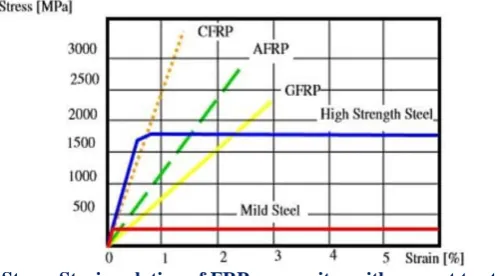
Fig.1. Stress-Strain relation of FRP composites with respect to steel.
The use of FRP materials to strengthen load-bearing or structural elements in existing structures is referred to as “retrofitting”. Retrofitting applications can be broadly classified into two types. The first type is called “strengthening”, where structure’s initial strength or ductility need to be upgraded to account for new services or levels of loading. The other type of FRP retrofitting is “repairing”, In this case, FRPs are used to repair an existing and deteriorated structure to bring its load-carrying capacity, ductility or stability back to the level for which it was designed for. Some of major application of FRP is as follows
II.
MATERIAL AND METHOD:
FRP composites laminates can be applied to RC structure, any composite structure, steel structure, etc. As we discussed earlier FRP composites comprises of fiber and polymer matrix.
Fig. 2. shows the configuration of FRP composites in a simplified format.
A. Materials: a. FIBERS:
Glass Fiber: These fibers vary from other forms of glass fibers, this are deliberately used to trap air for insulating application. These fibers are combination of SiO2, Al2O3, CaO, MgO, etc. this fiber are melted to a
9 to 17 µm. After this in the roving process this small fiber are spun to form large diameter strands. Which is woven in the form of mat to use in construction field. The glass fiber is far most popular to reinforce plastic and thus enjoys a wealth of production processes.
Carbon Fiber: These are created when polyacrylonitrile fibres (PAN), Pitch resins, or Rayon are carbonized (through oxidation and thermal pyrolysis) at high temperatures. Through further processes of graphitizing or stretching. Carbon fibres are manufactured in diameters analogous to glass fibres with diameters ranging from 4 to 17 µm. These fibres woven into larger threads for further production processes. Further production processes include weaving or braiding into carbon fabrics, cloths and mats analogous to those described for glass that can then be used in actual reinforcements.
Aramid Fiber: Aramids are generally prepared by the reaction between an amine group and a carboxylic acid halide group (aramid). Commonly, this occurs when an aromatic polyamide is spun from a liquid concentration of sulphuric acid into a crystallized fibre. Fibres are then spun into larger threads in order to weave into large ropes or woven fabrics (Aramid). Aramid fibres are manufactured with varying grades based on strength and rigidity, so that the material can be adapted to meet specific design requirements, such as cutting the tough material during manufacture.
There are many other such fibers having different combinations of manufacturing such as Basalt Fiber, Jute Fiber etc.
b. Polymer Matrix:
As its defined earlier there are two types of polymer matrix mainly i)Thermosetting ii) thermoplastic.
Thermoplastic are environmental sensitive but can be remolded at a specific temperature while the cost of such polymer matrices is high.
Thermosetting are very extensively used due to its economic availability. They are once created they cannot be remolded. They are not sensitive to nature and hence they put a greater advantage over thermoplastic.
B. METHODS OF APPLICATION:
Mainly there are two types of application processes in FRP
There are a number of applications of FRP composites as the strengthening material of reinforced concrete elements. FRP composites strips can be bonded to the external tension zone of beams and slabs thus increasing the flexural strength of element. FRP composites sheets can be wrapped around reinforced concrete columns thus increasing the confinement and the axial strength. Furthermore, it increases the flexure, shear and torsion strength and improve the ductility.
NSM-FRP is an appealing method to strengthen existing and new structures due to its advantages over EBR systems, mainly from the improved efficiency achieved from better strain distribution resulting in higher utilization of available strain and its higher resistance to many environmental factors due to being embedded into the concrete cover. Although temperature susceptibility is still slightly high for NSM-FRP, it is considerably reduced by changing the grout filler type.
III.
APPLICATIONS OF FRP
Carbon FRPs are used in prestressed concrete for applications where high resistance to corrosion and electromagnetic transparency of CFRP are important.
CFRP composites are employed for underwater piping and structural parts of offshore platform. Added to that, FRP declines the risk of fire.
Carbon fibre reinforced polymers are used to manufacture underwater pipes for great depth because it provides a significantly increased buoyancy (due to its low density) compared to steel.
The stairways and walkways are also made of composites for weight saving and corrosion resistance.
It is used in high-performance hybrid structures.
FRP bars are used as internal reinforcement for concrete structures.
FRP bars, sheets, and strips are used for strengthening of various structures constructed from concrete, masonry, timber, and even steel.
FRPs are employed for seismic retrofitting.
Fibre reinforced polymers are used in the construction of special structures requiring electrical neutrality.
The high energy absorption of aramid fibre reinforced polymer (AFRP) composites makes them suitable for strengthening engineering structures subjected to dynamic and impact loading.
IV.
TYPICAL STRENGTHENING APPLICATION:
temperature.Beams should be strengthened after a certain period of loading because damage, which may be in the form of structural damage or corrosion, may have been initiated.
M.R. Mostakhdemin Hosseini, S.J.E. Dias, J.A.O. Barros[4] studied the behavior of slabs with different reinforcing CFRP percentage. For this experimental study they prepared 4 slabs of 120 X 600 mm in c/s and length of 2600mm and adequately reinforced it. Out of four slabs they take 0%, 20%, 40% prestressing force applied to CFRP reinforcement applied to three of them. And one for reference without any CFRP reinforcement. The four-point slab bending test was carried out on this slab and measure the property of applied load, deflection and strain in CFRP laminates. After carrying out experiments they found that with application of CFRP laminates with pre-stressed nature shows significant increase in load carrying capacity at cracking, service and ultimate capacity, for 20% of prestressing force of 258%, 123%, & 125%. while applying 40% of prestressing force an increase of 400%, 190%, & 134%. By applying prestressing force, the flexural behavior of RC slab increased but deflection decreased.
Alberto Turco, Massimiliano Bocciarelli, Antonio Nanni, Carlo Poggi[3] in this paper he analyses the influence of width and thickness of composite laminates on RC beams and slabs. Two different codes are used for design of beams i) ACI 440.2r and ii) CNR-DT200. the tests were conducted on three-point bending test configuration and testing was performed by hydraulic MTS. A total of 6 beams and 4 slabs were casted, and were made different configuration (1w-2w-0w,1a-2a-0a) here w stands for width and a for area. One beam and one slab are taken for reference with 0w,0a. the test shows the CFRP configuration with double area and double width gives ultimate load carrying capacity. the test shows that the bending stiffness after yielding is function of CFRP area and is not affected by its other configuration (width or no. of piles). For FE modelling they used ABACUS/CAE6.10. for numerical stimulation of the expt. Test by means of 2D model. Use of 4-noded bilinear plane strain quadrilateral element (CPE4) were used in redefined mesh. The load deflection curve for slab by expt. and FE model were compared and found out to be having good accuracy. And CFRP strengthening led to increase in 8% - 27% flexural capacity.
Shear strengthening of reinforced concrete (RC) beam with Hybrid Composite Plates (HCP) technique: this paper was published byHadiBaghi, Joaquim A.O. Barros, FatmirMenkulasi[2] and presents a study on efficiency of HCP in enhancing shear. For that purpose, they had casted 17 beams out of which 10 beams where T beam and remaining where rectangular. Two different processes of application were taken using 1) epoxy adhesive, 2) mechanical anchors in addition epoxy adhesive. Also, the effect inclination of laminates is studied. Here they used NSM technique for application. All beams were single span simply supported beams. To induce shear failure in only one span, a three-point bending test setup of different shear span length was adopted. Different composition of technique had taken for rectangular, NSM technique, no. of laminates provided, damaged beam, length, shear reinforcement, bonding method used. The results of their experiment show us that CFRP (Carbon Fiber Reinforced Polymer) in HCP have contributed to higher shear strength as compared to SHCC (Strain Hardening Cementitious Composite). Also, in case of rectangular beams CFRP laminates which are provided at an angle of 45o gives more effective maximum load carrying capacity than laminates provided at an angle of 90o. While in case of T-beams the mechanical anchors show good result by taking about 125% more load for same deflection as that of simple adhesive bending. The T- beam also behaves remarkably when connection between flange and web are used. The beams with HCP application prove to be beneficial in carrying maximum load as compared to normal shear reinforcement beam. Analytical results were concluded to be accurate. since variation between the analytical and experimental results is only 10%.
A detailed study of behaviour of FRE composites is necessary due to its growing use. Where structure sometimes may be comes in contact with sudden elevated temperature for e.g. A bridge made with the use of FRP and unfortunately accident happens. Their will elevated temperature for time being due to burning. And also, FRP bars have the significantly lower heat resistant than steel bars. So, it becomes necessary for its study. Fatigue behaviour of concrete beams reinforced with GFRP & CFRP bars after exposure to elevated temperatures is explained by Jun Zhao, Guanghui Li, Zike Wang, Xiao-Ling Zhao[5] in his paper. They prepared a total of 13 concrete beams reinforced GFRP & CFRP bars. And were tested under static and fatigue loading after exposure to different levels of elevated temperatures, the influences of elevated temperature, holding time, fatigue load level and FRP bar type on the fatigue behaviour of beams were investigated in his paper. Concrete beams with the identical dimensions of 150×200×1800 mm was designed, which were reinforced with either GFRP bars (9 beams) or CFRP bars (4 beams). Among these beams, one GFRP beam and one CFRP beam were subjected to the monotonic static loading at room temperature for obtaining the ultimate capacity for reference, the other GFRP and CFRP beams were subjected to the repeated loading at room temperature or after the exposure to elevated temperature for obtaining the fatigue behaviour. All the beams were tested in four-point bending. The concrete beams were heated using a gas-electric mixed furnace. The CFRP proves to be more reliable than GFRP at elevated temperature. Both CFRP & GFRP perform fairly for temperature up to 400oC, but sharply losses their performance for temperature up to 600oC for 2 hr.
R.A.Hawileh, H.A. Musto, J.A.Abdalla, M.Z.Naser[8]prepared F.E model of R.C beam externally strengthened with side-bonded FRP laminates for this they prepared FE model on Ansys Software for Checking its effectiveness they compared it with practical result. Experiment had been carried out on 9 R.C beams, out of these two beams were strengthened with SB-CFRP sheets of 50mm and 100 mm. One beam is used as control beam (strengthened).For studying the effect of concrete compressive strength on the performance of RC beams externally strengthened with side bonded CFRP laminates of 100mm wide, they have prepared six beams of 25, 35, and 47.2 MPa, out of which three beams of different compressive strength were taken as control beams.
Jincheng Yang, Reza Haghani, Mohammad Al-Emrani [6] proposed this paper which deals with a new innovative method of application of CFRP laminates by using prestressing force without use of anchor. They applied 30% of prestressing force of its ultimate strength and developed finite element model for studying force transfer mechanism. A beam of 4.5m long and c/s 200x300mm2 was prepared with adequate strength of concrete and sufficient reinforcement. The CFRP material was applied to a length of 3.8m and c/s of 80x1.45mm 2. The new prestressing equipment set up was prepared and details are shown in the paper for step prestressing method. The result shows that there is 16% increase in shear carrying capacity than any other conventional method.
Habibur Rahman Sobuz et al. [7] studied about Bending and time-dependent responses of RC beams strengthened with bonded carbon fiber composite laminates. In this experiment they perform four-point bending test for flexural analysis and sustained load test for time dependent analysis. The test variation included different thickness of CFRP laminates along with two different types of loadings for cracked and uncracked beams. Total 14 beams were casted for experimental purpose. Thickness used were0.4, 0.8, 1.2 mm respectively. Control beams were also there for reference. Cracked and uncracked beams were analysed for time dependent analysis. Result came form experiment is that CFRP laminates indicates that externallybonded CFRP laminates is an effective method to strengthenthe reinforced concrete beams and improve the structural loadcarrying capacity.The use of transverse edge strips increased the flexural capacityof strengthened beams by as much as 33% when compared tostrengthened beams without edge strips. The W-wrapped CFRPedge strips arrest the propagating cracks more effectively thanthe U-shaped CFRP edge strips.the larger the CFRP reinforcement ratio, the smallerwas the long-term deflection. For the same sustained loading, amaximum reduction of 35% in deflection was observed in uncracked3-layers strengthened beam as compared tothe control one. Whereas for the cracked section, the corresponding reduction in deflection was 56% as comparedto the un-strengthened beam.
V.
CONCLUSION
As shown in this review, FRPs demonstrate superior strength development and durability performance. This review also provided a straightforward perspective of improving the application and performances of RC beams through strengthening and retrofitting with FRP. The following conclusions can be drawn and specific recommendations are provided to future studies related to the strengthening of RC beams with FRP:
FRP systems are very versatile and easy to install which come in handy in flexural, shear, torsional and axial retrofitting applications.
International organization of Scientific Research
22 | Page
elements can be used to develop structures with high impact and blast resistance along with seismic resistance.
There is limited research on the use of FRP strengthening systems for torsional applications in RC beams and also for axial applications in RC walls. Further research with regard to such application is warranted specifically on the use of ductile FRP materials (PET, PEN) and hybrid systems.
Pre-damaged and cracked RC beams that have been undergoes shear loading or have lost steel mass because of corrosion can be effectively repaired by using FRP. The performance of repaired and retrofitted beams using FRP system are significant and can prolonged the service life of structures for a reliable limit.
Performance of FRP-strengthened/reinforced structures is limited by the performance of FRP materials and systems under surrounding loading and environmental conditions.
The implementation of new technologies (such as sensing devices) can provide better insights to long-term behaviour of FRP-strengthened concrete structures.
ACKNOWLEDGEMENT:
The author would like to thank Prof. M A Banarase for his support and valuable suggestion.
REFERENCES:
[1]. Haifa Saleh, Robin Kalfat, KamiranAbdouka, Riadh Al-Mahaidi, punching shear strengthening of RC slabs using L-CFRP laminates, May 2019
[2]. HadiBaghi, Joaquim A.O. Barros, FatmirMenkulasi, Shear strengthening of reinforced concrete beams with Hybrid Composite Plates (HCP) technique: Experimental research and analytical model, July 2016 [3]. Alberto Turco, Massimiliano Bocciarelli, Antonio Nanni, Carlo Poggi, Influence of width and thickness
of composite laminates on the flexural behaviour of reinforced concrete beams and slabs, June 2017 [4]. M.R. Mostakhdemin Hosseini, S.J.E. Dias, J.A.O. Barros, Flexural strengthening of reinforced low
strength concrete slabs using prestressed NSM CFRP laminates,compositesb November 2015.
[5]. Jun Zhao, Guanghui Li, Zike Wang, Xiao-Ling Zhao, Fatigue behavior of concrete beams reinforced with glass- and carbon-fiber reinforced polymer (GFRP/CFRP) bars after exposure to elevated temperatures, September 2019
[6]. Jincheng Yang, Reza Haghani⁎, Mohammad Al-Emrani, Innovative prestressing method for externally bonded CFRP laminateswithout mechanical anchorage, July 2019
[7]. Habibur Rahman Sobuz, Ehsan Ahmed, Norsuzailina Mohamed Sutan,Noor Md. Sadiqul Hasan, Md. Alhaz Uddin, Md. Jahir Uddin, Bending and time-dependent responses of RC beams strengthenedwith bonded carbon fiber composite laminates, conbuildmat,December 2011.
[8]. R.A. Hawileh, H.A. Musto, J.A. Abdalla, M.Z. Naser, Finite element modeling of reinforced concrete beams externally strengthened in flexure with side-bonded FRP laminates, compositesb, May 2019.