Research on Grade Optimization Self-tuning
Method for System Dependability Based on
Autonomic Computing
Ming-chuan Zhang
College of Electronic and Information Engineering, Henan University of Science and Technology, Luoyang, China Email: [email protected]
Qing-tao Wu, Rui-juan Zheng, Wang-yang Wei and Guan-feng Li
College of Electronic and Information Engineering, Henan University of Science and Technology, Luoyang, China Email: [email protected], [email protected], [email protected], [email protected]
Abstract—In order to enhance the service performance, the
preservation and increase of system dependability are researched and a system dependability self-tuning method is proposed based on autonomic computing. The self-tuning method attempts to achieve the sustained growth of system dependability by on-line evaluation, dynamic prediction and tuning of self-tuning scheme. There are four tuning methods random interval, settled interval, dependability threshold value and event trigger, which are discussed in the simulation experimentation. The tuning effects that affect system dependability increment are analyzed, and the optimal tuning opportunities for each tuning method are given. The result of simulation experiment shows that the tuning methods will ensure the positive increase of system dependability increment except random interval.
Index Terms—Dependability, Optimization, Self-tuning,
Autonomic Computing
I. INTRODUCTION
With the development of economic globalization, the application of computer system takes on a new thorough trend increasingly. The politics, economy, commercial operation and other kinds of transaction processing more and more rely on computer data service. In the meantime, the current distributed computer system and open network environment based on the Internet/Intranet increase system complexity, failure-rate and unsafe factors. The rigorous requirements of computer system performance and service quality are proposed in this situation, that is, high quality and low and even no risk reliable service.
In 2005, The Microsoft Corporation sets up science research foundation through the RFP(Request for Proposal) to research the field of trust computing. The
research contents include integrality, secrecy, reliability, security and security software engineering. The considerable research results are acquired by Michael Reiter and Jason Hong who work in Carnegie Mellon University[1,2]. The research of integrality for trust
computing is emphasized particularly on by Linda Morales who works in Texas A&m University[3]. The
researches aiming at security are done and acquire prominent achievements by Alfred Weaver of University of Virginia and his colleagues[4]. These researches are
supported by Defense Advanced Research Projects Agency, National Aeronautics and Space Administration, National Science Foundation and Microsoft Corporation.
Recent years, the trust computing is hot topic for universities and research institutes such as Tsinghua University, Wuhan University, Peking University and Institute of Software Chinese Academy of Sciences. The abundant achievements in the field of trust computing are achieved by professor Zhang who works in Wuhan University and participates in the development of the first Chinese trusted computer[5,6].
The national academician Changxiang Shen has the prominent contribution on promoting the construction and development of trust computing through researching trust computing platform and enhancing security mechanism using trust computing [7]. The trust network is
a new branch of trust computing. The concept, attributes and key techniques are researched by professor Chuang Lin and are realized uniform understand concerning correlative concepts of trust network[8]. In 2005, Hengzhi
chip and its computer are developed by Lenovo Group and TPM chip is developed by Sinosun Corporation. These productions pass successively assessment of State Secret Code Regulatory Commission. Other corporations participate in the development of trust production one after the other. The representative productions have trust network framework developed by Topsec Corporation, terminal trust control system developed by Westone Corporation and trust memory system developed by Tip Corporation.
This work was supported by the National Natural Science Foundation of China under Grant No.61003035.
The autonomic self-optimization of system safety performance has been a hot topic in the research field at home and abroad. An optimization method for system safety that is called E-voting is researched in reference [9]. The optimization potential of E-voting method is shown through the safety trend of E-voting system. Two self-tuning strategies for intrusion-tolerance of cryptographic protocol are proposed in reference [10]. The two strategies that are algorithm self-tuning strategy and parameter self-tuning strategy can dynamically accommodate the running of cryptographic protocol, tolerate/defence parts of attack behaviours and protect the running safety of cryptographic protocol according to the attack types. The optimization model and self-configuration model for autonomic computing system are researched in reference [11-12].
The researchers focus in the self-configuration method of autonomic computing facing to service. Theese researches are valuable attempts in the fields autonomic computing, such as self-configuration, service matching, self-tuning strategies and system realization. The relative universal method is proposed to resolve the above problems, which has the valuable contribution to the systematism and standardization of the research work of autonomic computing. However, for the performance optimization of certain type service can not meet the integrated performance optimization of computer system, the current service matching algorithms has some limitations.
There are prominent achievements in the field of trust computing through the development of thirty years. However, the research results concentrate on the aspect of security framework of hardware dependability and system dependability. The research concerning the dependability increment method of network system is infrequent.
In this paper, the first research purpose is to realize the dependability increment method of network system based on autonomic calculation. The second one is to establish self-tuning mechanism to preserve or enhance the dependability characteristic such as reliability, security, secrecy through feedback of information. The last one is to realize network dependability sustained growth through tuning fault restoration, resource self-configure based on grad optimization.
II. AUTONOMIC THEORY
The thought of autonomy come form autonomic nervous system of human body. The autonomic nervous system can manage automatically various key functions of human body without the control of cerebral consciousness. The autonomic computing is a new way and new method of system management. It is the ability that manages itself through tuning hardware and software resources dynamically and spontaneously according to system requirement change of inside and outside. The research of autonomic computing has four aims. The first one is to realize self-management of target system. The second one is to achieve configuration, self-reparation, self-optimization and self-protection of the
target system using the least manual intervention. The third one is to reduce the management cost of complex calculating circumstance. The last one is to enhance the usability of target system. The concept of autonomic computing whose favorable characteristics have been accepted by computer science community is proposed by Paul Horn who works in the IBM in 2001. A series of internal conferences about autonomic computing such as International Conference on Autonomic Computing, International Conference on Autonomic and Trusted Computing are held termly by IEEE or ACM to advance the research and application of autonomic computing theory actively.
The relevant researches of autonomic computing are developed by overseas universities and research institutes under support of governments. The researches focus on the application of autonomic computing in safety software design, disaster event dealing of computer system, fault-tolerant and self-recovery of database, the configuration and recovery of network management system, grid calculating, parallel calculating, autonomic computing system, etc. These researches expand completely the application field of autonomic computing. In domestic, the application basic researches surrounding autonomic computing focus on software engineering, grid calculating, memory system, self-tuning of isomerous grid circumstance, etc. The research results that have been achieved have property verification for code security, developer studio ACE of autonomic computing, resources sharing, mobile agents, independent FC-SAN memory system, independent software architecture, assessment technologies of autonomic computing, mapped model, etc. In a word, as a new research thought of computer system, autonomic computing shows powerful vitality and open up a broad application foreground in the fields of software engineering, network service, system security management, etc. These results that have been achieved provide theoretical basis and method foundation for further researching bio-inspired characteristics of system security, especially for autonomic mechanism.
Although the researches of trusted calculating and autonomic computing have been developed for a certain time and some stage progresses have been achieved, the researches of both theoretical exploration and technology development in autonomic computing are still in the early stage. Few researches focus on the material application and interdisciplinary research of autonomic computing. The researches of autonomic trusted technology that has important research foreground still have not the breakthrough progress.
III.GRAD OPTIMIZATION THEORY
The optimization theory is an important tool in decision-making and physics system analysis. It is widely used in science, engineering, economics, industry fields and so on. Non-restraint optimization method is given a certain point x(k) and a searching direction d(k). Then, the
search whose speed is restricted is done from x(k) along
point x(k), the region whose center is x(k) is called trust
region. The quadratic approximation equation of target function is optimized in the trust region. Searching subsequence point x(k+1) in certain mode, if the result can
not satisfy the precision requirement, a new trust region whose center is x(k+1) is defined and the quadratic
approximation equation of target function is optimized in the new trust region. Such-and-such, the iterative will halt until the result satisfies the precision requirement. The trust region method accords with fast searching of dependability grad maximum value in self-tuning strategy. The method is used as the theory support of dependability self-tuning scheme in the research of self-tuning strategy. The self-tuning process of dependability function f(x) is to search historical grad maximum value for given dependability point. Because the minimum value and maximum value of grad calculation are equal and signs are different, self-tuning scheme that grad maximum value correspond to is acquired through calculating the opposite number of the calculation result of trust region method. For the function f (x), the core of self-tuning
process is to acquire the minimum value.
4
), (
min f x x R (1) The system dependability D of current time is assessed onlinely according to dependability function (equation (1)). The dependability instantaneous grad Gd is
calculated and the prior point set PGd ={P1,P2,…,Pn} which has the same grad in the dependability curve of transcendental system is taken out.
The f(x) is expanded according to the given point Pi(k) (i=1..n) and sliding window rk (trust radius) is set. The quadratic approximation of f(x) is acquired as in (2).
) ( ) ( ) ( 2 1 ) ( ) ( ) ( ) ( ) ( ) ( 2 ) ( ) ( ) ( ) ( k i T k i T k i k i T k i k i P x P f P x P x P f P f x f (2)
Maken di=x-Pi(k), the quadratic model is acquired as in (3). i k i T i i T k i k i k d P f d d P f P f d ) ( 2 1 ) ( ) ( ) ( ) ( 2 ) ( ) (
(3)In order to approximately substitute
k( )
d
i for f(x+ di) in the field of Pi(k), the value of di is restricted(|| di ||≤rk). Thus, the minimum value of function is decomposed into a series of sub-questions. k i i k i T i i T k i k i i k r d t s d P f d d P f P f def d . . ) ( 2 1 ) ( ) ( ) ( min ) ( 2 ) ( ) ( (4)
Finally, the optimal tuning scheme is sought through tuning parameters and the self-feedback of historical tuning information is achieved.
IV.THE SELF-TUNING METHOD
According to inner circumstance and system behavior, system dependability self-tuning method based on autonomic computing theory assesses onlinely the current dependability of target system, predicts the future trend of dependability realtimely, tunes the inner circumstance information that arouses the change of dependability to achieve microcosmic tuning of system inner circumstance and enhance dependability. Among them, the self-tuning mechanism is the important portion to achieve self-tuning of the system running state and behavior. The main contents of the self-tuning mechanism are shown as follows.
A. The online assessment of dependability
Firstly, the inner circumstance factors impacting system dependability are synthetically analyzed; then, the dependability is assessed onlinely according to the dependability future trend of transcendental system that is driven by inner circumstance; lastly, the system dependability is preserved or enhanced by the self-tuning scheme.
Over here, the dependability approximative function f(x) is shown as follows, and trust region radius is r1,
0<µ<η<1(µ=1/4, η=3/4), k=1 and precise value of ε.
) ( ) ( ) ( 2 1 ) ( ) ( ) ( ) ( ) ( ) ( 2 ) ( ) ( ) ( ) ( k i T k i T k i k i T k i k i P x P f P x P x P f P f x f
B. The future trend prediction of dependability
Firstly, the future trend of dependability driven by inner circumstance is dynamically predicted according to current system behavior, states and transcendental knowledge; then, the inner circumstance that potentially induces the decline of dependability is tuned realtimely to avoid the decline of dependability.
Over here, the dependability forecast is done through the prior points set PGD = {P1, P2, … , Pn}. The minimum
value is decomposed into a series of sub-questions which is shown as in (4). The weight of dependability trend is shown as in (5).
... ) ( 2 1 ) ( ) ( W ) ( 2 ) ( ) (
i k i T i k i k i d P f d P f P f (5)C. The self-tuning scheme
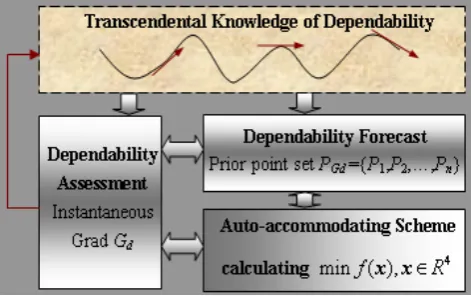
Tuned according to dependability curve of transcendental system, the factors that induce(or potentially induce) the change of system dependability are automatically tuned to achieve the preservation and increment of system dependability. The schematic diagram is shown as in figure 1.
renews and optimizes transcendental self-tuning curve.
The tuning process is shown as follows. V.T
HE SIMULATION EXPERIMENTATION
Figure 1. Self-tuning Schematic Diagram Based on Autonomic Computing Theory
Algorithm 1
Step 1: begin. Step 2:
Making Prior Points are Pi(1), Trust Region radius is r1,
parameters k=1, µ=1/4 and η=3/4(0<µ<η<1), and giving ε a precise value. Then calculating current Instantaneous Grad of dependability Gd,
Step 3:
Calculating f(Pi(k)), , if || ||≤ε, the
calculating halts and acquires solution Pi(k), goto Step 7; otherwise, calculating .
( )
( k i
f P
2 (k
i
f P
The aims of dependability self-tuning method are to self-tune the future trend of current system dependability and ensure the non-negative increment of current system dependability according to transcendental tuning knowledge. The before-mentioned analysis indicates the feasibility of self-tuning method based on trust region computing. That is to say, the dependability function can be accurately analyzed and the system dependability can be tuned using this method. However, the effect of self-tuning is measured according to the material manifest of quantitative index in the process of system practical running. In order to validate the effect of self-tuning, the simulation experimentation is done through calling the self-tuning algorithm to acquire the system dependability increment.
The simulation experimentation is accomplished in the local area network of laboratory. The simulation process including self-tuning methods, self-tuning strategies and transcendental knowledge are configured to the local area network of laboratory. Three network servers which are The Web server, Http Proxy server and Ftp server are included in the local area network. The operating systems that are run in the network host include Windows XP, Windows NT, Windows Me, Windows 2000, Windows 2003 and Linux.
) ( ( )k )
i f P
)
(
)
Step 4:
Solving the sub-question, acquiring the optimization solution of the sub-question di(k) , making
)
(
)
(
)
(
)
(
) ( )
(
) ( ) ( )
(
k i k k
i
k i k i k
i k
d
P
f
d
P
f
P
f
=
(6)Step 5:
If
k≤µ, makingP
i(k1)
P
( ) ; otherwise, makingThere are many choices of tuning opportunities in the tuning strategy. In order to seek the best tuning opportunity, the tuning opportunities that affect system dependability increment are analyzed in this paper. Four types of tuning opportunities that are random interval, settled interval, dependability threshold value and event trigger are researched in the simulation experimentation.
A. Random interval
k i
) ( )
( )
1
( k
i k
i k
i
P
d
P
(7)
Step 6:
Modifying rk, if
k ≤µ, making rk+1=(1/2)rk; ifµ<
k<η, making rk+1= rk; if
k≥η, making rk+1=2rk. k = k+1, goto Step 3.Step 7:
Renewing or optimizing transcendental curve. Step 8: end.
This method forms a closed feedback loop of self-tuning based on autonomic computing theory. It endows the target system with autonomic computing and enhances the system dependability in the mean time. The autonomic dependability of target system would be enhanced in the manner of mutual feedback through the single self-tuning of dependability and all previous renewal of transcendental knowledge.
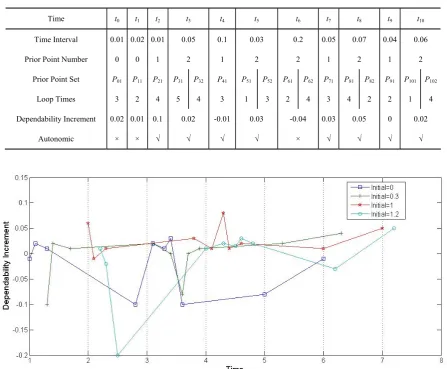
When choosing self-tuning opportunity of random interval, the ten segments which start from the time t=3s are chosen. In the process of system running, the self-tuning effect of system dependability which is caused by self-tuning method is shown as in table I.
Starting from the time t=3s, the positive dependability increment can be acquired adopting self-tuning method in most cases according to Table I. Because the interval of self-tuning is random, the dependability increment may be negative if the interval is relatively long. The simulation experimentations whose starting time of random value and interval are different are done repetitiously to show the self-tuning effect of random interval in the general sense. The comparison of self-tuning effect is shown as in figure 2.
TABLE I.
THE SELF-TUNING EFFECT OF RANDOM INTERVALS
Time t0 t1 t2 t3 t4 t5 t6 t7 t8 t9 t10
Time Interval 0.01 0.02 0.01 0.05 0.1 0.03 0.2 0.05 0.07 0.04 0.06
Prior Point Number 0 0 1 2 1 2 2 1 2 1 2
Prior Point Set P01 P11 P21 P31 P32 P41 P51 P52 P61 P62 P71 P81 P82 P91 P101 P102
Loop Times 3 2 4 5 4 3 1 3 2 4 3 4 2 2 1 4
Dependability Increment 0.02 0.01 0.1 0.02 -0.01 0.03 -0.04 0.03 0.05 0 0.02
Autonomic × × √ √ √ √ × √ √ √ √
Figure 2. Self-tuning Effects of Random Intervals
B. Settled interval
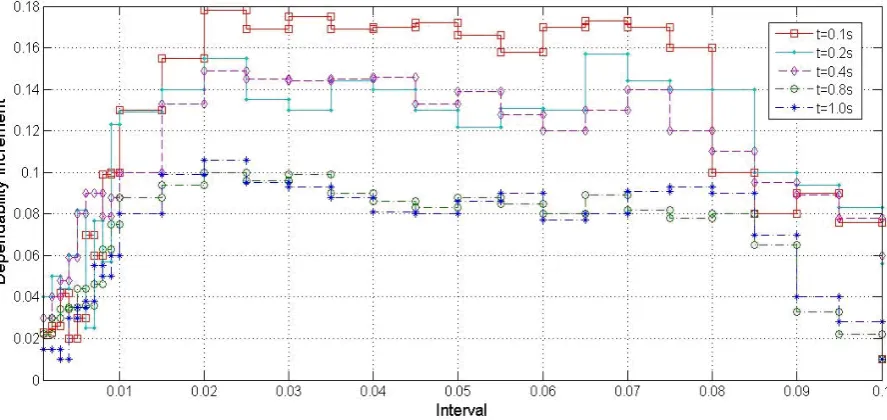
The settled interval is that the self-tuning is carried out every interval according to the fixed starting time. The key problem of this self-tuning method is choosing the settled interval. In the simulation experimentation, the settled interval Δt=0.001s, Δt=0.002s, …, Δt=0.01s, Δt=0.015s, Δt=0.02s, Δt=0.025s, Δt=0.03s, …, Δt=0.09s, Δt=0.095s, Δt=0.1s are adopted and the self-tuning effect in the time t=0.1s, t=0.2s, t=0.4s, t=0.8s, Δt=1s are acquired. The result is shown as in figure 3.
The positive dependability increment can be acquired after each self-tuning adopting settled interval according to figure 3. For the same system which starts running at the same time, the dependability increment reaches to maximum value in any time if the interval Δt=0.02s. The interval Δt=0.02s is thought to be the optimal interval in settled interval self-tuning method. Because the system dependability can be enhanced steadily through this self-tuning method, the application of settled interval is relatively broad especially for Δt=0.02s.
C. Dependability threshold value
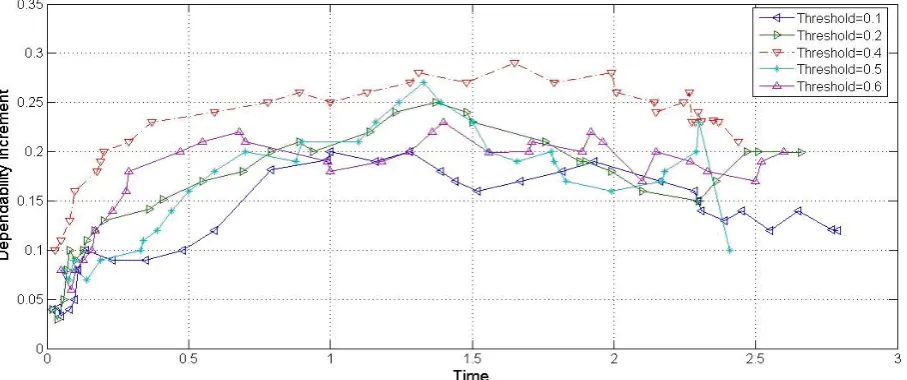
Adopting self-tuning method based on dependability threshold value, the self-tuning function is automatically called to execute self-configure of system resources and self-renew of system parameters, if the system dependability is less than the certain threshold value. The value interval of system dependability is [0.1, 1.9] according to the established dependability function. If the dependability threshold value chooses 0.5, the self-tuning effect is shown as in figure 4.
method. Because the system dependability can be
enhanced steadily through this self-tuning method also, the application of threshold value is relatively broad especially for Threshold = 0.4.
Figure 3. Dependability Increments in Settled Intervals
Figure 4. Dependability Increment That Dependability Threshold Value is 0.5
D. Eevent trigger
There is a biggish difference between self-tuning opportunity of event trigger and the self-tuning opportunity of other three methods narrated as above. The self-tuning opportunity of event trigger is not restricted simply by the dependability of target system or time factors, but more restricted factually by the dynamic variation of system local variable and global variable. The variables include error rate, leaving electricity quantity of nodes, data transfer rate, end to end delay, bandwidth delay product, network throughput, etc. There are only three variables that are selected as parameters in the simulation experiment because of limited space. When the system is running, the system dependability changes dynamically, as changes the event increment
In summary, the self-tuning method of settled interval, dependability threshold value and event trigger can acquire anticipant self-tuning effect on the proper conditions. The tunealbe property and the conditions of optimal tuning effect are shown as in table II.
However, there is no rule to follow in the self-tuning method of random interval. The self-tuning method of settled interval whose control and realization are simple can effectively avoid the disorder of random interval. The self-tuning method of dependability threshold value can follow realtimely the change of dependability and enhance the dependability increment through starting the tuning method in time. For the event trigger self-tuning method, the self-self-tuning is implemented according to the percentage of event increment to ensure the enhancement of system key service dependability.
Because the emphasis of three methods is different, the certain self-tuning method is chosen according to actual self-tuning requirement to promote the enhancement of system dependability constantly.
TABLE II.
THE CONDITIONS OF OPTIMAL TUNING EFFECT
tuning opportunity conditions tuneable
Random interval uncertainty ×
Settled interval Δt=0.02s √
Dependability threshold value Threshold=0.4 √
Eevent trigger decreasing -converging) Complexity(increasing- √
Figure 5. Impacts on Tuning Effect of Dependability Threshold Value
VI.CONCLUDING REMARKS
The network system dependability is the security fault-tolerant questions which are widely concerned. The methods of system dependability increment are proposed based on grad optimization theory, autonomic computing and other three works. The first one is to realize the dependability online assessment orientated to the maintenance and increment of system dependability; the second one is to realize the dynamic forecast of non-negative dependability; the last one is to realize self-seeking and self-tuning of tuning scheme. The favorable self-tuning effects adopting settled interval, dependability threshold value or event trigger on the proper conditions are validated by the simulation experimentation. In the future work, the dynamic conformity of multiple self-tuning opportunities will be further researched to enhance the system dependability increment synthetically.
ACKNOWLEDGMENT
This work was supported in part by a grant from the National Natural Science Foundation of China (NSFC) under the grant No. 61003035.
REFERENCES
[1] Michael Reiter. “Computer Security Meets Ubiquitous
Computing: Security for, and by, Converged Mobile Devices,” http://www.cylab.cmu.edu.
[2] I Jason, A James. Landay. “An Architecture for
Privacy-Sensitive Ubiquitous Computing.” Proceedings of the 2nd International Conference on Mobile Systems, Applications, and Services(MobiSYS). 2004, pp.177 -189.
[3] L Morales, M Eltoweissy, M Hossain Heydari, I Hal
Sudborough. “Towards Trusted Online Dissemination of Consumer Information,” Proceedings of the 37th Hawaii International Conference on System Sciences, 2004. http: //csdl2.computer.org/comp/proceedings/hicss/2004/2056/0 9/205690280b.pdf.
[4] PW Zheng, Alfred C Weaver. “A Privacy Preserving
Enhanced Trust Building Mechanism for Web Services,” IEEE International Conference on Web Services (ICWS), Orlando,Florida,2005.7. http://www.cs.virginia.edu/papers /Privacy _Perserving.pdf.
[5] Huanguo Zhang, Jie Luo, Gang Jin. “Development of
Trusted Computing Research,” Journal of Wuhan University (Natural Science Edition), 2006, 52(5), pp.513-518.
[6] Huanguo Zhang. “Research and development of the
Trusted Computing,” Chinese Conference on Trusted
Computing and Information Security. Hebei, Baoding, Oct. 2006, pp.467-473.
[7] Changxiang Shen. “Developing China’s Trusted
Computing Technique and production greatly,” Chinese Conference on Trusted Computing and Information Security. Hebei, Baoding, Oct. 2006, pp.341-346.
[8] Chuang Lin. “Trustworthy Networks and Evaluation
Methods for Network Survivability and Security,” Chinese Conference on Trusted Computing and Information Security, Oct. 2006, pp.252-257.
[9] B. Ondrisek. “E-Voting System Security Optimization,”
Proceedings of the 42nd Hawaii International Conference on System Sciences, Jan. 2009, pp.1-8.
[10]Yao-hui Hao, An-na Li, Yuan-bo Guo. “Adaptive
Re-configuration Policy for Intrusion-tolerance of Cryptographic Protocol,” Communications Technology, 2008, 41(4), pp.42-43, 46.
[11]Fei Wang. “An Autonomic Calculating Model and Its
Application Research Based on DFL,” master thesis, Soochow University, Dec. 2006.
[12]Bao-lei Ge. “Research on Autonomic Calculating System”
master thesis, Soochow University, Dec. 2008.
[13]Rui-juan Zheng, Ming-chuan Zhang, Qing-tao Wu.
“Analysis and Application of Bio-Inspired Multi-Net Security Model,” Information Security. 2010, 9(1), pp.1-17.
Ming-chuan Zhang was born in Henan
Province, PRC in May 1977. Ming-chuan Zhang studied in Harbin Engineering University (Harbin, Heilongjiang Province, PRC) from Sept.2002 to Mar.2005, majored in computer application and earned a Master of Engineering Degree in two and a half year’s time.
He works as a LECTURER in Henan University of Science and Technology from Mar.2005 to now. His research interests include component technology and computer security.
Qing-tao Wu was born in Jiangxi Province,
PRC in Mar 1975. Qing-tao Wu studied in East China University of Science and Technology(Shanghai, PRC) from Mar 2003 to Mar 2006, majored in computer application and earned a Doctor of Engineering Degree in three year’s time.
He works as an ASSOCIATE PROFESSOR in Henan University of Science and Technology from Mar 2006 to now. His research interests include component technology and computer security.