@Mayas Publication Page 48 A STUDY ON REVOLUTIONARY CHANGES IN BANKING SERVICES ON USAGE
OF MOBILE BANKING AND ITS DIFFICULTIES
RADHA KRISHNA MURTHY GHATTY
Research Scholar, Bharathiar University, Coimbatore
Dr.V. MURALI KRISHNA
Research Supervisor, Bharathiar University, Coimbatore
B.G.V. PHANI MADHAV
Research Scholar, Bharathiar University, Coimbatore
Abstract
The Internet transforms the search for
information. The IT has primarily been used
under two different purpose one is business
process other is connectivity and
communication. In the current scenario
usage of mobile phones increased rapidly,
few factors are influencing the clients of
banking services to use a particular mode of
mobile for mobile banking. Mobile banking
technology changes the world banking and
cash transfers. Mobile banking tenders
modern opportunities for the banks to offer
convenience to the banking customers in
developing countries and the extent of huge
population of unbanked clients in arising
markets. At the end of the year 2017, more
than 900 million customers are anticipated
to perform mobile transactions. This study
outline relates the gap of research to adopt
of mobile banking between the customers.
In the banking services a wireless and latest
mobile technical into wider area to provide
their clients for planning for paying of
bills, payments without going into long
queues and they don’t want to waste of their
valuable time. The number of samples
Bank account holders 150 in various banks.
Key words: Mobile, internet, transactions,
sample banks
Introduction:
An application of mobile computing which
enables Mobile banking to the customers,
with the mobile banking the customers can
utilize banking services anywhere and at any
time with their mobile device. By the mobile
banking checking of bank balances, to send
money from one account to other account
without going to the bank and their saving of
@Mayas Publication Page 49 of banking, client needs, distribution of
income, and usage of mobile this changes
between multiple players in banking sector.
Mobile banking is revolution it efforts on
the Global one of the rapid developing
sector is mobile communication technology.
By using the mobile, client will get the
services like Short Message Service (SMS).
In the banking with the help of internet
account holder can access his account at any
time, customer can easily checkout bank
balance, deposits, withdrawals, transfer
money from one account to another account
comfortably sitting in their home or in
office. One of the biggest set back mobile
banking availability of Internet access, the
under developed countries like India the
fundamental limitation in rural areas mobile
Internet connectivity which reduces the
client requirement to just a mobile phone.
Usage of mobile phones rapidly increasing
in India. The prime purpose of mobile
banking is “Anywhere anytime Banking is available”
India - Mobile Banking:
Banking financial services are complex
generally needed a greater trust for the users
in the usage of this technology. From the
year of 1995 there is a tremendous
improvement in mobile users in India. A
significant growth in mobile networks in this
decade but the Mobile Banking wasn’t
accepted widely. Last two years, users of
mobile banking have increased four times as
compare to Debit cards and Credit cards.
Now day’s 35 banks have permitted to
operate mobile banking in India. Banks are
transformed to green banking with paperless
transactions i.e. Mobile banking, Internet
banking, ATM services etc., Now a days
banking services are advances as customer
@Mayas Publication Page 50 happy with the latest services provided by
the Banks. Adversely the adoption and
approval rates are very lack even though
from liberated customers.
The mobile banking banks will provide
these services
Getting of bank balance Mini-statements
Cheque book request Updates of payment of bills Payments of Donations for trust Alerts on schedule payments
Receive SMS while depositing and
Withdrawing of cash or transfer of cash
Mutual funds
Recharge for mobile
Commercial payment processing Bill payment processing
Paying of Electricity bills
Information regarding interest rate, new
policies, rate of interest
Acceptance of Mobile Banking in India
In India more than 60% of the banking
customers were residing at rural areas it is
quite different as compare to overseas banks
to specifically in under developing markets
like India. The use of mobile technology in
India has undergone rapidly. From the last
20 years we have observed a great extent of
changes in the Banking services. Customers
of Banking Services and other organizations
positively responded in large intact.
Financial Services generally need a lot of
trust for the consumer and complex one to
use latest technology. Banking services have
changes from paper based to green
transactions solutions provider latest of the
technologies in Banking Services like
mobile-banking, online-banking, ATM
services etc. So many reasons are there why
the latest advancements is not able to get
acceptance from the large number of
customers. This article concentrates on
various factors which define why customers
are not utilizing mobile banking and other
advancements.
Review of Literature
This research aim is to satisfy the gap by
cracking light on the general utilization of
mobile services and in exact on influence
characteristics of demographic on usage.
The survey was conducted in Nellore district
customers. This model change, from
conventional banking to latest electronic
@Mayas Publication Page 51 quickly growing penetration rates of smart
mobile phones are between other the factors
of this study. This approach working is
practical and provides insights drawn from
the quantitative experiential survey. The
recently emerge smart mobile banking
services stand for a modernization where
both services of intangibility and an
inventive medium of service delivery
employ high technology are here.
Scope for Mobile-Banking in India
Telecom services in India are in recent
scenario which indicates that mobile phone
service or cellular service was emerging
tremendously in last six years. As Telecom
Regulator Authority of India report on in
Indian telecommunication, the land line
phone connections were decreasing in the
last few years and smart mobile phone
number of connections were increasing very
rapidly. Recently, 17 cellular service
providers arranging cellular service in our
country and there were 631.48 million
phone connections in India out of these
594.32 million mobile phone connections.
Mobile phone connections equally
developed in rural and urban areas in India.
The rural mobile connections have reached
the 196.98 million mark as against 117.93
million in last year and now 33.77 per cent
of total wireless subscribers are now in rural
areas and the rural telecommunication
network was 26.39 per cent.
Research Methodology
This study is based on both secondary and
primary. Secondary data was collected
through the different websites and other
reference. Similarly Primary data was
collected through direct interaction of the
mobile-banking users and non-users of
mobile banking. In the data collection
method qualitative method was chosen In
place of collecting statistical data as regards
to mobile banking service to financial
inclusion this research is based on primary
data collected to main research work carried
by authors. Definitions, and advance the
final research design. This research is both
qualitative and quantitative. This research is
based on the data collected through
“Questionnaire” with Mobile banking Users
and Non mobile banking users.
Research Design
The data have been categorized into two
categories – secondary and primary data.
The Secondary data have been collected
from magazines, journals, newspaper, and
@Mayas Publication Page 52 The primary data is collected through the
research method of exploratory
Questionnaire with users of mobile banking
and non users of mobile banking basically,
Employees, Professionals, Students,
Businessmen, and servicemen etc.
Objectives of the Study:
This study outlines adoption of mobile
banking between the clients.
To investigate the acceptance of Mobile banking services between the
Customers.
To know the factors affecting the
adoption and utilization of Mobile
Banking.
Data Analysis
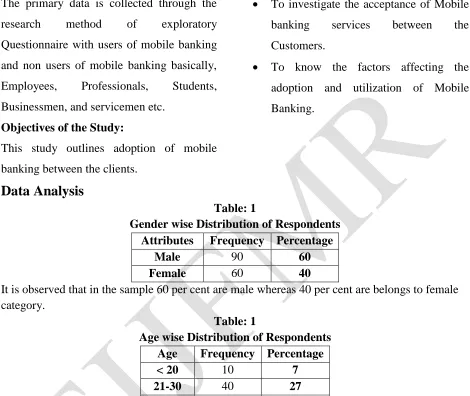
Table: 1
Gender wise Distribution of Respondents Attributes Frequency Percentage
Male 90 60
Female 60 40
It is observed that in the sample 60 per cent are male whereas 40 per cent are belongs to female category.
Table: 1
Age wise Distribution of Respondents Age Frequency Percentage
< 20 10 7
21-30 40 27
31-40 60 40
41-50 30 20
> 51 10 6
From the above table it is observed that the respondents age group respondents are belongs to 31-40 age group i.e., 40 per cent, whereas 27 per cent are belongs to 21-30 age group
respondents.
Table 3
Income wise Distribution of Respondents Income ( ) Frequency Percentage
< 10,000 45 30
10000 - 25,000 55 37
@Mayas Publication Page 53 From the above table it is observed that the respondents Income wise 10000-25000 are 37 per cent whereas 33 per cent are more than 25000 and 30 percent of respondents are less than 10000 income category.
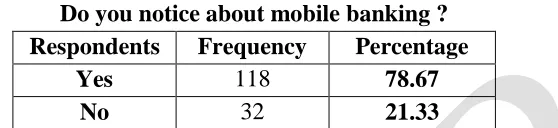
Table 4
Do you notice about mobile banking ? Respondents Frequency Percentage
Yes 118 78.67
No 32 21.33
From the above table it is observed that the respondents noticed about Mobile Banking are 78.67 per cent and they don’t know about mobile banking are belongs to 21.33 per cent.
Table 5
Could you prefer to utilize Mobile Banking Service? Respondents Frequency Percentage
Yes 110 73.33
No 40 26.67
From the above table it is observed that the respondents who are utilizing Mobile Banking service are 73.33 per cent and a 26.67 percent they don’t know about mobile banking in the sample area of Nellore.
Table 6
Which one you opt – Online banking or Mobile Banking? Respondents Frequency Percentage
Online Banking 62 41.33
Mobile Banking 88 58.67
From the above table it is observed that the respondents opt through Mobile Banking are only 41.33 per cent whereas 58.67 per cent are exercising Online banking.
Table 7
Are you satisfied using with Mobile Banking? Respondents Frequency Percentage
Yes 98 65.33
No 52 34.67
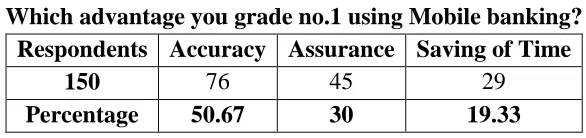
@Mayas Publication Page 54 Table 8
Which advantage you grade no.1 using Mobile banking? Respondents Accuracy Assurance Saving of Time
150 76 45 29
Percentage 50.67 30 19.33
From the above table it is observed that the
total 150 respondents rated advantages with
mobile banking are 50.67 per cent for
accuracy, 30 per cent are assurance and a
19.33 per cent were rated for saving time of
doing banking activities.
Suggestions
Various actions are essential to speed up the
financial inclusion during mobile banking
even as at the same time ensure protection
for the customers. Many of these measures
fall in the regulatory space and policy. Usage of technology for mobile banking
must be safe and should ensure
non-reputability, integrity, authenticity
and confidentiality, i.e. authentication by
m PIN and ID.
Creating customer awareness and inform
the public on use of different modes of
Mobile banking.
The Central Bank of India and
commercial banks must plan a
coordinated campaign in partnership
with professional to educate customers
and the trainers.
Banks can tender EMI or rental based
smart mobile phone handsets to their
customers for providing mobile phones
and conduct awareness programs to
increase the users of mobile banking.
Conclusion
In the present study it concludes that mobile
phones have a huge potentiality for doing
money transactions leads to the financial
growth, reduced cost and greater
convenience to the customers. The usage of
mobile banking service is user friendly in
nature and it is so easy to use in banking
services with the smart mobile phone users
even in the rural areas. All the telecom
service providers, Regulators and
manufactures of the mobile phones need to
be provide efforts for the penetration of
Mobile banking from major cities to urban
and finally to rural areas. Since last 7 years
mobile services are developed tremendously
@Mayas Publication Page 55 Reference:
1. Thornton, Jennifer and White, Lesley
(2001), "Customer Orientations and
Usage of Financial Distribution
Channels," Journal of Services
Marketing.
2. Bångens L and Söderberg, B. (2008),
Mobile Banking –Financial Services for
the Unbanked? ISBN:978-91-85991-01-
3. http://www.spidercenter.org/files/mbank
ing_study.pdf accessed on 02/01/2011.
3. Black, N. J. & Lockett, A. &
Winklhofer, H. & Ennew, C. 2001. The
adoption of Internet Financial services: a
qualitative study, International Journal
of Retail and Distribution Management.
4. Cheney, Julia S. (2008), an Examination
of Mobile Banking and Mobile
Payments: Building Adoption as
Experience Goods? Discussion paper,
the Federal Reserve System, USA, E. M.
1995. Diffusion of innovations. 4th
edition. New York: Journal of the
Association for Information Systems.
5. How croft, B. & Hamilton, R. & Hewer,
P. 2002. Consumer attitude and the
usage and Adoption of home-banking in
the United Kingdom. International