Abstract
The most frequently used measuring instrument for determination of dental fear and anxiety (DFA) in children nowadays is the Dental Sub-scale of the Children's Fear Survey Schedule (CFSS-DS). In this study we wanted to explore the reliability and validity of CFSS-DS Sub-scale in Bosnian children patients’ sample. There were 120 patients in the study, divided in three age groups (8, 12, and 15 years of age), with 40 patients in each group. Original CFSS-DS scale was translated into Bosnian language, and children’s version of a scale was used. The high value of the Cronbach's coefficient of internal consistency (α=0.861) was found in the entire scale. Four factors were extracted by screen-test method with Eigen values higher than 1, which explained 63.79% variance of results. CFSS-DS scale is reliable and valid psychometric instrument for DFA evaluation in children in Bosnia and Herzegovina. The differences between our research and those of others may appear due to many factors.
© 2011 Association of Basic Medical Sciences of FBIH. All rights reserved
KEy wOrDS: reliability, validity, CFSS-DS, children, Bosnia and Herzegovina.
Children's Fear Survey Schedule (CFSS-DS)
in children in Bosnia and Herzegovina
Elmedin Bajrić1*, Sedin Kobašlija1, Hrvoje Jurić2
1 Department of Preventive and Pediatric Dentistry, Faculty of Dentistry, University of Sarajevo, Bolnička 4a, 71 000 Sarajevo, Bosnia and
Herzegovina. 2 Department of Pedodontics, School of Dental Medicine, University of Zagreb, Gundulićeva 5, 10 000 Zagreb, Croatia
IntroductIon
Psychometrics is the disciplinary home of a set of sta-tistical models and methods that have been developed primarily to summarize, describe, and draw inferences from empirical data collected in psychological research [1]. It is necessary to explore psychometric characteris-tics of any measuring instrument before its use. Some of the basic psychometric characteristics of a mea-suring instrument are its reliability and validity [2, 3]. reliability of a measuring instrument is its capa-bility to measure phenomena precisely, and can be assessed by determination of internal consis-tency reliability with Cronbach's α coefficient [4, 5]. Instrument validity is defined as the instrument capabil-ity to measure exactly what it is made for. One of the types of instrument validity is construct validity [5, 6]. One of the special means of construct validity determi-nation is factor analysis. It is a method of determidetermi-nation of latent structure of results obtained with an instru-ment, which is based on the analysis of the connection
of manifest or starting variables. The manifest variables are obtained by giving the values to components of a psy-chometric scale for example. Therefore, the variables obtained by factor analysis are linear combinations of manifest variables and are called latent (hidden). Consid-ering this we can say that latent variables reveal the po-tential causes of the connection of phenomena [3, 7, 8, 9]. Despite the expansion of dental science and huge im-provements in dental care, discontinuation in dental vis-its is still the main problem nowadays. The main reasons for avoiding the dentists are dental fear and anxiety (DFA). The most frequently used measuring instrument for determi-nation of DFA in children nowadays is the Dental Subscale of the Children's Fear Survey Schedule (CFSS-DS) [10, 11]. It was designed by Cuthbert and Melamed in 1982 [10], and is based on the instrument for measuring of fear presence in younger children, named Fear Survey Schedule for Children (FSS-FC). FSS-FC was designed by Scherer and Nakamura [12]. In studies where CFSS-DS is compared with other avail-able psychometric instruments for measuring of DFA pres-ence in children it is shown that CFSS-DS scale has high reliability [11, 13, 14]. Beside its worldwide usage and high re-liability, CFSS-DS scale has a simple and fast application, and represents cost-effective way for DFA evaluation. On the oth-er hand, thoth-ere are more variabilities in the analysis of CFSS-DS validity, although results are good (some authors think that some self-report measures of DFA are not capable to
* Corresponding author: Elmedin Bajrić, Department of Preventive and Pediatric Dentistry, Faculty of Dental Medicine, University of Sarajevo, Bolnčka 4a, 71 000 Sarajevo, Bosnia and Herzegovina Tel: +387 33 214 249; Fax: +387 33 443 395
e-mail: [email protected]
distinguish between general fear and anxiety and DFA) [15]. In this study we wanted to explore the reliability and validity of CFSS-DS scale in Bosnia and Herzegovina children patients’ sample, so that we could use this psychometric instrument in future for measuring DFA presence in children in our country.
MAterIAls And Methods
Subjects
There were 120 patients in the study, without any physical or psychiatric illness, or mental abnormality. Patients were divided in three age groups (8, 12, and 15 years of age), with 40 patients in each group. The sample comprised of 66 boys (55%) and 54 girls (45%). All examinees were regular patients of the Clinic for Preventive and Pediatric Dentistry, Faculty of Dentistry, university of Sarajevo. Patients with symptoms of acute toothache or any other dental emergency (bleeding, swelling, dental trauma) were also excluded from the sample.
Procedures
Purpose of the study was explained in appropriate way to examinees and their parents, and parents gave the writ-ten consent for participation of their children in the study. Original CFSS-DS scale was translated into Bosnian lan-guage, and children’s version of a scale was used before the dental procedures were performed (children were filling the data, which is opposite to parent’s version of a scale where parents answer to the same questions instead of their chil-dren in the way how they assume that the chilchil-dren would feel in that situations). CFSS-DS scale has 15 dental and other situations, ranged by the likert scale from 1 to 5 (1 – not afraid, 5 – very afraid). Total score is between 15 and 75. Cut-off score for the evaluation of DFA presence in exam-inees is 38. Our research was approved by the Ethical Com-mittee of the Faculty of Dentistry of university of Sarajevo.
Statistical analysis
The following statistical methods were used in our research: descriptive statistics for age and sex sample distribution and the presence of results obtained with CFSS-DS scale in the sample; CFSS-DS scale reliability was determined by the Cronbach's α coefficient of internal consistency; CFSS-DS scale validity was determined by exploring of con-struct validity with factor analysis with varimax rotation. All statistical methods were done by SPSS 17.0 software package (SPSS Inc., uSA) for windows operative system.
results
Distribution of results obtained with CFSS-DS scale in the sam-ple is presented in Table 1. This distribution is asymmetrical
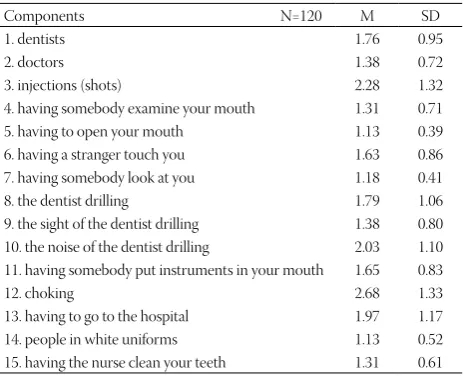
be-cause the skewness value is more than two times higher than its mistake. Table 2 represents the arithmetic means and standard deviations of results of CFSS-DS components in the sample. As it is shown from the Table 2 the highest average results values in our sample had the following CFSS-DS components: 12) choking, 3) injections, 10) the noise of the dentist drilling, 13) having to go to the hospital, 8) the dentist drilling and 1)
dentists.
CFSS-DS scale reliability
we used the internal consistency determination proce-dure to explore the validity of results obtained by CFSS-DS scale. The high value of the Cronbach's coefficient of inter-nal consistency (α=0.861) was found in the entire scale. The Table 3 represents corrected values of item-total correlations.
Factor analysis of CFSS-DS scale
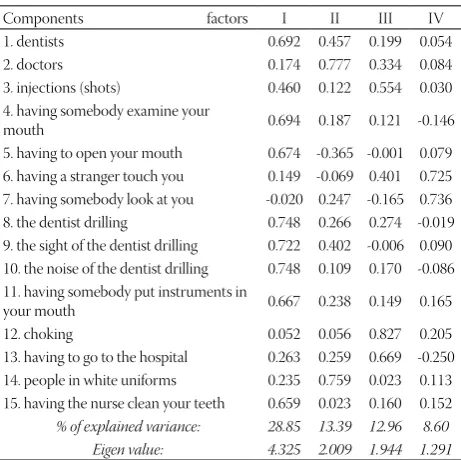
Factor analysis of CFSS-DS components with varimax rotation is applied in order to explore the validity of this psychometric instrument. Four factors were extracted by screen-test method with Eigen values higher than 1, which explained 63.79% variance of results. results of analysis of CFSS-DS components are shown in Table 4. The first factor explained 28.85% of variance and was com-prised of CFSS-DS components that describe the usual den-N Min Max M SD Skew Se-skew Kurtosis Se-kurt
CFSS-DS 120 15 53 24.60 7.86 1.57 0.221 2.23 0.44
Table 1. Descriptive values of results obtained with CFSS-DS
scale
N – total number in the sample
Min – minimal CFSS-DS score obtained by examinees Max - maximal CFSS-DS score obtained by examinees
Components N=120 M SD
1. dentists 1.76 0.95
2. doctors 1.38 0.72
3. injections (shots) 2.28 1.32
4. having somebody examine your mouth 1.31 0.71
5. having to open your mouth 1.13 0.39
6. having a stranger touch you 1.63 0.86 7. having somebody look at you 1.18 0.41
8. the dentist drilling 1.79 1.06
9. the sight of the dentist drilling 1.38 0.80 10. the noise of the dentist drilling 2.03 1.10 11. having somebody put instruments in your mouth 1.65 0.83
12. choking 2.68 1.33
13. having to go to the hospital 1.97 1.17
14. people in white uniforms 1.13 0.52
15. having the nurse clean your teeth 1.31 0.61
Table 2. Arithmetic means and standard deviations of results of
CFSS-DS components
tal practice, including uncomfortable and painful treatments (cavity preparation for example). The second factor explained 13.39% of variance and included two components related to general fear from doctors in white coats. The third factor ex-plained 12.96% of variance of results and relates to extreme situations (injections, choking, having to go to the hospital). Finally, the fourth factor was extracted, and it explained 8.6% of variance. This factor was related to unusual situa-tions that did not belong to usual experiences in dental of-fice or hospital surrounding, but represent general situations.
dIscussIon
results of many studies support the high reliability of CFSS-DS scale as an instrument for measuring DFA presence in children [11]. Arapostathis et al. found that Cronbach's coefficient α was 0.85 in greek sample [16]. In the study of Nakai et al. from Japan [17], the high value of Cronbach's coefficient is determined in CFSS-DS scale (α=0.89). Similar findings are also in the studies of ten Berge et al. [18] from Netherlands (α=0.85), Alvesalo et al. [19] from Finland (α=0.85) and lee et al. [20] from Taiwan (α=0.90). Our re-sult of Cronbach's coefficient of internal consistency α is 0.86, and is in accordance with the above mentioned find-ings. we think that this result is based on precise and clear meaning of the questions in the CFSS-DS scale that were understandable and unequivocal to our patients, and that they were completely able to answer to these questions. Considering the factor structure of CFSS-DS scale, in the study of Nakai et al. [17] three factors were identi-fied, which jointly explained 54.8% of variance of results. Factor I (explains 20.2% of variance) is characterized by fear from very invasive procedures. Factor II, character-ized by fear from less invasive procedures, explains 19.7% of variance. Factor III, characterized by fear of poten-tial victimization, explains 14.9% of variance of results. Milgrom et al. defined four factors in the sample of Chinese immigrant children, with 54% of variance ex-plained [21]. Three factors were very similar to those from research from Japan [17], while the fourth addi-tional factor appears as fear from touching or observing. Three factors were also defined in the study of ten Berge et al. [18], and the total variance of results is also significantly more explained than in the study in Japan (65%; factor I explains a big part of variance – 48%). However, the fac-tor structure itself also differed, comparing to Japan study [17]. That was especially related to the second and third fac-tor. Thereby factor II also contained issues related to fear from strangers, so it could be called fear from “less invasive aspects of dental treatment” (9.5% of variance). Because the structure of the third factor was also somewhat different, it could be called fear from “medical aspects” (7.5% of vari-ance). Authors of this study said after their analysis that this kind of results indicated somewhat weak factor struc-ture, and that CFSS-DS scale measures essentially primary one-dimensional concept of DFA, that could be defined as “fear from invasive aspects of treatment”. In another study from ten Berge et al. [22] stronger factor structure of CFSS-DS scale was found comparing to the previous study. Four factors were extracted, which altogether explain 60% of variance of results. Factors are: 1) fear from less invasive phases of dental treatment, 2) fear from medical aspects, 3)
Components R Item-Total
1. dentists 0.747
2. doctors 0.534
3. injections (shots) 0.586
4. having somebody examine your mouth 0.572
5. having to open your mouth 0.341
6. having a stranger touch you 0.298
7. having somebody look at you 0.076
8. the dentist drilling 0.744
9. the sight of the dentist drilling 0.649 10. the noise of the dentist drilling 0.615 11. having somebody put instruments in your mouth 0.621
12. choking 0.393
13. having to go to the hospital 0.501
14. people in white uniforms 0.427
15. having the nurse clean your teeth 0.538
Table 3. Corrected values of item-total correlations
The lowest values were determined for non-specific general situations „hav-ing a stranger touch you” and „hav„hav-ing somebody look at you”
Components factors I II III Iv
1. dentists 0.692 0.457 0.199 0.054
2. doctors 0.174 0.777 0.334 0.084
3. injections (shots) 0.460 0.122 0.554 0.030 4. having somebody examine your
mouth 0.694 0.187 0.121 -0.146
5. having to open your mouth 0.674 -0.365 -0.001 0.079 6. having a stranger touch you 0.149 -0.069 0.401 0.725 7. having somebody look at you -0.020 0.247 -0.165 0.736 8. the dentist drilling 0.748 0.266 0.274 -0.019 9. the sight of the dentist drilling 0.722 0.402 -0.006 0.090 10. the noise of the dentist drilling 0.748 0.109 0.170 -0.086 11. having somebody put instruments in
your mouth 0.667 0.238 0.149 0.165
12. choking 0.052 0.056 0.827 0.205
13. having to go to the hospital 0.263 0.259 0.669 -0.250 14. people in white uniforms 0.235 0.759 0.023 0.113 15. having the nurse clean your teeth 0.659 0.023 0.160 0.152
% of explained variance: 28.85 13.39 12.96 8.60
Eigen value: 4.325 2.009 1.944 1.291
Table 4. Rotated factorial matrix
fear from cavity preparation, and 4) fear from strangers. In the study of Alvesalo et al. [19] three factors were also found, with 54% of variance explained. The sequence and structure of some factors quite differed in compari-son to other studies. So, for example, factor II contained components related to fear from potential victimiza-tion (strangers, choking and hospital), and explained 9% of variance, while factor III (explained 9% of the variance) contained components related to fear from less invasive dental procedures (mouth opening, dental examination). Our results showed 63.79% of the variance explained, which is high value, and this mostly agrees with the findings of ten Berge et al. [18] in Dutch sample. The structure of the indi-vidual factors is mainly similar to those in other studies by character as well as composition. It has to be emphasized that four factors were extracted by factor analysis of CFSS-DS scale in our sample. The appearance of the fourth factor is in concordance with some other studies [21, 22]. It is also necessary to mention, regarding the factor structure in our study that not a single factor precedes in explaining of total variance of results, which is similar to study from Japan [19]. The differences between our research and those of others may appear due to many factors. Age differences of exam-inees influence different levels of perception and expression of DFA. Cultural differences and language characteristics and differences among examinees in the studies can also play an important role in obtained scores on CFSS-DS scale [21, 23, 24]. Thereby in our country there is lack of health awareness campaigns considering pretty bad oral health state (very high DMFT/dmft and other indexes of oral health). People in our country visit the dental office very rare in order to prevent oral health disease; dentists are be-ing visited mostly when the problem is obvious and mostly very difficult to solve. These facts are different in other coun-tries. The ways of filling the CFSS-DS scale (parent and child version of the instrument) can also have a great influence, considering that it is certain that parents cannot adequately evaluate the level of DFA presence in their children [25].
conclusIon
At the end we want to point out, considering the ob-tained results of our study, that CFSS-DS scale is reli-able and valid psychometric instrument for DFA evalu-ation in children in Bosnia and Herzegovina, due to its further application for researches of DFA in our country.
AcknowledgeMents
This study was supported by great efforts of complete staff of Clinic for Preventive and Pediatric Dentistry,
Faculty of Dentistry, university of Sarajevo.
declArAtIon of Interest
There is not any conflict of interest for this material in the manuscript for all authors, between the authors, or for any organization.
references
1. rao Cr, Sinharay S, editors. Handbook of Statistics. vol. 26. Am-sterdam, The Netherlands: Elsevier; 2007. pp: 1-22.
2. lu y, Fang JQ. Advanced medical statistics. Singapore: world Sci-entific Publishing; 2003. pp: 203.
3. Matthews DE, Farewell vT. using and understanding Medical Statistics. Fourth edition. Basel, Switzerland: Karger; 2007. pp: 298-308.
4. Everitt B. Medical statistics from A to z. A guide for clinicians and medical students. Second edition. New york: Oxford university Press; 2006. pp: 65.
5. Feinstein Ar. Principles of medical statistics. Boca raton: A CrC Press Company; 2002. pp: 610-623.
6. Fisher lD, van Belle g. Biostatistics, A methodology for the health sciences. Second edition. Hoboken, Ny: John wiley & Sons Inc.; 2004. pp: 10-24.
7. Child D. The Essentials of Factor Analysis. Third edition. New york: Continuum; 2006. pp: 108-125.
8. gorsuch rl. Factor Analysis.Second edition Hillsdale, New Jersey: lawrence Erlbaum; 1983. pp:127-141.
9. Berggren u, Carlsson Sg, gustafsson JE, Hakeberg M. Factor anal-ysis and reduction of a Fear Survey Schedule among dental phobic patients. Eur J Oral Sci 1995; 103:331-338.
10. Cuthbert MI, Melamed Bg. A screening device: children at risk for dental fears and management problems. ASDC J Dent Child 1982; 49:432-436.
11. Klingberg g, Broberg Ag. Dental fear/anxiety and dental behav-ior management problems in children and adolescents: a review of prevalence and concomitant psychological factors. Int J Paediatr Dent 2007; 17:391–406.
12. Aartman IHA, van Everdingen T, Hoogstraten J, Schuurs AHB. Self-report measurements of dental anxiety and fear in children: a critical assessment. ASDC J Dent Child 1998; 65:252–258. 13. ten Berge M. Dental fear in children: Prevalence, etiology and risk
factors. Thesis. Amsterdam: university of Academic Centre for Dentistry Amsterdam; 2001.
14. Klingberg g. Dental anxiety and behaviour management problems in paediatric dentistry-a review of background factors and diagnos-tics. Eur Arch Paediatr Dent. 2008;9 Suppl 1:11-5.
15. Scherer Mw, Nakamura Cy. A fear survey schedule for children (FSS-FC): A factor analytic comparison with Manifest anxiety (CMAS). Behav res Ther 1968; 6:173-182.
16. Arapostathis KN, Coolidge T, Emmanouil D, Kotsanos N. reliabil-ity and validreliabil-ity of the greek version of the Children’s Fear Survey Schedule-Dental Subscale. Int J Paediatr Dent 2008; 18:374-379. 17. Nakai y, Hirakawa T, Milgrom P, Coolidge T, Heima M, Mori y, et
al. The Children’s Fear Survey Schedule–Dental Subscale in Japan. Community Dent Oral Epidemiol 2005; 33:196–204.
18. ten Berge M, Hoogstraten J, veerkamp JSJ, Prins PJM. The Dental Subscale of the Children’s Fear Survey Schedule: a factor analytic study in the Netherlands. Community Dent Oral Epidemiol 1998; 26: 340–343.
19. Alvesalo I, Murtomaa H, Milgrom P, Honkanen A, Karjalainen M, Tay KM. The dental fear survey schedule: a study with Finnish chil-dren. Int J Paediatr Dent 1993; 3:193-198.
in a Taiwanese population. Community Dent Health 2009; 26:183-187.
21. Milgrom P, Jie z, yang z, Tay KM. Cross-cultural validity of a par-ent’s version of the Dental Fear Survey Schedule for children in Chinese. Behav res Ther 1994; 32:131–135.
22. ten Berge M, veerkamp JS, Hoogstraten J, Prins PJ. On the struc-ture of childhood dental fear, using the Dental Subscale of the Chil-dren's Fear Survey Schedule. Eur J Paediatr Dent 2002; 3:73-78.
23. Bergius M, Berggren u, Bogdanov O, Hakeberg M. Dental anxi-ety among adolescents in St. Petersburg, russia. Eur J Oral Sci. 1997;105(2):117-22.