Journal of Business and Economics 2014, 7 (14), 137-154.
DOI: 10.17015/ejbe.2014.014.08
Testing the Validity of the Triplet Deficit
Hypothesis for Turkey: Asymmetric Causality
Analysis
Yusuf Ekrem AKBAŞ
*, Fuat LEBE
**,Fatma ZEREN
***Abstract
In this study, the validity was analyzed of the triple deficit hypothesis in Turkey between the years 1960 and 2012. First, the stationarity of positive and negative shocks related to the current account deficit, budget deficit, and savings gap was tested. As a result of unit root tests, it was concluded that all the positive and negative shocks were I(1). Then, the causal relationship was analyzed with regard to the aforesaid shocks of variables by means of an asymmetric causality test. As a result of the asymmetric causality test, bi-directional causality was found between the current account deficit and the budget deficit and between the current account deficit and savings gap. Therefore, it can be concluded that the triple deficit hypothesis is valid in Turkey
.
Keywords: Triplet Deficit, Current Account Balance, Budget, Saving-Investment, Asymmetric Causality
JEL Code Classification: F32, H62, O16, C32, F41
*
Assist. Prof. Dr. in Economics, Adıyaman University, Adiyaman, Turkey. E-mail: [email protected]
**
Assist. Prof. Dr. in Economics, Adıyaman University, Adiyaman, Turkey. E-mail: [email protected]
***
1. Introduction
Recently, intensive studies have been conducted on the problems of the current account deficits and budget deficits which emerged in developed countries starting in the 1980s when globalization movements started to gain speed in the world economy and gradually spread to emerging countries. It is possible to group the conducted studies around two approaches. The first of these is the ‘traditional (Keynesian) approach’, which states that there is a positive relationship between the budget deficit and the current account deficit of a given country and the direction of this relationship is from budget deficit to current account deficit. According to this approach, in an economy where a flexible exchange rate is adopted, there will be a decrease in the aggregate savings of the country in the event that the taxes collected are less than public expenditures. Such a situation will first cause the national interest rates of the country to increase and afterwards to exceed the global average interest rate. The increase in the national interest rate will lead to an inflow of high amounts of foreign capital into the country and cause an increase in the value of the domestic currency. For this reason, while exports will become more expensive, imports will become cheaper. As a result, net exports will decrease and a current account deficit will be experienced (Froyen, 1999: 396). Economists who hold the traditional view explain this relationship as the ‘twin deficit hypothesis’.
that there is no relationship between the budget deficit and the current account deficit of a given country.
It is concluded that the traditional approach was valid in some studies about twin deficits in the literature (Zietz and Pemberton, 1990; Rosensweig and Tallman, 1993; Dibooglu, 1997; Fidrmuc, 2003; Pattichis, 2004; Corsetti and Müller, 2006; Mukhtar et al., 2007; Ito, 2009; Ganchev, 2010; Iram, et al. 2011; Trachanas and Katrakilidis, 2013). However, the findings of several other studies support the REH (Dewald and Ulan, 1990; Kim, 1995; Kaufmann et al. 2002; Kim and Roubini, 2008; Ratha, 2012). Yet, some studies have also cast doubts on the validity of both traditional and REH approaches and have argued that the savings-investment gap is effective in the emergence of a current account deficit (Milesi-Ferretti and Razin, 1996; Higgins and Klitgaard, 1998; Cooper, 2001; Gale and Orszag, 2003; Freund, 2005; Hubbard, 2006; Kuijs, 2006; Gruber and Kamin, 2007). Although there was a budget surplus in some developed countries, growing current account deficits cast doubts on the validity of the twin deficit hypothesis.
With the liberalization of capital movements worldwide, the necessity that domestic investments be limited to the amount of domestic savings disappeared. When domestic investments are greater than domestic savings, the financing of the emergent savings-investment gap from abroad causes the savings-investment balance to play a role, along with the budget deficit, in the emergence of a current accounts deficit. This means that the budget balance, savings-investment balance, and current accounts balance of a country are all in deficit. Such a scenario is known as the ‘triple deficit hypothesis’ in the literature.
Knowing whether the twin or triple deficit hypothesis is valid for a country is highly important for policy selection. If policymakers know which hypothesis is valid for the economy of a given country, they can make better decisions to deal with a budget deficit, going either for public borrowing or adjustment of tax rates. For this reason, the results of the studies testing which of the aforementioned hypotheses is valid are important when making decisions. In countries like Turkey, where macroeconomic imbalances are at serious levels, knowing whether the triple deficit hypothesis is valid and, if so, how and to what extent it occurs is important for the reasons mentioned above.
Studies conducted on the Turkish economy mainly focus on twin deficits, whereas the effect of the savings-investment balance on the formation of the current account balance (that is, the triple deficit) is ignored. We believe that our study will contribute to the literature in this respect. Moreover, the empirical studies about foreign literature conducted on a case of a triple deficit used common classical approaches1. However, different from existing empirical studies, the asymmetric
1
causality test developed by Hatemi-J (2012) was used in this study. In this respect, our study is a first in the literature.
This paper aims to test the validity of the triple deficit in the Turkish economy using an asymmetric causality test. In this context, our study consists of five sections. Section 2 presents the related literature. The methodology, including the data and the models used in the study, is presented in Section 3. Empirical findings and economic comments on these findings are given in Section 4. Finally, Section 5 presents the conclusion of the study, including policy recommendations.
2. Literature Review and Theory
National income equations have represented the theoretical basis of the relationship between the budget deficit and the current account deficit (Lipsey et al., 1999: 337). The theoretical basis of the relationship among the savings gap, budget deficit, and current account deficit can be obtained with reference to this national income equation. It is as follows:
Y=C+I+G+ (X-M) = C+S+T (1)
where Y is national income, C is consumption expenditures, I is investment expenditures, G is public expenditures, X is goods and services exports, M is goods and services imports, S is savings, and T is tax. In equation (1) leakages are equal to injections. Therefore, equation (1) can be shown as follows:
I+G+X = S+T+M (2)
With the help of equation (2), the relationship among the budget deficit, current account deficit, and savings gap can be determined as follows:
(X-M) = (S-I) + (T-G) (3)
Equation (3) shows that the sum of the budget balance and the saving-investment balance is equal to the current account balance. In other words, equation (3) can be written as follows:
Current account deficit (CA) = Savings gap (SA) + Budget deficit (BA) (4)
Equation (4) established the theoretical basis of our study.
accompanies this deficit, the twin deficit is valid in economics. If both of the internal economic balances have a deficit, the triple deficit is valid in economics.
The relationship between the budget deficit and current account deficit is the subject of many studies in the literature. These studies have tried to determine the direction of this relationship by using different methods for different countries or groups of countries. Since the budget balance and current account balance had a deficit in the U.S. economy in the 1980s, initial researches were shown that generally focus on the U.S. economy (Darrat, 1988; Miller and Russek, 1989; Latif-Zaman and Da Costa, 1990; Tallman and Rosensweig, 1991; Bahmani-Oskooee, 1992). However, similar studies also have been encountered for other countries. Studies focusing on current account deficits and budget deficits have obtained a variety of results. Prover findings to traditional opinion have been obtained in numerous studies (Bernheim, 1988; Zietz and Pemberton, 1990; Biswas et al., 1992; Rosensweig and Tallman, 1993; Dibooglu, 1997; Egwaikhide, 1999; Khalid and Guan, 1999; Vamvoukas, 1999; Piersanti, 2000; Kulkarni and Erickson, 2001; Leachman and Francis, 2002; Fidrmuc, 2003; Kouassi et al., 2004; Pattichis, 2004; Corsetti and Müller, 2006; Salvatore, 2006; Mukhtar et al., 2007; Lau and Tang, 2009; Ito, 2009; Ganchev, 2010; Holmes, 2011; Iram et al., 2011; Zamanzadeh and Mehrara, 2011; Kalou and Paleologou, 2012; Trachanas and Katrakilidis, 2013). These studies have emphasized that budget deficits have a major impact on current account deficits. Some studies also obtained prover results for the REH which stated no interaction or restricted interaction between the two deficits (Abell,1990; Enders and Lee, 1990; Dewald and Ulan, 1990; Kearney and Monadjemi, 1990; Boucher, 1991; Feldstein, 1992; Kim, 1995; Alkswani, 2000; Kaufmann et al., 2002; Erceg et al., 2005; Kim and Roubini, 2008; Ratha, 2012).
validity of the triple deficit hypothesis which emphasizes that imbalances emerge in the current account because of changes in the volume of savings.
In a study on developing countries, Zaidi (1985) found that the expansion of investment expenditures would put pressure on saving rates and thus cause an increase in budget deficits and have a negative effect on external deficits.
Dooley et al. (1987) analyzed data from developed and emerging countries for the period of 1960-1984 through OLS analysis. The results of the analysis showed that it was necessary, especially for emerging countries, to finance current account imbalances that occur as a result of savings gaps through resources in the form of credits and grants. Moreover, the authors emphasize that a decrease in current account deficits depended on increases in savings rates. In a study of 18 member states of the Organization for Economic Cooperation and Development (OECD) for the period 1960-1985, Roubini (1988) determined that savings gaps and the budget deficits that occur as a result had increasing effects on external deficits. Baxter and Crucini (1993) analyzed the data from eight developed countries for the period 1960-1985 and found that the savings-investment relationship was stronger in developed countries compared to underdeveloped and developing countries and that increases that occur in investment volume increase current account deficits. Eisner (1994) conducted a VAR analysis on data from the US for the period 1972-1991. He argued that a decrease in public expenditures increases the savings of the public sector and therefore shrinks budget deficits. Furthermore, he attributed foreign trade deficits to increasing public expenditures and the budget deficits that emerge as a result and concluded that the triple deficit hypothesis was valid for the US. In a study of data from 25 industrialized countries for the period 1970-1997, Freund (2005) stated that a reduction in investment expenditures could reverse current account deficits by causing an increase in investment rates. Kuijs (2006) analyzed data for the period 1980-2005 and found that the triple deficit hypothesis applied in reverse to the Chinese economy and called this a case of ‘triple surpluses’. In their study of 61 countries for the period 1982-2003, Gruber and Kamin (2007) stated that globally increasing savings negatively affected economies that experienced a savings gap and thus caused an increase in the current accounts deficit.
through the OLS approach and found that REH was valid for the country. In addition, he also found that budget deficits rather than savings gaps were caused by different macroeconomic factors and therefore it was difficult to state that current account deficits occurred due to budget deficits. In a structural VAR analysis of the data from 18 OECD countries for the period 1962-1994, Domenech et al. (2000) stated that the primary reason for budget deficits was not savings gaps and that REH was valid for the countries in question.
There are no empirical studies regarding the triple deficit hypothesis that have been conducted with regard to the Turkish economy. However, there are a lot of studies focus on twin deficits. For example, in their studies, Zengin (2000), Kutlar and Şimşek (2001), Akbostancı and Tunç (2002), Ata and Yücel (2003), Utkulu (2003), Ay et al. (2004), Yaldız (2006), Acaravcı and Öztürk (2008), Erdinç (2008), Uz (2010) and Altıntaş and Taban (2011) obtained findings that confirm the traditional approach. Furthermore, there are also studies that support REH for the Turkish economy (Bilgili and Bilgili, 1998; Kuştepeli, 2001; Aksu and Başar, 2005, 2009).
3. Data and Methodology
In this study, the validity of the triple deficit hypothesis in Turkey was analyzed. The analysis covered annual data for the period 1960-2012. The original values are used in the econometric analysis. Moreover, the data was evaluated as a percentage of gross domestic product (GDP). The data used in the study are as follows:
CA: Current account deficit (% GDP)
BA: Budget deficit (% GDP)
SA: Savings gap (% GDP)
The CA and SA series were obtained from the electronic database of the World Development Indicator (WDI), a World Bank electronic database. The BA series was also obtained from the OECD statistical database.
Firstly, the stationarity of positive and negative shocks was tested in this study. Then, an asymmetric causality test was carried out to determine whether there was a causal relationship among the shocks.
3.1. Asymmetric Causality Test
This test developed by Hatemi-J (HJ) is based on the Toda-Yamamoto (TY) (1995) causality test. Tests for a unit root and cointegration in the economic time series and the estimation of the cointegrating vector are required before causality tests based on Granger causality can be conducted. It is not necessary that series be stationary at level and cointegrated for the TY test. The TY test is based on the estimation of the VAR(p+dmax) process in which p is the optimal lag length and dmax
be analyzed in the HJ test. In this regard, the HJ test differs from the TY and causality tests developed by Hacker and Hatemi-J (2006, 2010).Moreover, the HJ test also calculates the causal parameters (Hatemi-J and Uddin, 2012: 465).Given that the current account deficit; denoted by CA, the budget deficit; denoted by BA, as well as the net savings gap; denoted by SA, are integrated variables, each can be defined as a random walk process, as follows:
(5)
and
(6)
1 2 0 2 ,
1 t
t t t i
i
C A C A−
ε
C Aε
=
= + = +
∑
(7)where t=1,2,…,T. The constants X0 and Y0 are the initial values, and the variables
1 ,i
ε
andε
2 ,i indicate white noise error terms. Positive and negative shocks can be identified as the following, respectively:1i
max(
1 ,i0),
2imax(
2 ,i0),
2imin(
1 ,i0)
ε
+=
ε
ε
+=
ε
ε
−=
ε
and2i
min(
2 ,i0).
ε
−=
ε
Therefore,
ε
1 ,iandε
2 ,i can be defined as follows:1i 1i 1i
ε
=
ε
++
ε
−and
ε
2i=
ε
2+i+
ε
2−i. It follows that1 1 0 1 1
1 1
t t
t t t i i
i i
BA BA−
ε
BAε
+ε
−= =
= + = +
∑
+∑
(8)1 1 0 1 1
1 1
t t
t t t i i
i i
SA
SA
−ε
SA
ε
+ε
−= =
=
+
=
+
∑
+
∑
(9)and likewise
1 2 0 2 2
1 1
t t
t t t i i
i i
CA CA−
ε
CAε
+ε
−= =
= + = +
∑
+∑
(10)Finally, the positive and negative shocks of each variable can be defined in a cumulative form as follows:
1 1
1 1
,
t t
t i t i
i i
BA+
ε
+ BA−ε
−= =
=
∑
=∑
(11)1 1
1 1
,
t t
t i t i
i i
SA+
ε
+ SA−ε
−= =
=
∑
=∑
(12)2 2
1 1
,
t t
t i t i
i i
CA+
ε
+ CA−ε
−= =
=
∑
=∑
(13)1 1 0 1 ,
1 t
t t t i
i
SA
SA
−ε
SA
ε
=
=
+
=
+
∑
1 1 0 1 ,
1 t
t t t i
i
BA
BA
−ε
BA
ε
=
where the impact of each negative and positive shock on the relevant variable is permanent. These phases can be used to test for asymmetric causality between the variables.
4. Empirical Results
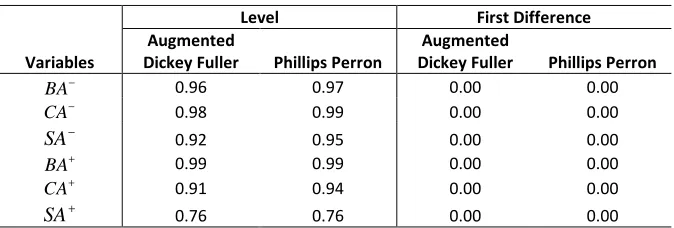
Before asymmetric causality analysis can be applied, it is necessary to determine the order of stationarity of series shocks related to the three aforementioned variables. In this context, the results of the unit root test for series are shown in Table 1.
Table 1: The Results of Unit Root Tests
Variables
Level First Difference Augmented
Dickey Fuller Phillips Perron
Augmented
Dickey Fuller Phillips Perron
BA− 0.96 0.97 0.00 0.00
CA− 0.98 0.99 0.00 0.00
−
SA 0.92 0.95 0.00 0.00
BA+ 0.99 0.99 0.00 0.00
CA+ 0.91 0.94 0.00 0.00
+
SA 0.76 0.76 0.00 0.00
Note:p-values were shown in table.
As shown in Table 1, the positive and negative series shocks are not stationary at level. Order of stationarity for these shocks are I(1). After determining the order of stationarity of positive and negative shocks, an asymmetric causality test can be applied. The results of this asymmetric test are presented in Table 2.
Table 2: The Results of Asymmetric Causality Test
Null
hypothesis Test value
Bootstrap CV at %1
Bootstrap CV at %5
Bootstrap
CV at %10 Optimal Lag
BA+⇏CA+ 0.12 10.00 5.46 3.36 1
BA-⇏ CA- 6.87** 7.75 3.57 2.53 1
SA+⇏ BA+ 1.47 18.90 8.91 6.58 2
SA-⇏ BA- 1.95 10.20 4.27 2.77 1
SA+⇏ CA+ 25.28*** 19.73 11.40 7.02 2
SA-⇏ CA- 4.03** 9.15 3.88 2.97 1
BA+⇏ SA+ 4.79 22.56 11.08 8.31 2
BA-⇏ SA- 0.16 9.38 4.35 3.16 1
Notes: 1. The symbol BA⇏CA means that BA does not cause CA and CV means critical value. 2. Cumulative positive (BA+
, CA+
and SA+
) and cumulative negative shocks (BA, CA
and SA
-) are used. 3. Optimal lags were selected by Hatemi-J Criterion.
4. ***
and **
denote statistical significance at the 1% and 5% level of significance respectively
this case is 0.89, which means that a 1% permanent negative budget deficit shock will cause a 0.89% reduction in the current account deficit in the Turkish economy. We tested another relationship which is statistically significant between the savings gap and the current account deficit. The results show that the null hypothesis that negative savings gap shocks do not cause a negative shock in the current account deficit can be rejected at the 5% significance level. The estimated parameter is 0.53. This means that a 1% permanent negative savings gap shock will cause a reduction in the current account deficit. The null hypothesis of no Granger causality cannot be rejected for the other two cases that deal with matching shocks. However, we also tested for combinations that consist of positive shocks. The results show that the null hypothesis that positive savings gap shocks do not cause a positive shock in the current account deficit can be rejected at the 1% significance level. The estimated parameter appears to be 0.08. This means that a 1% permanent positive savings gap shock will cause a 0.08% increase in the current account deficit. The null hypothesis of no Granger causality cannot be rejected for the other three cases. Therefore, it is clear that the triple deficit hypothesis is valid in Turkey.
The most important recipe for the development of developing countries such as Turkey is to allocate a significant share of national income to investments. Domestic savings have an important role to play in financing investments. Investments cannot be increased due to the lower level of savings resulting from the insufficient national income levels of developing countries; the level of efficiency lags behind and the low level of national income continue. Ultimately, the insufficient savings in these countries fail to fully finance investments, and thus the issue of a budget deficit emerges. Turkey has an emerging economy and its level of national income is higher than other developing countries. Accordingly, the core problem for Turkey is not financial bottlenecks caused by insufficient domestic savings due to insufficient national income and related insufficient investments, but the fact that the ratio of domestic savings is very low. According to WDI, the domestic savings/GDP ratio of Turkey was 17% in 2011 but decreased to 12% in 2012. These figures are extremely low because the domestic savings/GDP ratios of both developed and developing countries are much higher than the ratio in Turkey. The report states that the 2012 total domestic savings/GDP ratios of developed countries such as Denmark, France, Germany, Italy, Holland, Spain and Sweden were 21.95, 17.58, 22.89, 18.85, 26.10, 20.67 and 24.92 respectively. The 2012 total domestic savings/GDP ratios of developing and emerging countries such as Argentina, Brazil, Chile, China, Israel, Mexico, India and Russia were 24.08, 16.20, 24.42, 50.79, 20.87, 30.63, 23.62, 27.90 and 33.27 respectively. Taking into consideration households in Turkey and the domestic saving trends of companies on the basis of these ratios, we can conclude that domestic savings in Turkey are really low.
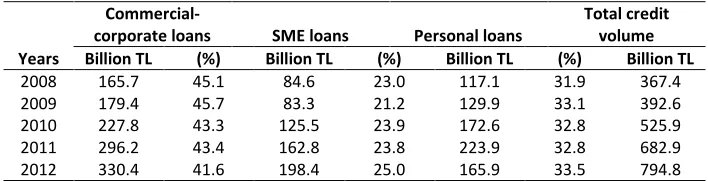
amount of credits is possible by using interest rate and monetary policy instruments such as required reserve ratios and rediscount ratios. Also, policymakers should give priority to these practices such as restructuring the banking sector with regard to credit arrangements and sectorial credits. In a country where the triple deficit hypothesis applies, increasing manufacturing and export credits can contribute to the national economy in the long run, although reducing the number of credits is important for increasing the ratio of national savings. Hence the types of credit that should be reduced are personal loans for residences and vehicles and consumer loans, which actually increase total demand. These conclusions are clearly illustrated for Turkey in the table summarized in Table A1. As seen in the table, the total credit volume in Turkey has increased significantly year by year. Although the share of commercial-corporate loans within total credits is high, the ratio of this credit type has declined year by year. Despite the increase in SME loans, the increase rate by years is not very high. The number of consumer loans is increasing and the ratio of these loans within total credits is significant. According to these conclusions, SME loans should be increased and consumer loans should be reduced in order to increase savings. In this context, the Banking Regulation and Supervision Agency (BRSA) have an important role to play. The BRSA should supervise the banking sector more strictly.
Besides domestic financial bottlenecks caused by the savings gap during the economic development process, foreign exchange bottlenecks caused by the foreign exchange deficit is also a serious problem. Achieving economic development primarily requires the importation of capital goods. However, foreign exchange earnings fall behind the level required for the target development ratio since the majority of foreign exchange incomes depend on exportation of products having lower added value, and thus the problem of a current account deficit emerges in the economy.
Therefore, policies that encourage the production of goods with high added value will prevent foreign exchange bottlenecks.
5. Conclusion
estimated causal parameter appears to be 0.53. This means that a 1% permanent negative savings gap shock will cause a 0.53% reduction in the current account deficit. The null hypothesis of no Granger causality cannot be rejected for the other two negative shocks. However, we tested for a combination that consists of positive shocks. The results show that the null hypothesis that positive savings gap shocks do not cause a positive shock in the current account deficit can be rejected at the 1% significance level. The estimated causal parameter is also 0.08, which means a 1% permanent positive savings gap shocks will cause a 0.08%enhancement in the current account deficit in Turkey. The null hypothesis of no Granger causality cannot be rejected for the other three positive shocks. According to the causality results of positive and negative shocks, we conclude that the triple deficit hypothesis was valid in Turkey between the years 1960 and 2012.
The most important recipe for the development of developing countries such as Turkey is to allocate a significant share of national income to investments. Domestic savings have an important role to play in financing investments. Investments cannot be increased due to the lower level of savings resulting from the insufficient national income levels of developing countries; the level of efficiency lags behind and the low level of national income continue. Ultimately, the insufficient savings in these countries fail to fully finance investments, and thus the issue of a budget deficit emerges. In this context, increasing total savings is very important for ensuring a sustainable budget deficit and current deficit. Otherwise, the mechanism triggered by the savings deficit will create budget deficit and current account deficit problems. Therefore, policymakers should move towards policies that increase domestic savings. The leading policy is to reduce the amount of total credits. Reducing the total amount of credits is possible by using interest rate and monetary policy instruments such as required reserve ratios and rediscount ratios. Also, policymakers should give priority to these practices such as restructuring the banking sector with regard to credit arrangements and sectorial credits. In this context, the monetary policy authority and BRSA have important roles to play. The BRSA should supervise the banking sector more strictly.
The most important point here is that although Turkish government has the power to establish the budget and investment-savings balances which form the internal economic balance of a country, the central bank, as the monetary policy enforcer, has the power to use instruments such as interest, loan, and foreign exchange rates. The coordination of institutions is very important while implementing economic policy, including finance and monetary policy. The goals of an authority assigned to conduct financial policy and those of an authority assigned to implement monetary policy might conflict, or the instruments used might prevent the goals of the other authority from being achieved, even though these two authorities may have similar goals. Hence, the authorities responsible for financial and monetary policies should coordinate their actions in order to successfully implement economic policy.
References
Abell, J.D. (1990). “Twin Deficits During the 1980s: An Empirical Investigation.” Journal of Macroeconomics 12(1): 81-96.
http://dx.doi.org/10.1016/0164-0704(90)90057-H
Acaravci, A. & Ozturk, I. (2008). “Twin Deficits Phenomenon: Empirical Evidence from the ARDL Bound Test Approach for Turkey.” Bulletin of Statistics and Economics 2:57-64. Akbostancı, E. & Tunç, G.İ. (2002). “Turkish Twin Deficits: An Error Correction Model of Trade Balance.” ERC Working Papers.
Aksu, H. & Başar, S. (2005). “İkiz Açıklar Hipotezi’nin Türkiye Açısından Araştırılması.” İktisat, İşletme ve Finans Dergisi 20(234): 109-114.
Aksu, H. & Başar, S. (2009). “Türkiye için İkiz Açıklar Hipotezinin Tahmini: Bir Sınır Testi Yaklaşımı.” Ankara Üniversitesi Siyasal Bilgiler Fakültesi Dergisi 64(4): 1-14.
Alkswani, A.M. (2000). “The Twin Deficit Phenomenon in Petroleum Economy: Evidence from Saudi Arabia”, Seventh Annual Conference, Economic Research Forum, Amman. Altıntaş, H. & Taban, S. (2011). “Twin Deficit Problem and Feldstein-Horioka Hypothesis in Turkey: ARDL Bound Testing Approach and Investigation of Causality.” International Research Journal of Finance and Economics 74: 30-45.
Ata, A.Y. & Yücel, F. (2003).“Eş-bütünleşme ve Nedensellik Testleri Altında İkiz Açıklar Hipotezi: Türkiye Uygulaması.” Çukurova Üniversitesi SBE Dergisi 12(12): 97-110.
Ay, A., Karaçor, Z., Mucuk, M. & Erdoğan, S. (2004).“Bütçe Açığı-Cari İşlemler Açığı Arasındaki İlişki: Türkiye Örneği (1992-2003).” Selçuk Üniversitesi Sosyal Bilimler Enstitüsü Dergisi 12: 75-82.
Bachman, D.D.(1992).“Why is the U.S. Current Account Deficit so Large? Evidence from Vector Auto regressions.” Southern Economic Journal 59(2): 232-240. http://dx.doi.org/10.2307/1060527
Bahmani-Oskooee, M. (1992). “What are the Long-Run Determinants of the U.S TradeBalance?” Journal of Post Keynesian Economics 15(1): 85-97.
Barro, R.J. (1989). “The Ricardian Approachto Budget Deficits.” The Journal of Economic Perspectives 3(2): 37-54.
http://dx.doi.org/10.1257/jep.3.2.37
Bernheim, B.D. (1988). “Budget Deficits and the Balance of Trade.” NBER Working Paper, No.10935.
Bilgili, E. & Bilgili, F. (1998). “Bütçe Açığının Cari İşlemler Dengesi Üzerindeki Etkileri: Teori ve Uygulama.” İktisat İşletme ve Finans, Mayıs Eki, 13(146):4-16.
Biswas, B., Tribedy, G. & Saunders, P. (1992).“Further Analysis of the Twin Deficits.” Contemporary Economic Policy 10(1): 104-107.
http://dx.doi.org/10.1111/j.1465-7287.1992.tb00217.x
Boucher, J.L. (1991). “The U.S. Current Account: A Long and Short Run Empirical Perspective.” Southern Economic Journal 58(1): 93-111.
http://dx.doi.org/10.2307/1060036
Cooper, R.N.(2001).“Is the U.S. Current Account Deficit Sustainable? Will it be Sustained?” Brookings Papers on Economic Activity 2001(1): 217-226. http://dx.doi.org/10.1353/eca.2001.0002
Corsetti, G. & Müller, G.J. (2006). “Twin Deficits: Squaring Theory, Evidence and Common Sense.” Economic Policy 21(48): 597-638.
http://dx.doi.org/10.1111/j.1468-0327.2006.00167.x
Darrat, A.F. (1988). “Have Large Budget Deficits Caused Rising Trade Deficits?”Southern Economic Journal 54(4): 870-887.
http://dx.doi.org/10.2307/1059523
Dewald, W.G. & Ulan, M. (1990). “The Twin-Deficit Illusion.” Cato Journal 9(3):689-707. Dibooglu, S. (1997).“Accounting for US Current Account Deficits: An Empirical Investigation.” Applied Economics Taylor and Francis Journals 29(6): 787-793.
Domenech, R., Taguas D. & Varela, J. (2000).“The Effects of Budget Deficit on National Saving in the OECD.” Economics Letters 69(3): 377-383.
http://dx.doi.org/10.1016/S0165-1765(00)00316-5
Dooley, M., Frankel J. & Mathieson, D.J. (1987).“International Capital Mobility: What Do Saving-Investment Correlations Tell Us?” IMF Staff Papers 34(3): 503-530. http://dx.doi.org/10.2307/3867094
Egwaikhide, F.O. (1999). “Effects of Budget Deficit on Trade Balance in Nigeria: A Simulation Exercise.” African Development Review 11(2): 265-289.
http://dx.doi.org/10.1111/1467-8268.00011
Eğilmez, M. (2006). “Üçüz açık.” Radikal, Retrieved from
http://www.radikal.com.tr/haber.php?haberno=188787
Eisner, R. (1994). “National Saving and Budget Deficits.” The Review of Economics and Statistics 76(1): 181-186.
http://dx.doi.org/10.2307/2109836
Elwell, C.K. (2007). “The U.S. Trade Deficit: Causes, Consequences and Cures”, CRS Report for Congress.
Elwell, C.K. (2010). “The U.S. Trade Deficit: Causes, Consequences and Policy Options”, CRS Report for Congress.
Erceg, C.J., Guerrieri, L. & Gust, C. (2005). “Expansionary Fiscal Shocks and the Trade Deficit.” International Finance Discussion Papers, No. 825, Washington.
Erdinç, Z. (2008). “İkiz Açıklar Hipotezinin Türkiye’de 1950-2005 Yılları Arasında Eşbütünleşme Analizi ve Granger Nedensellik Testi ile İncelenmesi.” Anadolu Üniversitesi Sosyal Bilimler Dergisi 8(1): 209-222.
Feldstein, M. (1992). “The Budget and Trade Deficits aren’t Really Twins.” NBER Working Paper, No. 3966.
http://dx.doi.org/10.3386/w3966
Feldstein, M. (2008). “Resolving the Global Imbalance: The Dollar and the U.S. Saving Rate.”Journal of Economic Perspectives American Economic Association 22(3): 113-125. http://dx.doi.org/10.1257/jep.22.3.113
Fidrmuc, J. (2003). “The Feldstein-Horioka Puzzle and Twin Deficits in Selected Countries.”
Economics of Planning 36(2): 135-152.
http://dx.doi.org/10.1023/B:ECOP.0000012256.88112.c2
Fischer, S. & Easterly, W. (1990). “The Economics of the Government Budget Constraint.” The World Bank Research Observer 5(2): 127-142.
http://dx.doi.org/10.1093/wbro/5.2.127
Freund, C. (2005). “Current Account Adjustment in Industrial Countries.” Journal of International Money and Finance 24(8): 1278-1298.
http://dx.doi.org/10.1016/j.jimonfin.2005.08.014
Froyen, R.T. (1999). Macro Economics Theories and Policies. 16th ed., New Gersey: Prentice Hall Inc.
Gale, W.G. & Orszag, P.R. (2003). “Economic Effects of Sustained Budget Deficits.” National Tax Journal 56(3): 463-485.
Ganchev, G.T.(2010).“The Twin Deficit Hypothesis: The Case of Bulgaria.” Financial Theory and Practice 34(4): 357-377.
Gruber, J.W. & Kamin, S.B. (2007). “Explaining the Global Pattern of Current Account Imbalances.” Journal of International Money and Finance 26(4): 500-522. http://dx.doi.org/10.1016/j.jimonfin.2007.03.003
Hacker, R.S. & Hatemi-J, A.(2006). “Tests for Causality Between İntegrated Variables Using Asymptotic and Bootstrap Distributions: Theory and Application.” Applied Economics 38(13): 1489–1500.
http://dx.doi.org/10.1080/00036840500405763
Hacker, R.S. & Hatemi-J, A. (2010). HHcte: GAUSS Module to Apply a Bootstrap Test for Causality With Endogenous Lag Order. Statistical Software Components G00012. Boston College Department of Economics
Hakkio, C.S. (1995). “The U.S. CurrentAccount: The Other Deficit.” Economic Review 80:11-24.
Hatemi-J, A. & Uddin, G.S. (2012). “Is the Causal Nexusof Energy Utilization and Economic Growth Asymmetric in the US?” Economic Systems 36(3): 461–469. http://dx.doi.org/10.1016/j.ecosys.2011.10.005
Hatemi-J, A. (2012). “Asymmetric Causality Tests with an Application.” Empirical Economics
43(1):447-456.
Hatsopoulos, G.N., Krugman, P.R. & Summers, L.H. (1988). “U.S. Competitiveness: Beyond
the Trade Deficit.” Science 241(4863): 299-307.
http://dx.doi.org/10.1126/science.241.4863.299
Higgins, M. & Klitgaard, T. (1998). “Viewing the Current Account Deficit as a Capital Inflow.” Current Issues in Economics and Finance 4(13): 1-6.
Holmes, M.J. (2011). “Threshold Cointegration and the Short-Run Dynamics of Twin Deficit
Behaviour.” Research in Economics 65(3): 271-277.
http://dx.doi.org/10.1016/j.rie.2010.11.004
Hubbard, R.G. (2006). “The U.S. Current Account Deficit and Public Policy.” Journal of Policy Modeling 28(6): 665-671.
http://dx.doi.org/10.1016/j.jpolmod.2006.06.006
Iram, M.P.S., Shadid, A.,Mahpara, S. & Fazli, R. (2011). “Old Wine in New Bottles: Testing the Keynesian Preposition of Twin Deficit in Case of Pakistan.” International Journal of Business and Social Science 2(5): 209 213.
Ito, H. (2009). “U.S. Current Account Debate with Japan Then, with China Now.” Journal of Asian Economics 20(3): 294-313.
http://dx.doi.org/10.1016/j.asieco.2009.02.006
Kalou, S. & Paleologou, S.-M. (2012). “The Twin Deficits Hypothesis: Revisiting an EMU Country.” Journal of Policy Modeling 34(2): 230-241. http://dx.doi.org/10.1016/j.jpolmod.2011.06.002
Kaufmann, S., Winckler, G. & Scharler, J. (2002).“The Austrian Current Account Deficit: Driven by Twin Deficits or by Intertemporal Expenditure Allocation?” Empirical Economics 27(3): 529-542.
http://dx.doi.org/10.1007/s001810100094
Kearney, C. & Monadjemi, M. (1990). “Fiscal Policy and Current Account Performance: International Evidence on the Twin Deficits.” Journal of Macroeconomics 12:197-219. http://dx.doi.org/10.1016/0164-0704(90)90029-A
Khalid, A.M. & Guan, T.W.(1999). “Causality Tests of Budget and Current Account Deficits: Cross-Country Comparisons.” Empirical Economics 24(3): 389-402. http://dx.doi.org/10.1007/s001810050062
Kim, K.-H. (1995). “On the Long-Run Determinants of the U.S. Trade Balance: A Comment.” Journal of Post Keynesian Economics 17(3): 447-455.
Kim, S. & Roubini, N.(2008). “Twin Deficit or Twin Divergence? Fiscal Policy, Current Account and Real Exchange Rate in the U.S.” Journal of International Economics 74(2): 362-383. http://dx.doi.org/10.1016/j.jinteco.2007.05.012
Kouassi, E., Mougoue, M. & Kymn, K.O. (2004). “Causality Tests of the Relationship Between The Twin Deficits.” Empirical Economics 29(3): 503-525.
http://dx.doi.org/10.1007/s00181-003-0181-5
Kuijs, L. (2006). “How will China’s Saving-Investment Balance Evolve?” World Bank Policy Research Working Paper, No.3958.
Kulkarni, K.G. & Erickson, E.L. (2001). “Twin Deficit Revisited: Evidence from India, Pakistan and Mexico.” Journal of Applied Business Research 17(2): 97-104.
Kutlar, A. & Şimşek, M. (2001). “Türkiye’de Bütçe Açıklarının Dış Ticaret Açıklarına Etkileri, Ekonometrik Bir Yaklaşım: 1984(4)-2000(2).” Dokuz Eylül Üniversitesi İİBF Dergisi 16(1): 1-13. Labonte, M. (2005). “Is the U.S. Trade Deficit Caused by a Global Saving Glut?”, CRS Report for Congress.
Latif-Zaman, N. & Da Costa, M.N. (1990). “The Budget Deficit and the Trade Deficit: Insights Into This Relationship.” Eastern Economic Journal 16(4): 349-354.
Lau, E. & Tang, T.C. (2009). “Twin Deficits in Cambodia: Are There Reasons for Concern? An Empirical Study.” Monash University Working Paper, No. 11/09, Australia.
Leachman, L.L. &Francis, B.(2002).“Twin Deficits: Apparition or Reality?”Applied Economics 34(9): 1121-1132.
http://dx.doi.org/10.1080/00036840110069976
Lipsey, R.G., Courant, P.N. & Ragan, C.T.S. (1999). Economics. 11thed., United States: The Addison-Wesley Publishing Company.
Mann, C.L. (2002). “Perspectives on the U.S. Current Account Deficit and Sustainability.”
Journal of Economic Perspectives 16(3): 131-152.
http://dx.doi.org/10.1257/089533002760278758
Milesi-Ferretti, G.M. & Razin, A. (1996). “Sustainability of Persistent Current Account Deficits.” International Journal of Finance Economics 1(3): 161-181. http://dx.doi.org/10.1002/(SICI)1099-1158(199607)1:3<161::AID-IJFE19>3.0.CO;2-W Miller, S.M. & Russek, F.S. (1989). “Are the Twin Deficits Really Related?” Contemporary Economic Policy 7(4): 91-115.
http://dx.doi.org/10.1111/j.1465-7287.1989.tb00577.x
Mukhtar, T., Zakaria, M. & Ahmed, M. (2007). “An Empirical Investigation for the Twin Deficits Hypothesis in Pakistan.” Journal of Economic Cooperation 28(4): 63-80.
Pattichis, C. (2004). “Budget and Trade Deficits in Lebanon.” Applied Economics Letters 11(2): 105-108.
http://dx.doi.org/10.1080/1350485042000200204
Penati, A. & Dooley, M. (1984). “Current Account Imbalances and Capital Formation in Industrial Countries: 1949-1981.” IMF Staff Papers 31(1): 1-24. http://dx.doi.org/10.2307/3866976
Piersanti, G. (2000). “Current Account Dynamics and Expected Future Budget Deficits: Some International Evidence. ”Journal of International Money and Finance 19(2): 255-271. http://dx.doi.org/10.1016/S0261-5606(00)00004-8
Ratha, A., (2012). “Twin Deficits or Distant Cousins? Evidence from India.” South Asia Economic Journal 13(1):51-68.
http://dx.doi.org/10.1177/139156141101300103
Rosensweig, J.A. & Tallman, E.W. (1993). “Fiscal Policy and Trade Adjustment: Are the Deficits Really Twins?” Economic Inquiry 31(4): 580-594.
http://dx.doi.org/10.1111/j.1465-7295.1993.tb00892.x
Roubini, N. (1988). “Current Account and Budget Deficits in an Intertemporal Model of Consumption and Taxation Smoothing: A Solution to the Feldstein- Horioka Puzzle?” NBER Working Paper, No. 2773, Camberidge, MA.
Salvatore, D. (2006). “Twin Deficits in the G-7 Countries and Global Structural Imbalances.” Journal of Policy Modeling 28(6): 701–712.
Szakolczai, G. (2006). “The Triple Deficit of Hungary.” Hungarian Statistical Review 84(10): 40-62.
Tallman, E.W. & Rosensweig, J.A. (1991). “Investigating US Government and Trade Deficits.” Economic Review (Federal Reserve Bank of Atlanta) 76(3): 1-11.
Toda, H.Y. & Yamamoto, T. (1995). “Statistical Inference in Vector Auto regressions with Possibly Integrated Processes.” Journal of Econometrics 66(1-2): 225–250. http://dx.doi.org/10.1016/0304-4076(94)01616-8
Trachanas, E. & Katrakilidis, C. (2013). “The Dynamic Linkages of Fiscal and Current Account Deficits: New Evidence from Five Highly Indebted European Countries Accounting for Regime Shifts and Asymmetries”. Economic Modelling 31: 502-510. http://dx.doi.org/10.1016/j.econmod.2012.12.026
Utkulu, U.(2003). “Türkiye’de Bütçe Açıkları ve Dış Ticaret Açıkları Gerçekten İkiz Mi? Koentegrasyon ve Nedensellik Bulguları.” Dokuz Eylül Üniversitesi İİBF Dergisi 18(1): 45-61. Uz, I. (2010). “Determinants of Current Account: The Relation Between Internal and External Balances in Turkey.” Applied Econometrics and International Development 10(2): 115-126. Vamvoukas, G.A. (1999). “The Twin Deficits Phenomenon: Evidence from Greece. ”Applied Economics 31(9):1093-1100.
http://dx.doi.org/10.1080/000368499323571
Winner, L.E. (1993). “The Relationship of the Current Account Balance and the Budget Balance.” American Economist 37(2): 78-84.
Yaldız, E. (2006). İkiz Açık Hipotezi ve Türkiye. İzmir İktisat Kongresi Araştırma Merkezi Bilimsel Çalışma Raporları Serisi 1, İzmir.
Zaidi, I.M. (1985). “Saving, Investment, Fiscal Deficits and the External Indebtedness of Developing Countries.” World Development 13(5): 573-588.
http://dx.doi.org/10.1016/0305-750X(85)90022-1
Zamanzadeh, A. & Mehrara, M. (2011). “Testing Twin Deficits Hypothesis in Iran.” Interdisciplinary Journal of Research in Business 1(9): 7-11.
Zengin,A. (2000). “İkiz Açıklar Hipotezi (Türkiye Uygulaması).” Ekonomik Yaklaşım 11(39): 37-67.
Zietz, J. & Pemberton, D.K. (1990). “The U.S. Budget and Trade Deficits: A Simultaneous Equation Model.” Southern Economic Journal 57(1): 23-34.
Appendix
Table A1.The Distribution of Total Credit with Regard to Types in Turkey
Years
Commercial-
corporate loans SME loans Personal loans
Total credit volume Billion TL (%) Billion TL (%) Billion TL (%) Billion TL
2008 165.7 45.1 84.6 23.0 117.1 31.9 367.4
2009 179.4 45.7 83.3 21.2 129.9 33.1 392.6
2010 227.8 43.3 125.5 23.9 172.6 32.8 525.9
2011 296.2 43.4 162.8 23.8 223.9 32.8 682.9
2012 330.4 41.6 198.4 25.0 165.9 33.5 794.8