Local privacy protection classification based
on human‑centric computing
Chunyong Yin
1, Biao Zhou
1, Zhichao Yin
2and Jin Wang
3*Introduction
Human-centric computing is the wave of the future, which not only helps bring us con-venience but also presents new challenges of processing and analyzing massive data. With the rapid development of the Internet and the arrival of the era of big data, our privacy data is also unconsciously leaked [1–5]. From the existing research situation, the ways of privacy protection mainly include data distortion, encryption and block chain [6]. The classical k-anonymity method was proposed by Sweeney and Samarati [7]. Since this method does not include randomized processing, attackers can still infer privacy information related to individuals from data sets satisfying the anonymity nature of this method [8]. At the same time, k-anonymity method can not deal with consistency attacks and background knowledge attacks. In view of this, Machanavajjhala et al. pro-posed an improved algorithm [9]. Based on such privacy protection schemes, no rea-sonable assumptions about attack models are made. In 2006, Dwork et al. proposed a differential privacy model to solve this problem [10]. Dwork analyzed the sensitivity cal-culation method of each query function in the differential privacy k-means algorithm in detail, proposed different allocation methods of privacy budget in two cases, and gave the total sensitivity of the whole query sequence. In [10], differential privacy, a method
Abstract
Human-centric computing is becoming an important part of data-driven artificial intelligence (AI) and the importance of data mining under Human-centric comput-ing is gettcomput-ing more and more attention. The rapid development of machine learncomput-ing has gradually increased its ability to mine data. In this paper, privacy protection is combined with machine learning, in which a logistic regression is adopted for local differential privacy protection to achieves classification task utilizing noise addition and feature selection. The design idea is mainly divided into three parts: noise addition, feature selection and logistic regression. In the part of noise addition, the way of add-ing noise usadd-ing Laplace mechanism to original data achieves the purpose of disturbadd-ing data. The part of feature selection is to highlight the impact of noised data on the clas-sifier. The part of logistic regression is to use logistic regression to implement classifica-tion task. The experimental results show that an accuracy of 85.7% can be achieved for the privacy data by choosing appropriate regularization coefficients.
Keywords: Data-driven, Human-centric computing, Privacy protection, Machine learning, Classification
Open Access
© The Author(s) 2019. This article is distributed under the terms of the Creative Commons Attribution 4.0 International License (http://creat iveco mmons .org/licen ses/by/4.0/), which permits unrestricted use, distribution, and reproduction in any medium, provided you give appropriate credit to the original author(s) and the source, provide a link to the Creative Commons license, and indicate if changes were made.
RESEARCH
*Correspondence: [email protected]
3 School of Computer &
of an attacker cannot distinguish the encrypted results under the state of the inscription was proposed. Because the model does not need to rely on the attacker’s background knowledge, and provides a higher level of semantic security for the privacy information, this model is widely used at present.
Around the people-centered data generation sources are also more and more widely, the current society is in the forefront of the development of artificial intelligence. It can be predicted that future computing will be human-centered computing. Data col-lected from different electronic devices can be processed and analyzed to better design information systems, improve transportation systems, promote social and economic development, and also provide better personalized services [11, 12]. What needs to be emphasized is that the tremendous progress of data analysis and data mining technol-ogy in recent years has enabled attackers to mine a lot of privacy-related information from massive data, so the protection of privacy data is an important and arduous task [13]. With the emergence of big data and the gradual maturity of deep learning tech-nologies [14–19], AI is gradually becoming a popular solution for data analysis and pre-diction [20–23], cutting-edge technologies and Human-centric computing [24]. In [24], Rabaey thinks that the sense of miniaturization, the computational and driving devices, and the appearance of interfaces that fit the human body provide the basis for the sym-biosis between biological functions and electronic devices. Hence, the data driven artifi-cial intelligence is required to perform data processing and analyzing in human-centric computing [25]. The security development of AI is the security and development of data in the final analysis. Therefore, in the process of data processing and analysis in AI, the security and privacy issues involved in computation cannot be ignored. Faced with the huge amount of data, especially in the area of health care, more personal privacy data are involved, such as medical history [26, 27], cases, education, family income and so on [28]. Especially for the privacy data, it is more important. Ideally, it not only protects the privacy data, but also realizes a certain degree of data mining without exposing the privacy data [29]. At present, how to find a balance between protecting privacy data and making protected data available is a hot research direction. Therefore, privacy protec-tion is a cross-cutting technology that combines multiple disciplines [30]. It is a natural combination to mine private data through machine learning technology.
In this scheme, the relative balance between data protection and data mining is achieved. In short, the privacy data generated by adding noise is still usable and can be classified by machine learning. The basic design idea is as follows. Firstly, the original data is preprocessed to eliminate useless information, then the local differential privacy is realized by Laplace mechanism, and then the normalization operation is carried out. Next, in order to highlight the impact of noise data and improve the classification effect of the classifier, the necessary feature selection is carried out. Finally, the classical logis-tic regression in machine learning is used to realize the classification task. There are three key points. The first is the mechanism of adding noise, the second is the method of feature selection, and the third is the realization of logical regression. Noise is added to protect data. The main purpose of feature selection is to highlight the impact of noise data on the subsequent classifier. Logic regression is the way to achieve classification.
introduced in detail. The experiment and result analysis will be given in “Experiments”. Finally in “Conclusion”, we summarize the research content and look forward to the future research direction.
The main contributions are as follows:
1. Compared with the research status of privacy protection, we do not use the main-stream clustering methods, but used classification methods. The experimental results show that choosing a reasonable model can not only protect data, but also achieve a certain degree of data mining effect.
2. As far as the degree of privacy protection is concerned, considering the actual situa-tion, some data need not be protected. At the same time, in order not to destroy the distribution of real data sets and ensure the authenticity of classification results, we have not added noise to all data. In reality, the data needed to be protected should often be specified by the user. So we only add noise to local sensitive data to achieve the purpose of protection.
3. In order to highlight the impact of local privacy data on classification results, we have made the necessary feature selection, but also to ensure that the noise feature is not eliminated. The experimental results show that although this method can reduce the accuracy of classification, the data is still available in general.
Relevant work and theory
This section mainly introduces the related work and the related concepts of privacy pro-tection. In the related work part, the application of machine learning method in privacy protection is emphasized. In the related theory part, the key concepts of privacy protec-tion are taken as the focus of introducprotec-tion.
Relevant work
In the business and medical fields, there are often a large number of private data, and data mining and machine learning will have to deal with such large-scale data. How to mine and analyze useful information is a research topic of privacy protection while pro-tecting privacy information. So the application of data mining and machine learning technology under differential privacy is an important research.
In the field of privacy protection, machine learning mainly focuses on the classification of supervised learning and clustering of unsupervised learning. In the field of privacy protection, machine learning mainly focuses on the classification of supervised learn-ing and clusterlearn-ing of unsupervised learnlearn-ing. Supervise learnlearn-ing methods in machine learning, such as support vector machines and logistic regression and other methods, to achieve the task of classifying private data [34, 35]. In [36], Jia proposes an approach to preserve the model privacy of the data classification and similarity evaluation for dis-tributed systems. The clustering method of unsupervised learning is more widely used in privacy protection. The problem mainly focuses on the research of wireless sensor networks [37–40], wireless multi-hop networks [41, 42] and smart grid [43] where the AI technologies are widely used to solve the route, service prediction and service selec-tion problem [44–47]. In [48], Gao thinks tradiselec-tional clustering approaches are directly performed on private data and fail to cope with malicious attacks in massive data min-ing tasks against attackers’ arbitrary background knowledge. To address these issues, the authors propose an efficient privacy-preserving hybrid k-means under Spark. In [49], Kai et al. propose a mutual privacy preservation K-means clustering scheme. It neither discloses personal privacy information nor discloses community characteristic data (clusters).
Relevant theory
This part mainly introduces ε-differential privacy [50], Laplace mechanism and Laplace sensitivity [51, 52].
ε-differential privacy: For a random algorithm M , Pm is a set of all the values that
algo-rithm M can output. If for any pair of adjacent data sets D and D′ , and any subset Pm of Sm , algorithm M satisfies in formula (1):
The algorithm M satisfies ε-differential privacy, where ε is the privacy protection budget. The smaller the parameter ε is, the closer the probability distribution is and the higher the degree of protection is. On the contrary, the larger the parameter ε is, the lower the degree of protection.
Laplace mechanism: By adding Laplace noise to the data set to change the real value, the differential privacy is satisfied before and after adding noise, thus protecting the pri-vacy data. It is the most widely used noise mechanism to disturb data and achieve the purpose of privacy protection.
For query function f , the Laplace mechanism satisfies differential privacy by adding noise satisfying Lap
0,∇εf
distribution, in short, F(D)=f(D)+noise . Noise is to sat-isfy Laplace distribution. It should be noted that in order to ensure unbiased estimation,
the mean µ of noise added to satisfy Laplace distribution should be 0. That is,
nosie∼Lap(b) . The probability density of noise is defined as in formula (2):
Given ∇f , the smaller ε is, the larger b is. Conversely, the larger ε is, the smaller b is. (1) Pr [M(D)∈Sm]≤eεPrMD′∈Sm
(2)
f(x|b)= 1
2be
Laplace sensitivity D(F) : If the existence function F(C)∈R , the sensitivity of F is defined as in formula (3):
According to the noise level and probability density, the smaller the privacy budget ε is, the higher the degree of protection is.
Proposed method
The design idea is mainly divided into three parts: noise addition, feature selection and logistic regression. The part of noise addition is to realize the disturbance of the original data and protect the privacy data. The part of feature selection is to highlight the impact of noised data on the classifier, so that it can form a stronger contrast with the original data without noise. The part of logistic regression is to use supervised logistic regression to implement classification task. In this section, we need to note the effect of the regu-larization coefficient on the classification model. In order to highlight the classification results with or without noise under the same classification model, it is necessary to pay attention to the relationship between the noise intensity and the regularization coeffi-cient, taking into account the features selected by the feature selection process.
Main design ideas
The method presented in this paper can be simplified in Fig. 1.
As shown in the Fig. 1, the preprocessing section deals mainly with useless informa-tion in raw data. Firstly, the noise addiinforma-tion part mainly adds the noise satisfying Laplace mechanism to the data, which aims to protect the local privacy data. Then the feature selection part is to highlight the performance of privacy data in classifiers on the one hand, on the other hand, to remove redundant features, so that the classifier has a bet-ter generalization effect. Then normalization is used to improve the convergence rate of the classifier. Finally, the logical regression part is used as the final classifier to classify the data, and the classification indicators are obtained to evaluate whether the method achieves the desired classification effect and whether it can protect the privacy data while making these data available.
Noise addition part
This section focuses on adding noise to the previously mentioned data set. Firstly, the probability density function of Laplace function is given, and then the influence of parameters ε and b on the intensity of noise addition and the degree of privacy protec-tion is discussed.
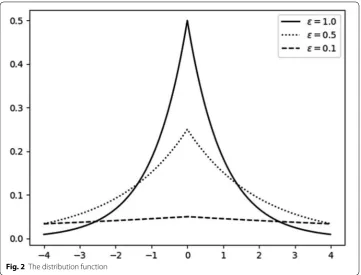
The distribution function of noise under different ε is shown in Fig. 2.
(3) D(F)=max
C1,C2
�F(C1)−F(C2)�1
Assuming b= ∇fε , as shown in the Fig. 2, the smaller ε is, the bigger b is the more uni-form the added noise, the smaller the probability of adding noise to 0, the greater the
degree of confusion and the higher the degree of protection. Then the privacy budget ε
can be modified through b , and then control the intensity of privacy protection.
Feature selection part
In this part, we mainly deal with the methods for feature selection. Here we use Random Forest (RF) in ensemble learning and Classified and Regression Decision Tree (CART) for each decision tree [53]. Firstly, CART is introduced briefly, and then the flow chart of feature selection is given.
CART forms a tree structure, and the splitting of nodes is based on the minimum Gini
index. The methods of constructing CART are as follows:
Step 1: If the condition of stopping classification is satisfied, the splitting is stopped. The stopping condition is that the Gini coefficient is less than the threshold or the number of samples is less than the threshold.
Step 2: Otherwise, the minimum Gini coefficient is selected for segmentation. The features for splitting are preserved and the feature set with selection is added sequen-tially.
Step 3: Steps 1–2 is performed recursively until the splitting is completed.
Step 4: The output is a set of features arranged from strong to weak according to the importance of features.
A represents the classification feature and divides data set D into D1 and D2 , then Gini index of set D is defined as in formula (5):
The minimum Gini index reduces the uncertainty of samples to the greatest extent, so it is the basis for classification. In the process of gradual splitting, features for splitting are preserved at one time until all splitting is completed, and feature sets for classifica-tion are output, then the importance of features is consistent with the order of storage.
Random Forest is an integrated algorithm, which belongs to bagging type. It combines several weak classifiers, and the final result is obtained by voting or taking the mean. The algorithm of feature selection using the RF is as follows:
Logistic regression design part
The essence of logistic regression is to determine the cost function J for a classification problem, then choose the optimal iteration method to solve the parameters of the model, and finally verify the model. Logical regression is very suitable for binary classification (4) Gini(t)=1−
k
p(ck|t)2
(5) Gini(D,A)= |D1|
|D|Gini(D1)+ |D2|
problems, and the training of the model is faster. In this part, firstly the linear boundary conditions are given, secondly the prediction function is selected and the cost function is constructed, and finally the parameter training method of the model is given.
The boundary conditions can be expressed as in formula (6):
θi is the parameter to be trained in the model, xi is the attribute value of the sample and z is the linear output.
The predictive function can be expressed as in formula (7):
hθ is the probability value of z prediction.
The cost function with regularization can be expressed as in formula (8):
J(θ ) is the cost function, θ is the model parameter, and C is the regularization
coef-ficient. The stochastic gradient descent algorithm is used to minimize the cost function, and then the model parameters are obtained.
Experiments
In this section, the experimental environment, the source and processing of data sets and three different groups of experiments are described.
Experimental environment
The experimental environment includes Inter (R) Core (TM) i5-4210 M CPU @2.60 Ghz, RAM 4.00G, operating system win10 and programming language python. The experi-mental data set is from UCI repository. In the data set, there are 116 samples, each of which s has 10 attributes and the classification label of which is 1 (healthy controls) or 2 (patients). (6) z= n i=1 θixi
(7) hθ =
1 1+e−z =
1 1+e−
θixi
(8)
J(θ )= −
1 m m i
y(i)log
hθ x(i) + 1−yi
log
1−hθ
x(i) +C n
j=1 θj2
Table 1 Part of data set
ID Attribute Data type
1 Age Int
2 BMI Float
3 Glucose Int
4 HOMA Float
5 Resistin Float
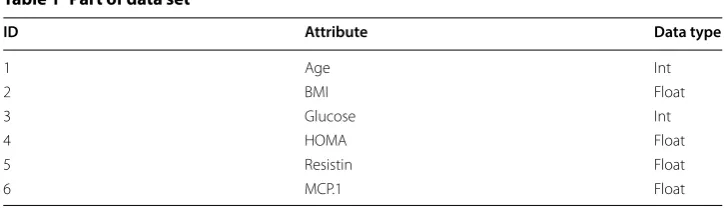
The data set URL is http://archi ve.ics.uci.edu/ml/datas ets/Breas t+Cance r+Coimb ra. Part of the data set information is shown in Table 1.
In experiments, BMI index is selected as the privacy data, which is processed by add-ing noise to form privacy protection data.
Evaluations index of classification result
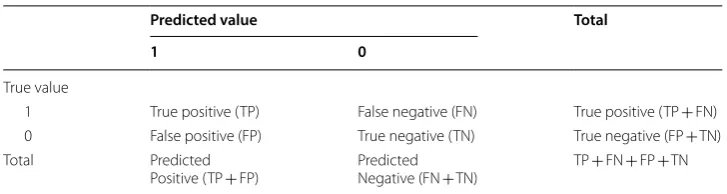
In this part, the accuracy ( ACC ), the true positive rate ( TPR ) and the false positive rate ( FPR ) are calculated by using the confusion matrix, and then the meaning of the receiver operating characteristic curve ( ROC ) drawing and the area under the curve ( AUC ) is explained. These indicators will serve as the basis for evaluating classification models. A detailed description of the confusion matrix is shown as Table 2.
The accuracy calculation is shown in formula (9).
Because the accuracy of a classification model is relatively one-sided, we need to intro-duce the values of FPR and TPR , and form a set of FPR and TPR values according to
dif-ferent thresholds, then draw ROC curve, and then calculate the area under the curve,
that is, the value of AUC . The closer the corresponding AUC value is to 1, indicating that the better the effect of the classifier.
The definitions of FPR is shown in formula (10) and TPR is shown in formula (11).
As the threshold decreases, more and more instances are classified into positive classes, but these positive classes are also doped with real negative instances, that is, TPR and FPR will increase simultaneously. As the threshold increases gradually,
fewer instances will be predicted as positive classes, and the values of FPR and TPR
will decrease and tend to 0 at the same time. When the threshold decreases gradually, more instances will be predicted as positive classes, then FPR and TPR will gradually increase, and tend to 1 at the same time. The threshold here refers to the threshold that an instance is predicted to be positive, an instance larger than the threshold is predicted (9)
ACC= TP+TN
TP+FN+FP+TN
(10)
FPR= FP
FP+TN
(11)
TPR= TP
TP+FN
Table 2 Confusion matrix
Predicted value Total
1 0
True value
1 True positive (TP) False negative (FN) True positive (TP + FN) 0 False positive (FP) True negative (TN) True negative (FP + TN) Total Predicted
to be positive, and a case smaller than the threshold is predicted to be negative. Ideally, FPR is 0 and TPR is 1.
Experimental results and analysis
In this experiment part, we mainly design the influence of data on classification effect under the condition of adding noise or not, the classification effect of the same regu-larization coefficient C under the condition of adding different intensity of noise, and the classification situation of different regularization coefficient under the same intensity of noise.
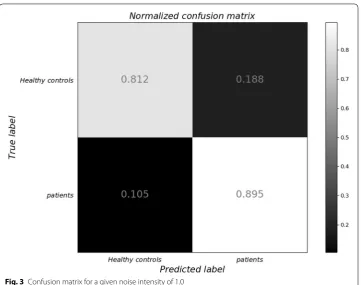
The confusion matrix for a given noise intensity of 1.0 is given in Fig. 3.
As shown in Fig. 3, the probability of correct prediction is relatively high. Especially, the accuracy of predicting real patients to be sick is 89.5%, which is much higher than 81.2% for health control. However, it was noted that the probability of predicting real patients to be healthy and controllable was 18.8%, which indicated that there were a certain number of false positive cases ( FP ), which would have a negative impact in the actual environment. After analysis, it is known that the data after noise processing does have a better accuracy, but there may also be a risk of high false positive rate.
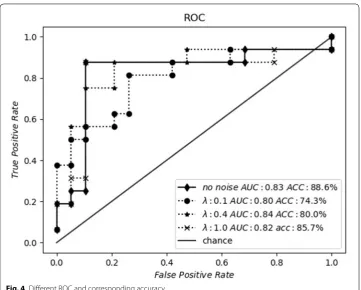
The effect of data on Classification under noisy and non-noisy conditions, and gives it in the form of ROC is shown in Fig. 4.
Firstly, in Fig. 4, it is pointed out that the stronger the noise is, the higher the interfer-ence intensity is. That is to say, the smaller the noise intensity is, the closer the new data is to the original data. In the absence of noise, the classification accuracy is 88.6%, while
in the presence of noise intensity of 1.0, the classification accuracy is only reduced by about 3%. With the noise intensity increasing, the accuracy is also gradually reduced. When the noise intensity is 0.1, the noise interference degree is the largest, resulting in the classification accuracy reduced by about 14.3%. This shows that the noise ence ability does affect the classification accuracy of the classifier. If the noise interfer-ence ability is stronger, the classification accuracy is lower. On the contrary, the lower the noise interference ability, the higher the classification accuracy will be guaranteed. In addition, it should be noted that the change trend of AUC value is basically consist-ent with that of accuracy. The experimconsist-ental results show that the value of AUC with or without noise can be above 0.8.
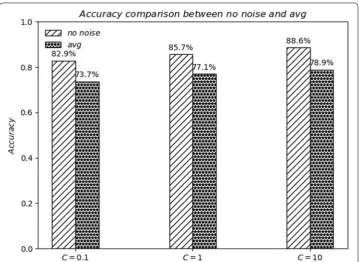
Figure 5 shows the comparison of the accuracy of different regularization coefficients C without adding noise and the average accuracy after adding different noise.
Firstly, as a whole, with the regularization coefficient C decreasing gradually, the accu-racy will decrease whether noise is added or not. The reason is that the regularization coefficient decreases due to the decision of the classifier itself, which leads to the over-fitting of the classification model and reduces the classification effect. Locally, given the positive deterioration coefficient, that is, given a certain classifier, the classification result without noise is always better than the average case with added noise. From the experimental results, the classification accuracy without noise will be improved by 8.6% to 9.7%. This shows that the addition of noise does affect the classification effect of the classifier. However, it is noteworthy that even with the addition of noise, the mining of privacy data can still be achieved after choosing the appropriate positive deterioration
coefficient. For example, in the case of C=10 and adding noise, the average classifica-tion accuracy of privacy data can still reach about 80%.
Conclusion
In this paper, we combine privacy protection with data mining to implement a local pri-vacy protection classification based on Human-centric computing. First, perform the necessary pre-processing on the original data. Then, in order to achieve disturbance of the source data, the protected data is formed by adding noise conforming to the Laplace mechanism to the privacy data. Secondly, in order to highlight the influence of the noisy data and also to better classify the generalization ability, the random forest strategy is adopted for feature selection. Then use the classic logistic regression model in machine learning to implement the classification task. Finally, the experiment shows that after selecting the appropriate regularization coefficient, the accuracy of the noise-added data can reach 85.7%.
Considering the actual situation, the deficiency of this paper is that the number of patients predicted as health controllable is relatively large and the overall prediction accuracy is not high. The next step is to improve the degree of mining privacy data without affecting the machine learning model as much as possible.
Abbreviations
AI: artificial intelligence; RF: random forest; CART : classified and regression decision tree; ACC : accuracy; TPR: true positive rate; FPR: false positive rate; ROC: receiver operating characteristic curve; AUC : area under the curve; TP: true positive; FN: false negative; TN: true negative; FP: false positive.
Acknowledgements
It was supported by the Priority Academic Program Development of Jiangsu Higher Education Institutions (PAPD), Post-graduate Research & Practice Innovation Program of Jiangsu Province (KYCX18_1032).
Authors’ contributions
CY conceptualized the study. BZ performed all experiments and wrote the manuscript. ZY analyzed all the data. JW advised on the manuscript preparation and technical knowledge. All authors read and approved the final manuscript. Funding
This work was supported by the National Natural Science Foundation of China (61772282, 61772454, 61811530332). Availability of data and materials
We declared that materials described in the manuscript will be freely available to any scientist wishing to use them for non-commercial purposes.
Competing interests
The authors declare that they have no competing interests. Author details
1 School of Computer and Software, Nanjing University of Information Science and Technology, Nanjing 210044, China. 2 College of Information Science and Technology, Nanjing Forestry University, Nanjing 210037, China. 3 School of
Com-puter & Communication Engineering, Changsha University of Science and Technology, Changsha 410004, China.
Received: 9 June 2019 Accepted: 26 August 2019
References
1. Zhaojun L, Gang Q, Zhenglin L (2019) A survey on recent advances in vehicular network security, trust, and privacy. IEEE Trans Intell Transp Syst 20(2):760–776
2. Xiong L, Jian N, Bhuiyan MZA (2018) A robust ECC-based provable secure authentication protocol with privacy preserving for industrial internet of things. IEEE Trans Ind Inf 14(8):3599–3609
3. Sangaiah AK, Medhane DV, Han T, Hossain MS, Muhammad G (2019) Enforcing position-based confidentiality with machine learning paradigm through mobile edge computing in real-time industrial informatics. IEEE Trans Ind Inf 15(7):4189–4196
4. Perez AJ, Zeadally S, Jabeur N (2018) Security and privacy in ubiquitous sensor networks. J Inf Process Syst 14(2):286–308
5. Kang WM, Moon SY, Park JH (2017) An enhanced security framework for home appliances in smart home. Human Centric Comput Inf Sci 7(1):6
6. Kim HW, Jeong YS (2018) Secure authentication-management human-centric scheme for trusting personal resource information on mobile cloud computing with blockchain. Human Centric Comput Inf Sci 8(1):11
7. Sweeney L (2002) K-anonymity: a model forprotecting privacy. Int J Uncertainty Fuzziness Knowl Based Syst 10(5):557–570
8. Sweeney L (2002) Achieving k-anonymity privacy protection using generalization, and suppression. Int J Uncer-tainty Fuzziness Knowl Based Syst 10(5):571–588
9. Machanavajjhala A., Gehrke J., Kifer D., and Venkitasubramaniam M. (2006) L-diversity: privacy beyond k-anonymity. In: 22nd international conference on data engineering. IEEE Computer Society
10. Dwork C (2006) Differential privacy. International colloquium on automata, languages, and programming. Springer, Berlin, pp 1–12
11. Jian S, Chen W, Tong L (2018) Secure data uploading scheme for a smart home system. Inf Sci 453:186–197 12. Zhou SW, He Y, Xiang SZ, Li KQ, Liu YH (2019) Region-based compressive networked storage with lazy encoding.
IEEE Trans Parallel Distrib Syst 30(6):1390–1402
13. Hu P, Dhelim S, Ning H (2017) Survey on fog computing: architecture, key technologies, applications and open issues. J Netw Comput Appl 98:27–42
14. He S, Li Z, Tang Y, Liao Z, Wang J, Kim HJ (2019) Parameters compressing in deep learning. Comput Mater Con (accepted)
15. Zhang J, Jin X, Sun J, Wang J, Sangaiah AK (2018) Spatial and semantic convolutional features for robust visual object tracking. Multimedia Tools Appl. https ://doi.org/10.1007/s1104 2-018-6562-8
16. Zhang J, Jin X, Sun J, Wang J, Li K (2019) Dual model learning combined with multiple feature selection for accurate visual tracking. IEEE Access 7:43956–43969
17. Zhang J, Wu Y, Feng W, Wang J (2019) Spatially attentive visual tracking using multi-model adaptive response fusion. IEEE Access 7:83873–83887
18. Zhang J, Wang W, Lu C, Wang J, Sangaiah AK (2019) Lightweight deep network for traffic sign classification. Ann Telecommun. https ://doi.org/10.1007/s1224 3-019-00731 -9
19. Zhang J, Lu C, Li X, Kim H-J, Wang J (2019) A full convolutional network based on DenseNet for remote sensing scene classification. Math Biosci Eng 16(5):3345–3367
20. Yin Y, Chen L, Xu Y, Wan J, Zhang H, Mai Z (2019) QoS prediction for service recommendation with deep feature learning in edge computing environment. Mobile Netw Appl. https ://doi.org/10.1007/s1103 6-019-01241 -7 21. Yin Y, Chen L, Xu Y, Wan J (2018) Location-aware service recommendation with enhanced probabilistic matrix
22. Yin Y, Xu Y, Xu W, Gao M, Yu L, Pei Y (2017) Collaborative service selection via ensemble learning in mixed mobile network environments. Entropy 19(7):358
23. Yin Y, Xu W, Xu Y, Li H, Yu L (2017) Collaborative QoS prediction for mobile service with data filtering and SlopeOne model. Mobile Inf Syst 2017:1–14
24. Rabaey JM (2018) Towards true human-centric computation. Commun Comput 131:73–76
25. Heng Z, Wenchao M, Jun Q (2019) Distributed load sharing under false data injection attack in an inverter-based microgrid. IEEE Trans Ind Electron 66(2):1543–1551
26. Guo Kehua, He Yan, Kui Xiaoyan, Sehdev Paramjit, Chi Tao, Zhang Ruifang, Li Jialun (2018) LLTO: towards efficient lesion localization based on template occlusion strategy in intelligent diagnosis. Pattern Recogn Lett 116:225–232 27. Guo Kehua, Li Ting, Huang Runhe, Kang Jian, Chi Tao (2018) DDA: a deep neural network-based cognitive system for
IoT-aided dermatosis discrimination. Ad Hoc Netw 80:95–103
28. Ozatay M, Verma N (2019) Exploiting emerging sensing technologies toward structure in data for enhancing per-ception in Human-Centric applications. IEEE Internet Things J 6(2):3411–3422
29. Gergely A, Luca M, Castelluccia C (2019) Differentially private mixture of generative neural networks. IEEE Trans Knowl Data Eng 31(6):1109–1121
30. Yin C, Xi J, Sun R, Wang J (2018) Location privacy protection based on differential privacy strategy for big data in industrial internet-of-things. IEEE Trans Ind Inf 14(8):3628–3636
31. Vaidya J, Shafiq B, Basu A, Hong Y (2013) Differentially private Naive Bayes classification. In: Proceedings of the 2013 IEEE/WIC/ACM international joint conferences on web intelligence (WI) and intelligent agent technologies (IAT) 32. Mohammed N (2011) Differentially private data release for data mining. In: ACM SIGKDD international conference
on knowledge discovery and data mining ACM; 2011. pp 493–501
33. Tang DY, Zhou SW, Yang WJ (2019) Random-filtering based sparse representation parallel face recognition. Multime-dia Tools Appl 78(2):1419–1439
34. Yin C, Ding S, Wang J (2019) Mobile marketing recommendation method based on user location feedback. Human Centric Comput Inf Sci 9(1):14–31
35. Yin C, Shi L, Sun R, Wang J (2019) Improved collaborative filtering recommendation algorithm based on differential privacy protection. J Supercomput 7:1–14
36. Jia Q, Guo L, Jin Z (2018) Preserving model privacy for machine learning in distributed systems. IEEE Trans Parallel Distrib Syst 29(8):1808–1822
37. Wang J, Gao Y, Liu W, Wu W, Lim S (2019) An asynchronous clustering and mobile data gathering schema based on timer mechanism in wireless sensor networks. Comput Mater Continua 58(3):711–725
38. Wang J, Gao Y, Liu W, Sangaiah AK, Kim H-J (2019) Energy efficient routing algorithm with mobile sink support for wireless sensor networks. Sensors 19(7):1494
39. Pan J-S, Kong L, Sung T-W, Tsai P-W, Snasel V (2018) Alpha-fraction first strategy for hierarchical wireless sensor networks. J Internet Technol 19(6):1717–1726
40. Pan J-S, Lee C-Y, Sghaier A, Zeghid M, Xie J (2019) Novel systolization of subquadratic space complexity multipliers based on Toeplitz matrix-vector product approach. IEEE Trans Very Large Scale Integr Syst 27(7):1614–1622 41. He S, Xie K, Xie K, Xu C, Wang J (2019) Interference-aware multi-source transmission in multi-radio and
multi-chan-nel wireless network. IEEE Syst J. https ://doi.org/10.1109/JSYST .2019.29104 09
42. He S, Xie K, Chen W, Zhang D, Wen J (2018) Energy-aware routing for SWIPT in multi-hop energy-constrained wire-less network. IEEE Access 6:17996–18008
43. He S, Zeng W, Xie K, Yang H, Lai M, Su X (2017) PPNC: privacy preserving scheme for random linear network coding in smart grid. KSII Trans Internet Inf Syst 11(3):1510–1533
44. Wang J, Gao Y, Yin X, Li F, Kim HJ (2018) An enhanced PEGASIS algorithm with mobile sink support for wireless sen-sor networks. Wire Commun Mobile Comput. https ://doi.org/10.1155/2018/94720 75
45. Nguyen T-T, Pan J-S, Dao T-K (2019) An improved flower pollination algorithm for optimizing layouts of nodes in wireless sensor network. IEEE Access. https ://doi.org/10.1109/ACCES S.2019.29217 21
46. Meng Z, Pan J-S, Tseng K-K (2019) PaDE: an enhanced differential Evolution algorithm with novel control parameter adaptstion schemes for numerical optimization. Knowl Based Syst 168:80–99
47. Pan J-S, Kong L, Sung T-W, Tsai P-W, Snáel V (2018) A clustering scheme for wireless sensor networks based on genetic algorithm and dominating set. J Internet Technol 19(4):1111–1118
48. Gao Z, Sun Y, Cui X (2018) Privacy-preserving hybrid K-means. Int J Data Warehouse Min 14(2):1–17
49. Xing K, Hu C, Yu J (2017) Mutual privacy preserving k-means clustering in social participat-ory sensing. IEEE Trans Ind Inf 13(4):2066–2076
50. Gong M, Pan K, Xie Y (2019) Differential privacy preservation in regression analysis based on relevance. Knowl Based Syst 173:140–149
51. Wang J, Gao Y, Liu W, Sangaiah AK, Kim HJ (2019) An improved routing schema with special clustering using PSO algorithm for heterogeneous wireless sensor Network. Sensors 19(3):671–688
52. Wang J, Ju C, Gao Y, Sangaiah AK, Kim G-J (2018) A PSO based energy efficient coverage control algorithm for wire-less sensor networks. Comput Mater Continua 56:433–446
53. Chen W, Xie X, Wang J (2017) A comparative study of logistic model tree, random forest, and classification and regression tree models for spatial prediction of landslide susceptibility. CATENA 151:147–160
Publisher’s Note