JADD, Sep. – October 2014, Vol 1, Issue 5
Research Article
Formulation Development and Evaluation of Effervescent Floating Matrix Tablet As Gastroretentive Drug Delivery System
Pravin Babarao Suruse*1, Umesh Dhaniram Shivhare1 and Mrunalini Raghunath Raut1
1Department of Pharmaceutics, Sharad Pawar College of Pharmacy, Wanadongri, Hingana Road,
Nagpur-441110 (MS), India.
Available online: October, 2014
ABSTRACT:
The present work was aim to formulate effervescent floating matrix tablets of Pentoxifylline as gastro retentive drug delivery system. Rapid gastrointestinal transit could result in incomplete drug release from the drug delivery system above the absorption zone leading to diminished efficacy of the administered dose. Pentoxifylline is the hemorrheologic agent, lowering blood viscosity and improving erythrocyte flexibility. It is having half-life 0.4 - 0.8 h (1-1.6 h for active metabolite) with the usual oral dose is 400 mg three times daily. The tablets were prepared by direct compression technique, using polymers such as hydrophilic polymer HPMC K15M and hydrophobic polymer MCC (Avicel PH101). Sodium bicarbonate and citric acid used as a gas generating agent. The prepared tablets were evaluated for their physicochemical properties as well as drug release profile. The effect of effervescent agents and polymeric substance were also investigated for floating properties and drug release characteristics. Drug release pattern of all formulations followed non-fickian diffusion or anomalous diffusion. Thus, a combination of HPMC K15M and MCC PH101 extends the release for a period of 12 h
Keywords: Floating drug delivery system, Pentoxifylline, gastric residence time and effervescent agent.
INTRODUCTION
A drug delivery system (DDS) is defined as a formulation or a device that enables the introduction of a therapeutic substance in the body and improves its efficacy and safety by controlling the rate, time and place of release of drugs in the body. This process includes the administration of the therapeutic product, the release of the active ingredient by the product and the subsequent transport of the active ingredients across the biological membranes to the site of action.1
Drugs that are easily absorbed from gastrointestinal tract (GIT) and have short half-lives are eliminated quickly from the systemic circulation. Frequent dosing of these drugs is required to achieve suitable therapeutic activity. To avoid this limitation, the development of oral sustained-controlled release formulations is an attempt to release the drug slowly into the gastrointestinal tract (GIT) and maintain an effective drug concentration in the systemic circulation for a long time. After oral administration, such a drug delivery would be retained in the stomach and release the drug in a controlled manner, so that the drug could be supplied continuously to its absorption sites in the gastrointestinal tract (GIT).2
MATERIALS AND METHODS
Pentoxifylline was received as a gift sample from Sun Pharma, Mumbai. HPMC K15M was received as a gift samples from Colorcon Asia Pvt. Ltd., Goa, India. Micro crystalline cellulose (MCC), polyvinyl pyrrolidone K-30 (PVP K-30), Sodium bicarbonate and citric acid anhydrous were obtained from Loba Chemical, Mumbai, India. Magnesium stearate and talc were procured from S. D. Fine Chem. Ltd. Mumbai, India. All other chemicals and reagents used were of analytical grade.
Preformulation studies:
Melting Point:
The melting point Pentoxifylline was determined by capillary method and was found to be 103 0C to 107 0C which complies with the melting point reported in
BP.
Ultra-violet scanning:
The scanning of Pentoxifylline was performed in simulated gastric fluid and λmax was found to be 254
nm which compiles with the λmax reported in B.P.3
JADD, Sep. - October 2014, Vol 1, Issue 5 of Pentoxifylline:
An effervescent floating matrix tablet of Pentoxifylline with hydroxyl propyl methyl cellulose (HPMC) was prepared by wet granulation method. Microcrystalline cellulose was used as diluent along with sodium bicarbonate and citric acid as an effervescent agent (gas generating agent). Poly vinyl pyrollidine K30 (PVP K30) dissolved in sufficient isopropyl alcohol as a granulating agent; magnesium stearate as a lubricant and talc as a glidant.
All the ingredients were accurately weighed and sieved through sieve No. 60. In order to mix the
ingredients thoroughly, drug and all the excipients (shown in Table I) except the lubricant (magnesium stearate and talc) were blended geometrically in mortar and pestle for 15 min and granulated using PVP K30 dissolved in sufficient isopropyl alcohol by passing through sieve No. 12. Granules were dried at 60ºC for 4 h. The dried granules were sized through
sieve No. 18 and lubricated by adding magnesium stearate and talc. Tablets were compressed on a single punch tablet machine (Rimek Minipress II, Mehsana) using flat surfaced, round shaped punches of 16 mm diameter.4
Table I: Composition of floating matrix tablet
Ingredients (mg) Formulation code
Pentoxifylline F1 F2 F3 F4 F5 F6 F7 F8 F9
HPMC K15M 400 400 400 400 400 400 400 400 400
Micro crystalline cellulose 100 100 100 150 150 150 200 200 200
PVP K30 30 35 40 30 35 40 30 35 40
Sodium bicarbonate 24 24 24 24 24 24 24 24 24
Anhydrous citric acid 142 142 142 142 142 142 142 142 142
Talc 3.5 3.5 3.5 3.5 3.5 3.5 3.5 3.5 3.5
Magnesium stearate 6.5 6.5 6.5 6.5 6.5 6.5 6.5 6.5 6.5
Evaluation of effervescent floating matrix tablets: Tablets were evaluated for both its precompression parameters like bulk density, tapped density, carr’s index, hausner ratio, angle of repose as well as their post compression parameters tablet thickness, hardness, friability, uniformity of weight, content uniformity of drug and all other specific evaluation tests for floating drug delivery system like floating lag time, total floating time and release rate of drug. Precompression Parameters:
Bulk density and Tapped density:
Both bulk density (BD) and tapped density (TD) was determined. A quantity of 2 g of powder blend from each formula, previously shaken to break any agglomerates formed, was introduced into 10 ml measuring cylinder. After that the initial volume was noted and the cylinder was allowed to fall under its own weight on to a hard surface from the height of 2.5 cm at second intervals. Tapping was continued until no further change in volume was noted. BD and TD were calculated using the following equations.5
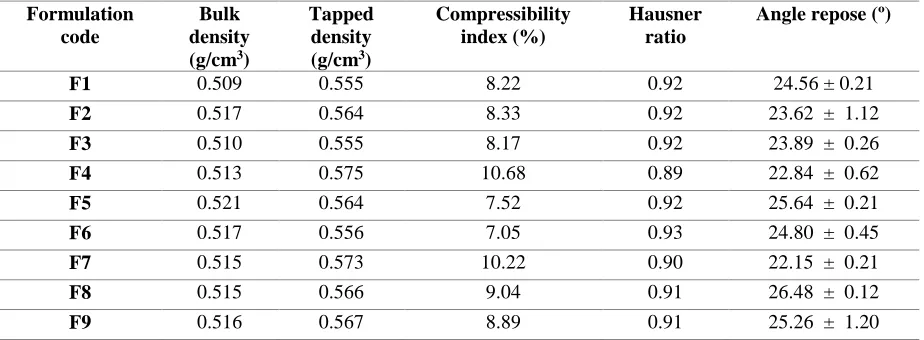
The results of bulk density and tapped density were reported in Table II.
Bulk density = W/V0
Tapped density = W/Vf
Where, W - weight of powder, V0 - initial volume, Vf
- final volume
Compressibility index and Hausner ratio:
The compressibility index and hausner ratio are measures of the propensity of a powder to be compressed. As such, they are measures of the relative importance of interparticulate interactions. In a free-flowing powder, such interactions are generally less significant, and the bulk and tapped densities will be closer in value. For poorer flowing materials, there are frequently greater interparticle interactions and a greater difference between the bulk and tapped densities will be observed. These differences are reflected in the compressibility index and the hausner ratio.5 The compressibility index and
hausner ratio were calculated by using measured values for bulk density (Db) and tapped density (Dt)
and results are shown in Table II.
Compressibility index = Dt − Db/Dt X 100
JADD, Sep. - October 2014, Vol 1, Issue 5 Where, Db- Bulk density, Dt - Tapped density.
Angle of repose:
The angle of repose of powder blend was determined by the funnel method. The accurately weight powder blend were taken in the funnel. The height of the funnel was adjusted in such a way that the tip of the funnel just touched the apex of the powder blend.
The powder blend was allowed to flow through the funnel freely on to the surface.5 The diameter of the
powder cone was measured and angle of repose was calculated.
Tan θ = h/r or θ = tan-1(h/r)
Where, h = height of pile, r = radius of the base of the pile, θ = angle of repose
Table II: Precompression parameters for formulations F1- F9
Formulation code
Bulk density (g/cm3)
Tapped density (g/cm3)
Compressibility index (%)
Hausner ratio
Angle repose (º)
F1 0.509 0.555 8.22 0.92 24.56 ± 0.21
F2 0.517 0.564 8.33 0.92 23.62 ± 1.12
F3 0.510 0.555 8.17 0.92 23.89 ± 0.26
F4 0.513 0.575 10.68 0.89 22.84 ± 0.62
F5 0.521 0.564 7.52 0.92 25.64 ± 0.21
F6 0.517 0.556 7.05 0.93 24.80 ± 0.45
F7 0.515 0.573 10.22 0.90 22.15 ± 0.21
F8 0.515 0.566 9.04 0.91 26.48 ± 0.12
F9 0.516 0.567 8.89 0.91 25.26 ± 1.20
* All values are expressed as mean ± SD (n=5) Post- compression parameters:
Tablet Hardness:
The crushing strength of prepared tablets was determined for tablets of each batch by using Monsanto hardness tester.5
Tablet Thickness:
The thickness of the tablets was determined by using vernier caliper. Five tablets were used and average values were calculated.5
Weight variation test:
Twenty tablets were selected randomly from each batch and weighed individually. The average weight of each batch of tablet was calculated. Individual weight of the tablets was compared with the average weight. Since the tablets weighed over 250 mg, Indian Pharmacopoeia specifies that the tablets pass the test if not more than two of the individual weights deviate from the average weight by more than 5 %.5
The friability of tablets was determined using Roche friabilator. It is expressed in percentage (%). Ten
tablets were initially weighed (W0) and transferred
into friabilator. The friabilator was operated at 25 rpm for 4 min or run up to 100 revolutions.5 The
tablets were weighed again (Wf) and friability was
calculated. (Table III)
% Friability = (1-Wf / W0) x 100
Where, W0 -Weight of tablet before test, Wf -Weight
of tablet after test
Drug content uniformity:
The tablets were weighed and taken in a mortar and crushed to powder. A quantity of powder equivalent to 400 mg of Pentoxifylline was taken in a 100 ml volumetric flask and 0.1 N HCl was added. It was then heated at 60ºC for 30 ml. The solution was
JADD, Sep. - October 2014, Vol 1, Issue 5
Table III: Postcompression parameters for formulations F1 – F9
* All values are expressed as mean ± SD (n=20); ^ All values are expressed as mean ± SD (n=5) # All values are expressed as mean ± SD (n=10)
Swelling study (Water uptake study):
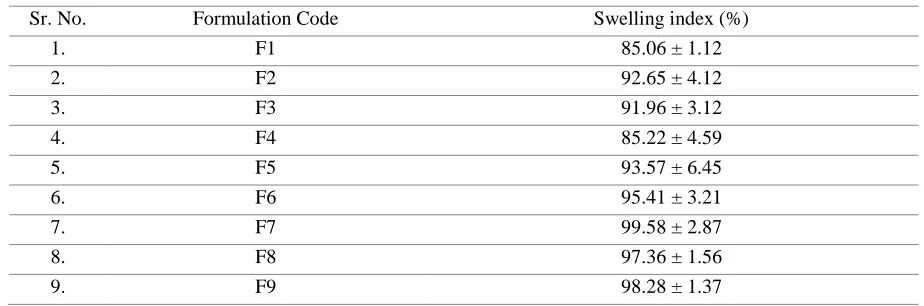
Swelling of tablet excipients particles involves the absorption of a liquid, resulting in an increase in weight and volume. Liquid uptake by the particle may be due to saturation of capillary spaces within the particles or hydration of macromolecule. The liquid enters the particles through pores and bind to large molecule, breaking the hydrogen bond resulting in the swelling of particle. The extent of swelling can be measured in terms of % weight gain by tablet.7
The swelling capacity study of the tablet was done using USP XXII type I dissolution apparatus. The
medium used was 0.1 N HCl (900 ml) and rotated at 100 rpm. The medium used was maintained at 37 ± 0.5ºC throughout the study. After a selected time
intervals, the tablets were withdrawn, blotted to remove excess water and weighed.8 Swelling
characteristics of the tablets were expressed in terms of swelling index (%). (Table IV)
Swelling index (%) = Wf – Wi / Wi × 100
Where, Wf - Weight of swollen tablet, Wi - Initial
weight of tablet
Table IV: Results of swelling study of formulations F1 – F9
Sr. No. Formulation Code Swelling index (%)
1. F1 85.06 ± 1.12
2. F2 92.65 ± 4.12
3. F3 91.96 ± 3.12
4. F4 85.22 ± 4.59
5. F5 93.57 ± 6.45
6. F6 95.41 ± 3.21
7. F7 99.58 ± 2.87
8. F8 97.36 ± 1.56
9. F9 98.28 ± 1.37
All values are expressed as mean± SD (N=5)
In vitro buoyancy study:
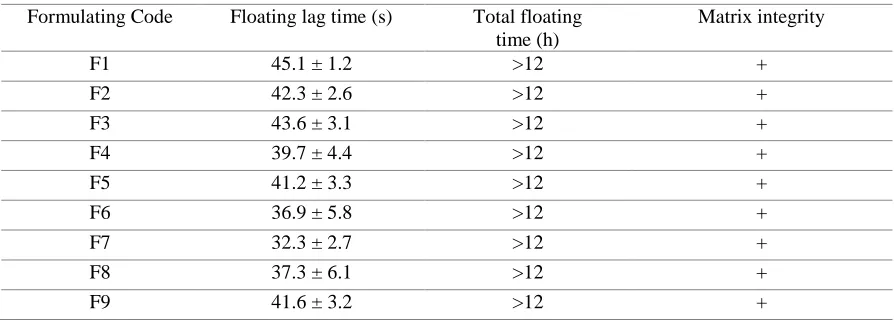
The time, tablets took to emerge on the water surface i.e. floating lag time (FLT) and the time, tablets constantly float on the water surface i.e. total floating time (TFT) were evaluated. The buoyancy of the tablets were studied in
Formulation code
Hardness ^ (kg/cm2)
Thickness ^ (mm)
Weight variation * (mg)
Friability # (%) Content
JADD, Sep. - October 2014, Vol 1, Issue 5
USP XXII type II dissolution apparatus at 37± 0.5ºC with paddle rotation at 100 rpm in 900 ml of stimulated gastric fluid at pH 1.2. The measurements were carried out for each formulation of tablets. The time of duration of floatation was observed visually and reported in Table V and Figure I.9
[a] [b]
Figure I: In-vitro buoyancy study [a] Before floating [b] After floating
Table V: In vitro buoyancy data of floating tablets
Formulating Code Floating lag time (s) Total floating time (h)
Matrix integrity
F1 45.1 ± 1.2 >12 +
F2 42.3 ± 2.6 >12 +
F3 43.6 ± 3.1 >12 +
F4 39.7 ± 4.4 >12 +
F5 41.2 ± 3.3 >12 +
F6 36.9 ± 5.8 >12 +
F7 32.3 ± 2.7 >12 +
F8 37.3 ± 6.1 >12 +
F9 41.6 ± 3.2 >12 +
In vitro drug release studies
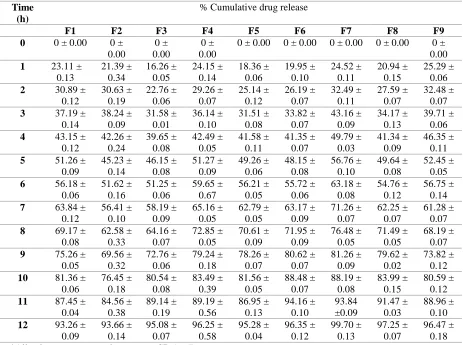
The Pentoxifylline released from different floating tablet formulation was determined by using a USP XXII paddle apparatus under sink condition (Lab India Disso 2000). The dissolution medium was 900 ml simulated gastric fluid (pH-1.2, no enzyme) at 37 ± 0.5ºC; paddle speed 100 rpm, to stimulate in vivo condition. The prepared formulation was subjected to dissolution tests for 12 h. At every 1 h interval, a
sample was withdrawn, filtered through Whatmann filter paper and replaced by an equal volume of dissolution medium. Drug content in the dissolution sample was determined at 254 nm by UV spectrophotometer (UV- 1700). Cumulative percent drug released was found at each time interval and graph was plotted between cumulative % drug released and time in h.7 The results of in vitro drug
JADD, Sep. - October 2014, Vol 1, Issue 5
Table VI: In vitro drug release data of formulation F1 TO F9
Time (h)
% Cumulative drug release
F1 F2 F3 F4 F5 F6 F7 F8 F9
0 0 ± 0.00 0 ± 0.00
0 ± 0.00
0 ± 0.00
0 ± 0.00 0 ± 0.00 0 ± 0.00 0 ± 0.00 0 ± 0.00 1 23.11 ±
0.13 21.39 ± 0.34 16.26 ± 0.05 24.15 ± 0.14 18.36 ± 0.06 19.95 ± 0.10 24.52 ± 0.11 20.94 ± 0.15 25.29 ± 0.06 2 30.89 ±
0.12 30.63 ± 0.19 22.76 ± 0.06 29.26 ± 0.07 25.14 ± 0.12 26.19 ± 0.07 32.49 ± 0.11 27.59 ± 0.07 32.48 ± 0.07 3 37.19 ±
0.14 38.24 ± 0.09 31.58 ± 0.01 36.14 ± 0.10 31.51 ± 0.08 33.82 ± 0.07 43.16 ± 0.09 34.17 ± 0.13 39.71 ± 0.06 4 43.15 ±
0.12 42.26 ± 0.24 39.65 ± 0.08 42.49 ± 0.05 41.58 ± 0.11 41.35 ± 0.07 49.79 ± 0.03 41.34 ± 0.09 46.35 ± 0.11 5 51.26 ±
0.09 45.23 ± 0.14 46.15 ± 0.08 51.27 ± 0.09 49.26 ± 0.06 48.15 ± 0.08 56.76 ± 0.10 49.64 ± 0.08 52.45 ± 0.05 6 56.18 ±
0.06 51.62 ± 0.16 51.25 ± 0.06 59.65 ± 0.67 56.21 ± 0.05 55.72 ± 0.06 63.18 ± 0.08 54.76 ± 0.12 56.75 ± 0.14 7 63.84 ±
0.12 56.41 ± 0.10 58.19 ± 0.09 65.16 ± 0.05 62.79 ± 0.05 63.17 ± 0.09 71.26 ± 0.07 62.25 ± 0.07 61.28 ± 0.07 8 69.17 ±
0.08 62.58 ± 0.33 64.16 ± 0.07 72.85 ± 0.05 70.61 ± 0.09 71.95 ± 0.09 76.48 ± 0.05 71.49 ± 0.05 68.19 ± 0.07 9 75.26 ±
0.05 69.56 ± 0.32 72.76 ± 0.06 79.24 ± 0.18 78.26 ± 0.07 80.62 ± 0.07 81.26 ± 0.09 79.62 ± 0.02 73.82 ± 0.12 10 81.36 ±
0.06 76.45 ± 0.18 80.54 ± 0.08 83.49 ± 0.39 81.56 ± 0.05 88.48 ± 0.07 88.19 ± 0.08 83.99 ± 0.15 80.59 ± 0.12 11 87.45 ±
0.04 84.56 ± 0.38 89.14 ± 0.19 89.19 ± 0.56 86.95 ± 0.13 94.16 ± 0.10 93.84 ±0.09 91.47 ± 0.03 88.96 ± 0.10 12 93.26 ±
0.09 93.66 ± 0.14 95.08 ± 0.07 96.25 ± 0.58 95.28 ± 0.04 96.35 ± 0.12 99.70 ± 0.13 97.25 ± 0.07 96.47 ± 0.18 *All values are expressed as mean ± SD (n=5)
Treatment of drug release data with different kinetic equations
Different mathematical model may be applied for describing the kinetics of the drug release process from matrix tablets, the most suited being the one which best fits the experimental results. The kinetics of Pentoxifylline was determined by finding the best fit of the dissolution data to distinct models- Zero order, First order, Higuchi and Korsmeyer Peppas.10
Zero order kinetics: A zero-order release would be predicted by the following equation.
At= A0 – K0t
Where, At - Drug release at time‘t’
A0 - Initial drug concentration
K0 - Zero-order rate constant
First order kinetics: A first-order release would be predicted by the following equation.
Log C = Log C0– 303.2 Kf t
Where, C - Amount of drug remained at time‘t’ C0- Initial amount of drug
Kf - First-order rate constant
Higuchi’s model: Drug released from the matrix devices by diffusion has been described by following Higuchi’s classical diffusion equation.
Q = Kht ½
Where, Q - Percentage of drug released at time‘t’ Kh- Higuchi’s drug release rate constant
Korsmeyer peppas model: The release rates from controlled release polymeric matrices can be described by the equation proposed by Korsmeyer Peppas et al.
Q = Kmt n
JADD, Sep. - October 2014, Vol 1, Issue 5
Km - Kinetic constant incorporating structural and
geometric characteristics of the tablets
n - Diffusional exponent indicative of the release mechanism
The results of in vitro drug release profile obtained for all the floating tablet formulations were plotted in modes of data treatment as follows:
i. Cumulative percent drug released versus time (zero-order kinetic model)
ii. Log cumulative percent drug remaining versus time (First-order kinetic model) iii. Cumulative percent drug released versus
square root of time (Higuchi’s model) iv. Log cumulative percent drug released
versus log time (Korsmeyer Peppas equation).10
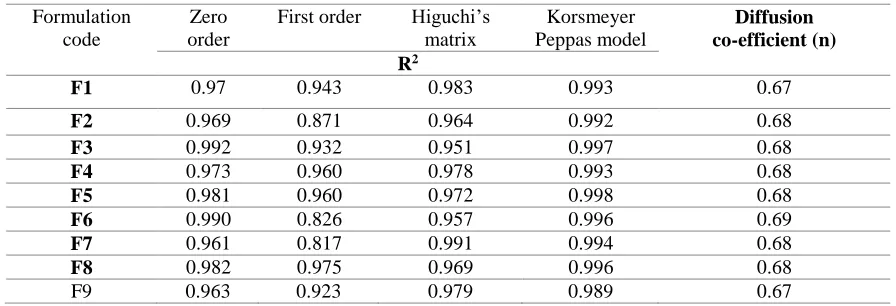
Table VII: Kinetic treatment of drug release data of various formulations F1 to F9
Stability studies:
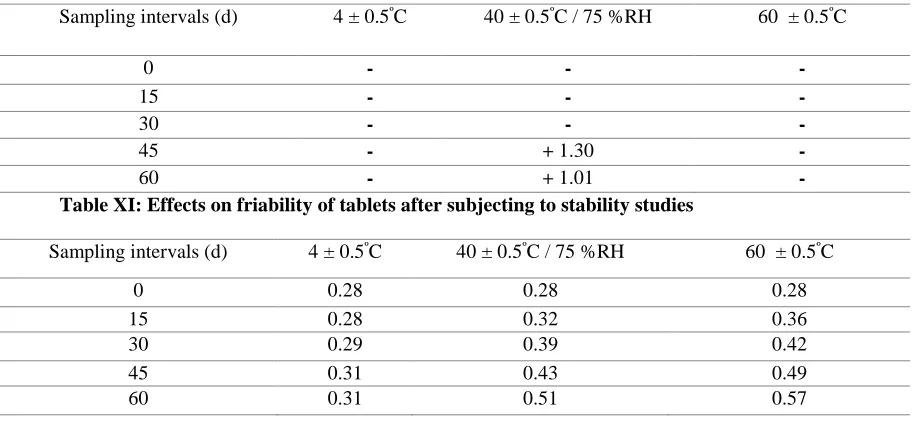
Stability studies were carried out for optimized batch (F7) of effervescent floating matrix tablets of Pentoxifylline. The tablets were packed in aluminium foil placed in airlight container and kept at 4ºC in refrigerator, 40ºC / 75 % RH and 60ºC for 60 d. At the interval of 15 d, the tablets were withdrawn and evaluated for physical properties and in vitro drug release. The results of stability studies are shown in following tables. (Table VIII-XIII)
Table VIII: Effects on visual appearance of tablets after subjecting to stability studies
Sampling intervals (d) 4 ± 0.5ºC 40 ± 0.5ºC / 75 %RH 60 ± 0.5ºC
0 - - -
15 - - -
30 - - -
45 - - +
60 - + ++
-No change, + Dull white colour, + + Light yellow colour
Table IX: Effects on hardness of tablets after subjecting to stability studies
Sampling intervals (d) 4 ± 0.5ºC 40 ± 0.5ºC / 75 %RH 60 ± 0.5ºC
0 5.5 5.2 5.2
15 5.5 5.2 5.2
30 5.6 5.2 5.1
45 5.7 5.2 4.8
60 5.7 5.1 4.8
Table X: Effects on weight variation of tablets after subjecting to stability studies Formulation
code
Zero order
First order Higuchi’s matrix
Korsmeyer Peppas model
Diffusion co-efficient (n) R2
F1 0.97 0.943 0.983 0.993 0.67
F2 0.969 0.871 0.964 0.992 0.68
F3 0.992 0.932 0.951 0.997 0.68
F4 0.973 0.960 0.978 0.993 0.68
F5 0.981 0.960 0.972 0.998 0.68
F6 0.990 0.826 0.957 0.996 0.69
F7 0.961 0.817 0.991 0.994 0.68
F8 0.982 0.975 0.969 0.996 0.68
JADD, Sep. - October 2014, Vol 1, Issue 5
Sampling intervals (d) 4 ± 0.5ºC 40 ± 0.5ºC / 75 %RH 60 ± 0.5ºC
0 - - -
15 - - -
30 - - -
45 - + 1.30 -
60 - + 1.01 -
Table XI: Effects on friability of tablets after subjecting to stability studies
Sampling intervals (d) 4 ± 0.5ºC 40 ± 0.5ºC / 75 %RH 60 ± 0.5ºC
0 0.28 0.28 0.28
15 0.28 0.32 0.36
30 0.29 0.39 0.42
45 0.31 0.43 0.49
60 0.31 0.51 0.57
Table XII: Effects on % drug content of tablets after subjecting to stability studies
Sampling intervals (d) 4 ± 0.5ºC 40 ± 0.5ºC / 75 %RH 60 ± 0.5 ºC
0 98.80 98.80 98.80
15 98.62 98.43 98.13
30 98.54 98.28 97.32
45 98.37 97.91 97.16
60 97.97 97.23 96.98
Table XIII: Effects on % drug released of tablets after subjecting to stability studies
Sampling intervals (d) 4 ± 0.5ºC 40 ± 0.5ºC / 75 %RH 60 ± 0.5ºC
0 99.70 99.70 99.70
15 99.57 99.63 99.54
30 99.31 99.35 99.37
45 99.17 98.89 98.91
60 98.96 98.78 98.87
DISCUSSION AND CONCLUSION
The approach of present study was to develop effervescent floating matrix tablet of Pentoxifylline and hence evaluated the release profile of these formulations. The prepared tablets showed excellent in vitro effervescent floating properties. For effervescent, sodium bicarbonate and citric acid are added resulted in the reduction of floating lag time. All the effervescent floating matrix tablets have showed a floating time of 12 h. The floating lag time is depended upon the concentration of gas generating
JADD, Sep. - October 2014, Vol 1, Issue 5
Release of Pentoxifylline from most of the formulation was found to follow zero order kinetics (0.96 to 0.99) and derived correlation coefficient ‘R2’(0.99) indicated good fit of Higuchi model
suggesting that diffusion is the predominant mechanism controlling the drug release. When drug release data fitted to Korsmeyer Peppas equation, the values of slope ‘n’ (0.65 to 0.69) indicated that the drug release was by Non-Fickian mechanism. Among the various effervescent floating matrix tablet formulation studied, formulation F7 containing drug polymer ratio (4:2) prepared with HPMC K15M showed promising results releasing 99.70 % of the drug in 12 h with a floating lag time of 32.3 s and floating time of 12 h has been considered as an ideal formulation.
Optimized batch of floating tablet of Pentoxifylline (F7) was further subjected for short term stability studies and found to be stable for 60 d. Formulation F7 appears suitable for further pharmacodynamic and pharmacokinetic studies to evaluated clinical safety of these floating tablets in suitable animal and human models.
ACKNOWLEDGEMENT
The authors are thankful to Sun Pharma, Mumbai and Colorcon Asia Pvt. Ltd., Goa, India for providing gift samples of Pentoxifylline and HPMC K15M respectively.
REFERENCE
1. R. K. Chang and J. R. Robinson. Sustained drug release from tablets and particles through coating. In: H. A. Lieberman, L. Lachman and J. B. Schwartz (eds.), Pharmceutical Dosage form: Tablets Vol III., Marcel Dekker, New York, 2005, pp. 199-202.
2. Kumar S., Jamil F., Rajput M. and Sharma S., Gastro retentive drug delivery system: features and facts. Int J Res Pharm Biomed Sci, 125-136, (2012).
3. British Pharmacopoeia 2009. Vol. 2, pp. 4597-4598.
4. Thube W. M., Formulation and evaluation of extended release tablet of Pentoxifylline. Int J of Pharm Res and Development, 2(4): 1-11, (2008).
5. R. K. Chang and J. R. Robinson. Sustained drug release from tablets and particles through coating. In: H. A. Lieberman, L. Lachman and J. B. Schwartz (eds.), Pharmceutical Dosage form: Tablets Vol III., Marcel Dekker, New York, 2005, pp. 411.
6. Radke R. S., Deshmukh S. B., Jagtap P. S., Gangane P. S., and Godwani D. R., Design and evaluation of gastro-retentive floating tablets of Captopril. International Journal of Pharma and Bio Sciences, 1(2): 1-10, (2010). 7. Abu-Huwaij R., Obaidat R. M., Sweidan K.
and Al- Hiari Y., Formulation and in vitro Evaluation of xanthum gum or carbopol 934-based mucoadhesive patches, loaded with Nicotine. AAPS Pharm Sci Tech, (12): 21-27, (2011).
8. Indian Pharmacopoeia 1996. Vol. 2. The Indian Pharmacopoeia Commission, Ghaziabad; pp. 734.
9. Indian Pharmacopoeia 2007. Vol. 2. The Indian Pharmacopoeia Commission, Ghaziabad; pp. 134- 135.