www.scienceworldjournal.org ISSN 1597-6343
Remote Real-Time Indoor Device Tracking Based on Fuzzy Inference System (FIS)
REMOTE REAL-TIME INDOOR DEVICE TRACKING BASED ON
FUZZY INFERENCE SYSTEM (FIS)
Luhutyit Peter Damuut1, Amos Peter2 and Ayuba Peter3
1, 2, 3 Department of Mathematical Sciences, Kaduna State University, Kaduna State – Nigeria.
Authors’ e-mail addresses: [email protected], [email protected]2 and [email protected]3
ABSTRACT
Tracking electronic devices in indoor scenarios is a challenging exercise in view of the limitations inherent in Global Positioning System (GPS). This is attributable to the fact that the GPS requires a direct line of sight, to at least three satellites in orbit, with the device in order for it to be successfully localized and tracked. This paper focuses on the use of Wi-Fi Access Point’s (AP) Receive Signal Strength Indication (RSSI) values, in combination with a Fuzzy Inference System (FIS) in order to deduce (approximate within a degree of certainty) the location of a remote mobile electronic device. The results obtained shows significant improvement in the quality of service benchmarks within the problem domain.
Keywords: Device, Tracking, Fuzzy, Inference
1 INTRODUCTION
Since time immemorial, localization has been critical for the survival of both humans and animals. This is because these species heavily depended on their sense of sight and sound to locate food, preys and danger (predators) in order to avoid them. A classic example of localization is the use of echo location or bio-sonar by bats to locate and identify objects. However, these methods are outdated, could be very boring, prone to error, time wasting and prohibitively costly. The need for human beings to know their positions and that of items in their surroundings is thus very important.
The importance of knowing the positions of objects, animals and people in all aspects of life cannot be overemphasized. Knowing the exact location of objects, animals and human beings can reduce cost and resources wastage respectively, save lives and property depending on the circumstances.
Thanks to the progress made in science and technology which led to the invention of a novel means of localization – the GPS. The GPS’s ability to perform location trailing of an electronic device is a remarkable achievement in the area of localization. However, GPS has imitations in indoor environments due to barriers such as buildings, which hinders the line of vision required for effective satellite communication. This led to the development of non-worldwide direction-finding tools and techniques including Bluetooth, Infrared (IR), Radio Frequency Identification (RFID) tags, among others (Altintas & Serif, 2012).
Amongst the wireless technologies widely used in indoor localization is the IEEE 802.11b Access Point (AP) which is not only cost-effective, but enables increased bandwidth utilization. The deployment of 802.11b/g by Wi-Fi positioning systems to infer the locations of devices demonstrates their suitability for indoor environments, where conventional methods prove unreliable (Rizos, Roberts, Barnes, & Gambale, 2010). In inferring the location of a device, the Receive Signal Strength Indication (RSSI) of each AP is measured. An AP basically propagates a
wireless signal that compliant devices can sense and connect to (Castanon-Puga, Salazar, Aguilar, Gaxiola-Pacheco, & Licea, 2014).
Detecting and following devices that generate information on their position is the most important and demanding undertaking for positioning applications. There are basically two approaches in detecting the location of devices in in-house surroundings. The first approach is the Broadcast Dependent method, where the signal obtained is calculated using mathematical model(s) to determine the device’s position. This approach is unreliable due to interference associated with indoor radio signal propagation such as noise, movements of people among others. The second approach is the position fingerprinting method, where the signals received at different positions are stored first in a radio map and later used to map the stored signals in order to determine the location of a device (Vui & Nordin., 2014). The disadvantage of this approach is due to its stationary nature, implying that with each change in the location, fresh set of data is required. To address this challenge, (Abdat, Wan, & Supramaniam., 2010) suggests an in-house adaptive localization system that adapts to the changes in the surrounding occasioned by interference. In determining the precise location of devices in real-time, deterministic approach using Nearest Neighbor (NN) algorithms have been proposed (Hernández, Bergasa, Alonso, & Magdalena, 2009). Other approaches use probability distributions on the locations. Although not cost-effective, the probabilistic approach results in more accurate device location.
This paper seeks to employ fuzzy logic approach in order to locate mobile electronic devices in indoor environments, taking advantage in its ability to handle imprecision and uncertainty in the RSSI values from the APs.
The rest of the paper is organized as follows: Section 2 presents the literature review, section 3 discusses the tools and techniques adopted in the problem solution. Section 4 presents the details of the experiments conducted and the results obtained as well as the discussion of same. The paper is concluded in section 5 pointing the way for further research on the problem domain.
2 Literature Review
The commonly used localization techniques include GPS, Bluetooth and Radio Frequency Identification technologies amongst others (Rizos, Roberts, Barnes, & Gambale, 2010). Among these, the GPS is the most popular due to its ability to provide outstanding coordinate information. Though GPS has maintained large scale coverage and is an excellent physical positioning technology that uses lateration technique, it is not effective in indoor surroundings or in places with very tall structures (Kannan & Tay, 2010).
Several technologies have been developed in the past for the purposes of localization and trailing of humans, objects and even animals particularly where GPS has not been very effective. The
Fu
ll L
en
gt
h Rese
ar
ch
Ar
Remote Real-Time Indoor Device Tracking Based on Fuzzy Inference System (FIS) Active Badge system which relies on Infra-red (IR) is one of the
earliest and popular means of localization. At intervals of ten seconds, the Active Badge System produces a special IR signal on the person wearing it. Detectors placed at various positions can locate the objects on which the badges are attached and transmit the information to a computer. Active Badge System gives reasonably correct position however, it is known to give inaccurate location estimations where there is intense light or sunshine besides, it is also relatively costly (Li, Fang, Hao, & Yang., 2010).
The authors of (Gheorge, Rughinis, & Tapus, 2010)present a variant of Active Badge that uses IR senders placed at strategic positions in house ceilings. A light detector worn on the head detects the IR senders and sends the signal to a computer system which infers the location of the person wearing it. These systems have the same shortcomings that are found in the original Active Badge system.
In (Saxena, Gupta, & Jain., 2008), other localization systems that use IR technology such as the Angle of Arrival (AOA) and Time Difference of Arrival (TDOA) to infer location of objects are presented. These approaches though useful in outside surroundings, experienced setbacks such as noise.
The RF localization systems are based on radio frequency emissions (Torres-Solis, Falk and Chau, 2010). This approach estimates the location of a mobile target in the environment by measuring the properties of an electromagnetic wave radiated by a transmitter received by a mobile station. These properties typically depend on the distance travelled by the signal and the characteristics of the surrounding environment (Torres-Solis etal., 2010). The merit of this system is its ability to localize mobile device without the need for extra hardware (Saxena, Gupta, & Jain., 2008)
Using RF technology in position estimation and trailing of devices was first implemented in RADAR developed at Microsoft Research. This technique uses the 802.11 Wireless Local Area Network (WLAN) to create a database for locating devices by matching the signals in the data base using K-Nearest Neighbour (KNN) algorithm (Saxena et al., 2008). Notable drawbacks in this approach include imprecision and interference from other devices and applications (Castanon-Puga, Salazar, Aguilar, Gaxiola-Pacheco, & Licea, 2014)
The cricket is another indoor location system, invented at the Massachusetts Institute of Technology (MIT) (Altintas & Serif, 2012) that utilizes both RF and ultrasound in providing a position maintenance service to clients. Cricket utilizes tiny devices placed at certain strategic locations within a building, where they are not disturbed (e.g. in ceilings and walls). This tiny device is called a beacon. The beacons give position information through RF indicators. The Cricket depends on a scattered system of detectors, resulting in high power consumption (James, Monisha, Emalda Roslin, & Nandhitha, 2013).
ParcTab from Xerox, is a mobile device used in indoor computing environments. It relies on hand-held non-wired nodes called tabs that use IR to connect the nodes in a LAN. ParcTab operates on batteries and is able to sense devices within a room. ParcTab is not able to detect packet collision however, due to diffusion at the recipient caused by IR broadcasts (Fan, Zhang, & Wang, 2012) Another localization system is the active RFID positioning system which basically uses RSS, Angle of Arrival (AOA), TOA, and TDOA. The idea of active RFID positioning system began with SpotON using RSS for the purpose of positioning. The system uses RFID reader with several integrated circuit (IC) cards to build
an in-house, non-wired detection system. The RSS between the RFID reader and the card is inferred by a regression method. The weakness of this system in indoor positioning is signal instability (Wang & Wu, 2012)
Moreover, there are other location sensing technologies that maintain some degree of precision but do not model vagueness common with sensors such as BATS and the 3D identification that utilizes collection of RF sensors to determine the position of specially tagged items in 3D ( (Garcia-Valverde, et al., 2013). The Smart Floor system which recognizes and trails a client by utilizing Hidden Markov techniques relies on footstep inscriptions obtained from ground stock with detectors and Cyber Guide which utilizes beacons to represent nearness detectors for the purpose of localization (Li, Fang, Hao, & Yang., 2010).
3 Tools and Techniques
A Windows software called NetStumbler is used to identify Wi-Fi network Access Point (APs) in Wi-Fi compatible electronic devices. The choice of this software is based on the fact that it is stable, secure and relatively easy to set up. Moreover, NetStumbler is capable of updating RSSI values from Aps in seconds (Netstumbler, 2018).
In addition, NetStumbler can generate significant amount of information including Medium Access Control (MAC) addresses of APs, Service Set Identification (SSID), Channel, Speed, Type, Noise, Received Signal Strength Indicator (RSSI), Signal to Noise Ratio (SNR), among others. A custom VBScript is used to extract the MAC addresses and the corresponding RSSI values of the Aps under consideration.
The RSSI values together with the MAC addresses are fed into the Fuzzy Inference System (FIS) using a MATLAB script. The discrete output generated after the defuzzification process is used to infer the remote indoor location of the designated device (laptop).
This is possible due to changes in the discrete output at different locations in the building though very minimal. The signal values range from -79dBm to -32dBm, and the basic model used for generating signal is as given by equation (1).
0
1 1
0
10 log(
)
m k
n
i j
i j
x
RSSI
x
w
f
x
(1)Where RSSI is received signal strength indicator in decibels meter; x0 is reference distance used in normalizing path loss, usually 1m; n is exponent of loss path mean; m is the number of walls separating the sender and receiver; k is the number of floors between the sender and receiver; w is the wall attenuation factor while f is the floor attenuation factor.
3.1 Fuzzy Set (FS)
Given a universe of discourse 𝑈, a fuzzy set 𝐴, is a set of ordered pair consisting of an element 𝑦 and its corresponding MF
𝜇𝐴(𝑦) given asin equation (2) below.
𝐴 = {(𝑦, 𝜇𝐴(𝑦))|𝑦𝜀𝑈} (2)
If 𝑈 is continuous, 𝐴 is given as in equation (3).
𝐴 = ∫𝑈𝜇𝐴(𝑦)/𝑦 (3)
In equation (3), the integral notation means a set of all points 𝑦𝜀𝑈
and their corresponding MF𝜇𝐴(𝑦).
For a discrete universe of discourse 𝑈, the fuzzy set 𝐴 is given
Remote Real-Time Indoor Device Tracking Based on Fuzzy Inference System (FIS) as in (4)
𝐴 = ∑𝑈𝜇𝐴(𝑦)/𝑦 (4)
Here (i.e., in equation (4)), the summation sign means the set of all points 𝑦𝜀𝑈 and their corresponding MF𝜇𝐴(𝑦) which means the union of the sets. The slash in the expressions denotes association of elements and their corresponding membership grade, so long as the condition 𝜇𝐴(𝑦) > 0 is satisfied.
3.2 Fuzzy Membership Function (MF)
This explains the mapping of each point in the input space to a membership degree or membership value in the close interval [0, 1] (Thirumalai & Senthilkumar, 2017). The initial step in any FLC process is deciding on the MFs. A fuzzy procedure usually classifies the inputs and allocates membership values to them. There are several input MFs shapes that can be used. The common MFs are the Triangular MF, Trapezoid MF and Gaussian MF. Any shape that can correctly give the allocation of data and an area of change by neighboring MFs is often utilized (Li, Sui, & Tong, 2017). This paper uses the Triangular MF whose input design is as shown in Figure 1.
Figure 1: Input MF
The justification for the choice of the triangular MF is based on its suitability for on-line implementations, as evidenced in (Mendel, 1995), since the focus of this paper is on real-time indoor tracking of device locations.
The localization algorithm is as follows:
Input: M (MAC Addresses); N (RSSI Values); FIS (Fuzzy Inference System)
Output: L (Target Locations)
While (Stopping criteria not met) do For all M ∈ N do
Evaluate FIS using N; Update L;
End For End While
4 EXPERIMENTAL SETUP, RESULTS AND DISCUSSIONS Setup
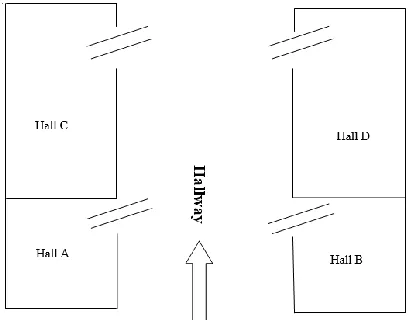
The target locations consist of four separate halls, two each on both sides separated by a hall way as shown in Figure 2. Hall A and B have dimension of 10m X 7m each, while halls C and D have dimensions of 12m X 9m and 6m X 4m respectively. For the purpose of localization, the building is partitioned and labeled Hall A, Hall B, Hall C and Hall D respectively. RSSI values from three APs serve as inputs to the FL system developed using MATLAB FL Toolbox. At each instance, the output obtained at each location is recorded as the device is moved from one location to
the other. This procedure was repeated for several APs in order to determine which AP proved more reliable, at what time of the day, and under what circumstances.
The entire procedure was repeated for five days in order to establish a set of more reliable APs with reasonable or approximate degree of confidence linked with each result. In each of the experiments at different locations, the mean of the output and variance were computed. Plots of APs were also made to observe the variation associated with each AP. When the set of more reliable APs were obtained, tolerance limits were formed based on the variance obtained. This was then used to infer the location of the device within the four halls in real-time as it was moved from one location to another.
Figure 2: Layout of Target Device Locations
4.1 RESULTS
The results of the research work for the real time localization of the laptop are presented in Tables 1 and Table 2.
Table 1. Shows the average RSSI values for each AP for three days
Table 2. Shows the mean RSSI values and the variances for the four different target locations
Remote Real-Time Indoor Device Tracking Based on Fuzzy Inference System (FIS) From Table 2, it is obvious that while the variance for Hall A and
Hall B are identical, Hall C has no variation in the RSSI values, implying relative stability. Hall D however has the highest variation as exhibited by its variance value of 1.33333.
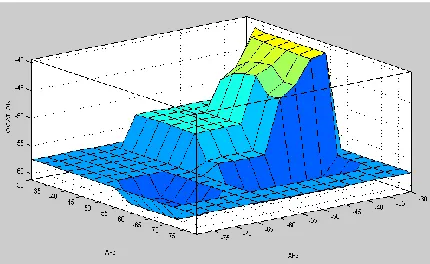
The surface plot (Figure 3) shows the range of RSSI values for AP1 against AP2 that can be used to infer the location of the computing device (laptop) in any of the potential targets (Figure 2). The range of signal variations for AP1 is from 75dBm to -38dBm approximately and for AP2 is from -68dBm to -30dBm accordingly.
Figure 3. Surface Plot of AP1vs AP2
In Figure 3, the l surface plot shows higher chance of making an inference of location of the device with RSSI values between -58dBm and -38dBm for AP2 and -55dBm to -30dBm for AP1 respectively.
Figure 4. Surface Plot of the RSSI values of AP1 vs AP3 From Figure 4, it can be seen that higher RSSI values (above 30dBm) for AP1 and RSSI values in the range 50dBm and -40dBm for AP2 correspond to a relatively high chance of inferring a location with mean RSSI value in the range -55dBm to -44dBm accordingly.
In Figure 5, the range of Signal Strength (SS) variation for AP2 is roughly between (77dBm to 50dBm) and for AP3 is (70dBm to 30dBm) thus, inferring a location with SS values ranging from -58dBm to -38dBm.
The results (i.e. the mean and variance) of the RSSI values for the four locations in the target building, show significant differences. This is due to the fact that the Wi-Fi signal of some of the APs are noticeably degraded or attenuated by the concrete columns in the building.
Figure 5: Surface Plot of AP2 vs AP3 and Location
From Figure 5, it is clear that the FIS has a higher chance of inferring a location with RSSI values in the range 45dBm to -30dBm for AP2 and -60dBm to -35dBm for AP3 respectively.
The results obtained from the experiments are compared in terms of variance and Root Mean Square Error (RMSE) (Mahapatra, 2013) as shown in Table 5.
Table 3: Variance and RMSE Comparison
From Table 3, it is evident that incorporation of fuzzy inference system in the localization problem led to significant enhancements as indicated by the very low levels of the variance as well as the RSME.
The use of Mean Square Error (MSE) is amongst several ways of calculating the difference between inferred values and the real values of a given estimation. If an estimator is nonbiased, then MSE is also the variance of the prediction (Wikipedia, 2018).
5 Conclusions
This paper demonstrates the use of Netstumbler in conjunction a Fuzzy Inference System (FIS) to locate and track mobile electronic (Wi-Fi-enabled) device in indoor environments. The performance of the real-time localization system further buttresses the usefulness of FL, especially its flexibility and ability to adequately handle imprecision and uncertainty.
The paper did not however address the simultaneous tracking of multiple remote devices. This will be considered in our future work.
6 Acknowledgements
The authors wish to appreciate the Almighty God for providing the needed inspiration as well as the wherewithal to start and conclude this work. Moreover, worth mentioning is the invaluable contribution of family, friends and colleagues for positive criticism of the work.
Remote Real-Time Indoor Device Tracking Based on Fuzzy Inference System (FIS)
REFERENCES
Abdat, M., Wan, T.-C., & Supramaniam., S. (2010). Survey on Indoor Wireless Positioning Techniques: Towards Adaptive Systems. International Conference on Distributed Framework and Applications (DFmA). Altintas, B., & Serif, T. (2012). Indoor location detection with
RSS-based short term memory location (KNN-STM). Pervasive computing and communications, 794-798.
Castanon-Puga, M., Salazar, S. A., Aguilar, L., Gaxiola-Pacheco, C., & Licea, G. (2014). Localization of Indoor Areas Using Wi-Fi Signals,Type-2 Fuzzy Inference Systems and Data Mining. World Congress on Engineering.
Fan, Z., Zhang, Z., & Wang, H. (2012). A Vertical handoff Algorithm Application to the Integration of WLAN and WMAN Wireless Heterogeneous Networks. Fourth International Conference on Computational and Information Sciences (ICCIS), (pp. 803-806).
Garcia-Valverde, T., Garcia-Sola, A., Hagras, H., Dooley, J. A., Callaghan, V., & Botia., J. A. (2013). A Fuzzy Logic-Based System for Indoor Localization Using WiFi in Ambient Intelligent Environments. IEEE Transactions on Fuzzy Systems, pp. 702-718.
Gheorge, L., Rughinis, R., & Tapus, N. (2010). Fault-Tolerant Flooding Time Synchronization Protocol for Wireless Sensor Networks. Sixth international Conference on Networking and Services, (pp. 143-149).
Hernández, N. F., Bergasa, L. M., Alonso, J. M., & Magdalena, L. (2009). Wifi Localization System Based on Fuzzy Logic to Deal With Signal Variations. IEEE Conference on Emerging Technologies & Factory Automation (ETFA), (pp. 1-6).
James, C., Monisha, A., Emalda Roslin, S., & Nandhitha, N. M. (2013). A Study and Evaluation of Various Routing Mechanism for an Efficient Wireless Sensor Network.
International Journal of Innovative Research in Computer and Communication Engineering.
Kannan, R., & Tay, B. (2010, June). Time of flight based two way ranging for real time locating systems. IEEE Conference on Robotics, Automation and Mechatronics, 199-205.
Li, R., Fang, Z., Hao, B., & Yang., F. (2010). Research on Indoor Wireless Localization System for Radioactive Sources Based on ZigBee. International Conference on Computing, Control and Industrial Engineering (CCIE), (pp. 359-362).
Li, Y., Sui, S., & Tong, S. (2017). Adaptive Fuzzy Control Design for Stochastic Nonlinear Switched Systems With Arbitrary Switchings and Unmodeled Dynamics. IEEE Transactions on Cybernetics, pp. 403-414.
Mahapatra, P. P. (2013). Fuzzy Logic Based Location Estimation.
International Journal of Innovative Research and Development.
Mendel, J. M. (1995). Fuzzy Logic Systems for Engineering: A Tutorial. Proceedings of the IEEE, pp. 345-377.
Netstumbler. (2018, 01 12). Netstumbler. Retrieved from Netstumbler: www.netstumbler.com
Rizos, C., Roberts, G., Barnes, J., & Gambale, N. (2010). Experimental results of Locata: A high accuracy indoor positioning system. IEEE international Conference on Indoor Positioning and Indoor Navigation (IPIN), (pp. 1-7). Saxena, M., Gupta, P., & Jain., B. N. (2008). Experimental Analysis of RSSI-Based Location Estimation in Wireless Sensor Networks. 3rd International Conference on Communication Systems Software and Middleware. Thirumalai, C., & Senthilkumar, M. (2017). An Assessment
Framework of Intuitionistic Fuzzy Network for C2B Decision Making. 4th International Conference on Electronics and Communication Systems (ICECS), (pp. 164-167).
Vui, L. C., & Nordin., R. (2014). Lateration Technique for Wireless Indoor Positioning in Single-Storey and Multi-Storey Scenarios. Journal of Theoretical & Applied Information Technology.
Wang, C.-S., & Wu, S.-S. (2012). An Adaptive RFID Localization Mechanism Supporting 3D Virtual Tour System.
International Conference on Ubi-Media Computing, (pp. 219-224).
Wikipedia. (2018, 01 20). Root Mean Square. Retrieved from Wikipedia:
https://en.wikipedia.org/wiki/Root_mean_square